Since its introduction, the colours of love theory (Lee, Reference Lee1973) has been one of the theoretical models most used in love research. This theory gained recognition with the work of Hendrick and Hendrick (Reference Hendrick and Hendrick1986). It organises attitudes towards love according to six styles and predicts a circumplex model with dimensions closer or more distant depending on the proximity. In spite of theoretical postulations, research on this theory has primarily used factor analysis without checking the hypothesis of circularity posited by the model. Forty-six years after its inception, there have been no empirical studies testing Lee's hypothesis of a disc of colours. The objective of this study was to examine the extent to which colours of love theory can be described as a circumplex model. For this, we evaluated the psychometric properties of one of the scales typically used to assess such a theory, the Love Attitudes Scale (LAS), using a sample from Brazil. Our goal was to verify the adequacy of the scale for colours of love theory as a circumplex model from a psychometric point of view.
Colours of Love Theory
The colours of love theory (Lee, Reference Lee1973, Reference Lee1974, Reference Lee1977) assesses ways to express love, making an analogy of the styles of love with colours arranged in a disc. The blending of these colours is like the blending of chemical components in which two components can form a third different component. There are three primary colours, which give rise to three secondary colours. The three ‘primary’ colours of love are named Eros, Storge, and Ludus; the three secondary colours are Agape, Mania, and Pragma. Like the corresponding colours, each secondary style is composed of elements from two adjacent primary styles. The following descriptions are based in existing literature (Chen & Wu, Reference Chen and Wu2017; Hendrick & Hendrick, Reference Hendrick and Hendrick1986; Lasswell & Lasswell, Reference Lasswell and Lasswell1976; Lee, Reference Lee1973).
Eros (passionate, physical love) is a love style in which the individual is concerned about his or her image, marked by a strong and immediate physical attraction to the partner. Individuals in this style look for a partner who matches their ideal of beauty. They have pleasure talking about the skin, smell, hair, muscles and other physical characteristics of their loved one. People with Eros characteristics are presumed to have different chemical reactions just by looking at those they consider beautiful people. They are romantic, and most engage in sexual relations soon after their first meeting.
Storge (friendship or companionate love) is based on friendship and companionship. It is a love style in which people engage in relationships without hurry, madness, or foolishness. Individuals in this style let feelings unfold over time. Aware of the risks of love, they avoid intense feelings. For them, sex is the most intimate form of self-revelation. Accordingly, one must wait for it to occur. They have long-term relationship expectations. The Storges think it is inconceivable that two people quarrel simply when finishing a relationship.
Ludus (game-playing love) is a love style that involves seeking many partners, living love as a game. Although seen as promiscuous by moral people, individuals who belong to this love style know the rules of the game of love and play by them. One strategy for this is having control over their feelings, trying not to have their partners involved. They never seek long-term plans and describe their relationship as casually dating so as not to create expectations of the other person. Sex is just fun and does not have the goal of emotional involvement. As with Eros, the Ludus lovers must have the security itself. They are not possessive or jealous. Even if the relationship is near the end, they do not take the initiative to finish it, in consideration of their partner, letting the love flame go out slowly.
Agape (all-giving, self-sacrificing love — a combination of Eros with Storge) is an unselfish style of love. This style inherits from Eros the fascination for one's partner, and from Storge a low sexualisation of such fascination. Agape is the classic vision of Christian love: to give without receiving. Individuals within this type are more concerned about their partners than they are with themselves. They are willing to love without expectation of reciprocity; they are kind, careful, and helpful.
Mania (possessive, dependent love — a combination of Eros and Ludus) is a love style involving obsession, possessiveness, and jealousy with the beloved object. As with Eros, Mania individuals develop a passion quickly. As Ludus, they try to have control over their own feelings (although with more difficulty than Ludus people). This is a style characterised by a need for constant reassurance about being loved and by intense dependence. Mania individuals have very strong feelings, which they struggle to control, causing dependency on their beloved person. They tend to manifest physical symptoms related to such feelings, such as agitation, anxiety, or difficulty sleeping. They can develop quick and strong passion toward inappropriate individuals. They are very sensitive to love, alternating intense joy when receiving a small signal from the loved one with deep sorrow, such as in the absence of the loved one.
Pragma (practical, objective love — a combination of Storge and the Ludus) is a love style that portrays lovers seeking a partner who is suited more to their social standards than to their feelings. They use manipulations of their consciousness to find the partner (characteristic of Ludus) and take it easy to choose a partner (characteristic of Storge). Compatibility is based on practical or logical criteria. Thus, people with this love style are looking for a partner corresponding to particular demographic characteristics such as age, religion, education, profession, political ideas, among other aspects, letting their feelings for the partner appear after verifying compatibility of the desired features.
Some sex differences were found in the literature. However, the reported differences were not constant. In the original study (Hendrick & Hendrick, Reference Hendrick and Hendrick1986), males were higher in the Ludus category than females, while females were significantly higher in Storge, Pragma and Mania than males. Research conducted in Spain indicated that women had lower scores in Ludus and higher scores in Mania and Eros than men (Rodríguez-Santero, García-Carpintero, Muñoz, & Porcel Gálvez, Reference Rodríguez-Santero, García-Carpintero Muñoz and Porcel Gálvez2017). Another study focused on adolescents from Spain found that males were significantly higher in Ludus and Agape than females (Rodriguez-Castro, Lameiras, Carrera, & Vallejo-Medina, Reference Rodriguez-Castro, Lameiras, Carrera and Vallejo-Medina2013). In Serbia, women reported significantly higher scores on Mania, whereas men were significantly higher in Ludus (Todosijević, Arančić, & Ljubinković, Reference Todosijević, Arančić and Ljubinković2009). In China, men's scores were significantly higher for all dimensions, except Pragma (Yang & Liu, Reference Yang and Liu2007). In a cross-cultural sample, men were significantly higher in Ludus and Agape (Jonason & Kavanagh, Reference Jonason and Kavanagh2010). Ludus style appears to be consistently higher for men. For the other factors, however, these prior data indicate inconsistency in sex differences across different cultures and studies.
Although informative, these love styles are just idealised constructs. It is difficult to identify individuals with one love style only. More commonly, people manifest a combination of love styles, some more strongly than others. These characteristics seem to depend on the cognitive profile and personality of each individual (Lasswell & Lasswell, Reference Lasswell and Lasswell1976). Each love style has logical relations with the adjacent style, but the qualitative properties are unique (Hendrick & Hendrick, Reference Hendrick and Hendrick1986). These kinds of models are called ‘circumplex’.
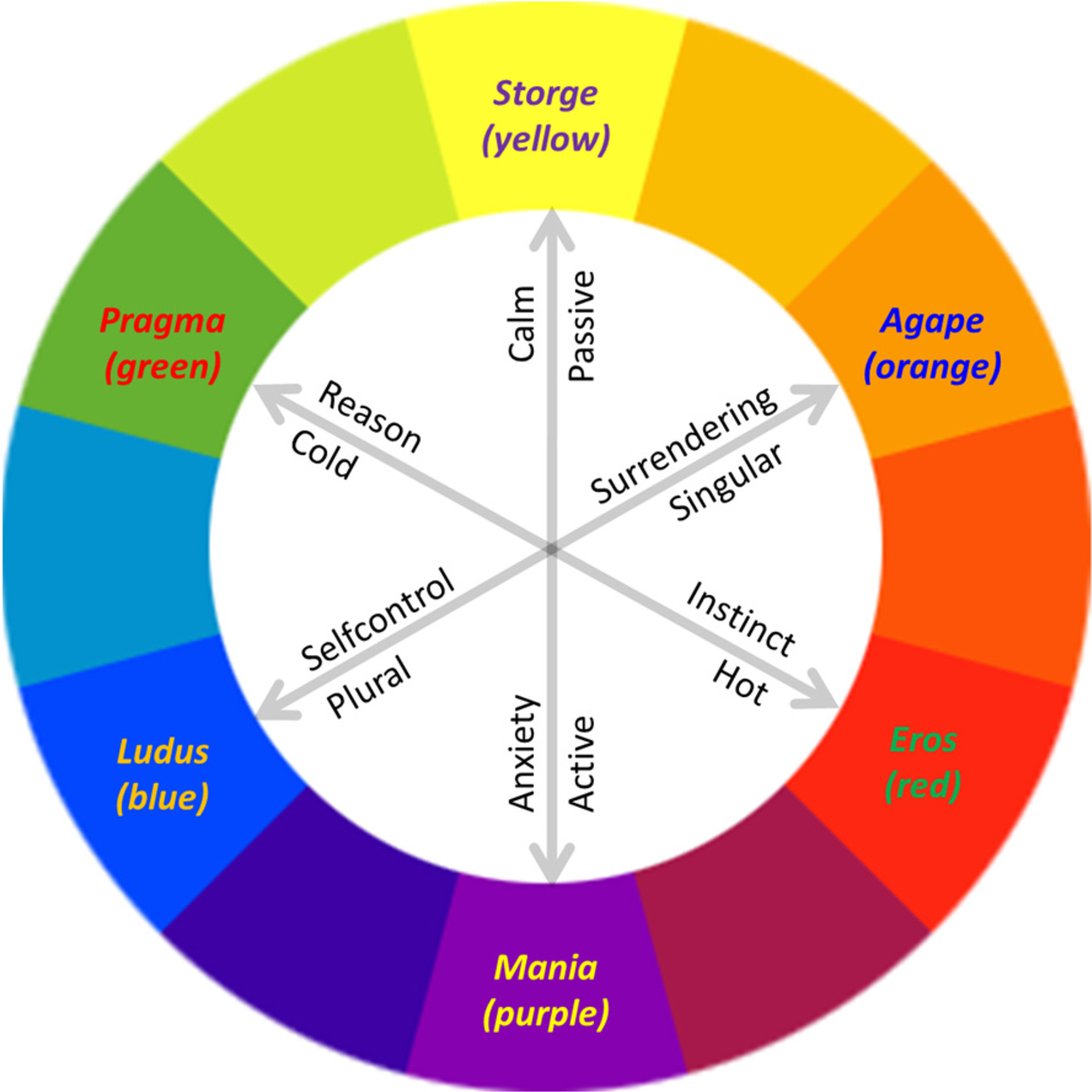
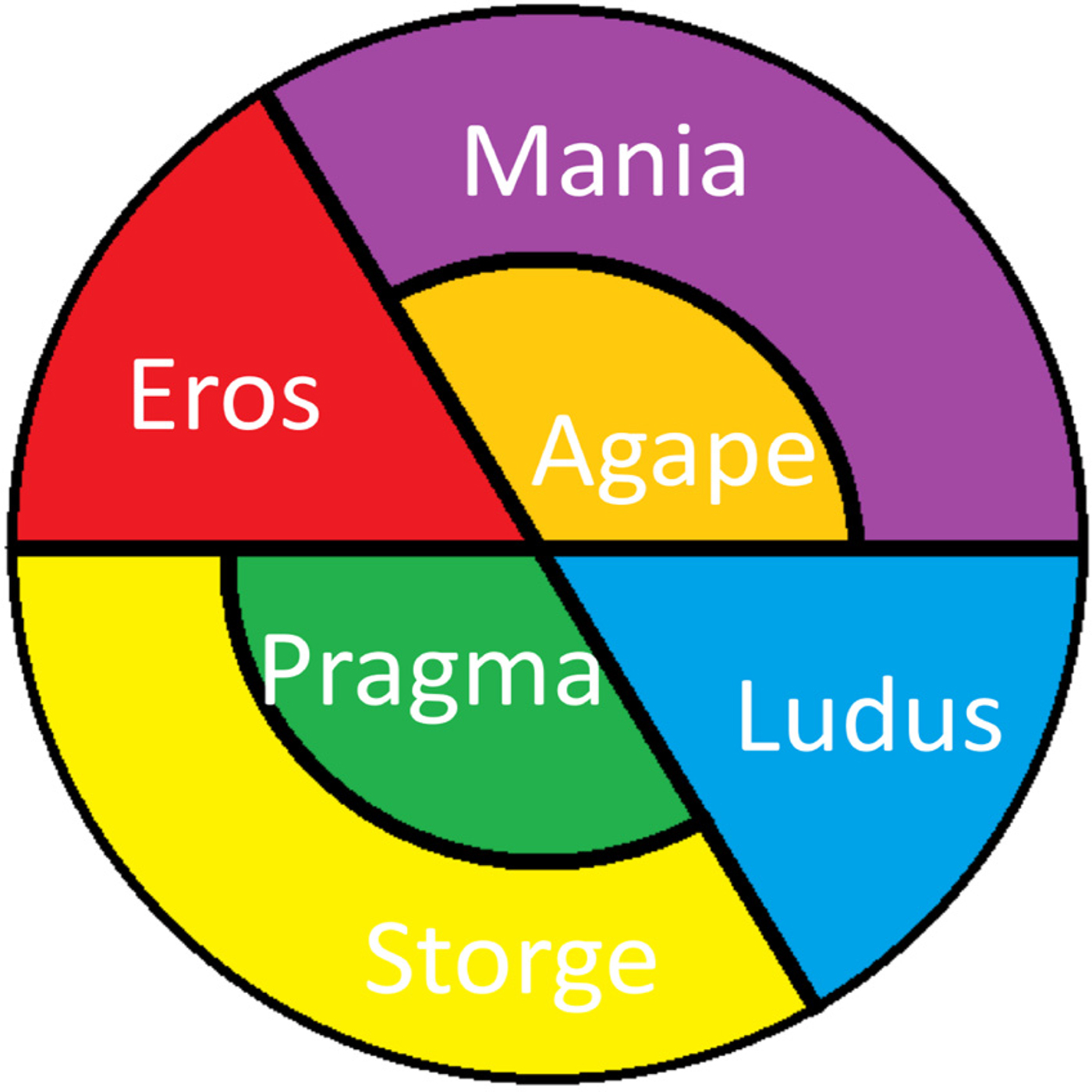
Figure 1 shows a representation of the colours of love theory (Lee, Reference Lee1974). In the disc portrayed in this figure, each colour has a complementary dimension. In other words, each primary colour has a secondary colour on the opposite side of the disc. Thus, for instance, the Eros style would be complementary to Pragma; Ludus would be complementary to Agape; and Storge would be complementary to Mania. Knowing that these relationships work for the disc of colours does not imply that the same relationships will work for the love styles. However, this is plausible, based on the description of the styles. People typified as Storge live the love without haste, leaving things to unfold according to their own time. For the Mania dimension, however, the opposite is true. Individuals best described according to the Mania dimension develop a strong love very quickly and seek the object of their passion actively. Considering both descriptions, it would appear that there is a complementary relationship mainly based on the haste with which love develops.
Colours of Love axes.

The same complementary relationship can also be identified in relation to the Ludus and Agape dimensions. The Ludus control their involvement, which is demanding for many partners. But Agape has a devotion to the lover much larger than him or herself. Still, they centre on one person only. The inverse relationship between Ludus and Agape occurs regarding the number of partners and dedication to them.
Finally, Eros and Pragma are also complementary. Individuals described as Eros would choose their partners based on physical appearance. They value aspects such as kissing and engaging in sexual relations. Pragma individuals, in contrast, have more rational criteria for choosing partners, valuing characteristics such as intelligence, education and social status. Thus, the Eros individual lives love in a more instinctive way, whereas Pragma have a more rational way.
Figure 1 also shows how the three axes are configured to support the type of love (Lee, Reference Lee1974). According to the Storge-Mania axis, Storge individuals are passive and calm, hoping that love happens. Mania individuals, on the other hand, are eager to experience love and seek it in an active way. According to the Ludus-Agape axis, Ludus individuals control their feelings, with the purpose of having multiple partners. In contrast, Agape individuals will keep their feelings to one person only. The Eros-Pragma axis distinguishes between Eros, who follows his/her instincts in search of warm relations, and Pragma, who is cold and rational in choosing a partner.
In the field of love, Fehr and Broughton (Reference Fehr and Broughton2001) associated types of love with an interpersonal circle of personality. As a circumplex model, this theory also can be related to work in human values (Schwartz, Reference Schwartz1994) or vocational styles (Holland, Reference Holland1959, Reference Holland1996). The analogy of six love styles with the disc of colours is a crucial feature of the original theory (Lee, Reference Lee1973, Reference Lee1974). Thus, the original claim that there are six love styles in a circumplex structure needs empirical support, along with the claim that there are three primary and three secondary styles. Despite the original formulation that some styles are closer to the others, the literature lacks any test of the circumplex hypothesis. Previous studies (Rodriguez, Montgomery, Peláez, & Salas Martinez, Reference Rodriguez, Montgomery, Peláez and Salas Martinez2003; Rodriguez-Castro et al., Reference Rodriguez-Castro, Lameiras, Carrera and Vallejo-Medina2013; Rodríguez-Santero et al., Reference Rodríguez-Santero, García-Carpintero Muñoz and Porcel Gálvez2017; Rohmann, Führer & Bierhoff, Reference Rohmann, Führer and Bierhoff2016; Rotzien, Vacha-Haase, Murthy, Davenport, & Thompson, Reference Rotzien, Vacha-Haase, Murthy, Davenport and Thompson1994; Yang & Liu, Reference Yang and Liu2007) successfully showed the six factors; however, they did not test the spatial location of the factors. In order to test the circumplex aspect of Lee's theory, multidimensional scaling (MDS) is the best approach rather than using techniques such as factor analysis. However, MDS is absent in the literature, probably because factor analysis is a standard way to analyse scales. One possible reason for the abandonment of the analogy to the colour disc can be found in the original article of the most used scale of the love styles:
One implication of the analogy to chemical compounds is that although the six love styles are logically interrelated, each style has qualitative properties independent of all of the other styles. Empirically, measures of these six love styles should be orthogonal to each other. In sum, the love styles are all equally valid ways of loving. There is no one type of love, but rather many different types. (Hendrick & Hendrick, Reference Hendrick and Hendrick1986, p. 393)
This emphasis on orthogonality may have discouraged researchers from observing the relationships between factors. According to Shaver and Hazan (Reference Shaver and Hazan1988), Lee's metaphors are ingenious but misleading. However, Lee (Reference Lee, Sternberg and Barnes1988) explained this orthogonality using the metaphor of a paint blending: ‘It is important to remember that when things are combined, some of the qualities of each ingredient are lost and some new qualities, not found in any one of the ingredients, may emerge’ (p. 45). This theoretical debate is both interesting and important, but it requires empirical evidence.
The only empirical study that covered the proposal of a disc of colours was undertaken by Neto (Reference Neto2002). The author asked 143 women how much each of the styles of love could be associated with 12 colours. With the exception of Eros (red), the colours that were most associated with the styles of love did not correspond to those proposed by Lee (Reference Lee1973). This method directly tested the colours metaphor, but was not sufficient to test circularity.
Love Styles Measurement Instruments
There are several types of instruments to measure love according to Lee's typology (Reference Lee1973). Lee (Reference Lee1974) himself proposed a questionnaire with 35 questions, but he did not conduct any psychometric evaluation. Lasswell and Lasswell (Reference Lasswell and Lasswell1976) also developed a measurement tool, but did not provide its psychometric properties. This instrument was investigated in Brazil by Barros and Calvano (Reference Barros and Calvano2005), who translated the scale into Portuguese. The authors found a structure consisting of six factors compatible with the Lee's love styles (Reference Lee1973).
One of the measurement tools most widely used in the literature is the Love Attitudes Scale (LAS), with the first version provided by Hendrick and Hendrick (Reference Hendrick and Hendrick1986). This scale has seven items for each of the six love types. The measure has reasonable internal consistency, with alpha values between .69 (Storge) and .83 (Agape). Other properties of the scale include low correlations among the love styles. This scale was further reduced in subsequent work, resulting in either three or four items per love type (Hendrick, Hendrick, & Dicke, Reference Hendrick, Hendrick and Dicke1989). Such alterations hardly affected the internal consistency of the scale.
A translation into Portuguese of the Hendrick and Hendrick version (Reference Hendrick and Hendrick1986) was used by Neto (Reference Neto1993, Reference Neto1994, Reference Neto1998, Reference Neto2002), and retained the properties of the original instrument. This scale was then used in Portuguese-speaking countries (Portugal, Angola, Mozambique, Cape Verde and Brazil), in addition to France, Switzerland and Macau, which responded to the scale in Cantonese (Macau) or French (Switzerland and France). Confirmatory factor analysis of the reduced version with four items on each subscale indicated reasonable factor loadings. Some interesting differences in love styles among the countries emerged from these analyses. For example, Brazil was the Portuguese-speaking country with the highest scores in the Storge and Agape dimensions. It should be noted that in this study, low scores represented higher levels of performance (Neto et al., Reference Neto, Mullet, Deschamps, Barros, Benvindo, Camino and Machado2000). In Portugal, 39 of the 42 items loading strongly on the presumed factor, with reasonable coefficient alphas.
Another version of the Hendrick and Hendrick scale (Reference Hendrick and Hendrick1986) translated into Portuguese was used by De Andrade and Garcia (Reference De Andrade and Garcia2009). The authors collected data from 509 participants recruited from a relationships website. Despite a moderate adequacy of common variance (Kaiser-Meyer-Olkin value of .77), the instrument was divided into six factors, as expected by the theory. The results also indicated low correlations among the six factors, suggesting relative orthogonality among them. Except for Ludus (α = .55), all the other factors showed Cronbach's alpha values above .74. People who declared themselves more passionate possessed significantly higher scores on the Eros, Agape, Ludus and Mania dimensions.
Even considering some limitations in the reliability scores, the LAS (Hendrick & Hendrick, Reference Hendrick and Hendrick1986) is still widely used (Rodriguez et al., Reference Rodriguez, Montgomery, Peláez and Salas Martinez2003; Rodriguez-Castro et al., Reference Rodriguez-Castro, Lameiras, Carrera and Vallejo-Medina2013; Rodríguez-Santero et al., Reference Rodríguez-Santero, García-Carpintero Muñoz and Porcel Gálvez2017; Rohmann et al., Reference Rohmann, Führer and Bierhoff2016; Rotzien et al., Reference Rotzien, Vacha-Haase, Murthy, Davenport and Thompson1994; Yang & Liu, Reference Yang and Liu2007). Its main advantage, replicated by these studies, is a good factor structure, consistent with Lee's original theory (Reference Lee1974). Nevertheless, more work is needed to further assess the properties of this instrument. The purpose of this study was to investigate with greater depth the validity of the LAS. In particular, we assessed whether the scale measures the theoretical hypotheses proposed by the circularity of love styles (Lee, Reference Lee1973). Considering that no other study has analysed the colours of love as a circumplex model, this study proposed to carry out this empirical test of the theory.
Method
Participants
Participants in this study were 1,549 people from 12 Brazilian states and the Federal District (mean age = 25.17 years, SD = 7.74). The data collection was performed in at least one third of the units of the Federation of each of the five geographic regions of Brazil (Instituto Brasileiro de Geografia e Estatística, 2017). The total sample included 1,048 (67.7%) women, 500 (32.3%) men, and one participant who did not report sex. Participants described their sexual orientation mostly as heterosexual (n = 1452, 93.7%), and reported being single (n = 1165, 75.2%) or married (n = 246, 15.9%), and having no children (n = 1242, 80.2%) at the time of data collection.
Measures
A questionnaire with demographic information, the LAS (Hendrick & Hendrick, Reference Hendrick and Hendrick1986), the Relationship Assessment Scale (RAS; Hendrick, Reference Hendrick1988), and the Sternberg Triangular Love Scale — Reduced version (STLS-R; Sternberg, Reference Sternberg1998) were applied in Portuguese language. The Portuguese version of the LAS was adapted by Neto (Reference Neto1993), who carried out back translation and pretests (Brislin, Reference Brislin, Lonner and Berry1986). This adaptation was made from the Portuguese language of Portugal, so minor changes were required to adapt it to the Portuguese language of Brazil (e.g., the word ‘exactamente’ was replaced by ‘exatamente’ in the itemFootnote 1 Sample_15). This translated instrument had been implemented in Portugal (Neto, Reference Neto1994, Reference Neto1998, Reference Neto2002; Neto et al., Reference Neto, Mullet, Deschamps, Barros, Benvindo, Camino and Machado2000), but was seldom used in Brazil. The LAS was answered in a Likert-type scale, from 1 to 5. The RAS (a measure of relationship satisfaction) was adapted for Brazil by Cassepp-Borges and Pasquali (Reference Cassepp-Borges and Pasquali2011) and the STLS-R (a measure of love) by Cassepp-Borges and Pasquali (Reference Cassepp-Borges and Pasquali2014). The questionnaires were implemented using pen and paper, and almost all subjects agreed to participate.
Procedures
This research project was approved by the Ethics Committee in Research of the Institute of Humanities at the University of Brasilia (Brazil) on October 2, 2009, according to the recommendations of Resolution 196/1996 of the Brazilian National Health Council. All participants were asked to sign a term of free and informed consent and they were not financially compensated.
The factorial structure was evaluated with exploratory factor analysis (EFA), instead of confirmatory factor analysis (CFA), because it allowed items to load on other factors than those expected. Some authors (Brown, Reference Brown2006; Damásio, Reference Damásio2012) recommend to use EFA in the earlier stages of a theory. Although this study analyses a theory more than 45 years old, we intended to re-evaluate the assumed factor structure. Data analysis also verified the internal consistency of each factor as well as the correlations among factors. However, to infer a circumplex structure from an EFA, a two-factor structure is necessary (Fabrigar, Visser, & Browne, Reference Fabrigar, Visser and Browne1997), and six factors were expected (Hendrick & Hendrick, Reference Hendrick and Hendrick1986).
To evaluate the circumplex structure, we used multidimensional scaling (MDS). Similar to factor analysis, MDS is an exploratory technique that is easy to use (Fabrigar, Visser, & Browne, Reference Fabrigar, Visser and Browne1997) and is widely implemented in areas such as geography. For example, it is used to obtain a map from a table of distances between cities, by using two axes (north-south and east-west). In psychological research, MDS can be used, for example, to create perceptual maps that represent distances between items of a scale based on correlations (Kruskal & Wish, Reference Kruskal and Wish1978). In our analyses, we used EFA to identify which items belonged to which factor. We used MDS to evaluate the hypothesis of circumplex structure.
Results
Dimensionality
In the first set of analyses, we examined the factorial structure of the various subscales of the LAS using EFA with Promax rotation. The Harman (Reference Harman1967) criteria (each factor should explain at least 3% of the total variance), a visual inspection of the scree plot (Cattell, Reference Cattell1966), and parallel analysis (Horn, Reference Horn1965) indicated a solution with six factors, which was in line with the colours of love theory (Lee, Reference Lee1973).
Results from the factor structure of LAS are presented in Table 1. The criterion for considering an item as belonging to a factor was a loading higher than .32 (Pasquali, Reference Pasquali2005). Most items loaded on the specified factor, with values ranging from reasonable to good. Some items (e.g., Sample_36 item: ‘I always try to help my boyfriend in difficult situations’) showed loadings on other factors. Table 1 also provides the composites (calculated from the means) for each factor. The highest mean was found for Eros and the lowest for Ludus, possibly caused by social desirability.
Factorial Structure of LAS With Alpha Factoring Extraction and Promax Rotation

Note: †Capital letters in the name of each item indicates the initial letter of the factor for which the highest factor loadings of the item was expected. Factorial loadings over .32 are shown in bold type. Explained variances: 2 factors = 13%, 3 factors = 22%, 4 factors = 27%, 5 factors = 30%, 6 factors = 33%. Residual covariance: 2 factors = 39%; 3 factors = 30%; 4 factors = 21%; 5 factors = 13%; 6 factors = 6%. Communalities (h 2) estimated before rotation.
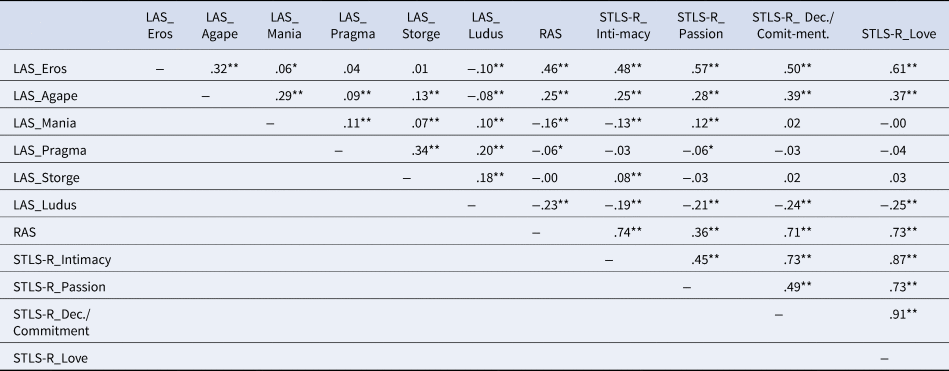
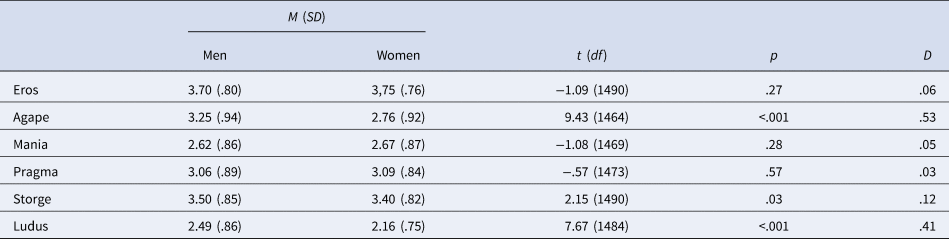
Table 2 shows correlations among the LAS factors and with other scales. All LAS correlations were small, implying a relative orthogonality among the factors. However, the dimensions Agape and Eros, Agape and Mania, and Storge and Pragma appeared to have weak but non-trivial correlations. Moreover, the LAS dimensions correlated with other scales, although at lower levels. For example, Agape and Eros correlated significantly with love and relationship satisfaction. Ludus, which in multidimensional scaling was on an opposite side to the Agape and Eros, was negatively correlated with STLS-R and RAS. Contrary to predictions, the correlation between intimacy and the Storge factor was weak (r = .08, p < .01). Intimacy, however, was the love dimension most strongly related to Storge. Likewise, decision/commitment was presumed to be related to Pragma, the rational aspects of love, but this was not the case (r = −.03, p = ns). Agape and decision/commitment were moderately related (r = .39, p < .01), which is theoretically sound since both deal with devotion to one's partner. Both Eros and the three dimensions of love have items in which the respondent's partner is mentioned, and this may bring correlations between these scales. Some gender differences in LAS scores were also founded. Table 3 shows that men had a significantly higher levels of Agape, Storge and Ludus than women.
Pearson Correlations Between LAS, RAS, and STLS-R

Note: *p < .05 (two-tailed), **p < .01 (two-tailed).
Sex Dfferences in Love Styles

Circularity
To examine the theoretical proposed circumplex model, we carried out a multidimensional scaling analysis. This technique considers distances and proximities between variables, thus deeming it appropriate to evaluate the circularity hypothesis.
Using the PROXSCAL analytic method (Kruskal, Reference Kruskal1964), a two-dimensional model with intervals constructed from Euclidean distances (i.e., square root of the sum of the differences between the values of the items squared) was implemented. The model eliminated cases with missing data, using 72% of the sample (n = 1,116). Kruskal and Wish (Reference Kruskal and Wish1978) suggest a scree plot of Stress values to determine the number of dimensions. Using this criterion, the presence of an elbow was not clear, meaning that there was no considerable gain in adjustment when dimensions were added to the model (Jaworska & Chupetlovska-Anastasova, Reference Jaworska and Chupetlovska-Anastasova2009). The dimension and their corresponding S-Stress values were: (2 dimensions = .18549, 3 dimensions = .11919, 4 dimensions = .08683, 5 dimensions = .06760, 6 dimensions = .05273, 7 dimensions = .04385, 8 dimensions = .03629, 9 dimensions = .03184, 10 dimensions = .02819). For this reason, the model with two dimensions was adopted. The advantage of this solution is the parsimony and the interpretability. Furthermore, it is in line with Lee's original theory (Reference Lee1973) represented by a two-dimensional circle.
Information about saturation coefficients and adjustment indicate that the model can be considered fair (S-Stress = .185; optimal scaling factor = .904; Tucker's coefficient of congruence = .951; Guiguère, Reference Guiguère2007). It should be noted that the coefficients are sensitive to the number of variables. The recommendation for not accepting values over .100 for S-Stress can be lowered when there is a large number of stimuli or measurement error present (Davison & Sireci, Reference Davison, Sireci, Tinsley and Brown2000), as is the case in this study.
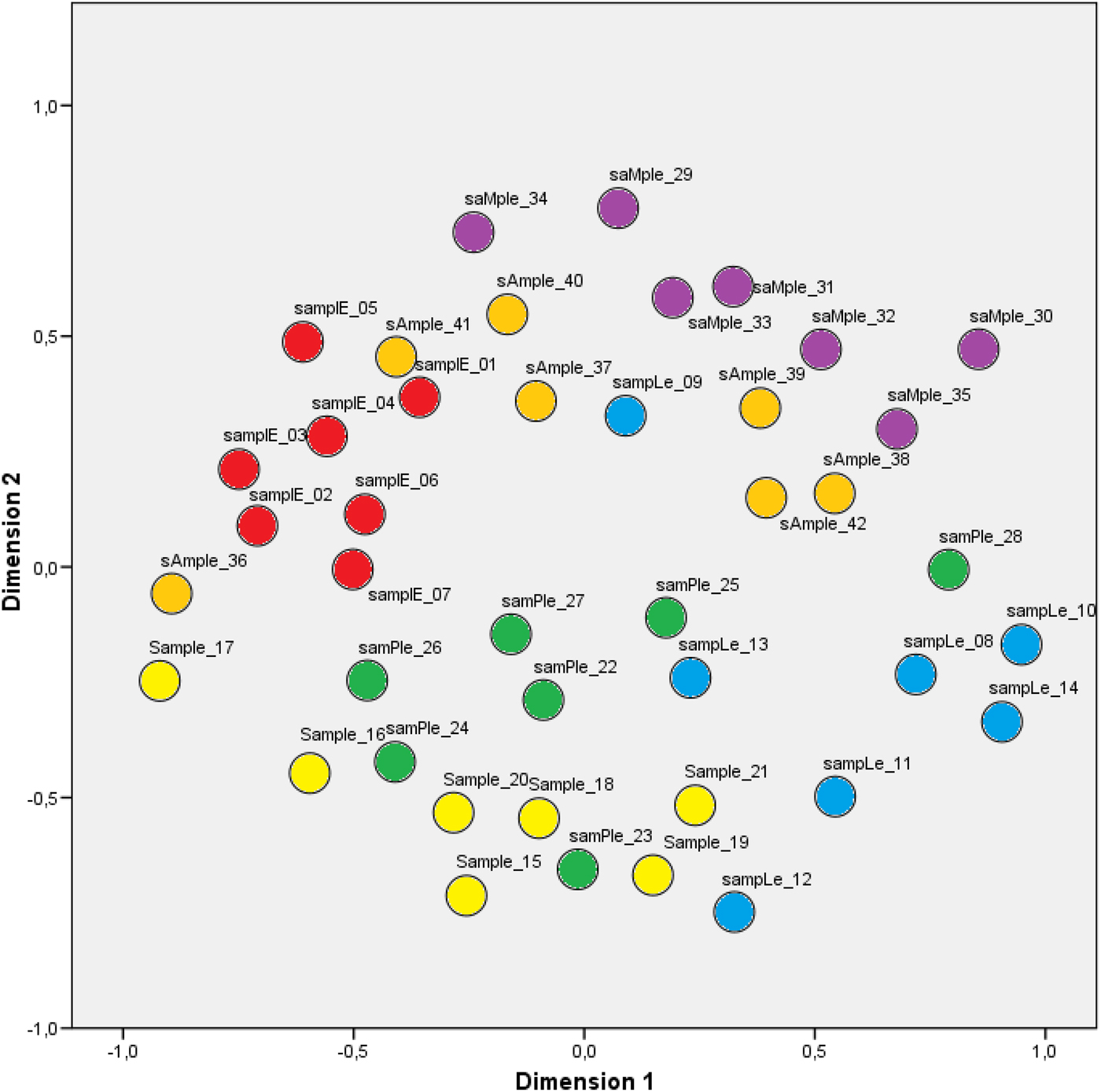
Figure 2 displays results of these analyses by placing all the items on a perceptual map. This figure shows that the model approaches circularity, with colours being distributed on a disc. For the most part, green (Pragma) is between yellow (Storge) and Blue (Ludus). The next colour in the disc, purple (Mania), is in line with the theoretical model. In contrast to theoretical predictions, however, there is an inversion between the orange (Agape) and red (Eros) colours in the perceptual map. According to theory, red (Eros) should be close to purple (mixture between red and blue — Mania), not orange (Agape). Orange (Agape) is the red mixture (Eros) and yellow (Storge), and should be placed between these two colours.
Perceptual map of LAS items.

To understand the results in more detail, it is important to explain some items individually. For example, only one item of the Ludus factor (Sample_9: ‘I believe that what my lover doesn't know about me won't hurt him/her’) was located farther away from its dimension. This same item also showed low factor loadings (see Table 1) and perhaps does not function properly in the Portuguese language or with this sample. Similarly, item Sample_12 (‘My lover would get upset if he/she knew of some of the things I've done with other people’) was grouped with items from the Ludus dimension and also demonstrated low factor loadings.
The Pragma dimension also had some items scattered on the perceptual map. For example, item Sample_28 (‘Before getting very involved with anyone, I try to figure out how compatible his/her hereditary background is with mine in case we ever have children’) approached the Ludus dimension, which can be attributed to the fact that it describes self-perceptions characteristic of this style. Pragma, however, lies under the Storge, which leads to the assumption that the Pragma may be a less intense form of Storge.
For Agape (orange), item Sample_36 item (‘I try to always help my lover through difficult times’) was the only item that stood between the Eros (red) and Storge (yellow) dimensions. This item addresses a different aspect of Agape, namely, help without taking the partner's perspective before one's own (e.g., Sample_38: ‘I cannot be happy unless I place my lover's happiness before my own’). This result raise the hypothesis that the items from Agape are below the Mania dimension in the perceptual map. Sacrificing one's own desires in favour of a partner (Agape) would be the first step for a person's life to revolve around the partner. In other words, Agape can be thought of as a weaker Mania. However, the fact that item Sample_36 is in the predicted place suggests that the Agape dimension could address an aspect of altruism without self-sacrifice.
Discussion
Summary of Findings
In this article we examined Lee's colours of love theory (Reference Lee1973, Reference Lee1974). In particular, we used empirical data to evaluate the theoretical proposition of six kinds of love style. Based on our analyses, several findings are important in relation to Hendrick and Hendrick's (Reference Hendrick and Hendrick1986) measure of Lee's original theory.
First, the correlations between the styles obtained in our factor analyses and the distances in our multidimensional scaling do not support the location proposed by Lee's theory (Reference Lee1973). To support such a hypothesis, each love type should be correlated with the adjacent dimensions in the model and uncorrelated with those farthest away. Agape and Eros are close styles and therefore should be correlated, and that was the case in our analyses. This is also theoretically true for Storge and Pragma, and was supported in our data. The correlation between Agape and Mania, however, cannot be explained by the theory, because Eros is located between them in the disc of colours. Similarly, data correlations do not suggest the absence of circularity, only that the position of each kind of the colour disc can be reviewed.
Overall, identifying six factors in the data supports the theory and is in line with previous studies (De Andrade & Garcia, Reference De Andrade and Garcia2009; Hendrick & Hendrick, Reference Hendrick and Hendrick1986; Rodriguez et al., Reference Rodriguez, Montgomery, Peláez and Salas Martinez2003; Rodriguez-Castro et al., Reference Rodriguez-Castro, Lameiras, Carrera and Vallejo-Medina2013; Rodríguez-Santero et al., Reference Rodríguez-Santero, García-Carpintero Muñoz and Porcel Gálvez2017; Rohmann et al., Reference Rohmann, Führer and Bierhoff2016; Rotzien et al., Reference Rotzien, Vacha-Haase, Murthy, Davenport and Thompson1994; Yang & Liu, Reference Yang and Liu2007). Some details of the finding, however, depart from previous work and theoretical notions. For example, the factor representing Ludus has a low level of precision, mainly due to the loss of items with low factor loadings. In the original instrument, Hendrick and Hendrick (Reference Hendrick and Hendrick1986) draw attention to an item with a higher loading on the Eros factor in Agape. The authors attributed this to the fact the item does not express self-abnegation. De Andrade and Garcia (Reference De Andrade and Garcia2009) excluded this item, but the rest of the items loaded on the same factors as in the present study. The use of EFA instead of CFA was indispensable to identify these unexpected patterns. However, no major differences were found between EFA and CFA solutions.
When comparing our findings with some previous studies (De Andrade & Garcia, Reference De Andrade and Garcia2009; Hendrick & Hendrick, Reference Hendrick and Hendrick1986; Neto, Reference Neto1998), we found that the percentage of explained variance is similar across studies. The alpha values are also similar in all four studies, with the exception of the Ludus, dimension, in which alpha values were higher (α = .74) in the original English language study (Hendrick & Hendrick, Reference Hendrick and Hendrick1986), and lower than .60 in this and in the other Portuguese language studies (De Andrade & Garcia, Reference De Andrade and Garcia2009; Neto, Reference Neto1998). Neto (Reference Neto2007) found a weaker internal consistency for Ludus in Portugal (.60) than in India (.67) or England (.77). Other alpha values vary from .69 to .91 in all factors in all studies. It can be reasonably concluded that our study has replicated some psychometric properties of the LAS shown in past research. Thus, our analyses indicate that the LAS has good factorial validity, with a simple structure in which items strongly load on one factor only. Its internal validity is high for most scales, with small values for one scale (e.g., .56 for the Ludus scale). Probably a cultural social desirability can explain the low precision in Portuguese language studies; however, this is speculative at this point. The relatively stable factorial solution is a strength of this study. This conjecture, however, is the next empirical question to be answered.
Theoretical Considerations and Future Directions
Based on the perceptual map from our MDS analyses, we revised the hypothesised circular model and proposed a new configuration for the colours of love theory. A representation of this proposed configuration is depicted in Figure 3. In this figure, we propose axes to divide the love styles, including Eros with Ludus, and Mania/Agape with Pragma/Storge. Agape would be considered a lower level of Mania, and Pragma would be considered a lower level of Storge, according to our data.
Multidimensional scaling representation of colours of love theory.

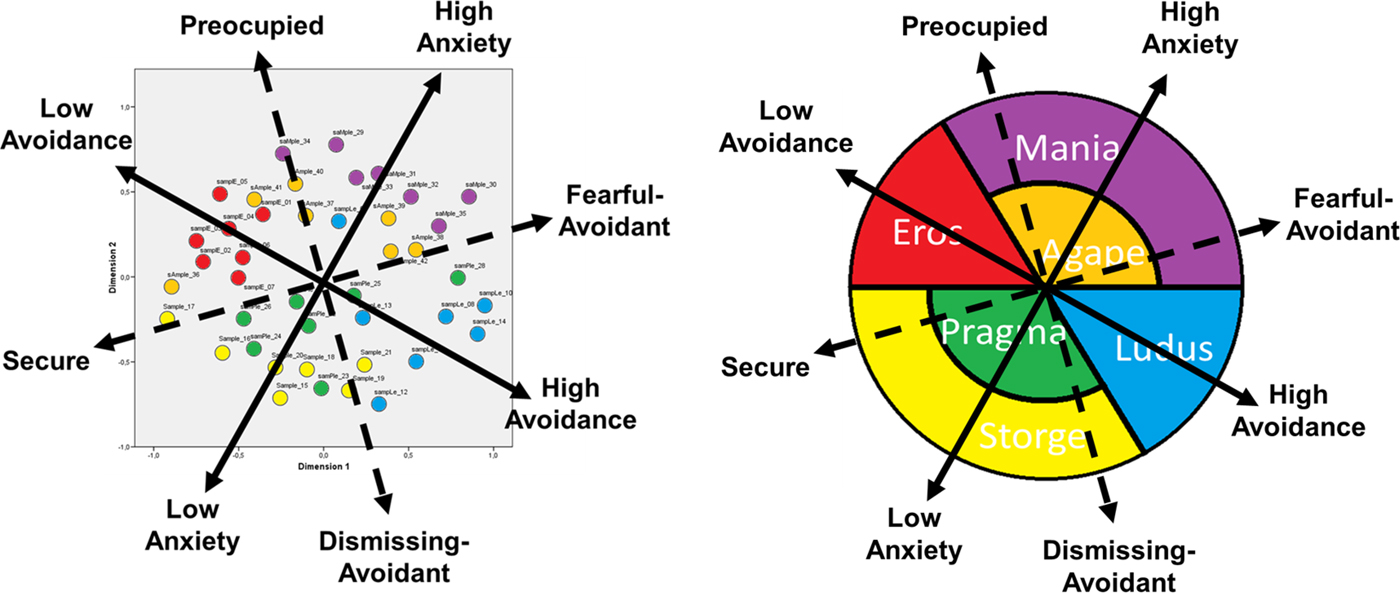
In addition to these axes, one theoretical framework that can provide insights into the love styles is adult attachment theory (Hazan & Shaver, Reference Hazan and Shaver1987). According to this model, avoidance and anxiety are the two dimensions that influence attachment. People with low anxiety and avoidance can be described as securely attached, and are characterised as feeling comfortable with intimacy. High anxiety and high avoidance, in contrast, typify fearful attachment. These are individuals who protect themselves from rejection by their partner. These two components can be thought of as axes in an attachment map. Thus, other combinations of anxiety and avoidance would lead to other types of attachment. For example, low anxiety and high avoidance would describe a dismissing attachment. People in this quadrant would tend to feel independent, but avoid close relationships. Similarly, high anxiety and low avoidance would lead to preoccupied attachment, where people could be described as having a positive impression of their partner, and seek self-acceptance in the others’ values (Bartholomew & Horowitz, Reference Bartholomew and Horowitz1991; Fraley & Shaver, Reference Fraley and Shaver2000).
We believe that anxiety and avoidance can be used to interpret the love styles. To facilitate this, we present a reinterpretation of the colours of love schema using the anxiety and avoidance axes (Figure 4). The axis Eros-Ludus can be interpreted as the axis of avoidance, in which Ludus represents high and Eros represents low avoidance. In turn, the axis Mania/Agape-Pragma/Storge is the anxiety axis, where Mania is the highest level of anxiety and Storge is the lowest.
Attachment theory representation of colours of love theory.

Shaver and Hazan (Reference Shaver and Hazan1988) argued that the theoretical description of Eros fits within a secure style, Ludus fits within avoidance, and Mania fits within anxiety. For Agape, they disagreed with Hendrick and Hendrick's (Reference Hendrick and Hendrick1986) configuration, focusing more on the self-sacrificing love than on the caregiving component (as in Lee's original description). Moreover, Storge and Pragma could be interpreted as absence of feelings (in our schema, Storge and Pragma are just the absence of anxiety). However, Shaver and Hazan did not provide empirical support for these hypotheses. In short, our empirical findings are compatible with attachment theory and, together, can be helpful to understand love styles. We believe this is an area of research worth pursuing.
The creation of axes to understand dimensionality and to simplify circumplex models is an important issue. For example, Prediger (Reference Prediger1982) summarised the six vocational styles from Holland's hexagonal model (Reference Holland1959) in two axes: data X ideas and things X people. Thus, our reorganisation is not discrepant with theory. Here, an idea would be that rather than measuring the six love styles, one would measure two axes. Besides being a more parsimonious model, this approach would likely require a shorter measurement instrument. If the model is circumplex, as provided by Lee's original hypothesis (Reference Lee1973), there should be axes connecting the opposite poles in the model.
Understanding the styles of loving on two axes instead of six factors has the advantage of being more parsimonious. However, this is the first study that tested the circumplexity hypothesis, and therefore other independent studies are needed to corroborate these findings. While the present research used a Brazilian sample and the LAS (Hendrick & Hendrick, Reference Hendrick and Hendrick1986), replications with other samples and scales are advocated. Such replications are needed in order to generalise our findings.
Even considering that similar models were found for men and women, there is a difference between the means of the two sexes, possibly due to the bias from the mostly female sample. The exclusion of participants with incomplete questionnaires can also be seen as a limitation to these findings. There is a pressing need to assess these ideas to further our understanding of love. One proposal would be to create new measures based on the model presented in Figure 4, thus unifying theories of attachment and of colours of love. There is also a need for more research on the LAS, not only with regard to its factorial structure but also its spatial location.
Acknowledgment
CAPES Scholarship (BEX 7392-14-1). The authors are grateful to Phillip R. Shaver for some ideas in the discussion section of this article.