

I. Introduction
With members’ return and continuity as core objectives of cooperatives, such a dual objective nature implies specific issues, which need to be addressed by the empirical research on marketing cooperatives (Soboh et al., Reference Soboh, Lansink, Giesen and Van Dijk2009). Indeed, cooperative members may have a lower stake in the future well-being of the firm, as owners of the cooperative, than in its current well-being, as suppliers of the cooperative (Staatz, Reference Staatz1989). Cross and Buccola (Reference Cross and Buccola2004) established that if cooperative lenders are not in position to assess the “right” price to be paid for raw material delivered by cooperative members, the latter may opt for a cash transfer that deteriorates the financial position of the cooperative. The desire to liquidate cooperative capital is in line with the yardstick competitive hypothesis (Cross, Buccola, and Thomann, Reference Cross, Buccola and Thomann2009), which states that cooperatives should be a temporary mechanism for agricultural producers to fight against the monopsony power of larger downstream firms (Nourse, Reference Nourse1942). In this perspective, as soon as market efficiency is “restored,” cooperatives make way for Investor Owned Firms (IOFs), which, a priori, benefit from a less costly ownership structure (Hansmann, Reference Hansmann1988; Cook, Reference Cook1995).
It appears that cooperatives, however, do not disappear even when they reach the turning point of maturity, that is, when the negative economic impact of market failures has been successfully corrected (Cook, Reference Cook1995; Frenken, Reference Franken2014; Boone and Özcan, Reference Boone and Özcan2016). They can successfully operate in a competitive market because of the superior alignment of farmers’ incentives and interests in cooperatives compared to a vertically disaggregated market with persistent transaction costs (Frenken, Reference Frenken2014),Footnote 1 or by being particularly capable of “intelligent change” (Moore and Kraatz, Reference Moore and Kraatz2011). Cook (Reference Cook1995) extended Nourse's story by considering that cooperatives that reach this stage face three options: (1) exiting (which is the option given by the yardstick competitive hypothesis); (2) continuing, by forming strategic alliances; and (3) transitioning, by shifting to a new model that tempers the disincentives stemming from the cooperative ownership structure. In this perspective, the liquidation established by Cross and Buccola (Reference Cross and Buccola2004) may be a way for cooperatives willing to exit to benefit from a cash transfer from banks in the final years of the cooperatives. Conversely, cooperatives that have formed strategic alliances or which have opted for new models may conserve their ability to invest. In this article, we examine the case of wine cooperatives to investigate this issue.
In most European countries, wine cooperatives have successfully reduced the market failures which resulted in major inefficiencies along the wine supply chain (Theodorakopoulou and Iliopoulos, Reference Theodorakopoulou and Iliopoulos2012; Schamel, Reference Schamel2014). As such, they appear to have reached the turning point of maturity, in the sense of Cook (Reference Cook1995). They have a significant market share, but competitiveness is undermined by poor financial performance (Theodorakopoulou and Iliopoulos, Reference Theodorakopoulou and Iliopoulos2012). This is the time of introspection related to the turning point of maturity. The reports on the future of cooperatives ordered by policymakers at the European level (see Bijman et al., Reference Bijman, Iliopoulos, Poppe, Gijselinckx, Hagedorn, Hanish, Hendrikse, Kühl, Ollila, Pyykönen and Van der Sangen2012) and, at a local level, for Bordeaux wine cooperatives (see Comité Interprofessionnel des Vins de Bordeaux (CIVB), 2010) are signs of this time.
In 2010, Bordeaux wine industry policymakers agreed on a strategic plan to encourage cooperatives to form cooperative federations. Some had already succeeded in implementing their own vertical-integration strategy, however, and were probably not interested in federating with less efficient cooperatives. Another significant proportion of cooperatives appear to be reluctant to change from the traditional downstream strategy, which is to sell wine in bulk to négociants (wholesalers who traditionally blend, brand, and bottle the wine), despite the supposed weaknesses of the model, for example, direct exposure to the bulk wine market-price risk.
In this context, downstream strategies appear to be the most differentiating factor of cooperatives, at least from the point of view of policymakers in the Bordeaux wine industry (CIVB, 2010). Theodorakopoulou and Iliopoulos (Reference Theodorakopoulou and Iliopoulos2012) also pointed to the sustainability of wine cooperatives, which have successfully implemented downstream integration of the supply chain, whether or not through a federation. As downstream strategy is likely to be related to cooperatives’ proactiveness, there should be a direct link between marketing options and the choices of exit, continuation, or transition, as proposed by Cook (Reference Cook1995). More specifically, we assume that the wine cooperatives which do not shift away from the traditional downstream strategy are more prone to exit through liquidation.
To investigate these issues, we examine two hypotheses: (1) downstream strategies reflect cooperatives’ choices regarding their options to exit, continue, or transition (Cook, Reference Cook1995); and (2) liquidation (Cross, Buccola, and Thomann Reference Cross, Buccola and Thomann2009), when cooperatives take advantage of information asymmetry to transfer cash from the bank to the cooperative members, is a form of exit. To test these two hypotheses, we have used an econometric approach to reveal the behavior of cooperatives regarding cash transfer from banks to producers. In a first set of models, we assess the effect of the price paid to producers on debt in the following period. Our objective in doing so is to examine whether debt can be used to compensate for the cash outflow related to overpricing. In a second set of models, we assess the effect of debt on the price paid to producers in the following period. Here, we examine whether cooperatives use debt to increase the price paid to producers. To test the two hypotheses, we introduce dummies for downstream strategies and cross them with the price paid to producers in the first set of models and with debt in the second set of models.
Our results reveal significant differences among the three types of cooperatives. Particularly, overpricing and high debt affect the cooperatives that chose status quo, that is, the traditional downstream strategy. This is consistent with our first hypothesis: downstream strategies of wine cooperatives reveal their willingness to develop or liquidate. However, our results invalidate our second hypothesis. Indeed, rather than a direct cash transfer from banks to producers, we observe that banks tend to lend to cooperatives which do not overpay producers, and that leverage implies price moderation. Banks are able to reduce the risk of bankruptcy by taking into account the efforts made by cooperative members to preserve financial health of cooperatives when they lend to them. The exit process is thus controlled: producers cannot use the cooperative as a structure to despoil banks.
In contrast, vertically-integrated cooperatives can use debt to increase the price paid to producers, and this price increases leverage of the cooperatives. We interpret this situation as a non-constrained lending regime, that is, a regime where cooperatives benefit from a non-restrained access to debt. The case of cooperatives which belong to a federation differs slightly: if their access to long-term debt has an impact on the price paid to producers, this is not the case with short-term debt. Moreover, we observe that their leverage is much lower than that of other cooperatives. We interpret this situation as a cautious financial support. This is consistent with the observation that there is no price premium for producers which belong to a cooperative federation, but rather a reduced risk of financial distress. Thus, the results show that the lending regimes play a determining role in the cooperative members’ incomes and so, provide incentives to the adoption of specific policies for cooperative members. To sum up, banks play a key role in the lifecycle of cooperatives.
II. Background: The Turning Point of Bordeaux Wine Cooperatives
In 2010, the Bordeaux wine region was comprised of 7,400 farms cultivating vineyards, of which 5,700 farms were specialized in wine growing. Vineyards cover 124,000 ha (about 50% of the Gironde agricultural area) and generate 90% of the agricultural revenue in the area. A total of 2,460 wine-growers belong to 39 cooperatives. They cultivate 24,279 ha, that is, 20% of the vineyards in the Gironde. Cooperatives process around 36% of the 5.8 million hectoliters of wine produced in Gironde. The average size of farms which only produce wine for cooperatives is about 10 ha (DRAAF, 2011).
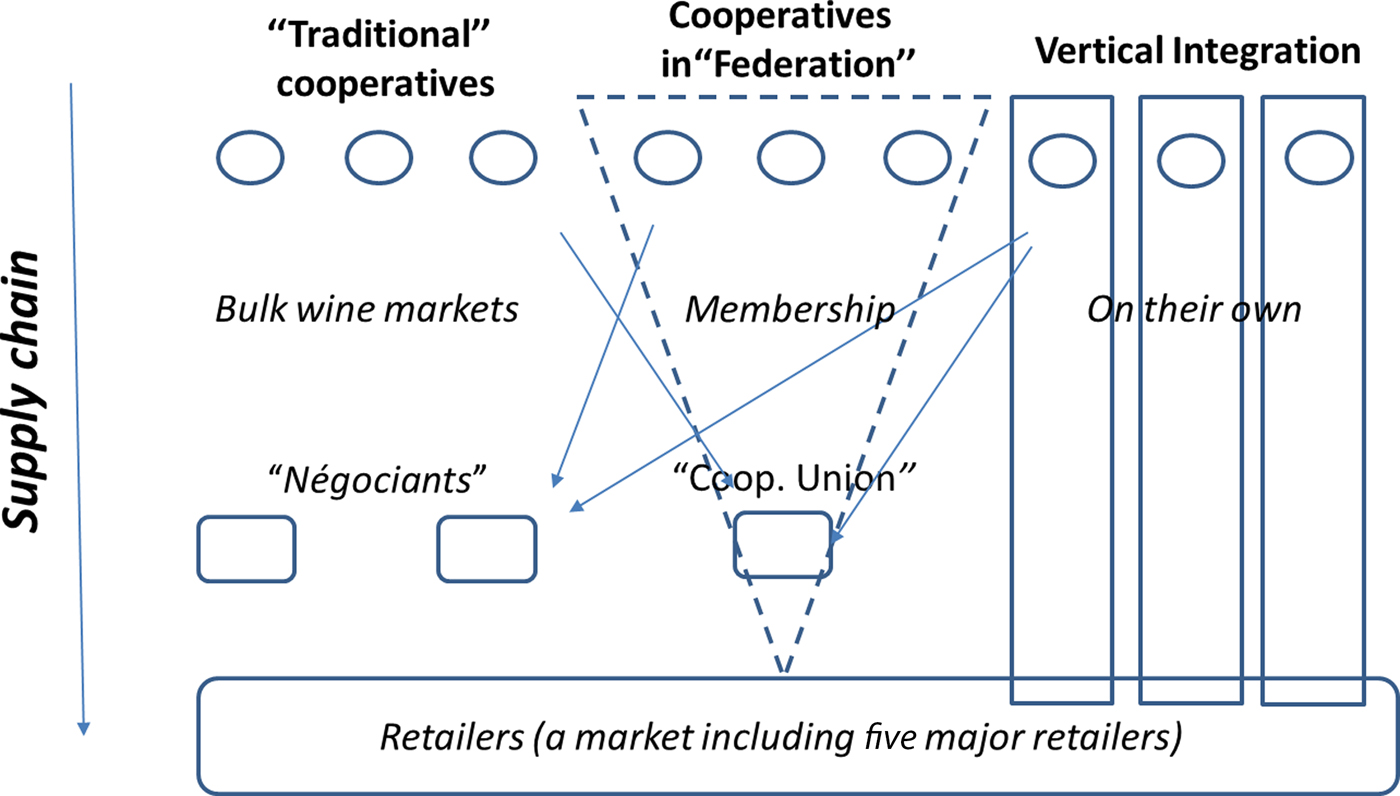
Cooperatives use three different channels to sell their wines. There is a “traditional” model, in which cooperatives limit their activities to the first step of wine-making and sell bulk wine to négociants which blend and market the wines. Some cooperatives are members of cooperative federations which compete directly with négociants: they blend and market the wines provided by the first-tier cooperatives. Others have successfully integrated downstream activities, that is, branding and marketing. As a result, the Bordeaux cooperatives can be classified according to three types of downstream strategies: “traditional cooperatives,” which sell bulk wine to négociants; cooperatives that belong to a federation and “sell” their wine to cooperative federation; and cooperatives that mostly blend, bottle, and market their wines themselves. Figure 1 shows the marketing channel according to these three downstream strategies.
The Downstream Strategies of Bordeaux Wine Cooperatives

The first decade of the 2000s was a time of introspection for the leaders of the Bordeaux wine cooperatives. The French wine industry had experienced a crisis, and the legitimacy of cooperatives had been called into question. A significant outcome of this period is a report published by the CIVB, the “Bordeaux demain” (Bordeaux tomorrow) roadmap (CIVB, 2010). The main conclusion is that cooperatives should federate. The stated objective was that five major cooperative federations emerge to balance the monopsony power of the five existing major retailers. At this time, cooperative federations and vertical integration were considered proactive policies to enable winegrowers to create and capture value within the food chain. In contrast, the conservative policy, implying direct exposure to the bulk-wine market price risk and a weak bargaining position in the supply chain, was perceived as a dead-end policy. This idea corresponded to the perception of the Bordeaux wine industry policymakers (CIVB, 2010) and can also be found in the report by Theodorakopoulou and Iliopoulos (Reference Theodorakopoulou and Iliopoulos2012) on the future of wine cooperatives in Europe.
The rationale for choosing a dead-end policy can be found in the lifecycle approach of Cook (Reference Cook1995). Indeed, when the benefits related to the cooperative organization are called into question by the members of the cooperative which are affected by the cost of ownership of the structure (Hansmann, Reference Hansmann1988), they can opt for an explicit or implicit choice of exit. Some seek strategic alliances to continue (to federate can be considered as such an alliance). Others shift to different models.
Therefore, we assume that the downstream strategies reflect the proactiveness of cooperatives and, as such, the choice of transformation, continuation, or exit. This is our first hypothesis. More specifically:
1. Vertical integration corresponds to transformation: Vertical integration corresponds to a shift in a new model that changes the contract between winegrowers and cooperatives, as the price paid to them cannot be based on the output price less the winemaking costs.
2. Federation corresponds to continuation: To form or join a cooperative federation makes it possible to control the downstream stages of supply chain without significantly changing the core activities of cooperative itself, nor the contract between cooperative and members.
3. Status quo corresponds to exit: To persist in the traditional downstream strategy, in which cooperatives limit their activities to the first stage of the wine making and are directly exposed to the risk of the bulk wine markets may be related to an implicit choice of exit.
Our second hypothesis is related to exit. Indeed, Cross and Buccola (Reference Cross and Buccola2004) show that there may be a rationale for cooperative members to exploit their informational advantage over the cooperative lenders to operate a cash transfer by overpricing their products. The authors consider that cooperative members take advantage of a hidden liquidation. In our view, this represents a possible exit for traditional cooperatives. Such a strategy can end with bankruptcy or a defensive merger that masks bankruptcy (Chaddad and Cook, Reference Chaddad, Cook, Karantininis and Nilsson2007).
III. A Method to Detect Liquidation
Detecting liquidation is an empirical challenge. Indeed, if it were that obvious, the cooperative lenders could anticipate financial distress, but many cooperative bankruptcies appear to have taken their stakeholders by surprise (Cross, Buccola, and Thomann, Reference Cross, Buccola and Thomann2009). According to our own knowledge, this idea also applies to the French wine industry.Footnote 2
Cross, Buccola, and Thomann (Reference Cross, Buccola and Thomann2009) proposed a method based on a comparison between the price paid to cooperative members and the price offered by investor-owned agribusiness to characterize liquidation. However, we cannot use this method in the Bordeaux wine industry because investor-owned wineries are still rare in Bordeaux. There is no “investor-owned-firm contract price” that could serve as a reference to check whether the price paid to cooperative members is excessive.
Thus, we propose a different empirical strategy. We observe the relationship between leverage (LEV), as a proxy of debt, and the price paid to producers (P) in two sets of econometric specifications. In the first set of specifications, we examine whether the cash transfer to producers increases the cooperative's debt. The cooperative's debt is the dependent variable, and we use a lagged proxy of the price paid to producers (P N−1) to prevent endogeneity. Our control variables (CV) are investment (proxied by the ratio of net to gross assets) and the value of the wine processed by cooperative (proxied by the output price). We apply this approach with three proxies of debt: (1) the ratio of the medium- and long-term debt to equity (medium- and long-term leverage), (2) the ratio of short-term debt on sales, and (3) the ratio of financial debt to equity (total leverage). In the second set of specifications, we examine reverse causality: the price paid to producers is the dependent variable, and the lagged proxy of debt is the explanatory variable. If liquidation is ongoing, we should observe that undercapitalization implied by overpayment increases debt and, reversely, that producers use debt not only for investment but to increase their payment through ex post overpricing.
According to our hypotheses, the relationship between debt and the price paid to producers should differ according to downstream strategies (DS). We use cross variables to highlight the phenomenon (see the specification equations (1) and (2)). In the general model equation (1), as the “traditional” cooperatives are prone to liquidation, we should observe a positive relationship between the price paid to producers and leverage (β 1 > 0): all else equal, cooperative members prioritize their current payments against their medium-term financial prospects. For other cooperatives, the relationship between the price paid to producers and debt may be negative if they anticipate a possible rationing from banksFootnote 3 or null if they do not.
In the second general model equation (2), a positive impact of debt on the price paid to producers (β 5 > 0) may indicate that the purpose of debt is a cash transfer to producers. Reversely, a negative relationship may indicate a disciplinary effect: the price to producers is reduced to preserve financial health.
 $$LEV = \beta _0 + \beta _1 DS \times P_{N - 1} + \beta _3 CV$$
 $$P = \beta _4 + \beta _5 DS \times LEV_{N - 1} + \beta _6 CV$$
IV. Data and Econometrics
A. Data
Thanks to a partnership between the professional organizations of the Bordeaux wine industry and the faculty of Bordeaux Sciences Agro, we were able to gather data on all 39 Bordeaux cooperatives that existed at the time of data collection. Our database is unique in the sense that it combines production and financial data collected during a survey targeting the cooperatives’ accountants. We asked them to provide data over a six-year period (2005–2011).Footnote 4 This enabled us to proxy the price paid to producers by dividing the cost of raw materials by the volume of production. It also provided the average price of the wine sold by the cooperative (the output price) and information on the distribution channel used by the cooperative through the volume sold in bulk to négociants, the volume transferred to federation, and the volume sold in bottles.
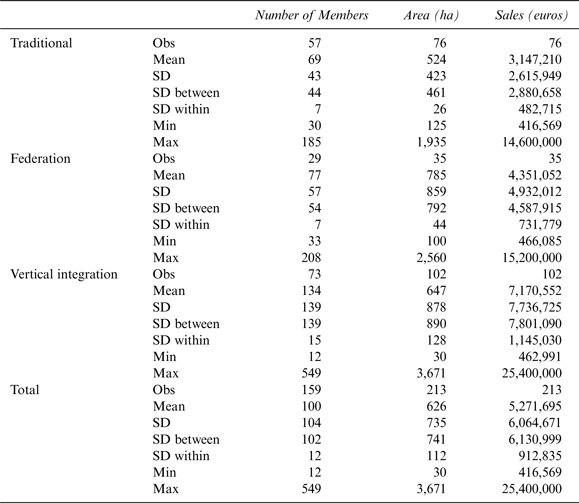
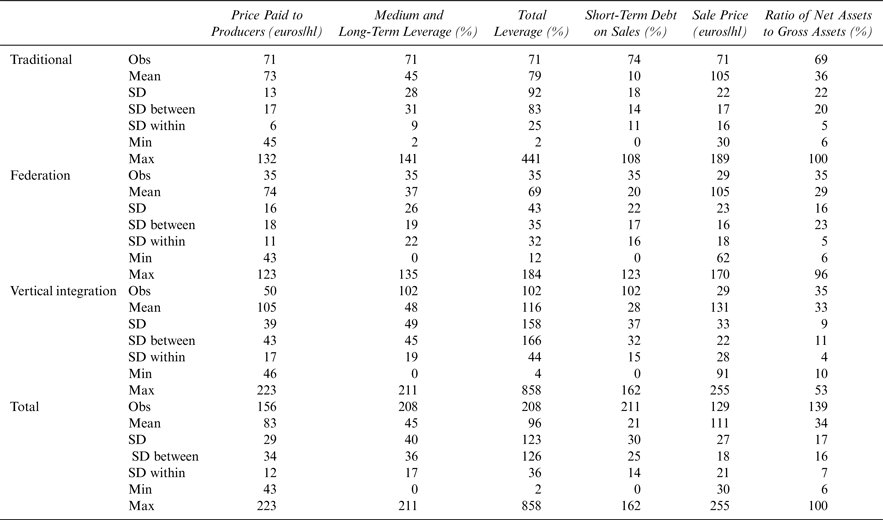
Following Cadot et al. (Reference Cadot, Alonso Ugaglia, Bonnefous and Del'homme2016), we consider the downstream strategy to be (1) traditional, when cooperatives do not belong to a federation or have not implemented a vertical-integration policy; (2) a federation, when more than 30% of turnover is accounted for by sales to a federation; and (3) vertical integration, when bottled wine accounts for more than 30% of the turnover. Table 1 lists general statistics and Table 2 focuses on the variables used for the regression models.
Size, Sales, and Downstream Strategies

Note: Observations are cooperative-year, that is, 39 cooperatives over a six-year period (2005–2011).
Source: Our database.
Price Paid to Producers, Leverage, Sale Price, and Investment

Note: Observations are cooperative-year, that is, 39 cooperatives over a six-year period (2005–2011).
Source: Our database.
B. Descriptive Statistics
Table 1 shows that Bordeaux wine cooperatives are small businesses: the average sales is 5,271,295 euros and the highest reported sales is 25,400,000 euros. Some are formed by about 30 farmers, while others include more than 200 members. The heterogeneity seems especially high in the cooperatives which have chosen vertical integration: the smallest cooperative (12 members) and the largest one (549 members) both belong to this category.
Table 2 shows that the price paid to producer members of traditional cooperatives and cooperatives in federation is equivalent, while the price paid to producers by vertically-integrated cooperatives is higher. It can also be seen that the average output price of cooperatives in federation does not differ from the output price obtained by traditional cooperatives, while the price obtained by the vertically-integrated cooperatives is higher. One striking point is that the minimum sale price is lower than the minimum price paid to producers in “traditional” cooperatives. This illustrates an extreme case of cash transfer from the cooperative to cooperative members which should result in negative retained earnings.
Surprisingly, the leverage ratios do not seem to differ according to cooperatives’ downstream strategies, except for the short-term debt, which is seemingly lower for traditional cooperatives and higher for vertically-integrated cooperatives. Moreover, we do not observe differences in investment, proxied by the ratio of net assets to gross assets. As a consequence, descriptive statistics, per se, do not reveal different behaviors regarding finance and investment among the three types of cooperatives, and this despite the different sale prices and prospects by the Bordeaux wine cooperative leaders (as expressed in CIVB, 2010).
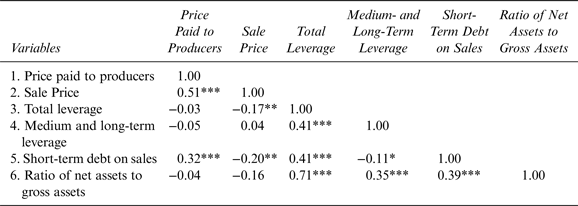
Table 3 displays the correlation matrix of the six variables used in our econometric models. It shows that the price paid to producers is strongly related to cooperatives’ ability to obtain a high sale price. There is also a positive and highly significant link between the price paid to producers and short-term debt. This shows that the price paid to producers is related to the bank financing.
Correlation Matrix

Source: Our database.
C. Estimation
Our empirical strategy to detect liquidation implies a panel regression analysis which aims to reveal the link between the price paid to producers and debt. The correlation matrix shows that there is no obvious link between these two variables. The multivariate analysis enables to control the possible effects of the ability to achieve a good quality, well-valuated product (proxied by the sale price) and of the investment behavior (proxied by the asset renewal ratio). Moreover, we use panel data to apply our study over a significant period of time (six years) and to reduce the endogeneity problem via the use of lagged variables. As the downstream strategy of cooperatives can be time invariant, the use of fixed effect models would result in controlling its effects. Thus, our analysis requires random effect models. The Hausman test shows that random effect models are appropriate for the analysis. Moreover, as we detected heteroscedasticity (the Breusch–Pagan test leads us to reject the hypothesis of homoscedasticity), we apply a feasible generalized least square approach, and adjust for heteroscedasticity across panels and (AR1) autocorrelation. Our estimation is not affected by multicollinearity (the variance influence factors for each variable are under six in each estimation model).
V. Results
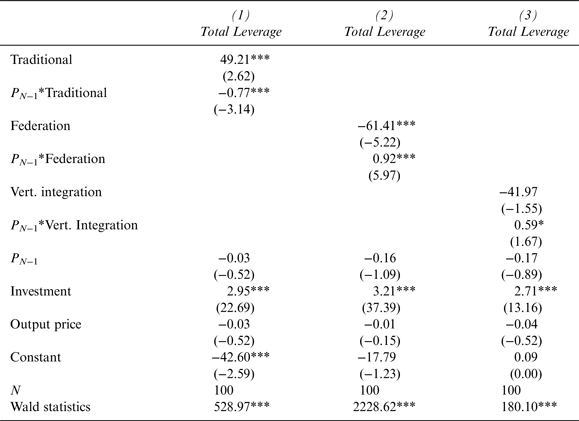
We present the results of our multivariate analysis in four tables. Table 4 presents the results for the first econometric specification: the impact of the price paid to producers on total leverage. Tables 4 to 6 display the impact of debt on the payment to producers.
Effect of the Price Paid to Producers on Total Leverage and Downstream Strategies of Cooperatives

z statistics in parentheses.
p < 0.10, ** p < 0.05, *** p < 0.01
Source: Our database.
A. Leverage and Payment to Producers
In model 1 of Table 4, we see that the leverage is much higher for traditional cooperatives than for cooperatives belonging to a federation and cooperatives that are vertically integrated. This means that the level of equity, which includes retained earnings, is much lower for traditional cooperatives, with respect to the capital invested in the cooperative. This reveals a preference for bank financing which, if it goes too far, can jeopardize the future of the cooperative. This is consistent with the assumption that traditional cooperatives are closer to exit than other types of cooperatives.
The effect of the cross variable (dummy for traditional cooperatives and price paid to producers) contradicts the hypothesis of liquidation by the traditional cooperatives. Indeed, it appears that the higher the price paid to producers of traditional cooperatives, the lower the leverage. This result shows that the price paid to producers is negatively related to the future debt requirements. Therefore, in contradiction with our second hypothesis, the cooperatives do not proceed to a direct transfer from banks to the producers via the price paid to producers.
In model 2 of Table 4, we see that the leverage of cooperatives which belong to a federation is low compared to that of other cooperatives with similar characteristics. The cross variable (dummy for cooperative federation and price paid to producers) shows that the price paid to producers has a direct impact on leverage. In this case, the impact is positive: the cash transferred to the producers via the price is partly offset by the lenders ex-post. Nevertheless, this transfer cannot be interpreted as a means of liquidation in favor of cooperative members as they are, on average, much less in debt than other cooperatives. A possible mechanism behind this result is the ability of federated cooperatives to use debt to maintain a minimum level of the price paid to producers (note that the price of 50 euros per hl is close to the minimum for farm profitability).
In this table, model 3 shows that the leverage of vertically-integrated cooperatives is not significantly lower than the leverage of the other types of cooperatives. The cross variable (dummy for vertical integration and price paid to producers) shows that the higher the price paid to producers, the higher the ex-post debt. This is weakly significant but contrasts strikingly with the relationship observed with the traditional cooperative.
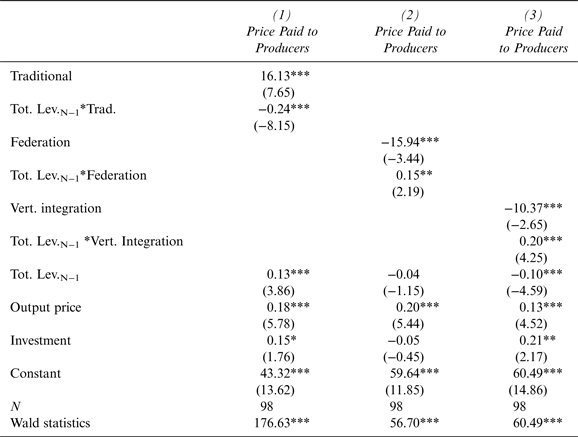
Table 5 provides evidence of a form of exit by traditional cooperatives. Indeed, model 1 shows that the price paid to producers by these cooperatives is higher than those paid to members of cooperatives in federation or vertically-integrated cooperatives, all else equals. There is overpricing. The cross variable (dummy for traditional cooperatives and total leverage) shows a negative effect of leverage on this abnormal payment to producers. Thus, the debt is not used to operate a cash transfer from banks to producers. However, we see that the ex ante leverage has a positive impact on the price paid to producers for cooperatives which belong to a federation or vertically-integrated cooperatives. This result shows that there is a cash transfer from banks to producers: these cooperatives can use debt to manage the price paid to producers. It is not the case for traditional cooperatives.
Effect of Total Leverage on the Price Paid to Producers and Downstream Strategies of Cooperatives

z statistics in parentheses.
p < 0.10, ** p < 0.05, *** p < 0.01.
Source: Our database.
B. The Cash Transfer Channel: Short or Medium- and Long-Term Debt?
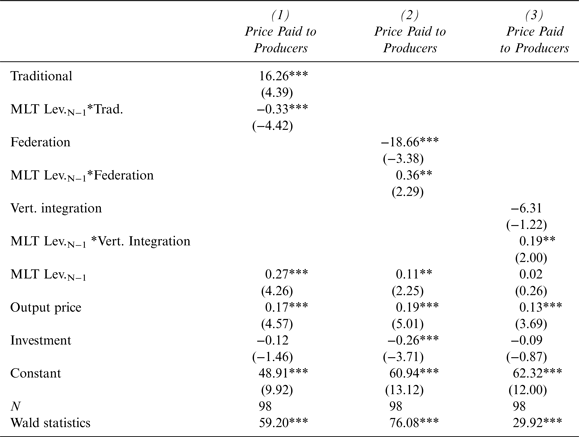
Table 6 shows that the results obtained using total leverage still hold when we consider only medium- and long-term leverage. One slight difference is that vertically-integrated cooperatives do not display a lower level of medium- and long-term leverage.
Effect of Medium- and Long-Term Leverage on the Price Paid to Producers and Downstream Strategies of Cooperatives

z statistics in parentheses.
p < 0.10, ** p < 0.05, *** p < 0.01.
Source: Our database.
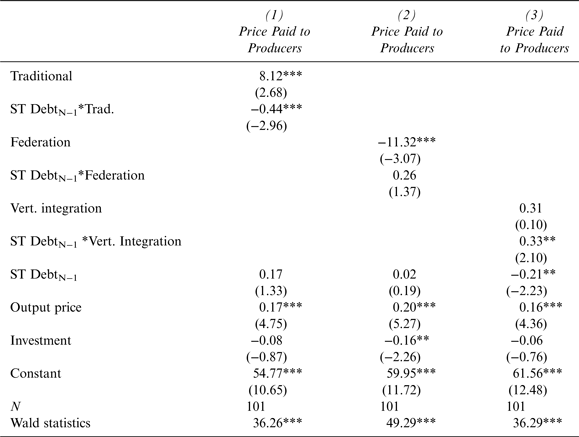
In model 1 in Table 7, we see that the context of high leverage and control of payment to producers still drives the results when we consider short-term debt in traditional cooperatives. This may reveal a situation of financial distress leading banks to strict monitoring: the negative link between debt and payment to producers still holds.
Effect of Short-Term Debt on the Price Paid to Producers and Downstream Strategies of Cooperatives

z statistics in parentheses.
p < 0.10, ** p < 0.05, *** p < 0.01.
Source: Our database.
In model 2 in Table 7, we see that cooperatives which belong to a federation are comparatively less indebted than others. Moreover, the results show that the positive link between debt and payment to producers seen in Table 6 no longer holds: cooperatives which belong to a federation do not (or cannot) use short-term debt to increase payment to producers. This differs strikingly from vertically-integrated cooperatives.
Indeed, model 3 shows that vertically-integrated cooperatives are, on average, no less indebted than other cooperatives, and that the payment to producers is positively related to short- term debt. This shows that banks give them the possibility to use debt to increase the cash income of members. This interpretation suggests that vertically-integrated cooperatives benefit from full credit availability that enables them to follow a financial policy free from financial constraints.
VI. Discussion
Our research is based on two hypotheses: (1) the cooperatives’ downstream strategies reflect their behavior with respect to their choices of exiting, continuing, or transforming; and (2) exit is well described by the liquidation model of Cross, Buccola, and Thomann (Reference Cross, Buccola and Thomann2009), who state that cooperatives can proceed to a transfer of cash from banks to the cooperative members because of the information asymmetry regarding the pricing of raw products provided by the cooperative members.
The first assumption appears to be confirmed by our econometric results. Indeed, we see that the price paid to producers by “traditional” cooperatives is higher than that paid by other cooperatives when the effects of sale price, leverage, and investment are controlled.Footnote 5 Moreover, the debt ratio shows that they rely more on bank finance. As a result, the “traditional” cooperatives are more exposed to financial risks. That may reflect an implicit choice of exit by cooperative members belonging to “traditional” cooperatives.
Our second assumption, regarding the core mechanism of exit, is contradicted by our results. Indeed, the coefficient of the variable crossing downstream strategy and the price paid to producers is negative, meaning that there is no direct impact of overpricing on debt: cooperatives do not take advantage of information asymmetry to undertake a transfer of cash from banks to producers. Rather it appears that banks control the risk of cash transfer via monitoring, which makes credit availability conditional on a moderation of the price paid to producers, and, reversely, leads the cooperatives to reduce the price paid to producers when they are leveraged.
There is no ambiguity in the relationship between debt and the price paid to producers in the case of vertically-integrated cooperatives: either short-term or long-term debt can be used by cooperatives to increase the price paid to producers. As such, these cooperatives benefit from great financial flexibility: they can use debt to manage the price paid to producers. The cooperatives belonging to a federation do not benefit from such a flexibility: access to medium- and long-term debt is related to a higher payment to producers, but this is not the case for short-term debt.
The previously noted analysis suggests a direct link between the strategic orientation of cooperatives and their relationship with their banks.Footnote 6 Banks play a central role, as cooperatives are by essence financially constrained (Chaddad, Cook, and Heckelei, Reference Chaddad, Cook and Heckelei2005). Banks provide financial supports with flexibility depending on the cooperative's strategic choice. The traditional cooperatives are supported by banks but under the condition of a tight control of the price paid to producers. The risk related to leverage and bank monitoring, however, can lead to an effective exit by bankruptcy or, more likely by a defensive merge with other cooperatives, at a low cost for banks. By contrast, the lending regime of cooperatives belonging to federation fits a policy of continuation: medium- and long-term debt is available if the cooperative is short of cash. The non-constrained lending regime provided to vertically-integrated cooperatives is sustainable if the cooperative members display a real long-term commitment. If it is not the case, the financial flexibility could be used to operate a non-sustainable cash transfer from the bank to the cooperative members. This argues for considering the role of the bank relationship (Petersen and Rajan, Reference Petersen and Rajan1994) in the lifecycle approach of cooperatives initiated by Cook (Reference Cook1995).
7. Conclusion
This research is based on the hypothesis that the downstream strategies of Bordeaux wine cooperatives reflect the three options facing cooperatives at the turning-point of maturity (Cook, Reference Cook1995): exit, continuation, or transformation. A second hypothesis is that the choice of exit can be achieved through a cash transfer from banks to cooperative members, following the liquidation process described by Cross and Buccola (Reference Cross and Buccola2004). Our empirical strategy is based on econometric specifications in which the downstream strategies are a moderating variable of the effect of debt on the price paid to producers, and reversely. We use lagged variables to examine the possible causality and avoid endogeneity.
The econometric results are consistent with our first hypothesis. Indeed, the cooperatives which have chosen the status quo, expected to be prone to exit, show both higher leverage and a higher price paid to producers than the two other types of cooperatives. The results, however, contradict our second hypothesis. The cooperatives prone to exit do not appear to be engaged in a liquidation process, in the sense of Cross and Buccola (Reference Cross and Buccola2004). According to these authors, cooperatives use their informational advantage on the price paid for raw products to make a cash transfer from banks to producers, who are the owners of the cooperative. Our results show the opposite: bank financing is available when there is a policy of price moderation to producers. Moreover, a high level of debt implies price moderation. We interpret this lending regime as a controlled process of exit: the bank finances cooperatives only if the outflows from cooperatives to cooperative members are reduced. The financial position of the cooperative is preserved until there is a future defensive merger, or until liquidation when the major part of debt is repaid.
Our results reveal that lending regimes are specific to the strategic options taken by the cooperatives. The lending regime of cooperatives choosing exit is a controlled process of liquidation. In contrast, the vertically-integrated cooperatives benefit from a non-constrained lending regime: their access to debt is not restricted and they can use it to manage the price paid to producers. The cooperatives which belong to federation are financed through a debt that is restricted. Nevertheless, we see that their access to long-term debt enables them to increase the price paid to producers, and that the price paid to producers is positively related to an ex post leverage, meaning that banks supports cooperatives in case of shortfall. This can be seen as a cautious financial support.
As a consequence, our research highlights a key role of banks in the lifecycle of cooperatives. Indeed, as the lending regimes determine the link between investment and the incomes of the cooperative members, banks have an impact on the incentives for change. As such, the bank relationship (Petersen and Rajan, Reference Petersen and Rajan1994) appears to be a key element of the lifecycle of cooperatives. This point deserves further investigation. In our view, this perspective would usefully complete the existing literature on the governance of cooperatives, which has mainly focused on the core organizational features of cooperatives (De Moura Costa, Chaddad, and Furquimde Azevedo, Reference De Moura Costa, Chaddad and Furquimde Azevedo2013; Benos et al., Reference Benos, Kalogera, Verhees, Sergaki and Penings2016).
Further research is also required to see how our methodology and results apply in other contexts.Footnote 7 Indeed, our sample is small, even though it included all Bordeaux wine cooperatives at the time that the data was collected, and our data covers only a short period. The lifecycle approach, however, requires a specification of the stage in the lifecycle of cooperatives. This approach also requires specifying the strategies implemented by cooperatives regarding their choice among exit, continuation, or transformation, which can differ with the location and the industry concerned. Note that, with this approach, we follow Benos et al. (Reference Benos, Kalogera, Verhees, Sergaki and Penings2016) in considering that the strategic attributes of cooperatives (such as downstream strategies) are as (certainly more) structuring as the organizational attributes of the cooperatives in terms of explaining cooperative performance and survival. A generalization of the results is possible only via a meta-analysis encompassing numerous cases sharing a minimum number of concepts. Our research puts the concept of the bank relationship on the agenda of cooperative theorists. We now look forward to seeing whether this proposition will lead to further studies.