Introduction
The species status and geographical distribution of the Baetis vernus group (Ephemeroptera: Baetidae) (Müller-Liebenau Reference Müller-Liebenau1969) remains poorly understood. The main reason is that the species are difficult to identify using morphological criteria. The group has a Holarctic distribution. At least nine species have been found in Europe (Ståhls and Savolainen Reference Ståhls and Savolainen2008; Savolainen Reference Savolainen2009; Bauernfeind and Soldán Reference Bauernfeind and Soldán2012). Bauernfeind and Soldán (Reference Bauernfeind and Soldán2012) surveyed the habitats of the species: they extend from slowly flowing eutrophic streams and lakes to Arctic-Alpine tundra brooks and ponds. Giberson et al. (Reference Giberson, Burian and Shouldice2007) report that the Nearctic B. bundyae Lehmkuhl and B. hudsonicus Ide were found in Arctic habitats ranging from large streams to small ponds.
Within the Baetis vernus group, the species identity of nymphs identified in various studies (e.g., Savolainen et al. Reference Savolainen, Drotz, Hoffsten and Saura2007) has not been adequately worked out for the B. macani complex consisting of B. macani Kimmins, B. bundyae, and B. jaervii Savolainen. Baetis bundyae, described from Canada, has been reported as a member of northern European fauna in several studies (Engblom Reference Engblom1996; Jacob Reference Jacob2003; Bauernfeind and Soldán Reference Bauernfeind and Soldán2012).
Savolainen et al. (Reference Savolainen, Drotz, Hoffsten and Saura2007) used enzyme electrophoresis to distinguish between five reproductively isolated taxa of the Baetis vernus group in northern Europe. They showed that the occurrence and distribution of diagnostic alleles indicated that there were at least two species within what had been known as Baetis macani Kimmins.
Ståhls and Savolainen (Reference Ståhls and Savolainen2008) used the barcoding fragment of mitochondrial COI sequences and multiple samples of B. macani nymphs of the forms identified by Savolainen et al. (Reference Savolainen, Drotz, Hoffsten and Saura2007) from central and northern Finland in a parsimony analysis. They resolved the B. macani samples in three different lineages. One of the B. macani lineages of Ståhls and Savolainen (Reference Ståhls and Savolainen2008) showed clear within-lineage substructuring so that some of the samples formed a sister group relationship with the samples of Nearctic B. bundyae Lehmkuhl. This result supported the conclusion from allozyme studies by Savolainen et al. (Reference Savolainen, Drotz, Hoffsten and Saura2007), which also found genetic substructuring within B. macani. Subsequently, Savolainen (Reference Savolainen2009) formalised one of the three distinct lineages as B. jaervii Savolainen including distinct morphological and biological characteristics of the taxon. Baetis jaervii nymphs live among littoral vegetation of lakes (lentic waters). One of the samples in the study by Ståhls and Savolainen (Reference Ståhls and Savolainen2008) labelled as B. bundyae was resolved as sister group to “B. macani+B. bundyae” in the parsimony tree. Comparison with multiple COI sequences from GenBank showed that this sample, originating from Canada, belonged to B. hudsonicus Ide, a Nearctic member of the B. vernus group and of the B. macani complex.
The results indicated that there still were (in addition to the lineage described as B. jaervii) two separate (reproductively isolated Drotz et al. Reference Drotz, Savolainen, Saura and Ståhls2012) lineages within the samples labelled Baetis macani from Finland. One of these is evidently B. macani Kimmins. Some individuals found in sympatry with B. macani clustered with the Nearctic B. bundyae samples. We here aim to resolve this question. To understand the species identities of the samples in light of mtDNA COI sequences we included samples from the type localities of both B. bundyae and B. macani. In addition we attempt to disentangle the identities of the nymphal forms of the B. macani complex, the species identities of earlier records (Engblom Reference Engblom1996; Jacob Reference Jacob2003; Bauernfeind and Soldán Reference Bauernfeind and Soldán2012) and, more specifically, does B. bundyae occur in Europe.
Material and methods
Specimen sampling
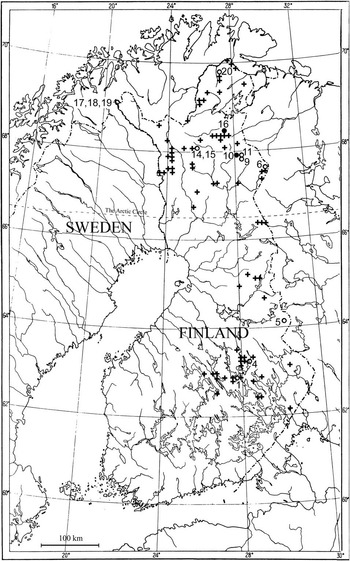
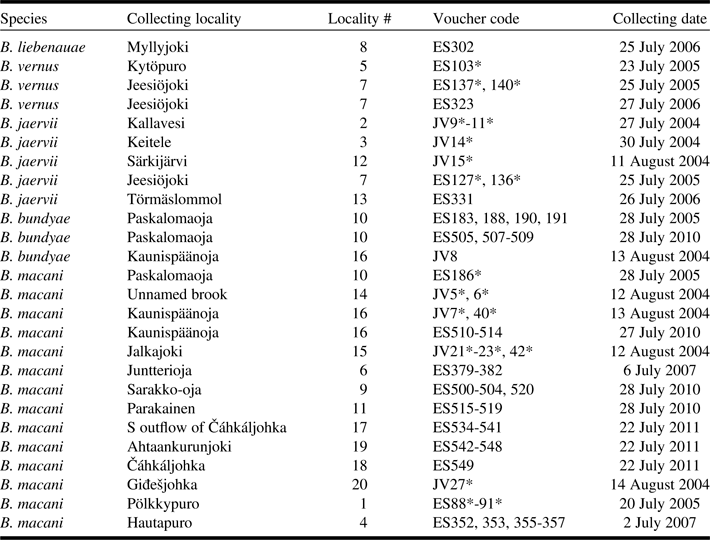
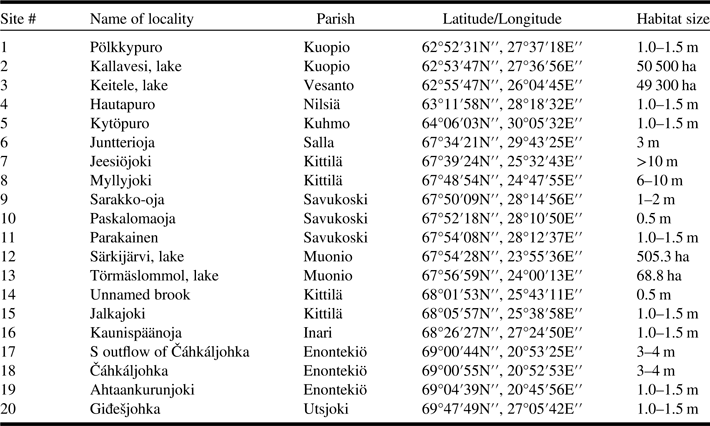
The Baetis bundyae samples from the type locality, Rankin Inlet, Nunavut, Canada are derived from the material used by Giberson et al. (Reference Giberson, Burian and Shouldice2007). Baetis macani could not be found in any of the water bodies at the type locality of Mount Saana, 800 m elevation, Finnish Lapland (Kimmins Reference Kimmins1957) in spite of multiple sampling efforts (see discussion). Instead, we collected B. macani nymphs from three sites close to the type locality (Sites 17, 18, and 19 in Table 2). In addition, material was collected from 10 other localities in western and eastern Finnish Lapland (Tables 1 and 2, Fig. 1).
Sampling localities of Baetis macani (○), B. bundyae (●), and unspecified (B. macani complex) samples stored at the Kuopio Museum of Natural History (+) in Finland.

Relationship between Baetis species sampling locality, voucher code (JV Johanna Viiri, ES Eino Savolainen), site number (see Table 2 and Fig. 1), and collecting date.

Note: Specimens marked with asterisks were included in Ståhls and Savolainen (Reference Ståhls and Savolainen2008).
Locality descriptions where Baetis nymphs were collected in western and eastern Finnish Lapland (see Fig. 1).

Note: Number of sampling locality, name of locality, parish, degrees N/E, width in m for brooks and rivers or area for lakes in ha.
Laboratory procedures
We sequenced the mtDNA COI gene region following the laboratory protocols for DNA extracting and polymerase chain reaction amplification and sequencing described in Ståhls and Savolainen (Reference Ståhls and Savolainen2008) and Drotz et al. (Reference Drotz, Savolainen, Saura and Ståhls2012). Ball et al. (Reference Ball, Hebert, Burian and Webb2005) have shown that the DNA barcoding region is a reliable method in assigning mayflies to species.
Parsimony analysis
We included Baetis liebenauae Keffermüller and B. vernus Curtis as outgroups (European Molecular Biology Laboratory (EMBL) accession numbers AM494667, AM494684-85), and rooted the tree using B. liebenauae. The ingroup included 64 samples of B. macani, six samples of B. bundyae, eight of B. jaervii and four samples of B. hudsonicus (Gen Bank accession numbers GU115135–GU115137, and newly generated ES222, compare to Ståhls and Savolainen Reference Ståhls and Savolainen2008, deposited at the Finnish Museum of Natural History, Helsinki). Of the B. macani sequences used within this study 26 were previously used in Ståhls and Savolainen (Reference Ståhls and Savolainen2008) (EMBL accession numbers AM494609-45, AM494658-67, AM494672-87), in addition to B. jaervii (EMBL accession numbers AM494633-40). Here we include 35 additional B. macani sequences from a few localities in Finnish Lapland (sites 6, 9, 11 and 16–19, Table 2) (EMBL accession numbers GU727832-50 and HF969278-312).
We used the program NONA v2.0 (Goloboff Reference Goloboff1999) for the parsimony analysis spawn with the aid of Winclada (Nixon Reference Nixon2002) using the heuristic search algorithm (command line: hold 100 000; mult*1000; hold/200) and for calculating non-parametric bootstrap values with 1000 replicates. Mean pairwise uncorrected sequence differences were calculated using MEGA 5.0 (Tamura et al. Reference Tamura, Peterson, Peterson, Stecher, Nei and Kumar2011). Measures of how well all individual characters fit on a phylogenetic tree is measured by the consistency index (CI). The average value is calculated by dividing the minimum possible number of steps by the observed number of steps on the tree. The retention index (RI) measures the number of synapomorphies expected from a data set that is retained as synapomorphy on a tree. All base positions were treated as equally weighted characters.
Results
Parsimony analysis
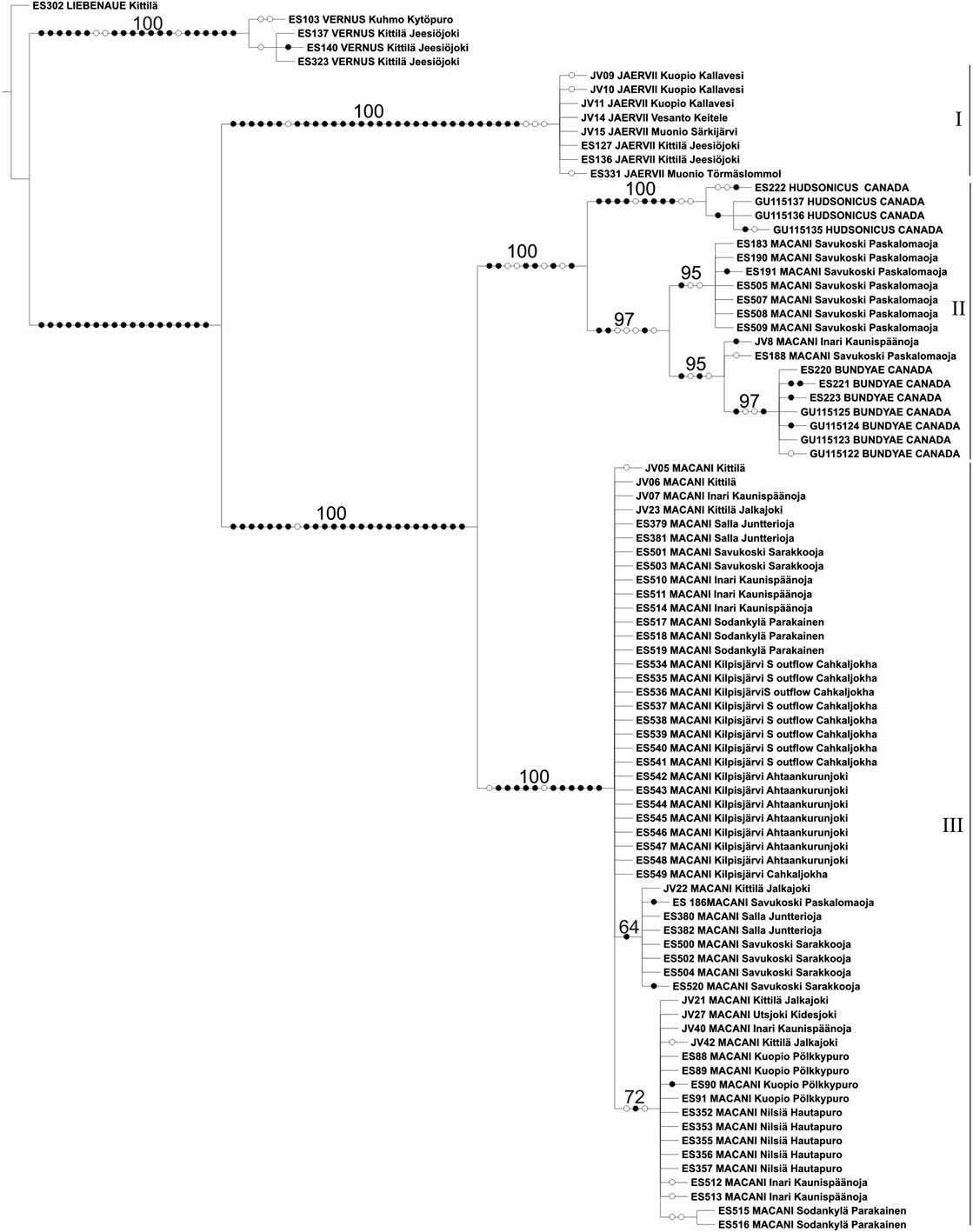
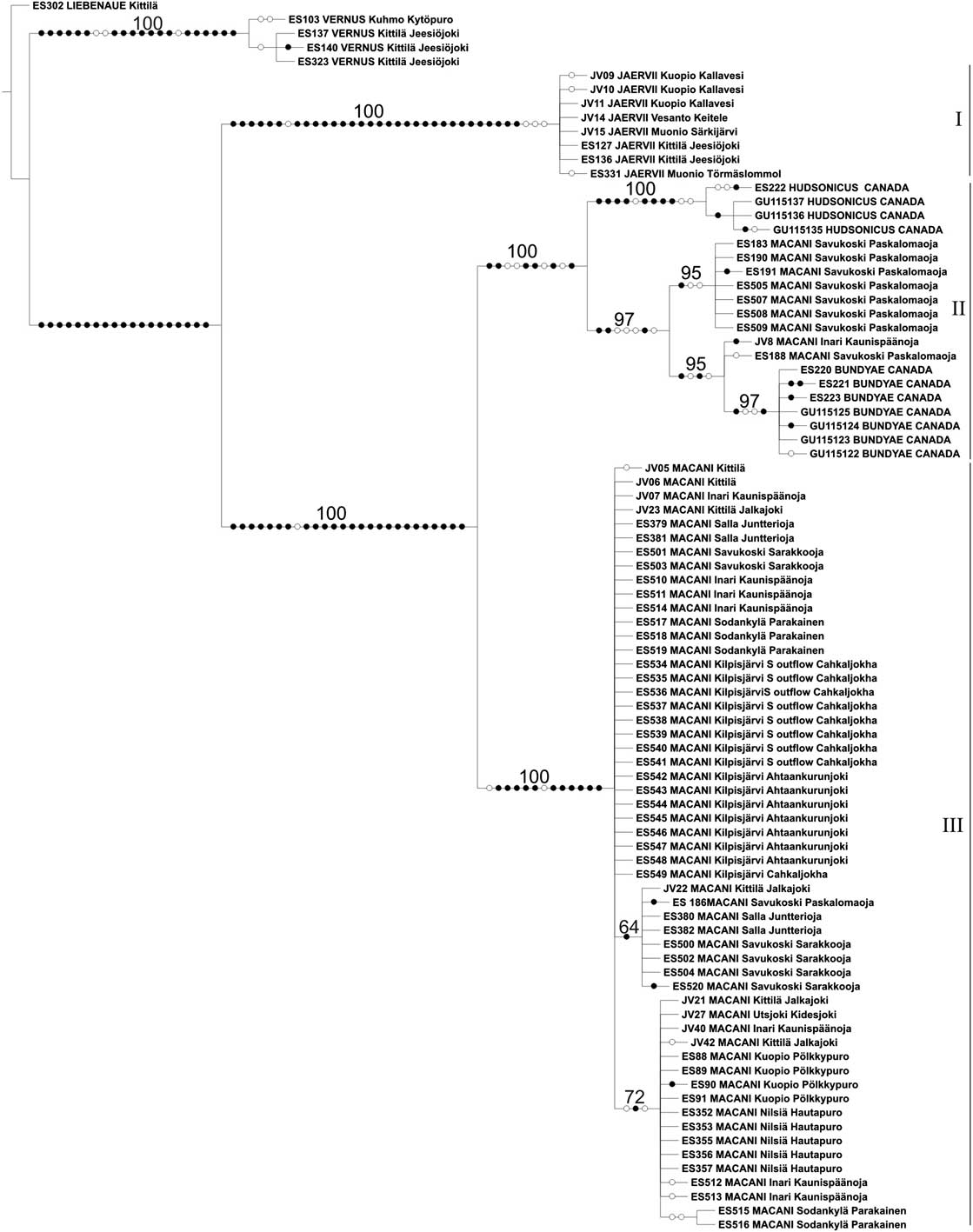
The parsimony analysis on the mtDNA COI sequences resulted in 81 equally parsimonious trees of 265 steps length, CI=0.83, RI=0.97, and these are presented as a strict consensus tree (Fig. 2). The Baetis jaervii, B. hudsonicus, and B. macani samples were resolved as monophyletic lineages. The remaining samples were resolved into a clade comprising nine nymphs (eight from Savukoski, Paskalomaoja and one from Inari, Kaunispäänoja) plus the included B. bundyae samples (four from GenBank and sequences with labcodes ES221-3 from the type locality generated in the present study). The morphology of these nine nymphs and that of the mandibles and gills in particular, agreed with samples of B. bundyae from Canada. Based on this evidence we identify these nine nymphs as members of the taxon B. bundyae. The largest clade consists of a many samples of B. macani from Finnish Lapland and central Finland. All samples from the vicinity of the type locality of B. macani belong to this largest clade. The mean uncorrected sequence difference between B. macani and B. bundyae was 6.4%, and within B. bundyae 1%. The first author collected on 19 July 2013, an additional sample of B. macani at Boratbokcá, 70°3'39"N, 27°42'29"E.
Strict consensus tree based from parsimony analysis of mtDNA COI. Filled circles denote unique (non-homoplasious) changes and open circles denote non-unique changes. Bootstrap support values indicated above branches. Species limits are outlined; (I) Baetis jaervii, (II) B. bundyae includes the references to the Finnish specimens prior misinterpreted as B. macani and (III) Baetis macani.
Discussion
Baetis bundyae Lehmkuhl, a species new to Finland
We conclude that B. bundyae is found in Finland at two sites in eastern Lapland. We also point out that at present the only way to differentiate the more widespread B. macani from B. bundyae is based on molecular methods: mtDNA and enzyme electrophoresis (Savolainen et al. Reference Savolainen, Drotz, Hoffsten and Saura2007; Drotz et al. Reference Drotz, Savolainen, Saura and Ståhls2012). The molecular phylogeny showed 1% intraspecific sequence divergence for the B. bundyae lineage, and 6.4% between B. macani and B. bundyae.
The original description of the nymphs of B. macani included material from two separate species, B. macani and B. jaervii. This has given rise to long-standing confusion in identifying closely related species that we attempt to resolve. In 1956, the renowned T. T. Macan collected mayfly nymphs from a pond on Mount Saana in Finnish Lapland. The material contained an apparently new species. Kimmins (Reference Kimmins1957) described the adults as B. macani. This description is valid and Macan described the morphology of the nymphs from the type locality but included material from lakes elsewhere. In the title of his paper Kimmins (Reference Kimmins1957) used the term “lentic” (still waters) to describe the habitat of B. macani. We do not regard this alpine habitat as lentic and have, in fact, never found B. macani in lentic waters (Savolainen et al. 2007). In her authoritative review of the European species of the genus Baetis, Müller-Liebenau (Reference Müller-Liebenau1969) included northern European material from flowing and stagnant waters under the taxon B. macani Kimmins (Reference Kimmins1957).
Lehmkuhl (Reference Lehmkuhl1973) described B. bundyae based on material collected in tundra ponds in Arctic Canada. Morihara and McCafferty (Reference Morihara and McCafferty1979) came to the conclusion that that B. bundyae has only “slight morphological differences” to B. macani. They only used nymphs collected from lakes in Europe when comparing B. macani with B. bundyae from Canada. They placed it, accordingly, on the “basis of distinct geographic segregation” as a subspecies to B. macani.
The taxon called B. macani is made up of two forms of nymphs in Finland (Savolainen and Saaristo Reference Savolainen and Saaristo1981). The lotic (flowing water) form with narrow gills and invisible tracheae was identified as B. bundyae by Engblom (Reference Engblom1996) and we show here that it is B. macani sensu lato. The other form lives in standing or slowly flowing water with shores rich in vegetation and it has wide gills with conspicuous tracheae. Further we show that the nymphs identified as B. macani by Bauernfeind and Humpesch (Reference Bauernfeind and Humpesch2001) and Jacob (Reference Jacob2003) also fit this pattern. One of the most important diagnostic characteristics is the first apical tooth of the nymph mandible that is manifestly broad in comparison with the second tooth. Accordingly, the nymphs labelled B. macani shown by Morihara and McCafferty (Reference Morihara and McCafferty1979) and Engblom (Reference Engblom1996) clearly represent B. jaervii. In addition, the mandibles of B. tracheatus illustrated by Engblom (Reference Engblom1996) belong to B. jaervii (Savolainen Reference Savolainen2009).
The confusion in the identities of these species is still occurring as shown by the recent review by Bauernfeind and Soldán (Reference Bauernfeind and Soldán2012) where they noted that the identity of B. bundyae is an open question and felt that it was not clear whether B. bundyae is either a junior synonym of B. macani (Jacob Reference Jacob2003), a subspecies of B. macani (B. macani bundyae, sensu Morihara and McCafferty (Reference Morihara and McCafferty1979)) or a separate species (McCafferty Reference McCafferty1994). However, they are evidently unaware of the formal description of B. jaervii as a separates species.
As stated earlier, Macan (Reference Macan1957) collected the type material from “on Mount Saana above Kilpisjärvi… in a small lake with large boulders on the bottom”. Kimmins (Reference Kimmins1957) writes “Mt Saana, c. 800 metres, near Kilpisjärvi”. This information evidently comes from Macan who did the collecting. The author Savolainen has sampled all potential standing waters on Saana in 1997 and 2011. In addition, the school of Arctic hydrobiology of the University of Jyväskylä has collected water insects from these ponds and lakes in 1999, 2000, and 2008. Mr. Tobias Schneider dragged in 2011 all of these waters once more for the express purpose of this study. The end result is straightforward: there are no mayflies in any of these ponds or lakes. Predatory dytiscid beetles, in particular Agabus Leach (Coleoptera: Dytiscidae) species are abundant in this habitat (Eriksson Reference Eriksson1972). We think that they may efficiently remove any mayfly nymphs so that the record by Macan (Kimmins Reference Kimmins1957) probably represents a stray occurrence.
The material from our sites 17, 18, and 19 from brooks flowing from Mt. Saana are as close to the type locality as possible. Almost all identified samples from Finland belong to this clade (compare Figs. 1, 2). The only exceptions, the Kaunispäänoja and Paskalomaoja, belong to the same clade as samples from the type locality of B. bundyae from Canada. These two sites (numbers 10 and 16) in eastern Lapland included, in addition to B. macani, individuals identified as B. bundyae. The distance of these localities from the type locality at Kilpisjärvi is 300 km. We had, in fact, found that two reproductively isolated taxa were present in the population from the Kaunispäänoja in the study by Savolainen et al. (Reference Savolainen, Drotz, Hoffsten and Saura2007).
The nymph gills shown in the original description of B. macani by Macan (Reference Macan1957) are narrow with invisible tracheae. This is the form living in flowing water. Ståhls and Savolainen (Reference Ståhls and Savolainen2008) showed that this taxon is made up of two cryptic species. One of these forms (B. macani) is widespread in Finland while the other (B. bundyae) is restricted in small brooks in northernmost Finland (Fig. 1).
Brittain (Reference Brittain1975) has shown that what he called B. macani lives in a lake and its outflow at a middle alpine locality. Even though the locality at Finse that he studied is at an altitude of 1000 m, it is located in southern Norway. Accordingly, it corresponds to the biotope of Čáhkaljávri that we studied. In this context we may comment that there is no absolute distinction between lotic and lentic biotopes. Stony shores of lakes may harbour mayfly nymphs that otherwise live in flowing water.
Giberson et al. (Reference Giberson, Burian and Shouldice2007) described the life history of B. bundyae in Arctic Canada. Baetis bundyae has been reported from the Great Lakes region and along the Rocky Mountains to Wyoming in the south in North America (see references in Giberson et al. Reference Giberson, Burian and Shouldice2007) and is widely distributed “across the Canadian Arctic”. Giberson et al. (Reference Giberson, Burian and Shouldice2007) also noted studies reporting the life history of the species in northern Europe though the conclusions in those studies may be incorrect, based on the confusion on the species identity within B. jaervii, B. macani, and B. bundyae complex as described above.
Giberson et al. (Reference Giberson, Burian and Shouldice2007) reported B. bundyae in several localities in Nunavut, Canada, including the type locality at Rankin Inlet. These mayflies are found in all kinds of habitats, ranging from lakes through large rivers to small brooks and ponds. We have found them at two sites only. The Kaunispäänoja is a brook about 1 m wide while the Paskalomaoja is a ditch <1 m wide. Both have clear water, moss on the bottom and merge from a nearby spring. The Kaunispäänoja is on the arctic/alpine tree limit while the Paskalomaoja is within a mixed Scots pine, Norway spruce, and birch forest. Out of the total B. macani/B. bundyae material from Finland at the Kuopio Natural History Museum, samples from brooks this narrow make up only 37 samples out of the total of 162 samples; the rest comes from wider brooks and rivers.
There are three reproductively isolated taxa that fulfil the criteria of the Biological Species Concept (Mayr Reference Mayr1942). One of them (B. bundyae) is found in North America and Europe and two from Europe only (B. jaervii and B. macani). Northern terrestrial and freshwater faunas include a fair amount of taxa with a Holarctic distribution (Larsson et al. Reference Larsson, Alarie and Doughley2000; Bilton et al. Reference Bilton, Freeland and Okamura2001; Sanmartín et al. Reference Sanmartín, Enghoff and Ronqvist2001). Winds have been show to explain the spread of insects over extensive areas of the Arctic (Hogg and Williams Reference Hogg and Williams1996; Bonan Reference Bonan2008; Brittain Reference Brittain2008) and B. bundyae in particular (Giberson et al. Reference Giberson, Burian and Shouldice2007). They may explain a distribution across Siberia and European Russia, while a trans-Atlantic dispersal seems unlikely.
Kjærstad et al. (Reference Kjærstad, Webb and Ekrem2012) have compared the DNA barcodes among North American and North-Norwegian specimens of 23 different taxa of mayflies. As in the case of B. bundyae, two barcodes were identical while the rest showed at least some degree of differentiation between the continents. Kjærstad et al. (Reference Kjærstad, Webb and Ekrem2012) attribute variable differences among species to different times of faunal exchange. This may imply that mayflies are able to spread effectively over the entire Holarctic.
Acknowledgements
The first author acknowledges support from Kuopion Luonnon Ystäväin Yhdistys. The Finnish Ministry of Environment has given financial support within the project involved in mapping threatened animal species in Finland. Drs. Milla Rautio and Tobias Schneider have supplied information on the distribution of Baetis in the Kilpisjärvi region. We thank Jukka Tuononen for providing us with the map.