




No CrossRef data available.
WELFARE GAINS FROM STABILIZATION IN A STOCHASTICALLY GROWING ECONOMY WITH IDIOSYNCRATIC SHOCKS AND FLEXIBLE LABOR SUPPLY
Published online by Cambridge University Press: 14 July 2005
Abstract
Stochastic models with economywide shocks imply that the welfare costs of aggregate volatility are negligible. Empirical evidence suggests that the volatility of idiosyncratic shocks is several times that of aggregate shocks. This paper introduces both types of shocks. We find that if in the process of eliminating aggregate risk the policymaker can reduce idiosyncratic risk by an amount suggested by available empirical evidence, the welfare gains from stabilization can become significant. The introduction of idiosyncratic risk has important implications for asset pricing, and in particular may reduce the risk-free rate substantially, through the precautionary savings motive. Many of our results are sensitive both to the degree of risk aversion and to the flexibility of labor supply. The paper highlights the trade-offs involved in analyzing the effects of risk on growth and welfare and on asset pricing, clarifying the need to examine these issues within a unified stochastic general equilibrium framework.
Information
- Type
- ARTICLES
- Information
- Copyright
- © 2005 Cambridge University Press
INTRODUCTION
Attempts to assess the impact of risk on resource allocation and macroeconomic performance have generated anomalies and have been plagued by puzzles. Two such puzzles are intimately related. The first concerns the growth and welfare effects of output volatility, the so-called costs of business cycles. Assuming complete markets and the simplest exogenous growth model, Lucas (1987) obtains very small effects of economywide volatility on growth and welfare. He shows that the welfare cost of identically and independently distributed aggregate fluctuations is less than 0.1% of the consumption flow; see also Lucas (2003) for a review. Using a stochastic endogenous growth model, but with a larger menu of assets available to diversify risks, Turnovsky (2000) reaches a similar quantitative conclusion.
The second issue concerns the equity premium and risk-free return puzzles of Mehra and Prescott (1985) and Weil (1989), respectively. Mehra and Prescott (1985) show that a plausibly parameterized representative-agent stochastic exchange economy predicts an equity premium of, at most, 0.35%, in sharp contrast to the historically observed premium of about 6% in U.S. data. Weil (1989) points out that this is because the risk-free return generated by such a model is far in excess of the 0.8% average secular risk-free rate suggested by the data.
The fundamental problem is that the aggregate risk in a developed economy such as the United States is far too small to generate plausible equilibrium responses in the representative-agent model. Empirical cross-country studies by a variety of individuals suggest that the annual standard deviation of aggregate output fluctuations in OECD economies averages around 4%, although in the United States it is somewhat lower, being around 2.5%; see Danthine and Donaldson (1993), Gali (1994), and Gavin and Hausmann (1995). Aggregate consumption volatility is even lower, being of the order of 1–2%. Since in the standard stochastic growth model, aggregate output risk influences growth as a variance, the contribution of aggregate risk is essentially negligible. By the same token, the risk premium is obtained by “pricing” risk at the coefficient of relative risk aversion, R. Again, given the small aggregate risk, a meaningful risk premium requires that the coefficient of relative risk aversion be unrealistically high. Accordingly, Obstfeld (1994) bases his analysis on values of R=18, whereas Kandel and Stambaugh (1991) have proposed values of R as high as 30.
However, the assumption that all risk is economywide and can be diversified is clearly restrictive. Atkeson and Phelan (1994) criticize the Lucas method of focusing on aggregate shocks, claiming instead that incomplete markets are a potential source of large growth effects of output volatility. Indeed, while aggregate risk in the U.S. economy may be small, empirical evidence suggests that idiosyncratic risk has a standard deviation that is several times larger in magnitude; see Deaton and Paxson (1994), Pischke (1995), Storesletten et al. (2001, 2004), Meghir and Pistaferri (2004), and Krebs and Wilson (2004). Accordingly, substantial effort has recently, been devoted to analyzing the role of idiosyncratic risk in yielding more significant effects of risk on growth and aggregate welfare. Initial effort in this direction was begun by İmrohoro[gcaron]lu (1989), who calculates the costs of business cycles in a simple incomplete-markets economy where each agent has a storage technology. The shocks she considers have only limited persistence, and accordingly, she finds the costs of aggregate fluctuations to be small, though larger than with complete markets. Subsequent important work, including in some cases more persistent shocks, has been conducted by Atkeson and Phelan (1994), Krusell and Smith (1999, 2002), Storesletten et al. (2001, 2004), and Krebs (2003) among others.1
Other related contributions include Clark et al. (1994), Barlevy (2000), and Chatterjee and Corbae (2002). Angeletos and Calvet (2001) assume uninsurable idiosyncratic risk and examine the transitional dynamics of a neoclassical growth model.
This paper develops a general equilibrium stochastic growth model of capital accumulation with both economywide and idiosyncratic shocks in the individual production process. The shocks are specified as Brownian motion processes, so that all shocks are permanent. We assume the absence of a risk-free asset, implying that individuals have to bear all risk inherent in their risky capital. We introduce elastically supplied labor in conjunction with an appropriate production technology, so that the equilibrium is one of endogenous stochastic balanced growth. The inclusion of labor income is an important feature of the model since it has the desirable property of increasing the marginal propensity to consume out of wealth from around 0.06, in the absence of labor income, to more plausible values of over 0.2; see, for example, Carroll (2000) and Carroll and Kimball (1996).2
This characteristic is shared by Turnovsky (2000) for the case of complete markets and no idiosyncratic shocks.
Bodie et al. (1992) examine the introduction of labor supply flexibility in a partial equilibrium framework and find that it helps smooth consumption in the presence of risk. Basak (1999) examines a stochastic equilibrium-related model with labor and human capital but does not consider endogenous leisure choice. Bianconi (2001) discusses the effects of labor/leisure choice and market completeness on asset prices in a static general equilibrium framework.
Our objective is to determine the welfare gains from stabilizing for the aggregate shocks in the presence of idiosyncratic risk. Since we are concerned primarily with numerical magnitudes, we calibrate the model and thereby obtain a quantitative assessment of these effects on a number of key economic variables as well as their impact on economic welfare. The general conclusion is that idiosyncratic shocks in individual productivity under incomplete insurance may be an important factor in determining significant magnitudes of the growth and welfare effects of stabilizing for aggregate volatility.
A key aspect of our model is to allow for the potential dependence of individual risk (volatility) upon aggregate market risk. Intuitively, it seems plausible to argue that the risk specific to an individual is likely to vary with the overall risk present in the aggregate economy. There are several ways of formulating this type of relationship. Storesletten et al. (2001, 2004) relate individual volatility to the aggregate state of the economy (as described by a particular realization of the aggregate shock), and associate the elimination of aggregate risk with the reduction of business-cycle variation in the volatility of idiosyncratic shocks to a common average value. Beaudry and Pages (2001) also assume that individual volatility depends upon realizations of aggregate shocks such that idiosyncratic risk is higher in recessions and lower in expansions. Atkeson and Phelan (1994) and Krusell and Smith (1999, 2002) compute the welfare gains of eliminating aggregate volatility in the presence of incomplete markets and consumer heterogeneity, respectively. Extending Atkeson and Phelan (1994), Krusell and Smith (1999) introduce an “integration principle” whereby the elimination of aggregate risk eliminates the variability of idiosyncratic risk, thus leading to a constant average level; see also Krebs (2003).
In this paper, we adopt a slightly different approach, one that can be viewed as a complement to the Krusell–Smith integration principle. We focus on the case in which all agents face common idiosyncratic risk (although different realizations of individual shocks). We then project average idiosyncratic risk on aggregate risk and measure the extent to which changes in the latter lead to changes in the former.4
One way of describing the difference is that the Krusell–Smith integration principle is associated with reducing the standard deviation of idiosyncratic risk (across agents). Our approach is associated with reducing its mean.
As expected, the model continues to yield the conclusion that the gains from stabilizing for economywide fluctuations alone are negligible, even for high degrees of risk aversion. However, for plausible sensitivity of idiosyncratic risk to aggregate volatility, much larger welfare gains from stabilizing for aggregate risk are obtained. Moreover, most of the gains come from the associated reduction in idiosyncratic risk rather than in the elimination of aggregate risk itself. For example, the gains from reducing idiosyncratic risk by 0.025 from 0.15 to 0.125 are approximately 12 times those resulting from the comparable reduction of aggregate risk from 0.025 to 0.5
Krebs (2003) reaches a similar conclusion in his analysis where he finds that almost all the welfare gains from eliminating business cycles is due to the elimination of the variation in uninsurable idiosyncratic risk.
As Constantinides and Duffie (1996) argue, the introduction of permanent idiosyncratic shocks offers a promising approach to enriching the asset pricing implications of the representative-agent model.6
Campbell (1999) provides a related result in the context of idiosyncratic labor income, pointing out that with plausible standard deviation of idiosyncratic labor income, risk aversion must be unrealistically large to give meaningful equity premiums. Saito (1998) provides the connection between the Constantinides and Duffie (1996) model and the simple Merton (1969) framework, showing that the impact on risk premiums can be obtained without the complex pattern of time variation in the conditional variance of idiosyncratic shocks suggested by Constantinides and Duffie (1996).
The implications of incomplete markets and idiosyncratic risk for asset pricing have generated substantial literature, much of which is reviewed by Constantinides (2002). Of particular relevance is the contribution by Krebs and Wilson (2004), which we mention further in note 24.
Carroll and Samwick (1997) present empirical evidence of precautionary saving using PSID data.
The key to these asset pricing implications (besides idiosyncratic shocks being permanent) is that the idiosyncratic risk is tied to capital that is nonmarketable, making the risk nondiversifiable. In this respect, our implications for asset pricing with nondiversifiable risk are consistent with those obtained by previous authors, though using somewhat different frameworks.9
Heaton and Lucas (1992) and Lucas (1994) examine the effects of nondiversifiable risk in economies without production and find that individuals would self-insure when faced with idiosyncratic transitory risk. Our analysis considers permanent idiosyncratic shocks in a production economy. Saito (1998) examines the effect of idiosyncratic risk on the riskless return in a simple stochastic growth model, and in this respect, our approach represents an extension of his work.
The link between welfare costs and excess returns in our framework derives from our adoption of the Merton (1969) framework where volatility and mean returns are positively related. Thus, the elimination of volatility may lead to welfare gains and simultaneous effects on mean and excess returns. Alvarez and Jermann (2000) carefully study the link between the cost of consumption uncertainty, the equity premium, and the slope of the term structure of real interest rates.
The paper is organized as follows. Section 2 presents the basic macroeconomic structure and develops the macrodynamic equilibrium. Most of our analysis is conducted numerically, and Section 3 discusses the basic calibration of the economy. Section 4 discusses in some detail the measurement of the aggregate and idiosyncratic risk, while Section 5 assesses the relative importance of economywide and idiosyncratic risk on the key macroeconomic issues. Section 6 provides a brief discussion of the asset pricing implications, while Section 7 concludes. Details of the solutions and specific derivations are relegated to the Appendix.
MODEL
Production
The economy is populated by a large number, I, of individuals indexed by i. Each individual i is endowed with one unit of time that he allocates between leisure, l, and labor, (1−l). There is only one good in this economy. A typical individual i produces output, dQi, in firm i, in accordance with the stochastic Cobb–Douglas production function

where Ki is the individual instantaneous stock of capital, (1−l)BiK is the individual labor supply in efficiency units, and K≡[sum ]iKi/I measures the average per-individual economywide stock of capital. The parameter β determines the magnitude of the labor share in total output and the extent of the external effect on production, as in Arrow (1962) and Romer (1986), and more recently Corsetti (1997) and Turnovsky (2000). We show below that the adjusted efficiency term BiK yields a hybrid of exogenous labor-augmenting and externality spillover technologies.
The technology is subject to two types of stochastic shocks. First, dy is a normally distributed temporally independent, economywide, total factor productivity shock common to all individuals and having mean zero and constant variance σ2ydt over the instant dt. Second, the agent is subject to a normally distributed temporally independent, individual-specific, total factor productivity shock, dzi, with mean zero and constant variance σ2zdt over the instant dt, common to all agents. To focus on the diversification of the two sources of shocks, we assume that they are uncorrelated. We assume that agents are identical in all respects, except in their random drawing that they receive of the idiosyncratic shock. Thus, since the labor supply decision is based on common information, it is identical for all agents, and thus need not be indexed by the individual agent.
An important feature of the model is the assumption that, although the shocks themselves are uncorrelated, in general equilibrium the volatility of the idiosyncratic shocks (measured by its standard deviation, for example) is an increasing function of the volatility of the economywide disturbances. Intuitively, it is plausible to argue that economywide risks are likely to exacerbate the individual-specific risks. Indeed, we find compelling empirical evidence to support such a relationship.
The stochastic production function exhibits constant returns to scale in the private decisions, the fraction of time devoted to work, and the individual capital stock, as well as in the individual and aggregate capital stocks. The labor-augmenting technology comprises two multiplicative component, BiK. Bi parameterizes an internal effect generated by the accumulated effects of the idiosyncratic total factor productivity shocks and its variance. In the absence of such an internalized effect, we will find that the aggregate production function will be incapable of generating equilibrium ongoing growth. However, we also find that a specific, but plausible, specification of Bi is able to restore ongoing growth at both the individual and aggregate levels.
Aggregating (1) over the I individuals yields the economywide (average) stochastic output

For a sufficiently large number of agents, I, the law of large numbers implies
; that is, as I→∞, the individual risk vanishes upon aggregation. In that case, (2) may be approximated by

As we shall show below, the macroeconomic equilibrium is one in which the aggregate (average) capital and individual capital stocks grow in accordance with


where ψ, ψi are the mean economywide and individual growth rates, and dw, dxi are the mean economywide and individual shocks to the equilibrium growth rate. Thus, in equilibrium, all agents accumulate capital at the same average rate, though subject to idiosyncratic shocks that reflect the underlying shocks to productivity.
Taking the stochastic differential of Ki/K and using (3a) and (3b) implies that agent i's relative stock of capital evolves according to

Assuming that all agents begin with the same initial endowment of capital, Ki,0=K0, the solution to this equation is

so that the ratio of agent i's stock of capital to the economywide average capital stock reflects the accumulation of the individual shocks to his stock of capital, as well as the volatility through time.
Substituting (4) into the aggregation relationship
, and multiplying the individual shocks xi(t)−xi(0) by (1−β), implies

Then, using (4), we obtain

Assume for the moment that Bi=1, as would be the case in a deterministic economy [see Romer (1986)]. Then, substituting (6) into (2′), we obtain

That is, the aggregate production function is linear in the accumulating stock of capital, with productivity increasing with employment. However, the presence of idiosyncratic risk in the capital accumulation process causes the productivity of capital to decline with time, and thus precludes the existence of a stochastic balanced growth path.11
The reason for this is the fact that, for Brownian motion processes, variances are first-order terms.
A stochastic balanced growth can be restored by introducing an exogenous stochastic labor-augmenting component having the property

There are several ways this may be achieved, the most natural being to assume12
The condition (8) for ongoing growth is the analogue to the conventional “knife-edge condition” Bi=1, associated with the conventional Romer model, to which it reduces in the absence of risk.

This specification asserts that Bi, the stochastic labor-augmenting technological change impinging on individual i's technology comprises two components. First, the accumulation of past idiosyncratic exogenous total factor productivity shocks enhances the labor-augmenting technology and has a positive permanent impact on labor efficiency. On the other hand, the volatility associated with the idiosyncratic exogenous productivity shocks has an adverse impact on labor efficiency. Our production technology is a hybrid of the exogenous labor-augmenting technological change, Bi, and the externality from spillovers, K, familiar from Arrow (1962) and Romer (1986). Substituting (9) into (1) and using (4), we see that, in equilibrium, individual output follows the process

whereas substituting (9) directly into (2′) and evaluating, the equilibrium aggregate output evolves according to

Thus, the introduction of the stochastic labor-augmenting technological change with the externality from spillovers ensures that, in equilibrium, both individual and aggregate output are generated by stochastic “AK” technologies and therefore are consistent with an equilibrium stochastic balanced growth path. It is important to stress that both (10a) and (10b) are equilibrium relationships.
We assume that the wage rate,
, over the period (t, t+dt), paid by producer i is determined at the start of the period and is set equal to the expected marginal physical product of labor in that firm over that period. The total return to labor,
, over the period is thus specified nonstochastically by

which is directly proportional to the capital stock employed by the firm. In equilibrium, firms having more capital, and therefore more productive workers, pay proportionately higher wages.
We assume that capital depreciates nonstochastically at the rate δ per unit of time. The rate of return to capital in firm i is thus determined residually by

where

The average economywide wage rate and return to capital are thus, respectively,


where rK is defined above and

Individual and aggregate returns to capital have the identical means, though the former is more volatile since the idiosyncratic risk is eliminated in the aggregate.13
The source of idiosyncratic risk in our model is individual total factor productivity as opposed to labor income. This is a plausible and alternative source of variability given, for example, the possibility of household productive activities and individual-specific human capital accumulation not captured by the nonaccumulating factor.
According to this specification, the wage rate is fixed over the period (t, t+dt), with all short-run fluctuations in output being reflected in the stochastic return to capital. Although this allocation of risk may seem extreme, it may be rationalized with the argument that wages are sluggish due to contractual arrangements. Furthermore, casual empirical evidence suggests that the returns to capital are more significantly volatile than are wages.14
In the United States, for example, the relative volatility of real stock returns have typically been around 20% per annum, whereas the relative volatility of wages has been comparable to that of output, 2%. As we note in Section 6, the assumption that all output volatility is reflected in the return to capital can generate reasonably plausible risk-return properties of average stock returns.
Individual Consumption and Capital Accumulation
The individual agent is assumed to choose his consumption and rate of capital accumulation to maximize the expected value of the intertemporal constant elasticity utility function

subject to the stochastic accumulation equation

where we assume that consumption and leisure are chosen at the nonstochastic rates Cidt, ldt, respectively. Note that the agent, being atomistic, treats his wage as evolving exogenously, although in equilibrium it is tied to his capital stock in accordance with (11a). In the Appendix, we show that the solution to this problem implies the following equilibrium for the individual agent:


In addition, the equilibrium must satisfy the transversality condition, which for the constant elasticity utility function is given by

In the Appendix, we show that this condition reduces to Ci/Ki>βA(1−l)β.15
This condition asserts that the consumption/capital ratio exceeds labor income, a condition that is met in all of our simulations. In the absence of labor income, it reduces to the original condition, C/K>0, obtained by Merton (1969).
Equations (13a) and (13b) describe the individual's mean growth and consumption/capital ratio, while (13c) is the marginal rate of substitution between consumption and leisure. Substituting for (13d)–(13h), equations (13a)–(13c) jointly determine ψi, Ci/Ki, andl, in terms of parameters that are assumed to be identical for all agents, thus validating our assumption that each agent's labor supply is identical. The key point to observe about these equations is that the agent's equilibrium depends upon the overall volatility of wealth, as measured by the sum of the economywide and individual-specific variances. It is only with respect to specific realizations of the idiosyncratic shocks that individual agents may differ. In particular, the consumption/capital ratio in (13b) and (13c) is identical for all i so that perfect aggregation across individuals is feasible. The term involving the overall volatility, σ2w+σ2x, in the consumption/capital ratio in (13b) represents the precautionary saving component of the marginal propensity to consume.
Macroeconomic Equilibrium
Averaging (13a) and (13b) over the I individuals in the economy and substituting for the equilibrium returns to capital and labor, we see that the key equilibrium quantities, namely, the equilibrium economywide growth rate, the consumption/capital ratio, the fraction of leisure time, and the aggregate and individual volatilities, are given by


Comparing (14a) with (13a), we see that the economywide mean growth rate is identical to the individual's rate of capital accumulation; both depend upon the economywide and the individual-specific risk. However, because the individual-specific shocks average out in the aggregate, the volatility of the aggregate growth rate is reduced to σ2w, in contrast to σ2w+σ2x for the individual's rate of capital accumulation. Written in the form (14b), we see that the effect of the net return to capital on consumption depends upon −γ, reflecting the fact that it has both a positive income effect and a negative substitution effect. In contrast, labor income, βA(1−l)β, is fully reflected in consumption. Thus, (14b) is a generalization of the conventional expression for the consumption/capital ratio, to which it reduces in the absence of labor income.
Of particular significance is the welfare of the representative agent, as the economy evolves along its stochastic equilibrium growth path. In the Appendix, we show that

Given the transversality condition equation (15) implies Ωγ>0. Equation (15) forms the basis for analyzing the impacts of changes in volatility on economic welfare. We do so by converting the changes implied by (11b) into certainty equivalent measures of initial capital stock.
The qualitative effects of an increase in either economywide risk, σ2y, or idiosyncratic risk, σ2z, on the key equilibrium quantities can be immediately determined from equations (14) and (15). Since both sources of risk enter additively, they have the same qualitative impact. Thus, in the more plausible case where γ<0, an increase in either source of risk will reduce the consumption/capital ratio, increase the time devoted to labor (reduce l), and thus raise the productivity of capital, its growth rate, and volatility. This is because with sufficiently risk-averse agents, higher capital variability requires a higher rate of return on investment, which is associated with higher growth rates. The reduction in the consumption/capital ratio is also a reflection of the positive precautionary savings effect, a further manifestation of the higher volatility on growth. This relationship, generally typical of linear stochastic growth models of this type, runs counter to some recent empirical evidence suggesting that volatility and growth are negatively related.16
This same result is obtained by Obstfeld (1994) and Grinols and Turnovsky (1998). It runs counter to recent empirical evidence by Ramey and Ramey (1995) that finds growth and volatility to be negatively correlated. However, the empirical evidence is not unambiguous, and early studies by Kormendi and Meguire (1985) obtain a positive relationship, more supportive of the qualitative implications of this model.
CALIBRATION
The qualitative effects just noted are straightforward. It is obvious that the idiosyncratic shocks, by influencing the equilibrium additively with the economywide shocks, provide a reinforcing effect. The interesting issue is one of the magnitudes and to this we now turn.
We calibrate the model using the following parameters characteristic of the U.S. economy:
Production parameters: β=0.6, A=0.65, δ=0.04;
Preference parameters: ρ=0.04; γ=−1.5, −4, −8; θ=1, 1.75, 2.5;
Stochastic shocks:, σy=0, 0.025, 0.04; σz=0, 0.15, 0.20, 0.26.
The parameter θ describes the degree of substitution between leisure and consumption in utility. The value θ=1.75 corresponds to the value chosen in the business-cycle literature and implies equilibrium fractions of time devoted to leisure of around 0.7, consistent with the empirical evidence. In effect, θ may be related to measures of the elasticity of labor supply with respect to the real wage. Thus, θ=1, θ=2.5 correspond to low substitution for leisure (or low elasticity of labor supply) and high substitution for leisure (or high elasticity of labor supply), respectively.17
See, for example, Hansen and Wright (1992) and Cooley (1995) for business-cycle models that include endogenous labor/leisure choice. The elasticity of labor supply to which we refer is evaluated in general equilibrium across balanced growth paths and, because of the nonseparability of labor and leisure in the utility function, it is a function of the endogenous choice of leisure, l/(1−l) as well as θ. However, nonseparability in utility has the desirable property of guaranteeing a balanced growth path with constant leisure; that is, income and substitution effects cancel out [see, e.g., Caballé and Santos (1993)].
The critical parameters of our numerical simulations are the relative volatility of average per-capita income and individual idiosyncratic shocks. Gali (1994) provides estimates of σ for OECD countries, measured as percentage variations of GDP about trend output. The mean figure he obtains using this measure is around 6%, the figure for the United States being 3.6%. Other authors, using different measures, obtain somewhat smaller estimates, with around 2.5% being typical for the United States; see Danthine and Donaldson (1993), Gavin and Hausmann (1995), Ramey and Ramey (1995). Estimates obtained for σz are much larger. Pischke (1995) finds the standard deviation of idiosyncratic shocks to be around 6.5 times as large as the standard deviation of average per-capita income. Deaton and Paxson (1994) find a similar pattern using the volatility of consumption data. Storesletten et al. (2001) use the same methodology as Deaton and Paxson (1994) to provide direct GMM-based estimates of the standard deviation of idiosyncratic shocks that are much larger than the previous estimates. We also find in our sample data that the standard deviation of idiosyncratic shocks is much larger than alternative measures of aggregate risk. Finally, Krebs and Wilson (2004) provide an extensive discussion of recent empirical evidence on idiosyncratic risk, from which we conclude our range of values for σz is entirely consistent with the values they propose.
The key issue that we wish to consider concerns the potential co-reduction in idiosyncratic risk with the aggregate volatility. We noted at the outset how the seminal work by Lucas (1987, 2003) focused entirely on the welfare gains of eliminating aggregate volatility, with no consideration of individual volatility. We also noted the approach of subsequent authors such as Atkeson and Phelan (1994), Krusell and Smith (1999, 2002), and Krebs (2003) to incorporate idiosyncratic risk, and how their analysis of the welfare gains of stabilizing for aggregate shocks involves eliminating the variability in idiosyncratic risk. On the other hand, it is plausible to argue that idiosyncratic risk is, in part, a function of aggregate risk, a relationship that can be expressed in different ways. Recent papers by Beaudry and Pages (2001) and Storesletten et al. (2001, 2004) argue that the idiosyncratic risk varies with the realization of the aggregate shocks being higher when the economy suffers an adverse aggregate shock. In Storesletten et al. (2001, 2004), the elimination of aggregate risk removes the variability of idiosyncratic risk. We adopt a somewhat different approach and project idiosyncratic risk on aggregate risk to obtain an empirical estimate of the potential change in average idiosyncratic risk for a given change in aggregate risk.
RELATIONSHIP BETWEEN IDIOSYNCRATIC AND AGGREGATE RISK
Recently, several authors have analyzed separately the empirical properties of idiosyncratic risk [e.g., Meghir and Pistaferri (2004)] and the properties of aggregate and idiosyncratic risk [e.g., Storesletten et al. (2004), Altissimo and Zaffaroni (2003)]. A novel aspect of our approach is in focusing on the projection of idiosyncratic risk σz on aggregate risk σy. Indeed, we present empirical evidence to suggest that there is a strong positive relationship between aggregate volatility and the volatility of idiosyncratic shocks, so that, to the extent a stabilization policy reduces the former, it reduces the latter as well. To this end, we postulate the relationship

This equation can be viewed as a reduced-form relationship that asserts that in addition to a direct relationship between σy and σz, there is an indirect effect that operates through other economic variables, x. In addition, φ denotes a set of exogenous factors that influences the economy in general, including possibly idiosyncratic risk. We see from (16) that even if there is no direct relationship between σy and σz, a decrease in aggregate volatility through its effect on the economic variables in x may thus still reduce idiosyncratic risk.
The linearized version of the reduced-form relationship (16) forms the basis for our empirical work. For an aggregate relationship, we assume that agents in making their individual decisions do not take this, or any underlying stabilization policy that it may embody, into account. Rather, the agent observes σy and σz, as given, with (16) describing the equilibrium relationship between them.
The econometric identification of the effect of aggregate risk on idiosyncratic risk is not a simple task, for various reasons, including the availability of accurate data. Our objective is to use our empirical estimates of a linearized version of (16) to get some sense of the sensitivity of idiosyncratic risk to aggregate risk, rather than to focus on the specifics of the equilibrium relationship. To ensure that our findings are reasonably robust, we run OLS regressions of idiosyncratic risk on aggregate risk, controlling for potential time and age effects, using the various measures of both aggregate risk and idiosyncratic risk, described below. In addition, we have introduced alternative measures of aggregate economic activity as the indirect channel, x, through which σy may impact on σz. Of these, the measure of the annual unemployment rate for the United States (Bureau of Economic analysis data), which we denote by lur, is the most satisfactory. Intuitively, a change in aggregate risk may lead to a contraction in activity, raising unemployment, which would then impact on the variability of individual earnings.
Measures of Aggregate Risk
We employ four measures of aggregate risk derived in the following way18
Our measures of aggregate risk are distinct from typical measures used in cross-country empirical studies, for example, Ramey and Ramey (1995), Kormendi and Meguire (1985), where country aggregate risk is the standard deviation of GDP growth over a long time span, say 20 years. Here, we look at aggregate measures of risk within one year, as described below. In addition to (i)–(iv), we also examined measures based on the absolute deviation (as an estimate of the standard deviation) of per-capita GDP from a linear trend, and from a Hodrick–Prescott nonlinear trend. The results using the deviation from the linear trend are implausible because there is too much persistence in the deviations from the linear trend, making the measure analogous to deviations in levels of per-capita GDP, as opposed to volatility per se. The results using the deviation from the nonlinear Hodrick–Prescott trend are more compatible with our results because, as the trend varies, it incorporates past changes into the levels. However, we could not statistically identify the effect on idiosyncratic risk. Hence, we focused on the measures below, which basically update the average level per year and compute the standard deviation from the new average level, thus incorporating past information in the current measure of aggregate volatility.
- We obtain data for the value of real GDP per capita (Bureau of Economic Analysis seasonally adjusted data) for each quarter (i.e., the value of GDP in a given quarter only) in a given year t, take its logarithm, and calculate the standard deviation for the four observations in each year. This yields a measure of the quarterly variability of aggregate income per capita within a given year; we denote this measure σy|gdp.
- Using the same data set as in (i), we also compute the value of real GDP per capita for each quarter over the previous year (this is the yearly value of GDP per quarter) in a given year t, take its logarithm, and calculate the standard deviation for the four observations in each year. This gives us an alternative measure of the variability of aggregate income per individual in the year, which we denote by σy|gdp_a. This measure is smoother than the per-quarter measure because of the overlapping of observations for each quarter in the whole year; that is, it also includes values of GDP from quarters in the previous year, so it gives a measure of aggregate risk for a longer backward horizon relative to the per quarter measure in (i).
- We obtain data for the index value of Industrial production (Bureau of Economic Analysis seasonally adjusted data) for each month (i.e., the value in the month only) in a given year t, take its logarithm, and calculate the standard deviation for the 12 observations in each year. This gives us a measure of the variability of the monthly aggregate output within the year, which we denote by σy|ip.
- We perform the same calculation as (i) for the growth (difference in the logs) of quarterly real GDP per capita within the year. This yields a measure of the standard deviation of the aggregate growth rate, denoted by σw, as in the theory.
Measures of Idiosyncratic Risk
To check for the robustness of our estimates, we employ three measures of idiosyncratic risk, all basically from the Panel Study of Income Dynamics (PSID):
- The first measure is from Gourinchas (2000).19These are data for real individual earnings (nominal earnings deflated by the Personal Consumption Expenditure deflator) from 1979–1992, for 41 cohort-cells, ages 25–65, of the PSID. The measure of idiosyncratic risk is the standard deviation of the log of real individual earnings controlling for time effects and family size as in Gourinchas (2000, p. 20). We take the standard deviation and obtain σz|Gourinchas: 574 obs, mean=0.761, stdev=0.081, min=0.639, max=0.882.
We thank Pierre-Olivier Gourinchas for kindly providing his data to us.
- In our model, we focus on permanent idiosyncratic shocks. Meghir and Pistaferri (2004) have calculated measures of the standard deviation of the permanent component of individual earnings also using PSID data.20We use the estimates of the standard deviation of the permanent component of the individual earnings shock for the period 1969–1991 from Tables A4 (pooled sample) and A5 of their paper. The first measure is the estimated standard deviation and the second measure is the estimated standard deviation conditional on external factors, that is, including ARCH effects. The properties of these measures are σz|Meghir-Pistaferri: 23 obs, mean=0.178, stdev=0.042, min=0.111, max=0.257, E[σz|Meghir-Pistaferri]: 23 obs, mean=0.182, stdev=0.040, min=0.117, max=0.255. A measure of the total variation of individual earnings in the Meghir and Pistaferri (2004) paper, including permanent and transitory components, is σzT|Meghir-Pistaferri: 23 obs, mean=0.626, stdev=0.040, min=0.567, max=0.717. Relative to the total variation of the individual earnings in this sample, the decompositions of Meghir and Pistaferri (2004) show that the average variation of the permanent component accounts for approximately one thirds of the total average variation; the other two thirds are accounted for by the transitory component.
We thank Luigi Pistaferri for providing additional data from their paper.
- We also obtained our own sample from the PSID for individual earnings from 1974 to 1998 (1997 is not available), individuals ages 25–65, male and female heads of household with at least a bachelor's degree for 31 cohort-cells per year.21We calculate the average standard deviation of the log of individual earnings deflated by the CPI, obtaining σz|PSID-1974–1998: 744 obs, mean=0.750, stdev=0.235, min=0.438, max=1.265. All measures of idiosyncratic risk confirm with our theoretical model in the sense that all individuals face the same average idiosyncratic risk, though each may have a different shock. In comparing the alternative measures of idiosyncratic risk, sample (iii) from 1974–1998, which includes the 1990s, shows more variability than do the other two samples, which do not include the latter period.
We thank Jonathan Fisher of the Bureau of Labor Statistics for kindly providing the data.
Empirical Estimates
Tables 1–3 present results of regressions estimated using OLS with robust standard errors due to White (1980). Table 1 presents the regression results for the Gourinchas (2000) data set. In Table 1A, the first column gives an estimate of the effect of aggregate risk measured by the standard deviation of quarterly GDP on idiosyncratic risk of about 2.1, with a 95% confidence interval of [1.229, 3.069]. In the second column, controlling for the unemployment rate reduces the direct effect to about 1.7 [0.478, 2.886]. However, we note that in the third column, the effect of aggregate risk on the unemployment rate is positive so that the overall effect is positive, suggesting that the indirect effect reinforces the direct effect. In Table 1B, the first column gives an estimate of the effect of aggregate risk measured by the standard deviation of monthly industrial production on idiosyncratic risk of about 2.2 [1.622, 2.734]. In the second column, controlling for unemployment reduces the direct effect to about −0.9 [−1.750, 0.0211], but again we note that in the third column the effect of aggregate risk on the unemployment rate is sufficiently dominant so that the overall effect is around 2.522. Both sets of estimates may be subject to bias due to the omission of other potentially significant variables. However, the conclusion from the PSID sample for 1979–1992 [Gourinchas (2000) data set] is that aggregate risk has a significantly positive effect on idiosyncratic risk, which conservatively can be taken to range between 1 and 3. That is, a 1-percentage-point decrease in aggregate risk will reduce idiosyncratic risk by between around 1 and 3 percentage points.22
The regressions for all three data sets find that lagged idiosyncratic risk is also highly significant. This suggests that the effect of economywide risk on idiosyncratic risk builds up over time, so that it may ultimately be larger than what is being suggested. This would imply that σz is time varying rather than constant over time as our theoretical model assumes. This in turn would imply that the equilibrium involves a transition to its stochastic balanced growth path.

One of the limitations of the Gourinchas data set is that it includes the transitory component of idiosyncratic shocks, whereas our model implicitly focuses on the permanent component. Table 2 presents the results using measures of the standard deviation of the permanent component of individual earnings using data from Meghir and Pistaferri (2004).

In Table 2A, for the measure of GDP aggregate risk, we were able to identify the effect for the standard deviation of quarterly GDP at annual rates, the longer backward horizon measure. The effect of this measure of aggregate risk on permanent idiosyncratic risk is about 2.8 [0.897, 4.734]. In the second column, we were able to identify the effect of the within-year standard deviation of monthly industrial production on permanent idiosyncratic risk, obtaining a coefficient of about 2.1 [0.299, 3.995]. The third column presents the effect of the unemployment rate on the permanent idiosyncratic risk and the fourth column the effect of within-year industrial production risk on unemployment. The effect through the unemployment channel is about 0.903·1.397=1.26.
In Table 2B, the dependent variable is the measure of individual risk, including ARCH effects as in Meghir and Pistaferri (2004, Table A5). As in the previous table, for the measure of GDP aggregate risk, we could identify the effect for the standard deviation of quarterly GDP at annual rates, the longer backward horizon measure. The effect of this measure of aggregate risk on permanent idiosyncratic risk is about 2.5 [0.723, 4.371]. In the second column, we were able to identify the effect of the within-year standard deviation of industrial production on permanent idiosyncratic risk, obtaining a coefficient of about 1.9 [0.256, 3.694]. The third column presents the effect of the unemployment rate on the permanent idiosyncratic risk and the forth column the effect of within-year industrial production risk on unemployment. The effect from the unemployment channel is about 0.903·1.240=1.12.
Both sets of equations yield generally similar results. The conclusion from the 1969–1991 sample of measures of permanent idiosyncratic risk [Meghir and Pistaferri (2004) data set] is that the effect of aggregate risk on permanent idiosyncratic risk is positive and of a conservative order of magnitude ranging between 1 and 2.5.
Table 3 presents the results using measures of the standard deviation of the individual earnings from our sample of the PSID for the more recent period, 1974–1998. In Table 3A, for the measure of GDP aggregate risk, we could identify the effect for the standard deviation of the growth of GDP at quarterly rates (difference of logs). Evaluating the expression (14d) for the equilibrium parameter values suggests σw/σy=A(1−l)β≈1/3. Hence, in the first column the coefficient of the standard deviation of the growth of GDP of 3.213 corresponds roughly to an effect of the standard deviation of the level of GDP of 3.213/3≈1.1 with a standard deviation of approximately 0.2. The unemployment rate in this case is negatively related to idiosyncratic risk, and the effect of the risk on growth of GDP on unemployment is also negative, ultimately giving a positive effect of aggregate risk on idiosyncratic risk through the unemployment channel. The inclusion of the 1990s in the sample has a different qualitative effect on the unemployment channel, but the overall effect is still positive, thus matching the total effect obtained in the first column.

In Table 3B, the measure of aggregate risk of the standard deviation of the level of monthly industrial production is relatively well identified. In the first column, the effect of the standard deviation of industrial production is about 1.6 [0.921, 2.292], roughly confirming our estimate from the first column of Table 3A. In the second column, the unemployment channel increases the direct effect of the aggregate risk on idiosyncratic risk from about 1.6 to 2.6. In the third column, the effect of σy|ip on unemployment is positive and this confirms the results of the first column and the relative effects of including the 1990s in the sample. The conclusion from the 1978–1998 sample of measures of idiosyncratic risk [our PSID sample data] is that the effect of aggregate risk on idiosyncratic risk is positive and of a conservative order of magnitude of 1 to 1.6.
Overall, our evidence, using alternative measures of both aggregate and idiosyncratic risk, suggests that aggregate risk has a substantial positive effect on idiosyncratic risk. Taking into account biases due to data limitations, it seems that overall a 1-percentage-point change in aggregate risk will plausibly lead to a change in idiosyncratic risk of between 1 and 3 percentage points.
NUMERICAL RESULTS
Benchmark and Sensitivity Analysis
In the numerical simulation, we begin by considering a benchmark economy in which there is no production risk. We then introduce an economywide production risk of 2.5%, consistent with Ramey and Ramey (1995) and other aggregate studies. We next add idiosyncratic risk of six times the size of the aggregate risk, consistent with the Pischke (1995) evidence, setting σz=0.15, and to obtain some idea of the sensitivity to σz, we increase it to 0.20. Finally, we consider a slightly riskier economy in which σy=0.04, σz=0.26, the relative magnitudes of the two types of risk again being consistent with the empirical evidence.
Equilibrium values for key quantities are reported in Table 4. In each case, we compute the welfare gains from eliminating all the aggregate risk under varying assumptions regarding the extent to which the reduction in aggregate risk is accompanied by a reduction in idiosyncratic risk. These results are reported in Table 5. The striking conclusion of these results is that the reduction of aggregate risk need be accompanied by only a modest elimination of idiosyncratic risk—certainly well within the degree suggested by the empirical evidence—in order for aggregate stabilization to yield significant welfare improvement.

In all cases we focus on the labor flexibility parameter θ=1.75 as representing the most plausible case, and subsequently consider the impact of variations in this parameter. Panel A reports the benchmark case of zero risk. For a coefficient of risk aversion R=2.5, we obtain an equilibrium growth rate of 1.81%, with 0.704 of the agent's time being allocated to leisure, implying an output/capital ratio of around 0.31, and a consumption to capital ratio of over 25%. The ratio C/K of around 0.25 is reasonably close to the empirical evidence suggested by Carroll (2000), this being due to the inclusion of labor income, in the absence of which C/K would otherwise drop to around 0.07. In a riskless economy, an increase in γ represents a decrease in the intertemporal elasticity of substitution. Thus, we see that γ=−4, γ=−8 are associated with increases in consumption and reductions in the growth rate.
Panel B introduces aggregate risk of 2.5%. The main point to observe is that aggregate risk of this magnitude has a negligible impact on the equilibrium, even for values of the coefficient of risk aversion as high as 9. This finding is consistent with Lucas (1987, 2003) and Turnovsky (2000).
Certain aspects of the equilibrium change dramatically with the introduction of idiosyncratic risk, σz=0.15 in Panel C. In Part (i), for a moderate degree of risk aversion R=2.5, the growth rate jumps to just 2%, and while the aggregate volatility remains low at 0.8%, the individual volatility increases dramatically to 4.8%. On the other hand, labor supply, the capital/output ratio, and the consumption/capital ratio are all relatively insensitive to the degree of risk in the economy—either aggregate or idiosyncratic—even for a relatively high degree of risk aversion.
In Part (ii) of Panel C, the idiosyncratic risk is increased from 0.15 to 0.20. This change has a substantial impact on the equilibrium growth rate and its volatility. The same pattern continues in Part (iii) of Panel C, which considers a slightly riskier economy in which σy=0.04, σz=0.25.
One important feature common to the three cases in Panel C is the nonmonotonicity of the mean growth rate with respect to R. This is in contrast to the monotonic decrease in (mean) growth with R in Panels A and B. The reason for this is that, for the constant elasticity utility function, an increase in (the magnitude of) γ reflects both a decrease in the intertemporal elasticity of substitution and an increase in the degree of risk aversion; that is, both effects are entangled.23
Note that by using the constant elasticity utility function, γ is related to both the coefficient of relative risk aversion R and the elasticity of intertemporal substitution ε by R=1−γ=1/ε. Thus, setting γ=−1.5,−4,−8, is also equivalent to assuming ε=0.4, 0.2, 0.11, respectively, which is also consistent with the empirical evidence. Introducing a recursive preference function enables us to disentangle the two parameters ε, R.
In all cases the equilibrium is highly sensitive to the labor elasticity parameter θ. Panels A–C illustrate the effects of an increase in the substitution between leisure and consumption (or increases in the elasticity of labor supply) measured by alternative values of θ. As θ increases, say from 1 to 2.5, c/k and y/k decline as l increases. This is because increased substitution between leisure and consumption allows an agent to substitute toward more leisure and less consumption along the indifference curve moving across balanced growth paths. This reduces the productivity of capital, reducing the output/capital ratio and the consumption/capital ratio. The reduction in work reduces both the aggregate and idiosyncratic risk and the corresponding mean growth rate. Most notably, more flexibility in labor supply is associated with reduced volatility at both the individual and aggregate levels. This is because adding the labor/leisure margin allows an individual to use labor supply flexibility to buffer the uninsurable risk.
Gains from Aggregate Stabilization
We now turn to the results presented in Table 5. This table reports the effects of eliminating the aggregate volatility, accompanied by varying degrees of reductions in idiosyncratic risk. Again, we focus our remarks on the benchmark case θ=1.75. Suppose that the economy is initially in equilibrium with moderate aggregate risk σy=0.025 and idiosyncratic risk σz=0.15, [Panel C(i) of Table 4]. Assume that the stabilization authority decides to eliminate all the aggregate risk. In this case, if doing so has no effect on idiosyncratic risk, then if the coefficient of risk aversion R=2.5, the welfare gain so obtained is only 0.06% of initial aggregate capital stock. Moreover, this increases to only 0.14% if the coefficient of risk aversion reaches R=9, the upper bound on its plausible value. These welfare effects are negligible, confirming that the familiar results of Lucas (1987) obtained for the stochastic Ramsey model extend to the stochastic endogenous growth model.

Now suppose that the reduction in aggregate risk of 0.025 is accompanied by a corresponding reduction in idiosyncratic risk by 0.025 from 0.15 to 0.125, for the empirical slope coefficient of 1, the plausible lower bound suggested by our empirical evidence. In this case, we find that the welfare gains from stabilization increase dramatically. If R=2.5, they increase approximately 12-fold to 0.73%, and to over 1% for higher, but plausible degrees of risk aversion. Moreover, the gains are due overwhelmingly to the reduction in the idiosyncratic risk rather than to the elimination of the aggregate risk. In other words, a reduction in idiosyncratic risk from 0.15 to 0.125 is far more beneficial than an equivalent reduction in aggregate risk from 0.025 to 0.
If the reduction in aggregate risk is accompanied by an approximate doubling in the reduction of idiosyncratic risk from 0.15 to 0.10, then the gains from the stabilization of the aggregate risk increase to between 1.3% to 2.8%, depending upon the degree of risk aversion. Further, if for the empirical slope coefficient of 3 (the likely upper bound), in the process of eliminating the aggregate risk, the idiosyncratic risk is halved to 0.075, the gains increase further to between 1.7% and 3.7%. Finally, if in the process of stabilizing the aggregate risk, the idiosyncratic risk is also eliminated entirely, the welfare gains increase to between 2.3% and 4.9%. In these extreme cases, the welfare gains from eliminating moderate aggregate risk are unquestionably substantial. However, it is interesting to note that over half of the maximum potential welfare gains can be achieved by eliminating just one third of the idiosyncratic risk. This is an obvious consequence of the fact that the risk appears as a variance in the equilibrium.
Looking across Panel (i) of Table 5, we see that since low values of θ are associated with increased risk, at both the aggregate and individual levels, the gains from stabilization are correspondingly increased, and similarly reduced as θ increases. We have already noted that leisure increases with θ. However, the positive welfare effect of additional leisure is dominated by the negative effects on growth and consumption reducing both overall and the gains from stabilization as well.
Panels (ii) and (iii) conduct a similar exercise for the higher degrees of risk and yield the same pattern of benefits. In all cases, we find that the welfare gains from eliminating aggregate risk with no reduction in idiosyncratic risk are extremely low. If one looks at this table overall, it seems reasonable to suggest that welfare gains from aggregate stabilization of the order of 2–3%, consistent with the empirical evidence by Clark et al. (1994) are not implausible, even with relatively modest accompanying reductions in idiosyncratic risk. Certainly it would seem highly likely that the welfare gains are at least 1% and this clearly cannot be dismissed as being negligible.
SOME IMPLICATIONS FOR ASSET PRICING
We now briefly examine the implications of the model for equilibrium asset pricing. To do this we consider the implicit pricing of a risk-free asset. Suppose such an asset (a bond) pays a return r. Following Saito (1998) and others, with all agents being identical, the only equilibrium is the no-trade equilibrium, the implication of which is that the equilibrium risk-free rate of return is

Thus, the risk premium on (untraded) capital is

The expression in (17b) is a direct generalization of Saito (1998) to include endogenous labor. It asserts that total risk is the sum of aggregate risk plus idiosyncratic risk, as a result of which the latter raises the risk premium, even if it is uncorrelated with aggregate risk, as we are assuming. This contrasts with the characterization presented by Constantinides (2002), who points out that in addition to being uninsurable and permanent, idiosyncratic risk must also be countercyclical; that is, it must be negatively correlated with equity returns. This is because in recessions, say, individuals face a double jeopardy of loss in employment and returns, thus requiring a higher premium to invest in risky financial assets. The difference is reconciled by noting that the literature discussed by Constantinides identifies idiosyncratic risk with labor income, whereas we assume labor income is riskless; see (\ref{eq14}a). Instead, in our analysis, the idiosyncratic risk is associated with the return to untraded capital.24
Krebs and Wilson (2004) distinguish between these two sources of idiosyncratic risk, referring to them as “labor income risk” and “entrepreneurial risk,” respectively. They present a discrete-time stochastic production model in which output is a constant-returns-to-scale function of physical capital and human capital, with raw labor being supplied inelastically. Conditioning the idiosyncratic risk on the aggregate state as in Storesletten et al. (1999, 2001), they find that uninsurable idiosyncratic income risk has a nonnegligible effect on the equity premium, of the order of 1%.
Table 6 reports the rates of return, the premium on the return to capital, and the savings rate for the varying degrees of aggregate and idiosyncratic risk. The following patterns can be identified:
- The mean return on capital is relatively insensitive to both the degree of risk aversion and to the degrees of aggregate and idiosyncratic volatility. This is because it is determined by the labor supply, which is insensitive to these parameters.
- In the presence of idiosyncratic risk, the mean return on capital and the savings rate are both nonmonotonically related to the degree of risk aversion. This reflects the corresponding nonmonotonicity in the growth rate, noted earlier.
- Aggregate volatility has a negligible effect on the riskless rate. In contrast, idiosyncratic risk has a substantial negative impact on the riskless rate, particularly when the degree of risk aversion is large. This is because high savings associated with the precautionary motive drives the rates of return down, and with the mean rate of return on capital insensitive to idiosyncratic shocks, the adjustment is borne by the riskless rate.
- In the case of relatively high volatility in Panel (iii) for R=9 and θ=1.75, the premium to capital reaches 6%, although the riskless rate is still around 2.4%. Moreover, if for this last case the share of labor in production is increased to β=0.65, then the riskless rate drops to 0.8%, with the risk premium increasing to 6.1%, consistent with the empirical evidence. The implied welfare gains from eliminating the aggregate risk remain around 3% as long as they are associated with a modest reduction in the idiosyncratic risk from 0.26 to 0.24.
- Both the return on capital and the risk-free rate are highly sensitive to the flexibility of labor supply, θ. As θ increases, the impact falls relatively more on the return on capital, causing the equity premium to be less sensitive to the degree of idiosyncratic risk. Again, more labor supply flexibility helps individuals buffer the uninsurable risk, thus reducing the price of the riskless asset and increasing its rate of return. However, we note that even with a flexible labor supply, modest decreases in idiosyncratic risk can generate large gains from stabilization and a plausible risk premium.

Our results show that idiosyncratic permanent nondiversifiable shocks increase the risk premium in the presence of nontradeable capital, thus confirming the results of Saito (1998).25
The model can also generate reasonable properties for the relative volatility of average equity returns. For example, for the parameter set of Table 6B(i), with γ=−4, we see that rK=8.44%, an equity premium of 1.12%. The volatility on the average return to capital, which from (11b) is given by
, equals 9.12%. For the parameter set of Table 6B(iii), with γ=−8, β=0.65, we obtain rK=6.93%, an equity premium of 6.1%, and the volatility on the average return to capital increases to 18%.
CONCLUSIONS
A plausible dynamic stochastic general equilibrium macroeconomic structure should be able to explain some observed anomalies. In this regard, stochastic models in which all shocks are economywide imply that the welfare costs of observed aggregate volatility are negligible. However, in reality, idiosyncratic shocks exist and are important, and indeed, empirical evidence suggests that the volatility of such shocks is several times that of aggregate shocks. Thus, in this paper we have derived an equilibrium growth path in which agents are subject to both types of shocks.
Although the existence of idiosyncratic shocks has little impact on the welfare gains obtained from eliminating aggregate shocks alone, again it seems plausible and is supported empirically that the magnitude of idiosyncratic risk is positively related to the degree of aggregate risk. Thus, we find that if, in the process of eliminating the aggregate risk, the policymaker can reduce (but not eliminate completely) the typical agent's idiosyncratic risk by an amount suggested by the empirical evidence, the welfare gains from aggregate stabilization are no longer insignificant. On the contrary, they may plausibly be of the order 2–3%, consistent with the empirical evidence of Clark et al. (1994). Moreover, the bulk of the gains are obtained from the reduction of the idiosyncratic risk, by even modest amounts, rather than from the macro stabilization. This finding carries with it the policy implication that a large payoff to aggregate stabilization policy is to try and stabilize the environment in which individuals operate.
The introduction of idiosyncratic risk has important implications for asset pricing, and in particular may reduce the risk-free rate substantially. By impinging significantly on precautionary savings, it puts downward pressure on the rates of return. However, with the mean productivity of capital and its mean rate of return determined by labor supply, which is insensitive to idiosyncratic shocks, the adjustment is reflected primarily in the risk-free rate.
Many of our results are sensitive both to the degree of risk aversion, which we have restricted to lie within an empirically plausible range, and to the flexibility of labor supply. As the flexibility of labor supply increases, volatility is reduced and the benefits from aggregate stabilization decline as well. We provide a general equilibrium version of the result of Bodie et al. (1992) that labor supply flexibility helps smooth consumption by buffering risk.
In general, our model highlights the trade-offs involved in analyzing the effects of risk on growth and welfare, on the one hand, and on asset pricing, on the other. These trade-offs involve many dimensions, including the flexibility of the labor supply, thus emphasizing the need to examine these issues within a stochastic general equilibrium framework.
There are several fruitful avenues for future research, of which two stand out. First, a natural extension would be to introduce stochastic labor income, with part of that risk being idiosyncratic. Second, our specification of the technology abstracts from any potential negative effects that production risk may have on factor productivity. Early empirical work on stochastic production functions has suggested that this may be significant, and if so, it would provide a further potentially important avenue whereby aggregate risk may impose welfare costs on the economy.26
See, for example, Just and Pope (1978).
APPENDIX
DERIVATION OF OPTIMALITY CONDITIONS
The representative agent's stochastic optimization problem is to choose consumption and the rate of capital accumulation to maximize

subject to the stochastic capital (wealth) accumulation equation

where the agent takes
as given, and
. These are functions of aggregate (average) labor supply and are also taken as given by the individual agent. Dividing (\ref{eq2}) by Ki yields

where ψi denotes the agent's mean rate of capital accumulation.
Equation (11a′) of the text specifies that the equilibrium wage rate is tied to the individual's capital, Ki. However, this is only the case in equilibrium, and the individual in making his decisions does not perceive this. Instead, he perceives his wage rate as growing exogenously with time, independently of his own capital, Ki(t), and hence we write
, the equilibrium solution for which is derived in (A.24).
Since the individual perceives the state variable, Ki, and since time appears both additively [through
] and through the exponential time discounting, we propose a value function of the time-separable form27
It is also possible to solve the stochastic optimization problem by postulating a value function of the form V(Ki, K, t)≡e−ρtX(Ki, K). This formulation involves two state variables and is equivalent to, but more cumbersome than, the approach adopted.

We define the differential generator of the value function V(Ki, t) to be

where for convenience we let σ2u≡σ2w+σ2x=A2(1−l)2β(σ2y+σ2z) denote the sum of the variances of the economywide and idiosyncratic shock.
The individual's formal optimization problem is to choose Ci to maximize

Taking the partial derivative of (A.4) with respect to Ci and l, and canceling e−ρt, yields


where XK(Ki) is the marginal value of an extra unit of capital. Dividing (A.5b) by (A.5a) leads to equation (13c). In principle, we may solve equations (A.5a) and (A.5b) to obtain the following expressions for the individual's consumption and labor supply:


In addition, the value function must satisfy the Bellman equation:

which may be expressed as

where dot denotes time derivative. This Bellman equation holds for all values of Ki, at all points of time t. Thus, we can take the partial derivative of this equation with respect to Ki. In so doing, we note that H(t) is independent of (the agent's) Ki, while (A.6) implies that Ci (and potentially l) is a function of Ki. Performing this calculation yields

and using (A.6a, A.6b), this reduces to

Consider now
, the stochastic differential of which is

Taking expected values of (A.10), and dividing by dt, implies

and substituting (A.11) into (A.9) leads to the relationship

The solution to this equation is by trial and error. Given the objective function (A.1a), we propose

where the parameter ε is to be determined. Evaluating the partial derivatives
,
and substituting into (A.12), the expected marginal utility evolves in accordance with

Combining with (A.10), the actual marginal utility follows the stochastic process

To determine the equilibrium growth path, we recall the optimality condition (A.6a). Taking the stochastic differential of this equation, with l being constant, implies

Using (A.15) to evaluate this expression leads to

Focusing on a stochastic balanced growth path along which E(dCi/Ci)=E(dKi/Ki) and recalling the definition of dui=dw+dxi leads to (13a) of the text:

Substituting this into (A.1b′) and focusing on the deterministic component leads to (13b) of the text:

SOLUTION FOR THE VALUE FUNCTION
Although the above solution has been obtained without completely solving the Bellman equation, we must nevertheless ensure that it is met. First, recall the optimality condition (A.5). Evaluating this for the value function (A.13) implies that

Combining (A.18) with (A.17b), we obtain

Note that in equilibrium, when
and therefore is constant, the equilbrium

and is constant, implying that ε is constant, consistent with the conjectured solution (A.13).
Now, we return to the Bellman equation (A.8), written as

Substituting for (A.19) and recalling the assumed form of (A.13), we can write this in the form

and substituting (A.19) into (A.20), the latter reduces to the following differential equation in H(t):

Since future values of Ki are not yet known, the bounded solution to this equation is

Intuitively, (A.22) asserts that the (utility) value associated with the labor income stream, which the agent takes as exogenously given, equals the discounted expected stream of future wage income evaluated at the marginal utility of income, εKγ−1i. The solution for the value function is thus

Finally, we may solve for
as follows: We solve the individual's accumulation equation (3b) of the text, and the individual i's stock of capital at time t is

where ψ is the mean equilibrium growth rate. Substituting into (11a), we immediately obtain

This is seen to be an explicit function of time, both through the risk-adjusted mean growth rate and the accumulation of past disturbances over the period (0, t), all of which are known at time t, thereby validating the initial assumption with respect to the evolution of the real wage. That is, the wage, rL, is assumed fixed over the period (t, t+dt), and then after the past disturbance has been incorporated, it is again fixed over the next instant (t+dt, t+2dt), and so on.
EVALUATION OF WELFARE ALONG THE EQUILIBRIUM PATH
The transversality condition is given by

Solving (A.17a), substituting into (A.18), and evaluating, we reduce this to the condition

Likewise, solving (A.16), substituting into (A.1a) and evaluating leads to

which is well defined as long as the transversality condition is met.
Previous versions of this paper were presented at the 2001 Society of Computational Economics annual conference at Yale University and at the 2003 Society of Computational Economics annual conference at the University of Washington. Comments and discussions are gratefully acknowledged. We thank Pierre-Olivier Gourinchas, Luigi Pistaferri, and Jonathan Fisher for kindly providing data to us, and we gratefully acknowledge the constructive comments of the two anonymous referees and an associate editor. Any errors are our own. Turnovsky's research was supported in part by the Castor endowment at the University of Washington.
References
Altissimo F. and
P. Zaffaroni
2003
Towards Understanding the Relationship Between Aggregate Fluctuations and Individual Heterogeneity.
Working paper,
European Central Bank and Banca D'Italia.
Alvarez and
Jermann
2000
Using Asset Prices to Measure the Costs of Business Cycles.
Working Paper, 797, NBER.
Angeletos G. and
L. Calvet
2001
Incomplete Markets, Growth and Business Cycles.
Working paper,
Harvard University and MIT.
Arrow K.J.
1962
The economic implications of learning by doing.
Review of Economic Studies
29,
155–
173.Google Scholar
Atkeson A. and
C. Phelan
1994
Reconsidering the costs of business cycles with incomplete markets.
NBER Macroeconomics Annual
9,
187–
206.Google Scholar
Barlevy G.
2000
Evaluating the Costs of Business Cycles in Models of Endogenous Growth.
Manuscript,
Northwestern University.
Basak S.
1999
On the fluctuations in consumption and market returns in the presence of labor and human capital: An equilibrium analysis.
Journal of Economic Dynamics and Control
23,
1029–
1064.Google Scholar
Beaudry P. and
C. Pages
2001
The costs of business cycles and the stabilization value of unemployment insurance.
European Economic Review
45,
1545–
1572.Google Scholar
Bianconi M.
2001
Heterogeneity, efficiency and asset allocation with endogenous labor supply: The static case.
Manchester School
69,
253–
268.Google Scholar
Bodie Z.,
R.C. Merton, and
W.F. Samuelson
1992
Labor supply flexibility and portfolio choice in a life cycle model.
Journal of Economic Dynamics and Control
16,
427–
449.Google Scholar
Caballé J. and
M. Santos
1993
On endogenous growth with physical and human capital.
Journal of Political Economy
101,
245–
273.Google Scholar
Campbell J.Y.
1999
Asset prices, consumption and the business cycle.
In J. Taylor and
M. Woodford (eds.),
Handbook of Macroeconomics, vol. 1C.
Amsterdam:
North-Holland.
Carroll C.
2000
Requiem for the representative consumer? Aggregate implications of microeconomic consumption behavior.
American Economic Review Papers and Proceedings
90,
110–
115.Google Scholar
Carroll C. and
M. Kimball
1996
On the concavity of the consumption function.
Econometrica
64,
981–
992.Google Scholar
Carroll C. and
A. Samwick
1997
The nature of precautionary wealth.
Journal of Monetary Economics
40,
41–
71.Google Scholar
Chatterjee S. and
D. Corbae
2002
On the Welfare Gains of Reducing the Likelihood of Economic Crises.
Working paper,
University of Pittsburgh.
Clark K.,
D. Leslie, and
E. Symons
1994
The costs of recession.
Economic Journal
104,
20–
36.Google Scholar
Constantinides G. and
D. Duffie
1996
Asset pricing with heterogeneous consumers.
Journal of Political Economy
104,
219–
240.Google Scholar
Constantinides G.,
J.B. Donaldson, and
R. Mehra
2002
Junior can't borrow: A new perspective on the equity premium puzzle.
Quarterly Journal of Economics
117,
269–
296.Google Scholar
Cooley T.F. (ed.)
1995
Frontiers of Business Cycle Research.
Princeton, NJ:
Princeton University Press.
Corsetti G.
1997
A portfolio approach to endogenous growth: Equilibrium and optimal policy.
Journal of Economic Dynamics and Control
21,
1627–
1644.Google Scholar
Danthine J.P. and
J.B. Donaldson
1993
Methodological and empirical issues in real business cycle theory.
European Economic Review
37,
1–
35.Google Scholar
Deaton A. and
C. Paxson
1994
Intertemporal choice and inequality.
Journal of Political Economy
102,
437–
467.Google Scholar
Epstein L. and
S. Zin
1990
“First-order” risk aversion and the equity premium puzzle.
Journal of Monetary Economics
26,
387–
407.Google Scholar
Gali J.
1994
Government size and macroeconomic stability.
European Economic Review
38,
117–
132.Google Scholar
Gavin M. and
R. Hausmann
1995
Overcoming volatility in Latin America.
Inter-American Development report.
Gourinchas P.-O.
2000
Precautionary Saving, Life Cycle and Macroeconomics.
Working paper,
Princeton University.
Grinols E. and
S.J. Turnovsky
1998
Risk, optimal government finance and monetary policies in a growing economy.
Economica
65,
401–
428.Google Scholar
Hansen G. and
R. Wright
1992
The labor market in real business cycle theory.
Federal Reserve Bank of Minneapolis Quarterly Review
1,
2–
12.Google Scholar
Heaton J. and
D. Lucas
1992
The effects of incomplete insurance markets and trading costs in a consumption-based asset pricing model.
Journal of Economic Dynamics and Control
16,
601–
620.Google Scholar
İmrohoro[gcaron]lu A.
1989
Cost of business cycles with indivisibilities and liquidity constraints.
Journal of Political Economy
97,
1364–
1383.Google Scholar
Just R.E. and
R.D. Pope
1978
Stochastic specification of production functions and economic implications.
Journal of Econometrics
7,
67–
86.Google Scholar
Kandel S. and
R.F. Stambaugh
1991
Asset returns and intertemporal preferences.
Journal of Monetary Economics
27,
39–
71.Google Scholar
Kormendi R. and
P.G. Meguire
1985
Macroeconomic determinants of growth: Cross-country evidence.
Journal of Monetary Economics
16,
141–
163.Google Scholar
Krebs T.
2003
Growth and welfare effects of business cycles in economies with idiosyncratic human capital risk.
Review of Economic Dynamics
6,
846–
868.Google Scholar
Krebs T. and
B. Wilson
2004
Asset returns in an endogenous growth model with incomplete markets.
Journal of Economic Dynamics and Control
28,
817–
839.Google Scholar
Krusell P. and
A. Smith
1999
On the welfare effects of eliminating business cycles.
Review of Economic Dynamics
2,
245–
272.Google Scholar
Krusell P. and
A. Smith
2002
Revisiting the Welfare Effects of Eliminating Business Cycles.
Working Paper,
Carnegie Mellon University.
Lucas D.
1994
Asset pricing with undiversifiable income risk and short sales constraints: Deepening the equity premium puzzle.
Journal of Monetary Economics
34,
325–
358.Google Scholar
Lucas R.E.
1987
Models of Business Cycles.
New York:
Basil Blackwell.
Meghir C. and
L. Pistaferri
2004
Income risk dynamics and heterogeneity.
Econometrica
72,
1–
32.Google Scholar
Mehra R. and
E. Prescott
1985
The equity premium: A puzzle.
Journal of Monetary Economics
15,
145–
161.Google Scholar
Merton R.
1969
Lifetime portfolio selection under uncertainty: The continuous time case.
Review of Economics and Statistics
51,
247–
257.Google Scholar
Obstfeld M.
1994
Risk-taking, global diversification, and growth.
American Economic Review
84,
1310–
1329.Google Scholar
Pischke J.-S.
1995
Individual income, incomplete information and aggregate consumption.
Econometrica
63,
805–
840.Google Scholar
Ramey G. and
V. Ramey
1995
Cross-country evidence on the link between volatility and growth.
American Economic Review
85,
1138–
1151.Google Scholar
Romer P.
1986
Increasing returns and long-run growth.
Journal of Political Economy
94,
1002–
1037.Google Scholar
Saito M.
1998
A simple model of incomplete insurance: The case of permanent shocks.
Journal of Economic Dynamics and Control
22,
763–
778.Google Scholar
Storesletten K.,
C. Telmar, and
A. Yaron
2001
The welfare cost of business cycles revisited: Finite lives and cyclical variation in idiosyncratic risk.
European Economic Review
45,
1311–
1339.Google Scholar
Storesletten K.,
C. Telmar, and
A. Yaron
2004
Cyclical dynamics in idiosyncratic labor market risk.
Journal of Political Economy
112,
695–
717.Google Scholar
Turnovsky S.J.
2000
Government policy in a stochastic growth model with elastic labor supply.
Journal of Public Economic Theory
2,
389–
433.Google Scholar
Weil P.
1989
The equity premium puzzle and the risk–free rate puzzle.
Journal of Monetary Economics
24,
401–
421.Google Scholar
White H.
1980
A heteroskedastic-consistent covariance matrix and a direct test for heteroskedasticity.
Econometrica
48,
817–
838.Google Scholar
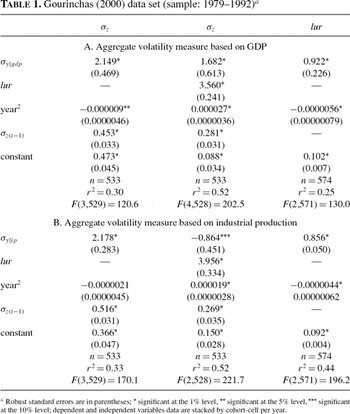
Gourinchas (2000) data set (sample: 1979–1992)a
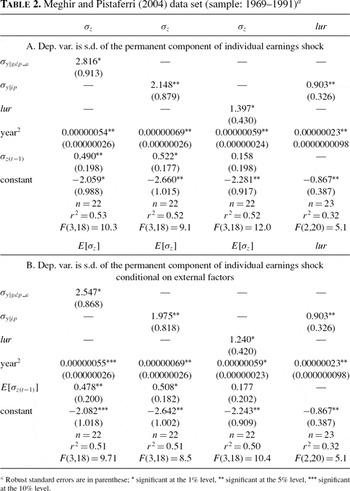
Meghir and Pistaferri (2004) data set (sample: 1969–1991)a
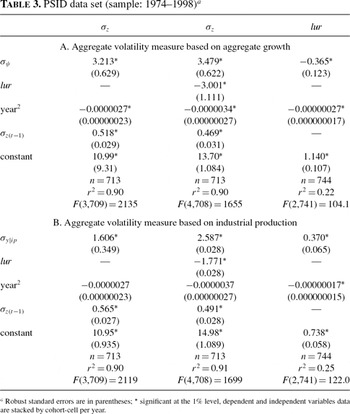
PSID data set (sample: 1974–1998)a
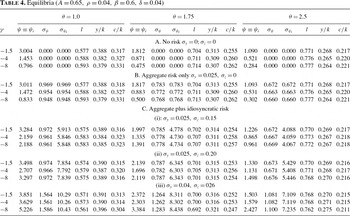
Equilibria (A=0.65, ρ=0.04, β=0.6, δ=0.04)
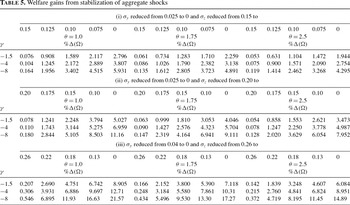
Welfare gains from stabilization of aggregate shocks
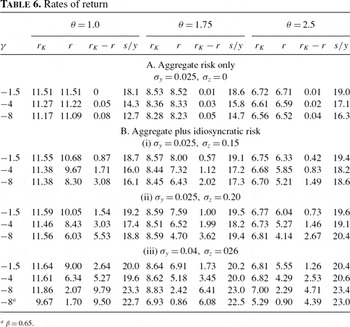
Rates of return
 You have
Access
- 7
- Cited by