Introduction
The worldwide incidence of obesity has doubled since 19801 and this epidemic has now spread to include women of reproductive age, with >50% of women entering pregnancy either overweight or obese.Reference Dodd, Grivell and Nguyen2, Reference Athukorala, Rumbold and Willson3 Whilst the causes of this rise in obesity prevalence are multifactorial, the ready availability of junk foods (JF) is an important contributing factor.Reference Swinburn, Sacks and Hall4 The term ‘junk food’ can be applied to a range of foods which are high in fat, sugar or salt, nutrient poor, as well as highly palatable.Reference Anderson and Patterson5 The consumption of these types of foods during pregnancy and lactation has been shown in animal models to have long-term consequences for the food preferences of the offspring. We and others have shown that the offspring of mothers fed a cafeteria diet (a well-established model of JF feeding in the rodent)Reference Sampey, Vanhoose and Winfield6 during the perinatal period have an increased preference for palatable foods as adults and also exhibit a greater susceptibility to diet-induced obesity when compared to the offspring of mothers fed a standard diet during the same time frame.Reference Ong and Muhlhausler7, Reference Bayol, Farrington and Stickland8
The detrimental effects of early life exposure to a cafeteria diet on the offspring have led to a search for interventions to ameliorate these effects.Reference Bayol, Farrington and Stickland8, Reference Gorski, Dunn-Meynell and Hartman9 There are currently limited studies which have attempted to separate the effects of prenatal and postnatal exposure to high-fat and high-sugar diets on the early life origins of food preferences. However, the results from these studies have provided evidence that nutritional exposures experienced in utero are likely to have distinct effects on the long-term outcomes in the offspring from those experienced during the early postnatal period. In one such study, providing dams who consumed a cafeteria diet during pregnancy with a standard chow diet during lactation blunted the increased preference for fat and sugar in their adult offspring.Reference Bayol, Farrington and Stickland8 It has also been demonstrated that providing dams with the cafeteria diet only during lactation also resulted in an increased preference for the palatable diet in the adult offspring.Reference Teegarden, Scott and Bale10, Reference Wright, Fone and Langley-Evans11 Exposure to a cafeteria diet during lactation has also been associated with increased perirenal fat mass in adult offspring,Reference Akyol, McMullen and Langley-Evans12 highlighting the importance of this period not only in establishing the regulation of food preferences but also in the programming of increased adiposity.
Despite evidence suggesting that the lactation period has a particularly important role in the programming of future metabolic outcomes, nutritional manipulations during pregnancy alone have also been demonstrated to result in offspring hyperphagia later in life.Reference Chang, Gaysinskaya and Karatayev13, Reference Chen, Simar and Morris14 There are currently no studies which have directly compared, within the same experiment, the long-term effects of exposure to a cafeteria diet exclusively during the prenatal or early postnatal period from those of exposure during the entire perinatal period. A cross-fostering paradigm, in which offspring are switched at birth from a dam consuming a cafeteria diet to a dam consuming a control diet, or vice versa, is the only way to adequately separate the effects of exposure to a cafeteria diet during lactation from the effects of exposure during pregnancy and avoid the carry-over effects on maternal physiology that may exist when a dam consuming a cafeteria diet during pregnancy is switched onto standard rodent feed after the birth of her pups.Reference White, Purpera and Morrison15 The ability to clearly delineate the long-term effects of JF exposure in either the pre- or postnatal period, and establishing to what extent prenatal exposures can be ameliorated by altering postnatal nutrition, will be critical for determining the optimal timing for intervention.
Therefore, the aim of the current study was to compare the effects of exposure to a cafeteria JF diet in utero or during the suckling period on food preferences and susceptibility to diet-induced obesity in the offspring. Specifically, we aimed to investigate the hypothesis that cross-fostering the offspring of mothers fed a cafeteria diet during pregnancy onto mothers fed a standard diet could prevent the establishment of an increased preference for JF and decrease the susceptibility to diet-induced obesity in the offspring.
Methods
Animals and feeding regime
Twenty-six female (200–250 g) and four male (200–300 g) Albino Wistar rats were used in this experiment. The animals were individually housed and allowed to acclimatise to the animal housing facility for at least 1 week before initiation of experimental procedure. During this time rats were fed ad libitum on standard laboratory rodent feed (Specialty Feeds, Glen Forrest, WA, Australia) with free access to water. After the acclimatisation period, the female rats were assigned to weight-matched groups, designated as either control (control, n = 14) or junk food (n = 12). Control rats were given free access to standard laboratory rodent feed while JF rats were fed a cafeteria diet comprising of peanut butter, hazelnut spread, chocolate biscuits, savory snacks, sweetened cereal, and a lard and chow mix. Detailed nutritional composition of this cafeteria diet has been published previously.Reference Ong and Muhlhausler7 Food intake was recorded every 2 days, by subtracting the amount that remained in the cage from the amount initially provided. All rats were individually housed under a 12-hour/12-hour light–dark cycle at a room temperature of 25°C throughout the experiment.
After 4–6 weeks on their respective diets, vaginal smears were conducted daily to determine the stage of the oestrous cycle. On the evening of diestrous/proestrous, two female rats were placed with a male rat for 24 hours. Vaginal smears were performed the following morning. The presence of sperm was used as confirmation of successful mating and designated as gestation day 0. Female rats were maintained on the same diet as before mating throughout pregnancy and lactation and were weighed once per week throughout the experimental period.
Cross-fostering
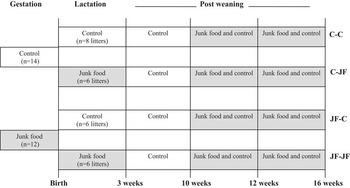
Pups were born at day 21 and 22 of gestation. Within 24 hours of birth, all litters were culled to eight pups, with four males and four females where possible. Pups were then cross-fostered to another dam which had given birth within the same 24-hour period from either the same or different dietary treatment group. This resulted in four groups of offspring: offspring from a control dam cross-fostered onto another control dam (C-C), offspring from a control dam cross-fostered onto a JF dam (C-JF), offspring from a JF dam cross-fostered onto control dam (JF-C) and offspring from a JF dam cross-fostered onto another JF dam (JF-JF).
Pups remained with their foster mothers until weaning [postnatal day (PND) 21]. After weaning, the pups were group housed with same-sex littermates and fed with standard laboratory rat feed until 10 weeks of age (Fig. 1). Pups were weighed every second day until weaning and once per week thereafter until the end of the experiment.
Experimental design. Offspring of control (n = 14 litters) and JF dams (n = 12 litters) were cross-fostered within 24 hours of birth to a dam receiving either the same or different diet as their natural mother. Offspring were kept with their foster mother until weaning (PND 21), and then placed on the control diet until 10 weeks of age. From 10 to 16 weeks of age offspring were given access to both the control and junk food diet for the determination of food preferences.

Determination of food preferences
After all offspring had been consuming the control diet for 6 weeks postweaning, up to two males and two females per litter were randomly selected to study food preferences and susceptibility to diet-induced obesity. These offspring were separated from the other offspring, housed with a same-sex litter mate and given free access to both the standard chow and cafeteria diet from 10 to 16 weeks (4 months) of age. Food intake was measured every 2 days by subtracting the amount left uneaten in the cage from the amount initially provided. The total intake of each food type was recorded and macronutrient preferences for each cage determined based on the nutritional composition of the foods consumed. The amount of food consumed was normalised to mean body weight. Food intake was divided by the number of offspring in the cage and normalised to the average of their weights.
Postmortem and tissue collection
At 12 and 16 weeks of age, one male and one female pup from each litter were killed for the determination of body fat mass. The rats were not fasted before postmortem and all postmortems were conducted in light phase between 8 and 10 a.m. All animals were weighed immediately before being killed with an overdose of CO2. Blood samples were collected by cardiac puncture, and blood was centrifuged at 3500 g, 4°C for 15 minutes and plasma stored at −20°C for subsequent analysis of hormone and metabolite concentrations. Individual fat depots including retroperitoneal fat, omental fat, gonadal fat, interscapular fat and subcutaneous fat were isolated and their respective weights recorded. All fat depots were snap frozen in liquid nitrogen and stored at −80°C for future molecular analyses.
Determination of hormone and metabolite concentrations
Plasma concentrations of glucose and nonesterified fatty acids (NEFA) were determined using the Infinity Glucose Hexokinase kit (Thermo Electron, Pittsburgh, PA, USA) and the Wako NEFA C kit (Wako Pure Chemical Industries Ltd, Osaka, Japan), respectively. Assays were conducted using Konelab 20 (Thermo Scientific, Vantaa, Finland). Plasma insulin and leptin concentrations were measured by immunoassay using the ALPCO Insulin (Rat) Ultrasensitive ELISA kit (ALPCO Diagnostics, Salem, NH, USA) and the Crystal Chem Rat Leptin ELISA kit (Crystal Chem Inc., Downers Grove, IL, USA). All assays were conducted according to manufacturer's instructions and intra- and inter-assay coefficients of variation were <10%.
Statistical analysis
Comparison of maternal food intake and birth outcomes in the control and JF groups was performed using Student's unpaired t-tests. The effect of maternal diet and sex on offspring food intake, body fat mass, plasma insulin, glucose, leptin and NEFA was analysed using three-way ANOVA, with sex, prenatal and postnatal maternal diet as factors. Where there were significant differences between males and females, the data by sex and analysed by two-way ANOVA (prenatal and postnatal maternal diet as factors). Three-way ANOVA and Student's unpaired t-tests were conducted using SPSS 18.0 software (SPSS Inc., Chicago, IL, USA). Offspring body weight gain over time was analyzed by two-way repeated measures ANOVA using Stata 11 software (StataCorp, College Station, TX, USA). The litter (mother) was used as the unit of analysis for all statistical tests. All data are presented as mean ± s.e.m. with a P value of <0.05 deemed statistically significant.
Results
Body weight and macronutrient intake of dams during pregnancy and lactation
JF dams were heavier than control dams at mating (control: 292.1 ± 7.6 g; JF: 343.4 ± 9.4 g; P < 0.01) and remained heavier until the end of lactation (control: 348.4 ± 6.7 g; JF: 397.3 ± 10.3 g; P < 0.01).
During pregnancy, JF dams consumed significantly more fat (control: 3.2 ± 0.2 g/kg/day; JF: 15.3 ± 0.7 g/kg/day; P < 0.01) than controls, but had lower intakes of protein (control: 13.5 ± 0.8 g/kg/day; JF: 6.6 ± 0.2 g/kg/day; P < 0.01) and carbohydrate (control: 41.4 ± 2.4 g/kg/day; JF: 29.6 ± 1.5 g/kg/day; P < 0.01). Average daily energy intake during pregnancy was not different between groups. During lactation, the higher fat intake (control: 6.8 ± 0.4 g/kg/day; JF: 26.4 ± 1.4 g/kg/day; P < 0.01), the reduced protein (control: 28.8 ± 1.6 g/kg/day; JF: 12.4 ± 0.6 g/kg/day; P < 0.01) and the reduced carbohydrate intake (control: 88.8 ± 4.8 g/kg/day; JF: 49.9 ± 1.8 g/kg/day; P < 0.01) observed in JF dams during pregnancy were maintained. In addition, JF dams also consumed significantly less total energy during the lactation period compared to control dams (control: 2643.8 ± 142.6 kJ/g/day; JF: 2001.6 ± 82.1 kJ/g/day; P < 0.01).
Effect of cross-fostering on birth outcomes and pup growth
Maternal diet had no effect on litter size (control: 13 ± 0.65; JF: 13 ± 0.68) or length of gestation (control: 22 ± 0.10 days; JF: 22 ± 0.00 days). JF litters had increased rates of pup death, with dead pups found in five out of 12 JF litters, but no pup deaths were observed in the control litters. All cross-fostered pups survived until weaning.
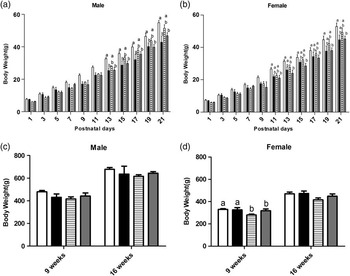
At birth offspring of JF dams were significantly lighter than offspring of control dams for both males (control: 7.7 ± 0.2 g; JF: 6.2 ± 0.1 g; P < 0.01) and females (control: 7.3 ± 0.2 g; JF: 6.0 ± 0.1 g; P < 0.01). However, there was no difference in body weights between groups from PND 1 to PND 9. From PND 9 until weaning (PND 21), male offspring suckled by JF dams (C-JF, JF-JF) were lighter than those suckled by control dams (C-C, JF-C), independent of maternal diet during pregnancy. In female offspring, a reduction in body weight was observed only in JF-JF offspring compared to controls (C-C) (Fig. 2).
Body weight of male (a, c) and female (b, d) offspring during the suckling period (a, b) and at 9 and 16 weeks of age (c, d) that was immediately before and at the conclusion of the determination of food preferences. Control dams fostered onto control dams (C-C, open bars), offspring of control dams fostered onto JF dams (C-JF, closed bars), offspring of JF dams fostered onto control dams (JF-C, striped bars) and offspring of JF dams fostered onto JF dams (JF-JF, grey bars), n = 5–6/group. Results presented as mean ± s.e.m. Different letters above bars denotes means that are significantly different P < 0.05. Males and females analysed separately.

Offspring growth and food intake during the postweaning period
In males, there was an interaction between prenatal and postnatal dietary exposure on body weight at 10 weeks of age, such that exposure to JF diet during lactation decreased the body weight of offspring born to control dams but not those born to JF dams. In females, offspring born to JF dams were significantly lighter at 10 weeks compared to those born to control dams, independent of dietary exposure during the suckling period.
There was no difference in the intake of the standard rodent feed between groups of offspring from weaning to 10 weeks of age in either males (C-C: 1876.7 ± 62.7 kJ/kg/day; C-JF: 2243.1 ± 34.8 kJ/kg/day; JF-C: 1863.8 ± 65.5 kJ/kg/day; JF-JF: 1968.6 ± 50.8 kJ/kg/day) or females (C-C: 1950.8 ± 68.4 kJ/kg/day; C-JF: 2170.9 ± 58.2 kJ/kg/day; JF-C: 2157.9 ± 88.2 kJ/kg/day; JF-JF: 2058.843.7 ± kJ/kg/day).
Effect of prenatal and postnatal maternal diet on offspring body composition at 12 and 16 weeks of age
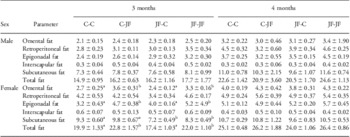
At 12 weeks of age, after 3 weeks on the cafeteria diet, there were no longer any differences in body weight between groups in the male offspring (C-C: 570.9 ± 11.6 g; C-JF: 530.3 ± 37.3 g; JF-C: 512.8 ± 16.5 g; JF-JF: 539.5 ± 21.3 g). In females, however, offspring exposed to the cafeteria diet before birth remained lighter than those born to control dams, independent of dietary exposure during the suckling period (C-C: 405.4 ± 6.8 g; C-JF: 401.2 ± 15.9 g; JF-C: 354.5 ± 8.7 g; JF-JF: 388.4 ± 17.7 g; P < 0.05). However, those female offspring who had been exposed to the cafeteria diet during the suckling period had significantly higher omental, epigonadal and total body fat mass as percentage of body weight after 3 weeks of access to the cafeteria diet, independent of dietary exposure before birth (Table 1). There were no differences between groups in body fat mass after 3 weeks on the cafeteria diet in the male offspring (Table 1).
Fat depots as percentage of body weight in male and female offspring at 3 and 4 months of age

Values expressed as mean ± s.e.m., n = 5–6/group at 3 months, n = 3–6/group at 4 months.
a,bDifferent superscript letters denote values that are significantly different within each time point and sex, P < 0.05.
At 16 weeks of age, after all offspring had been exposed to the cafeteria diet for 7 weeks, there was no difference in body weight between groups in either male or female offspring (Fig. 2). There were also no differences between groups in total body fat mass or the relative weight of any individual fat depot in either males or females (Table 1).
Effect of prenatal and postnatal maternal diet on offspring food preferences from 10 to 12 weeks of age
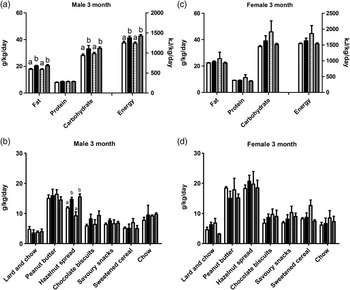
During the first 3 weeks of access to the cafeteria diet, male offspring that were suckled by JF dams had a higher intake of fat, carbohydrate and energy independent of whether they were exposed to the control or JF diet before birth (Fig. 3a). There was no effect of maternal diet during pregnancy and/or lactation on the intake of fat, protein, carbohydrate or total energy in the female offspring (Fig. 3b).
Intake of total energy (a, c) and fat, protein, carbohydrate (b, d) in male (a, b) and female (c, d) offspring during postnatal weeks 10–12. Offspring of control dams fostered onto control dams (C-C, open bars), offspring of control dams fostered onto JF dams (C-JF, closed bars), offspring of JF dams fostered on to control dams (JF-C, striped bars) and offspring of JF dams fostered onto JF dams (JF-JF, grey bars). Results presented as mean ± s.e.m.n = 5–6/group different letters above bars denotes means that are significantly different within each sex, P < 0.05.

Analysis of the intake of specific components of the cafeteria diet showed that in males, intake of hazelnut spread was significantly higher in offspring suckled by JF dams compared to those suckled by control dams, in line with the results observed for macronutrient intake (Fig. 3c). Again, this effect was independent of whether they were born to a control or JF dam. There was no effect of nutritional exposure either before birth or during the suckling period on intake of other cafeteria diet components or standard rodent feed in either males or females (Fig. 3c and 3d).
Effect of prenatal and postnatal maternal diet on offspring food preferences from 13 to 16 weeks of age
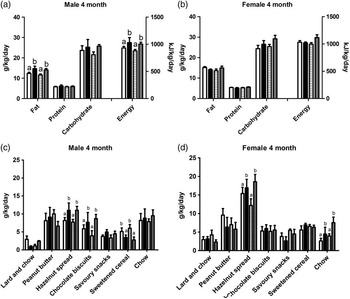
In the final 4 weeks of access to the cafeteria diet, male offspring suckled by JF dams continued to consume significantly more fat and total energy than those suckled by control mothers, independent of nutritional exposure before birth (Fig. 4a). There was no effect of maternal diet on protein or carbohydrate intake in the male offspring during this 4-week period. There was no difference in macronutrient intake during this period between groups in female offspring (Fig. 4b).
Intake of fat, protein, carbohydrate and total energy (a, b) and individual components of the cafeteria diet (c, d) in male (a, c) and female (b, d) offspring during postnatal weeks 13–16. Offspring of control dams fostered onto control dams (C-C, open bars), offspring of control dams fostered onto JF dams (C-JF, closed bars), offspring of JF dams fostered on to control dams (JF-C, striped bars) and offspring of JF dams fostered onto JF dams (JF-JF, grey bars). n = 3–6/group. Results presented as mean ± s.e.m. Different letters above bars denotes means that are significantly different within each sex, P < 0.05.

Examination of the intake of specific foods, showed that male offspring suckled by JF dams consumed more peanut butter and hazelnut spread but less sweetened cereal than those offspring suckled by control dams, independent of nutritional exposure before birth (Fig. 4c). In females, offspring exposed to the cafeteria diet during the suckling period exhibited an increased intake of the standard rodent feed and hazelnut spread compared to the offspring suckled by control dams (Fig. 4d). There was no effect of maternal diet during either pregnancy or lactation on intake of any other components of the cafeteria diet in either males or females or the intake of standard rodent feed in male offspring.
Effect of prenatal and postnatal maternal diet on blood hormones, glucose and NEFA at 12 and 16 weeks of age
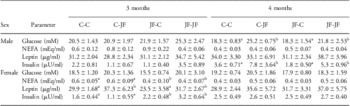
At 12 weeks of age, females exposed to the cafeteria diet during the suckling period had increased plasma leptin concentrations (Table 2), consistent with the increased fat mass observed in these offspring. Those females who were exposed to the JF diet before birth, however, exhibited higher plasma insulin concentrations and reduced plasma NEFA concentrations at 12 weeks of age, independent of the dietary exposure during the suckling period (Table 2). There was no effect of cafeteria diet exposure either before birth or during the suckling period on plasma concentrations of glucose, NEFA, leptin or insulin in male offspring.
Plasma concentrations of glucose, NEFA, leptin and insulin in male and female offspring at 3 and 4 months of age

Values expressed as mean ± s.e.m., n = 5–6/group at 3 months, n = 3–6/group at 4 months.
a,bDifferent superscript letters denote values that are significantly different within each time point and sex, P < 0.05.
At 16 weeks of age, male offspring suckled by JF dams (C-JF, JF-JF) had increased plasma glucose and insulin concentrations compared to those suckled by control dams, independent of dietary exposure before birth. There was no effect of exposure to the cafeteria diet either before birth and/or during the lactation period on plasma concentrations of glucose and insulin in females and leptin or NEFA in either male or female offspring at 4 months of age (Table 2).
Discussion
The findings of this study have demonstrated that there are differing effects of exposure to a high-fat, high-sugar cafeteria diet during the prenatal and early postnatal period on subsequent regulation of palatable food intake, body weight and body fat mass in the adult offspring, and that these effects are sex specific. Exposure to the cafeteria diet during the suckling period, independent of dietary exposure before birth, was associated with an increased propensity to develop diet-induced obesity in females and an increased preference for palatable foods in male offspring in young adulthood. Importantly, these effects of exposure to a cafeteria diet before birth were ameliorated by cross-fostering offspring to a dam consuming a nutritionally balanced diet. This study is the first to use a cross-fostering approach to isolate the effect of prenatal and early postnatal exposure to a cafeteria diet on the food preferences of the offspring, and adds to the growing body of evidence that there is potential to reverse at least some of the negative effects of inappropriate prenatal nutrition by interventions in the early postnatal period.
Early life exposure to a JF diet inhibits pup growth preweaning
Consistent with previous studies,Reference Ong and Muhlhausler7, Reference Bayol, Farrington and Stickland8 we found that both male and female offspring of JF dams were lighter at birth than offspring of control dams. This may be attributed to the reduced protein intake or micronutrient deficiencies in the cafeteria diet compared to the standard chow diet.Reference Gugusheff, Ong and Muhlhausler16 JF offspring cross-fostered onto control dams were no longer lighter than offspring of control dams during the early suckling period, this could suggest that growth deficits in these offspring were overcome by providing access to milk from dams consuming a nutritionally balanced diet. These data suggest that the effect of the maternal diet on milk composition and/or supply plays a central role in the early programming of food preferences, and it will be important in future studies to undertake measurements of milk composition to better explore this. It is also important to note that offspring weights during the suckling period were not recorded separately for individual pups in the current study, and it will be useful to undertake individual assessments in future studies to determine to what extent the growth profiles vary between littermates.
Clear sex differences in the growth profile of the offspring emerged after the first 9 days of postnatal life. In males, offspring suckled by JF dams were lighter at weaning than those suckled by control dams, independent of maternal diet before birth. In females, however, weight at weaning was only significantly reduced in offspring exposed to the cafeteria diet during both the prenatal and suckling periods, suggesting that an improved nutritional environment during the suckling period was not sufficient to overcome the growth deficits induced by maternal JF intake during pregnancy.
Interestingly, and in contrast to males, female offspring born to JF dams were lighter than those born to control dams after consuming the standard rat chow for 6 weeks after weaning and remained lighter even after 3 weeks of access to the cafeteria diet. It therefore appears that, in females, growth deficits programmed by exposure to a cafeteria diet, which are potentially lacking in protein and key micronutrients, before birth cannot be readily overcome by postnatal nutritional interventions. This result is consistent with the low protein model in which maternal consumption of a low protein diet during pregnancy alone has been demonstrated to impact the growth of female but not male offspring.Reference Zambrano, Bautista and Deas17, Reference Bellinger, Lilley and Langley-Evans18
Maternal JF consumption during lactation increases susceptibility to diet-induced obesity in female offspring
In contrast to overall growth, exposure to a maternal JF diet during the suckling period appeared to play the dominant role in the programming of adipose tissue in female offspring. After 3 weeks of free access to the cafeteria diet, female offspring suckled by JF dams had increased fat mass compared to those offspring suckled by control dams, independent of the diet their mother had consumed during pregnancy. Importantly, this occurred in the absence of a higher food intake, suggesting that these animals had an increased propensity to accumulate body fat. This increased susceptibility to diet-induced obesity was not observed in offspring of JF dams cross-fostered onto a control dam, suggesting that the susceptibility to diet-induced obesity in female offspring exposed to a high-fat, high-sugar diet before birth can be prevented by nutritional interventions in the early postnatal period. Interestingly, there was no longer any difference between groups after the offspring had been exposed to the JF diet for the full 10 weeks. This suggests that whilst being exposed to an ‘optimal’ nutritional environment in the perinatal period may render an individual less susceptible to diet-induced weight gain and fat deposition, this advantage is negated by persistent overconsumption of a high calorie diet in postnatal life.Reference Shankar, Harrell and Liu19, Reference Mitra, Alvers and Crump20
Maternal JF consumption during lactation alters the food preferences of male offspring
In males, offspring suckled by JF dams had a greater intake of fat, carbohydrate and total energy compared to offspring suckled by control dams when all offspring were provided with the cafeteria diet in adulthood, independent of whether they were born to a control or JF dam. Importantly, there were no differences between groups in the intake of standard rodent feed during this time, indicating that the increased energy intake was the consequence of increased consumption of the cafeteria diet (i.e. an increased preference for this palatable diet). We chose to measure food preferences in the animal's home cage, rather than a metabolic chamber in this study, due to the potential impact of the stress associated with moving the animal to an unfamiliar environment on habitual food intake. However, it will clearly be important in future studies to confirm our findings by conducting more intensive monitoring of metabolic balance in the offspring.
Maternal consumption of a palatable diet throughout both pregnancy and lactation has been shown to induce hyperphagia in the adult offspringReference Nivoit, Morens and Van Assche21 and increase offspring preference for a cafeteria diet.Reference Ong and Muhlhausler7, Reference Bayol, Farrington and Stickland8 This is the first study; however, to demonstrate that exposure to a maternal JF diet during the suckling period alone is associated with increases in the preference for a palatable diet equivalent to exposure during the entire perinatal period. The results of the present study are in agreement with the work of Gorski et al. who also used a cross-fostering approach, and showed that exposure to a high-fat diet during lactation increased offspring consumption of the same high-fat diet in adulthood.Reference Gorski, Dunn-Meynell and Hartman9 However, unlike the present study, Gorski and colleagues only provided the offspring with access to a high-fat diet, and therefore were not able to determine food preferences.
There was no significant effect of exposure to a cafeteria diet either before birth or during the suckling period on macronutrient intake in adulthood in female offspring in the present study. This is somewhat different to the results of our previous study, in which both male and female offspring of dams fed on the same cafeteria diet as in the present study exhibited an increased preference for fat intake from weaning until adulthood.Reference Ong and Muhlhausler7 However, unlike our previous study, the offspring in the current experiment were provided with a standard rodent chow for 3 weeks after weaning, which may have influenced the development of their food preferences. One possibility to explain the sex differences in the programming of food preferences is that the timing of development of two key systems known to play a central role in the regulation of palatable food intake, i.e., the central appetite-regulating and reward pathways,Reference Ong and Muhlhausler7, Reference Gorski, Dunn-Meynell and Hartman9, Reference Chang, Gaysinskaya and Karatayev13, Reference Vucetic, Kimmel and Totoki22, Reference Chen, Simar and Lambert23 is different in male and female offspring.Reference Simerly24 The findings of our study suggest that the suckling period is the critical period for the development of the reward system in males, but not in females. To the best of our knowledge there are no studies which have directly compared the development of the reward pathway in male and female offspring and this is clearly an important area for future research.
Early life exposure to a JF diet alters plasma insulin concentrations in adult offspring in a sex-specific manner
The effect of maternal cafeteria diet consumption on insulin concentrations in the adult offspring was dependent on both the sex of the offspring and the period of dietary exposure. In females, offspring born to JF dams had higher plasma insulin concentrations, in the absence of higher plasma glucose, after 3 weeks on a cafeteria diet compared to those born to control dams, independent of dietary exposure during the suckling period. The presence of higher insulin concentrations at any given concentration of glucose provides evidence of reduced insulin sensitivity; although this will need to be confirmed by direct assessment of insulin sensitivity in future studies. In males, on the other hand, higher glucose and insulin concentrations were only observed after 7 weeks of exposure to the cafeteria diet in offspring suckled by JF dams, independent of dietary exposure before birth, consistent with previous studies.Reference Samuelsson, Matthews and Argenton25, Reference Srinivasan, Katewa and Palaniyappan26 These results imply that the impact of cafeteria diet exposure during development on glucose–insulin metabolism is sex specific. Shelley and colleagues reported that changes to the insulin signalling pathway in skeletal muscle in 3-month old offspring of dams fed a cafeteria diet during pregnancy and lactation, was indeed different in males and females, with male offspring exhibiting increased expression of Akt2 and reduced Akt activity, and female offspring having reduced expression of IRS-1 and P13K.Reference Shelley, Martin-Gronert and Rowlerson27 It appears that in females, but not in males, the effects of exposure to a cafeteria diet before birth on the development of glucose homeostatic pathways cannot be reversed by nutritional interventions applied in the early postnatal period.
Summary and speculation
The present study is the first to show that exposure to a cafeteria diet exclusively during the suckling period is able to programme an increased preference for fat and an increased susceptibility to diet-induced obesity in the offspring to the same extent as exposure throughout the entire perinatal period. Importantly, these data suggest that the effects of exposure to a high-fat/high-sugar diet before birth on food preferences and susceptibility to diet-induced obesity later in life, can be prevented by providing access to a nutritionally balanced diet during the suckling period. Interestingly, the relative contribution of the nutritional environment during the prenatal and suckling periods were different in males and females, suggesting that the timing of nutritional interventions aimed at ‘reprogramming’ the offspring may need to be sex specific. We speculate that these sex differences may be a consequence of differences between sexes in the timing of development of key metabolic systems, and this will be important to further investigate in future studies.
It is important to exercise caution when extrapolating these results to the clinical context, since many of the developmental events which occur during the suckling period in rodents are already complete before birth in the human. Nevertheless, the data from this study provide evidence that there are critical windows of development during which exposure to a JF diet is most detrimental to long-term outcomes, and suggests that there may be an opportunity to prevent at least some of the adverse consequences of prenatal JF exposure by interventions applied during the lactation period. Gaining a better understanding of the sex-specific effect maternal diet has on the long-term metabolic outcomes of the offspring will be crucial if targeted and effective interventions to reduce the incidence of overweight and obesity are to be designed.
Acknowledgements
The authors acknowledge the expert assistance of Pamela Sim with animal protocols and would also like to thank John Carragher for editorial assistance.
Ethical Standards
This study was approved by the Adelaide University Animal Ethics Committee.
Financial Support
B.S.M. is supported by a Career Development Award from the National Health and Medical Research Council of Australia. J.R.G. and M.V. are supported by Australian Postgraduate Awards. Z.Y.O. is supported by a President's Scholarship from the University of South Australia. J.R.G., M.V. and Z.Y.O., are the recipients of top-up scholarships from Healthy Development Adelaide.
Conflicts of Interest
None.