INTRODUCTION
Pottery is one of the most important remains recovered from archaeological sites (Bonsall et al. Reference Bonsall, Cook, Manson and Sanderson2002; Tite Reference Tite2008; Nunes Reference Nunes, Toyota, Oliveira, Neves, Soares and Munita2013). Not only is it a record of human occupation but also its patterns, colors, and shapes can be related to specific uses and cultures (Bonsall et al. Reference Bonsall, Cook, Manson and Sanderson2002; Macario et al. Reference Macario, Buarque, Scheel-Ybert, Anjos, Gomes, Beauclair and Hatté2009). Many consider pottery the ideal artifact for its flexibility and capacity of expressing life stories (Skibo Reference Skibo2013). As a class of archaeological remains, ceramics tend to be better preserved than most other prehistorical vestiges (Hoopes and Barnett Reference Hoopes and Barnett1995), particularly in tropical areas. Despite the presence of ceramic remains, bones and charcoal are routinely used for radiocarbon dating of sites in temperate regions (Higham et al. Reference Higham, Jacobi and Bronk Ramsey2006; Boaretto et al. Reference Boaretto, Wu, Yuan, Bar-Yosef, Chu, Pan, Liu, Cohen, Jiao, Li, Gu, Goldberg and Weiner2009). However, in tropical regions, including many Brazilian sites, these materials are generally not suitable for 14C dating. At these sites, the soil can be very acidic, causing bones to be easily degraded and collagen is often not preserved (Zazzo et al. Reference Zazzo, Saliège, Person and Boucher2009; Talamo and Richards Reference Talamo and Richards2011; Sealy et al. Reference Sealy, Johnson, Richards and Nehlich2014). Charcoal is not always abundant in such contexts. It is either found in hearths that could have been recycled over many years or dispersed within the archaeological site (Théry-Parisot et al. Reference Théry-Parisot, Chabal and Chrzavzez2010). Moreover, despite being the most frequent source of chronological information (Scheel-Ybert et al. Reference Scheel-Ybert, Gouveia, Pessenda, Aravena, Coutinho and Boulet2003), charcoal samples may be influenced by the old-wood effect (McFadgen Reference McFadgen1982). Therefore, in contexts with a poor selection of dating materials, pottery can provide important chronological information (Cezar et al. Reference Cezar, da Rocha, Buarque and da Costa2001; Macario et al. Reference Macario, Buarque, Scheel-Ybert, Anjos, Gomes, Beauclair and Hatté2009).
Pottery is comprised of a very complex mixture of many compounds of a potentially wide variety of ages (Hedges et al. Reference Hedges, Tiemei and Housley1992). The base of this mixture is clay, which is usually collected from the ground in surrounding regions, possibly leading to 14C ages older than the settlement occupation (Hedges et al. Reference Hedges, Tiemei and Housley1992; Nakamura et al. Reference Nakamura, Yasuhiro, Sei’ichiro and Hirotaka2001). The use of pottery is mainly related to food processing (Hedges et al. Reference Hedges, Tiemei and Housley1992; Nakamura et al. Reference Nakamura, Yasuhiro, Sei’ichiro and Hirotaka2001; Scheel-Ybert et al. Reference Scheel-Ybert, Macario, Buarque, Anjos and Beauclair2008; Buarque Reference Buarque2009) or burials (Hedges et al. Reference Hedges, Tiemei and Housley1992; Scheel-Ybert et al. Reference Scheel-Ybert, Macario, Buarque, Anjos and Beauclair2008, Reference Scheel-Ybert, Beauclair and Buarque2013; Beauclair et al. Reference Beauclair, Scheel-Ybert, Bianchini and Buarque2009; Buarque Reference Buarque2009), and sometimes food or charcoal residues adhered to the sherd can be used for dating. For this reason, it is crucial to understand which chemical fraction of the material will provide dates contemporaneous with the occupation. For the sake of accuracy, sample preparation protocols for 14C dating of pottery should take into account the different chemical fractions and associated residual materials when these are available.
Several researchers have studied different protocols for 14C dating of pottery. Batten et al. (Reference Batten, Gillespie, Gowlett and Hedges1986) analyzed humic and acid-base-acid (ABA) residual carbon fractions of several materials (sherds, charcoal, seeds, wood, and burnt bones) from the same archaeological context and verified that the humic fraction was consistent with charcoal dates. Roosevelt et al. (Reference Roosevelt, Housley, Da Silveira, Maranca and Johnson1991) analyzed pottery using thermoluminescence (TL) and 14C dating and the dates from radiometric analysis were consistent with the accelerator mass spectrometry (AMS) 14C dating. Their samples were chemically treated following a protocol for extracting the humic fraction. Pottery was crushed, ultrasonicated in aqueous HCl, and the lipids were removed before the humic acids were extracted into aqueous NaOH. Carbon was obtained after inorganic matter removal by hydrofluoric (HF) and hydrochloric (HCl) acids. Hedges et al. (Reference Hedges, Tiemei and Housley1992) described the pottery fractions that can be isolated for dating: coating, temper, lipid, humic, residue, and HF digest. Studying ceramics from several provenances, they have observed that different sources of carbon would result in a wide range of 14C dates and that it is not always possible to isolate the desired fraction. Stäuble (Reference Stäuble1995) showed that the ages of organic temper in potsherds from the earliest Linearbandkeramik (LBK) culture in Europe were significantly older than expected. According to the author, this result could be due to the combustion of organic matter initially associated with the clay. On the other hand, 14C determinations of residues of organic foods were consistent with the expected ages.
O’Malley et al. (Reference O’Malley, Kuzmin, Burr, Donahue and Jull1999) presented a stepwise heating technique to extract only the temper carbon fraction from the inner and outer parts of potsherds. According to the authors, ages obtained from the former are in general older than those from the latter. Nakamura et al. (Reference Nakamura, Yasuhiro, Sei’ichiro and Hirotaka2001) used carbonaceous remains on the surface of potsherds for 14C dating and the samples were chemically treated using ABA with HCl (1.2M) and dilute NaOH (0.2M) to minimize the loss of carbon. The obtained ages were consistent with stratigraphy. Stott et al. (Reference Stott, Berstan, Evershed, Hedges, Bronk Ramsey and Humm2001) presented a method for dating specific compounds, presumed to be related to cooking, isolated from the lipids preserved in cooking pots. Powdered potsherd samples were extracted by Soxhlet with 2:1 v/v dichloromethane/methanol to produce a total lipid extract (TLE). Most of the TLE was hydrolyzed (methanolic NaOH), acidified, extracted, and derivatized in 2% v/v H2SO4/MeOH, to fatty acid methyl esters (FAMES) before extraction into hexane. The most abundant lipids found in potsherds, the C18 and C16 fatty acids (octadecanoic or stearic acid and hexadecanoic or palmitic acid) and the C18:1 unsaturated acid ((9E)-octadec-9-enoic or oleic acid) were separated by gas chromatography. Dates of each fraction were variable but replicates did not present such variability, showing that discrepancies were more likely due to sample context rather than to methodological issues.
In this work, we compare, for the first time, different protocols for 14C dating ceramic samples from Brazilian archaeological sites. As a preliminary work, we have evaluated ABA residues as opposed to humic fractions extracted from bulk samples of fragments of bowls or funerary urns that belong to Brazilian archaeological sites related to Tupi populations. The term Tupi refers to a linguistic stock comprising several languages that spread throughout eastern South America. In Brazil, the two groups most commonly referenced in literature since the arrival of Europeans are the Tupinambá populations, in the northeastern/southeastern regions and the Guarani, in the southern region (Noelli Reference Noelli2008). Detailed information about these populations, including their habits and beliefs, can be found in both written and iconographic records left by European chroniclers from the 16th century AD (Staden Reference Staden1978; Cezar et al. Reference Cezar, da Rocha, Buarque and da Costa2001; Macario et al. Reference Macario, Buarque, Scheel-Ybert, Anjos, Gomes, Beauclair and Hatté2009). Notably, the descriptions of ceramics and funerary structures contained in these documents show great similarity with the material culture recovered from archaeological sites. Moreover, the location of precolonial sites and characteristics of their daily activities allow these archaeological settlements to be related to the ancestors of those tribes described by the colonialists. Nevertheless, Jones (Reference Jones1997) argues that the association of archaeological cultures and ethnic groups persists as a tricky task in archaeology. This issue, along with the great temporal discrepancy between sites, led us to avoid assuming direct connections between our samples and information about the historical groups. This is also the reason why researchers usually employ the term Tupi-Guarani to refer to historically known groups, whereas Tupiguarani is reserved to those known only from archaeological records (Prous Reference Prous1992; Scheel-Ybert et al. Reference Scheel-Ybert, Macario, Buarque, Anjos and Beauclair2008).
AREA OF STUDY
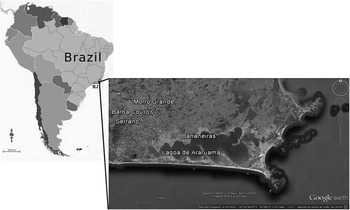
In this work, samples from four archaeological sites were analyzed, all of them situated around the city of Araruama (22°52′22″S, 42°20′35″W), in the so-called Lakes Region in the northern part of Rio de Janeiro State, as shown in Figure 1.
Map of South America showing the Brazilian territory and the study region on the southeastern coast

Because of the proximity to the Araruama lagoon, one of the largest hypersaline lagoons in the world (40 km in length, with a maximum width of 13 km and area of 120 km2) in a fruitful rainforest area, this region was occupied by several native groups (Macario et al. Reference Macario, Buarque, Scheel-Ybert, Anjos, Gomes, Beauclair and Hatté2009). Among the Tupiguarani settlements in Araruama are the Serrano, Barba Couto, Morro Grande, and Bananeiras archaeological sites.
Morro Grande is the earliest known Tupiguarani occupation. A sample of disperse charcoal from this site has been previously dated to 1740±90 BP (Beta-84333 in Buarque Reference Buarque1999), resulting in a calibrated age of 1820–1390 cal BP (95.4%). This date was considered very early, but is in accordance with other Tupiguarani occupations in Rio de Janeiro, as the date of 1650±160 BP for the ceramic layer of Zé Espinho shellmound, in Guaratiba (Crancio Reference Crancio1987) and São Paulo, and as the charcoal from domestic hearths, found inside an urn from the site SP BA7, situated in Itaporanga, dated as 1870±100 BP (Brochado Reference Brochado1973). More recently, Macario et al. (Reference Macario, Buarque, Scheel-Ybert, Anjos, Gomes, Beauclair and Hatté2009) have reported new dates for three charcoal samples from the Morro Grande site. A sample (Plid-0686B) from a funerary structure was dated to 510±160 BP or 750–0 cal BP (95.4%). Sample Gif-11045, dating to 2920±70 BP or 3220–2840 cal BP (95.4%), belonged to a specialized hearth, probably used for cooking ceramics (Scheel-Ybert et al. Reference Scheel-Ybert, Macario, Buarque, Anjos and Beauclair2008). From the same period, sample Plid-0688B, dated as 2600±160 BP or 3000–2150 cal BP (95.4%), was part of a funerary hearth at the same archaeological locus (Macario et al. Reference Macario, Buarque, Scheel-Ybert, Anjos, Gomes, Beauclair and Hatté2009).
The Serrano site is estimated to date around cal AD 1600 since it shows evidence of contact with the Europeans, reflected in the shape of the ceramics and the presence of associated materials such as metal objects, glass, and beads (Buarque Reference Buarque2010). There is no previous dating for this site as there was no charcoal available and the bones lacked enough collagen for 14C dating (Gaspar et al. Reference Gaspar, Tenorio, Buarque, Barbosa-Guimarães, Oliveira and Scheel-Ybert2004). The sample used in this work belongs to a funerary urn.
The Barba Couto site has not been previously dated either. It has two separated areas, one with no evidence of contact and another one, where several European beads were found in association with a burial. This suggests the possibility of reoccupation of the site after several years. The ceramic fragments found did not belong to a specific funerary structure and it is not known whether they had been used for cooking.
The Bananeiras site is characterized by increased amounts of calcium in the soil, which made it possible to date a human bone from a funerary urn. This single dating resulted in 430±40 BP (Beta-171160 in Buarque et al. Reference Buarque, Rodrigues-Carvalho and Silva2003). The potsherds found belong to a funerary structure composed by one decorated urn with lid and two associated bowls. Inside the urn, there was a small feminine skeleton with estimated age between 20 and 25 yr old and two pendants made of gastropod shell (Buarque et al. Reference Buarque, Rodrigues-Carvalho and Silva2003).
METHODS
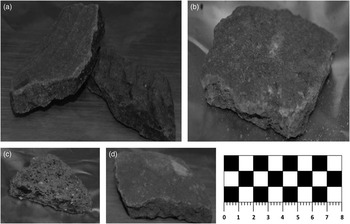
Two fragments of approximately 5 to 10 cm (Figure 2) were analyzed from each site: one fragment from each site was analyzed at LAC-UFF and the other at ORAU. For the present study, 20 g of each ceramic fragment was sampled in two lots, with 20 g for each pretreatment. From each sample, ABA residue and humic acid fractions were isolated. These two different fractions were extracted from the same fragment but from different aliquots.
Pictures of the analysed samples: (a) Bananeiras; (b) Barba Couto; (c) Serrano, and (d) Morro Grande. Note the corrugated pattern on the Bananeiras sample.

The standard ABA protocol for organic samples was applied at the Radiocarbon Laboratory of the Fluminense Federal University (LAC‐UFF) in Brazil. Chemical treatments with HCl (1.0M, 1 hr), NaOH (0.5M, 30 min), and HCl (1.0M, 1 hr) were carried out at 80°C and the samples were rinsed with ultrapure water between each step. The sample mass after chemical treatment varied between 90 and 95% of the initial mass.
The ABA residue fraction was combusted in individually sealed quartz tubes at 900°C. Graphitization was performed in PyrexTM tubes with zinc and titanium hydride at 550°C (Macario et al. Reference Macario, Oliveira, Carvalho, Santos, Xu, Chanca, Alves, Jou, Oliveira, Pereira and Moreira2015, Reference Macario, Oliveira, Moreira, Alves, Carvalho, Jou, Oliveira, Pereira, Hammerschlag, Netto, Seixas, Malafaia, Moreira, Cunha, Assumpção, Paula, Lima, Lopes, Diaz, Chanca and Gomes2016).
At the Oxford Radiocarbon Accelerator Unit (ORAU), the humic fraction was isolated from the solvent‐insoluble residue. After removal of carbonates by means of HCl (1.0M, 1 hr, 80°C), the humic fraction was recovered from the aqueous NaOH (0.5M, 30 min, 80°C) solution by precipitation using dropwise addition of concentrated HCl. The recovered fraction ranged from 0.5 to 1.0% of the initial sample mass and approximately 10 mg were placed in tins for combustion in the IRMS line consisting of a combustion elemental analyzer (Carlo-Erba NA 2000) coupled in the isotope ratio mass spectrometer (Sercon 20/20) (Brock et al. Reference Brock, Higham, Ditchfield and Bronk Ramsey2010). Graphitization took place in a double-fold tube filled with hydrogen gas where the side of the tube containing iron is heated to 560°C for 6 hr (Dee and Bronk Ramsey Reference Dee and Bronk Ramsey2000; Brock et al. Reference Brock, Higham, Ditchfield and Bronk Ramsey2010).
At ORAU, the samples were measured in a High Voltage 2MV accelerator (Bronk Ramsey et al. Reference Bronk Ramsey, Higham and Leach2004) and at LAC‐UFF the samples were measured in a single-stage NEC 250kV AMS system (Linares et al. Reference Linares, Macario, Santos, Carvalho, dos Santos, Gomes, Castro, Oliveira and Alves2015). The measurements were corrected for isotopic fractionation using stable isotope ratios measured simultaneously in the accelerator. Calibration was performed using the OxCal software v 4.2.4 (Bronk Ramsey Reference Bronk Ramsey2009, Reference Bronk Ramsey2013) with the Southern Hemisphere atmospheric curve SHCal13 (Hogg et al. Reference Hogg, Hua, Blackwell, Niu, Buck, Guilderson, Heaton, Palmer, Reimer, Reimer, Turney and Zimmerman2013).
RESULTS AND DISCUSSION
For the Bananeiras and Barba Couto sites, the resulting ABA-treated sample did not yield enough carbon to allow measurement. The results obtained for the other samples are presented in Table 1.
Radiocarbon ages of ceramics dated in LAC-UFF and ORAU. Dates from LAC-UFF were obtained on residue after an ABA pretreatment. Dates from ORAU were determined on the humic fraction. IRMS δ13C (‰) was analyzed at ORAU.

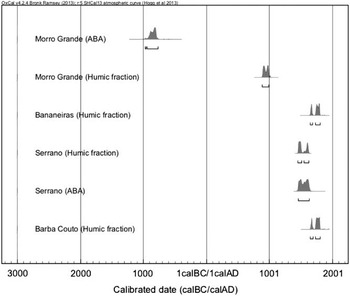
Regarding the humic fraction samples, the results are in agreement with the expected periods of occupation for each site. Figure 3 shows the probability distributions of the calibrated dates for the six results obtained.
Calibrated results for 14C dating of ABA residue/humic fraction from ceramics sample of the Morro Grande, Bananeiras, Serrano, and Barba Couto archaeological sites. Probability distributions as well as 95.4% probability intervals are displayed.

For Bananeiras and Barba Couto, the calibrated results are cal AD 1648–1803 (95.4%) and cal AD 1650–1805 (95.4%), respectively. This is consistent with historical reports of the extinction of this culture after battles with the Portuguese, culminating in the massacre or expulsion of the Tupiguarani populations from the Araruama region (Monteiro Reference Monteiro1949; Salvador Reference Salvador1982).
For the Serrano site, both ABA residue and humic fraction results [cal AD 1451–1624 (95.4%) and cal AD 1455–1631 (95.4%), respectively] are contemporary with the arrival and settlement of the Europeans in Brazil and are identical to each other. Meanwhile, the samples from the older Morro Grande site showed a difference of more than 1500 yr between the ABA and humic fractions. According to the work of Hedges et al. (Reference Hedges, Tiemei and Housley1992), such differences can be as large as thousands of years depending on the particular sources of potsherds.
Since Morro Grande has been previously dated to a wide occupational period, it is difficult to conclude which of the earlier results should be contemporaneous to the sample analyzed here. However, according to Batten et al. (Reference Batten, Gillespie, Gowlett and Hedges1986), humic acids tend to reflect the date of the burial stratum and would be the most probable estimate for the age of the object. The results for the Morro Grande sample are 974–771 cal BC (95.4%) for the ABA residue fraction, and cal AD 888–944 (95.4%) for the humic fraction. Following Batten et al. (Reference Batten, Gillespie, Gowlett and Hedges1986), the latter would then be considered the most reliable so far, but conclusive results will depend upon comparison with charcoal samples from the same context.
One possible explanation for the observed discrepancy between the pretreatments is that the 14C determinations are related to different aliquots of the same sample, since pottery is in general a very heterogeneous matrix. Homogenizing the sample before division or performing both methods for the exact same sample would probably result in a more accurate comparison. On the other hand, it would be important to analyze different aliquots using the same methodology as discrepancies among aliquots could signal potential sources of error such as heterogeneity. The lipid extraction from each of the analyzed samples is in progress.
CONCLUSIONS
Two different protocols for ceramics dating by 14C AMS were applied to ceramic samples from Tupiguarani archaeological sites in Brazil. For the Barba Couto, Serrano, and Bananeiras sites, the results are compatible with evidence of contact with Europeans who arrived in Brazil in the 16th century AD. For the Morro Grande site, a difference of over 1500 yr was observed between the 14C ages of the ABA residue and humic fractions. For a more conclusive test, our next step will be to compare a charcoal sample in the same archaeological context to the dated pottery. Issues like reproducibility among different aliquots and comparison of the different treatments in the same sample have to be taken into account. Even though pottery is not the most straightforward material for 14C dating, it can provide a valuable estimate in sites where no other material is available. Future steps we plan to take will also include lipid extraction.
ACKNOWLEDGMENTS
The authors would like to thank Brazilian financial agencies CNPq (Conselho Nacional de Desenvolvimento Científico e Tecnológico), CAPES (Coordenação de Aperfeiçoamento de Pessoal de Nível Superior) and FAPERJ (Fundação Carlos Chagas Filho de Amparo à Pesquisa do Estado do Rio de Janeiro). We also thank the anonymous reviewers for useful comments that helped improve this work.