Introduction
Although Kraepelin (Reference Kraepelin1913) originally believed that the dementia of dementia praecox predominated in the emotional and volitional rather than the intellectual spheres, and for Bleuler (Reference Bleuler1911) ‘all the fundamental functions that are accessible to present tests are preserved’, that there is cognitive impairment in schizophrenia is now established beyond doubt. This conclusion first began to gain acceptance after three reviews of neuropsychological studies (Goldstein, Reference Goldstein1978; Heaton et al. Reference Heaton, Baade and Johnson1978; Malec, Reference Malec1978) found that the performance of chronic schizophrenia patients was difficult to distinguish from that of patients with brain damage on a wide range of tests. Since then numerous studies have documented a neuropsychological profile in schizophrenia consisting of varying degrees of general intellectual impairment, against the background of which deficits in memory and executive function are conspicuous (for reviews see Elliott & Sahakian, Reference Elliott and Sahakian1995; Goldberg & Gold, Reference Goldberg, Gold, Hirsch, Weinberger and Crow1995; McKenna, Reference McKenna2007).
In a meta-analysis of studies carried out between 1980 and 1997, Heinrichs & Zakzanis (Reference Heinrichs and Zakzanis1998) found that the degree of cognitive impairment in schizophrenia varied widely but could reach the levels seen in central nervous system disease. Nevertheless, relatively few contemporary studies have formally compared schizophrenic cognitive impairment to that seen in patients with neurological disorders. McKenna et al. (Reference McKenna, Tamlyn, Lund, Mortimer, Hammond and Baddeley1990) and Evans et al. (Reference Evans, Chua, McKenna and Wilson1997) found that schizophrenia patients showed levels of memory impairment and executive impairment which did not differ from patients undergoing rehabilitation for closed head injury. Other studies have found that the performance of schizophrenia patients on executive tasks is as impaired, or in some areas more impaired, than patients with frontal lobe lesions (Elliott et al. Reference Elliott, McKenna, Robbins and Sahakian1995; Pantelis et al. Reference Pantelis, Barnes, Nelson, Tanner, Weatherley, Owen and Robbins1997; Rushe et al. Reference Rushe, Morris, Miotto, Feigenbaum, Woodruff and Murray1999). On the other hand, Duffy & O'Carroll (Reference Duffy and O'Carroll1994) found that memory impairment in a mixed sample of acute and chronic schizophrenia patients was on average considerably less marked than in patients with alcoholic Korsakoff's syndrome.
An enduring though often implicit theme in the literature has also been that schizophrenic cognitive impairment is somehow qualitatively different from that seen in patients with brain damage. In brain damage, poor performance on cognitive tests has obvious functional consequences. In schizophrenia, on the other hand, descriptions of forgetfulness and other day-to-day cognitive failures were conspicuous by their absence in the accounts of Kraepelin (Reference Kraepelin1913) and Bleuler (Reference Bleuler1911), and clinical impression today suggests that the relatives and carers of patients do not usually mention cognitive problems in daily life as areas of particular concern. Green and co-workers (Green, Reference Green1996; Green et al. Reference Green, Kern, Braff and Mintz2000) reviewed the evidence that cognitive impairment predicted poor functional outcome in schizophrenia, and concluded that this was the case. However, in almost all these studies, the term ‘functional’ referred to abilities such as independence in the community, social problem-solving or ability to acquire leisure and vocational skills, and not to daily-living failures such as forgetfulness, impulsiveness, perseverativeness and so on. In what appears to be the only study to address specifically cognitive failures in daily life, Evans et al. (Reference Evans, Chua, McKenna and Wilson1997) found no correlation between schizophrenia patients' scores on a battery of executive tests and carers' ratings of day-to-day executive failures.
Cognitive impairment in patients with brain damage is essentially stable; it may improve slowly with time or in response to rehabilitation but otherwise does not fluctuate. In contrast, cognitive impairment in schizophrenia is often considered to show state and trait characteristics. On the one hand, it is an enduring feature of the disorder which follow-up studies have uniformly found not to worsen over time (Russell et al. Reference Russell, Munro, Jones, Hemsley and Murray1997; Rund, Reference Rund1998; Heaton et al. Reference Heaton, Gladsjo, Palmer, Kuck, Marcotte and Jeste2001). On the other, several authors have found that certain aspects of cognitive function vary in relation to clinical status, worsening during acute relapses and improving again with recovery (Nuechterlein et al. Reference Nuechterlein, Buchsbaum, Dawson, David and Cutting1994; Kemp & David, Reference Kemp and David1996; Rund et al. Reference Rund, Landro and Orbeck1997; Park et al. Reference Park, Puschel, Sauter, Rentsch and Hell1999). Tracy et al. (Reference Tracy, Oesterling and Josiassen1995) have also claimed that schizophrenic cognitive impairment fluctuates over short periods of time independently of changes in clinical status: they assessed four chronic schizophrenia patients at fortnightly intervals on a range of motor, perceptual, vigilance and executive tasks. All four patients were found to show fluctuations in performance on each of the tests, although their performance remained in the impaired range throughout.
The aim of this study was to compare the memory and executive impairment seen in schizophrenia patients with that in a group of neurological patients with frontal and temporal lobe brain damage. The study addressed not only whether the degree of impairment in these areas of function is similar to that seen in patients with brain damage, but also whether it differs in kind, by virtue of having less impact on cognitive functioning in daily life and being more variable over short periods of time.
Method
Subjects
Thirty patients with schizophrenia (24 men and six women) were recruited from those under the care of one of the authors (P. J. M.). All the patients met Research Diagnostic Criteria (RDC; Spitzer et al. Reference Spitzer, Endicott and Robins1978) for schizophrenia and had chronic illnesses (mean duration 20 years, range 9–44 years). None had a history of drug or alcohol abuse. Of the 30 patients, four were in-patients on rehabilitation wards, and 26 were living outside hospital, usually in sheltered accommodation. All patients were maintained on neuroleptic medication [clozapine (n=21), olanzapine (n=4) and typical neuroleptics (n=5)] and were in a clinically stable state at the time of testing.
Twenty-four patients (eight male and 16 female) with frontal or temporal brain damage were recruited through the MRC Cognition and Brain Sciences Unit, Cambridge, Brain Injury Panel. Of 12 patients with frontal lobe damage, seven had left-sided lesions including four cases where a tumour had been removed, one case where a cerebral aneurysm had bled and been clipped and two cases where lesions were the result of ischaemia. Four patients had right-sided lesions, consisting of two cases where meningiomas had been removed and two where an aneurysm had been clipped. One patient had bilateral damage as a result of bifrontal meningioma removal. Among the temporal lobe patients, seven patients had left-sided lesions: four had undergone temporal lobectomy for epilepsy, two had had meningiomas removed and one had an ischaemic lesion. Four patients had right-sided lesions. These included two temporal lobectomies for epilepsy, one case where a meningioma had been removed and one case where the lesion had resulted from ischaemia.
Thirty healthy control subjects (22 men and eight women) were recruited locally through advertisements. None of the control subjects had a history of neurological or major psychiatric illness and none abused alcohol or drugs. They were selected to match the schizophrenia patient group with respect to age and premorbid IQ as estimated using the National Adult Reading Test (NART; Nelson, Reference Nelson1982).
All subjects spoke English as their first language. Demographic details are summarized in Table 1.
Characteristics of schizophrenia patients, patients with brain damage and healthy controls

NART; National Adult Reading Test; MMSE, Mini-Mental State Examination.
a BD≠S,C.
b S<BD, p<0.05.
Procedure
All subjects were given a battery of executive and memory tests. This included tests from the Cambridge Neuropsychological Test Automated Battery (CANTAB; Cambridge Cognition, Ltd, 2006): pattern recognition memory, spatial span, spatial working memory and the Tower of London (TOL) test. Since CANTAB tests are non-verbal, a number of verbal memory and executive measures were also included: the Rivermead Behavioural Memory Test (RBMT; Wilson et al. Reference Wilson, Cockburn, Baddeley and Hiorns1985), the prose recall subtest of this, verbal fluency (animals/1 min and letter ‘S’/1 min) and forward and backward digit span.
The same battery was repeated approximately 6 weeks later (mean interval 5.76; range 4–12 weeks). Most tests were simply repeated, but one, the RBMT exists in parallel forms and so two different versions were given. For the prose recall subtest of the RBMT, the test–retest analysis was carried out on the same (first) version of the story, which was also given the second time along with the parallel form.
After the first testing session, a relative or carer of each schizophrenia or brain-damaged patient filled out questionnaires concerning their day-to-day executive and memory failures. The carer questionnaire used for executive failures in daily life was the Dysexecutive Questionnaire (DEX), which was originally used in the validation of an executive test battery, the Behavioural Assessment of the Dysexecutive Syndrome (BADS; Wilson et al. Reference Wilson, Alderman, Burgess, Emslie and Evans1996). The DEX consists of 20 statements directed to areas such as impulsiveness (e.g. ‘S/he acts without thinking, doing the first thing that comes to mind’), planning problems (e.g. ‘S/he has difficulty thinking ahead or planning for the future’), and perseveration (e.g. ‘S/he finds it hard to stop repeating saying or doing things once they've started’). Failures are rated over the preceding month on a 5-point (0–4) rating scale ranging from ‘never’ to ‘very often’. An overall impairment score is derived from totalling the 20 items, to a maximum of 80.
The carer questionnaire for memory failures in daily life, the Memory Checklist, was adapted from that designed by Sunderland et al. (Reference Sunderland, Harris and Baddeley1983) for use in patients with head injury. This consisted of 35 questions rated for frequency of occurrence over the past few weeks, such as ‘Did he/she forget where things are normally kept or look for things in the wrong places?’, ‘Did he/she get details of what someone had said confused?’, and ‘Did you observe the patient getting lost on a journey or in a building where he/she has been before?’. A shortened 19-item version of this questionnaire was used by Wilson et al. (Reference Wilson, Cockburn, Baddeley and Hiorns1985, Reference Wilson, Cockburn, Baddeley and Hiorns1989) in the original validation study of the RBMT. The maximum score that can be obtained is 76. This version was used in the present study, but the rating period was altered to the preceding month in order to make the checklist comparable to the DEX questionnaire. In all cases, the carer was unaware of the patient's neuropsychological test results.
Data analysis
Differences in group performance were examined using analysis of covariance (ANCOVA), controlling for differences which were found in NART-estimated premorbid IQ between the schizophrenia and the brain-damaged patients (see below). Any non-normal distributions of data were transformed to equate group variance and reduce skewness. When an overall group difference was significant, post-hoc Tukey tests were applied.
Carer ratings of memory and executive failures were compared using repeated-measures analysis of variance (ANOVA). Because the executive and memory carer scales have slightly different score ranges (0–80 and 0–76 respectively), this analysis was preceded by Z-transformation. For each checklist a mean score for the combined schizophrenia and brain-damaged groups was calculated. Then the mean score for the schizophrenia group was subtracted from this and the difference was divided by the standard deviation for the combined group. The same process was then repeated for the brain-damaged group.
Stability of test performance over time was assessed by first calculating, within each subject group, the correlation coefficient between each test measure across the two testing sessions. Then the correlations between groups were compared using Fisher's test for the equality of two independent correlations. This provides a test of whether two correlations differ significantly in magnitude.
Results
Both the schizophrenia patients and patients with brain damage were well matched with the control group in terms of age [F(2, 83)=2.27, n.s.]. However, there was a borderline significant difference between the three groups on NART IQ [F(2, 83)=3.12, p=0.05]. This was due to a significant difference between the schizophrenia patients and the brain-damaged patients. There was also an overall gender difference (χ2=11.93, p<0.01), due to the brain-injured group having more females and less males compared to both the patients with schizophrenia and the controls.
Performance of the groups at the first test session
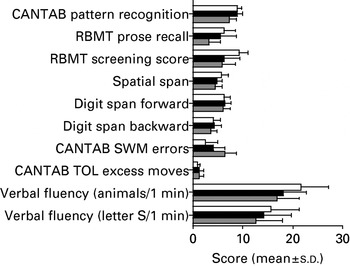
The schizophrenia patients were significantly impaired compared to the controls on 8/15 measures derived from the eight tests: spatial working memory errors and strategic performance, TOL maximum moves, verbal fluency (animals), spatial span, RBMT screening score and prose recall, and pattern recognition. The brain-damaged patients were impaired on 7/15 of the measures: spatial working memory errors and strategic performance, TOL maximum moves, verbal fluency (animals), RBMT screening score and prose recall, and pattern recognition. Neither patient group were impaired compared to the controls on digit span, verbal fluency (letter S), and for certain measures of the TOL test (minimal moves, excess moves and subsequent thinking times). The schizophrenia patients performed significantly more poorly than the brain-damaged patients on four tasks: pattern recognition memory, spatial working memory (total errors), RBMT prose recall and verbal fluency (animals). The brain-damaged patients did not perform significantly more poorly than the schizophrenia patients on any of the tests. Performance of the three groups on the main measures are summarized in Fig. 1.
Pattern of performance of schizophrenia patients ( ), brain-damaged patients (■), and healthy controls (□) on the memory and executive tasks. CANTAB, Cambridge Neuropsychological Test Automated Battery; RBMT, Rivermead Behavioural Memory Test; SWM, spatial working memory; TOL, Tower of London. (Scores on CANTAB pattern recognition and SWM errors have been divided by 10 to allow them to be graphed with the other tests.)

These differences were not affected by adding gender as a covariate in the analysis. We examined the effects of medication on the schizophrenia patients' performance by means of correlations between medication dosage (in chlorpromazine equivalents) and test scores. None of these correlations were significant. For the brain-damaged group, the 12 patients who were on anti-epileptic medication were compared with the 12 who were not. This again revealed no significant difference on any of the tests.
Relationship between test performance and carer ratings of memory and executive failures
For all of the schizophrenia patients but one, carer ratings were completed by an individual who was in regular contact the patient, e.g. a relative living with the patient or a hostel care staff member. The remaining patient had no relative or carer, but his questionnaires were filled in jointly by his community psychiatric nurse and P.J.M., both of whom knew him well. The carer ratings for the brain-damaged patients were completed by relatives (typically spouses) living with the patient. Questionnaires for one brain-damaged patient were not completed because no caregiver was available.
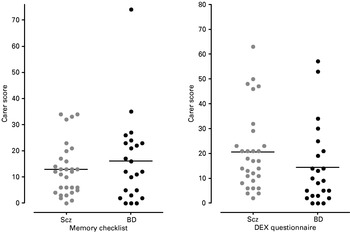
Scores on the memory and executive questionnaires for the two patient groups are shown in Fig. 2. From this it can be seen that there was a wide range of daily-life failures in both the schizophrenia and the brain-damaged patients. Leaving aside a single outlier on the memory checklist in the brain-damaged group, the distribution of scores was quite similar in both groups. However, the brain-damaged patients had a higher mean score on the memory checklist than the schizophrenia patients (16.09±16.28 v. 12.90±10.09), whereas the schizophrenia patients had a higher mean score than the brain-damaged patients on the DEX questionnaire (20.57±15.79 v. 14.43±16.03).
Carer ratings of memory and executive failures in daily life in schizophrenia (Scz) and brain-damaged (BD) patients.

These differences were examined in a repeated-measures ANOVA. This was preceded by Z-transformation, as described above. There were no main effects of group or carer scale (i.e. memory v. executive), but there was a significant group×carer scale interaction [F(1, 51)=12.44, p<0.001]: the schizophrenia patients were rated by carers as having significantly more executive than memory failures [t=−2.47, p<0.05], while the brain-damaged patients showed significantly more memory than executive failures [t=2.48, p<0.05]. These results remained unchanged after re-analysing the data excluding the brain-injured patient with an outlying score on the memory checklist.
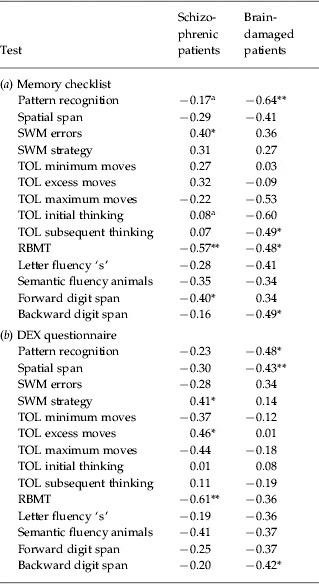
The correlations between the carers' ratings on the memory and executive checklists and scores on the memory and executive tests are shown in Table 2. Both the schizophrenia patients and patients with brain damage showed significant correlations between scores on the RBMT and carer ratings of memory failures in daily life (r=−0.57, p<0.01 and r=−0.48, p<0.05 respectively). The schizophrenia patients, but not the brain-damaged patients, also showed a significant correlation between RBMT scores and carer ratings of executive failures. In the schizophrenia patients carer ratings of memory also correlated significantly with spatial working memory between search errors (r=−0.40, p<0.05) and forward digit span (r=−0.40, p<0.05). For the brain-damaged patients, carer ratings of memory correlated with pattern recognition (r=−0.64, p<0.01), TOL subsequent thinking time (r=−0.49, p<0.05) and backward digit span (r=−0.49, p<0.05). Similarly, carer ratings of executive function correlated significantly with spatial working memory strategy (r=−0.41, p<0.05) and TOL excess moves (r=−0.46, p<0.05) in the schizophrenia patients; and with pattern recognition (r=−0.64, p<0.01), TOL subsequent thinking time (r=−0.48, p<0.05), spatial span (r=−0.43, p<0.05) and backward digit span (r=−0.42, p<0.05) in the brain-damaged patients. The remaining correlations were insignificant.
Correlations between neuropsychological test scores and carer ratings of cognitive failures

SWM, Spatial working memory; TOL, Tower of London; RBMT, Rivermead Behavioural Memory Test.
a Schizophrenics significantly different from the brain-damaged patients.
* p<0.05, ** p<0.01.
Stability of test performance across sessions
Practice effects were not a marked feature of the subjects' performance. Only two measures, RBMT screening score and the prose recall subtest of the RBMT, showed a significant main effect of session [F(1, 78)=4.62, p<0.05 and F(1, 77)=12.85, p<0.001 respectively], with improvement at the second testing session in both cases. There were trends towards improvement on some of the measures from two further tests: spatial working memory between search errors [F(1, 77)=3.44, p=0.07], and TOL attainment of perfect solutions [F(1, 67)=3.84, p=0.05], excess moves [F(1, 68)=3.60, p=0.06] and solving problems in the maximum number of moves [F(1, 67)=2.95, p=0.09].
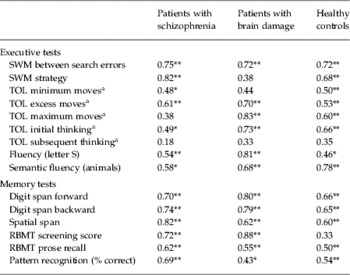
Correlations between test scores at session 1 and session 2 in the patient groups and controls are shown in Table 3. In the schizophrenia patients the correlations were significant for 13 out of 15 measures. Based on the scheme suggested by Weinberg & Goldberg (Reference Weinberg and Goldberg1990) seven of these test–retest correlations were moderately strong (i.e. r>0.60<0.80). For the brain-damaged patients, 11 out of 15 test–retest correlations were significant, and five of these were moderately strong. A broadly similar pattern of performance was found in the normal controls, where 13 out of 15 test–retest correlations were significant and six of these were moderately strong.
Test–retest correlations for the three groups

Missing data were excluded casewise.
SWM, Spatial working memory; TOL, Tower of London; RBMT, Rivermead Behavioural Memory Test.
a Spearman correlations.
* p<0.05, ** p<0.01.
Using Fisher's test, the schizophrenia patients' correlations did not differ significantly from those for the brain-damaged patients on 11 of 15 measures. The schizophrenia patients showed significantly less correlated (i.e. less stable) performance across sessions than the patients with brain damage on letter fluency (p<0.05) and TOL maximum move solutions (p<0.01). The brain-damaged patients in turn showed less stable performance than the schizophrenia patients on spatial working memory strategy (p<0.01), with differences approaching significance for RBMT (p=0.06), pattern recognition (p=0.09) and spatial span (p=0.07). Comparing the correlations between the schizophrenia patients and the normal controls likewise revealed no significant differences on 12 of 15 measures. The schizophrenia patients' performance was significantly more stable than that of normal controls on two tests, spatial span (p<0.05) and RBMT (p<0.05).
Discussion
This study found that a sample of chronic schizophrenia patients showed deficits in memory and executive function which were of approximately the same magnitude as those found in a group of patients with frontal and temporal brain damage. Where there were significant differences between the two groups, these were in the direction of worse performance by the schizophrenia patients. This was despite the fact that the patients were not at the most severe end of the spectrum of chronic schizophrenia – only four of 30 were chronically hospitalized – and they did not show the most severe degrees of general intellectual impairment associated with the disorder – none of the patients had Mini-Mental State Examination (MMSE) scores below the widely used cut-off of 24 for mild dementia.
This study therefore reconfirms an earlier generation of studies which found that chronic schizophrenia patients are difficult to distinguish from patients with brain damage (Heaton et al. Reference Heaton, Baade and Johnson1978; Goldstein, Reference Goldstein1978; Malec, Reference Malec1978). It also replicates a handful of contemporary neuropsychological studies which have found similar levels of memory (McKenna et al. Reference McKenna, Tamlyn, Lund, Mortimer, Hammond and Baddeley1990) and executive impairment (Elliott et al. Reference Elliott, McKenna, Robbins and Sahakian1995; Evans et al. Reference Evans, Chua, McKenna and Wilson1997; Pantelis et al. Reference Pantelis, Barnes, Nelson, Tanner, Weatherley, Owen and Robbins1997) in schizophrenia and brain-damaged patients. One further study (Rushe et al. Reference Rushe, Morris, Miotto, Feigenbaum, Woodruff and Murray1999) which examined the performance of schizophrenia patients and patients with unilateral frontal and temporal lesions on a computerized version of the Tower of Hanoi task (Rushe et al. Reference Rushe, Morris, Miotto, Feigenbaum, Woodruff and Murray1999) is difficult to evaluate because no overall measure of performance was used. Another study (Duffy & O'Carroll, Reference Duffy and O'Carroll1994) found significantly less memory impairment in a mixed group of acute and chronic schizophrenia patients than in a group of patients with the alcoholic Korsakoff syndrome. However, in this study the Korsakoff patients were required to meet a criterion of having marked anterograde amnesia, and so it is not surprising that their performance was poorer than in schizophrenia patients who were unselected for memory performance.
The schizophrenia patients in our study also resembled the brain-damaged patients in a further respect. This was that their memory impairment appeared to spare digit span. Both patient groups and the controls had an average digit span of >6, and in all three the range was closely similar: 4–9 in the schizophrenia patients and controls, and 4–8 in the brain-damaged patients. Preservation of short-term memory coupled with impaired long-term memory is of course typical of patients with the amnesic syndrome following temporal lobe damage, and this pattern has also been found in patients with frontal lobe damage (Baddeley & Wilson, Reference Baddeley and Wilson1988) and head injury (Baddeley et al. Reference Baddeley, Harris, Sunderland, Watts, Wilson, Levin, Grafman and Eisenberg1987). Nevertheless, it has been controversial whether such a pattern characterizes schizophrenia. McKenna et al. (Reference McKenna, Ornstein, Baddeley, Baddeley, Kopelman and Wilson2002) reviewed 12 studies and found that eight reported that forward digit span was normal and four found it to be impaired. In the latter studies the differences were usually of the order of one digit, and in three of the studies the patients and controls were not well matched, particularly for education. On the other hand, in a meta-analysis of studies of memory in schizophrenia, Aleman et al. (Reference Aleman, Hijman, de Haan and Kahn1999) found that forward digit span was significantly impaired: the effect size was 0.71, similar in magnitude to that of 0.64 for impairment in verbal and non-verbal recognition memory impairment, but at the same time considerably smaller than that of 1.21 for combined verbal and non-verbal recall.
In contrast, spatial span was impaired in the schizophrenia patients, a finding which is in keeping with those of other studies (also reviewed by McKenna et al. Reference McKenna, Ornstein, Baddeley, Baddeley, Kopelman and Wilson2002). A possible explanation for the more robust evidence for impairment of non-verbal span tests in schizophrenia is that tasks involving Baddeley's (Reference Baddeley1986) visuospatial sketch pad are believed to place heavier demands on the central executive component of working memory than those involving the phonological loop (Smith & Jonides, Reference Smith and Jonides1999). Against such an explanation, we did not find that the brain-damaged patients' spatial span was significantly lower than that of the controls. However, the fact that their scores were numerically lower than the controls' and the mean was quite close to that of the schizophrenia patients (and also that the difference was significant using unprotected tests), suggests that this apparent lack of impairment should be treated with caution.
A perhaps more fundamental way in which the schizophrenia and brain-damaged patients resembled each other was the finding that they both showed variable but overall equivalent memory and executive failures in daily life. In both groups, the carer ratings of memory failures were significantly correlated with memory impairment on the RBMT, an ‘ecologically valid’ measure of memory impairment, designed to pick up memory failures in daily life. There were also significant correlations with some, although by no means all the other memory measures. Similarly, both the schizophrenia and the brain-damaged patients also showed significant correlations between carer ratings of executive failures and performance on some but not all of the executive tasks used. That the carer ratings of executive failures also correlated with RBMT score in the schizophrenia patients, and that both patient groups showed correlations between carer ratings of memory failures and performance on certain executive tests should not be considered surprising, given the increasing recognition of the role of the frontal lobes in memory, both at the clinical/neuropsychological level (Baldo & Shimamura, Reference Baldo, Shimamura, Baddeley, Kopelman and Wilson2002) and from functional imaging studies (Fletcher & Henson, Reference Fletcher and Henson2001).
The pattern of carer ratings in the two patient groups might also provide a clue as to why, as noted in the Introduction, cognitive failures in daily life seem to be less clinically obvious in patients with schizophrenia than they do in patients with brain damage. In the schizophrenia patients, carer ratings of executive failures in daily life were significantly greater than ratings of memory failures, whereas the brain-damaged patients showed the reverse pattern. Memory impairment is often identified as the characteristic cognitive problem associated with disorders like brain damage and dementia, and is certainly easily noticed and described. In contrast, many of the most compelling behavioural features associated with frontal lobe dysfunction, such as poor motivation, impulsiveness and poor judgement, are as much in the realm of behaviour as in cognition. A predominance of objectively observable executive problems over memory problems in schizophrenia patients could therefore encourage their interpretation as ‘psychiatric’.
This study found that schizophrenic cognitive impairment was no more or less stable over a period of approximately 6 weeks than in patients with brain damage. Our findings therefore differ to the only other directly comparable study, that of Tracy et al. (Reference Tracy, Oesterling and Josiassen1995), who found significant fluctuations within individuals over fortnightly intervals on a range of motor, perceptual, vigilance and executive tasks. However, this study only examined four patients in a single case study-type way, and controls were not employed.
Also relevant to this issue is the finding that certain cognitive deficits in schizophrenia fluctuate in response to clinical status, appearing or worsening during acute relapses and improving again with recovery. Such state-related changes have been claimed for vigilance (Nuechterlein et al. Reference Nuechterlein, Buchsbaum, Dawson, David and Cutting1994), executive impairment (Kemp & David, Reference Kemp and David1996; Rund et al. Reference Rund, Landro and Orbeck1997), short-term memory (Rund et al. Reference Rund, Landro and Orbeck1997), and working memory (Park et al. Reference Park, Puschel, Sauter, Rentsch and Hell1999). However, Rund et al's. (Reference Rund, Landro and Orbeck1997) study found that such relapse-related changes in cognitive function were not uniform: while short-term memory and Wisconsin Card Sorting Test performance improved alongside the clinical improvement in a group of 15 schizophrenia patients, long-term memory impairment and performance on a backward masking task were stable across the study period. Furthermore, two studies examining the relationship between clinical status and neuropsychological function over longer periods (Rosmark et al. Reference Rosmark, Osby, Engelbrektson and Nyman1999; Hughes et al. Reference Hughes, Kumari, Soni, Das, Binneman, Drozd, O'Neil, Mathew and Sharma2003), failed to find that symptomatic improvement was associated with improvement in any area of cognitive function.
In summary, our findings suggest that schizophrenic cognitive impairment is broadly more similar to than different from that seen in neurological disorders causing brain damage. It impacts on the patient's daily life to much the same extent as in patients with brain damage, albeit perhaps with a different balance between executive and memory failures. Moreover, like cognitive impairment in patients with brain damage, it does not show marked short-term fluctuations, although here the qualification has to be added that our study did not address the issue of ‘state-related’ variations in response to changes in clinical status. Clearly, such a conclusion has implications for rehabilitation and cognitive remediation in schizophrenia.
Acknowledgements
B. J. S. was funded by a Wellcome Trust Programme grant (grant no. 019407). The work was carried out within an MRC and Wellcome Trust Behavioural and Clinical Neuroscience Institute.
Declaration of Interest
None.