

To the memory of Professor Simon Keay
This paper considers the use of glass in wall and floor revetments – opus sectile – during the Imperial era. In particular, it analyzes the way in which materials and motifs from the decorative language of glass craftmanship were “borrowed” from the language of marble, as a means of realizing luxury decorative displays in ancient buildings. The type (e.g., color and design), quantity, and location of glass insertions in marble opera sectilia will be stressed throughout the analysis. This will reveal that glass was used in marble revetments in a range of ways. Sometimes only limited glass elements were employed in schemes otherwise largely completed in marble. These elements occasionally bear a marbled appearance thanks to the coloring, mottling, and veining of their surface, while in other cases they are simply monochrome tiles. But decorative schemes totally composed of glass tiles are also found and will be considered here as another form of “loan” from the language of one craft to that of another. In fact, I believe that marble craftmanship was visually quoted not just by using marbled glass but also by creating compositions of variegated or contrasting slabs placed close together. This decorative scheme created a visual link to marble opus sectile.
In what follows, I present a survey of the evidence for glass use in marble revetment. It starts with the Egyptian glass industry and reviews the evidence for the working processes of raw glass and the emergence of a thriving craft specializing in vessels and revetment materials. I stress the combination of this craftsmanship with that of stone from the Ptolemaic kingdom onward. During this period the Egyptian stone industry flourished thanks to the availability of raw materials, transport facilities, and demand. During the Hellenistic period, the Alexandrian art market stimulated the development of these mixed decorations as paradigms of luxury, which Rome had a role in inheriting, reinterpreting, and amplifying up to Late Antiquity. The way in which the mixed use of marble and glass for both wall and floor revetments evolved during the Roman period is demonstrated here through the evidence from Rome itself, Italy, and the provinces, with a particular focus on the continuity of related production activities in Egypt.
This article is not intended to be exhaustive; it is not possible to mention every example of glass used in opus sectile. Instead, it focuses on the most significant examples of the technique, some of which are well known, while others are either less cited or the result of recent discoveries.Footnote 1 The evidence is grouped chronologically, with sections focused on significant sites. One of these is the Villa of Lucius Verus on the Via Cassia in Rome. It represents a well-studied context in which glass in opus sectile was widely used. Particular emphasis is also placed on a hitherto unpublished assemblage from the so-called Imperial Palace at Portus. This is treated in detail both because it has been possible to analyze the technical details of the use of opus sectile through fieldwork and because it provides proof that glass was used in marble floors as well as walls, a point that has been much debated. The rich set of panels found in Kenchreai, the port of Corinth, is another case study in the survey presented here. The panels differ from most of the other examples because they are entirely made of glass. But their decorative motifs strengthen a connection with artifacts that were made exclusively in marble or with just a few glass insertions. I next examine other significant examples, mostly dating to Late Antiquity, especially in terms of their interrelationships with other items. Finally, I analyze the use of glass in panels dealing with marine subjects.
The survey is followed by a discussion of the rationale behind the choice of materials made in the examples discussed. In particular, I examine the possible role of glass as a substitute for more expensive marble tiles. The aim here is not to downplay the decorative value of glass, despite its lower economic value. In fact, I argue that the decorative value of each material was based above all on a primary, almost automatic, reception derived from its shapes and colors.Footnote 2 In certain circumstances the economic hierarchy of raw materials was subverted by the refinement of glass craftsmanship. Therefore, I present a second possibility: that other considerations, and not the intrinsic one of the raw materials, sometimes made glass even more valuable than stone; its preciousness lay in the “simulation game” it played with marble.
The functioning of visual communication, between appearance and reality, is the conceptual universe in which we must move to address the meaning of these mixed media. As is shown in this article, an analysis of glass in opera sectilia can contribute to new reflections on ancient perceptions of materials used for decoration, especially when they were combined with, or used in substitution for, each other. More generally, it can contribute to the investigation of topics such as imitatio naturae and illusionism in ancient aesthetics.
Alexandria
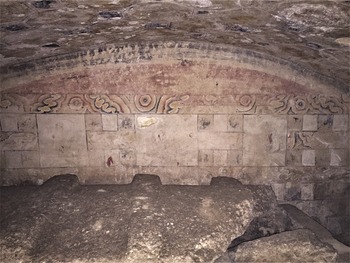
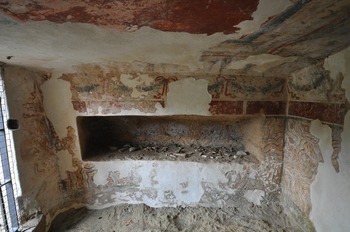
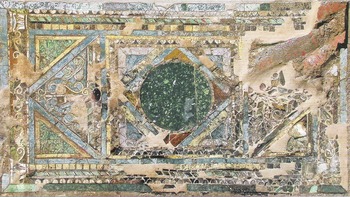
Glass was originally introduced into decorative schemes as a way of replacing precious or semiprecious stones in Mesopotamia in the late 3rd millennium BCE.Footnote 3 It continued to be used in Pharaonic Egypt, starting from the 28th Dynasty, and then again in the Hellenistic period.Footnote 4 However, it is Alexandria that offers the most complete evidence for the artistic independence that marbled, but not marble, decorative elements would achieve. Hellenistic paintings show how it became possible to refer to models via different media, themselves responding to precise compositional rules, especially in the way in which the walls were partitioned and the backgrounds created. Examples of this can be found in Hypogeum 1 in the Anfushi necropolis (Fig. 1), dating to the Late Hellenistic period, in Tomb 1 at Ammoi in Cyprus (Fig. 2),Footnote 5 or, again in Alexandria, Hypogeum 5 (Chambers 1 and 4) and Tomb 2 (Bedroom 4) in the Mustafa Pasha necropolis.Footnote 6
Anfushi necropolis, Alexandria (Egypt), Hypogeum 1, painted imitation of alabaster. (E. Gasparini.)

Ammoi necropolis, Nea Paphos (Cyprus), Tomb 1, painted imitation of alabaster. (E. Gasparini.)

The first known atelier producing raw glass was found in Beni Salama in the Wadi Natrun area. It dates to the 1st‒2nd c. CE and was excavated between 2003 and 2009. Its establishment was connected to the availability of natron. This mineral soda was capable of acting in the production process as a flux together with silica sand, used as a vitrifying agent, and calcium, the stabilizer to which antimony or manganese was added, which was necessary for decolorization.Footnote 7 This important discovery has improved our understanding of the Egyptian glass industry during the Imperial period, with regard to both its production and its wider commerce.
Although this workshop dates to the Imperial period, in Alexandria monochrome glass and glass mosaic were in circulation as early as the 4th c. BCE and continued to be used up to the 4th c. CE and beyond. That said, very few of these objects, many of which are preserved in the Graeco-Roman Museum, have a known provenance.Footnote 8 Breccia reported the discovery in the Shatby necropolis of glass paste imitating serpentino, dating to between the end of the 1st c. BCE and the early 1st c. CE.Footnote 9 At the same necropolis, plaques with a floral decoration, dating to the 3rd‒2nd c. BCE and of Egyptian production, have been found. What they were used for is uncertain; however, they could have been part of the wall decoration or grave furniture.Footnote 10
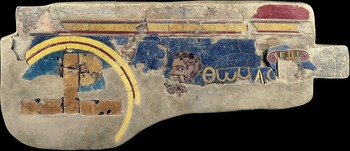
From Kom el-Dikka are the remains of the chryselephantine statue, probably depicting Serapis enthroned. It is assumed to come from the great Serapeum of Rhakotis but may well originate from the Temple of Isis and Serapis on the Via Canopica. It was erected by Ptolemy IV Philopator and his wife, Arsinoe, at the end of the 3rd c. BCE but destroyed by fire at the beginning of the 5th c. CE, shortly after the tumultuous events characterized by the Christian destruction of pagan monuments at the time of Theodosius I and the patriarch Theophilus in 391 CE.Footnote 11 The monument boasted highly varied decorative elements – stone, marble, gilded stucco, bronze, glass paste, and polychrome and semiprecious stones – that could have been used to embellish the throne and the base or (less probably) the cloak of the divinity, as a seated deity found in the temple of Soknebtynis in the Faiyum may suggest (Fig. 3).Footnote 12
El-Faiyum (Egypt), enthroned deity from the temple of Soknebtynis attesting to the multicolored decoration of the throne representations. (M.-D. Nenna; © CEAlex/CNRS Archive.)

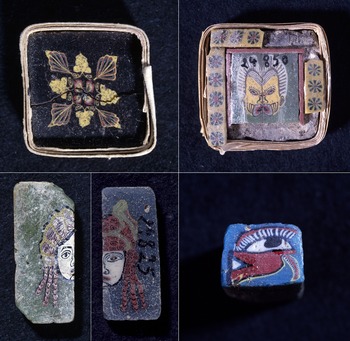
At Ras el Tin, in the western sector of Alexandria, a large number of glass fragments were recovered from Hypogea 9, 10, and 11; others were unearthed in the necropolis of Dush, in the Western Desert. All these elements date to a period spanning the end of the Ptolemaic period and the beginning of the Roman period. They were made of monochrome glass or mosaic glass and have geometric, floral, and figurative motifs. They comprise rectangular plates 3 mm thick, rough cubes 15 mm across, and sections of rectangular or square bars. The thin plates appear to be borders with friezes decorated with vegetal motifs. There are also cubes with female faces and rosettes, and sections of rectangular bars carrying a figurative decoration with the subjects facing left and right, presumably part of compositions in which they were placed in pairs (Fig. 4).Footnote 13 Originally, these panels may have decorated chests or, less likely, sarcophagi.
Ras el Tin necropolis, Alexandria (Egypt), and Dush (Western Desert, Egypt), glass plaques from the necropoleis. (A. Pelle; © CEAlex/CNRS Archives. Processing by E. Gasparini.)

We can observe the development of elements with marbled decoration intended as wall facings, at both Alexandria and other sites in the Faiyum and Upper Egypt, as demonstrated by the aforementioned fragments found by Breccia. The stones imitated include serpentino with a green background and light green inclusions, and also mottled lithotypes in a great variety of colors (brown and yellow; light green and yellow or white; blue and white or yellow).Footnote 14
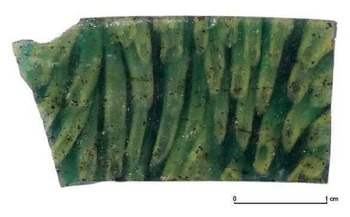
Secondary workshops that made use of raw glass were also installed in Kom el-Dikka: in the UN sector of the site, the excavation campaigns of the last few years have brought to light a glass mosaic plaque that compares well with the Egyptian productions of the turn of the 1st c. BCE and 1st c. CE.Footnote 15 Composed of opaque glass, it presents a set of stylized flowers, leaves, and fruits. Doubts remain as to whether it was part of a wall covering, and the possibility that it was part of the furniture decoration cannot be excluded. Even more significant is the presence of a small plate with decoration imitating serpentino (Fig. 5). This was found in the residential sector FW, together with two other fragments of polychrome decoration, in contexts dating to the 2nd to 3rd c. CE.
Kom el-Dikka, Alexandria (Egypt), sector FW, glass plate imitating serpentino. (Kucharczyk Reference Kucharczyk2018, 46, fig. 3; courtesy of the Polish Centre of Mediterranean Archaeology of the University of Warsaw.)

These finds seem to indicate that products made elsewhere circulated in Kom el-Dikka alongside objects of local manufacture, the production of which is indicated by both finished and semi-finished elements of coral and semiprecious stones (lapis lazuli, carnelian, agate, sardonic, onyx, amethyst, rock crystal) that were evidently imitated in glass.Footnote 16 The production process of these objects is widely attested throughout the site, although the stratigraphic contexts in which the evidence is found are often hard to date. We can cite here two circular brick kilns that were found during the excavation of Auditorium G, immediately below the floor,Footnote 17 or, more generally, the discovery of large blocks of dismantled kilns, deposits of limestone mixed with hyper-baked glass, glass drops, rods bearing the motif replicated in imitation serpentino, fragments of raw glass of various sizes and colors, remains of crucibles with traces of glass adhering to the walls, a significant number of stone molds for the creation of beads, and various types of waste (fragments of deformed containers, panels, semi-finished objects, etc.).Footnote 18 It is important to note that traces of production – molds, rods, beads – have also been found in Kom el-Dikka in 4th–6th-c. CE deposits, both in sector FW and in the residential area at street R4, thus demonstrating the durability of this artisan tradition and the continued imitation of marble.Footnote 19
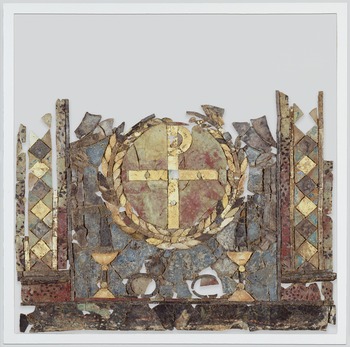
At the end of Antiquity, it was Christian architecture that inherited the tradition of decoration in glass opus sectile. Some of the better-known examples dated to the first half of the 5th c. CE have been found in Kellia, Egypt, which brings us neatly back to the beginning of our tour of the evidence, which started in the Wadi Natrun (Fig. 6).Footnote 20
Kellia (Egypt), glass panel. (Fibbi-Aeppli, Grandson – MSAC; courtesy D. Weidmann.)

Rome
In Rome, where at the turn of the 1st c. BCE and the 1st c. CE the decorative language of Alexandria set the standard for expressions of senatorial self-representation,Footnote 21 the condemnation of oriental inaudita luxuria by ancient authors extended to the use of marble and glass.Footnote 22 For Seneca, the luxury of glass cladding, which distorted the real character of a building, was closely associated with the use of marble and painted decorations.Footnote 23 Pliny cites Scaurus, who, having witnessed the luxurious decoration of the palaces of Sidon and Alexandria, as well as the glass workshops in Tyre, Sidon, and Alexandria during the Mithridatic Wars in the East, set about copying it by inserting glass paste tiles in his theater in Rome.Footnote 24 Even then, however, this building, according to Pliny, was distinguished above all by its three-story stage building, containing 360 columns, among which were shafts in africano, subsequently taken by Scaurus to his own home. In the same period, sources report the deployment of a giallo antico threshold in the house of Lepidus (78 BCE), columns in Hymettian marble in the atrium of the house of Crassus, and wall coverings in Luna marble in the house of Mamurra on the Caelian.Footnote 25
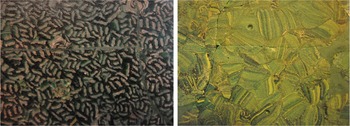
Important evidence for the use of glass as a decorative element in a domestic context can be found in the city of Lucus Feroniae, on the Via Tiberina, about 40 km north of Rome. In a domus dated to between the 1st c. BCE and the 1st c. CE and situated next to the forum, a large slab of glass imitation stone was unearthed, measuring 53 × 42 × 0.8–1.3 cm. The importance of this artifact is that it has different renderings on its two sides, both of which were intended to be visible. One is clearly an imitation of serpentino, while the other, which shows differently shaped mottling in yellow and green (large and quadrangular), has been interpreted as imitating malachite (Fig. 7).Footnote 26
Lucus Feroniae (Rome), glass slab imitating serpentino on one side (left) and malachite on the other (right). (E. Gasparini. By permission of the Soprintendenza Archeologia Belle Arti e Paesaggio per la provincia di Viterbo e l'Etruria meridionale.)

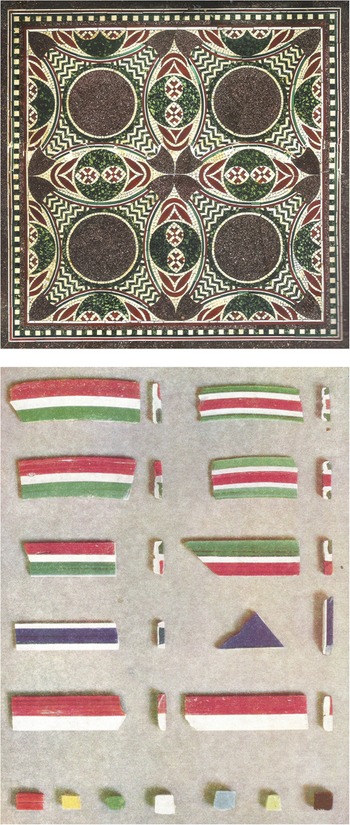
Caligula's two ceremonial ships on Lake Nemi were also clearly influenced by the Alexandrian thalamegoi, another context in which glass and marble were combined.Footnote 27 From one of them came a floor panel (Fig. 8).Footnote 28 The object testifies to the sophisticated combination of mosaic, marble, and glass paste.
Nemi (Rome), Museo delle Navi Romane, fragment of the opus sectile (above) and related glass filets (below) of the imperial ships. (Ucelli Reference Ucelli1950, figs. 251–52. By permission of the Direzione Regionale Musei Lazio – Nemi (Rm), Museo delle Navi Romane.)

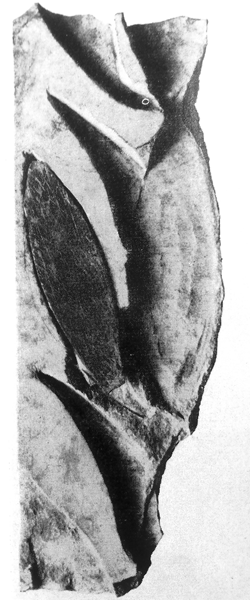
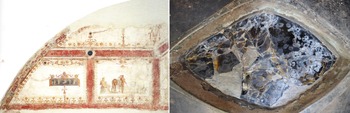
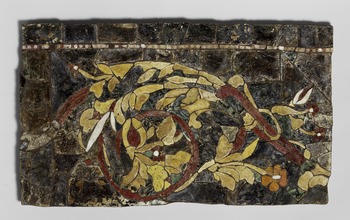
However, it is the Palatine itself that provides several examples of the decorative tradition that combines marble, stone, and glass paste revetments that more or less imitate natural materials. Since their publication, the important sectilia of the Domus Transitoria, specifically those in the area known as the Bagni di Livia, have been referenced in connection to this tradition and compared to the evidence from the Vesuvian cities. In Nero's palace the inlay technique is used, employing thin tiles set in a background from which they stand out thanks to the chromatic contrast.Footnote 29 This can be observed in a fragment of white palombino embellished with inlaid leaves made out of green glass paste (Fig. 9).Footnote 30 In the same sector of the residence there were also wall decorations of painted plaster into which blue glass globes were inserted;Footnote 31 these followed a scheme reminiscent of that of the contemporary or slightly later decoration of the House of the Golden Cupids in Pompeii, with its obsidian lozenges decorating the walls of the porticoes of the Rhodian peristyle (Fig. 10).Footnote 32 Another example of decorative glass artifacts attributed to the Palatine can be found in the Metropolitan Museum of Art in New York. Upon a background imitating serpentino and beneath an astragal of beads, the inlays form a vegetal motif: a stem develops from a stalk and ends in a scroll from which flowers emerge, suggesting it was originally the crowning frieze of a wall in opus sectile (Fig. 11).Footnote 33
Domus Transitoria, Rome, fragment of palombino with inlaid leaves made out of green glass paste. (Dohrn Reference Dohrn1965, 54, fig. 2.1. By permission of the Ministero della Cultura – Parco Archeologico del Colosseo.)

Left: Domus Transitoria, Rome, paintings with inserted blue glass globes; right: Pompeii, House of the Golden Cupids, obsidian lozenge inlaid in the Rhodian peristyle. (Left: Cima and Tomei Reference Cima and Tomei2012, 153, fig. 287. By permission of the Ministero della Cultura – Parco Archeologico del Colosseo. Right: E. Gasparini.)

Metropolitan Museum of Art, New York, glass opus sectile panel attributed to the Imperial Palace in Rome. (The Metropolitan Museum of Art, New York. Rogers Fund, 1913. Acc. no. 13.231.4. Open Access.)

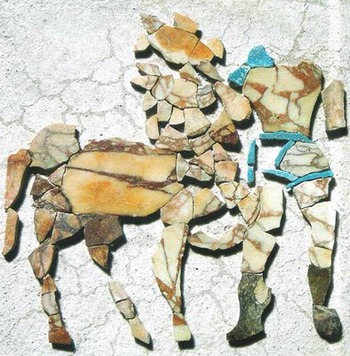
That the phenomenon of vitreous sectilia was not unknown at Hadrian's Villa at Tivoli can be seen from the finds in the Edificio a tre Esedre: a panel made up of orange, green, and blue glass paste scales,Footnote 34 and a scene reconstructed as depicting a charioteer with horse, measuring 27 × 34 cm. The bodies of the characters are in giallo antico brecciato, while the cloak and the charioteer's belt are rendered in turquoise glass paste (Fig. 12).Footnote 35 The excavation of rooms north of the Garden Stadium also makes it possible to locate a luxurious single latrine with part of the floor and wall decoration still in situ and the use of glass listels to divide up the wall panels.Footnote 36
Villa Adriana, Tivoli, reconstruction of a marble panel with vitreous insertions (Adembri Reference Adembri and Filippi2005a, 107. By permission of the Istituto autonomo Villa Adriana – Villa d'Este.)

The Villa of Lucius Verus on the Via Cassia
An extraordinary quantity of glass objects – around 30,000 – is preserved in the Gorga Collection, assembled between the end of the 19th c. and the beginning of the 20th c.Footnote 37 The glass tiles, which are the most numerous among these objects, are both monochrome and polychrome.Footnote 38 They present a great variety of shapes (squares, rectangles, triangles, trapezes, and lozenges, but also curvilinear cuts), dimensions, and thicknesses (from 1 to 7 mm). The most imitated marble is again serpentino. The frames also have different moldings and color combinations, as well as twisted rods, which must have been used to finish the edges and to divide areas of different decoration. Appliqués are rarer and usually come in the form of small snakes. It is interesting to note how, in some cases, the imitation of marble gives rise to imaginative results, with panels of red with white or yellow spots or dark veins, and blue with variegated veins.Footnote 39
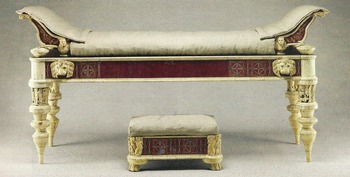
We know from excavation reports that most of these materials in the Gorga Collection come from the suburban Villa of Lucius Verus on the fifth mile of the Via Cassia, in the locality of Acquatraversa. The earliest of these reports date to the end of the 19th c. and describe large quantities of colored glass tiles used in the decoration of the villa, some of which were found still in their original position. Even more tiles were unearthed during new investigations conducted by the Soprintendenza Archeologica di Roma in 1987‒88 and 2005‒9.Footnote 40 Comparative research carried out on the Gorga Collection in the light of finds in other museum collections has allowed the reconstruction of at least four vitreous panels from the villa. All make very limited use of stone – palombino for white and slate for black – to create the thin listels.Footnote 41 One has a geometric cancellum pattern analogous to those found on other panels preserved in several museumsFootnote 42 but also found in a series of elements recovered during the excavation of the villa. It has been suggested that it originally adorned a kline of a sort similar to the bed and footrest in ivory preserved at the Metropolitan Museum of Art in New York, which is in fact a modern pastiche, created in the early 20th c. by combining several parts of the villa's klinai (Fig. 13).
Metropolitan Museum of Art, New York, modern reconstruction of a kline with glass panels similar to others belonging to the Gorga Collection. (The Metropolitan Museum of Art, New York. Gift of J. Pierpont Morgan, 1917. Acc. no. 17.190.2076. Open Access.)

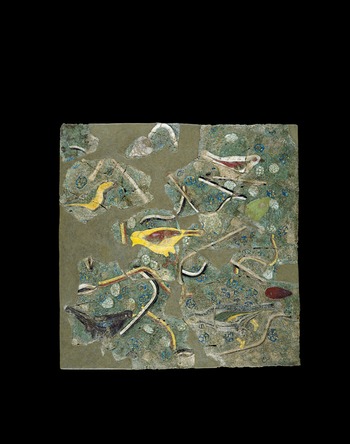
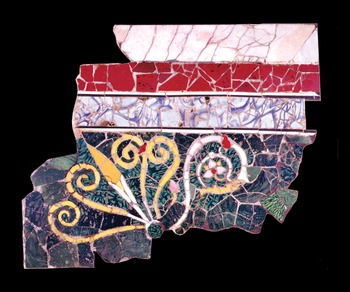
A second panel, albeit of more dubious attribution, is in the Corning Museum of Glass.Footnote 43 The panel depicts racemes, flowers, and birds, and about 30 fragments in the Gorga Collection are very similar to it (Fig. 14).Footnote 44 A third fragment, formerly part of the Stroganoff Collection, is now in the Museo Nazionale Romano at the Palazzo Massimo (Fig. 15). Set against a green background, the field is decorated by a palmette in yellow and white, with red details. It is bordered at the top by three frames. The first is white with blue veins, the second is red, and the third is white. The fragment appears to have been conceived for a corner, although scholars are not unanimous in accepting this interpretation. The polychromy of the glass imitates various stones: serpentino in the green background, giallo antico in the scrolls, and bardiglioFootnote 45 (other specialists have proposed pavonazzettoFootnote 46), followed by rosso antico and white marble in the three frames.
Corning Museum of Glass, New York, glass panel with birds. (CMOG 66.1.215. Image licensed by The Corning Museum of Glass, Corning, NY (www.cmog.org) under CC BY-NC-SA 4.0.)

Palazzo Massimo, Rome (Museo Nazionale Romano), glass opus sectile panel with a palmette (Gorga Collection), from the Villa of Lucius Verus on the Via Cassia. (Courtesy L. Saguì. By permission of the Ministero della Cultura – Museo Nazionale Romano.)

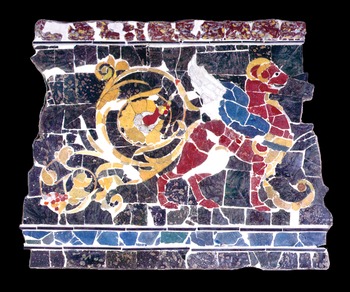
Finally, a fourth fragment, also now at the Palazzo Massimo (originally part of the Kircherian Museum) depicts a red griffin with a lion's head, a goat's horns, and a tail ending in yellow spirals on a mottled green background (Fig. 16). In this case too, the figurative field is bordered at the top and bottom by bands set within black and white strips. The presence of streaks or veins in almost all sectors of the decoration suggests the imitation of stones such as serpentino, giallo antico, rosso antico, verde antico, and broccatello di Tortosa, while a semiprecious note is created by the evocation of blue lapis lazuli.
Palazzo Massimo, Rome (Museo Nazionale Romano), glass opus sectile panel with a griffin (Gorga Collection), from the Villa of Lucius Verus on the Via Cassia. (Courtesy L. Saguì. By permission of the Ministero della Cultura – Museo Nazionale Romano.)

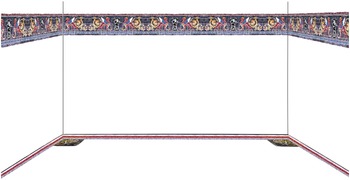
During the most recent archaeological investigations at the Villa of Lucius Verus, not only were 806 fragments found that are similar to the sectilia in the Gorga Collection,Footnote 47 but an attempt was made to attribute these decorative elements to specific rooms in which the preparation surfaces for the opus sectile floors have survived.Footnote 48 The scene with the griffin fragment must have been part of a composition which provided for at least a second symmetrical griffin, if not more, in pairs, facing the sides of a central element, presumably a candelabrum. The recurrence of this iconography in marble friezes makes it appropriate for the crowning of a wall decoration.Footnote 49 On the other side, the fragment with the palmette could fit the corners of the floor of Room 16 (see below), although a reconstruction with both motifs on the floor has also been suggested (Fig. 17).Footnote 50
Villa of Lucius Verus on the Via Cassia, Rome, Room 16, reconstruction of the Gorga panels. (Drawing by E. Gallocchio based on Saguì Reference Saguì and Vistoli2005, 226, fig. 23; courtesy L. Saguì.)

The finds unearthed at the Villa of Lucius Verus should make us reflect on an aspect of this material that has thus far received scant attention: namely whether, how, when, and where glass pastes were used in floors. Glass inlays and panels are usually attributed solely to walls, given the perceived fragility of the material; nevertheless, limited but significant evidence exists that proves they were also placed on floors. In this respect, the results of the investigations of the floor of Room 16 in the villa are particularly important. This room measured 9.50 × 8.70 m. Here, a first preparation bed in mortar was found, in which fragments of amphorae were laid, and a second level of mortar was placed above these. Around a central panel, embellished with octagons and squares, there are 16 square panels with sides of 1.45–1.50 m (about 5 Roman feet), in the center of which there is a roundel with a diameter of 0.70 m. The geometric scheme of the floor does not reach the walls but stops before a mortar band that frames the room. The in situ presence of glass paste tiles has led scholars to believe that the area was decorated with both marble and glass opus sectile (Fig. 18).Footnote 51
Villa of Lucius Verus on the Via Cassia, Rome, view of the floor of Room 16. (Courtesy E. Caserta. By permission of the Accademia Nazionale dei Lincei.)

The so-called Imperial Palace at Portus
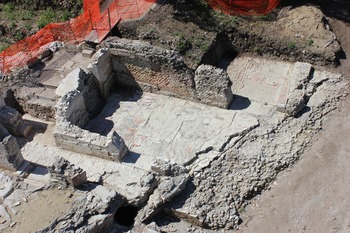
The finds from the Villa of Lucius Verus at Acquatraversa, though high quality, are not unique. They provide vital comparanda, therefore, for finds of glass revetment from other domestic contexts of the Imperial period. In fact, the arrangement in Room 16 of the villa compares well in terms of both layout and dimensions with a later context, dated between the end of the 4th c. and the mid-5th c. CE, from the so-called Imperial Palace at Portus. It was discovered during the excavations undertaken by the Portus Project.Footnote 52 These excavations, carried out between 2012 and 2015, concentrated on a series of official function rooms located behind the monumental façade of this structure, which looked out to sea across the Harbor of Claudius or the outer port (Fig. 19). The first floor of this structure (Building 8) was developed into a residential area consisting of richly decorated halls and corridors. Two of these (Rooms 12 and 15) had floor and wall revetments made out of opera sectilia, which in both cases testify to the mixed use of marble and glass (Fig. 20).
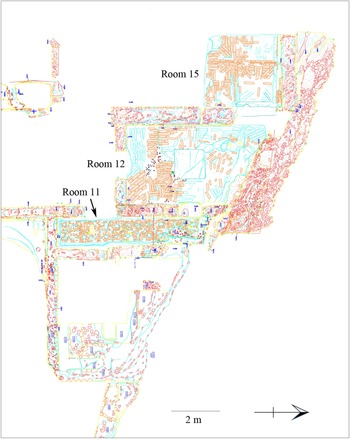
Imperial Palace, Portus (Fiumicino, Rome), plan of Building 8 with indications of the rooms discussed here. (Courtesy Portus Project.)

Imperial Palace, Portus (Fiumicino, Rome), aerial view of Rooms 11, 12, 15. (Courtesy Portus Project.)

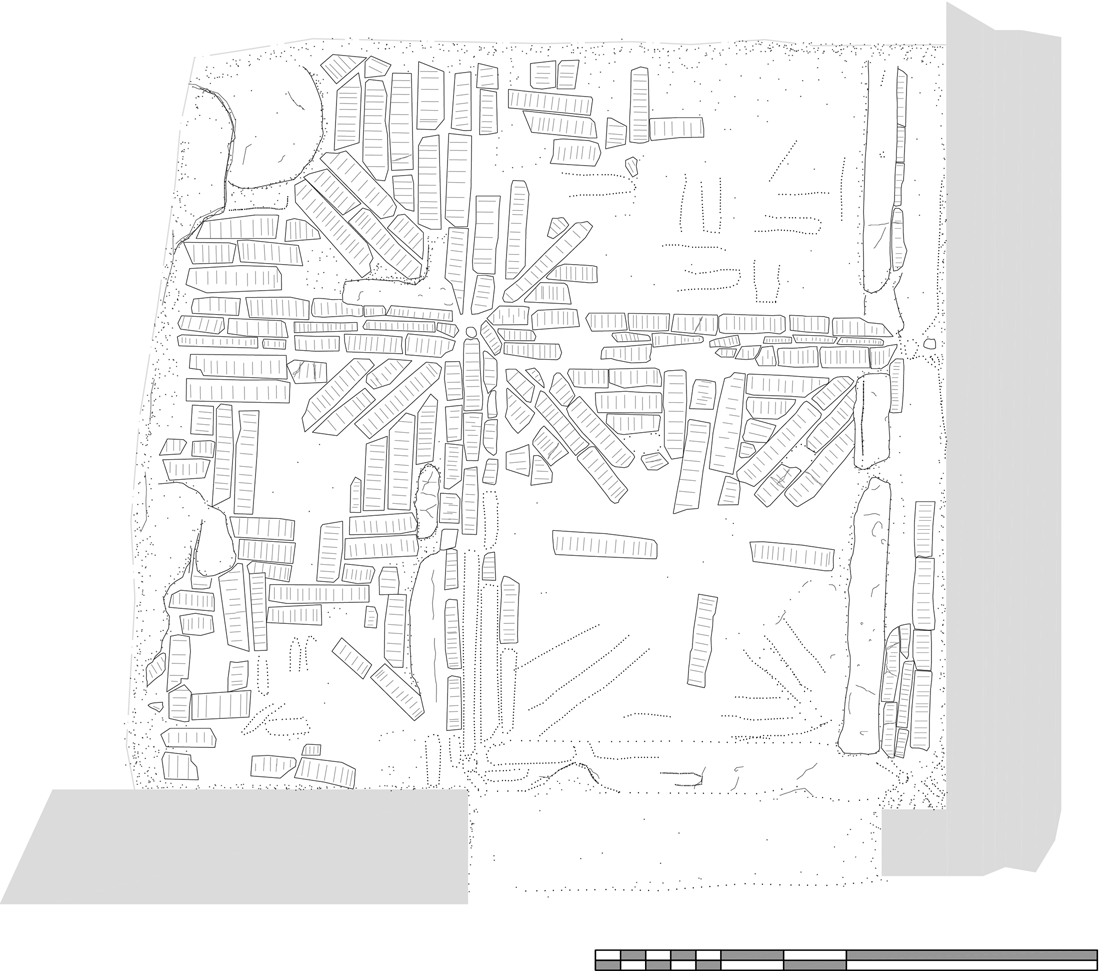
Although a large portion of Room 15 has yet to be excavated, it can still be reconstructed (Fig. 21). Here, the wall veneering,Footnote 53 the type of flooring, and the large dimensions of the room suggest an important space intended for the reception of large numbers of guests. The floor of the room has two preparatory layers: the first is characterized by a layer of mortar into which were set fragments of amphorae, arranged according to the decorative motif of the floor surface above; the second layer is made up of more mortar to cover the amphorae sherds. These ceramic fragments (of which only the imprint survives in some cases) outline the edges of four squares, only one of which is complete, with sides measuring 1.72–1.73 m (equivalent to about 6 Roman feet) and diagonals of 2 m. The amphorae fragments are arranged inside the squares in a star-like pattern, with a circular gap in the centers of the squares, which suggests that the floor had roundels with a diameter of about 0.60 m in these spaces (Fig. 22).
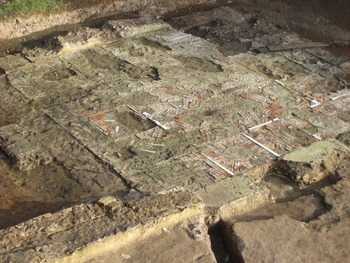
Imperial Palace, Portus (Fiumicino, Rome), opus sectile preparatory layers of Room 15. (E. Gasparini. By permission of the Portus Project.)

Imperial Palace, Portus (Fiumicino, Rome), Room 15, floor preparation with perpendicular and radial amphora slices; in the upper left corner, part of the circular imprint of a roundel. (Drawing by E. Gasparini. By permission of the Portus Project.)

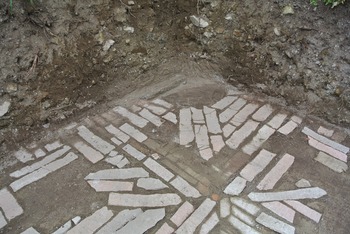
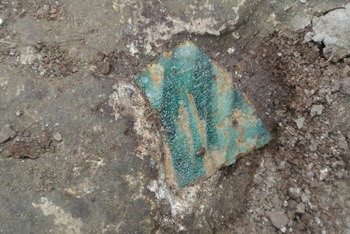
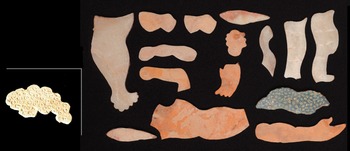
From the analysis of these imprints, one can deduce the existence of a floor made up of opus sectile “a grande modulo e schema unitario” (“with a large module and a unitary scheme”).Footnote 54 Although none of the floor tiles have been preserved, a small glass paste fragment (2.5 × 2 cm) was found encased in the mortar of the upper preparatory layer on the northern edge of the southeastern square (Fig. 23). This glass paste fragment was marbled to imitate serpentino, having an emerald green background with elongated dark green streaks.Footnote 55 The presence of this element, together with the two preparatory layers, a technique already discussed in relation to the Villa of Lucius Verus on the Via Cassia (above), suggests that this floor, too, had glass paste inlays.
Imperial Palace, Portus (Fiumicino, Rome), Room 15, marbled glass fragment in situ. (E. Gasparini. By permission of the Portus Project.)

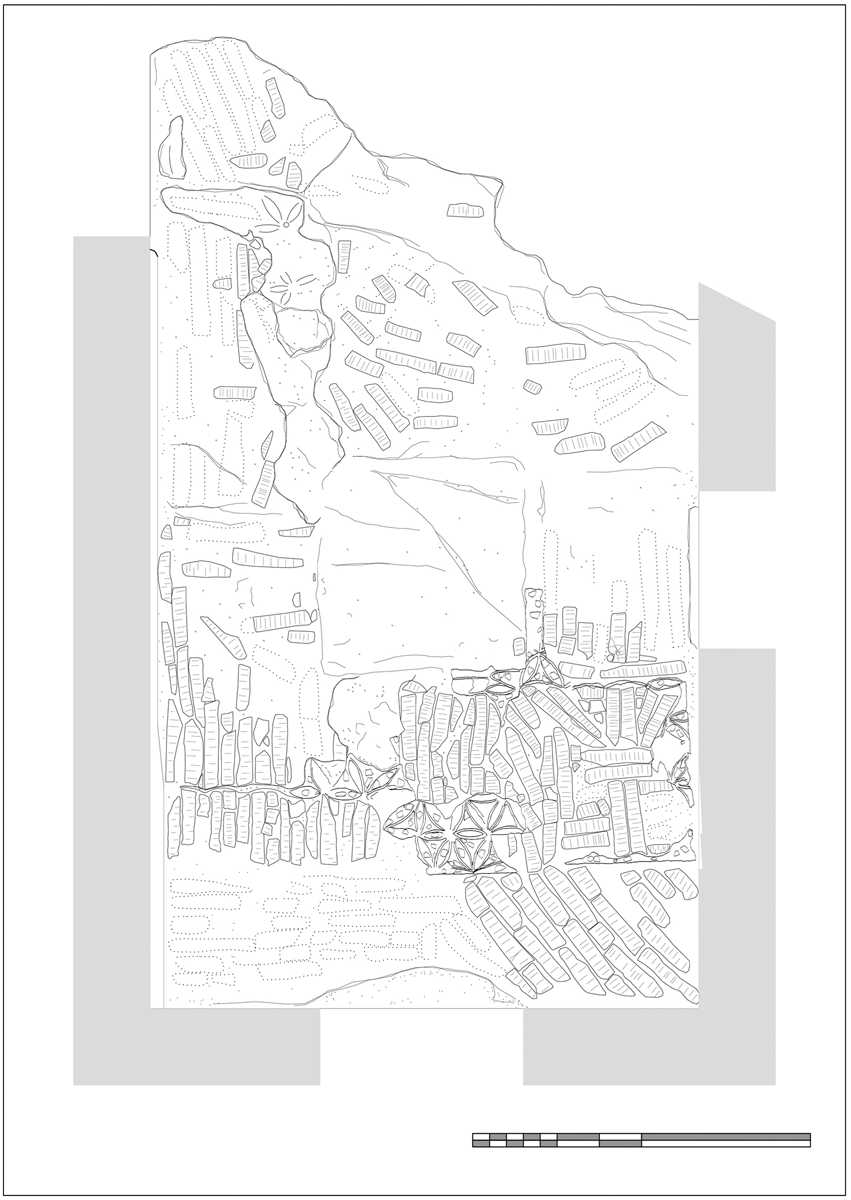
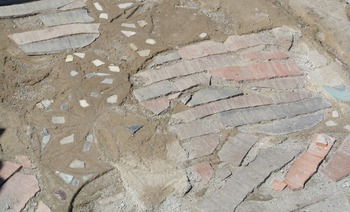
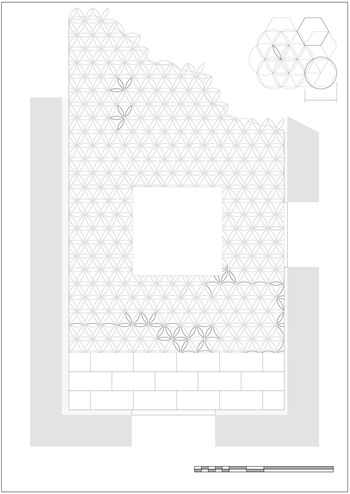
The use of glass for small components of opus sectile flooring is more evident in an adjoining room (Room 12), where we find the same type of decoration; this area may well have been reserved for public functions, for example, as a hall in which to receive select guests.Footnote 56 The preparation of the floor of Room 12 is preserved over almost the entire area, and here, as in Room 15, it is possible to detect two layers that overlie a brick base (Fig. 24). Within the upper layer are small fragments of marble, amphora fragments, and pieces of blue, yellow, and black glass paste (Fig. 25). Although these fragments, embedded in the mortar, were only put down to consolidate the floor tiles, from their arrangement we can reconstruct the opus sectile design which once sat above them, since the preserved floor itself consists of only three tiles, two in glass paste (one black, the other yellow) and one in a fragment of cipollino (Fig. 26). It is an opus sectile design “con motivo reticolare a modulo medio” (“with a reticular motif with medium module”).Footnote 57 The decoration includes intertwined circles (50 cm in diameter), inside which are inscribed flowers with six lanceolate petals, the bisectors of which coincide with the 25 cm radius of the circles.
Imperial Palace, Portus (Fiumicino, Rome), Room 12, floor preparation. (Drawing by E. Gasparini. By permission of the Portus Project.)

Imperial Palace, Portus (Fiumicino, Rome), Room 12, detail of the two preparation layers. (E. Gasparini. By permission of the Portus Project.)

Imperial Palace, Portus (Fiumicino, Rome), Room 12, reconstruction of the opus sectile. (Drawing by E. Gallocchio. By permission of the Portus Project.)

The reticular geometry of the design in Room 12 is interrupted at the southern edge, where the tiles seem to have been laid in a more homogeneous manner. The same seems to have been true for the central emblema, the decoration of which is no longer legible.Footnote 58 The yellow glass paste fragment is positioned like a petal, while the black one represents the triangular space between two petals. Neither the positioning of the blue glass paste pieces nor their role within the geometric design is clear. All we can say is that the blue elements feature heavily both in the preparation layer of the floor and in the decoration of the walls. Crucially, the presence of both marble and glass shows categorically that these materials were combined here.
In addition to numerous other comparanda for this type of floor, particular mention should be made of the arrangement in Room 16 at the Villa of Lucius Verus described above. There, as noted, a layer of mixed marble and glass was laid over a dense bed of amphora sherds.Footnote 59 When studying the two floors of the Imperial Palace at Portus and comparing them with those of the Villa of Lucius Verus, it is crucial to pay close attention to how the substrata of such floors were actually prepared, since this has proved to be a decisive factor in identifying the existence of mixed marble and glass decoration. Here, we can compare the substratum of the flooring of a corridor (Room 11) next to Room 12 in the Imperial Palace, where only marble was used for the floor. The substratum employed here consists of a single layer of marble and amphora fragments used together. This is quite different from what we find in Rooms 12 and 15, where a first layer, made up of amphora fragments alone, underlies an upper layer in which marble and glass paste appear.
The Imperial Palace floors add considerably to the known repertoire of sectilia flooring in marble and glass, which includes evidence from Pompeii dating to the 1st c. CE.Footnote 60 Despite the fragile nature of the material, we can only assume that the size and thickness of the tiles would have been sufficient to ensure their durability.Footnote 61
The vitreous sectilia market: Kenchreai and the spread of Alexandrian products
It is necessary to return to Late Antique Egypt and particularly to Alexandria to understand a large group of artifacts unearthed at Kenchreai, the port of Corinth, in an annex of the Sanctuary of Isis dating to the third quarter of the 4th c. CE.Footnote 62 The discovery of these items represents a milestone in our knowledge of vitreous sectilia, owing to the quantity of materials (approximately 120 panels of 120 × 120 cm or 120 × 60 cm on the side), their state of preservation, their variety, and the refinement of their iconographic repertoire. The Kenchreai panels are vital reference points for investigation of the motifs and production techniques of similar artifacts. Although they consist of panels made entirely of glass, since their publication it has been observed that they show a close relationship with marble opus sectile. In the context of the present study, this aspect is particularly interesting and deserves further emphasis.
It is well known that these finds have been attributed to an Alexandrian production center.Footnote 63 This hypothesis is supported by the persistence until Late Antiquity of glass craftsmanship in the Egyptian metropolis, as demonstrated by the aforementioned finds from the sector of the Kom el-Dikka R4 street. Alexandrian craftsmen, therefore, specialized in the manufacturing of finished panels that were intended for high-level clients in both Italy and other regions of the Empire.
M. Rodziewicz put forward the hypothesis that the coastal architecture represented in the panels is nothing other than the echo of real Egyptian residences.Footnote 64 This possibility is attractive, although such architecture is poorly documented by research in the field. Maritime villas such as these would have been inhabited not only by high-ranking officials but also by mercatores, who must have resided along the Mediterranean coast, west of Alexandria and on the shores of Lake Mareotis.
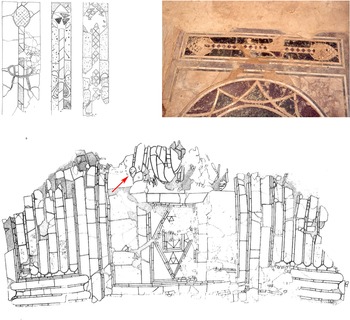
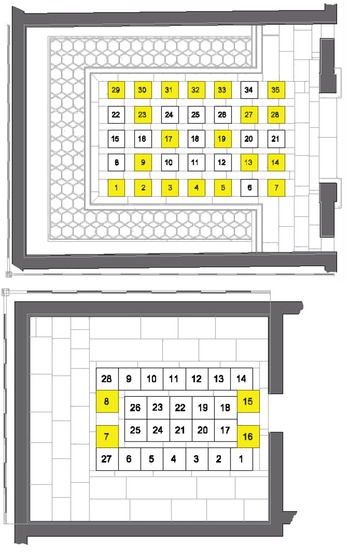
The connection between the Kenchreai panels and Alexandria can be taken one step further. In addition to the sea views hypothetically inspired by the marshlands of Egypt's western coast,Footnote 65 one might consider a parallel between their geometric and floral motifs – as well as the thyrsus appearing in a panel with a standing figure (Fig. 27) – and the marble panels of Kom el-Dikka and of Cyrenaica, both of which are defined by Guidobaldi as “emblemata plurilistellati a schema unitario” (“multi-stellate emblemata with a unitary scheme”).Footnote 66 They consist of a large group of opera sectilia that, from the Middle Imperial period, enriched the floors of numerous elite urban residences in and around Alexandria and Cyrenaica. These panels were part of a pan-Mediterranean trade mostly based on Alexandrian productions.Footnote 67 They may have circulated partly assembled and probably traveled with specialized workers, who would sometimes have incorporated local stones into their compositions.Footnote 68 In the case of the best-known floors, namely those of the triclinia of the House of Jason Magnus at Cyrene, the marble panels of which they were composed were enhanced by the insertion of green glass paste elements (Fig. 28). Glass is present in eight different types of panels: in one case, in the largest room, it appears in 20 out of 35 panels, and, in another, in 4 of the 28 panels (Fig. 29).
Marble and glass sectilia with representation of thyrsoi. Top left: House Gamma, Kom el-Dikka, Alexandria; top right: Villa of Huwariya; bottom: Kenchreai, Corinth. (M. Rodziewicz 1991a, 213, fig. 7; Ibrahim et al. Reference Ibrahim, Scranton and Brill1976, fig. 29. Courtesy M. Rodziewicz.)

House of Jason Magnus, Cyrene (Libya), green glass paste in the floor of the summer triclinium. (E. Gasparini.)

House of Jason Magnus, Cyrene (Libya), mapping of glass paste in the floors of the summer and winter triclinia. (Drawing by E. Gallocchio.)

The use of glass – although as small insertions – in the marble panels of Cyrenaica represents a little-known or underestimated data point in the history of research into these floors. Nevertheless, when added to the parallels in the geometric and floral motifs of the Kenchreai and Cyrenaica panels, this element seems to strengthen the hypothesis that both groups derived from Alexandrian craftmanship. It is in fact likely that the aforementioned Alexandrian glass producers collaborated with marble sectilia manufacturers within the Egyptian metropolis.
Other evidence from the Late Antique period
The Kenchreai panels are a unique case within the panorama of evidence for glass wall revetment. However, there are other examples of wall decoration from elsewhere that share some common elements with these exceptional artifacts. These comparanda made use of similar decorative schemes, which were produced in both marble and glass.Footnote 69 In fact, some of the closest parallels for the schemes at Kenchreai are provided by the marbled surfaces of Late Antique residences, many of them of broadly the same date, and the use of marbled glass in the Kenchreai panels is undeniably an explicit reference to marble sectilia.
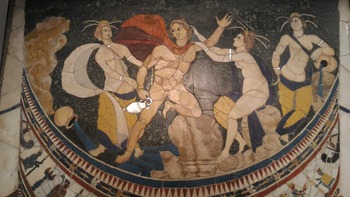
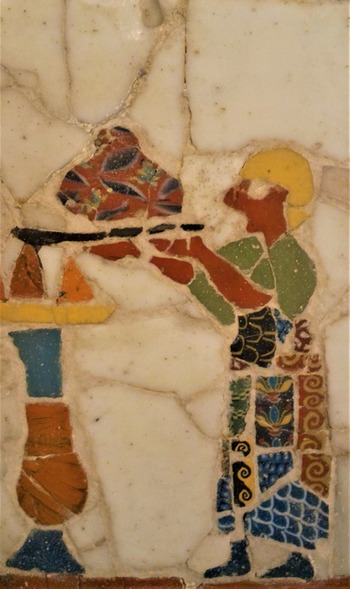
From the walls of the basilica of Junius Bassus on the Esquiline Hill (built in 331 CE) come the panels of Hylas with the Nymphs and the pompa circensis, now in the Palazzo Massimo, as well as the compositions with tigers devouring calves in the Palazzo dei Conservatori.Footnote 70 Among the best-known and most refined examples of mixed marble and glass sectilia, these decorations show the great artistic potential derived from the combination of the two types of material. In the Hylas panel (Fig. 30), marble seems to prevail on the far left of the composition.Footnote 71 Glass (even in minute polychrome compositions) was mainly used to embellish the decoration of the velum alexandrinum with its series of aligned Egyptianizing figures (Fig. 31). However, it has been observed that the millefiori glass of the drapery is closer to products of the 1st c. CE than to the glass of Kenchreai or the Thomas Panel (see below): this appears to be an enigmatic case of reuse (ancient or modern) of elements of vitreous encrustation from the 1st c. CE in an opus sectile panel of the 4th c. CE.Footnote 72 That said, monochrome glass is also used in the main scene to render blue, turquoise, red (alternating with rosso antico, albeit rarely), and yellow, accompanying giallo antico. This last material, thanks to its natural shades and artificial tan markings, was chosen for the complexion of human figures, so as to obtain, especially on Hylas's body, a more naturalistic rendering of the shadows and contours of the muscles. The choice of alabastro fiorito for the rocks was a good one, as was the skillful adaptation of a reused, molded element in the lower sector of the central rock. In addition to local stones such as palombino and green lithomarge (probably from Lazio), which form the separating strips of the mantle's frills, mother-of-pearl was employed to give particular brightness to the jar and the bracelets of the Nymphs.
Palazzo Massimo, Rome (Museo Nazionale Romano), marble and vitreous opus sectile from the basilica of Junius Bassus, depicting Hylas with the Nymphs. (E. Gasparini. By permission of the Ministero della Cultura – Museo Nazionale Romano.)

Palazzo Massimo, Rome (Museo Nazionale Romano), Hylas panel, Egyptian donor from the decoration of the velum alexandrinum. (E. Gasparini. By permission of the Ministero della Cultura – Museo Nazionale Romano.)

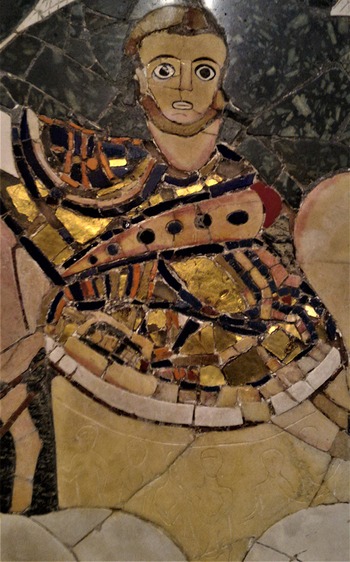
Turning to the panel of the pompa circensis, one must always bear in mind the modern restorations (in the 1600s and the late 1950s) that make it difficult to distinguish how much of what remains is ancient. Moreover, modern interventions separated the scene from the outline of a velum, into which it was inserted, as on the Hylas panel. Some of the slabs in the panel that interrupt the sequence of crustae in serpentino are considered to be modern. It also seems that even the original serpentino elements have in some cases been repositioned. The other lithotype with a green background has been identified as verde di Prato, but this attribution is questioned and in some studies it has been identified, perhaps more correctly, as verde rana fibroso, from Piedmont.Footnote 73 Other types of green stone are also mentioned and, though all of them are recognizable, I was unable to establish whether they were part of modern restorations or of the original composition: these include Vitelli porphyry of unknown origin, nephrite from the Tyrrhenian coast, and gabbro euphotide from Egypt. The horses’ legs and the right hand and left shoulder of the consul were also modified during restoration. Finally, examination of the 17th‒18th-c. documentation of the panel reveals the loss of other characters who would have completed and harmonized the scene.Footnote 74 Apart from the green lithotypes in the background, we can also distinguish the use of giallo antico and rosso antico for the reins, white marble for the flanks of the horses, and palombino. Monochrome glass appears interposed with the marble for the costumes of the characters, as well as glass with gold leaf for the consul's toga (Fig. 32).Footnote 75
Palazzo Massimo, Rome (Museo Nazionale Romano), pompa circensis, detail of the consul and his chariot. (E. Gasparini. By permission of the Ministero della Cultura – Museo Nazionale Romano.)

Beyond the Junius Bassus panels, we can note the presence of glass inserts in the late 4th-c. sectilia walls of the building outside the Porta Marina at Ostia: luminous effects were created by the glass pastes that completed the figurative scenes, for example, on the eyes and belts of the lions, on the stems of the large vegetal frieze, and on the semi-ovules of the abacus of the pilaster capitals.Footnote 76 The same use of glass can be observed in the remains of the rooms of the domus above the Sette Sale on the Oppian Hill. Among the published materials relating to the wall decoration of the basilica of the domus, which fits well into the series of sectilia of the building outside the Porta Marina and of the basilica of Junius Bassus, there is a bird in glass paste, which is combined with others in giallo antico,Footnote 77 while a blue vitreous inlay has been used to portray a dog's head.Footnote 78
Finally, mention should be made of the domus discovered during the excavations of the theater of Palazzo Altemps, where sectilia belonging to a figurative scene were found. This domus has been dated to between the end of the 3rd c. and the beginning of the 4th c., and the sectilia support this dating. The giallo antico used for the nudes is flanked by a tile in blue glass paste, dotted with small circles that perhaps allude to hair.Footnote 79 This tile is comparable to similar inlays in marble from the villa at Piazza Armerina, a fact that confirms how different materials could be used to portray identical themes (Fig. 33).
Right: Palazzo Altemps, Rome, excavations, marble and glass sectilia from a residential building; left: a similar opus sectile element from the Villa del Casale, Piazza Armerina (Sicily). (Right: MNR Archive. By permission of the Ministero della Cultura – Museo Nazionale Romano. Left: courtesy P. Pensabene.)

Among the Late Antique villas in Italy, the three emblemata in marble and glass paste that decorate the floor of the triclinium of the Villa at Faragola in Apulia are highly significant. Inserted in a floor composed of marble slabs and accompanied by a wall decoration, the three emblemata demonstrate once again the combined use of glass and marble.Footnote 80 First of all, it should be noted that in this case the panels are used on the floor and not on the walls of the room, but their compositional scheme shows that they were originally intended for a vertical arrangement on the walls.Footnote 81 Their reuse is part of a phenomenon of dismemberment and trade of individual panels that is well documented in both residences and churches: for example, in the Villa of Huwariya, 40 km west of Alexandria;Footnote 82 in the Funerary Church of the Southern Necropolis at Antinoe, in Middle Egypt;Footnote 83 and in the Basilica of Ras el-Hilal and the western Basilica of Apollonia in Cyrenaica.Footnote 84
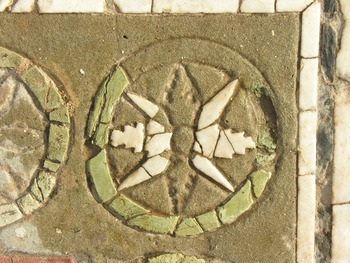
Unlike in the Kenchreai panels, which are of the same dimensions, at Faragola, stone and glass materials were combined. For example, the serpentino roundel in panel 1 (the best preserved) is flanked by triangular segments in which the same stone is imitated in glass (Fig. 34). This juxtaposition does not appear to be random, and it is unlikely, as some have argued, that the marble roundel, albeit derived from two adjoining tiles, is simply a restoration of an original glass tondo.Footnote 85 In fact, its central position explains the choice of marble, and it seems equally possible that the stone and glass were combined with the intent of generating an illusionistic play of reflections. Although the results of archaeometric analysis have not led to definitive answers,Footnote 86 the fact remains that the Faragola panels present precise syntactical, compositional, iconographic, and technical parallels with those in Kenchreai, to the extent that we can propose that they were produced either in Egypt or at the very least with the participation of Egyptian craftsmen.Footnote 87
Villa at Faragola (Apulia, Italy), Coenatio, Panel 1. (Volpe et al. Reference Volpe, De Felice and Turchiano2004, pl. 3; courtesy of the authors.)

The so-called Thomas Panel can also be traced back to Egypt, and in particular to the Faiyum. It is currently in the collections of the Corning Museum of Glass, having been acquired in 1986. In this case, archaeometric analysis has ascertained the same provenance as the glass from Kenchreai.Footnote 88 The fragment dates to the 4th–5th c. and is 79 cm long and 2‒3 mm thick (Fig. 35). Significantly, the tiles were inserted into a resinous mortar containing rectangular terracotta elements; this is the same technique as was used in the Kenchreai glass panels, as well as in the marble ones of the basilica of Junius Bassus in Rome. There is no certainty about the identity of Thomas, the bearded figure portrayed in profile on the panel, nor whether he should be identified with the apostle. In this case, however, the Christian context to which the decoration belongs is clear, which distinguishes it from the Kenchreai panels. Also notable is the use of gold leaf, which is absent from the other panels.Footnote 89
Corning Museum of Glass, New York, Thomas Panel. (CMOG 86.1.1. Image licensed by The Corning Museum of Glass, Corning, NY (www.cmog.org) under CC BY-NC-SA 4.0.)

Glass and marine themes
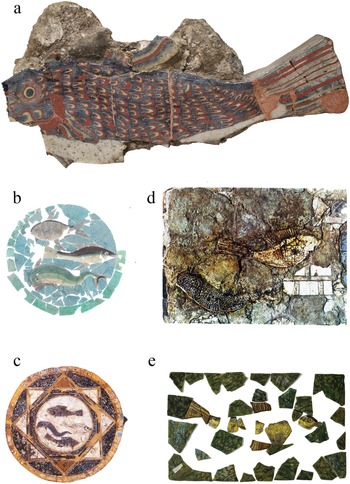
Among the most eloquent examples of vitreous sectilia are the marine scenes depicting fish. The brilliance and iridescence of glass lends itself particularly well to this subject matter. We can assume that this theme was already popular in the Early Imperial period. Indeed, a fragment of unknown provenance now in the Corning Museum of Glass (17.2 × 8.2 cm), which depicts a colored fish, has tentatively been attributed to between the 1st c. BCE and the 1st c. CE (Fig. 36a).Footnote 90 Other evidence comes from the Domus del Chirurgo in Rimini, which is dated to between the end of the 2nd c. and the beginning of the 3rd c. CE and was destroyed by a fire shortly after the mid-3rd c. CE. A tondo, 27 cm in diameter, on a turquoise blue background, shows three polychrome fish swimming over a seabed (Fig. 36b).Footnote 91 The residential part of this domus has yielded polychrome frescoes and mosaic floors with both geometric and figurative motifs. Among the household furnishings, the extensive collection of surgical and pharmacological equipment testifies to the medical profession of the last owner. This refined glass paste picture was found in the triclinium, next to the cubiculum of the taberna medica. A graffito on the cubiculum wall testifies that the doctor had the Greek name Eutyches. Moreover, he adhered to Epicurean ideals: a fragment of a statue, identified via an inscription as the philosopher Hermarchus, the first disciple and successor of Epicurus, was also found in the house. Two inscriptions in Greek should also be mentioned, found on jars for storing medicinal herbs.
Glass panels depicting fish: a. Corning Museum of Glass (unknown provenance); b. Casa del Chirurgo, Rimini; c. Corinth; d. Kenchreai; e. Villa at Aiano-Torraccia. (a. CMOG 61.1.6. Image licensed by The Corning Museum of Glass, Corning, NY (www.cmog.org) under CC BY-NC-SA 4.0.); b. Ortalli Reference Ortalli2007, 106, fig. 4, courtesy of the publisher; c. Oliver 2000, 350, fig. 1, courtesy of the publisher; d. Ibrahim et al. Reference Ibrahim, Scranton and Brill1976, fig. 31, courtesy of the publisher; e. Courtesy M. Cavalieri. Processing by E. Gasparini.)

The glass emblema from Rimini can be compared with an example depicting the same subject, but slightly larger in size, unearthed in Corinth in a building that possibly had a commercial nature. This building was destroyed in the second half of the 3rd c. CE and discovered in 1981.Footnote 92 A panel is mounted on a wooden support and may well have formed part of a wall decoration, although it is not clear whether it pertained to the room in which it was found or was simply deposited there. The image itself consists of four fish on a blue background, which, due to weathering, appears white (Fig. 36c). The fish occupy a central tondo (diam. 57 cm) that sits within an inscribed circle, which itself occupies an eight-pointed star formed by two interlocking squares arranged at 45 degrees. An almost identical frame was probably used for the tondo from Rimini, to judge from fragments of glass paste recovered during the excavations, confirming the hypothesis that the pieces came from the same workshop and leading to the suggestion that the artifact in Rimini may have been bought in Greece or via a personal contact.Footnote 93
The Corinth panel in turn has similarities with other examples, in particular vis-à-vis its representation of the fish, and its compositional technique reflects that of the later Kenchreai slabs (Fig. 36d). The fact that multiple examples of this technique have been found in Corinth might indicate the existence of a Corinthian workshop specializing in the creation of this much sought-after decor, either through the importation of semi-finished products from Alexandria or through collaboration with craftsmen from Egypt.
The fish panels from Rimini and Corinth can be compared with other evidence from the Villa of Aiano-Torraccia (Chiusi) in Tuscany. In its initial phase, dating to the late 3rd–early 4th c. CE, and even more so following its restructuring in the mid-4th–mid-5th c. CE, the villa was embellished with luxurious furnishings, among them mosaic wall and floor decorations – including in opaque glass paste and gold leaf – and opus sectile in both marble and glass.Footnote 94 The glass tiles were executed in monochrome glass paste, in a style similar to others made using the marbled technique.Footnote 95 Among Aiano's vitreous sectilia are marine scenes depicting fish, with one sporting multicolored scales (Fig. 36e). The fish were created with both monochrome and polychrome elements, using pieces that had been pre-worked.Footnote 96 Finally, a few fragments depicting a landscape, inspired perhaps by the Nile, are also suggestive of Alexandrian craftsmanship (as at Faragola), as are the style and technique of execution.Footnote 97
In addition to Rimini and Corinth, the comparison between Aiano-Torraccia and the Villa of San Vincenzino in Cecina (Livorno), attributed to Caecina Albinus, the urban prefect in 415 CE, is interesting. The excavations yielded numerous glass tiles probably belonging to the wall decoration of a triclinium with a nymphaeum. In this case, as in others in which the glass forms part of the encrustation of fountains or artificial grottoes, the happy juxtaposition of glass with water was a fundamental element of the general decoration, specifically conceived to enhance the light effects of the revetment.Footnote 98 An extensive selection of colored marbles decorated a large part of the building,Footnote 99 together with shells, pumice, small wooden elements,Footnote 100 ivory, and a remarkable quantity of glass tiles of different shapes and colors, including various marbled specimens. Finally, the fact that different thicknesses could be distinguished may indicate that some elements were used as floor tiles.Footnote 101
Visual dialogues between appearance and reality
The data collected through this survey can be discussed to clarify the meaning of decorative choices that involved the insertion of glass elements into wall and floor revetments. First and foremost, it is important to emphasize the difference between mixed sectilia and those composed entirely of glass inlays. Careful examination has shown that the former were used fairly widely for luxury wall veneering, especially during Late Antiquity. In such compositions, however, glass tended to be used in small quantities, with marble making up the bulk of the revetment. The same applies to the less widely attested use of glass as a component in floor sectilia. This was a period when construction, especially in the upper echelons of the market, heavily relied on pre-packaged materials. These circulated through commercial channels between procurement sites (such as quarries), processing sites (such as manufacturing centers), storage and sorting sites (such as large ports), and the urban construction sites for which the products were destined.
While marble panels may very well have been cut and laid on site, it is difficult to argue that the same thing happened for glass. Not only were the quantities in use minimal, but the technical complexity of manufacturing and processing were such that specialized equipment and workshops would have been required. Glass inlays must therefore have derived from a sector of the glass market consisting of ready-made products that could be purchased and inserted into the compositions, or they were made to order by specialized workshops to which clients turned for specific commissions.
Through the analyzed examples it is possible to detect another type of use of glass elements in opera sectilia. This consists of a mixed use, but with a much larger percentage of glass (as in the panels of the basilica of Junius Bassus), or the exclusive use of glass. Examples that fall into this last category are more restricted: the panels of the Villa of Lucius Verus, those from Kenchreai, and generally smaller compositions, such as those depicting fish found at Aiano-Torraccia, Rimini, and Corinth, or on the Thomas Panel.
The quantitative differences in the use of glass observed here, in addition to aesthetic choices, might have had economic roots; these, however, must be analyzed in detail to understand the value assigned to glass products. The entangled and multiform relationship of glass and marble can often be defined as an unequal one, due to the higher intrinsic value of the stone materials. It goes without saying that marble represented the paradigm of luxury, to the extent that it was often imitated in painting, mosaic, and glass. In the case of the last of these, it was necessary to resort to complex processing techniques in order to make so-called marbled glass. This craftsmanship can be considered a form of skeuomorphism, a term referring to objects that emulated the characteristics (shape, surface decoration) of artifacts made of different, and often more expensive, materials. In fact, skeuomorphism implies a hierarchy of decorative possibilities and a desire to make luxury objects or ornaments more accessible, as reflected, for example, by ceramic vessels that recall the forms of metal objects.Footnote 102
But I believe that this hierarchy based on the intrinsic value of materials may not have been strictly respected for glass products of the highest craftsmanship. To demonstrate this, it is first necessary to emphasize the freedom in marble imitations. Just as in the media of painting and mosaic, glass imitations of stone could often lead to highly imaginative results.Footnote 103 Did such imitations actually correspond to a specific type of stone? Should we consider the craftsmen open to free interpretation, or did they aim to imitate a specific stone and perhaps sometimes misunderstand their model?Footnote 104 Can a more positivist position regarding the scientific identification of imitated stones be sustained?Footnote 105 I have already observed how the imitation of serpentino was the most universally recognizable and was in fact also the most common; the rich assemblage of glass in the Gorga Collection supports this. The realistic imitation of some other stones can also be mentioned.Footnote 106 However, we have seen how often patterns of shapes and colors could be associated with more than one stone, as demonstrated by comparisons with paintings and mosaics.Footnote 107 In this regard, we can take as an example the band framing the panel with a griffin from the Gorga Collection (fig. 16), where we can see an imitation of broccatello di Tortosa (though scholars have traditionally considered it to be an imitation of the breccia di Settebassi).Footnote 108 Another example can be found in the panel with a palmette from the Gorga Collection, where the upper fascia is described as an imitation of either bardiglio or pavonazzetto.
Therefore, when a certain combination of colors and shapes is artificially created using glass, identifying the stone that it was originally intended to imitate can be extremely challenging. However, if we shift the perspective and look at these artifacts through the eyes of those by whom they were originally intended to be seen, establishing such identifications may no longer be such an overriding priority. What was being sought was, first and foremost, an aesthetic effect – a perception – based on the play of color and light. At a deeper level, what glass represented here, in a more or less realistic manner, was the abstract idea of marble rather than the material itself. This was achieved not only through the use of marbled glass but also simply by using glass for areas or iconographies in which the codified language of ancient decoration would have expected the presence of marble. For the latter, a case in point is the griffin panel from the Gorga Collection (fig. 16). It can be interpreted as part of a glass frieze portraying figures that crowned an elevation and, in fact, it reproduces a canonical iconography for the marble friezes of temples or other monumental Imperial buildings. However, the use of glass instead of marble can be interpreted as the engagement of a subtle interplay between an adherence to the rules of decor and their infringement.Footnote 109
The relationship in sectilia between glass, an artificial material, and marble, a natural one, can be further explored if it is read in the light of the ancient concept of art as imitatio naturae. The Alexandrian origins of glass decoration in Greco-Roman wall and floor veneering are linked to a widespread feature of Hellenistic literature: the more an artist succeeds in faithfully reproducing reality, the more valuable the work becomes. In fact, appreciation of art is a mental process that fills the gap between appearance and reality, and vice versa. Such a vision is built on Aristotelian thinking and its encyclopedic organization of the branches of knowledge. In a system that provides for the epistemological parity of all sciences, Aristotle includes art among the poetic sciences and places it in ontological parity with reality (Arist. Poet. 1447a.15).
This vision is reflected in the scenographic and illusionistic conception of Alexandrian art, as expressed by Theocritus in his Idyll 15. In this text, Gorgo and Prassinoa are described enjoying the parade of images during the annual feast in honor of Adonis, organized in Alexandria with great pomp by Queen Arsinoe: “the figures move as if they were real; they are alive, not woven! Man is a genius!” (Theoc. Id. 15.82‒83, transl. author). The same concept also emerges, for example, in the Peri Alexandreias of Callixenus of Rhodes as it has come down to us in the Deipnosophistai of Athenaeus of Naucratis (FGrH 627 F2, apud Ath. 5.196 A‒203 B), when the tent of Ptolemy II Philadelphus is described as fleeting and at the same time eternal.Footnote 110 Therefore, the concept of imitatio went hand in hand with illusionistic effects and the wonder they must have generated. Since Roman culture was deeply imbued with Hellenistic philosophy, I believe that this theoretical frame must have had some link with the use and reception of glass in opera sectilia up to Late Antiquity.
Conclusions
This survey has outlined the Hellenistic origins and the long life of glass in the decorative language of Roman architecture. Data from Alexandria and Egypt show that it was a much sought-after material that found a place in funerary, domestic, and public contexts. From the Late Republican period onward, owners of private Roman residences were very receptive to Alexandrian trends and borrowed freely from them. Glass revetments became an integral part of imperial and aristocratic palaces, and were used in progressively greater quantities. From the picture painted above, it emerges that glass sectilia really were, decoratively speaking, the jewel in the crown of Late Antique residences, both in Italy and in the provinces. Floors could also be enriched by the purchase of ready-made products available on a market that still seems to have been dominated by Alexandrian workshops during the Late Imperial period. As is demonstrated by the cases of the Villa of Lucius Verus on the Via Cassia and the so-called Imperial Palace at Portus, the glass used in these luxury revetments would have added a luminescent glow to marble floors by means of smaller insertions of individual slabs or panels embedded using a specific installation technique.
The use of glass panels, or indeed of small glass inserts, should not be considered a decorative choice merely aimed at replacing marble coverings with a cheaper material. This explanation cannot be totally ignored, especially considering that glass could be a replacement for the semiprecious stones sometimes used in small inserts. The question, however, is more complex: when glass was used independently, it was capable of acquiring a prestige all its own and I believe that this prestige made it even more valuable than marble.Footnote 111 Indeed, the words of Pliny, when he declares that “this was considered the proof of wealth, the true triumph of luxury: to possess that which can be totally destroyed in an instant” (Plin. HN 33.5, transl. author), are a clear reference to the value derived from the fragility of glass.
We can appreciate the experimental nature of these products and therefore their uniqueness, even if by Late Antiquity the technological development of the glass industry was a fait accompli.Footnote 112 The value was inherent in the material's very artificiality, in its ability to amaze through the brilliance of its colors, and in the effect of surprise derived from the use of a material that simulated natural stone yet was not stone.
In the case of mixed revetments with fairly similar percentages of glass and marble, another much sought-after effect was the blurring of the distinction between real and fake. An excellent example of this is found in the panels from the villa at Faragola (Fig. 34). Moreover, especially when we turn to marbled glass, we get the impression that, at least in some cases, the game of invention was more important than any attempt to imitate nature. In other words, it went beyond skeuomorphism. In order to create a “wow effect,” craftsmen were ready to place a little less emphasis on reproduction and a little bit more on inventio, that is to say, the promotion of novel motifs. Within the recognizable confines of nature, an unknown element had appeared, and since this new element could not be properly identified or understood, it was capable of generating great wonder.
Acknowledgments
The idea for this article came a few years ago during my participation in the Portus Project, when I was asked to analyze some opus sectile floors. I would therefore like to thank S. Keay, who, as project director, allowed me to present the unpublished data from his excavations. His premature death made the revision of this article for publication a very sad process for me. As part of the Portus Project, I would also like to thank Simon's closest collaborators, R. Cascino, F. Felici, and S. Kay, for their constant sharing of data. A second key moment in the development of my research arose from my involvement with M. Cisneros's project “Ficta vitro lapis: las imitaciones de piedras en vidrio en la Hispania Romana.” Discussions with Miguel allowed me to better contextualize many of the complex aspects regarding the relationship between marble and glass, and the phenomenon of imitation. I would also like to thank P. Pensabene, who shared his thoughts on some aspects of the topic dealt with in this article. For the images, I am grateful to E. Gallocchio, who created the reconstructions presented in this study. I am also grateful to all the institutions and scholars mentioned in the captions, who have kindly granted permission or provided me with their images to be published. Finally, I would like to thank P. Ditchfield for translating the text.