Health-related quality of life (HRQOL) has increasingly become an important dimension for the evaluation of suitability and efficacy of the health intervention. HRQOL is the patients’ subjective perception about how their health status and the associated medical care act upon their capability of carrying on with those daily life activities which are important to them and their general well-being. It allows the clinician to evaluate quality and efficacy of therapeutic protocol, taking into account the patients’ point of view. Thus, it contributes to individual monitoring and is an important predictor of morbi-mortality.
Regarding the biopsychosocial model, health and illness could be better understood considering a multiplicity of factors which include biological (e.g. physiological or genetic disorders), psychological (e.g. stress, mood or anxiety) and social (e.g. social support or interpersonal relationships) variables. All of them should be taken into account for prevention, diagnosis, treatment and recovery in the case of illness, and for identifying risk and protection factors in the case of health. In consequence, health, illness and medical care are closely interrelated (Suls & Rothman, Reference Suls and Rothman2004).
The HRQOL perceived by chronic kidney disease (CKD) patients on dialysis is influenced by several of these variables, such as social and demographic characteristics (age, gender, educational level, occupational status and also family and social support), physical and clinical aspects (sleep disturbances, functional status, comorbidity, dialysis stressors, health care requirements and residual renal function) and, finally, psychological factors (cognition levels, anxiety, depression and chronic stress response) (Vázquez et al., Reference Vázquez, Valderrábano, Fort, Jofré, López-Gómez, Moreno and Sanz-Guajardo2005). In fact, when HRQOL is assessed in renal patients on dialysis, a strong link is observed with mortality rates (Lopez Revuelta, García López, De Alvaro Moreno, & Alonso, Reference López Revuelta, García López, De Alvaro Moreno and Alonso2004; Østhus et al., Reference Østhus, Preljevic, Sandvik, Leivestad, Nordhus, Dammen and Os2012). Older people on dialysis have a better HRQOL perception than younger patients and some studies have reported gender differences, women revealing poorer evaluations about quality of life (QLI) than men (Mittal, Ahern, Flaster, Maesaka, & Fishbane, Reference Mittal, Ahern, Flaster, Maesaka and Fishbane2001). On the other hand, HRQOL is positively related to keeping employment, being married and having children (Fructuoso, Castro, Oliverira, Prata, & Morgado, Reference Fructuoso, Castro, Oliverira, Prata and Morgado2011).
There is extensive literature on physical and psychosocial differences with respect to dialysis modalities: haemodialysis (HD) and peritoneal dialysis (PD). Results have been contradictory, mostly due to the existence of several limitations: small samples, instruments not sufficiently tested in this population (new or generic HRQOL tests), lack of repeated measures, and lack of control of psychological, clinical and socio-demographic variables which influence HRQOL (Avramovic & Stefanovic, Reference Avramovic and Stefanovic2012). Some studies fail to find differences in clinical outcomes and QLI when comparing the two types of dialysis (Harris, Lamping, Brown, & Constantinovici, Reference Harris, Lamping, Brown and Constantinovici2002; Lamping et al., Reference Lamping, Constantinovici, Roderick, Normand, Henderson, Harris and Victor2000). A meta-analysis carried out by Cameron, Whiteside, Katz, and Devins (Reference Cameron, Whiteside, Katz and Devins2000) reveals lower distress and better psychological well-being in PD patients in comparison with those on HD. A recent study reports similar findings in the following aspects: disease burden, work, general health and personal satisfaction (Fructuoso et al., Reference Fructuoso, Castro, Oliverira, Prata and Morgado2011). On the contrary, in a Brazilian study on HRQOL, significant differences are found in some domains: better physical, social and functional outcomes are exhibited by HD than PD samples (Alvares, Cesar, Acurcio, Andrade, & Cherchiglia, Reference Alvares, Cesar, Acurcio, Andrade and Cherchiglia2012).
Nevertheless, HRQOL changes over time and this should be taken into consideration in research on this topic. For instance, emotional and hedonic adaptation to poor health usually occurs in HD patients after the first year on dialysis. However, in some of them there is also a strong tendency to suicide, mostly caused by clinical levels of anxiety and depression, this being modulated by cultural and geographic factors (Chen et al., Reference Chen, Tsai, Hsu, Wu, Sun, Chou and Wang2010; Riis et al., Reference Riis, Loewenstein, Baron, Jepson, Fagerlin and Ubel2005). CKD patients on dialysis are also prone to exhibit a long-term stress response due to their chronic clinical situation and the burden associated with treatment requirements.
Nonetheless, the above-mentioned discrepancies are not reported for patients receiving a renal transplant (TX). In these patients, QLI is better and similar to that of the healthy controls (Alavi, Aliakbarzadeh, & Sharifi, Reference Alavi, Aliakbarzadeh and Sharifi2009; Liem, Bosch, Arends, Heijenbrok-Kal, & Hunink, Reference Liem, Bosch, Arends, Heijenbrok-Kal and Hunink2007; Sayin, Mutluay, & Sindel, Reference Sayin, Mutluay and Sindel2007). This is one of the reasons why, if possible, organ transplant is the best renal replacement therapy for most of them.
Therefore, the aim of this study was to evaluate HRQOL from a biopsychosocial perspective in different renal replacement therapies (HD, PD and TX), considering the influence of general and group-specific variables: mood, anxiety, quality of sleep, and treatment side effects.
Methods
Participants and procedure
Ninety CKD patients from the University Hospital Dr. Peset, Valencia, Spain (51 males, 39 females; aged 24–65 years) took part in the study, which was approved by the Hospital Ethics Committee and was in accordance with the Helsinki Declaration of 1975. A total of 58 receiving dialysis treatment (43 constantly on HD and 15 on continuous ambulatory PD modalities), and 32 TX patients who had not had a previous transplant, and received corticosteroids and one of the following immunosuppressive drugs: sirolimus (n = 10), tacrolimus (n = 11) or cyclosporine (n = 11) were recruited in their nephrology unit. Some data from these TX participants were used in our previously published pilot study (Martínez-Sanchis et al., Reference Martínez-Sanchis, Bernal, Montagud, Candela, Crespo, Sancho and Pallardo2011).
Subjects were interviewed by the psychologist, who informed them about the aim of the study. Forty-four randomly selected healthy volunteers formed the control group (21 males, 23 females; aged 25–65 years). The inclusion criteria for these subjects were to be gender-matched, with a similar age and educational level as the CKD patients group. Severe cardiovascular problems, diabetic nephropathy and psychiatric or psychological disorders were exclusionary criteria to participate.
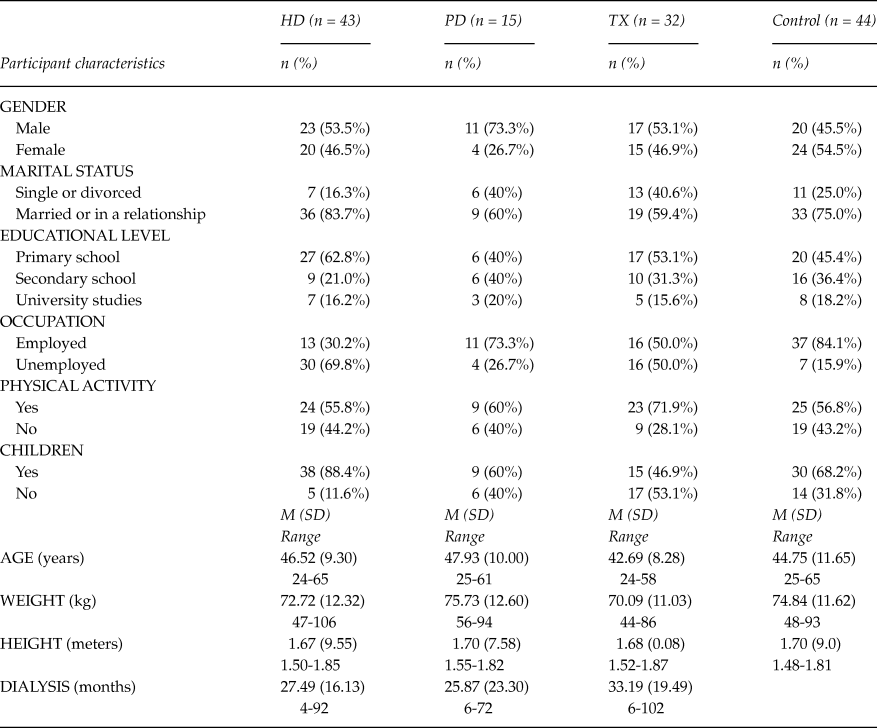
Firstly, after signing the informed consent, patients and controls reported socio-demographic data, habits, physical characteristics as well as time spent on dialysis (Table 1). Then, all of them filled in questionnaires evaluating QLI in general, HRQOL, mood, anxiety and quality of sleep. In patients under dialysis a test on dialysis stressors was administered, and those who had received a TX completed a test on QLI related to transplantation-specific symptoms.
Socio-demographic, physical characteristics, and time spent on dialysis

Note: HD = Haemodialysis; PD = Peritoneal dialysis; TX = Renal transplant.
Measures
In order to measure general health perception and expectancy, the following global question was included: “How do you think your health will be in the future, worse, similar, or better?” which synthesizes objective and subjective experiences with regard to the subjects’ health (Wilson & Cleary, Reference Wilson and Cleary1995).
Quality of Life Index–Spanish version (QLI-Sp)
The QLI-Sp (Mezzich et al., Reference Mezzich, Ruipérez, Pérez, Yoon, Liu and Mahmud2000) is a self-report questionnaire which assesses quality of life in the general population. It registers both satisfaction and relevance regarding various aspects of life such as well-being (physical and psychological), general functioning (self-care, occupational and interpersonal), support (social or emotional and that from the community), and fulfilment (personal and spiritual). It consists of 10 items which score from 0 to 10 (from bad to excellent). A high Cronbach’s alpha internal consistency has been found (α = .89), showing a high interrelation between the items of the questionnaire.
Short-Form Health Survey (SF-36)
The SF-36 (Ware & Sherbourne, Reference Ware and Sherbourne1992) is a self-report questionnaire which evaluates HRQOL both in the general population and in specific patient groups. It assesses the positive and negative mental and physical health status. The 36 items are classified into 8 categories: physical functioning, physical role, bodily pain, general health, vitality, social functioning, emotional role, and mental health. The Spanish version, translated and validated by Alonso, Prieto, and Antó (Reference Alonso, Prieto and Antó1995) was used. Cronbach’s alpha has been found to be high (α = .78).
Stressors Scale
The Stressors Scale (Baldree, Murphy, & Powers, Reference Baldree, Murphy and Powers1982) is specific for discomfort caused by dialysis. Although it was initially validated for HD, it has also been used in PD populations (Wang et al., Reference Wang, Lin, Liang, Wu, Tung and Tsay2014; Ye et al., Reference Ye, Chen, Lin, Wang, Zhang, Yang and Yu2008). In this modified version, one of the items related to stress caused by the economic burden of the treatment was eliminated due to the fact that the financial model carried out by the Spanish National Healthcare System is based on universal coverage as a constitutionally-guaranteed right. There is a total of 28 items to record the incidence and intensity of treatment-related stressors. Participants assess the degree of discomfort that each stressor causes using a Likert scale of 4 points (1 being “does not bother me much” to 4 “very troublesome”). A total score is obtained by summing the result of each of the items (the higher the score, the higher the degree of stress) and additionally, they can be classified into two components: physiological and psychosocial stressors (6 and 22 items, respectively). The questionnaire was translated for us by following the procedure of reverse translation. Total Cronbach’s alpha is .89 (physiological stressors α = .61; psychosocial stressors α = .83).
End-Stage Renal Disease Symptom Checklist-Transplantation Module (ESRD-scl)
The ESRD-scl (Franke et al., Reference Franke, Reimer, Kohnle, Luetkes, Maehner and Heemann1999) evaluates QLI after TX, focusing on transplantation-specific symptoms, side effects of immunosuppressive drugs, and psychological distress. It is a self-administered 43-item questionnaire which results in a global score consisting of the following subscores: limited physical capacity; limited cognitive capacity; cardiac and renal dysfunction; side effects of corticosteroids; increased growth of gum and hair; and transplantation-associated psychological distress. The subscales are scored from 0 to 4. We used the Spanish version, translated and validated by Ortega, Valdés, Rebollo, and Ortega (Reference Ortega, Valdés, Rebollo and Ortega2007). Cronbach’s alpha for overall score is .91 (range between .60 and .86 for dimensions).
The Hospital Anxiety and Depression Scale (HADS)
The Spanish version of HADS (Zigmond & Snaith, Reference Zigmond and Snaith1983), validated by Herrero et al. (Reference Herrero, Blanch, Peri, De Pablo, Pintor and Bulbena2003), is a 14-item self-assessment questionnaire containing two 7-item subscales to detect anxiety and depression disorders in medical non-psychiatric outpatients. Each item scores on a 4-point Likert scale from 0 to 3, giving a maximum subscale score of 21. Sub-scores equal or inferior to 7 denote absence of anxiety or depression; however, if they are equal or superior to 11 they reveal a possible presence of these clinical states. The Cronbach’s alpha for the full scale is .90 (α = .85 for the anxiety scale, and α = .84 for the depression scale).
Pittsburgh Sleep Quality Index (PSQI)
The PSQI (Buysse, Reynolds, Monk, Berman, & Kupfer, Reference Buysse, Reynolds, Monk, Berman and Kupfer1989) provides initial indexes of the severity and nature of sleep disturbances. It was developed to evaluate sleep quality during the previous month, and consists of 19 self-rated items which assess sleep duration and latency as well as frequency and severity of sleep disturbances. A global score ranging from 0 to 21 can be obtained using a 4-point Likert scale. The Spanish version of the PSQI was translated and validated in a Spanish population by Macías and Royuela (Reference Macías and Royuela1996). The Cronbach’s alpha for the full scale is .81.
Statistical analyses
In order to analyse continuous data, one or two-way ANOVA and HSD Tukey tests for post-hoc comparisons among groups were used if data were normally distributed and variance was homogeneous (Levene test for homogeneity of variance was used; significance level, p < .05). If variance was not homogeneous, ANOVA with Brown-Forsythe statistics, combined with Games-Howell post hoc analysis was applied. When data were not normally distributed, Kruskal-Wallis and Mann-Whitney U tests were calculated. For categorical data, χ2 tests were performed. Pearson bivariate correlations were carried out in order to study the associations of time spent on dialysis with HRQOL, HADS and PSQI. We have included an effect size index for some comparisons, using Cohen’s d, which provides a standardized measure of the magnitude of group differences that can be compared across samples (Cohen, Reference Cohen1988). A measure of effect size for Mann-Whitney U (r) was calculated by dividing Z by the square root of N (r = Z/√N; Field, Reference Field2005). Multiple linear regression analyses were used to calculate the effects of several independent psychological variables (quality of sleep, depression and anxiety scores) on each QLI-Sp and SF-36 subscales. Statistical pack SPSS 19 was used to conduct all analyses.
Results
Patients and controls were comparable with respect to gender, marital status, educational level, physical activity, weight, height and dialysis vintage (HD and PD patients) at the time of assessment. Posterior analyses revealed statistically significant differences with respect to occupation (χ2 = 28.1, p = .001) and having children (χ2 = 15.3, p = .001). Controls differ from HD and TX patients regarding employment rates (p = .001), and subjects undergoing HD are parents in a higher proportion than the other groups of subjects: PD (p = .017), TX (p = .001) and controls (p = .023) (Table 1).
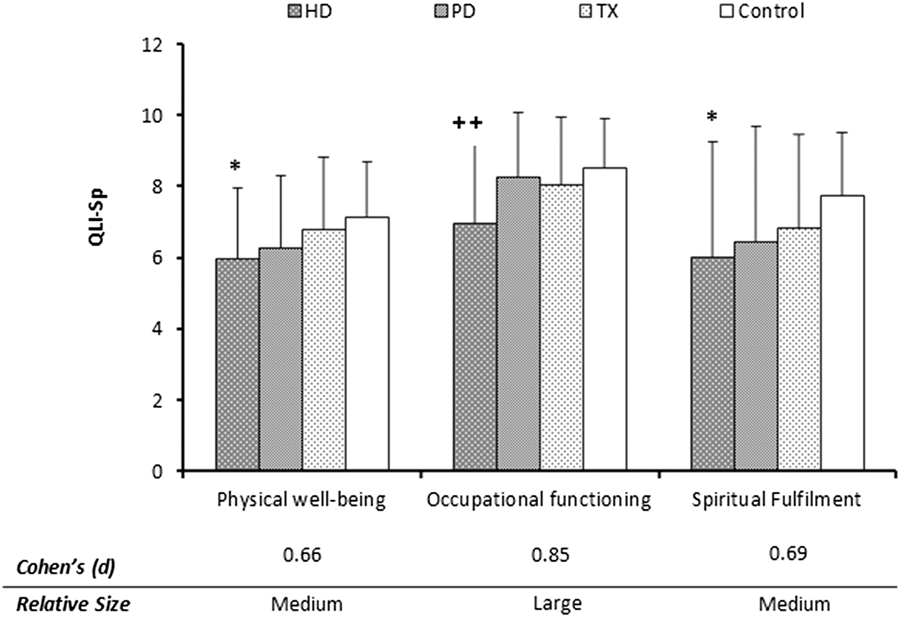
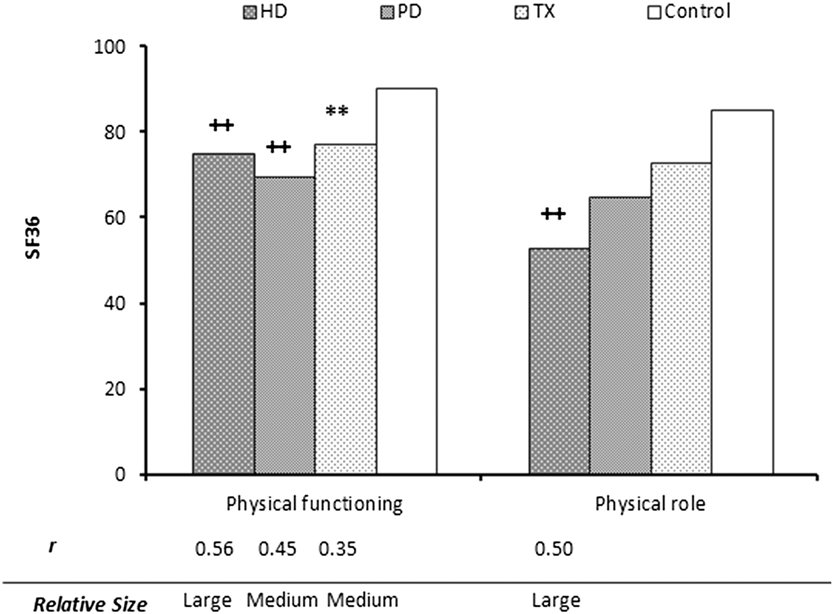
With respect to data belonging to QLI-Sp and SF-36 questionnaires, significant statistical differences were found in physical well-being, F(3, 131) = 5.13, p = .002, occupational functioning, F(3/92.2) = 5.67, p = .001, spiritual fulfilment, F(3/66.97) = 2.95, p = .039, physical functioning, H(3) = 27.42, p = .001, and physical role, H(3) = 19.13, p = .001.
Post-hoc comparisons revealed that control subjects showed a better physical well-being (p = .022), occupational functioning (p = .001) and spiritual fulfilment (p = .013) than HD patients. Controls also had a better physical functioning than HD (U = 237.5, Z = –4.77, p = .001), PD (U = 74.5, Z = –3.29, p = .001), and TX patients (U = 427, Z = –3.02, p = .003) and also obtained higher scores in physical role than HD patients (U = 303.5, Z = –4.21, p = .001).
Differences between patients and controls in physical well-being, occupational functioning and spiritual fulfilment (QLI-Sp).
Note: ++p = .001 *p < .05.

Differences between patients and controls in physical functioning and physical role (SF-36).
Note: ++p = .001 **p < .01.

Bivariate Pearson correlations between subscales from QLI and SF-36 tests revealed positive associations between physical well-being and physical functioning (r = 0.351, p = .001) and occupational functioning and physical role (r = 0.422, p = .001).
There were no differences among HD and PD subjects regarding physiological distress or total stress due to treatment (Stressors Scale). HD patients experienced more psychological distress than PD patients (t = 2.152, p = .036) and, in the former group, this component was significantly related to anxiety (r = 0.428, p = .002), depression (r = 0.391, p = .005) and quality of sleep (r = 0.339, p = .013) scores.
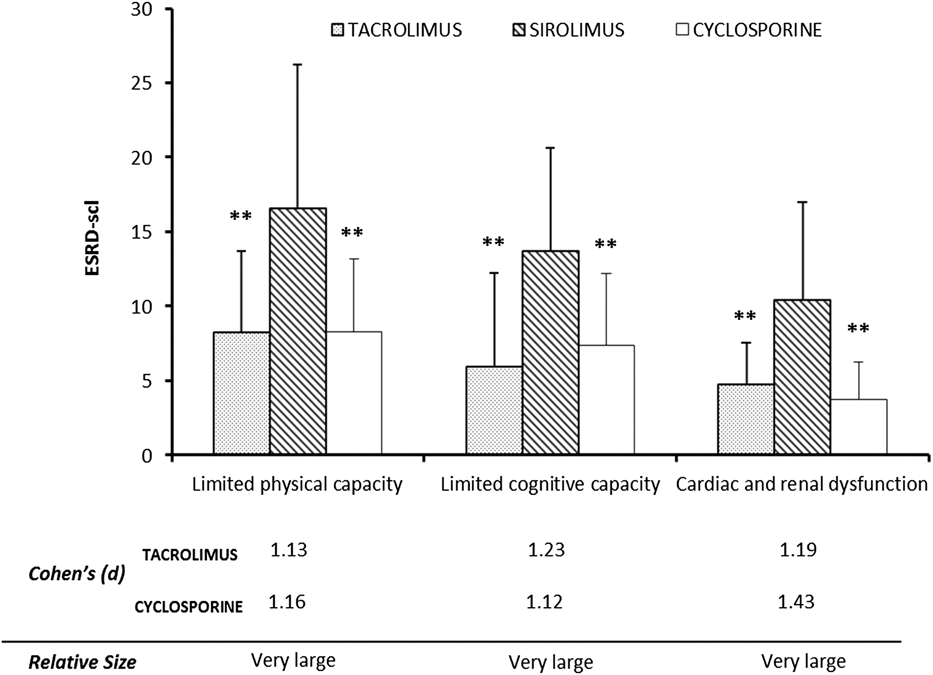
Results obtained from the ESRD-scl test showed significant differences among immunosuppressive treatment groups in some subscales: limited physical capacity, F(2, 27) = 5.35, p = .01, limited cognitive capacity, F(2, 27) = 5.55, p = .01, cardiac and renal dysfunction, F(2, 27) = 5.86, p = .01, and increased growth of gum and hair, F(2, 27) = 8.23, p = .002. When comparing by gender, women complained about cardiac/renal dysfunction, F(1, 27) = 4.70, p = .04, and corticosteroid side effects more than men, F(1, 27) = 13.8, p = .001. Those on sirolimus protocol exhibited more cardiac/renal dysfunctions (p = .01 and p = .02) and more physical (p = .04 and p = .02) and cognitive limitations (p = .03 and p = .01) than the other two groups (cyclosporine and tacrolimus, respectively). Finally, subjects receiving cyclosporine showed more growth of gums and hair than sirolimus and tacrolimus groups (p = .01, Cohen’s d = 1.40 and 1.25 respectively, a very large effect).
Differences between sirolimus and the other two groups (tacrolimus and cyclosporine) in ESRD-scl test.
Note: **p < .01.

Although none of the groups obtained clinical scores in anxiety or depression, there were significant differences with respect to the latter, H(3) = 9.03, p = .03, but only between TX and HD groups. TX patients obtained lower depression scores than HD patients (U = 429.5, Z = –2.79, p = .005). No differences were found with respect to sleep concerns or future expectancies about health.
Bivariate Pearson correlations between dialysis vintage and subscales from all tests revealed a positive association with sleep disturbances (r = 0.320, p = .01) and depression (r = 0.273, p = .04) scores and a negative relationship with total QLI-Sp score (r = –0.329, p = .01).
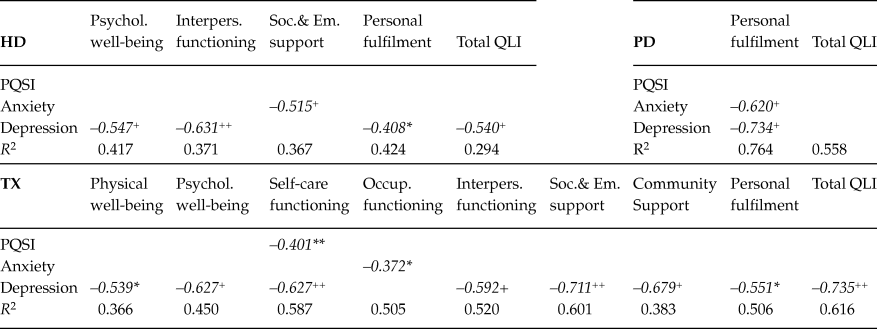
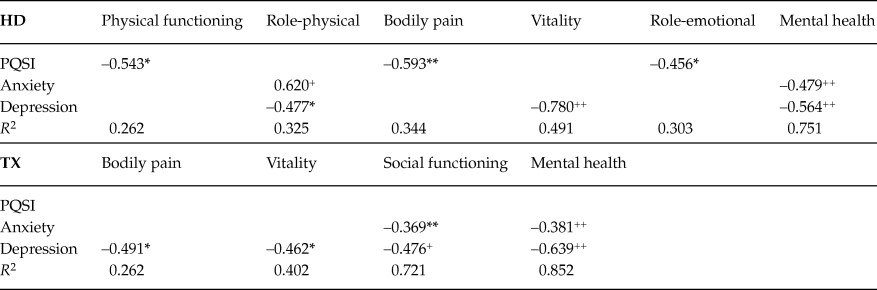
Regression models including sleep, anxiety and depression were estimated for subscales of QLI-Sp and SF-36 (Tables 2 and 3). In TX patients low depressive scores would be related to an optimal QLI in almost the totality of subscales while in HD patients they could explain part of the variability in psychological well-being, interpersonal functioning and personal fulfillment.
Standardised regression coefficients and proportion of total variance explained (R2) by PQSI, anxiety and depression (predictors) in the regression model for each of the subscales of the QLI-Sp test (dependent variables)

Note: QLI = Quality of life; Psychol. well-being = Psychological well-being; Interpers. Functioning = Interpersonal functioning; Soc. & Em. Support = Social and Emotional support; Occup. Functioning = Occupational functioning; Interpers. Functioning = Interpersonal functioning; PSQI = Pittsburgh Sleep Quality Index; HD = Haemodialysis; PD = Peritoneal dialysis; TX = Renal transplant.
*p ≤ .05; **p < .01; +p < .005; ++p = .001.
Standardised regression coefficients and proportion of total variance explained (R2) by PQSI, anxiety and depression (predictors) in the regression model for each of the subscales of the SF-36 test (dependent variables)

Note: PSQI = Pittsburgh Sleep Quality Index; HD = Haemodialysis; PD = Peritoneal dialysis; TX = Renal transplant.
*p ≤ .05; **p < .01; +p < .005; ++p = .001.
Discussion
The dimensions of QLI that were most affected, regardless of whether they referred specifically to health or not, were occupational function (Physical Role subscale measured by SF-36 and Occupational Functioning by QLI-Sp) and physical status (Physical Functioning subscale measured by SF-36 or Physical Well-being by QLI-Sp).
Only the HD group has a significantly more negative perception than controls of their QLI regarding the degree to which physical health interferes with work or other activities. HD treatment makes greater negative differences in the life of this group than in the case of the PD or TX groups. Their perception of occupational function is more negative because they cannot work due to the incompatibility of treatment with a job or with the job they previously had. Moreover, in this population the increase in employment ratio after renal transplantation seems to be moderate (50% of unemployment in our sample) as was found in other studies (Overbeck et al., Reference Overbeck, Bartels, Decker, Harms, Hauss and Fangmann2005). This change in the patient's life may enhance feelings of incapacity and dependence which, at the same time, could increase the likelihood of depression and cognitive deficits (Feroze, Martin, Reina-Patton, Kalantar-Zadeh, & Kopple, Reference Feroze, Martin, Reina-Patton, Kalantar-Zadeh and Kopple2010). In the present study, although no groups reach clinical levels of anxiety or depression, TX are those who exhibited the lowest depression scores in comparison to the rest of subjects and score significantly lower than HD. TX patients have improved their quality of life significantly respecting the dialysis period and on the contrary controls expect to get worse as time goes by. Furthermore, patients undergoing PD normally keep their jobs and even choose this option to be able to do so if clinically possible. It could be said that this is the best option while awaiting renal transplant because renal function, although residual, is better preserved than under HD protocol and could contribute to decrease the unemployment rates found in TX condition.
CKD patients have a significantly more negative perception of their QLI than controls with respect to the degree to which physical health interferes with daily physical activities although only those undergoing HD show worse physical well-being. This poor perception could be due, in part, to the existence of axonal depolarization that occurs after the dialysis session, which makes it much more difficult for the patient to do any physical work. At the same time, there are authors who emphasize the need to include physical activity within the protocol of dialysis patients to prevent motor impairment and to remedy the aforementioned depolarization (Howden, Fassett, Isbel, & Coombes, Reference Howden, Fassett, Isbel and Coombes2012; Krishnan & Kiernan, Reference Krishnan and Kiernan2009).
Patients receiving HD find it more problematic to carry out leisure or physical activities owing to the length of the dialysis session (3 to 5 hours, 3 days a week), to which the time spent in traveling to the dialysis facility also has to be added. All this increases the negative perception of physical well-being, which directly influences how subjects could perceive their quality of life in general. Additionally, patients on HD are much more dependent on hospital staff, which increases feelings of incapacity and disability. Moreover, these patients perceive that their autonomy in carrying out everyday tasks is diminished, leading to functional dependence and a sense of lack of control over treatment and their lives, on the contrary, PD is under the control of the patients themselves. Furthermore, patients on HD are those who most negatively value the spiritual fulfilment variable, which could be related to the unfavourable perception of health regarding the existence of different associated pathologies, cognitive impairment and motor problems, and the lack of autonomy to carry out any kind of activity (Feroze et al., Reference Feroze, Martin, Reina-Patton, Kalantar-Zadeh and Kopple2010). It could also be related to the significant negative association between dialysis vintage and total QLI-Sp score found.
In terms of expectations about their health in the future, CKD patients are as equally positive as the control group. Patients under dialysis hope that with a future transplant their health will improve and some neurological and physical aspects linked to kidney failure would be attenuated. This modality is especially important in Spain, because it is one of the European countries with the highest deceased donation rates (it ranged from 33 to 35 per million population in 2009). In fact, the Spanish Model is being studied to be adopted by other countries (Matesanz, Domínguez-Gil, Coll, de la Rosa, & Marazuela, Reference Matesanz, Domínguez-Gil, Coll, de la Rosa and Marazuela2011).
On the other hand, time spent on dialysis was positively related to sleep disturbances and depression. Poor quality of sleep and the resulting lack of rest may influence the physical problems of patients and indirectly increase the negative perception of their physical well-being or general health. Moreover, poor quality of sleep over a long period would affect the perception of stressors arising from the treatment and stress response and indirectly increase the probability of experiencing depressive symptoms (Eryavuz et al., Reference Eryavuz, Yuksel, Acarturk, Uslan, Demir, Demir and Sezer2008). The need to control this aspect is important and should be considered in a protocol of dialysis due to the negative consequences impaired sleep may have on the patient.
Stressors linked to dialysis could be responsible for qualitative differences among groups. This treatment is an important source of stress, which could be a risk factor for several disorders (i.e. depression, anxiety and cardiovascular diseases). We found significant differences between HD and PD patients regarding the component related to psychosocial distress. It reveals a negative impact on the social area (e.g. hedonic adaptation), since the possibilities of leisure (sports, holidays, outings and meals away from home) are limited. These features are more pronounced in HD patients and reflect the high degree of discomfort experienced, which could be related to anxiety and depressive symptoms as is supported by the fact that only in these patients do anxiety and depression correlate positively with psychosocial stressors.
Those TX patients on sirolimus protocol exhibited more cardiac/renal dysfunctions and more physical and cognitive limitations than cyclosporine or tacrolimus groups. In fact, Bertrand et al. (Reference Bertrand, Desbuissons, Pallet, Debure, Sartorius, Anglicheau and Sberro-Soussan2013) found two cases of pericardial tamponade caused by this immunosuppressive drug in renal transplant recipients. Moreover, subjects receiving cyclosporine showed more growth of gums and hair than the other two groups, which is a common side effect of this drug (Martínez-Sanchis et al., Reference Martínez-Sanchis, Bernal, Montagud, Candela, Crespo, Sancho and Pallardo2011). Depending on gender, complaints are different too. Main concerns in women in comparison to men are those related to cardiac and renal problems and corticosteroid side effects, as was found in other studies (Franke, Yücetin, Yaman, Reimer, & Demirbas, Reference Franke, Yücetin, Yaman, Reimer and Demirbas2006). This could be explained by the existence of sex differences in renal function and pharmacodynamic responses, there being more adverse cardiovascular drug effects in women in comparison to men (Spoletini, Vitale, Malorni, & Rosano, Reference Spoletini, Vitale, Malorni and Rosano2012). Moreover, high levels of corticosteroids significantly alter appearance (hirsutism, acne, striae, “moon face”, “buffalo hump” and central or whole-body obesity), which could negatively affect the body image. This particularly applies to women from western countries unlike those from developing countries, where corticosteroid misuse and abuse is widespread for aesthetic purposes, fat being linked to beauty, wealth and health (Mansour, Odaa, & Wanoose, Reference Mansour, Odaa and Wanoose2010). Additionally, there are sex differences in the impact of the following side effects of corticosteroids: reduction of bone mineral density, osteoporosis and associated fractures throughout the body; these being higher in women (Manson, Brown, Cerulli, & Fernandez Vidaurre, Reference Manson, Brown, Cerulli and Fernandez Vidaurre2009).
Among the limitations of the present study could be included the size of the sample, although size effect tests were calculated (Cohen’s d and r), and the fact that it belongs only to one hospital unit. It would be interesting to extend this study to incorporate other local and national hospitals.
Although SF-36 is one of the most widely used instruments in clinical and healthy populations, it does not include several domains which are especially relevant to CKD patients, such as work status, sleep, family or spiritual concerns. Other limitations of general HRQOL questionnaires are the lack of exploration of symptomatology related to anxiety and depression (Avramovic & Stefanovic, Reference Avramovic and Stefanovic2012). Therefore, this study provides an overview in which quality of life, general expectations about health, work status and daily activities, sleep, anxiety and depression are evaluated in CKD patients with the three renal replacement protocols. There is extensive literature which compares both kinds of dialysis or HD and TX, but very few take into consideration the three of them. As medical interventions have grown in efficacy in terms of survival rates, the focus at the present is on increasing the quality of life. It would be interesting to provide a model of psychological intervention for CKD patients to facilitate adaptation to their new lifestyle and reduce the negative effects to the greatest extent possible. We should especially consider a broader intervention protocol for patients who have to undergo HD, which would include psychological support, quality of sleep monitoring and increment of physical activities to reduce the deteriorating effects of the treatment and inactivity.