INTRODUCTION
Giardia intestinalis (syn. G. lamblia, G. duodenalis) is a mammal-infecting parasite (Adam, Reference Adam2001). Since 1988, the World Health Organization has recognized that there are more than 280 million infections per year in Africa, Asia and America alone (Comité OMS d'Experts, 1988; Feng and Xiao, Reference Feng and Xiao2011). Giardiosis can be symptomatic or asymptomatic; however, independent of the clinical course, trophozoites harm enteric cells, hinder the absorption of nutriments and cause different degrees of malabsorption (Astiazarán-García et al. Reference Astiazarán-García, Espinosa-Cantellano, Castañón, Chávez-Munguía and Martínez-Palomo2000), which can lead to malnutrition and delayed cognitive development (Berkman et al. Reference Berkman, Lescano, Gilman, Lopez and Black2002). The main treatments against G. intestinalis are based on derivatives of the following compounds: acridine, mepacrine (Mendelson, Reference Mendelson1980) and quinacrine (Harris et al. Reference Harris, Plummer and Lloyd2001); nitroimidazoles, including metronidazole (Freeman et al. Reference Freeman, Klutman and Lamp1997), tinidazole (Jokipii and Jokipii, Reference Jokipii and Jokipii1980), ornidazole (Jokipii and Jokipii, Reference Jokipii and Jokipii1982), and other 5-nitroimidazoles (Upcroft et al. Reference Upcroft, Campbell, Benakli, Upcroft and Vanelle1999); benzimidazoles, albendazole (Dutta et al. Reference Dutta, Phadke, Bagade, Joshi, Gazder, Biswas, Gill and Jagota1994), mebendazole (Bulut et al. Reference Bulut, Gulnar and Syseb1996), nitrofuranes, and furoxone (Pickering, Reference Pickering1985); and more recently, nitazoxanide, a nitrothiazole (Romero et al. Reference Romero, Robert, Muñoz and Geyne1997; Ponce-Macotela et al. Reference Ponce- Macotela, Gómez-Garduño, González-Maciel, Reynoso-Robles, Anislado-Tolentino and Martínez-Gordillo2001). However, these drugs all produce undesirable secondary effects, ranging from nausea, (Davidson, Reference Davidson1984) and metallic taste in the mouth (Spellman, Reference Spellman1985) to psychosis (Upcroft et al. 1996), carcinogenesis (Gardner and Hill, Reference Gardner and Hill2001) and possible genetic damage (Legator et al. Reference Legator, Connor and Stoeckel1975; Mitelman et al. Reference Mitelman, Hartley-Asp and Ursing1976). In addition, there is evidence suggesting the selection of resistant strains to anti-giardial drugs (Upcroft, Reference Upcroft1994; Upcroft and Upcroft, Reference Upcroft and Upcroft2001; Sangster et al. Reference Sangster, Batterham, Chapman, Duraisingh, Jambre, Shirley, Upcroft and Upcroft2002; Dunn et al. Reference Dunn, Burgess, Krauer, Ekmann, Vanelle, Crozet, Gillin, Upcroft and Upcroft2010). Therefore, it is necessary to research and develop new alternatives for giardiosis treatment. Traditional indigenous medicine and ethnobotanical knowledge are commonly used as sources to find new drugs. In previous studies (Ponce-Macotela et al. Reference Ponce-Macotela, Navarro-Alegría, Martínez-Gordillo and Alvarez-Chacón1994, Reference Ponce-Macotela, Rufino-González, González-Maciel, Reynoso-Robles and Martínez-Gordillo2006), whole Lippia extracts were found to be more potent than tinidazole; however, which substance(s) are responsible for the activity against Giardia is still unknown. In this study, we characterize the anti-Giardia activity of fraction 6 (F-6) from whole oregano ethanol extract.
MATERIALS AND METHODS
Giardia isolate
Giardia intestinalis INP020300B2 isolated from a lamb and identified as genotype A-I (not published) was cultured in TYI-S-33, harvested in log phase, washed 3 times with cold sterile phosphate-buffered saline (PBS, pH 7·0), counted in a Neubauer chamber, and used in bioassays.
Oregano plants
Oregano from Milpillas, Guanajuato was identified, and a sample was deposited at the Biology Institute with the identification code MEXU-IB-UNAM 1 022 934 as Lippia graveolens (HBK, 1818, syn. Lantana origanoides, Lippia berliandieri). Lippia leaves were frozen with dry ice and grounded in a mortar to a fine powder. The powder was then extracted in 75% ethanol/water (v/v) at 4°C, with continuous stirring. The extractable substances were dried in a centrifuge (SpeedVac) at 1800 rpm for 8 h, then weighed and stored in amber bottles until experimental use.
Fractions
To identify the compound(s) responsible for the anti-giardial activity, the whole extract was fractionated on a chromatography column packed with silica gel and eluted with hexane/ethyl acetate (4:1), in fractions of 100 ml. We then analysed collected fractions using silica gel thin layer chromatography (TLC), and TLC spots were detected by spraying with 2% ceric sulphate (Ce(SO4)2) solution in 50% sulphuric acid and heating at 100°C. Fractions with the same retardation factor (Rf) were pooled, vacuum-dried in a rotary evaporator TLC-re-analysed and stored in amber bottles at 4°C until experimental use.
Pooled fractions that showed strong anti-giardial activity were further analysed for purity by HLPC. To characterize the major compounds within the fraction spectroscopy at 800 and 4000 nm, nuclear magnetic resonance (H-NMR Variant Gemini) 200 MHz, mass spectrograph in a Joel RX 505 HA, and polarizer light rotation was performed.
Bioassays
To ascertain anti-Giardia activity, bioassays were performed as previously described (Ponce-Macotela et al. Reference Ponce-Macotela, Rufino-González, González-Maciel, Reynoso-Robles and Martínez-Gordillo2006). Briefly, 1·5 million G. intestinalis trophozoites were exposed to different Lippia fractions in PBS (pH 7·0), at concentrations ranging from 2 μg ml−1 to 50 μg ml−1 (fractions were dissolved in dimethyl sulphoxide (DMSO) before each single experiment, the final DMSO concentration was less than 0·05%) in 1.5 Eppendorf tubes, and incubated at 37°C for 2 h. To eliminate traces of extract, the trophozoites were washed twice with PBS. Cellular viability was tested in 2 ways. First, the reduction of MTT-tetrazolium salts to MTT-formazan was measured. For this technique, exposed parasites were washed and subsequently incubated for 30 min at 37°C in a solution containing 40 μl of MTT-tetrazolium salts (5·0 mg ml−1) and catalysed with 20 μl of PMS (2·5 mg ml−1). The synthesized dye was dissolved in isopropanol/hydrochloric acid and its concentration was measured in a spectrophotometer set at 570 nm (Ponce-Macotela et al. Reference Ponce-Macotela, Navarro-Alegría, Martínez-Gordillo and Alvarez-Chacón1994). Second, cellular viability was tested by re-growth in fresh TYI-S-33 medium. The washed trophozoites, from experimental and control populations, were inoculated into culture tubes with fresh TYI-S-33 culture medium and incubated at 37°C. To determine if there were changes in the Giardia populations, we looked for living cells attached to the tube walls every 24 h for 1 week. If there were trophozoites still alive, then the cells were harvested and counted in a Neubauer chamber.
Ultrastructure
To identify ultrastructural modifications, Giardia trophozoites from experimental and control groups were fixed in 2·5% glutaraldehyde buffered with phosphate buffer (0·1 M, pH 7·2), post-fixed in 1% osmium tetroxide, dehydrated in an ethanol series and embedded in LR white resin. Thin sections were mounted on formvar-coated copper grids and stained with lead citrate/uranyl acetate. The structural changes from 50 fields for each sample were recorded using a Carl Zeiss EM-109 transmission electron microscope.
Mimicking F-6 with commercial compounds
To reproduce F-6 mix we bought the 3 major compounds identified in Lippia-F-6 (LF-6). Bioassays were performed with every single compound to identify the substance with the main anti-giardial activity and with the artificial mix, because we hypothesize that these substances could have synergic activity. Assays to measure the Giardia sensitivity were the reduction of tetrazolium salts to MTT-formazan and re-growth, as we have described previously.
Every experiment was performed 4 times in a triplicate fashion and the controls were: unexposed trophozoites, trophozoites exposed to DMSO, tinidazole 250 μg ml−1, and trophozoites treated with 3 freeze and thaw cycles in liquid N2.
Toxicity test on human lymphocytes
Lymphocytes were isolated from a whole blood sample obtained from a healthy donor using Ficoll-Paque gradient centrifugation. Approximately 300 000 lymphocytes were exposed to increasing concentrations of F-6 from 2–10 μg ml−1 in RPMI-1640 and incubated for 2 h at 37°C in 5% CO2. The cells were then washed with PBS and 1×10⁵ lymphocytes were re-cultured in 100 μl of RPMI-1640 culture medium plus, 49 μl of XTT-tetrazolium salts (1 mg ml−1), and 1 μl of PMS (0·383 mg ml−1) in a 96-well plate and incubated at 37°C for 24 h in 5% CO2. Synthesized formazan was measured using a spectrophotometer set at 490 nm. As a negative control, unexposed lymphocytes were used, and as a positive control, cells treated with 3 freeze-thaw cycles in liquid N2 were used.
Statistics
Statistical analysis was performed using the SPSS version 17 program. ANOVA and Tukey tests at a significance level of P=0·05 and Probit analyses were performed.
RESULTS
Fractions
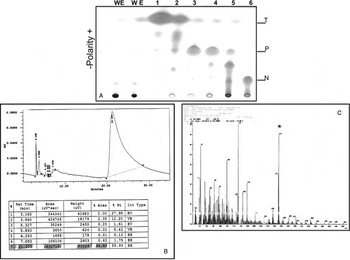
Whole oregano extract was separated into 32 fractions, which were examined by TLC with ceric sulphate as the developing reagent. Fractions with the same Rf were mixed together, resulting in 6 fractions, the TLC-pattern of these fractions is shown in Fig. 1.
TLC showing the pattern of 6 isolated fractions (1–6) and the whole extract (WE) from Lippia graveolens. (A) Relative positions of T: thymol; P: pinocembrin; N: naringenin. (B) Shows the F-6 relative concentration of compounds by HPLC, major component was naringenin. (C) The MS from F-6 shows a molecular ion (*) with 272 molecular weight, that corresponds to C15H12O5.

Bioassays
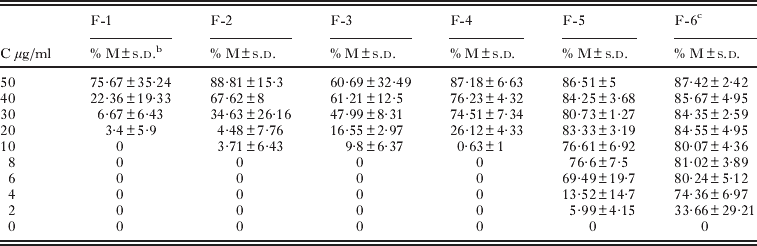
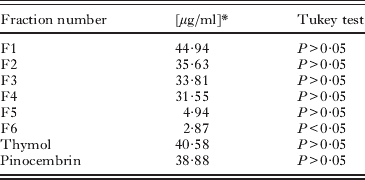
Lippia fractions were tested by measuring the reduction of MTT-tetrazolium salts to formazan and re-culturing in fresh medium. The performance of the 6 fractions was charted in Table 1. ANOVA analysis indicated significant differences between fractions at P<0·05. Probit analysis revealed that fractions F-5 and F-6 had the best levels of anti-Giardia activity in 2-h experiments, with LD50 values of 4·94 and 2·87 μg ml−1 (Table 2). Fraction F-6 had the highest level of anti-Giardia activity, killing more than the 80% of the population detected with tetrazolium salts assay and 100% of the population with the growth inhibition method at the lowest concentration 6 μg ml−1. HPLC analysis of F-6 demonstrated that there were several compounds, the major one accounting for 94·80% of the area and traces in concentrations as low as 0·01% of the area (Fig. 1). Infrared spectroscopy analysis revealed absorption spectra consistent with a double bond of an aromatic ring from a phenolic or carbolic group and H−NMR suggested the presence of a flavanone. Mass spectra yielded a molecular ion with a molecular weight of 272 (Fig. 1). These data are compatible with the compound 5,7,4′-trihidroxiflavanona, more commonly known as naringenin (Dominguez et al. Reference Domínguez, Sánchez, Suárez, Baldas and González1989; Arcila-Lozano et al. Reference Arcila-Lozano, Loarca-Piña, Lecona-Uribe and Mejía2004).
Anti-giardial activity of fractions from Lippia graveolens from whole extract and controla
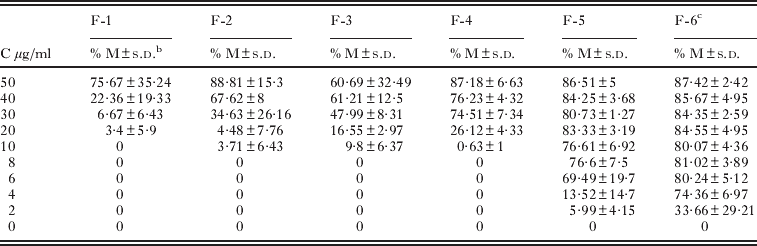
a Tinidazol at 250 μg/ml produced a mortality of 44·52±2·41, and inhibited 99·95% of G. intestinalis re-growth in fresh TYI-S-33.
b % mortality±standard deviation.
c F-6 inhibited 99·95% of G. intestinalis re-growth in fresh TYI-S-33.
Concentrations required to kill 50% of Giardia intestinalis populations and their significance values by Tukey tests for Lippia graveolens fractions, and commercial compounds
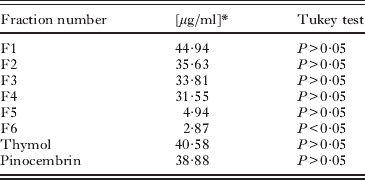
* Probit test, LD50.
Re-culture and ultrastructure
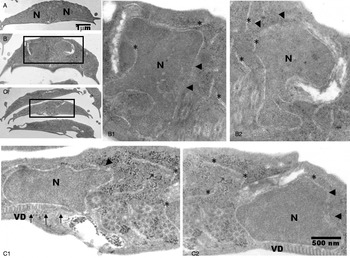
In re-culture experiments, 2 μg ml−1 of F-6 was sufficient to produce profound physiological injuries that inhibited the growth of Giardia trophozoites in fresh TYI-S-33 medium. This result was substantiated by ultrastructural analysis, in which F-6 treatment at 2 μg ml−1 led to more evident endoplasmic reticulum cisterns (*) and irregularly shaped nuclei (Fig. 2B, C). Near the nuclei, large gaps of amorphous material and glycogen granules were found. In some cases, the double nuclear envelope was discontinuous (arrowheads Fig. 2B1, B2, C1 and C2). There was also destruction of the suckling (ventral) disc structure (VD arrows) and vesicles under the cytoplasm membrane. Trophozoites treated with concentrations of 4, 6, and 8 μg ml−1 presented a similar injury (data not shown). In contraposition with untreated trophozoites that present the classic structure, nucleus, axonemes, ventral suckling disc, ventrolateral flange and lateral crest (Fig. 2A).
(A) Untreated Giardia intestinalis trophozoites showing the classic morphology (N) nucleus. (B and C) Trophozoites treated with F-6 from Lippia graveolens at 2 μg ml−1 Scale bar=1 μm. B1, B2, C1 and C2 highlight nuclear envelope discontinuities (arrowheads) membrane systems emphasized with asterisk, there are electron-lucid places filled with an amorphous proteinaceous substance. C1, arrows show damage in ventral suckling disc (VD) Scale bar=500 nm.

Toxicity assays
Toxicity assays did not reveal any differences between Lippia-F-6 treated lymphocytes and untreated lymphocytes.
Mimicking the F-6 activity
The anti-giardial activities of pure thymol, naringenin and pinocembrin are summarized in the Table 3, it showed that neither pure compounds nor the artificial mix were able to mimic the anti-giardial activity of the Lippia-F-6. Values of LD50 were thymol 40·58 μg ml−1 and pinocembrin 38·88 μg ml−1; data from the reduction of tetrazolium salts to formazan viability test are shown in Table 2.
Performance of commercial compounds against Giardia intestinalis trophozoitesa
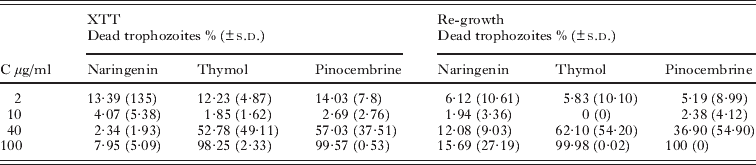
a Artificial F-6 with 3 compounds has a poor effectiveness against G. intestinalis, less than naringenin.
DISCUSSION
Oregano is a plant used as a spice in many parts of the world. It is also a source of compound(s) with activity against Giardia and, as we previously demonstrated, it has a stronger anti-giardial effect than tinidazole (Ponce-Macotela et al. Reference Ponce-Macotela, Navarro-Alegría, Martínez-Gordillo and Alvarez-Chacón1994, Reference Ponce-Macotela, Rufino-González, González-Maciel, Reynoso-Robles and Martínez-Gordillo2006). In those studies, however, the total extract was used at very high concentrations, ranging from 58·88 to 300 μg ml−1. Here we analysed the anti-giardial activity of fractions isolated by column chromatography on Giardia trophozoites. The damage was evaluated using the reduction of MTT-tetrazolium salts to MTT-formazan and re-culturing in fresh TYI-S-33. Although the MTT-tetrazolium salt assay has low sensitivity, it allowed us to find a gross concentration that killed nearly 80% of the Giardia population and to discard concentrations that were below the efficacy of tinidazole.
We found that whole extract of Lippia contained several substances that were able to kill Giardia trophozoites. Fraction F-1 was mainly comprised of essential oils and had an LD50 of 44·94 μg ml−1. This value is lower than that recorded by Machado et al. (Reference Machado, Dinis, Salgueiro, Cavaleiro, Custódio and Sousa2010). Probit analysis, indicated that fractions F5 and F6 had good activity against Giardia in experiments as short as 2 h. These experiments were performed with the B2 Giardia isolate, which is more resistant to tinidazole and nitazoxanida treatment than the MM or WB isolates (Ponce-Macotela et al. Reference Ponce- Macotela, Gómez-Garduño, González-Maciel, Reynoso-Robles, Anislado-Tolentino and Martínez-Gordillo2001).
In re-culture experiments, we found that a concentration of 6 μg ml−1 produced irreversible damage on 100% of the B2-Giardia isolate population, as even treated trophozoites were unable to grow in fresh culture medium. From these results we inferred that the lethal dose at 100% was 6 μg ml−1; (LD100=6 μg ml−1). This concentration was 10 times lower than values previously reported for the MM-isolate (Ponce- Macotela et al. Reference Ponce-Macotela, Rufino-González, González-Maciel, Reynoso-Robles and Martínez-Gordillo2006).
To further understand the failure of the trophozoites to re-populate tubes in re-culture experiments, we looked for ultrastructural damage on Giardia trophozoites. The analysis revealed that the lowest concentration of fraction F-6 tested, 2 μg ml−1, was enough to damage the nuclear envelope, giving rise to perforations on the nuclear membrane (Fig. 2, arrowheads). In previous studies, we demonstrated that total Lippia ethanol extract produced changes in permeability, causing trophozoites to appear swollen. In addition, we observed a lack of glucocalix, gaps on the nuclear envelope and a loss of the nucleoskeleton structure (Ponce-Macotela et al. Reference Ponce-Macotela, Rufino-González, González-Maciel, Reynoso-Robles and Martínez-Gordillo2006). Similar gaps on the Giardia nuclear envelope treated with Lippia essential oils were observed by Machado et al. (Reference Machado, Dinis, Salgueiro, Cavaleiro, Custódio and Sousa2010), suggesting that oils reduce Giardia adherence. We also found that the ventral (suckling) disk showed protein pattern destruction, which could explain the findings of Machado et al. (Reference Machado, Dinis, Salgueiro, Cavaleiro, Custódio and Sousa2010). The fraction F-6 is mainly comprised of naringenin, thymol, pinocembrin and traces of undetermined compounds. Naringenin is a flavonoid found in many plants; in a previous study, anti-giardial activity with an IC50=47·84 μg ml−1 was demonstrated (Calzada et al. Reference Calzada, Meckes and Cedillo-Rivera1999). In addition, it has anti-bacterial activity as tested in Staphylococcus aureus, Salmonella enterica, and Listeria monocytogenes (Mandalari et al. Reference Mandalari, Bisignano, D'Arrigo, Ginestra, Arena, Tomaino and Wickhamm2010). Pinocembrin from Teloxys graveolens has an activity with an IC50=57·4 μg ml−1 (Calzada et al. Reference Calzada, Meckes and Cedillo-Rivera1999, Reference Calzada, Velázquez, Cedillo-Rivera and Esquivel2003). The F-6 mix from Lippia had activity against G. intestinalis after 2 h of treatment, with a LD100 of 6 μg ml−1.
At this moment, we are yet unable to establish the identity of the compound responsible of the anti-giardial activity because the LD50 found for thymol and pinocembrin were higher than those observed for F-3. On the other hand, we failed to mimic the Lippia F-6 because artificial F-6 had a very low performance when we compared between them. These facts can only be explained if we assume that some of the components at the trace level had the main anti-giardial activity, or that all compounds are necessary because they have synergic activity. This is an ongoing study with a successful mix of compounds, which is capable of killing 50% of a Giardia trophozoite population at concentrations as low as 2·87 μg ml−1 in experiments as short as 2 h.
In addition, toxicity experiments did not show differences between experimental and control groups (P>0·5), suggesting that F-6 (at 10 μg ml−1) did not damage the defensive cells. Additional studies should be performed to confirm the lack of toxicity of F-6.
Many important follow-up experiments are possible, including identification of the F-6 molecular targets on Giardia trophozoites and performing experiments in vivo.