INTRODUCTION
Leishmaniasis is a mandatory notifiable disease in Greece, endemic in most islands and coastal regions of Greece and constitutes a veterinary and public health issue of major concern. From 1998 to 2011, human leishmaniasis cases were recorded in the mainland as well as in the islands of Greece with a mean annual incidence of 0·36 cases per 100 000 population (Gkolfinopoulou et al. Reference Gkolfinopoulou, Bitsolas, Patrinos, Veneti, Marka, Dougas, Pervanidou, Detsis, Triantafillou, Georgakopoulou, Billinis, Kremastinou and Hadjichristodoulou2013). Regarding the canine population, the overall reported seroprevalence in seven regions of the Greek mainland was nearly 20% ranging from 2·05% in Florina to 30·12% in Attiki (Athanasiou et al. Reference Athanasiou, Kontos, Saridomichelakis, Rallis and Diakou2012). Studies that have been conducted in Greece using geographical information system (GIS) mapped the occurrence of human leishmaniasis and related it to dog seropositivity (Ntais et al. Reference Ntais, Sifaki-Pistola, Christodoulou, Messaritakis, Pratlong, Poupalos and Antoniou2013; Sifaki-Pistola et al. Reference Sifaki-Pistola, Ntais, Christodoulou, Mazeris and Antoniou2014). Several studies conducted in other countries produced environmental risk mapping and spatial analysis of canine and human leishmaniasis using GIS, thus showing how an ecological approach can help improve our understanding of the spatial distribution of leishmaniasis (Chamaillé et al. Reference Chamaillé, Tran, Meunier, Bourdoiseau, Ready and Dedet2010; Franco et al. Reference Franco, Davies, Mylne, Dedet, Gállego, Ballart, Gramiccia, Gradoni, Molina, Gálvez, Morillas-Márquez, Barón-López, Pires, Afonso, Ready and Cox2011; Barón et al. Reference Barón, Morillas-MáRquez, Morales-Yuste, DíAz-SáEz, GáLlego, Molina and MartíN-SáNchez2013; Tsegaw et al. Reference Tsegaw, Gadisa, Seid, Abera, Teshome, Mulugeta, Herrero, Argaw, Jorge and Aseffa2013; Seid et al. Reference Seid, Gadisa, Tsegaw, Abera, Teshome, Mulugeta, Herrero, Argaw, Jorge, Kebede and Aseffa2014).
The previous years increase in the incidence rate of human leishmaniasis cases in Thessaly, Central Greece, prompted us to investigate possible risk factors. The aim of the study was to analyse together human cases and Leishmania infected dogs taking into consideration environmental parameters. The overall objective was to provide evidence for target interventions.
MATERIALS AND METHODS
Study area
Thessaly is located in the central part of Greece and has a total area of 14·036 km2, which roughly represents 11% of the whole country. Thirty six per cent of the land is flat and 17% is semi-mountainous, whereas the remaining 45% is mountainous (Domenikiotis et al. Reference Domenikiotis, Spiliotopoulos, Tsiros and Dalezios2005). The administrative region of Thessaly consists of four prefectures (Larissa, Trikala, Karditsa and Volos). These prefectures include 26 municipalities which are further divided in 545 municipality districts.
Human leishmaniasis cases
All the officially notified human leishmaniasis cases (n = 82) reported during 2007–2014 to Hellenic Centre for Disease Control and Prevention (HCDCP) from the treating physicians were included in this study (Supplementary Table S1). The human cases reported to HCDCP were considered and recorded as a human leishmaniasis case when presenting clinical picture compatible with human leishmaniasis and when the protozoan parasite was detected in cytological examination of clinical samples (whole blood and/or bone marrow) (Islam, Reference Islam2013) or when at least one clinical sample (whole blood and/or bone marrow) was polymerase chain reaction (PCR) positive according to the PCR assays performed in the two different reference laboratories in Greece (Spanakos et al. Reference Spanakos, Patsoula, Kremastinou, Saroglou and Vakalis2002; Christodoulou et al. Reference Christodoulou, Antoniou, Ntais, Messaritakis, Ivovic, Dedet, Pratlong, Dvorak and Tselentis2012) or when the patient was seropositive (Indirect Fluorescent Antibody Test or Enzyme-linked Immunosorbent Assay or Latex or immunochromatographic test) (with serology titre ⩾1/160 for IFAT). In overall, all the human leishmaniasis cases were PCR positive to at least one sample examined or the protozoan parasite was detected in cytological examination of clinical samples except five human cases which were seropositive only. The geo-references for the human cases were obtained by geocoding and they were resolved to municipality district level.
Leishmania infected dogs
Dogs submitted to veterinary clinics in Thessaly, after clinical examination by the private practicing veterinarians, if suspected to be Leishmania infected, they were subjected to sample collection. Exfoliative epithelial cells, lymph node aspirates and whole blood in ethylenediamine tetra-acetic acid (EDTA) were collected from the dogs suspected to be Leishmania infected and they were sent still frozen to the Laboratory of Microbiology and Parasitology, University of Thessaly, Karditsa, Greece, for molecular investigation. The canine samples were stored at −20 °C for pending DNA extraction. Total genomic DNA extraction was performed on the samples collected from each dog using a commercially available DNA extraction kit (Thermo Scientific GeneJET Genomic DNA Purification Kit) according to the manufacturer's protocol. The purified DNA was stored at −20 °C. The samples were analysed by ITS-1 nested PCR (ITS-1 nPCR) as described previously (Leite et al. Reference Leite, Ferreira, Ituassu, de Melo and de Andrade2010). In overall, 85 stray and owned dogs which were PCR positive to at least one of the samples examined were considered Leishmania infected and included in the study (Supplementary Table S2). Data on canine samples were located in the field using handheld Global Positioning System (GPS) Garmin units. The geo-references were resolved to specific houses level.
Ethics statement
The human data which are being analysed in this study, were part of the on-going surveillance of human cases performed by HCDCP and were reported by the treating physicians. The human data were provided at the municipality district level and were completely anonymized to the authors, without being publicly available. The canine samples included in this study were collected by private practicing veterinarians. No animals were euthanized during the study and efforts taken to ameliorate animal suffering. The study did not involve any experimentation, but was based in samples, that had been collected from the dogs for routine diagnostic purposes. Diagnostic veterinary procedures are not within the context of relevant EU legislation for animal experimentations (Directive 86/609/EC) and may be performed in order to diagnose animal diseases and improve animal welfare.
Environmental parameters
Climatic variables were derived from the WorldClim version 1.4. (Hijmans et al. Reference Hijmans, Cameron, Parra, Jones and Jarvis2005). Land uses and population density were derived from the Corine Land Cover 2000 database (European Environment Agency-EEA). The boundaries of the municipalities/district/community were retrieved from the national open data catalogue (http://www.geodata.gov.gr). Distance from permanent water and altitude values extracted from a digital elevation model (DEM). To create environmental layers (n = 32) for the analysis, we used ArcGIS 10·1 GIS software (ESRI, Redlands, CA, USA). All data layers were converted to a common projection, map extent and resolution. The resolutions (pixels) of the climatic and NDVI (Normalized Difference Vegetation Index) variables were 10 × 10 km2 at source and they were converted to 1 × 1 km2 when used for the Maxent modelling. All the other environmental variables were feature data type (land uses, distance from farms etc) which were converted to raster dataset with the same resolution and cell size using the conversion tool from the spatial analyst extension. In order to determine the altitude and the values for each environmental variable of the human cases precisely, the cell statistics Tool from the Spatial Analyst extension of ArcToolbox and the mean centre of the Spatial Statistics Tool, ArcGIS 10·1 were used for each one of the municipality districts where human leishmaniasis cases were recorded. Then we extracted the cell values at the mean feature point location.
Environmental Niche Model (ENM)
In the Maxent modelling, the pixels of the study area define the area where the distribution of the Maxent probability is defined. Pixels with occurrence records constitute the sample points and the features are environmental parameters (climatic, vegetation, topographic etc.). Maxent method requires presence-only data, utilizes both continuous and categorical data and includes efficient deterministic algorithms and mathematical definitions (Phillips et al. Reference Phillips, Anderson and Schapire2006). Human leishmaniasis cases and dogs that were Leishmania positive were used as occurrence points for the ENM procedure. Maximum entropy modelling (MaxEnt software version 3.3·3) was used to predict the appropriate ecological niches for humans and dogs (Phillips et al. Reference Phillips, Anderson and Schapire2006). The ‘bias file’ was included in the analysis in order to represent the sampling effort and to reduce the sampling bias. The goodness of fit of the model predictions was evaluated by the mean area under the curve (AUC) of the receiver operating characteristic curve (ROC). We used the Jackknife procedure to reduce the number of environmental variables to only those that showed a substantial influence on the model. According to Ceccarelli et al. (Reference Ceccarelli, Balsalobre, Susevich, Echeverria, Gorla and Marti2015) we repeated the test with the Jackknife test until all the remaining variables have a positive effect on the total gain.
RESULTS
Human leishmaniasis cases data
The human leishmaniasis cases were recorded in 19 of the 26 Municipalities of Thessaly ranging from one to 19 cases. The 82 human leishmaniasis cases officially notified in our study period are subdivided as follows: four in 2007, five in 2008, four in 2009, five in 2010, four in 2011, 14 in 2012, 32 in 2013 and 14 in 2014 (annual epidemiological report of HCDCP). It becomes obvious that the annual occurrence of human leishmaniasis cases was almost stable from 2007 to 2011; thereafter, the number of cases increased 3-fold in 2012. Subsequently, it reached the maximum number in 2013 (the number of cases increased almost 8-fold compared with 2007–2011 and 2-fold compared with 2012) and after that, a decline presented in 2014. Thus, 60 out of the 82 human leishmaniasis cases were recorded during 2012–2014. Interestingly, half of the cases recorded in 2012–2014 (30/60), were living in the prefecture of Larissa.
Visceral leishmaniasis was the only form of the disease reported in the region of Thessaly during our study time period. Overall, 54% of the human cases were males. The range for the age was 1–84 years old, with a median of 61 years old. The majority of the human leishmaniasis cases (n = 37) were adults older than 65 years while only two cases were children in the first year of age. Only two cases reported had Albanian nationality while the remaining had Greek nationality. It is also worth mentioning that 23 out of the 82 (28%) human leishmaniasis cases reported were immunocompromised. Regarding the presence of dogs, 32% of the human leishmaniasis cases reported the ownership of a dog without known canine leishmaniasis while the remaining 68% reported the absence of dogs in the home. However, 82% of the cases reported the presence of stray dogs in the region. Concerning the presence of vectors, 76% reported the presence of sandflies in their living area.
The majority of the human leishmaniasis cases were recorded in low altitude, 27–200 m above sea level. The mean altitude was 171 m asl (range 27–1083 m ± 190 329 s.d.). The minority of cases was recorded in broadleaved forests while the majority of cases were recorded in discontinuous urban fabric, cultivated and permanently irrigated land.
Data on Leishmania infected dogs
Regarding the canine population, Leishmania infected dogs were found in each one of the four prefectures of Thessaly. In particular, 10 dogs in the prefecture of Magnisia, 23 dogs in the prefecture of Karditsa, 38 dogs in the prefecture of Larissa and 14 dogs in the prefecture of Trikala were found Leishmania PCR positive to at least one of the samples examined (exfoliative epithelial cells, lymph node aspirates and whole blood in EDTA for each dog).
According to their lifestyle, 38% (32/85) and 62% (53/85) of the dogs used in this analysis were stray and owned dogs, respectively, while 49% of owned dogs were hunting dogs (26/53). Overall, the 58% (49/85) of the dogs were males. Concerning the age groups, 42% (36/85) and 46% (39/85) of the dogs were young adults (>1 and ⩽3 years old) and adults (>3 and ⩽9 years old), respectively, whereas only 4% (4/85) and 3% (3/85) were young (<1 years old) and old (>9 years old), respectively. The age group was unknown for two dogs.
The majority of the Leishmania infected dogs were found in low altitude, with a mean altitude of 151 m asl (range 38–538 m ± 92·715173 s.d.) and in urban and rural areas, in irrigated and non-irrigated land.
Predictive ENM for human cases
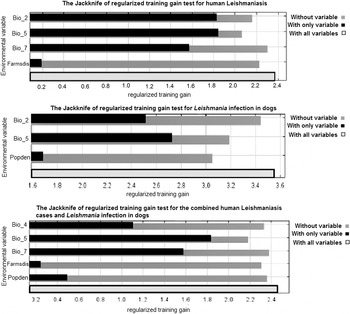
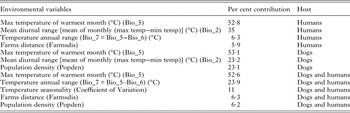
The contribution of the environmental variables to the MaxEnt model analysed in this study are shown in Table 1. Jackknife of regularized training gain test for human leishmaniasis in Thessaly is shown in Fig. 1. The environmental variable with the highest gain when used in isolation is Max Temperature of Warmest Month (°C) (Bio_5) while the variable that decreases gain the most when omitted, is distance from farms (Farmsdis). Regularized training gain (sum of the likelihood of the data plus a penalty function) is 2·367, training AUC is 0·964 and unregularized training gain is 2·574.
Jackknife analysis results: (a) The Jackknife of regularized training gain test for human leishmaniasis in Thessaly, Central Greece. (b) The Jackknife of regularized training gain test for Leishmania infection in dogs in Thessaly, Central Greece. (c) The Jackknife of regularized training gain test for the combined human leishmaniasis and Leishmania infection in dogs in Thessaly, Central Greece. Bio_2: Mean Diurnal Range [Mean of monthly (max temp−min temp)] (°C); Bio_5: Max Temperature of Warmest Month (°C); Bio_7: Temperature Annual Range (BIO7 = BIO5−BIO6) (°C); Farmsdis: Farms Distance; Popden: Population density.

The contribution of the environmental variables to the MaxEnt model

Predictive ENM for canine cases
The contribution of the environmental variables to the MaxEnt model analysed in this study are shown in Table 1. Jackknife of regularized training gain test for Leishmania infection in dogs in Thessaly is shown in Fig. 1. The environmental variable with the highest gain when used in isolation is Max Temperature of Warmest Month (°C) (Bio_5) and the most important when omitted is human population density (Popden). Regularized training gain (sum of the likelihood of the data plus a penalty function) is 3·544, training AUC is 0·989 and unregularized training gain is 3·731.
Predictive ENM for combined human and canine cases
The contribution of the environmental variables to the MaxEnt model analysed in this study are shown in Table 1. Jackknife of regularized training gain test for human leishmaniasis and Leishmania infection in dogs in Thessaly is shown in Fig. 1. Concerning the combined human and canine cases, the environmental variable with the highest gain when used in isolation is Max Temperature of Warmest Month (°C) (Bio_5) while the variable temperature annual range (Bio_7 = Bio_5–Bio_6) also presents high gain when used in isolation. The variable that decreases gain the most when omitted is distance from farms (Farmsdis). Regularized training gain (sum of the likelihood of the data plus a penalty function) is 2·452, training AUC is 0·973 and unregularized training gain is 2·639.
Identification of high-risk areas
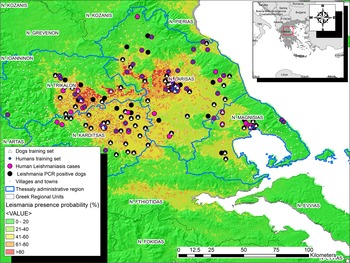
The areas presenting probability greater than 80% for the presence of Leishmania infection according to the MaxEnt model were considered as high-risk areas (Fig. 2). The model used in this study recognized the high-risk areas for Leishmania infection, most of which were concentrated in the central plain of Thessaly. Other high-risk areas were located along the coast line of the region and in the western and eastern areas with low altitudes (Fig. 2). The highest percentage of the high-risk areas was found in low altitude (<200 m asl) and in irrigated and cultivated agricultural areas. In total, 115 out of the 528 villages and small towns were found in high-risk areas.
Map of Thessaly, Central Greece showing the geographical distribution of human leishmaniasis cases and Leishmania PCR positive dogs (2007–2014) and the probability for the presence of human leishmaniasis cases and Leishmania infected dogs.

DISCUSSION
In this study, we used ENM from MaxEnt (Phillips et al. Reference Phillips, Anderson and Schapire2006) in order to identify the environmental variables related to human leishmaniasis cases and Leishmania infection in dogs and to recognize high-risk areas in the region of Thessaly, Central Greece. The analysis revealed that the maximum temperature of the warmest month contributes to the highest per cent to define environmental niche profiles for humans and dogs separately as well as for the combined human and canine cases in the study area. Moreover, our ecological niche modelling approach has produced the first risk map of Leishmania infection in Thessaly combining data from humans and dogs.
Among the sandfly species that have been reported in our study area, there are four sandfly species which are considered to be proven vectors of Leishmania spp; Phlebotomus perfiliewi, P. tobbi, P. similis and P. neglectus presenting specific spatial distribution and biological habits. In particular, P.perfiliewii is related to humid climate of mainland Greece, being scarcer on Greek islands with a distinctly hot and dry Mediterranean climate. In contrast, P.tobbi is a sandfly with preference to a more arid and semiarid bioclimate. P.similis as well as P.neglectus appear to be more common on the islands than in continental Greece (Ivović et al. Reference Ivović, Patakakis, Tselentis and Chaniotis2007). The presence of these phlebotomine species may be favoured by the climatic conditions in the region of Thessaly but the estimation of the vector abundance and the phlebotomine sandfly species diversity, distribution and Leishmania infection needs to be further investigated in order to reach accurate conclusions.
It is well known that leishmaniasis is a climate-sensitive disease, affected by changes in rainfall, atmospheric temperature and humidity. As it has been repeatedly suggested these changes can strongly impact on the ecology of vectors and reservoir hosts by altering their distribution and influencing their activity, survival and population sizes (Elnaiem et al. Reference Elnaiem, Connor, Thomson, Hassan, Hassan, Aboud and Ashford1998; Killick-Kendrick, Reference Killick-Kendrick1999; Aspöck et al. Reference Aspöck, Gerersdorfer, Formayer and Walochnik2008; Gage et al. Reference Gage, Burkot, Eisen and Hayes2008; Ready, Reference Ready2010; Ballart et al. Reference Ballart, Guerrero, Castells, Barón, Castillejo, Alcover, Portús and Gállego2014). Other environmental parameters including land cover (Colacicco-Mayhugh et al. Reference Colacicco-Mayhugh, Masuoka and Grieco2010) and the availability of organic matter may also affect the presence and abundance of vectors (Kassem et al. Reference Kassem, Tewfick and Sawaf2001; Ozbel et al. Reference Ozbel, Sanjoba, Alten, Asada, Depaquit, Matsumoto, Demir, Siyambalagoda, Rajapakse and Matsumoto2011).
Franco et al. (Reference Franco, Davies, Mylne, Dedet, Gállego, Ballart, Gramiccia, Gradoni, Molina, Gálvez, Morillas-Márquez, Barón-López, Pires, Afonso, Ready and Cox2011) reported that the canine leishmaniasis seroprevalence for the Western Europe was inversely U-shaped for the predictors altitude, minimum night-time land surface temperature, night-time land surface temperature amplitude of tri-annual cycle and to a lesser degree the enhanced vegetation index phase of annual cycle. In another study conducted in Greece during 2005–2010 high mean land surface temperature was related to higher risk for dog seropositivity (Ntais et al. Reference Ntais, Sifaki-Pistola, Christodoulou, Messaritakis, Pratlong, Poupalos and Antoniou2013). Although our study concerns human as well as canine cases of Leishmania infection in the region of Thessaly and not in Greece in overall, the importance of the environmental temperature is a common observation with the studies conducted so far in different countries (Chamaillé et al. Reference Chamaillé, Tran, Meunier, Bourdoiseau, Ready and Dedet2010; Franco et al. Reference Franco, Davies, Mylne, Dedet, Gállego, Ballart, Gramiccia, Gradoni, Molina, Gálvez, Morillas-Márquez, Barón-López, Pires, Afonso, Ready and Cox2011) and in Greece (Ntais et al. Reference Ntais, Sifaki-Pistola, Christodoulou, Messaritakis, Pratlong, Poupalos and Antoniou2013) probably because it strongly affects the vector distribution and activity. Furthermore, areas of 0–1000 m altitude were estimated to present higher risk than those of >1000 m (Ntais et al. Reference Ntais, Sifaki-Pistola, Christodoulou, Messaritakis, Pratlong, Poupalos and Antoniou2013) which is in agreement with our findings as the majority of the human leishmaniasis cases as well as the Leishmania infected dogs were recorded in low altitude (mean altitude of 171 and 151 m asl, respectively). Moreover, the highest percentage of the high-risk areas was found in low altitude (<200 m asl). Regarding the land cover, the majority of human cases were recorded in discontinuous urban fabric, cultivated and permanently irrigated land and the majority of the Leishmania infected dogs was found in urban and rural areas, in irrigated and non-irrigated land. Most of the high-risk areas were found in irrigated and cultivated agricultural areas. These findings are in accordance with Ntais et al. (Reference Ntais, Sifaki-Pistola, Christodoulou, Messaritakis, Pratlong, Poupalos and Antoniou2013) who reported that the presence of water bodies in an area, the agricultural areas and the semi-natural areas presented the highest risk as well as with previous studies conducted in other countries (Alonso et al. Reference Alonso, Giménez Font, Manchón, Ruiz de Ybáñez, Segovia and Berriatua2010; Chamaillé et al. Reference Chamaillé, Tran, Meunier, Bourdoiseau, Ready and Dedet2010; Colacicco-Mayhugh et al. Reference Colacicco-Mayhugh, Masuoka and Grieco2010; Abdel-Dayem et al. Reference Abdel-Dayem, Annajar, Hanafi and Obenauer2012).
In another study conducted in Greece during 2007–2010, spatial analysis was used to compare Veterinary Questionnaires results with dog seropositivity data (Sifaki-Pistola et al. Reference Sifaki-Pistola, Ntais, Christodoulou, Mazeris and Antoniou2014) retrieved from a previous study (Ntais et al. Reference Ntais, Sifaki-Pistola, Christodoulou, Messaritakis, Pratlong, Poupalos and Antoniou2013). This analysis showed that the areas of Attiki, Peloponisos, Kavalla, Kerkira and the western regions of Greece are high-risk areas whereas Thessaly was estimated as a low to medium risk area for CanL (Sifaki-Pistola et al. Reference Sifaki-Pistola, Ntais, Christodoulou, Mazeris and Antoniou2014). Even though, in our study which was conducted during 2007–2014, an increase in human leishmaniasis cases took place in 2012 and 2013 in the region of Thessaly, a study period which is not included in the previous studies (Ntais et al. Reference Ntais, Sifaki-Pistola, Christodoulou, Messaritakis, Pratlong, Poupalos and Antoniou2013; Sifaki-Pistola et al. Reference Sifaki-Pistola, Ntais, Christodoulou, Mazeris and Antoniou2014). By using the available presence-only data for human cases and Leishmania infected dogs; the model used in our study recognized the high-risk areas for Leishmania infection in the region of Thessaly, most of which were concentrated in the central plain of Thessaly. Other high-risk areas were located along the coast line of the region and in the western and eastern areas with low altitudes (Fig. 2). It is worth mentioning that in the agricultural areas of Thessaly, 115 out of the 528 villages and small towns were found in high-risk areas.
As it has been already suggested by Franco et al. (Reference Franco, Davies, Mylne, Dedet, Gállego, Ballart, Gramiccia, Gradoni, Molina, Gálvez, Morillas-Márquez, Barón-López, Pires, Afonso, Ready and Cox2011), surveys regarding human and canine leishmaniasis present several limitations in terms of their scope and standardization, which however can be used as guidelines for the collection of prospective data. In our study, extreme altitudes were included for both hosts as the human cases were recorded in altitudes ranging from 27 to 1083 m and the Leishmania PCR positive dogs were found in altitudes ranging from 38 to 538 m asl. Data on age and lifestyle have been registered for humans and dogs. However, the dog density has yet to be defined in our study area and this is a limitation of our study.
The results of this study should be treated with caution as although human leishmaniasis is a mandatory notifiable disease in Greece, our analysis could be affected by the quality of the collected human cases. It is well-known that both underdiagnoses and underreporting of the human leismaniasis cases is occurring in most European countries. Thus, our results could be affected by eliminating the power of the study to identify possible risk factors. However, sampling bias in human cases is not justified while for canine samples our methodology and analysis eliminated the sample bias. Another possible limitation of our study is the high percentage of immunocompromised persons in the human cases raising the possibility of reactivation and not of being new cases. The epidemiological pattern of the region was the same as of the whole Greece as it was published before (Gkolfinopoulou et al. Reference Gkolfinopoulou, Bitsolas, Patrinos, Veneti, Marka, Dougas, Pervanidou, Detsis, Triantafillou, Georgakopoulou, Billinis, Kremastinou and Hadjichristodoulou2013) and is confirmed by recent data from the National Surveillance Center. The percentage of immunocompromised cases (28%) among the human cases in the study area is similar with the percentage in the whole country. While someone can support that immunocompromised cases could be regarded as reactivation, at the same time could be considered as new cases due to host sensitivity. Moreover, we modelled the human leishmaniasis cases excluding the immunocompromised patients (n = 23) and the analysis showed that the environmental variables which contribute to the MaxEnt model do not differ when the immunocompromised patients are included. Thus, their inclusion does not mask the result and the prediction.
Maxent method requires presence-only data, utilizes both continuous and categorical data and includes efficient deterministic algorithms and mathematical definitions (Phillips et al. Reference Phillips, Anderson and Schapire2006). Thus, this method enhanced the capabilities of results analysis in our study leading in the identification of high-risk areas for Leishmania infection in the study area. Further studies concerning the identification of high-risk areas as well as large entomological studies in the mainland and islands of Greece are needed in order to raise awareness and implement targeted control measures for the protection of public health and the improvement of the disease surveillance.
SUPPLEMENTARY MATERIAL
To view supplementary material for this article, please visit http://dx.doi.org/10.1017/S0031182016000378
ACKNOWLEDGEMENTS
We would like to thank the personnel of the Hellenic Center for Diseases Control and Prevention (HCDCP) for their assistance: Eleni Triantafyllou and Theano Georgakopoulou.
FINANCIAL SUPPORT
This research has been co-financed by the European Union (European Social Fund – ESF) and national funds through the Operational Programme ‘Education and Lifelong Learning’ of the National Strategic Reference Framework (NSRF) – Research Funded Project: THALES. Investing in the knowledge society through the European Social Fund (grant number MIS 377266 to C.B., A.G., C.N.T., E.P. and V.S.).