Introduction
In recent years, the escalating incidence and complexity of Chemical, Biological, Radiological, Nuclear, and Explosive (CBRNE) events have highlighted the urgent imperative for comprehensive preparedness frameworks within health care systems.Reference Olivieri, Ingrassia and Della Corte1 Hospitals function as critical response entities in crises, serving as the frontline institutions responsible for addressing the acute medical needs of affected individuals and managing the broader public health security implications.Reference Henning, Brennan and Hoegg2, Reference Ranse, Mackie and Crilly3 The dynamic nature of CBRNE threats, which span acts of terrorism, industrial accidents, and emerging infectious diseases, presents distinctive challenges that necessitate health care providers to possess specialized expertise and competencies to respond effectively.Reference Kako, Hammad and Mitani4
CBRNE is diverse, encompassing a wide range of hazardous agents, with distinct physical and biological properties that responders must understand to manage incidents effectively. The risk of responder exposure remains significantly elevated during CBRNE events because these events are unpredictable, involve hazardous agents, are characterized by incomplete situational awareness, rapidly changing in-scene conditions, and environmental contamination.Reference Romney, Callaway, Burstein, Callaway and Burstein5 Additionally, there is a need to use the appropriate personal protective equipment (PPE) and to have sufficient CBRNE-specific training.Reference Romney, Callaway, Burstein, Callaway and Burstein5, Reference Kumar, Goel and Chawla6 Responding to CBRNE events requires tailored decontamination protocols, specialized equipment, and training to ensure the safety of both casualties and responders.Reference Kumar, Goel and Chawla6 The distinctive characteristics of CBRNE incidents may also result in atypical patterns of illness and injury among affected individuals, thereby complicating the processes of triage and treatment within health care facilities. Such incidents can rapidly exhaust medical resources, including personnel, pharmaceuticals, and essential supplies.Reference Romney, Callaway, Burstein, Callaway and Burstein5 Collectively, these factors underscore the imperative nature of CBRNE as a focal point for governments and organizations globally, thereby necessitating the enhancement of preparedness and response capabilities to protect public health and national security. Effective collaboration among various agencies, including emergency services, public health authorities, and community organizations, is critical to ensuring a coordinated response that effectively addresses the immediate threats and the long-term societal impacts of CBRNE incidents.Reference Jacobs-Wingo, Schlegelmilch and Berliner7, Reference Qzih and Ahmad8
The existing body of literature emphasizes the critical importance of disaster preparedness training within health care settings, asserting that regular and comprehensive training of health care professionals can significantly enhance their preparedness and resilience.Reference Yazjehan, Halim Md and NorRuwaida9 The current landscape of disaster preparedness training for health care workers remains inconsistent and is typically categorized into several structured formats.Reference Ranse, Shaban and Considine10, Reference ’Ranse and ’Hammad11 These programs vary by region, institutional resources, and policy frameworks. Education in disaster can range from traditional face-to-face methods, such as didactic classroom-based lectures, whose primary focus is theoretical knowledge, to flexible E-learning platforms that support theoretical learning at a reduced cost.Reference Ingrassia, Foletti and Djalali12 Scenario-based approaches, such as the tabletop exercise (TTX), are widely used to train teams in incident response and to evaluate contingency plans.Reference Grance, Nolan and Burke13 More immersive methods include full-scale drills that replicate actual emergency scenarios and using artificial intelligence such as virtual reality, augmented reality, and mixed reality, utilizing computer technology to create a simulated environment that allows the user to interact with the computer-generated imagery in both real and virtual environments to evaluate both technical and non-technical skills potentially; these methods are widely used nowadays.Reference Brown, Margus and Hart14, Reference Khanal, Medasetti and Mashal15 These artificial intelligence methods allow replicating complex emergencies and offer safe, cost-effective environments to practice critical decision-making. These features make these tools extremely useful for disaster management applications.Reference Khanal, Medasetti and Mashal15 Despite the range of available educational formats, several persistent and critical gaps continue to undermine the overall effectiveness of disaster and CBRNE training.Reference Skryabina, Reedy and Amlôt16, Reference Williams, Nocera and Casteel17 The key issue is the lack of a standardized, competency-based curriculum across health care systems.Reference Goniewicz, Goniewicz and Włoszczak-Szubzda18–Reference Schultz, Koenig and Whiteside20
Aim
This scoping review aims to assess the effectiveness of various CBRNE training methods, including didactic instruction, simulations, drills, and tabletop exercises, in developing health care providers’ competencies and knowledge within hospital settings.
Methods
Design
This integrative literature review was guided by the Preferred Reporting Items of Systematic Reviews and Meta-Analysis (PRISMA) GuidelinesReference Tricco, Lillie and Zarin21 (see Supplementary Table 1) for data collection and Whittemore and Knafl’sReference Whittemore and Knafl22 framework for data analysis.
Data Collection
In collaboration with the research team, the medical librarian (JYK) developed and executed comprehensive searches in Ovid MEDLINE, Ovid Embase, Scopus, Web of Science Core Collection, and CINAHL on September 13, 2024. Relevant keywords and controlled vocabulary were carefully selected to capture all relevant literature on CBRNE training in hospital settings. Searches were limited to English-language articles. Refer to the appendices for full search strategies (see Supplementary Table 2). After removing duplicates, the unique outcomes obtained from the search were subjected to title and abstract screening utilizing a web-based platform known as Covidence (www.covidence.org). In addition to subscription databases, the research team reviewed the first 200 results from Google Scholar for inclusion, which has been demonstrated to be a reasonable number of results to screen, as there is a high overlap between Web of Science and Google Scholar.Reference Tricco, Lillie and Zarin21 Bibliographies from the included studies were also reviewed. This scoping review was reported according to the Preferred Reporting Items for Systematic Reviews and Meta-Analyses extension for Scoping Reviews (PRISMA-ScR).Reference Tricco, Lillie and Zarin21 The title and abstract were screened by three authors (AM, EA, AA), with any discrepancies being resolved by an additional author (FI). Following the same approach, the articles were subjected to a thorough full-text review, resulting in the definitive count of studies included for data extraction by the established inclusion and exclusion criteria (see Table 1). Studies were eligible for inclusion if they met the following criteria: (1) conducted within a hospital setting; (2) involved hospital-based health care providers (e.g., nurses, physicians, pharmacists, emergency department personnel); (3) evaluated a CBRNE-related training intervention (e.g., simulation, drills, tabletop exercises, full-scale exercises, didactic training, virtual or computer-based programs); and (4) reported outcomes related to the effectiveness of the training in improving knowledge, competencies, preparedness, or related performance indicators. Only full-text, English-language, peer-reviewed articles were included.
Inclusion and exclusion criteria

CBRNE: Chemical, Biological, Radiological, Nuclear, Explosive; EMS: Emergency Medical Services.
We intentionally restricted the review to hospital-level training initiatives because the objective of this scoping review was to assess the effectiveness of CBRNE training as it is delivered and operationalized within health care facilities, where personnel face unique clinical, operational, and infrastructural challenges.
Studies were excluded if they: (1) focused on out-of-hospital, community-based, EMS, military, or public health agency training programs; (2) described national, inter-regional, or governmental preparedness initiatives without direct implementation inside hospitals; (3) did not include a training component; or (4) did not report any measure of training effectiveness. This approach prioritizes evidence most relevant to the clinical and operational realities of hospitals during CBRNE events.
Data Analysis
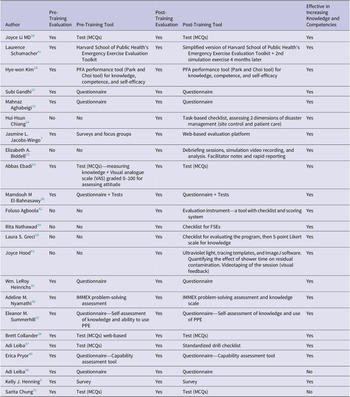
Whittemore and Knafl’sReference Whittemore and Knafl22 integrative review framework guided the structured data extraction, thematic analysis, and synthesis of findings from the included studies. Data extraction was completed by one reviewer (AB) and independently verified by a second reviewer (AM) to ensure accuracy and completeness. When uncertainties or discrepancies arose during data extraction or categorization, these were resolved through discussion among the review team, with escalation to a senior author when needed. This structured conflict-resolution process ensured the validity and consistency of the extracted data. Information extracted from each paper was then entered into a Microsoft Word 2018 table (Microsoft Corporation, Redmond, Washington, USA). This information encompassed author(s), country, the classification of the research study, the category of health care provider, the methodology of training and education, and the specific type of CBRNE threat, all organized within a table (see Table 2). The subsequent table aggregated information on the evaluation methodologies employed, as well as the efficacy of the training programs (see Table 3). The concluding table (see Table 4) encompasses the benefits of training as perceived by the health care providers, followed by the optimal training methodologies, and finally, the author’s recommendations.
Data analysis (general, type of health care provider, training method, CBRNE type)

Decon: Decontamination; ED: Emergency Department.
Evaluation methodology and effectiveness of training

FSE: Full Scale Exercise; IMMEX: Interactive MultiMedia Exercises; MCQs: Multiple Choice Questions; PFA: Psychological First Aid.
Data analysis (health care provider’s perceived benefits, optimal training method, and recommendations)

ACLS: Advanced Cardiovascular Life Support; ATLS: Advanced Trauma Life Support; CBET: Computerized bioterrorism education and training; PALS: Pediatric Advanced Life Support; PPE: Personal Protective Equipment; SBET: Standard Bioterrorism Education and Training.
Results
A total of 7794 results were retrieved, and when all duplicates were removed, 4785 distinctive results remained. Three authors (AM, EA, AA) screened the results for title and abstract, with a fourth author (FI) addressing any conflicts. Subsequently, 122 articles were selected and reviewed in full-text using the same process, including 23 articles for data extraction in the study (see Figure 1), as per the inclusion and exclusion criteria (see Table 1).
Modified PRISMA flow diagram.Reference Moher, Liberati and Tetzlaff58
Moher D, Liberati A, Tetzlaff J, Altman DG. Preferred Reporting Items for Systematic Reviews and Meta-Analyses: The PRISMA Statement. PLoS Med. 2009;6(7):e1000097. doi:10.1371/journal.pmed.1000097

Sixteen (70%) of the articles were quantitative, 3 (13%) qualitative, and 4 (17%) were mixed methods. Seven (30%) studies were experimental, 3 (13%) quasi-experimental, one (4%) interventional, 4 (17%) observational, 2 (8%) cross-sectional, 3 (13%) prospective (1 cohort and 2 randomized trials), 2 (9%) descriptive, and 1 (4%) case study.
Provider Type and Training Methods
Among the 23 analyzed articles, nurses emerged as the most extensively trained health care providers (See Table 2). Nine articles focused exclusively on nurses,Reference Jacobs-Wingo, Schlegelmilch and Berliner7, Reference Aghabeigi, Taghinejad and Mozafari23–Reference Nyamathi, Casillas and King30 2 addressed physicians,Reference Chung, Mandl and Shannon31, Reference Summerhill, Mathew and Stipho32 9 encompassed both physicians and nurses,Reference Henning, Brennan and Hoegg2, Reference Biddell, Vandersall and Bailes33–Reference Pryor, Heck and Norman40 1 was directed towards hospital pharmacies,Reference Schumacher, Senhaji and Gartner41 and in 2 instances,Reference Agboola, McCarthy and Biddinger42, Reference Hood, Fernandes-Flack and Larrañaga43 the specific category of health care provider was not delineated, being referred to in one of them as “hospital-based emergency decontamination teams.”Reference Hood, Fernandes-Flack and Larrañaga43 Additionally, Biddell et al.Reference Biddell, Vandersall and Bailes33 incorporated respiratory therapists and infection control experts.
The training methodologies identified within the reviewed literature encompassed didactic instruction, simulation exercises, tabletop activities, full-scale exercises, drills, virtual environment training, computer/web-based platforms, and curricula development (see Table 2). While specific studies focused exclusively on a single training method, others explored 2 or more approaches. Notably, Tabletop exercises emerged as the predominant training modality, as referenced in 6 articles (26%). Following this, didactic sessions and simulation were each mentioned in 5 studies (21.7%). Furthermore, 3 articles (13%) discussed drills; 2 (8.6%) addressed full-scale exercises; 2 (8.6%) were implemented within virtual environments; 2 (8.6%) pertained to computer/web-based training, and 1 article (4%) examined a pilot curriculum related to CBRNE. Notably, the articles that referenced simulation did not depict whether it pertained to tabletop exercises, full-scale simulations, or drills; consequently, it was classified into a distinct category.
CBRNE Threats Covered in Training
Regarding categorizing CBRNE threats utilized in the training exercises, the analyzed articles contained single, mixed, and unspecified threats (see Table 2). Specifically, single threat articles comprised 14 (61%), mixed threats accounted for 6 (26%), and unspecified threats were represented by 3 (13%), with references to HAZMAT. Within the domain of single threat, biological scenarios emerged as the predominant theme, with 11 (48%) instances highlighting anthrax, smallpox, and a respiratory illness outbreak as the primary diseases examined. The subsequent category pertained to chemical threats, constituting 2 (9%) articles. Finally, within the context of single threats, explosive threats were represented in 1 scenario (4%). In the realm of mixed threat studies, all 6 articles incorporated chemical threats, 4 articles that addressed biological threats, 4 that examined radiological threats, and 4 that included explosive threats. Notably, no nuclear threats were identified in any of the 23 articles subjected to review.
Training Evaluation Methodology
Among the 23 reviewed articles, 17 (74%) implemented pre-training evaluation instruments. These encompassed questionnaires (n = 7, 41%) that featured self-assessment and capability evaluations, multiple-choice tests (n = 5, 30%), and surveys (n = 2, 11.7%). Additionally, there were (n = 3, 17.6%) that employed specialized evaluation tools, which included the Psychological First Aid (PFA) performance tool (Park & Choi tool), the Harvard T.H. Chan School of Public Health’s emergency exercise toolkit, and the IMMEX problem-solving tool (see Table 3).
Regarding post-training evaluation, every article (100%) integrated and utilized various methodologies, predominantly relying on questionnaires (n = 7, 30.4%). Other methods included multiple-choice tests (n = 5, 21.7%), surveys (n = 1, 4.3%), checklist (n = 5, 21.7%), debriefing sessions (n = 1, 4.3%), and visual feedback (n = 2, 8.6%), which involved the analysis of recorded training videos. The specialized tools were applied in 5 articles (21.7%) and comprised the abovementioned instruments, in addition to ultraviolet light tracing and a 5-point Likert scale. Schumacher et al.Reference Schumacher, Senhaji and Gartner41 conducted a follow-up full-scale exercise 4 months after the initial training. The first exercise assessed initial response levels, while the second compared efficiency and effectiveness, serving as a post-evaluation tool.
Effectiveness of Training
Of the 23 articles reviewed, 21 (91%) reported that the training effectively enhanced health care providers’ knowledge and competencies (see Table 3). The effectiveness was demonstrated in competency, knowledge, enhanced preparedness, increased awareness, confidence in skills and procedures, and readiness for real-life disasters. Among those articles, 5 (24%) employed intervention versus control groups for comparative analysis. Summerhill et al.Reference Summerhill, Mathew and Stipho32 implemented didactic sessions with simulation and compared those with a control group with no training. The intervention cohort showed increased knowledge relative to the control group. Aghabeigi et al.Reference Aghabeigi, Taghinejad and Mozafari23 compared a didactics group and a control group, revealing that the intervention enhanced knowledge, preparedness, and awareness concerning bioterrorism. Ebadi et al.Reference Ebadi, Yousefi and Khaghanizade25 assessed 3 groups, with 2 intervention groups and 1 control group lacking training. The first intervention group received a didactic session, while the second employed a multimedia CD for training that contained images, audio, text, slides, and questions. The authors identified no statistically significant difference in effectiveness between the 2 intervention groups, demonstrating increased competency and preparedness compared to the control group. Nyamathi et al.Reference Nyamathi, Casillas and King30 contrasted a computer-based program entitled “Computerized Bioterrorism Education Training (CBET)” with didactic sessions named “Standard Bioterrorism Education Training (SBET).” The authors reported that both modalities were effective, with CBET facilitating improved critical thinking and problem-solving abilities while requiring less dependence on expert consultation. Conversely, participants in the SBET showed a decrease in the employment of superfluous diagnostic tests. Kim and ChoiReference Kim and Choi29 organized 3 groups: experimental, comparison, and control. The experimental group underwent simulation training, which contrasted with the didactic session received by the comparison group. In contrast, the control group was provided with handouts on psychological first aid after exposure to chemical disasters. The authors concluded that the simulation group demonstrated statistically significant enhancements in competency and knowledge compared to the other groups.
Among the 2 articles that reported the ineffectiveness of training, both pertained to biological threats. Leiba et al.Reference Leiba, Goldberg and Hourvitz36 conducted sentinel drills focused on anthrax across 23 hospitals. The findings revealed no statistically significant difference in knowledge levels before and after the drill. The authors concluded that a national framework for drills could assist in evaluating and potentially augmenting national preparedness; however, it does not serve as an effective stand-alone tool. In the second article, Chung et al.Reference Chung, Mandl and Shannon31 developed an educational website addressing bioterrorism. Two cohorts were evaluated: one receiving web-based intervention and the other serving as a control group. The intervention group was granted access to the website and weekly case scenarios. The authors concluded that this methodology was ineffective in enhancing participants’ knowledge regarding bioterrorism.
While most articles relied on a single training method, 4 incorporated 2 or more training modalities. Summerhill et al.Reference Summerhill, Mathew and Stipho32 combined didactic sessions and simulation. Collander et al.Reference Collander, Green and Millo34 applied didactic sessions with tabletop exercises and simulation, concluding that a multimodal training approach is the most effective strategy. Pryor et al.Reference Pryor, Heck and Norman40 utilized tabletop exercises with simulation, whereas Leiba et al.Reference Leiba, Drayman and Amsalem37 implemented didactic sessions and drills. Leiba et al.Reference Leiba, Goldberg and Hourvitz36, Reference Leiba, Drayman and Amsalem37 conducted 2 studies, 1 of which was previously referenced regarding Anthrax drills in Israel, demonstrating their ineffectiveness in enhancing the knowledge and competencies of health care providers. However, when the authors executed training using two training methods, it was determined to be effective, concluding that multifaceted training represents the optimal approach for effective training. Irrespective of whether the researchers employed singular or multiple training methodologies, none concluded whether any training method was superior or optimal to others in enhancing effectiveness.
Knowledge and Skill Retention
Out of 23 published articles, 6 examined the retention of knowledge and skills. Summerhill et al.Reference Summerhill, Mathew and Stipho32 investigated knowledge retention 1 year after training and discovered a statistically significant reduction in test scores compared to the initial post-training assessments. The article authored by Aghabeigi et al.Reference Aghabeigi, Taghinejad and Mozafari23 evaluated the cohort 1 month following training and observed no significant discrepancies in knowledge or skills; however, it did not explore the dimensions of long-term retention. Nathawad et al.Reference Nathawad, Roblin and Pruitt39 executed 2 exercises 1 year apart concerning a biological outbreak (SARS) necessitating quarantine measures. The outcomes of both exercises were analyzed to ascertain performance improvements, revealing that the second full-scale exercise demonstrated enhanced effectiveness in completing numerous critical tasks compared to the first exercise. Leiba et al.Reference Leiba, Drayman and Amsalem37 reported no significant differences in scores between individuals who participated in drills less than 3 months post-training and those who had more than 3 months of training. Thus, while initial knowledge may be robust immediately following training, retaining such knowledge over time may exhibit variability. Nyamathi et al.Reference Nyamathi, Casillas and King30 performed follow-up assessments 3 months after training, illustrating that the cohort undergoing computer-based emergency training retained knowledge and skills as per the assessment methodology. Nonetheless, it did not evaluate long-term retention. Chung et al.Reference Chung, Mandl and Shannon31 investigated a web-based educational intervention, which was determined to be an ineffective training modality for enhancing knowledge and competencies. The study conducted post-intervention assessments at 1 month and 6 months and found no enhancement in knowledge retention in both the web-based and control groups.
Limitations
This scoping review has several limitations. First, the search strategy, while comprehensive, was restricted to English-language and full-text published articles, which may have excluded relevant studies available in other languages or unpublished sources such as grey literature or conference abstracts. Second, the review focused exclusively on health care providers working in hospital settings. Studies involving pre-hospital care providers (e.g., emergency medical services), public health personnel, military staff, or other non-hospital jurisdictions were excluded. A study conducted by Chang and KimReference Chang and Kim44 met all of the specified inclusion criteria but ultimately had to be disregarded due to its occurrence outside of a hospital setting. Excluding these groups may omit key insights about training effectiveness in broader, multidisciplinary contexts where inter-agency coordination is essential. Finally, only studies explicitly reporting on both a training method and its effectiveness were included. Consequently, studies discussing training methods without evaluating their impact or those assessing preparedness without specifying the training approach were excluded, which may have narrowed the scope of findings on CBRNE education strategies.
Discussion
The efficacy of training was illustrated throughout the research, with 91% of the evaluated articles suggesting that such training was effective. It was displayed as a) improved knowledge, skills, and competenciesReference Jacobs-Wingo, Schlegelmilch and Berliner7, Reference Aghabeigi, Taghinejad and Mozafari23, Reference Kim and Choi29, Reference Summerhill, Mathew and Stipho32, Reference Collander, Green and Millo34, Reference Heinrichs, Youngblood and Harter35, Reference Li, Kaziny and Perron38; b) enhanced confidence, awareness, and preparednessReference Aghabeigi, Taghinejad and Mozafari23, Reference Gandhi, Yeager and Glaman27, Reference Summerhill, Mathew and Stipho32, Reference Collander, Green and Millo34, Reference Heinrichs, Youngblood and Harter35, Reference Nathawad, Roblin and Pruitt39; and c) better teamwork and communication (see Table 4).Reference Gandhi, Yeager and Glaman27, Reference Greci, Ramloll and Hurst28, Reference Summerhill, Mathew and Stipho32, Reference Li, Kaziny and Perron38 However, one study yielded results that diverged from this review’s findings. A systematic review executed by Williams et al.Reference Williams, Nocera and Casteel17 concerning the effectiveness of disaster training for health care practitioners indicated that the outcomes are insufficient and inconclusive regarding their efficacy. This may stem from the review’s inclusion of articles published between 2000 and 2005 and a limited sample size (9 articles) that predominantly concentrated on computer and lecture-based training approaches, thereby overlooking a thorough examination of alternative training strategies. The articles examined in this study demonstrated effectiveness via the post-training tools, indicating immediate enhancements and advantages following the training. Nevertheless, the durability of these improvements over time remains undetermined.Reference Skryabina, Reedy and Amlôt16 An ideal method to evaluate the outcomes of a training regimen would involve analyzing the benefits and implications during an actual emergency; however, such conditions are not feasible. Among the 6 articles that assessed knowledge and skill retention,Reference Aghabeigi, Taghinejad and Mozafari23, Reference Nyamathi, Casillas and King30–Reference Summerhill, Mathew and Stipho32, Reference Leiba, Goldberg and Hourvitz36, Reference Nathawad, Roblin and Pruitt39 Nathawad et al.Reference Nathawad, Roblin and Pruitt39 conducted 2 exercises a year apart concerning a biological outbreak, observing that the second exercise exhibited greater effectiveness in executing critical tasks in comparison to the first. Numerous articles advocated for further research into the retention of knowledge acquired from the training program and its longitudinal effects on disaster response.Reference Greci, Ramloll and Hurst28–Reference Nyamathi, Casillas and King30, Reference Summerhill, Mathew and Stipho32, Reference Collander, Green and Millo34, Reference Nathawad, Roblin and Pruitt39 This highlights the importance of not only assessing immediate retention but also understanding how these skills evolve and their impact on real-world performance in crises.
The predominant threat identified in this research was biological, paralleling the findings presented in an article published in 2017 by Skryabina et al.Reference Skryabina, Reedy and Amlôt16 The analysis indicated that 28% encompassed bioterrorism, while an additional 20% pertained to pandemic influenza and various other infectious diseases. The study did not include any nuclear threats, which is consistent with the outcomes of this review. With the training intervention, this scoping review ascertained that tabletop exercises are the predominant methodology.
Different training modalities have different educational impacts. Tabletop exercises (TTX) are effective for improving decision-making, interdisciplinary communication, and planning for low-frequency, high-consequence CBRNE events because they provide the teams with an opportunity to rehearse their roles, address operational gaps, and improve coordination in a low-pressure setting. However, psychomotor or real-time clinical skills can’t be assessed using TTX; simulation and full-scale exercises are more suitable. Simulation-based education, including functional drills and virtual environments, has been found to be efficacious in improving knowledge, competency, situational awareness, and confidence compared with traditional educational methods.Reference Kim and Choi29, Reference Summerhill, Mathew and Stipho32, Reference Heinrichs, Youngblood and Harter35 The computer-based and virtual platform can support critical thinking and distance learning, offering better alternatives when face-to-face training is unavailable or difficult due to social distancing restrictions encountered during the COVID-19 pandemic.Reference Greci, Ramloll and Hurst28, Reference Nyamathi, Casillas and King30, Reference Heinrichs, Youngblood and Harter35, Reference Jung45 The COVID-19 pandemic helped accelerate the transition to hybrid E-learning and virtual simulation, and enabled more structured evaluation of training outcomes.Reference Csorba and Dabija46
Although the study shows that none of the individual training modalities was superior, studies that combined multiple approaches, such as didactic teaching, tabletop exercises, and simulation, showed the greatest improvements in knowledge, skills, and preparedness.Reference Collander, Green and Millo34, Reference Leiba, Drayman and Amsalem37, Reference Pryor, Heck and Norman40 This supports the post-COVID transition toward combining different educational methods, rather than relying on a single method.Reference Jung45, Reference Sia, Chin and Voon47
However, Skryabina et al.Reference Skryabina, Reedy and Amlôt16 identified that operation-based drills were utilized more frequently (59%), followed by discussion-based tabletop exercises at a rate of 27%. Their study could not determine which training modality was optimal for enhancing knowledge and competencies among health care providers. Nevertheless, each method possesses distinct advantages. Structured educational programs, including lectures or workshops, have been demonstrated to augment knowledge and preparedness significantly. Mirzaei et al.Reference Mirzaei, Eftekhari and Sadeghian48 executed a 1-day disaster management workshop, enhancing nurses’ knowledge, attitude, and practice scores by 33%, 15%, and 66%, respectively. Similarly, a 16-hour structured program improved nurses’ preparedness for disaster response, with noteworthy advancements in emergency response, clinical management, self-protection, and personal readiness.Reference Lin, Tzeng and Chiang49
Simulation-based training, encompassing tabletop and full-scale methodologies, effectively enhances disaster response competencies. Research employing standardized patients and simulation demonstrated that participants’ performance improved significantly in triage, communication, and decision-making.Reference Bajow, Alesa and Shaheen50 Additionally, another investigation highlighted that simulation exercises were instrumental in revealing deficiencies within hospital protocols and improving operational preparedness.Reference Abualenain, Alhajaji and Kamel Alsulimani51 Furthermore, Bajow et al.Reference Bajow, Alesa and Shaheen50 and Aliakbari et al.Reference Aliakbari, Pirani and Heidari52 also established that drills significantly elevated staff performance, with 83% of participants indicating enhanced response capabilities and improved competencies among nursing professionals. Emerging research suggests virtual reality is a viable substitute for training to enhance knowledge and confidence in disaster response.Reference Jung45 This innovative approach enhances practical skills. It provides a safe environment for learners to experience high-pressure scenarios without real-world consequences, ultimately leading to better preparedness in actual emergencies. An article utilizing a simulated emergency department revealed that subjects felt increased confidence in managing CBRNE incidents after training.Reference Heinrichs, Youngblood and Harter35
One of the challenges identified in the scoping review study pertains to the variable participation and engagement levels in training programs. Despite the importance of CBRNE preparedness, many health care providers do not participate in relevant training programs. Research conducted in Turkey in 2023 revealed that only 39% of participants reported having previously received CBRNE training.Reference Babacan53 Another challenge identified is insufficient resources and equipment. A study by Mortelmans et al.Reference Mortelmans, Gaakeer and Dieltiens54 highlighted a notable lack of preparedness for CBRNE incidents in Dutch Hospitals. Only 40% of hospitals had decontamination facilities, while 32% possessed suitable PPE and decontamination teams. Time constraints, costs, and competing priorities also hinder the implementation of training programs. A study conducted in the United States found that clinicians are willing to engage in training but are concerned about the time and financial investment required.Reference McInerney and Richter55
Although regional health care system structures and resource levels can influence the implementation and effectiveness of CBRNE training, the studies included in this review were predominantly conducted in the United States. As a result, the available evidence did not allow for a meaningful comparison of training approaches across different geographical settings. While regional variation is an important conceptual factor, examining these contextual differences falls outside the scope of the current dataset.
Effective disaster training programs are essential for enhancing hospital preparedness and ensuring health care providers have the knowledge, skills, and confidence to respond to emergencies.Reference Farhat, Alinier and Chaabna56 To achieve this, it is recommended to incorporate multiple teaching strategies, such as lectures, simulations, and operational drills, which have significantly improved disaster response readiness.Reference Leiba, Drayman and Amsalem37 Additionally, the integration of technology with the use of virtual training and simulation-based training can further enhance clinical and operational skills. It provides an immersive and realistic environment, allowing trainees to experience high pressure without real risks. Moreover, it offers scenario variety and practice repetition, helping them master specific skills and become adaptable to various conditions.Reference Heinrichs, Youngblood and Harter35, Reference Subbarao, Bond and Johnson57
Fostering multidisciplinary collaboration within training programs and enhancing communication and teamwork are also crucial. Regular and frequent training is vital for maintaining preparedness and knowledge retention and incorporating “Just in Time” refreshers. A study conducted in Iran indicated that periodic training significantly boosts nurses’ disaster response competencies,Reference Aliakbari, Pirani and Heidari52 while Agboola et al.Reference Agboola, McCarthy and Biddinger42 stated that frequent participation in preparedness exercises is associated with better performance in disaster response, suggesting that regular training is key to maintaining high levels of preparedness.
Conclusion
CBRNE training, when implemented efficiently through a combination of emergency preparedness exercises, effectively improves health care professionals’ knowledge and competencies. The current literature reveals a disparity between CBRNE threats and training and evaluation methods. Efforts should be made to establish standardized training curricula, protocols, and evaluation instruments for CBRNE preparedness and consistency in pre- and post-training evaluation. This initiative will improve uniformity in training, facilitate the assessment and monitoring of effectiveness, and enhance the capacity of health care practitioners to respond adeptly during emergencies. Consistent and frequent training is imperative for retaining knowledge-acquired exercises and consolidating skills, ensuring that information is comprehensively understood and applied in practical contexts. The authors recommend that regular multimodal training focusing on increasing knowledge, skills, and critical thinking has the most significant potential to enhance CBRNE response effectiveness. Multidisciplinary training among hospital personnel would be ideal, as it reflects real-life responses to CBRNE incidents. These occurrences are distinctive, necessitating a tailored methodology and comprehensive, responsive strategy due to the complexity involved in concurrently ensuring hospital personnel’s safety and operational efficacy.
Supplementary material
The supplementary material for this article can be found at http://doi.org/10.1017/dmp.2025.10274.
Acknowledgments
None
Author contribution
Almas Malek, MD: Conceptualization, validation, investigation, data curation, writing: original draft, review, and editing. Attila J. Hertelendy, PhD: Conceptualization, validation, investigation, writing: review and editing, supervision, and project administration. Eman Alshaikh, MD, FIBODM: Investigation, data curation, writing: original draft, review, and editing. Ahmad Alshadad, MBChB: Investigation, data curation, writing: original draft. Abdulrahman Buhiji, MD: Investigation, data curation. Jamie Ranse, RN, PhD: Validation, resources, writing: review and editing, and supervision. Amit Boukai, MD, MPH: Investigation, data curation. Christina Woodward, MD: Writing: review and editing. Ejemai Eboreime, MD, PhD: Investigation, resources. Janice Y. Kung: Methodology, Investigation, resources. Amalia Voskanyan, RN: Supervision, project administration. Gregory Ciottone, MD: Supervision, writing: review and editing, and project administration. Fadi Issa, MD: Conceptualization, validation, data curation, writing: review and editing, supervision, and project administration.
Competing interests
None