Introduction
A massive earthquake measuring 8.0 on the Richter scale struck Wenchuan County, Sichuan Province, China, on May 12, 2008. More than 87 000 people were reported dead, as well as 350 000 injured and 5 million homeless. Reference Zhang, Reinhardt, Gosney and Li1 A substantial number of the victims suffered musculoskeletal trauma, resulting in unilateral, bilateral or even multiple limb amputation, fractures, and spinal cord injuries. Overall, 0.93% of the injured after the 2008 Sichuan earthquake underwent upper or lower limb amputation. Reference Li, Pan and Li2
Amputation is considered one of the devastating consequences of an earthquake, leading to severe physical and psychological impairments. Reference Klute, Berge and Orendurff3 Amputees face restricted daily activities, phantom limb sensation and pain, depression, lifestyle change, and unemployment. Reference Li, Chan and Chau4-Reference Awais, Dar and Saeed7 Moreover, it has been shown that the quality of life (QOL) of the amputees 4 years after the 2008 Sichuan earthquake was still significantly lower than that of the general population. Reference Li, Reinhardt and Zhang6 Illiteracy or low level of education among lower-limb amputees was associated with a particular risk of low QOL, and specific rehabilitation programs would be necessary to facilitate their reintegration into normal life. Reference Li, Reinhardt and Zhang6
Few studies have been conducted to reveal the QOL and rehabilitation outcomes of lower-limb amputees after major natural disasters. Reference Li, Chan and Chau4-Reference Wen, Randolph, Elbaum and De la Rosa8 To date, much of the attention has been focused on the function and QOL among the victims with spinal cord injuries Reference Li, Reinhardt and Gosney9-Reference Rauch, Baumberger and Moise11 and fractures, Reference Gao, Leung and Liang12,Reference Ni, Reinhardt and Zhang13 with little information available on the QOL of the amputees. Reference Li, Chan and Chau4-Reference Li, Reinhardt and Zhang6 The demand for long-term rehabilitation of victims after an earthquake has significantly increased. Reference Zhang, Reinhardt, Gosney and Li1
The purpose of this study was to document and investigate the prosthesis-related QOL in the lower-limb amputees after the 2008 Sichuan earthquake, using a validated instrument, Prosthesis Evaluation Questionnaire (PEQ), Reference Chu and Wong5 and further to identify the potential risk factors associated with this long-standing QOL. The results will be useful to enhance the understanding of the post-earthquake amputees’ QOL and develop various post-disaster integrated rehabilitation strategies.
Methods
Design and Sample
This was a cross-sectional study to investigate the QOL of the lower-limb amputees 10 years after the 2008 Sichuan earthquake. The participant selection criteria were (1) lower-limb amputation secondary to the 2008 Sichuan earthquake, (2) daily prosthetic usage, and (3) ability to read and write Chinese. This study was approved by the Institutional Review Board of the Hong Kong Polytechnic University.
Recruitment
The lower-limb amputees were identified from the electronic database in a local rehabilitation center of Deyang, one of the most severely affected regions in Sichuan after earthquake. The center was established by Hong Kong Red Cross since the 2008 Sichuan earthquake, and supported by Hong Kong Polytechnic University to provide prosthetic and rehabilitation services for the victims. Initially, 305 amputees were reviewed from the electronic database, of which 172 were identified according to the selection criteria and were contacted via telephone call by the research team for introduction of the study purpose. Among these cases, a total of 66 amputees agreed to participate in this study. Data collection was performed through a face-to-face interview, using paper and pen in the rehabilitation center of Deyang between February and June 2018. Prior to the interview, written informed consents were obtained from all the participants.
Measures
The participants’ demographic characteristics were collected using a standardized data form, including their age, gender, marital status, education level, occupation, living independence, comorbidity, amputation level, and daily hours of prosthetic usage.
The prosthesis-related QOL was assessed by the PEQ, which is a comprehensive outcome measure specifically used for the patients with lower limb amputation. Reference Parker, Kirby, Adderson and Thompson14-Reference Wurdeman, Stevens and Campbell16 The PEQ is composed of 82 questions categorized into 9 validated scales, including utility (UT), appearance (AP), sounds (SO), residual limb health (RL), perceived response (PR), frustration (FR), social burden (SB), ambulation (AM), and well-being (WB). Of these, UT rates the fit, comfort, temperature, and expenditure of energy when using the prosthesis; AP denotes the look and influence on wearing; SO describe the squeaking, clicking, or belching sounds; RL rates how much of the time the amputees’ residual limb was swollen or developed the rashes, pimples, and blisters, and so forth, to the point of changing the fit of the amputees’ prosthesis; PR, FR, and SB assess the social and emotional aspects of using a prosthesis; AM rates the ability to move around when using a prosthesis; and WB describes whether amputees are satisfied with the particular situations following the amputation. Reference Legro, Reiber and Smith17-Reference Franchignoni, Ferriero and Giordano19
The scales have been validated for internal consistency and temporal stability, and are scored as a unit. Reference Harness and Pinzur18,Reference Van de Weg and Van der Windt20 The question of each PEQ scale is scored as a continuous numerical variable (0-100) in a visual analog scale format, with poor responses rated as 0 and excellent responses rated as 100. Thus, a higher score indicates a more positive outcome. The scale score is calculated as the arithmetic mean of all the questions that make up that particular scale. The version of PEQ used in this study was translated to Chinese characters by Chu and Wong research team in 2004. Reference Chu and Wong5
Statistical Analysis
All statistical tests were conducted using IBM SPSS 19.0 (IBM UK Ltd, Portsmouth, United Kingdom; IBM Corp, Armonk, NY). The score of each PEQ subscale was presented as mean ± SD (standard deviations). The descriptive statistics, including the mean, SD, quartile, and range were analyzed for each PEQ subscale. Due to the small number of participants in this study, the multiple linear regression analysis cannot be used to investigate the potential demographic factors associated with each PEQ subscale. In order to indirectly reveal the potential demographic factors with relevance to the QOL of the participants in this study with lower-limb amputation after the 2008 Sichuan earthquake, the scores of each PEQ subscale were compared among the cohorts of participants with different demographic characteristics using t-test (2-tailed) or 1-way analysis of variance (ANOVA). A two-sample t-test (2-tailed) was used to compare the scores of each PEQ subscale in the dichotomous groups, such as gender, living independence, occupation, comorbidity, amputation level, and hours of daily prosthetic usage. Comparisons among 3 or more categorized groups, such as age, marital status, and education level, were performed by 1-way ANOVA with subsequent comparisons using post hoc Bonferroni tests. The alpha level of statistical significance was set at P ≤ 0.05.
Results
Demographic Characteristics of Lower-Limb Amputees After the Sichuan Earthquake
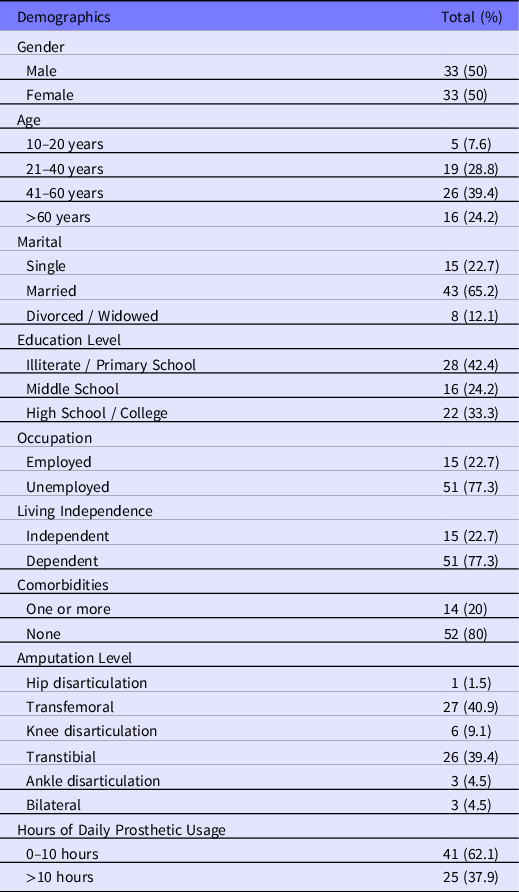
In this cross-sectional study, a total of 66 lower-limb amputees after the 2008 Sichuan earthquake was recruited. The demographic characteristics of these victims are shown in Table 1. Overall, the proportion of males and females was identical (33 males and 33 females). The ages of the participants ranged from 17 to 86 years, with a mean age of 45.8 ± 18.7. Most of them (65.2%) were married, whereas 15 (22.7%) were single. The majority of the participants received an education, including primary school (34.8%), middle school (24.2%), high school/college, whereas 7.6% of participants were illiterate. In addition, only less than one fourth (22.7%) of lower-limb amputees were living independently, while most of them were living with family. Currently, 20% of the lower-limb amputees from the 2008 Sichuan earthquake had 1 or more comorbidities (ie, diabetes, hypertension, disc degeneration, cholecystitis, gastritis, and liver disease). In the unilateral amputation, the participants with transfemoral and transtibial level accounted for 40.9% and 39.4%, respectively. The hours of daily wearing prosthesis were less than 5 hours (4.5%), 6–10 hours (57.6%), 10–15 hours (25.8%), and more than 15 hours (12.1%).
Demographic characteristics of lower-limb amputees 10 years after the 2008 Sichuan earthquake (n = 66)

Prosthesis-Related QOL of Lower-Limb Amputees After the Sichuan Earthquake
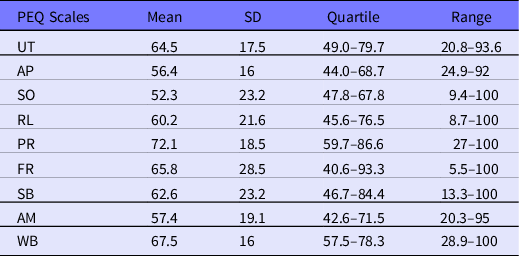
The prosthesis-related QOL of the participants was documented by PEQ scores in Table 2. It was noted that the extreme lower values of SO, RL, and FR were less than 10, indicating that these subscales could severely affect the QOL of some lower-limb amputees after the earthquake.
Descriptive statistics of PEQ subscales scores in lower-limb amputees 10 years after the Sichuan earthquake

Note: PEQ: prosthesis evaluation questionnaire; UT: utility; AP: appearance; SO: sounds; RL: residual limb health; PR: perceived response; FR: frustration; SB: social burden; AM: ambulation; WB: well-being.
Comparison of QOL Among the Lower-Limb Amputees With Different Demographic Characteristics After the Sichuan Earthquake
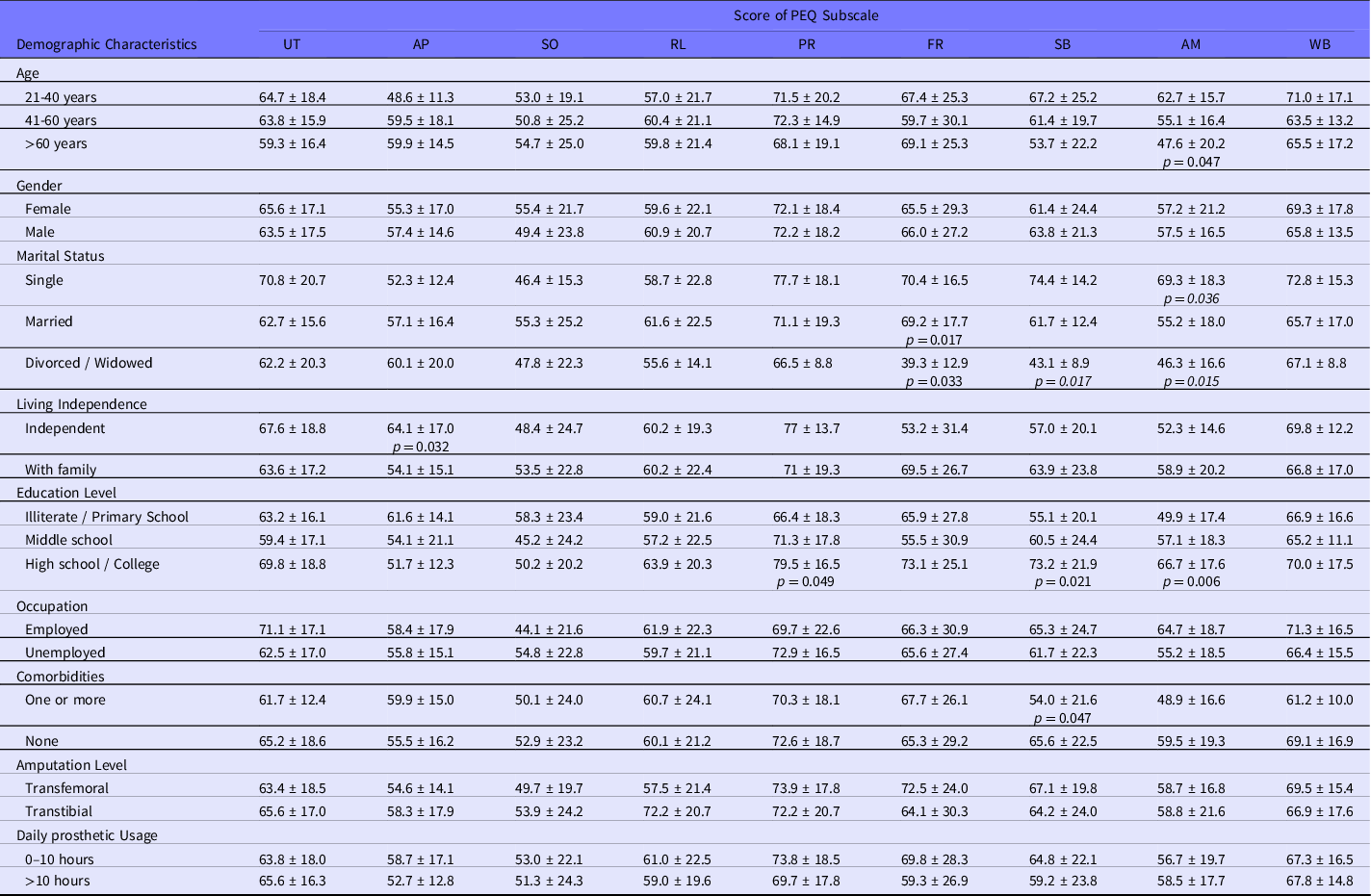
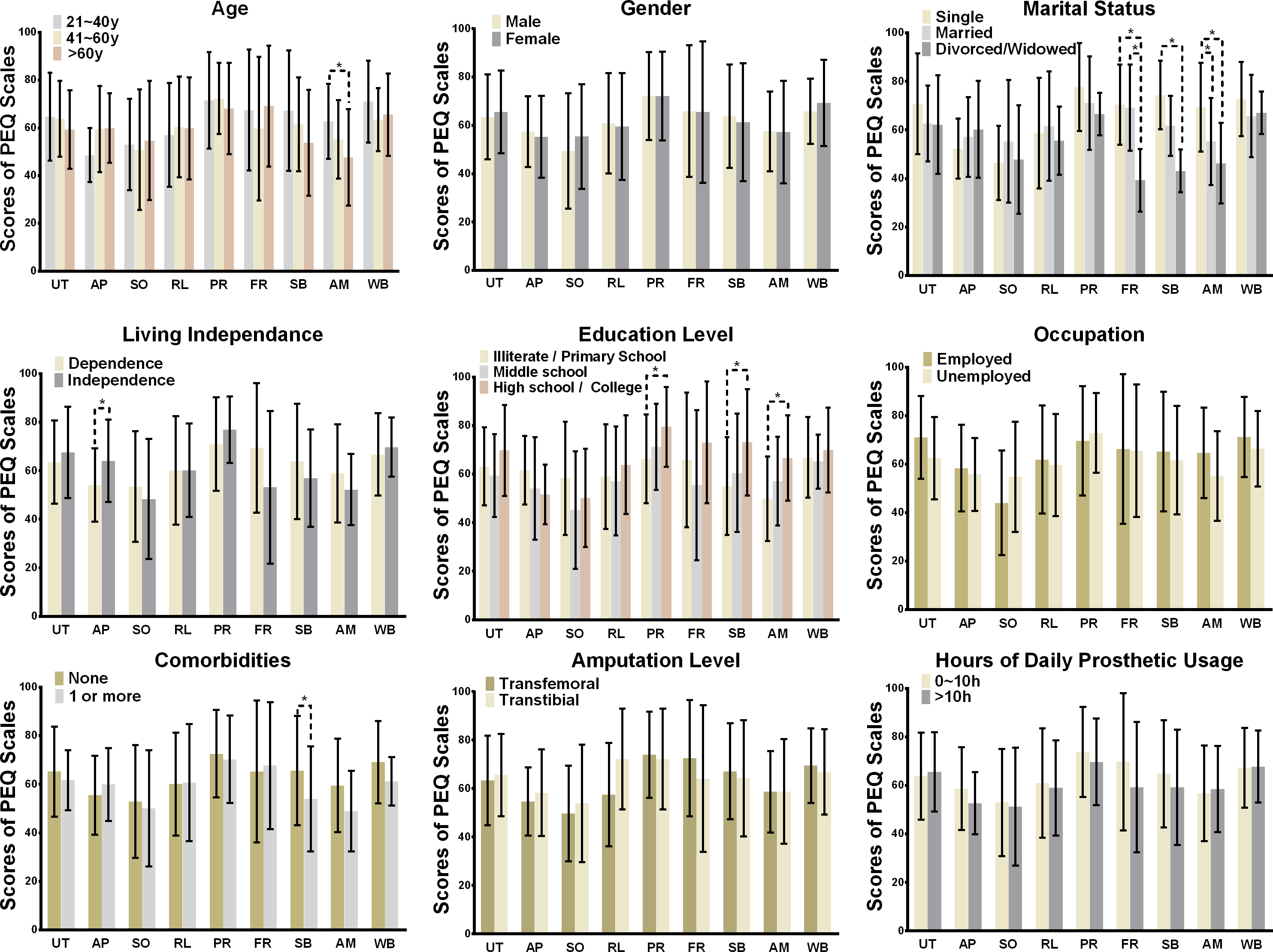
Comparisons of QOL among the lower-limb amputees with different demographic characteristics after the Sichuan earthquake are shown in Table 3 and Figure 1. Amputees more than 60 years of age had a significantly lower score of AM scale than the younger ones (P = 0.047). Compared with the married (P = 0.017) or single participants (P = 0.033), the score of FR scale was significantly lower in the divorced or widowed cohort. It was found that those who lived dependently with family scored significantly less in AP scale than those living alone (P = 0.032). Amputees having a high school or college education were scored significantly greater in the subscales of PR (P = 0.049), SB (P = 0.021), and AM (P = 0.006) than those who were illiterate or received primary school education. Among those who had 1 or more comorbidities, the score of SB scale was rated as lower than those without comorbidities (P = 0.049).
Comparisons of QoL among the lower-limb amputees with different demographic characteristics after the Sichuan earthquake

Note: The prosthesis-related QoL was assessed by PEQ instrument. The score of each PEQ subscale was presented as means ± SD and a higher score indicates a more positive outcome. p-values were obtained from two-sample t-tests (two-tailed) in the case of 2 categories; in the case of 3 categories one-way analysis of variance (ANOVA) were used for assessing the overall significance and post-hoc Bonferroni tests for subsequent comparisons among the individual groups. P-values for comparisons between the first and the second rows in each group are shown in the first row, for comparisons between the second and the third row in the second row, and for comparisons between the third and the first row in the third row. QoL: quality of life; PEQ: prosthesis evaluation questionnaire; UT: utility; AP: appearance; SO: sounds; RL: residual limb health; PR: perceived response; FR: frustration; SB: social burden; AM: ambulation; WB: well-being.
Literature review of QoL of lower-limb amputees documented by PEQ scores

Note: The score of each PEQ subscale was presented as means ± SD. QoL: quality of life; PEQ: prosthesis evaluation questionnaire; UT: utility; AP: appearance; SO: sounds; RL: residual limb health; PR: perceived response; FR: frustration; SB: social burden; AM: ambulation; WB: well-being.
The prosthesis-related QOL of lower-limb amputees by each of the demographic characteristics 10 years after the 2008 Sichuan earthquake.
The prosthesis-related QOL was assessed by PEQ instrument, with a higher score indicating a more positive outcome. An asterisk (*) indicates that P-value was less than 0.05. A 2-sample t-test (2-tailed) was used to compare the scores of each PEQ subscale in the case of gender, living independence, occupation, comorbidities, amputation level, and hours of daily prosthetic usage. ANOVA with post hoc Bonferroni tests was applied in the case of age, marital status, and education level.
QOL = quality of life; PEQ = Prosthesis Evaluation Questionnaire; UT = utility; AP = appearance; SO = sounds; RL = residual limb health; PR = perceived response; FR = frustration; SB = social burden; AM = ambulation; WB = well-being.

Discussion
This study investigated and documented the long-term outcomes of prosthesis-related QOL in the lower-limb amputees using the PEQ instrument 10 years after the 2008 Sichuan earthquake. Comparisons of PEQ subscales among cohorts with different demographic characteristics showed that the participants with aging, divorce or widow, lower educational level, living dependently, and comorbidities presented lower scores in the AM, FR, AP, and SB scales, respectively. The amputees with illiterate or primary school education showed significantly lower scores in the PR, SB, and AM scales than those who had undergone high school or college.
The PEQ has been validated as a self-reporting questionnaire to evaluate the prosthesis-related QOL for the individual with amputation. Reference Parker, Kirby, Adderson and Thompson14 The whole profile of long-term outcomes of QOL of those with lower-limb amputation who participated in this study after the Sichuan earthquake was analyzed. More attention should be paid to the SO, RL, and FR due to the extremely lower values (less than 10 out of 100) in some of the participants. The SO and RL were related to the techniques of prosthetic design, fabrication, and fitting. As demonstrated, it would be critical to optimize these prosthetic factors to match with the lower-limb amputees, and thus it could offer improvements in energy expenditure, activity level, balance, and proprioception. Reference Friel21 Additionally, FR could reveal how frequent the participants felt frustrated with their prosthesis. Depressive symptoms were prevalent among amputees, Reference Darnall, Ephraim and Wegener22,Reference Foote, Kinnon and Robbins23 and mental health outcomes were found to be indicative of preparedness for full integration back into society. Reference Ladlow, Phillip and Etherington24 A comparison among the literatures and current study was done (Table 4), and the scores of SO, RL, and AM scales appeared to be relatively lower in the patients with lower-limb amputation 10 years after the Sichuan earthquake. Reference Chu and Wong5,Reference Legro, Reiber and Smith17,Reference Harness and Pinzur18,Reference Pinzur, Pinto and Saltzman25 In Chu and Wong’s study, the QOL of adolescents with lower-limb amputation after the 2008 Sichuan earthquake was documented using PEQ and appeared to have a better QOL compared with the lower-limb amputees recruited in this study. Reference Chu and Wong5
The potential demographic factors associated with the scales of PEQ were indirectly identified in the lower-limb amputees after the Sichuan earthquake. The results showed that the lower-limb amputees over the age of 60 years reported a lower score of AM, suggesting that the older amputees presented lower mobility compared with the younger ones when using their prostheses. Moreover, the lower-limb amputees with no or primary school education presented lower scores of PR, SB, and AM than those with high school or college education. Li et al. showed that education level was a significant predictor of QOL, mental health, and satisfaction of the amputees sustained in the Sichuan earthquake. Reference Li, Reinhardt and Zhang6 The lower level of education was reported to be linked to the posttraumatic depression and stress in lower-limb amputees. Reference Guo, He and Qu26
It was also revealed that the lower-limb amputees living dependently with family scored less in AP than those living independently. Some amputees seemed not to be satisfied with the appearance of their prostheses, particularly for those living with their family members. In addition, the divorced amputees had significantly lower scores in the scale of FR compared with the married or single amputees. The amputees with comorbidities showed lower scores of SB than those without comorbidities, suggesting that preexisting comorbidities still brought more burdens on their partner or family members. Taken together, the vulnerable amputees after an earthquake could be identified based on the demographic characteristics, such as aging, divorce or widow, living dependently, lower level of education, and comorbidities.
The level of amputation was found closely associated with the energy expenditure of ambulation. Reference Li, Chan and Chau4,Reference Yilmaz, Gulabi and Kaya27 No general consensus exists on the association between the level of amputation and QOL. A systematic review including 27 studies indicated that a higher level of amputation was associated with decreased QOL in lower-limb amputation following trauma. Reference Penn-Barwell28 In contrast, a national survey of musculoskeletal tumor-related amputation in England confirmed the association between level of amputation and physical function but not QOL outcomes. Reference Furtado, Grimer and Cool29 In this study, the amputees with transtibial and transfemoral amputation did not show significant difference in QOL, which could be due to the long-term and continuous involvement of the amputees in post-earthquake rehabilitation programs.
Limitations
This cross-sectional study was conducted 10 years after the 2008 Sichuan earthquake and the profiles of prosthesis-related QOL of lower-limb amputees at different stages of rehabilitation were not collected, which would be difficult to carry out long-term prospective analyses and comparisons. In addition, the sample size was relatively small, and the participants were recruited from a list of existing electronic databases rather than being randomly stratified to select representative proportions; however, the amputation level and injury severity in this study were comparable to some typical epidemiological data such as the recent Haiti earthquake. A large number (106 out of 172) of the patients desisted from the rehabilitation center, hence the results might be skewed by the fact that patients with greater mobility were better able to participate in this study. Any bias with assistance completing the PEQ questionnaire might also affect the results. Last, a comparison study was not conducted. It would be useful to compare the current findings with a comparative group. The rehabilitation center involved only served the amputees from the earthquake, and there could be cultural and regional differences for a direct comparison with other groups. The findings of the current study could be regarded as a useful reference for future disaster managements.
Conclusion
This is the first study to document the long-term outcomes of prosthesis-related QOL of a sample of amputees after 10 years of the 2008 Sichuan earthquake and to provide an essential reference for the future development of post-disaster rehabilitation strategies. The potential demographic factors associated with QOL were also investigated, which would be crucial for the government and health care professionals to identify the vulnerable amputees during the long-term period of recovery. A comparison study is crucial to reveal the difference of long-term outcome of the lower-limb amputees triggered by earthquake or other causes. The prospective longitudinal studies are warranted to investigate the long-term effect of post-disaster rehabilitation programs on the QOL of amputees.
Funding statement
The Hong Kong Polytechnic University supported this project, and Hong Kong Red Cross supported service provisions since the 2008 Sichuan earthquake.
Conflict(s) of interest
The authors declared no potential conflicts of interest with respect to the research, authorship, and/or publication of this paper.