Introduction
The development of the world food market has, in recent years, been marked by rapid, unexpected and complex changes. The world food industry is operating in an explicitly dynamic environment which demands constant adjustments and responses. These intensive processes increase the competitive advantage of operating activities on the global market and are the result of numerous changes in the period of new economy (Vukasovič, Reference VUKASOVIČ2009). In this saturated market environment, distribution channels, marketing activities, diversification strategies, and food quality are increasingly important. Modern food consumers are highly concerned about the safety and quality of the food products purchased. This concern goes simultaneously with their awareness of the relationship between the production practice and quality of food products, as well as environmental concerns in regards to food (Thøgersen and Ölander, Reference THØGERSEN and ÖLANDER2002). Moreover, the awareness has contributed towards a growing demand for food from non-conventional production practices as well as an increasing consumer interest in having a closer relationship with the food producer (Thompson, Reference THOMPSON1998; Wier et al., Reference WIER, HANSEN, ANDERSEN and MILLOCK2003; Botonaki et al., Reference BOTONAKI, POLYMEROS, TSAKIRIDOU and MATTAS2006; Vermeir and Verbeke, Reference VERMEIR I. and VERBEKE2006). This change has been especially significant in the demand for organic foods. In recent years there has been a rising trend in the consumption of organic products for several reasons. Some consumers buy them because they seek to purchase environmentally-friendly products while others want to become more health-conscious about what they eat. The market for organic products has increased considerably over the last decade due to consumer's increasing awareness of both health and environmental issues. This growth in demand is expected to continue in the coming years, even though the situation differs from one country to another in terms of type and quantities of production (Vindigni et al., Reference VINDIGNI, JANSSEN and JAGER2002). The future of organics will, to a large extent, depend on consumer demand. Thus, a consumer oriented approach to understanding organic agriculture is important not only in its own right, but also in terms of a response to shifting market dynamics (Bonti-Ankomah and Yiridoe, Reference BONTI-ANKOMAH and YIRIDOE2006). Nevertheless, to increase the consumption of organic products, many efforts are needed to communicate the benefits of organic products and farming to reach potential consumers.
Research related to consumer attitudes and preferences for organic produce is very sparse (Gendall and Betteridge, Reference GENDALL and BETTERIDGE1999; Gil et al., Reference GIL, GRACIA and SANCHEZ2000; Magnusson et al., Reference MAGNUSSON, ARVOLA, KOIVISTO HURSTI, ABERG and SJODEN2001; Pearson, Reference PEARSON2001; Squires et al., Reference SQUIRES, JURIC and CORNWELL2001; Stefanic et al., Reference STEFANIC, STEFANIC and HAAS2001; Chinnici et al., Reference CHINNICI, D'AMICO and PECORINO2002; Harper and Makatouni, Reference HARPER and MAKATOUNI2002; Conner, Reference CONNER2004; Radman, Reference RADMAN2005). Results of all studies confirmed that consumers have positive attitudes towards organic products. Organic products are perceived as healthier than conventional alternatives and that was one of the most common mentioned reasons for their purchase (Beharrel and Macfie, Reference BEHARREL and MACFIE J.H.1991; Hutchins and Greenhalgh, Reference HUTCHINS and GREENHALGH1995; Pearson, Reference PEARSON2001; Chinnici et al., Reference CHINNICI, D'AMICO and PECORINO2002; Harper and Makatouni, Reference HARPER and MAKATOUNI2002; Hill and Lynchehaun, Reference HILL and LYNCHEHAUN2002; O'Donovan and McCarthy, Reference O'DONOVAN and MCCARTHY2002; Radman, Reference RADMAN2005). In earlier research most respondents are described as white, female, professional and young (Harris et al., Reference HARRIS, BURRESS and EICHER2000), however these characteristics cannot be used across all studies as the response towards organic products varies according to the countries background, level of awareness, product availability and attitude changes. Consumer attitudes to organic products have been explored in a small number of qualitative studies (Torjusen et al., Reference TORJUSEN, NYBERG and WANDEL1999). Consumers do not always buy sustainable products as consequences of environmental concern or to benefit the community or due to personal beliefs but mainly to give priority to health, to be part of the social group, to distinguish from others and to accomplish the need to try new technologies (Vermeir and Verbeke, Reference VERMEIR I. and VERBEKE2006).
To the best of our knowledge, there has been no latest research pertaining to consumer attitudes toward organic meat in WBC. The aim of this paper is to enable better understanding of WBC consumers' awareness, attitude and perception towards organic meat, i.e. to gain insight in consumers’ preferences, motives, attitudes and interest to buy organically produced meat in WBC. The results of this research could be used for the marketing planning of organic meat, such as identifying of the target segments, the proper price strategy, the proper sale channels and the promotion of organic products.
Organic meat market
Organic meat is part of the organic foods, and is sold at a premium price. Organic beef and lamb are not very expensive compared with the conventionally produced equivalents. However, the cost involved in rearing poultry and pigs organically results in a significant price difference between organic and non-organic chicken, turkey and pork. The fact that organic meat demands a significant premium over conventional meat will inevitably deter some potential consumers, particularly those who have to budget when food shopping (Mintel, 1999).
Market research
State-of-the-art market research guidelines that emphasize the use of the methods for determination of key variables, the use of multi-item measurement scales and the use of various research plans were considered in analyses of the research results (Malhotra et al., Reference MALHOTRA, PETERSON and KLEISER1999). Details of the research methods can be found in Vukasovič, Reference VUKASOVIČ2010, Strašek, Reference STRAŠEK2011, and Vukasovič, Reference VUKASOVIČ2012.
The main goal of research presented in this paper is to identify the factors that determine the demand and consumption of organic meat, in order to gain insight in consumers’ preferences, motives, attitudes and interest to buy organic meat in the WBC. The paper also provides a comparison to the research results obtained in other countries.
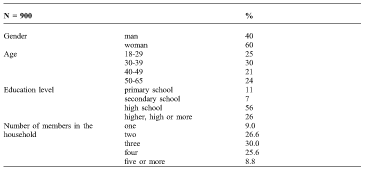
The research was carried out in selected WBC (Slovenia, Bosnia and Herzegovina, Montenegro and Serbia). A quantitative research method with individual interviews was used for data collecting. A stratified sample of the quantitative research, N=900 (540 women and 360 men), is represented by the inhabitants of a WBC population, aged 18 to 65 (Table 1).
Structure of the sample.
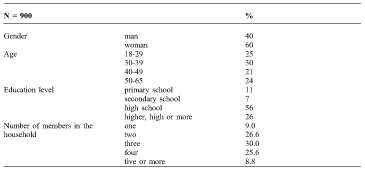
Most respondent were in the age group between 30 and 39 years. More than half of them had finished high school (56%), 26% had a higher, high or more education, 11% had a primary school and 7% of respondents completed secondary school. About 30% lived in a three member family, about 26% had two member families, about 25% had four member families and about 9% were single or lived in five or more member families. 80% of respondents currently living in cities, visit rural areas regularly, at least once a month. The respondents were interested in family farm products and possibly in organic products, suggesting that the survey respondents provide an interesting study group for this issue.
The introduction letter, reminder, and draft questionnaire were developed for purpose of the research. All questionnaires carried a stamped number in order to be able to add factual consumers’ data. The survey examined various factors and determinants that influence the attitudes, perceptions, knowledge and consumption of organic meat in selected WBC. The data were collected using a structured questionnaire administered on the field survey in January 2012 with the use of closed (questions with multiple choice answers) and open questions (questions that were not given the alternative answers).
The questionnaire was divided into the following research thematic areas:
• level of knowledge and awareness of the term 'organic products'
• consumer's buying behaviour to organic meat
• recognition of organic meat on the point of sale
• perception of organic meat in WBC
• demographic data at the end of the questionnaire.
Several attributes of organic products were measured by means of the five-point Likert scale anchors of 1 = low or bad degree of the characteristic, and 5 = high or good degree of the characteristic.
The survey concept is based on prior literature. Magnusson et al. (Reference MAGNUSSON, ARVOLA, KOIVISTO HURSTI, ABERG and SJODEN2001) learned that the most important purchase criteria for food are: taste, health, long shelf-life, and quality aspects of the product. A survey conducted in European Community (EC) countries (Lennernas et al., Reference LENNERNAS, FJELLSTROM, BECKER, GIACHETTI, SCHMITT, REMAUT DE WINTER and KEARNEY1997) has shown that quality/freshness, taste, healthy diet, price, family preferences and habits are the most important food-choice factors. Wandel and Bugge's (1997) showed that taste, freshness, appearance and nutritional value are significant in choice of fruits and vegetables. Verbeke (Reference VERBEKE2001) demonstrated that the top-five important attributes for fresh meat in Belgium are freshness, quality, taste, healthiness, and free of hormones (Radman, Reference RADMAN2005). The final section of the questionnaire dealt with socioeconomic characteristics of the respondents.
Analysis of quantitative data provided by mentioned questionnaire used the Statistical Package for Social Sciences (SPSS 17.0). The data obtained from the survey were analysed with univariate analysis in order to check distributions of frequencies and to detect possible errors occurring during the research and/or data entering. Chi-square, ANOVA and correlation analysis were performed to examine the differences in buying behaviour and attitudes among respondents. The level of comparison was set at 0.05.
The survey aims to examine a number of research hypotheses regarding profile of WBC organic food consumers, formulated based on the literature presented in introduction section. More specifically, the research hypotheses are:
H1: The definition of 'organic' is yet not clearly installed in the food market and in consumers’ perception in WBC.
H2: There is a significant relationship between a gender and consumer's educational level and the frequency of organic meat purchases in WBC.
H3: Gender variable has an effect on the purchase place of organic meat.
H4: The most important motives of purchasing organic meat in WBC are health, safety, good quality and natural content of the meat.
H5: There is a significant relationship between a consumer's gender and the organic meat perception.
Level of knowledge and awareness of the term ‘organic products’
Organic is a word interpreted by individuals in a variety of ways and contexts. The term has many different meanings and interpretations and is often associated and sometimes confused with terms such as ‘green’, ‘ecological’, ‘environmental’, ‘natural’ and ‘sustainable’ (Hutchins and Greenhalgh, Reference HUTCHINS and GREENHALGH1995; McDonagh and Prothero, Reference MCDONAGH and PROTHERO1997; Schifferstein and Oude Ophuis, Reference SCHIFFERSTEIN and OUDE OPHUIS1998). For example, what is organic to one consumer may not be to another and producers and regulators’ interpretations of the term may differ from those of the consumer (Lilliston and Cummins, 1998; Aarset et al., Reference AARSET, BECKMANN, BIGNE, BEVERIDGE, BJORNDAL, BUNTING, MCDONAGH, MARIOJOULS, MUIR, PROTHERO, REISCH, SMITH, TVETERAS and YOUNG2004). The data of quantitative research have shown that knowledge and recognition is not high for organic products. Eighty percent of respondents clearly installed the definition of organic. The best knowledge is present at younger population and respondents with higher educational level. The different definitions given can be categorised according to the following: organic products are products that contain no pesticides, hormones and Genetically Modified (GM) ingredients; organic products are produced naturally, they are home grown products and environmentally friendly; organic products are healthy and safe. Based on the presented results the hypothesis 1 was confirmed. According to the research of Renko and Bošnjak (Reference RENKO and BOŠNJAK2009) and Vlahović et. al. (2011), in Croatia around 83% of respondents and in Serbia 87% were informed of the existence of organic products. This is slightly higher compared to the results obtained from the survey carried out in WBC. The conclusion that can be drawn from these facts is that better knowledge could be achieved through constant education of consumers. This means that there is a need in WBC to continuously inform the consumer about the meaning of the organic products and the meaning of the labelling put on products. Both health care institutions and other institutions of public importance, and manufacturers as well, should take this suggestion on board. It is in the best interest of all subjects participating in the process of production, research and consumption of food to lift the quality of nutrition in WBC to a higher level. According to Gracia and de Magistris (Reference GRACIA and DE MAGISTRIS2007), information on organic products is an important factor, representing the only instrument that consumers have to differentiate the attributes of organic products from those of the conventional ones, and to form positive attitudes and quality perceptions towards these products. The knowledge of organic products is determined by socio-demograpic variables (education level, income, values, lifestyle), but it is also affected by information provided by public administration, mass media, environmental associations and shopping sites.
Consumer knowledge and awareness will continue to be important in the organic food market in two respects. Firstly, there is still a segment of the potential market that is not yet informed about organic foods. A second dimension to the knowledge and awareness puzzle is the possibility that those who do not consider organic products may have a general knowledge about them, but do not have enough detailed information to clearly differentiate the unique attributes of organic from conventionally grown alternatives. In summary, knowledge and awareness about organic products can affect attitudes and perceptions about the product and, ultimately, buying decisions.
Consumer's buying behaviour organic meat
In the next question we asked respondents about whether they believed that differences between organic and conventional meat truly existed. The great majority of respondents believed there were differences (89%), only 11% doubted that such differences existed. Only consumers that claimed to believe in the differences were considered for further analysis.
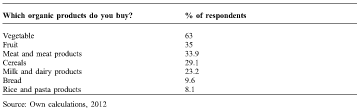
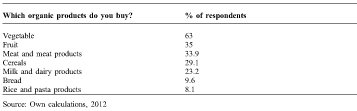
The data for analysing the assortment of organic products purchasing was collected by means of open-ended questions. Vegetables were the most popular types of organic food eaten with 63% of all respondents stating they consumed organic vegetables and 35% claimed to eat organic fruit. Other organic foods consumed by respondents included meat and meat products (33.9%), cereals (29.1%), milk and dairy products (23.2%) (Table 2). Similar results about consumer's buying behaviour organic products were obtained in a study of Croatian consumers (Radman, Reference RADMAN2005), Sicilian consumers (Chinnici et al., Reference CHINNICI, D'AMICO and PECORINO2002) and in the study of Irish organic products consumers (O'Donovan and McCarthy, Reference O'DONOVAN and MCCARTHY2002).
Purchase of organic products.
Source: Own calculations, 2012
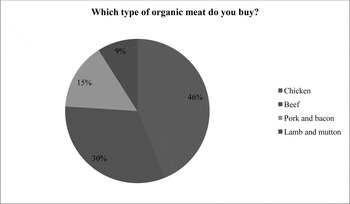
Chicken was the most popular choice of organic meat. A total of 46% of respondents consumed organic chicken, followed by organic beef (30%), organic pork and bacon (15%) and organic lamb and mutton (9%) (Figure 1). Similar results about consumer's buying behaviour organic meat were obtained in a study of Irish organic products consumers (O'Donovan and McCarthy, Reference O'DONOVAN and MCCARTHY2002).
Type of organic meat purchases.
Source: Own calculations, 2012

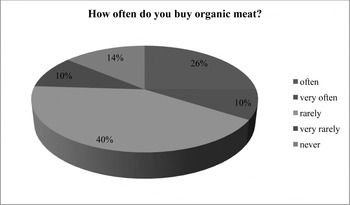
About 36% of respondents claimed to buy organic meat either ‘often’ or ‘very often’ and 40% buy such products ‘rarely’, and 24% of respondents either did not buy or they bought organic products very rarely (Figure 2).
Frequency of the purchase of organic meat.
Source: Own calculations, 2012

With the second hypothesis the researcher assessed there is a significant relationship between a gender and consumer's educational level and the frequency of the purchase of organic meat. Differences in consumer buying behaviours with respect to their demographic characteristics were verified by Chi-square analysis. Chi-square analysis showed that there were differences in consumer buying behaviours with respect to their demographic characteristics. In accordance with other studies (Davies et al., Reference DAVIES, TITTERINGTON and COCHRANE1995; Wandel and Bugge, Reference WANDEL and BUGGE1997; Radman, Reference RADMAN2005), we found that women tend to buy organic meat more often than men. More than 46% of women and 28% of men claimed to buy organic meat often or very often (x2 = 12.9 35; df = 2; p = 0.005). Further, our results suggested that more educated people more often purchase organic meat than other consumers. It was found that 46% of respondents with high education bought organic meat often or very often, while the share of such buyers among respondents with finished secondary school is lower and amounts to 21% (x2 = 9.128; df = 2; p = 0.014). About 57% of the urban population buy organic meat often or very often, compared to 23% of the rural population (x2 = 8.423; df = 2; p = 0.009). Based on the presented results hypothesis 2 was confirmed. Other socio demographic characteristics did not show significant impact on the frequency of purchasing organic meat. In WBC urban and touristic areas there is a lot of potential and an important role for the development of the organic market. It seems that the organic sector could, in the near future, rely mainly on tourism and on the development of cities.
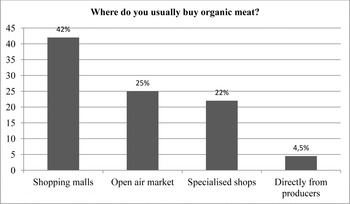
In the case of the frequency and location of organic meat purchase, the most of WBC consumers purchase organic meat in shopping malls (42%) and at the open air market (25%). Around 22% of respondents indicated that they bought organic meat in specialised shops, so called ‘healthy food’ shops and around 11% of respondents bought organic products directly from producers (Figure 3). With the third hypothesis the researcher assessed whether gender variable has any effect on the purchase place of organic meat. T-test was performed on H2 and Levene's test results indicated equal variances between both male and female consumer groups (F = 0.986; p = 0.351). No significant differences could be detected, implying no support for H3 (p = 0.227>0.05).
Usual purchase places for organic meat.
Source: Own calculations, 2012

According to research results by Radman (Reference RADMAN2005), in Croatia most of the respondents (46.3%) purchase organic products at the local city markets and only 9.9% buy them in supermarkets. In Serbia consumers (45%) mostly buy organic products in specialised shops, so called ‘healthy food’ shops, followed by conventional retail stores (supermarkets) (25%), green markets (15%), and direct purchases from producers (11%) (Vlahović et al., Reference VLAHOVIĆ, PUŠKARIĆ and JELOČNIK2011). According to research by Briz and Al-Hajj (Reference BRIZ and AL-HAJJ2004), organic products in Spain are mostly purchased directly from producers (52.3%). The most favoured location for organic products purchase in some countries is the supermarket. In Greece 80.9% (Fotopoulos and Krystallis, Reference FOTOPOULOS and KRYSTALLIS2002), in U.S.A. 49% (Dimitri and Greene, Reference DIMITRI and GREENE2002), in Czech Republic 50%-60% (Richter, Reference RICHTER2005) of examinees shop for organic products in supermarkets. In Macedonia, according to Sekovska (Reference SEKOVSKA2010), the distribution of organic products is mainly through supermarkets 50% (specially organized departments for healthy food). The other important sale channel consists of specialized shops for organic products, with a share of 45%, while an additional 5% comes from direct sales from farms to companies which deal in catering (restaurants, hotels, etc.) and some public institutions (hospitals).
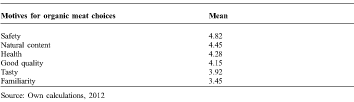
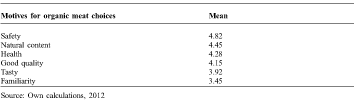
Among the purchasers motives safety, natural content, health, good quality, tasty, familiarity of the meat were indicated as the most important reasons of purchasing organic meat in WBC (Table 3). Based on the presented results the hypothesis 4 was confirmed.
Motives for organic meat choices.
Source: Own calculations, 2012
Recognition of organic meat on the point of sale
63% of the respondents think they may recognize organic meat on the point of sale. Higher level of recognition is characteristic for younger consumers and respondents with higher education levels. Similar results about recognition of organic products on the point of sale were obtained in a study of Serbian consumers (Vlahović et al., Reference VLAHOVIĆ, PUŠKARIĆ and JELOČNIK2011). On the market, the organic products (also meat) are marked with a legally defined sign. On purchasing products bearing the sign ‘organic’, consumers may be sure that at least 95% of the ingredients are of organic origin, that the product complies with all inspection regulations, that it is packed in biodegradable packaging and possesses codes and personal data of the inspection body. Therefore any certified organic product must be marked with the label ‘organic product’. Unfortunately, on the market there are many labels for so-called ‘health food’ that often confuse consumers and slow down the demand growth (Vlahović et al., Reference VLAHOVIĆ, PUŠKARIĆ and JELOČNIK2011). For example, in Macedonia, according to Sekovska (Reference SEKOVSKA2010), most of the consumers can not recognize the national logo for organic product (45.9%). Just 18.2% of them are familiar with it, but usually they are not quite sure about its meaning, confusing it with the Macedonian logo for quality.
Perception of organic meat
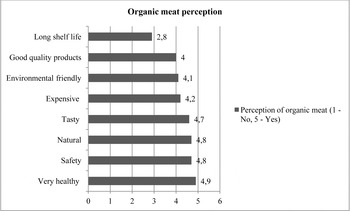
Since the beginning of the 1980s some trends in food consumption has became evident in WBC: increased vegetable, fruit, cheese, meat and fish consumption, on the one hand, and decreased sugar consumption on the other. Reasons for these trends, which are usually mentioned by experts, are increased health concerns and preferences for diet as well as lower demand for calorie intake (Vukasovič, Reference VUKASOVIČ2011). Those trends were also found in our quantitative research. In this part of the research, with face-to-face survey and with the method of semantic differential, in assembly of structured questionnaire, the stand points and the perception of consumers towards organic meat we have been researched. Characteristics of organic meat, prepared in advance were in the questionnaire in order to help the consumers express their points of view toward the mentioned products. Respondents expressed their opinions by marking an answer in the proper spot. They were evaluating the characteristics that refer to organic meat. The average evaluations of the recounted characteristics were calculated based on the acquired evaluations and by that an image of views of WBC consumers toward organic meat was determined. <0}A research made in WBC shows that consumers perceive organic meat as very healthy, safe, natural, tasty, expensive, environmental friendly and of good quality. Consumers are generally dissatisfied with meat shelf life (Figure 4).
Organic meat perception.
Source: Own calculations, 2012

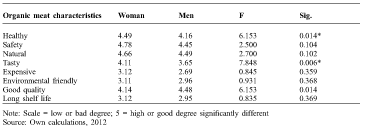
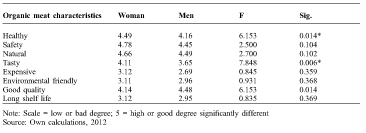
Some socio-demographic characteristics and buying behaviours of consumers influence their perception of organic products. ANOVA showed that women considered organic meat healthier and tastier than did men (Table 4). Based on the presented results the hypothesis 5 was confirmed.
Organic meat perception and sex of respondents.
Note: Scale = low or bad degree; 5 = high or good degree significantly different
Source: Own calculations, 2012
Most of studies concluded that consumers purchase organic food because of a perception that such products are safer, healthier and more environmental friendly than conventionally produced alternatives.
Conclusions
In WBC, in the last few years the production of organic products and also interest of consumers for organic products have increased significantly. Market supplies have been increased and dispersed from specialized shops and organic products markets to shopping malls. When consumer decided whether to buy organic or not, it clearly involved a complex set of factors that cannot easily be interpreted. In WBC, the organic food is considered at the introductory stage where not many people are aware about. The aim of this paper is to enable better understanding of WBC consumers' awareness, attitude and perception towards organic meat, i.e. to gain insight in consumers’ preferences, motives, attitudes and interest to buy organically produced meat in WBC.
Based on the research results the following conclusions can be drawn:
• The definition of ‘organic’ is not yet clearly installed in the food market and in consumers’ perception. 80% of respondents clearly understood the definition of organic. This means that there is a need in WBC to continuously inform the consumer about the meaning of the organic products and the meaning of the labelling put on products.
• Vegetables were the most popular types of organic food eaten with 63% of all respondents stating they consumed organic vegetables and 35% claimed to eat organic fruit. Other organic foods consumed by respondents included meat and meat products (33.9%), cereals (29.1%), milk and dairy products (23.2%).
• Chicken was the most popular choice of organic meat. A total of 46% of respondents consumed organic chicken, followed by organic beef (30%), organic pork and bacon (15%) and organic lamb and mutton (9%)
• About 36% of respondents claimed to buy organic meat either ‘often’ or ‘very often’.
• In the case of the frequency and location of organic meat purchase, the most of WBC consumers purchase organic meat in shopping malls (42%) and (25%) at the open air market.
• Among the purchase motives safety, natural content, health, good quality, tasty, familiarity of the meat were indicated as the most important reasons of purchasing organic meat.
• Research made in WBC shows that consumers perceive organic meat as very healthy, safe, natural, tasty, expensive, environmental friendly and of good quality. Consumers are generally dissatisfied with shelf life
This paper gives the latest insight into buying behaviour and attitudes of organic meat consumers in WBC. According to the research results an important task for the producers will be to increase consumers’ knowledge of what an organic product is and how to differentiate it in the marketplace. Therefore, knowing how consumers perceive organic meat products by understanding the reasons for buying them would probably help the marketers of organic food to establish a proper communication message. The results of the research could be used for planning further marketing activities. These results are particularly useful for product marketing and future product development in the organic food sector, as they provide an indication as how it can better reach and satisfy existing organic food consumers, and possibly, adapt organic food consumers in order to attract new segments and a new generation of consumers.