


1. INTRODUCTION
Terahertz (THz) wave refers to the part of electromagnetic spectrum ranging from 0.1 to 10 THz or from 3 to 300 cm−1. The strong generation of these radiations is the present concern of the scientific world, so that the complete electromagnetic spectrum can be fully exploited for the development of science. The first experimental observation of THz waves by Hamster (Hamster et al., Reference Hamster, Sullivan, White and Falcne1993) paved the way to a new research area that has been neglected for many decades due to the lack of proper generation and detection techniques. The sudden boom in the field of THz technologies lies in its non-ionizing character and power to penetrate deep into the material without causing any damage to it. These characteristics make it a unique scientific tool and it finds applications in a variety of fields like material characterization, remote sensing, security screening, explosives identification, time domain spectroscopy, medical imaging (Han et al., Reference Han, Cho and Xhang2000; Ferguson & Zhang, Reference Ferguson and Zhang2002; Shen et al., Reference Shen, Lo, Taday, Cole, Tribe and Kemp2005; Ebbinghaus et al., Reference Ebbinghaus, Schröck, Schauer, Bründermann, Heyden, Schwaab, Böke, Winter, Tani and Havenit2006; Pickwell & Wallace, Reference Pickwell and Wallace2006; Tonouchi, Reference Tonouchi2007), etc.
Attempts have been made to generate THz radiations by semiconductor, electro optic devices, and through optical rectification (Jepsen et al., Reference Jepsen, Jacobsen and Keiding1996; Lee et al., Reference Lee, Meade, Perlin, Winful, Norris and Galvanauskas2000; Shen et al., Reference Shen, Upadhya, Beere, Linfield, Davies, Gregory, Baker, Tribe and Evans2004). However, the need of high power THz radiations can never be achieved by the above given processes as solid state devices are not capable of handling high power due to their low power damage limit. Moreover, such devices are also constrained by the small values of conversion efficiencies.
Plasma can witness the production of high power THz radiations. Since it is already in an ionized state, extremely high powers can be handled without any constraint of medium breakdown and it also shows strong nonlinear effects at high power. A large number of schemes of THz emission have been studied based on laser–plasma interaction both experimentally and theoretically (Sprangle et al., Reference Sprangle, Penano, Hafizi and Kapetanakos2004; Sheng et al., Reference Sheng, Mima and Zhang2005; Xie et al., Reference Xie, Dai and Zhang2006; Amico et al., Reference Amico, Houard, Akturk, Liu, Bloas, Franco, Prade, Couairon, Tikhonchuk and Mysyrowicz2008; Houard et al., Reference Houard, Liu, Prade, Tikhonchuk and Mysyrowicz2008; Kim et al., Reference Kim, Taylor, Glownia and Rodriguez2008; Bhasin & Tripathi, Reference Bhasin and Tripathi2009; Hu et al., Reference Hu, Shen, Lei, Li and Xu2010; Kostin & Vvedenskii, Reference Kostin and Vvedenskii2010; Liu et al., Reference Liu, Dai, Chin and Zhang2010; Sharma & Singh, Reference Sharma and Singh2014). Generation of THz waves has also been reported in magnetized plasma by the Cerenkov wake field excitation by short laser pulses (Yoshii et al., Reference Yoshii, Lai, Katsouleas, Joshi and Mori1997; Dorranian et al., Reference Dorranian, Ghoranneviss, Starodubtsev, Yugami and Nishida2005). The experiment demonstrating the generation of THz waves by wake field excitation has been done by considering the beam propagation perpendicular to the direction of applied magnetic field (Yugami et al., Reference Yugami, Higashiguchi, Gao, Sakai, Takahashi, Ito, Nishida and Katsouleas2002).
The propagation of laser beams in nonlinear media encounters a very interesting and useful mechanism known as self-focusing of laser beams (Akhmanov et al., Reference Akhmanov, Sukhorukov and Khokhlov1968; Sprangle et al., Reference Sprangle, Tang and Esarey1987; Brandi et al., Reference Brandi, Manus, Mainfray, Lehner and Bonnaud1993; Singh et al., Reference Singh, Singh and Sharma2013). It has been observed that self-focusing of laser beams in preformed plasma by the nonlinear mechanisms plays a key role in the enhancement of THz yield (Hussain et al., Reference Hussain, Singh, Singh and Sharma2014; Singh & Sharma, Reference Singh and Sharma2014; Kumar et al., Reference Kumar, Singh, Singh and Sharma2015). Moreover it has also been observed that THz emission strongly depends on the spatial profile of the laser beam, the emission of THz waves by Gaussian, amplitude modulated Gaussian beams, cosh Gaussian, hollow Gaussian beams (HGB), (Sharma et al., Reference Sharma, Singh, Sharma, Chauhan and Ji2010; Singh et al., Reference Singh, Singh and Sharma2013; Hussain et al., Reference Hussain, Singh, Singh and Sharma2014; Kumar et al., Reference Kumar, Singh, Singh and Sharma2015) etc., has been investigated in detail. Amongst these, the HGB, also referred to as dark hollow beam due to the null intensity in the center, has also gained considerable attention on account of its extensive applications in the study of plasmas, atomic, and modern optics. Due to their null intensity at the center, such beams are extremely useful in neutral particle guiding and trapping. The dynamical behavior and several other propagation characteristics of these beams have been investigated theoretically and several models have been developed like the transverse electromagnetic (TEM01) mode, higher order Bessel beams (Kuga et al., Reference Kuga, Torii, Shiokawa, Hirano, Shmizu and Sasada1997; Xu et al., Reference Xu, Wang and Jhe2000; York et al., Reference York, Milchberg, Palastro and Antonsen2008; Sodha et al., Reference Sodha, Mishra and Misra2009), etc.
The propagation of a non-uniform intense laser beam inside the plasma encounters both ponderomotive nonlinearity and relativistic nonlinearity, leading to the self-focusing of laser beam. Under the application of extremely high power laser beam in the plasma the electrons acquire velocities comparable with the velocity of light. In view of this the relativistic mass correction has to be taken into account. This correction in mass causes a change in the refractive index of the plasma as given by the relation 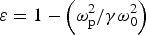 ${\rm \varepsilon} = 1 - \left( {{{{\rm \omega} _{\rm p}^2} / {{\rm \gamma \omega} _0^2}}} \right)$, where
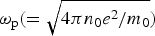 ${{\rm \omega} _{\rm p}}( = \sqrt {{{4{\rm \pi} {n_0}{e^2}} / {{m_0}}}} )$ is the plasma frequency, ω0 is the laser frequency, n 0 is the plasma electron density, e and m 0 are the charge and rest mass of the electron, respectively, and γ is the relativistic Lorentz factor. Thus with changing mass the refractive index changes and causes the beam to suffer self-focusing in the plasma. This relativistic nonlinearity comes into play only when the incident laser power exceeds the critical threshold given as (Sprangle et al., Reference Sprangle, Tang and Esarey1987; Sun et al., Reference Sun, Ott, Lee and Guzdar1987) P c = 17γ(ω0/ωp)2GW. For the pulse duration τpe < τ < τpi, both ponderomotive and relativistic nonlinearity will be operative but when τ < τpe only the relativistic nonlinearity is encountered. For the sake of simplicity we have considered only the case when relativistic nonlinearity is operative (Brandi et al., Reference Brandi, Manus, Mainfray, Lehner and Bonnaud1993).
In this work, the propagation of HGB in magnetized plasma at relativistic laser intensities has been studied under the paraxial approximation. In this paper, we are presenting a method of investigating the generation of THz waves, by the nonlinear interaction of HGB and electron plasma wave (EPW) in a rippled density plasma. Resonant excitation of THz radiations occurs at the difference frequency of the laser beam and EPW, when the phase matching conditions are appropriately satisfied. Due to the relativistic effect, the mass of the electron changes, thereby introducing the nonlinearity in the plasma (Umstadter, Reference Umstadter2003) and resulting in the self-focusing of HGB. Further, this self-focused beam interacts with one of the modes of magnetized plasma that is, with EPW in the presence of density ripple and leads to the generation of sufficiently strong electromagnetic radiations, lying in the THz regime.
2. SELF-FOCUSING OF HGB DUE TO RELATIVISTIC NONLINEARITY IN MAGNETO PLASMA
Consider a right circularly polarized electromagnetic HGB propagating along the direction of static background magnetic field B 0 in uniform collisionless magnetized plasma, having equilibrium electron density n 0. Under the paraxial approximation, the electric field vector associated with the laser beam can be expressed as:
 $${{E_ +} (r,z) = \left( {{E_x} + i{E_y}} \right) = {A_ +} (r,z)\exp i\left( {{\omega _{0 +}} t - {k_{0 +}} z} \right)}$$
This approximation assumes complex amplitude A + slowly varying in z and t compared with ω0+ = k 0+c that is, |∂A +/∂z| ≪ |k 0+A +| and |∂A +/∂t| ≪ |ω0+A +|. Here,  ${k_{0+}} ( = {{\rm \omega}_{0+}}/ \c{c} \sqrt {{{\rm \varepsilon}_{0+}}})$ and ω0+ are the propagation wave vector and angular frequency of the laser beam, respectively. The complex amplitude (A +) for the HGB can be written as
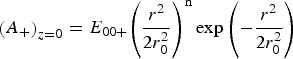 $${\left( {{A_ +}} \right)_{z = 0}} = {E_{00 +}} {\left( {\displaystyle{{{r^2}} \over {2r_0^2}}} \right)^{\rm n}}\exp \left( { - \displaystyle{{{r^2}} \over {2r_0^2}}} \right)$$
Here, “+” sign denotes the right circular mode of propagation, E 00+ refers to the initial amplitude of the HGB, corresponding to the position of maximum irradiance  ${r_{\max}} ( = {r_0}\sqrt {2n} )$, n is the order of HGB (n = 0 corresponds to the fundamental Gaussian laser beam) and r 0 refers to the initial width of the HGB. Equation of motion governing the response of electrons at all frequencies is given as:
 $${m_0}\displaystyle{\partial \over {\partial t}}\left( {\gamma {{\vec v}_{\rm k}}} \right) + {m_0}{\vec v_{\rm k}} \cdot \nabla \left( {{\rm \gamma} {{\vec v}_{\rm k}}} \right) = - e{\vec E_{\rm k}} - \displaystyle{e \over c}\left( {{{\vec v}_{\rm k}} \times B} \right)$$
where γ is the Lorentz factor given by  ${\rm \gamma} ( = {(1 - (v_ + ^2 /{c^2}))^{ - {1 / 2}}})$ and e is the electronic charge. It can be clearly seen from Eq. (2a) that γ depends on
 $v_ + ^2 $ and this term will contain time independent as well as time dependent components (through higher harmonics). However, for the present case: That is, steady state self-focusing, the derivative of γ with respect to time will not affect the self-focusing phenomenon. Therefore this has not been taken into account, under this simplification the oscillatory velocity of the electrons at pump frequency ω can be obtained by solving the following simplified form of the above equation (Hasson et al., Reference Hasson, Sharma and Khamis2010):
 $${m_0}{\rm \gamma} \displaystyle{{\partial {{\vec v}_{\rm k}}} \over {\partial t}} = - e{\vec E_{\rm k}} - \displaystyle{e \over c}\left( {{{\vec v}_{\rm k}} \times {B_0}} \right)$$
Here the contribution from the Lorentz force factor  $[ - e/c({\vec v_{\rm k}}$
 $\times {B_{\rm k}})]$ is also not considered because this term is important only in the case of ponderomotive nonlinearity or relativistic ponderomotive nonlinearity that is, at a larger time scale than that of the current scheme. For ultra-short laser pulses relativistic nonlinearity is set up almost instantaneously. Therefore at such a small time scale there is not much significance of the Lorentz term. By using Eq. (2b), the oscillatory velocity of electrons for the right circular mode of polarization comes out to be:
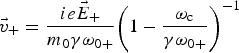 $${\vec v_+} = \displaystyle{{ie{{\vec E}_+}} \over {{m_0}{\rm \gamma} {{\rm \omega}_{0+}}}} {\left( {1 - \displaystyle{{{{\rm \omega} _{\rm c}}} \over {{\rm \gamma} {{\rm \omega} _{0+}}}}} \right)^{ - 1}}$$
The relativistic factor  ${\rm \gamma} ( = {(1 - (v_ + ^2 /{c^2}))^{ - {1 / 2}}})$ can be expressed as (Hasson et al., Reference Hasson, Sharma and Khamis2010; Hassan et al., Reference Hassan, Al-Janabi, Singh and Sharma2012):
 $${\rm \gamma} \cong 1 + {{\rm \alpha} _ +} {A_ +} A_ + ^{\ast} $$
where  ${{\rm \alpha} _ + } = \displaystyle{{{e^2}} \over {2m_0^2 {c^2}{\rm \omega} _{0 + }^2 }}{\left( {1 - {{\rm \omega} _{\rm c}}/{{\rm \omega} _{0+ }}} \right)^{ - 2}}\quad {\rm and}\quad {{\rm \omega} _{\rm c}} = \displaystyle{{e{B_0}} \over {{m_0}c}}.$In the regime, where the relativistic nonlinearity is operative, the components of the complex dielectric tensor
 ${\rm \underline{\underline {\rm \varepsilon}}} $ are given as follows:
 $${{\rm \varepsilon} _{xx}} = {{\rm \varepsilon} _{yy}} = 1 - \displaystyle{{{\rm \omega} _{\rm p}^2} \over {{\rm \omega} _{0 +} ^2 {\rm \gamma}}} {\left( {1 - \displaystyle{{{\rm \omega} _{\rm c}^2} \over {{\rm \omega} _{0 +} ^2 {{\rm \gamma} ^2}}}} \right)^{ - 1}},\quad {{\rm \varepsilon} _{zz}} = 1 - \displaystyle{{{\rm \omega} _{\rm p}^2} \over {{\rm \omega} _{0 +} ^2 {\rm \gamma}}} $$
 $${{\rm \varepsilon} _{xy}} = - {{\rm \varepsilon} _{yx}} = - i\left( {\displaystyle{{{\rm \omega} _{\rm p}^2} \over {{\rm \omega} _{0 +} ^2 {\rm \gamma}}}} \right)\left( {\displaystyle{{{{\rm \omega} _{\rm c}}} \over {{\rm \gamma} {{\rm \omega}_{0+}}}}} \right){\left( {1 - \displaystyle{{{\rm \omega} _{\rm c}^2} \over {{\rm \omega} _0^2 {{\rm \gamma} ^2}}}} \right)^{ - 1}}$$
 $${{\rm \varepsilon} _{xz}} = {{\rm \varepsilon} _{yz}} = {{\rm \varepsilon} _{zx}} = {{\rm \varepsilon} _{zy}} = 0$$
where ωp = (4πn 0e 2/m 0)1/2 is the electron plasma frequency.
When the electromagnetic wave propagates in the plasma at relativistic intensities, it modifies the dielectric constant. For the right circular mode of polarization of the incident laser beam, the dielectric constant is given by:
 $${{\rm \varepsilon} _ +} = {{\rm \varepsilon} _{{\rm x}x}} - i{{\rm \varepsilon} _{xy}} = 1 - \displaystyle{{{\rm \omega} _{\rm p}^2} \over {{\rm \omega} _{0 +} ^2 {\rm \gamma}}} {\left( {1 - \displaystyle{{{{\rm \omega} _{\rm c}}} \over {{{\rm \omega} _{0 +}} {\rm \gamma}}}} \right)^{ - 1}}$$
By using Eq. (4) in above equation, ε+ can be expressed as:
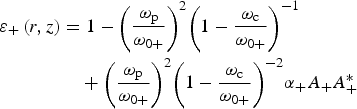 $$\eqalign{ {{\rm \varepsilon} _ +} \left( {r,z} \right) & = 1 - {\left( {\displaystyle{{{{\rm \omega} _{\rm p}}} \over {{{\rm \omega} _{0 +}}}}} \right)^2}{\left( {1 - \displaystyle{{{{\rm \omega} _{\rm c}}} \over {{{\rm \omega} _{0 +}}}}} \right)^{ - 1}} \cr & \quad + {\left( {\displaystyle{{{{\rm \omega} _{\rm p}}} \over {{{\rm \omega} _{0 +}}}}} \right)^2}{\left( {1 - \displaystyle{{{{\rm \omega} _{\rm c}}} \over {{{\rm \omega} _{0 +}}}}} \right)^{ - 2}}{{\rm \alpha} _ +} {A_ +} A_ + ^{\ast}} $$
Inside the magnetized plasma the propagation dynamics of HGB is governed by the following wave equation given as (Sodha et al., Reference Sodha, Ghatak and Tripathi1974):
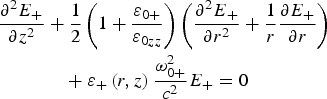 $$\eqalign{\displaystyle{{{\partial ^2}{E_ +}} \over {\partial {z^2}}} & + \displaystyle{1 \over 2}\left( {1 + \displaystyle{{{{\rm \varepsilon} _{0 +}}} \over {{{\rm \varepsilon} _{0zz}}}}} \right)\left( {\displaystyle{{{\partial ^2}{E_ +}} \over {\partial {r^2}}} + \displaystyle{1 \over r}\displaystyle{{\partial {E_ +}} \over {\partial r}}} \right) \cr & \quad + {{\rm \varepsilon} _ +} \left( {r,z} \right)\displaystyle{{{\rm \omega} _{0 +} ^2} \over {{c^2}}}{E_ +} = 0} $$
Now, using Eq. (1a) in Eq. (7) and considering A +(r, z) to be a slowly varying function of z, one obtains:
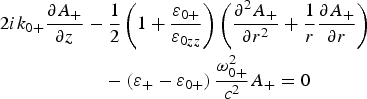 $$\eqalign{ 2i{k_{0 +}} \displaystyle{{\partial {A_ +}} \over {\partial z}} & - \displaystyle{1 \over 2}\left( {1 + \displaystyle{{{{\rm \varepsilon} _{0 +}}} \over {{{\rm \varepsilon} _{0zz}}}}} \right)\left( {\displaystyle{{{\partial ^2}{A_ +}} \over {\partial {r^2}}} + \displaystyle{1 \over r}\displaystyle{{\partial {A_ +}} \over {\partial r}}} \right) \cr & \quad - \left( {{{\rm \varepsilon} _ +} - {{\rm \varepsilon} _{0 +}}} \right)\displaystyle{{{\rm \omega} _{0 +} ^2} \over {{c^2}}}{A_ +} = 0} $$
Here, the complex amplitude A +(r, z) of the electric field of the laser beam can be expressed as:
 $${A_ +} \left( {r,z} \right) = {A_{0 +}} \left( {r,z} \right)\exp \left\{ { - i{k_{0 +}} {S_ +} \left( {r,z} \right)} \right\}$$
where S +(r, z) is termed as the eikonal of the electromagnetic beam. It is responsible for the divergence and converging character of HGB. By using Eq. (9) in Eq. (8), and equating the real and imaginary parts, we obtain the following equations
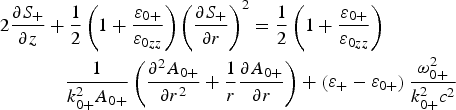 $$\eqalign{2\displaystyle{{\partial {S_ +}} \over {\partial z}} & + \displaystyle{1 \over 2}\left( {1 + \displaystyle{{{{\rm \varepsilon} _{0 +}}} \over {{{\rm \varepsilon} _{0zz}}}}} \right){\left( {\displaystyle{{\partial {S_ +}} \over {\partial r}}} \right)^2} = \displaystyle{1 \over 2}\left( {1 + \displaystyle{{{{\rm \varepsilon} _{0 +}}} \over {{{\rm \varepsilon} _{0zz}}}}} \right) \cr & \quad \displaystyle{1 \over {k_{0 +} ^2 {A_{0 +}}}} \left( {\displaystyle{{{\partial ^2}{A_{0 +}}} \over {\partial {r^2}}} + \displaystyle{1 \over r}\displaystyle{{\partial {A_{0 +}}} \over {\partial r}}} \right) + \left( {{{\rm \varepsilon} _ +} - {{\rm \varepsilon} _{0 +}}} \right)\displaystyle{{{\rm \omega} _{0 +} ^2} \over {k_{0 +} ^2 {c^2}}}} $$
and
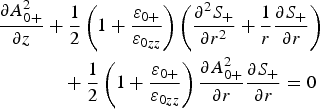 $$\eqalign{ \displaystyle{{\partial A_{0 +} ^2} \over {\partial z}} & + \displaystyle{1 \over 2}\left( {1 + \displaystyle{{{{\rm \varepsilon} _{0 +}}} \over {{{\rm \varepsilon} _{0zz}}}}} \right)\left( {\displaystyle{{{\partial ^2}{S_ +}} \over {\partial {r^2}}} + \displaystyle{1 \over r}\displaystyle{{\partial {S_ +}} \over {\partial r}}} \right) \cr & \quad + \displaystyle{1 \over 2}\left( {1 + \displaystyle{{{{\rm \varepsilon} _{0 +}}} \over {{{\rm \varepsilon} _{0zz}}}}} \right)\displaystyle{{\partial A_{0 +} ^2} \over {\partial r}}\displaystyle{{\partial {S_ +}} \over {\partial r}} = 0} $$
In order to further simplify the equations, we transform the (r, z) variables to (η, z) variable by the following relation (Sodha et al., Reference Sodha, Mishra and Misra2009):
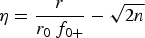 $$\eta = \displaystyle{r \over {{r_0}{\,f_{0 +}}}} - \sqrt {2n}$$
where f 0+ denotes the dimensionless beam width parameter. By using the above transformation, we obtain η = 0 as the position of maximum irradiance (as seen in case of Gaussian beams for r = 0) corresponding to  $r = {r_0}{\,f_{0 +}} \sqrt {2n} $. Therefore the complex dielectric function ε+(η, z) can be expressed around η = 0 as:
 $${{\rm \varepsilon} _ +} ({\rm \eta}, z) = {{\rm \varepsilon} _{0 +}} ({\rm \eta}, z) - {{\rm \eta} ^2}{{\rm \varepsilon} _{2 +}} ({\rm \eta}, z)$$
Using the paraxial ray approximation  $\eta \ll \sqrt {2n} $, the amplitude and eikonal of the HGB can be expressed as (Akhmanov et al., Reference Akhmanov, Sukhorukov and Khokhlov1968; Sodha et al., Reference Sodha, Mishra and Misra2009):
 $${\left( {{A_{0 +}}} \right)^2} = \displaystyle{{E_{00 +} ^2} \over {{2^{2{\rm n}}}f_{0 +} ^2}} {\left( {\sqrt {2n} + {\rm \eta}} \right)^{4{\rm n}}}\exp \left( { - {{\left( {\sqrt {2n} + {\rm \eta}} \right)}^2}} \right)$$
and
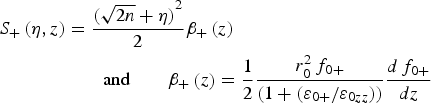 $$\eqalign{{S_ +} \left( {{\rm \eta}, z} \right) & = \displaystyle{{{{(\sqrt {2n} + {\rm \eta} )}^2}} \over 2}{{\rm \beta} _ +} \left( z \right) \cr & \quad \quad {\rm and}\quad \quad {{\rm \beta} _ +} \left( z \right) = \displaystyle{1 \over 2}\displaystyle{{r_0^2 {\,f_{0 +}}} \over {(1 + ({{\rm \varepsilon} _{0 +}} /{{\rm \varepsilon} _{0zz}}))}}\displaystyle{{d{\,f_{0 +}}} \over {dz}}} $$
where  ${\rm \beta} _{_ + } ^{ - 1} (z)$ denotes the radius of curvature of the hollow Gaussian laser beam. On substituting Eqs (13) and (14) in Eq. (10), we obtain the equation governing the dynamics of beam width parameter.
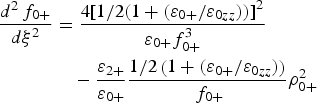 $$\eqalign{ \displaystyle{{{d^2}{\,f_{0 +}}} \over {d{{\rm \xi} ^2}}} & = \displaystyle{{4{{[1/2(1 + ({{\rm \varepsilon} _{0 +}} /{{\rm \varepsilon} _{0zz}}))]}^2}} \over {{{\rm \varepsilon} _{0 +}} f_{0 +} ^3}} \cr & \quad - \displaystyle{{{{\rm \varepsilon} _{2 +}}} \over {{{\rm \varepsilon} _{0 +}}}} \displaystyle{{1/2\left( {1 + ({{\rm \varepsilon} _{0 +}} /{{\rm \varepsilon} _{0zz}})} \right)} \over {{\,f_{0 +}}}} {\rm \rho} _{0 +} ^2} $$
Here, ρ0+ = r 0ω0+/c and 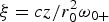 ${\rm \xi} = cz/r_0^2 {{\rm \omega}_{0 +}} $ are the dimensionless parameters describing the propagation distance and the initial width of the laser, respectively. The dielectric functions ε0+(z) and ε2+(z) are obtained by using Eqs. (6) and (12b) as follows (Sodha et al., Reference Sodha, Mishra and Misra2009),
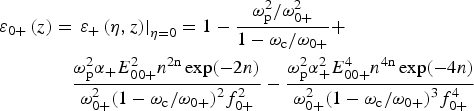 $$\eqalign{ {{\rm \varepsilon} _{0 +}} \left( z \right) & = {\left. {{{\rm \varepsilon} _ +} \left( {{\rm \eta}, z} \right)} \right \vert _{{\rm \eta} = 0}} = 1 - \displaystyle{{{{{\rm \omega} _{\rm p}^2} / {{\rm \omega} _{0 +} ^2}}} \over {1 - {{{{\rm \omega} _{\rm c}}} / {{{\rm \omega} _{0 +}}}}}} + \cr & \quad \displaystyle{{{\rm \omega} _{\rm p}^2 {{\rm \alpha} _ +} E_{00 +} ^2 {n^{2{\rm n}}}\exp ( - 2n)} \over {{\rm \omega} _{0 +} ^2 {{(1 - {{{{\rm \omega} _{\rm c}}} / {{{\rm \omega} _{0 +}}}} )}^2}f_{0 +} ^2}} - \displaystyle{{{\rm \omega} _{\rm p}^2 {\rm \alpha} _ + ^2 E_{00 +} ^4 {n^{4{\rm n}}}\exp ( - 4n)} \over {{\rm \omega} _{0 +} ^2 {{(1 - {{{{\rm \omega} _{\rm c}}} / {{{\rm \omega} _{0 +}}}} )}^3}f_{0 +} ^4}}}$$
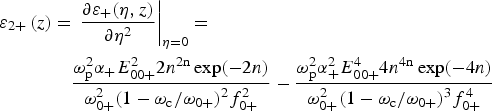 $$\eqalign{{{\rm \varepsilon} _{2 +}} \left( z \right) & = {\left. {\displaystyle{{\partial {{\rm \varepsilon} _ +} ({\rm \eta}, z)} \over {\partial {{\rm \eta} ^2}}}} \right \vert _{{\rm \eta} = 0}} = \cr & \quad \displaystyle{{{\rm \omega} _{\rm p}^2 {{\rm \alpha} _ +} E_{00 +} ^2 2{n^{2{\rm n}}}\exp ( - 2n)} \over {{\rm \omega} _{0 +} ^2 {{(1 - {{{{\rm \omega} _{\rm c}}} / {{{\rm \omega} _{0 +}}}} )}^2}f_{0 +} ^2}} - \displaystyle{{{\rm \omega} _{\rm p}^2 {\rm \alpha} _ + ^2 E_{00 +} ^4 4{n^{4{\rm n}}}\exp ( - 4n)} \over {{\rm \omega} _{0 +} ^2 {{(1 - {{{{\rm \omega} _{\rm c}}} / {{{\rm \omega} _{0 +}}}} )}^3}f_{0 +} ^4}}}$$
3. GENERATION OF THz WAVES
On account of the nonlinear interaction between the high power HGB $({\vec E_{{\rm 0 +}}}, {{\rm \omega}_{0 +}}, {\vec k_{0 +}} )$ and the EPW
 $({\vec E_{\rm 1}},{{\rm \omega} _1},{\vec k_1})$ propagating through the collisionless magnetized plasma, the THz waves
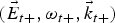 $({\vec E_{t +}}, {{\rm \omega} _{t +}}, {\vec k_{t +}} )$ are generated at the difference frequency of the HGB and EPW. The presence of ripple density plasma takes care of the momentum phase matching and as a result, paves the way for high power radiation generation. The variation of the electric field of THz wave can be expressed as:
 $${\vec E_{{\rm t} +}} = \hat r{E_{{\rm t}0 +}} \exp i\left( {{{\rm \omega} _{{\rm t +}}} t - {k_{{\rm t} +}} z} \right)$$
where, the + sign indicates the right circularly polarized state and  $\hat r = \hat x + i\,\hat y$, with
 $\hat x$ and
 $\hat y$ being unit vectors along the perpendicular directions, ωt+ and k t+ denote the frequency and the propagation wave number of the generated THz waves, respectively. The electric field variation of the EPW is given by:
 $${\vec E_1} = \hat z{E_1}\exp i\left( {{{\rm \omega} _1}t - {k_1}z} \right)$$
Where, ω1 and k 1 are the angular frequency and propagation wave number of the EPW. Under the influence of this field, the electrons acquire an oscillatory velocity  ${\vec v_1}$ given by:
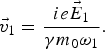 $${\vec v_1} = \displaystyle{{ie{{\vec E}_1}} \over {{\rm \gamma} {m_0}{{\rm \omega} _1}}}.$$
This oscillating velocity is related to the density perturbation caused by the plasma wave by continuity equation as (Shukla & Sharma, Reference Shukla and Sharma1982; Sharma et al., Reference Sharma, Singh, Sharma, Chauhan and Ji2010; Hassan et al., Reference Hassan, Al-Janabi, Singh and Sharma2012)  ${\vec v_1} = {{\rm \omega} _1}/{\vec k_1}{\rm \mu} $, here
 ${\rm \mu} = {\tilde n_{\rm p}}/{n_0}$ corresponds to the normalized density of the plasma wave. When the laser beam is propagating in the ripple density magnetoplasma, the total number density of electrons can be expressed as a combination of background density (n 0), density perturbation due to EPW
 $({\tilde n_{\rm p}})$, and density of ripple (n q) as :
 $$N = {n_0} + {\tilde n_{\rm p}}\exp \left\{ {i\left( {{{\rm \omega} _1}t - {k_1}z} \right)} \right\} + {n_{\rm q}}\exp \left( { - iqz} \right)$$
Inside the plasma, the dynamics of THz field ( ${\vec E_{{\rm t +}}} $) generation is governed by the following wave equation:
 $$\displaystyle{{{\partial ^2}{{\vec E}_{{\rm t} +}}} \over {\partial {z^2}}} - \displaystyle{1 \over {{c^2}}}\displaystyle{{{\partial ^2}{{\vec E}_{{\rm t} +}}} \over {\partial {t^2}}} = \displaystyle{{4{\rm \pi}} \over {{c^2}}}\displaystyle{\partial \over {\partial t}}\left( {{{\vec J}_{\rm l}} + {{\vec J}_{{\rm nl}}}} \right)$$
where,  ${\vec J_{\rm l}}$ and
 ${\vec J_{{\rm nl}}}$ are the linear and nonlinear current densities and their magnitude depends on the number density and the velocity of electrons as given by the following equation:
 $${\vec J_{\rm l}} = - e{n_0}(\vec v_{\rm l}^{\rm \;e} + \vec v_{\rm l}^{\rm \;i} )\; \;{\rm and}\;{\vec J_{{\rm nl}}} = - e{n_{\rm q}}\vec v_{{\rm nl}}^{\rm \; e} $$
The nonlinear interplay between the incident laser beam and plasma wave and the evaluation of the velocity components both are governed primarily by two equations namely,
1. Continuity equation:
(21) $$\displaystyle{{\partial {N_{\rm j}}} \over {\partial t}} + \vec \nabla \cdot \left( {{N_{\rm j}}{{\vec v}_{\rm j}}} \right) = 0$$
2. Momentum balance equation:
(22)$${m_{\rm j}}{\rm \gamma} \displaystyle{{\partial {{\vec \upsilon} _{\rm j}}} \over {\partial t}} + {m_{\rm j}}\left( {{{\vec v}_{\rm j}} \cdot \vec \nabla} \right){\vec v_{\rm j}} = {e_{\rm j}}\left[ {\vec E + \displaystyle{1 \over c}{{\vec v}_{\rm j}} \times \left( {{{\vec B}_0} + \vec B} \right)} \right]$$
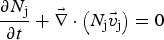

where, m j, ${\vec v_{\rm j}}$, and N j are the mass, the fluid velocity, and the particle density of species j = e, i (electrons, ions), respectively.
 ${\vec B_0}$ is the externally applied static magnetic field where as,
 $\vec E$ and
 $\vec B$ are the self-consistent electric and magnetic fields corresponding to the THz waves.
The linear components of the electron and ion velocities are  $\vec v_{\rm l}^{\rm \; e} = ie{\vec E_{{\rm t} +}} /{\rm \gamma} {m_0}{{\rm \omega} _{{\rm t} +}} {\left( {1 - {{\rm \omega} _{\rm c}}/{\rm \gamma} {{\rm \omega} _{{\rm t} +}}} \right)^{ - 1}}$ and
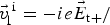 $\vec v_{\rm l}^{\rm \; i} = - ie{\vec E_{{\rm t} +}} /$
 ${\rm \gamma} {m_0}{{\rm \omega} _{{\rm t} +}} {\left( {1 + ({{\rm \omega} _{{\rm ci}}}/{\rm \gamma} {{\rm \omega} _{{\rm t} +}} )} \right)^{ - 1}}$, respectively. Here, ωci( = eB 0/m ic) is the ion cyclotron frequency. In order to evaluate the nonlinear electron velocity acquired on account of interaction between the laser beam and EPW, we use the magnetic field of the laser beam
 ${\vec B_{0 +}} = c{k_{0 +}} /{{\rm \omega} _{0 +}} \left( {\hat z \times {{\vec E}_{0 +}}} \right)$ in the momentum balance equation and obtain (Shukla & Sharma, Reference Shukla and Sharma1982):
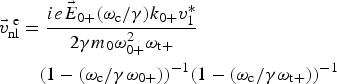 $$\eqalign{ \vec v_{{\rm nl}}^{\rm \;e} & = \displaystyle{{ie{{\vec E}_{0 +}} ({{\rm \omega} _{\rm c}}/{\rm \gamma} ){k_{0 +}} v_1^{\ast}} \over {2{\rm \gamma} {m_0}{\rm \omega} _{0 +} ^2 {{\rm \omega} _{{\rm t} +}}}} \cr & \quad {\left( {1 - ({{\rm \omega} _{\rm c}}/{\rm \gamma} {{\rm \omega}_{0+}} )} \right)^{ - 1}}{\left( {1 - ({{\rm \omega} _{\rm c}}/{\rm \gamma} {{\rm \omega} _{{\rm t} +}} )} \right)^{ - 1}}} $$
However, the ion contribution towards nonlinearity has been neglected on account of its small value. After substituting the velocity components, the linear and nonlinear current densities come out to be:
 $${\vec J_{\rm l}} = \displaystyle{{ - i{\rm \omega} _{\rm p}^2 {{\vec E}_{{\rm t} +}}} \over {4{\rm \pi \gamma} {{\rm \omega} _{{\rm t} +}}}} {\left( {1 - \displaystyle{{{{\rm \omega} _{\rm c}}} \over {{\rm \gamma} {{\rm \omega} _{{\rm t} +}}}}} \right)^{ - 1}}{\left( {1 + \displaystyle{{{{\rm \omega} _{{\rm ci}}}} \over {{\rm \gamma} {{\rm \omega} _{{\rm t} +}}}}} \right)^{ - 1}}$$
and
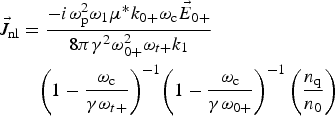 $$\eqalign{{{\vec J}_{{\rm nl}}} & = \displaystyle{{ - i{\rm \omega} _{\rm p}^2 {{\rm \omega} _1}{{\rm \mu} ^{\ast}} {k_{0 +}} {{\rm \omega} _{\rm c}}{{\vec E}_{0 +}}} \over {8{\rm \pi} {{\rm \gamma} ^2}{\rm \omega} _{0 +} ^2 {{\rm \omega} _{t +}} {k_1}}} \cr & \quad {\left( {1 - \displaystyle{{{{\rm \omega} _{\rm c}}} \over {{\rm \gamma} {{\rm \omega} _{t +}}}}} \right)^{ - 1}}{\left( {1 - \displaystyle{{{{\rm \omega} _{\rm c}}} \over {{\rm \gamma} {{\rm \omega}_{0+}}}}} \right)^{ - 1}}\left( {\displaystyle{{{n_{\rm q}}} \over {{n_0}}}} \right)} $$
On substituting Eqs (24) and (25) in Eq. (20), the equation governing the dynamics of THz generation for the maximum irradiance condition (η = 0) is obtained as:
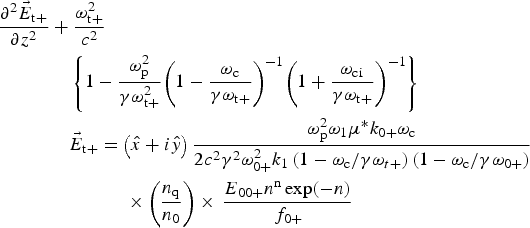 $$\eqalign{\displaystyle{{{\partial ^2}{{\vec E}_{{\rm t} + }}} \over {\partial {z^2}}} & + \displaystyle{{{\rm \omega} _{{\rm t} + }^2 } \over {{c^2}}} \cr & \quad \left\{ {1 - \displaystyle{{{\rm \omega} _{\rm p}^2 } \over {{\rm \gamma \omega} _{{\rm t} + }^2 }}{{\left( {1 - \displaystyle{{{{\rm \omega} _{\rm c}}} \over {{\rm \gamma} {{\rm \omega} _{{\rm t + }}}}}} \right)}^{ - 1}}{{\left( {1 + \displaystyle{{{{\rm \omega} _{{\rm ci}}}} \over {{\rm \gamma} {{\rm \omega} _{{\rm t + }}}}}} \right)}^{ - 1}}} \right\} \cr & \quad {{\vec E}_{{\rm t} + }} = \left( {\hat x + i\hat y} \right)\displaystyle{{{\rm \omega} _{\rm p}^2 {{\rm \omega} _1}{\mu ^{\ast}}{k_{0 + }}{{\rm \omega} _{\rm c}}} \over {2{c^2}{{\rm \gamma} ^2}{\rm \omega} _{0 + }^2 {k_1}\left( {1 - {{\rm \omega} _{\rm c}}/{\rm \gamma} {{\rm \omega} _{t + }}} \right)\left( {1 - {{\rm \omega} _{\rm c}}/{\rm \gamma} {{\rm \omega} _{0 + }}} \right)}}\cr & \qquad\qquad\times\left( {\displaystyle{{{n_{\rm q}}} \over {{n_0}}}} \right) \times \,\displaystyle{{{E_{00 + }}{n^{\rm n}}\exp ( - n)} \over {{\,f_{0 + }}}}} $$
On further simplifying the above equation using the similar procedure for relativistic factor as used in Section 2, we obtain:
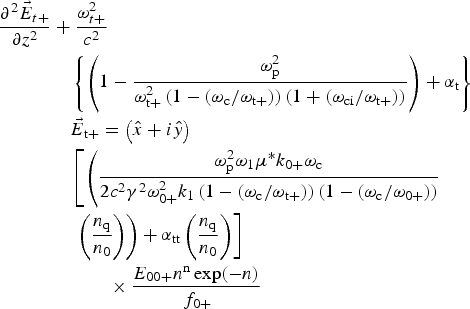 $$\eqalign{\displaystyle{{{{\rm \partial} ^2}{{\vec E}_{t + }}} \over {{\rm \partial} {z^2}}} & + \displaystyle{{{\rm \omega} _{t + }^2 } \over {{c^2}}} \cr & \quad \left\{ {\left( {1 - \displaystyle{{{\rm \omega} _{\rm p}^2 } \over {{\rm \omega} _{{\rm t} + }^2 \left( {1 - ({{\rm \omega} _{\rm c}}/{{\rm \omega} _{{\rm t + }}})} \right)\left( {1 + ({{\rm \omega} _{{\rm ci}}}/{{\rm \omega} _{{\rm t} + }})} \right)}}} \right) + {{\rm \alpha} _{\rm t}}} \right\} \cr & \quad {{\vec E}_{{\rm t} + }} = \left( {\hat x + i\hat y} \right) \cr & \quad \left[ {\left( {\displaystyle{{{\rm \omega} _{\rm p}^2 {{\rm \omega} _1}{\mu ^{\ast}}{k_{0 + }}{{\rm \omega} _{\rm c}}} \over {2{c^2}{{\rm \gamma} ^2}{\rm \omega} _{0 + }^2 {k_1}\left( {1 - ({{\rm \omega} _{\rm c}}/{{\rm \omega} _{{\rm t} + }})} \right)\left( {1 - ({{\rm \omega} _{\rm c}}/{{\rm \omega} _{0 + }})} \right)}}} \right.} \right. \cr & \quad \left. {\left. {\left( {\displaystyle{{{n_{\rm q}}} \over {{n_0}}}} \right)} \right) + {{\rm \alpha} _{{\rm tt}}}\left( {\displaystyle{{{n_{\rm q}}} \over {{n_0}}}} \right)} \right] \cr & \quad\quad\quad \times \displaystyle{{{E_{00 + }}{n^{\rm n}}\exp ( - n)} \over {{\,f_{0 + }}}}} $$
Here, αt and αtt denote the contribution of relativistic mass increase to the generation of THz radiations, their values can be expressed as:
 $${{\rm \alpha} _{\rm t}} = \displaystyle{{{\rm \omega} _{\rm p}^2} \over {{c^2}}}\left( {1 + \displaystyle{{{{\rm \omega} _{{\rm ci}}}{{\rm \omega} _{\rm c}}} \over {{\rm \omega} _{{\rm t} +} ^2}}} \right){\left( {1 + \displaystyle{{{{\rm \omega} _{{\rm ci}}}} \over {{{\rm \omega} _{{\rm t} +}}}}} \right)^{ - 2}}{\left( {1 - \displaystyle{{{{\rm \omega} _{\rm c}}} \over {{{\rm \omega} _{{\rm t} +}}}}} \right)^{ - 2}}{{\rm \alpha} _ +} {A_{0 +}} A_{0 +} ^{\ast} $$
and
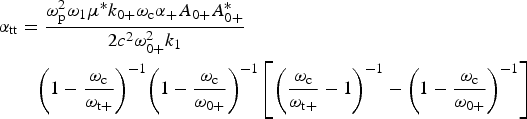 $$\eqalign{ {{\rm \alpha} _{{\rm tt}}} & = \displaystyle{{{\rm \omega} _{\rm p}^2 {{\rm \omega} _1}{{\rm \mu} ^{\ast}} {k_{0 +}} {{\rm \omega} _{\rm c}}{{\rm \alpha} _ +} {A_{0 +}} A_{0 +} ^{\ast}} \over {2{c^2}{\rm \omega} _{0 +} ^2 {k_1}}} \cr & \quad {\left( {1 - \displaystyle{{{{\rm \omega} _{\rm c}}} \over {{{\rm \omega} _{{\rm t} +}}}}} \right)^{ - 1}}{\left( {1 - \displaystyle{{{{\rm \omega} _{\rm c}}} \over {{{\rm \omega} _{0 +}}}}} \right)^{ - 1}}\left[ {{{\left( {\displaystyle{{{{\rm \omega} _{\rm c}}} \over {{{\rm \omega} _{{\rm t} +}}}} - 1} \right)}^{ - 1}} - {{\left( {1 - \displaystyle{{{{\rm \omega} _{\rm c}}} \over {{{\rm \omega} _{0 +}}}}} \right)}^{ - 1}}} \right]} $$
Thus, the amplitude of the generated THz wave can be obtained by solving Eq. (27) with proper boundary conditions. It can also be seen from this equation that if the relativistic effects become negligible that is, αt and αtt become zero, then we arrive at the usual non-relativistic case of THz generation.
4. RESULTS AND DISCUSSIONS
When an extremely high intensity HGB propagates in the collisionless magnetoplasma then it accelerates electron to relativistic speeds and consequently introduces a nonlinearity in plasma. This nonlinearity is attributed to the relativistic variation of mass, causing a change in the dielectric constant of the plasma. Due to this variation in the refractive index of the plasma, the incident beam suffers self-focusing. The intensity variation of HGB given by Eq. (13) describes the dependence of the amplitude on the order of the beam (n) and on the dimensionless beam width parameter (f 0+) along the direction of propagation in the paraxial regime. Equation (15) shows the converging/diverging behavior of the laser beams in the magnetized plasma. In this equation, the first term on the right hand side leads to the divergence (diffraction), while the second term is responsible for the convergence (nonlinear coupling term) of the respective beams. We have solved this equation numerically by Runge–Kutta methods with the following boundary conditions (Akhmanov et al., Reference Akhmanov, Sukhorukov and Khokhlov1968):
 $$\mathop {\left. {{\,f_{0 +}}} \right \vert} \nolimits_{ z = 0} = 1\quad {\rm and}\quad {\mathop {\left. {\displaystyle{{d \mathop f\nolimits_{0 +}} \over {d z}}} \right \vert} \nolimits_{z = 0} = 0}. $$
For the numerical illustration, we have chosen the following set of laser-plasma parameters:ω0+ = 1.77 × 10¹⁵ rad/s, ωp = 5.62 × 10¹⁴ rad/s, background magnetic field B 0 = 0.5 and 1.5 MG, n q = 0.2n 0, intensity of the laser beams, I = 1 × 10¹⁸ W/cm2, the initial radius of the laser beams, r 0 = 20 µm. To examine the propagation characteristic of the beam, that is, the self-focusing phenomenon inside the magnetoplasma we have solved Eq. (15) for the above set of parameters and the numerical results are presented in Figure 1. This figure shows the variation of dimensionless beam width parameters (f 0+) with the normalized distance (ξ) for n = 0, 1, and 2 corresponding to B 0 = 0.5 and 1.5 MG, respectively. Here, ξ = z/R d,  ${R_{\rm d}}( = {{\rm \omega}_{0+}} r_0^2 /c)$ is the diffraction length.
Variation of f 0+ with ξ for various orders of the HGB laser at two different magnetic fields.

The results obtained in Figure 1 reveal the effect of order of the beam and background magnetic field on the self-focusing of the laser beam. It is clear from the figure that on increasing the order of the beam the self-focusing decreases. It has also been observed that an increase in the background magnetic causes a significant change in the focusing position of the beam.
At the focused position, the intensity of the laser beam increases manifold and the interaction of this highly intense beam with EPW results in the nonlinear oscillatory velocity of electrons at difference frequency. This nonlinear oscillatory velocity of electrons couples with the density ripple and leads to the nonlinear current density at THz frequency (ωt+ = ω0+ − ω1) and wave number (k t+ = k 0+ − k 1 − q). Figure 2 shows the schematic representation for the generation of THz radiation in presence of external applied static magnetic field in the ripple density plasma. It must be taken into notice that, the generated electromagnetic wave can propagate only when generated electromagnetic wave frequency is either smaller than the electron cyclotron frequency ωc or greater than the right hand cut off frequency  ${{\rm \omega} _{\rm r}}( = 1/2({{\rm \omega} _{\rm c}} + {({\rm \omega} _{\rm c}^2 + 4{\rm \omega} _{\rm p}^2 )^{1/2}}))$. This condition comes out from the dispersion relation. In this mechanism, even if the above criterion is satisfied the generated electromagnetic wave cannot get the energy from the laser beams until they satisfy the phase matching condition. The generated THz wave has frequency and wave vector (ωt+, k t+) while the nonlinear current density (source of THz radiation) which arises due to the coupling of nonlinear velocity with the density ripple has frequency and wave vector ((ω0+ − ω1) and (k 0+ − k 1 − q)). The laser beams can deliver the energy to the THz wave when exact phase matching condition k t+z − ωt+t = (k0+ − k1)z − (ω0+ − ω1)t − qz is satisfied. Since k t+ ≠ (k 0+ − k 1) therefore the ripple wave no. (q) is playing the key role in this mechanism to satisfy the phase matching condition. Figure 3 shows the variation of ripple wave number q with changing electron cyclotron frequency. Thus, for different values of static magnetic field, we require different q for fulfilling the criterion of exact phase matching.
Schematic representation for THz radiation generation in externally applied static magnetic field in ripple density plasma.
Variation of ripple wave number (q) with magnetic field.
However, if we include the absorption of the laser beams (due to the collisions) then, power and hence the yield of the generated THz will fall with distance of propagation due to absorption, even if the interaction length is infinite. The numerical calculations take care of this constraint by considering collisionless plasma (i.e., ν/ω0+ ≈ 10−5, where νis collisional frequency) and the interaction length to be smaller than the THz absorption length. The electron cyclotron frequency ωc corresponding to B 0 = 0.5 and 1.5 MG comes out to be 8.78 × 10¹² and 2.63 × 10¹³ rad/s, respectively, which is greater than the frequency of the generated THz radiation ωt+( = ω0+ − ω1) = 7.26 × 10¹² rad/s. Thus, it can be seen that the waves will propagate through the plasma. The dynamics of the propagation of generated THz wave amplitude is governed by the Eq. (27) and the results are presented in Figures 4 and 5. Figure 4 shows the variation of normalized THz wave amplitude with dimensionless distance of propagation for HGB (n = 0, 1 and 2) corresponding to B 0 = 0.5 and 1.5 MG, respectively. The amplitude of the generated THz wave varies considerably with order of the HGB “n”. The external applied magnetic field also effects the THz radiation generation. We observe that on increasing the static background magnetic field, the amplitude of the THz radiations decreases. This negative impact on the yield of the THz wave amplitude can be clearly understood by looking into the source term appearing in Eq. (27). Since the generated waves have frequency smaller than the electron cyclotron frequency, so an increase in magnetic field increases the magnitude of the term (1 − ωc/ωt+) which decreases the amplitude of the generated THz radiations. Figure 5 shows the power spectrum for the generation of THz radiation around the maximum irradiance position (η = 0).
Variation of normalized THz amplitude with orders of the HGB laser at two different magnetic fields.
Power of generated THz waves for varying order of the HGB at two different magnetic fields.
5. CONCLUSION
We can conclude that the nature of self-focusing experienced by the HGB in magnetized plasma at relativistic power is considerably reduced for higher orders of the pump beam. The generation of THz waves through the nonlinear interaction between this self-focused beam and EPW depend strongly on two factors: The order of the HGB and the strength of the applied external magnetic field. Thus the present scheme can be used as an efficient method for generating high power THz radiations by properly tuning the above mentioned factors that affect the yield of the generated waves.
ACKNOWLEDGMENT
Ms. Saba Hussain is highly grateful to the Department of Science and Technology (DST), India.



