Catheter-associated urinary tract infections (CAUTIs) are among the most prevalent healthcare-associated infections.Reference Umscheid, Mitchell, Doshi, Agarwal, Williams and Brennan 1 The CAUTI prevention bundle,Reference Saint, Olmsted and Fakih 2 developed in the inpatient setting, focuses on the prompt removal of urinary catheters and may lack relevance in settings where urinary catheters are often initiated.
One of the most effective means of preventing CAUTI is limiting urinary catheter use. The emergency department (ED), responsible for nearly half of hospital inpatient admissions,Reference Schuur and Venkatesh 3 is an optimal setting in which to reduce catheter placement. Approximately 9% of patients admitted through the ED receive a newly inserted urinary catheterReference Schuur, Chambers and Hou 4 ; however, 30%–65% of catheters placed in the ED lack medical need.Reference Schuur, Chambers and Hou 4 , Reference Fakih, Shemes and Pena 5 Studies show that ED adoption of urinary catheter medical appropriateness criteria is associated with decreases in urinary catheter use.Reference Fakih, Heavens, Grotemeyer, Szpunar, Groves and Hendrich 6 Yet, how EDs have integrated these criteria into their workflows is poorly understood, and knowledge of additional ED-specific CAUTI prevention strategies is lacking. We aimed to better understand ED CAUTI prevention efforts by enrolling EDs with CAUTI prevention programs and investigating program motivations, perceived CAUTI risk factors, and strategies to address CAUTI risk.
METHODS
We used the Consolidated Criteria for Reporting Qualitative Research to guide the reporting of our research data, the study design, and our study findings.Reference Tong, Sainsbury and Craig 7
Research Team
Our research team consisted of emergency physicians, an emergency nurse, a qualitative methods expert, and the research study’s project manager, a medical anthropologist.
Study Design
We used a qualitative comparative case study approach to analyze similarities and differences within and between emergency departments.Reference Yin 8 We sought to study positive deviants, ie, early-adopting EDs that were leading the way toward preventing CAUTI and that could serve as models for other EDs with less advanced practices. We defined early-adopting EDs as those having core attributes of ED CAUTI prevention programs,Reference Fakih, Heavens, Grotemeyer, Szpunar, Groves and Hendrich 6 , Reference Dyc, Pena, Shemes, Rey, Szpunar and Fakih 9 – Reference Liang, Theodoro, Schuur and Marschall 13 specifically, those using criteria for urinary catheter placement and monitoring the frequency of ED-placed catheters. We identified these EDs by reviewing results from a nationwide survey in which EDs reported their adoption of infection prevention best practices 14 and by contacting national professional organizations, (eg, the Emergency Nurses Association and the American College of Emergency Physicians).
From September 2011 to June 2012, we conducted semistructured in-person interviews, phone interviews, focus groups, and site visits with enrolled EDs. We first interviewed ED nurses and/or physician leaders and asked them and subsequent interviewees to refer staff involved in CAUTI programs. Enrolled EDs were visited during site visits, during which at least 2 members of the research team (JS, LM, CS, or EC) toured the ED and conducted in-person interviews and focus groups. Interviews were approximately 30–45 minutes in length and were conducted by a single researcher (LM, CS, JS, and/or EC). Focus groups consisted of 3–9 individuals, were 60–90 minutes in duration, and were led and moderated by at least 2 researchers (LM, CS, JS, or EC). Phone interviews were conducted before site visits to gain a general understanding of an ED’s CAUTI prevention program and, afterward, to speak to key informants unavailable during in-person data collection.
We asked about program motivations, perceived CAUTI risk factors, and strategies to overcome risks. An interview guide facilitated data collection (Online Appendix) and was pilot-tested with a convenience sample of nurses and physicians (N=5) prior to formal use. Interviews and focus groups were audio-recorded and transcribed verbatim; a subset of transcripts was reviewed for accuracy. Upon completion of each interview and focus group, a member of the research team authored field notes to provide a summary of findings. The research was funded by the Agency for Healthcare Research and Quality and was approved by the investigator’s institutional review boards.
Data Analysis
Interview data and field notes were analyzed using conventional content analysis, a systematic process of data coding and pattern identification.Reference Hsieh and Shannon 15 Codes (ie, meaning units) were identified a priori by reviewing CAUTI prevention literature and were refined over the course of data analysis to capture newly emerging content. Three researchers (EC, LM, and CS) coded data using NVivo qualitative data analysis Software; QSR International Pty Ltd. Version 9, 2010. To ensure the consistent coding of data, an audit trail of coding definitions and decisions was maintained. Approximately 10% of transcripts were double coded; coding disagreements were resolved through group discussion during weekly meetings. After all transcripts from an enrolled ED were coded, researchers worked in pairs to develop a detailed site summary, in which the motivations, perceived risk factors for CAUTI, and strategies implemented to address identified risks were described.
RESULTS
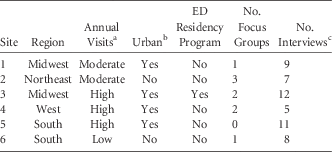
We enrolled 6 EDs that varied in geographic location, annual visit volume, urban classification, and the presence of an ED residency program (Table 1). Across 102 participants, we conducted 52 semistructured interviews with ED nurses and nurse leaders (N=25), ED physicians and physician leaders (N=13), hospital leaders (N=6), infection prevention personnel (N=4), mid-level care providers (N=3), and ancillary staff (N=1). A total of 9 focus groups were conducted with ED nurses (N=4), ancillary staff (N=3), ED physician leaders (N=1), and ED nurse leaders and physicians (N=1). We observed that ED and hospital staff held similar roles and responsibilities in CAUTI prevention programs. Nurse leaders championed programs by engaging nursing staff in strategies to minimize catheter use and improve insertion technique. Physician leaders supported use of urinary catheter medical appropriateness criteria. Hospital infection preventionists gathered surveillance data. Nurse educators were actively involved in ensuring proper insertion technique. Hospital leaders had made CAUTI prevention a hospital priority.
Characteristics of Enrolled Emergency Departments

NOTE. ED, emergency department.
a Low indicates <20,000 visits; moderate indicates 20,000–50,000 visits; high indicates >50,000 visits.
b US Census Bureau criteria. 20
c In-person and phone interviews.
Motivators of ED CAUTI Programs
All ED CAUTI prevention programs originated from hospitalwide efforts to reduce CAUTI. Emergency department leaders reported that they were motivated by surveillance data that identified the ED as a leading site of catheter placement and root cause analyses that identified the ED responsible for specific CAUTI cases. It was difficult to prove that CAUTIs originated in the ED. Prevention programs addressed this challenge by performing retrospective chart reviews and using electronic surveillance systems to identify patients with CAUTIs that had had an ED-inserted urinary catheter. Staff were motivated by the sharing of CAUTI improvement data (ie, decreases in urinary catheters) because they believed their efforts to change processes had reduced patient harm.
Perceived Risks for CAUTI and Strategies Used to Address Risks
Participants reported that the ED is a principal setting of urinary catheter placement and that inpatient CAUTI prevention strategies are not applicable to the ED. To identify ED CAUTI prevention components, programs actively examined ED workflow and identified 4 principal risks for CAUTI: (1) inappropriate reasons for urinary catheter placement; (2) physicians’ limited involvement in placement decisions; (3) patterns of catheter overuse; and (4) poor insertion technique.
Inappropriate criteria guiding catheter placement decisions
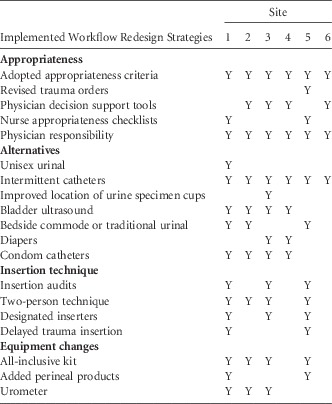
Nonmedical criteria often determined urinary catheter placement decisions, with catheters being used to manage patients with incontinence and to comply with patient requests. Cultural norms also guided urinary catheter use; catheters were a “standard of care” among trauma patients and patients with congestive heart failure. To improve appropriateness, all EDs implemented urinary catheter medical-appropriateness criteria and required the documentation of catheter need at order entry or catheter placement (Table 2). In 1 ED, standing catheter orders were removed from trauma protocols. In 4 EDs, physicians were required to use decision support tools and indicate the medical reason for catheter insertion. In 2 EDs, nurses were required to complete medical appropriateness checklists that were affixed to catheter kits. In some EDs, the implementation of appropriateness criteria was met with nurse and physician resistance. An ED nurse leader from Site 1 described resistance by nursing staff:
“It was a very big cultural change in nursing because, of course, the Foley catheter is a convenience. It is easier for the nurse just to go in and look at the Foley bag to get the output… but …when they found out that the patients were more comfortable, there [were] less infections, it just took a little bit of time … to win… over … nursing staff.”
Workflow Redesign Strategies

NOTE. Y, strategy described by at least 1 interviewee.
Similarly, in describing physician resistance, a hospital leader from Site 3 offered the following description:
“Physicians are generally a little bit more reluctant to move to protocolized control over what they do in the clinical arena as opposed to having absolute carte blanche to do what they think is right.”
Representative quotes of inappropriate criteria guiding catheter placement and strategies to overcome this perceived risk are shown in Figure 1.
Representative Quotes of Inappropriate Criteria Guiding Catheter Placement Decisions and Strategies to Overcome Perceived Risk.

Physicians’ limited involvement in catheter placement decisions
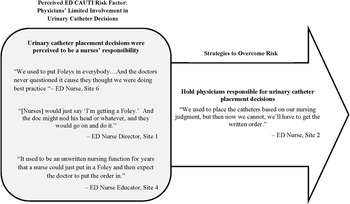
Physicians had limited involvement in catheter placement decisions, frequently becoming aware of a newly placed catheter after insertion when an order for a catheter was needed. While physician and nurse participants stated that catheter placement decisions were widely regarded as a nurse’s responsibility, all programs specified that physicians were responsible for making urinary catheter placement decisions. Some physicians expressed reluctance to accept responsibility for urinary catheter placement decisions. A physician from Site 5 stated:
“It was tough to get the physicians to accept responsibility for the catheters and that they had to be central to the process.”
Quotes illustrative of physicians’ limited involvement in catheter placement decisions and strategies to overcome this perceived risk are shown in Figure 2.
Representative Quotes of Physicians’ Limited Involvement in Urinary Catheter Decisions and Strategies to Overcome Perceived Risk.

Patterns of urinary catheter overuse
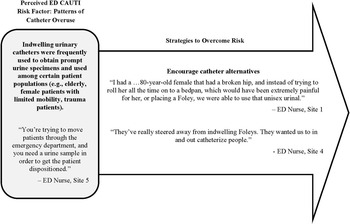
Catheter misuse was frequent among certain patient populations, and EDs implemented strategic alternatives to address patterns of misuse (Table 2). One moderate-volume ED implemented unisex urinals to facilitate patient voiding and to avoid catheter use among elderly female patients with mobility constraints. All EDs encouraged “in and out” catheterization for urine specimen collection; 1 high-volume ED placed urine collection cups in patient restrooms with signs encouraging urine specimen collection. In 4 EDs, the use of bladder ultrasound to assess post-void residual was encouraged in lieu of catheterization. In 1 ED, all nurses were trained in the bladder ultrasound technique. Quotes representative of patterns of overuse and alternatives to minimize use are shown in Figure 3.
Representative Quotes of Patterns of Catheter Overuse and Alternatives to Overcome Perceived Risk.

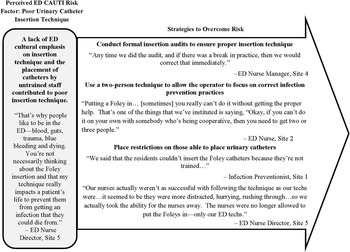
Poor urinary catheter insertion technique
A subset of EDs (N=3) critically examined the actual placement of urinary catheters. Nurse leaders noted that aseptic technique was assumed to have been standard practice, but upon actual inspection, they found that urinary catheters were being inserted by nursing staff that did not demonstrate proper insertion technique and by medical students and residents who were untrained in catheter placement. Subsequently, 1 high-volume ED transferred the responsibility of catheter insertions from nurses to nurse assistants, who received additional education. Another moderate-volume ED did not allow medical students or residents to insert catheters if they had not been trained.
To increase staff mindfulness in insertion technique, EDs redesigned urinary catheter placement workflow (Table 2). In 3 EDs, ongoing insertion audits were conducted in which catheter placement was formally observed and breaks in sterility were corrected immediately. In 4 EDs, a 2-person insertion technique was encouraged in which an informal observer (charge nurse or fellow staff nurse) corrected improper technique in real time and offered assistance as needed (eg, holding a patient’s perineum so the operator could focus on placement). At 2 sites, perineal products were added to catheter insertion kits, and staff reported increased attentiveness to perineal care and aseptic technique. Finally, at 2 sites, the timing of catheter insertions was delayed among trauma patients until the patient’s condition had stabilized and when fewer staff members were present because aseptic technique was difficult to maintain when multiple staff cared for an unstable trauma patient in parallel. Representative quotes regarding poor catheter insertion technique and strategies to overcome this perceived CAUTI risk are shown in Figure 4.
Representative Quotes of Poor Urinary Catheter Insertion Technique and Strategies to Overcome Perceived Risk.

DISCUSSION
An active assessment of ED workflow identified several latent practices that increased a patient’s risk for CAUTI, with inappropriate reasons guiding catheter placement being the greatest perceived risk. Studies show that the implementation of medical appropriateness criteria for urinary catheter placement, interdisciplinary champions and nurse and/or physician urinary catheter decision support tools is associated with minimized rates of ED-urinary catheter placement.Reference Fakih, Heavens, Grotemeyer, Szpunar, Groves and Hendrich 6 , Reference Dyc, Pena, Shemes, Rey, Szpunar and Fakih 9 – Reference Liang, Theodoro, Schuur and Marschall 13 Our sample of EDs used these well-documented strategies and lesser-known population-specific approaches (eg, removing urinary catheter orders from trauma protocols, implementing female urinals), suggesting that population-specific strategies may be an important component of ED CAUTI prevention. Similarly, while there is a lack of literature documenting aseptic technique during ED urinary catheter placement,Reference Carter, Pouch and Larson 16 half of our sample of EDs made it a priority to observe urinary catheter insertions and found poor infection prevention practices. Our findings indicate that while ED CAUTI prevention efforts primarily aim to minimize urinary catheter placement, there are additional opportunities to improve infection prevention practices at the point of catheter insertion.
We found that ED CAUTI prevention programs were triggered by hospitalwide efforts, rather than arising de novo in the ED community, which may indicate that ED CAUTI prevention is a low priority among ED leaders. Beginning fiscal year 2015, the Centers for Medicare and Medicaid Services imposed additional CAUTI financial penalties under its Hospital-Acquired Conditions (HAC) Reduction program, 17 which will likely accelerate hospital engagement in CAUTI prevention efforts. The most predominant motivator of CAUTI program compliance, however, was described by staff, who reported that they were motivated to address CAUTI by sharing CAUTI surveillance data, which held them accountable for their care. Previous research has indicated that performance feedback is an important element of improving professional practice,Reference LeMaster, Hoffart, Chafe, Benzer and Schuur 18 , Reference Jamtvedt, Young, Kristoffersen, O’Brien and Oxman 19 and our findings are consistent with these results.
Strengths and Limitations
We enrolled EDs and participants with a range of characteristics to facilitate a broad understanding of ED CAUTI prevention efforts. Strong methodological rigor was maintained throughout the course of the study, including a systematic process of coding by 3 investigators using multiple data sources. However, the dominant motivations, CAUTI risks, and prevention strategies identified may lack generalizability because our study sample consisted of positive deviant EDs. In addition, the study was not designed to evaluate the effectiveness of strategies on rates of CAUTI or ED urinary catheter placement, which should be addressed through subsequent quantitative evaluation.
In contrast to inpatient CAUTI programs that focus on the ongoing assessment and early removal of catheters, early-adopting EDs aimed to minimize catheter use and ensure proper insertion technique. A close assessment of ED workflow is critical to identifying and addressing local practices that present CAUTI risks.
ACKNOWLEDGMENTS
Financial support. EJC received grant support from the National Institute of Nursing Research (F31 NR014599) and additional financial support from the Jonas Center of Nursing Excellence.
JDS, DJP, LM, and CS received grant support from the Agency for Healthcare Research and Quality (grant no. R18 HS020013).
This project was funded by the Agency for Healthcare Research and Quality (AHRQ), U.S. Department of Health and Human Services (grant no. R18 HS020013). The opinions expressed in this document are those of the authors and do not reflect the official position of AHRQ or the U.S. Department of Health and Human Services.
Potential conflicts of interest. All authors report no conflicts of interest relevant to this article.
SUPPLEMENTARY MATERIAL
To view supplementary material for this article, please visit http://dx.doi.org/10.1017/ice.2015.267