As demonstrations of power, pageantry and propaganda, ceremonial entries from the sixteenth and early seventeenth centuries were arguably unrivalled. The vast sums spent on such spectacles underline this point, as does the fact that, in terms of their content, they attained new levels of symbolic, iconographic and aesthetic sophistication at this time. Their importance as cultural events has not escaped the gaze of musicologists, either; indeed, it has long been acknowledged that music could play a vital role within them. Yet for all that, many entries from this period remain surprisingly under-researched in modern scholarship, with the effect that the potential musicological riches lying dormant within their sources have still not been fully exploited.Footnote 1 To some extent, this can be attributed to the approaches typically adopted in previous studies, which have (a) focused exclusively on royal entries (particularly isolated events where music is known to have been a key component); (b) presented a broad overview of many types of entry (both royal and non-royal), frequently as part of an investigation into civic, regional or national soundscapes; or (c) cherry-picked certain ‘interesting’ extracts from such occasions in order to draw conclusions about music-making across the entire spectrum of early modern festivities (such as coronations, royal weddings and the like).Footnote 2
The prevalence of these methodologies has inevitably resulted in a disproportionate focus on royal entries. Moreover, this tendency has been partially encouraged by the documentation itself, since this often contains more detailed information and survives in greater abundance for royal entries than it does for their non-royal equivalents – something which is easily demonstrated in this context by turning towards the French entries made by Henri IV and Maria de’ Medici.Footnote 3 This has unsurprisingly resulted in a situation where the festivities organized for important non-royal dignitaries – among them princes, dukes and city governors – have been all but ignored by musicologists. Nonetheless, important questions arise from a consideration of such entries. To begin with, what role (if any) did music play in these spectacles, and did this resemble, or differ from, its usage in royal entries? Similarly, was the musical element largely functional in nature, or did it also serve to enhance the symbolism conveyed throughout the proceedings? Has any music survived which can be connected with these events, and can anything be established about the musicians themselves who participated in them?
This article seeks to address such questions, and does so via detailed examination of the entries made by nobles and other political figures into French cities during the years around 1600. In amassing the information presented here, most of which comes from unpublished primary printed accounts or archival records, the overriding aim was to be as exhaustive as possible. Such a goal may, of course, seem futile given the near impossibility of hoping to uncover everything of potential relevance to this investigation. Nonetheless, a truly representative assessment of music’s role in these events can only ever be achieved by attempting to examine all entries for which information survives from the period and geographical context in question, and that includes events for which nothing is currently known about the music (in this case, nearly a third of the total of 41 entries for which sources have been uncovered here), for these raise important questions about the nature of the extant documentation and the significance (perceived or real) of this art form within such spectacles. Moreover, if the study of music in individual entries is generally rendered problematic by the scanty nature of surviving sources, a collective approach is both possible and instructive. Not only does this compensate for the negative picture presented by documentation which ignores this aspect altogether; but also, more importantly, it inadvertently highlights the types of music that were most frequently incorporated into these spectacles. It is hoped that the corpus of information assembled here will also provide a useful resource for scholars studying music in royal entries by means of facilitating comparison with this art form’s usage in the equivalent festivities organized for lesser-ranked dignitaries.
Entries and their sources
In spite of certain differences between them, ceremonial entries in late sixteenth- and early seventeenth-century France followed fairly fixed customs and often adopted the same route as had been used on previous occasions. Many standardized elements also figured within these events, among them tableaux vivants and triumphal arches, tributes pronounced by municipal authorities, a cortège of important city figures (both civic and religious), the presentation of the city keys (to symbolize loyalty to the king or dignitary in question) and the closing Te Deum sung in the cathedral. Once the entry was finished, the visiting dignitary would then commence official business relating to his visit, usually on the day or days that followed.
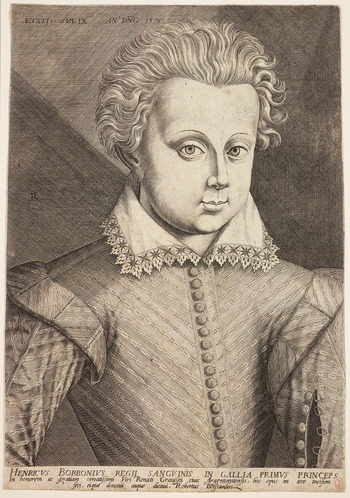
Music undoubtedly contributed to such events, yet the sources are often vague about this aspect of the ceremonial. Representative in this regard is the entry made into Orleans on 26 November 1595 by Henri II de Bourbon (1588–1646), the Prince of Condé (see Figure 1). At the time of his entry, the seven-year-old Henri was heir presumptive to the throne, a situation which changed only with the birth in 1601 of the future Louis XIII (Henri IV’s son). At Henri IV’s request, and in keeping with the Prince of Condé’s status, his entry was celebrated with great pomp. Orleans had a well-established tradition of providing solemn entries; indeed, equivalent receptions had been offered for French monarchs like Henri II (1551) and Charles IX (1563), and even for foreign visitors like Emperor Charles V (1539).Footnote 4
Henry II de Bourbon (1588–1646), the Prince of Condé. Engraving from 1596 by Robert Boissard (c.1570–?). Chantilly, Musée Condé, Fonds Estampes EST-P-22. © RMN-Grand Palais (domaine de Chantilly)/Michel Urtado.

Sources relaying the Prince of Condé’s entry confirm that it entailed processions of various nobles and ambassadors alongside troops of military and municipal figures; in addition, numerous archways, pyramids, obelisks and tableaux vivants (imbued with symbolism) punctuated the route, many carrying Latin or French inscriptions that extolled the young prince.Footnote 5 Nonetheless, music is scarcely mentioned in the surviving sources. In fact, if certain allegorical references are ignored (notably the tableau with the winged goddess Renomée holding a trumpet, stationed near the Couvent des Cordeliers),Footnote 6 the few points of musical interest are confined to references to trumpets and drums. For example, public demonstrations of joy ‘were followed by a confused and continuous noise of cannons, firecrackers, muskets, drums and trumpets, which were heard from far away and formed a concert that was supported by bonfires and peoples’ cheering’.Footnote 7 These instruments figured again in the following day’s procession, where the young prince was led to the porte Bannier (in the north of the city) in the same manner as on the previous day.Footnote 8 Under normal circumstances, such an event would also culminate in a Te Deum. However, as Henri was still Protestant and only received a Catholic education from January 1596 (at Henri IV’s instigation, following the request of Pope Clement VIII), he was barred from entering the cathedral of Sainte-Croix.Footnote 9
The situation for this entry parallels that of others made by nobles and members of the political elite. In some cases, trumpets and drums are the only musical aspect specified by chroniclers. A case in point is the Orleans entry made on 15 August 1593 by Claude de La Chastre (1536–1614), the Baron de La Maisonfort, Marshall of France and Governor of Orleans, whose visit was marked by cannon fire from the fortress and ramparts, the firing of artillery and ‘the sound of drums, trumpets and other instruments’.Footnote 10 For other events, surviving sources are completely silent about the role of music (see Table 1).
ENTRIES OF NOBLES AND OTHER DIGNITARIES WHERE SURVIVING SOURCES DO NOT MENTION MUSIC
| Dignitary | Location and date |
|---|---|
| François de Bourbon, Duke of Montpensier | Bayeux (22 August 1588) a |
| Christine de Lorraine, Grand Duchess of Tuscany | Avignon (25 March 1589) b |
| Catherine de Bourbon, Regent of Béarn and Princess of Navarre | Bayonne (8 February 1591) c |
| Pietro Duodo, Venetian ambassador, accompanied by two other ambassadors (Vincenzo Gradenigo and Giovanni Delfino) | Paris (late January 1595) d |
| Philibert de La Guiche, Governor of Lyons | Lyons (28 July 1596) e |
| Catherine de Bourbon | Rouen (9 December 1596) f |
| Philip William, Prince of Orange | Avignon (11 March 1599) g |
| Claude de La Chastre, Baron de La Maisonfort, Marshall of France and Governor of Orleans | Orleans (20 May 1605) h |
| Margherita Gonzaga, Duchess of Lorraine | Nancy (15 June 1606) i |
| Henri II de Bourbon, Prince of Condé | Aix en Provence (7 May 1607) j |
| Charlotte Catherine de La Trémoille, Princess of Condé | Aix en Provence (20 September 1608) k |
| Vincenzo I Gonzaga, Duke of Mantua | Péronne (13 October 1608) l |
| Henri II de Bourbon, Prince of Condé | Péronne (11 July 1610) m |
| Philibert de Savoie | Lyons (2 September 1610) n |
a Charles de Bourgueville, Les Recherches et antiquitez de la prouince de Neustrie, à present Duché de Normandie, comme des villes remarquables d’icelles: Mais plus speciallement de la Ville & Université de Caen (Caen: Vincent le Feure & Iean de Feure, 1588), 201.
b BMA, MS 1628, fol. 18v (Avignon entry of ‘la prinzeze de Loraine, grand ducheze de Thoscanne’, 25 March 1589); transcription in Joseph Girard, ‘La chronique de Jean de Rodolphe Roubert, bourgeois d’Avignon (1582–1606)’, Annales d’Avignon et du Comtat Venaissin, 2 (1913), 217–42 (p. 223).
c BNF, MS Fr. 10428, fols. 4r–5v (‘Entrée de Madame la Princesse à Bayonne, du huictiesme jour de Febvrier mil cinq cens quatre vingts unze’); transcription of the description in the Registre de l’Hôtel de Ville de Bayonne.
d Ibid., fols. 31r–32v (‘Reception faite par Henri IV aux Ambassadeurs à la Republique de Venise en 1594 au mois de Decembre’ and ‘1595. Ambassade des Venitiens au Roi Henri IV’); transcriptions of the accounts in Pierre-Victor Palma Cayet, Chronologie novenaire, contenant l’histoire de la gverre sous le regne dv tres chrestien roy de France & de Nauarre, Henry IIII. Et les choses les plus memorables aduenuës par tout le monde, depuis le commencement de son regne, l’an 1589. iusques à la paix faicte à Veruins en Iuin 1598. entre Sa Majesté tres-chrestienne, & le roy catholique des Espagnes Philippe II (Paris: Iean Richter, 1608), and Jacques-Auguste de Thou, Histoire universelle (1604, repr. London (= Paris): s.n., 1734), 16 vols.
e ADR, XII, 174 (Lyons entry of ‘M. de la Guiche, gouverneur de ceste ville’, 28 July 1596); transcription in Antoine Péricaud, Notes et documents pour servir à l’histoire de Lyon sous le règne d’Henri IV 1594–1610 (Lyons: Imprimerie de Mougin-Rusand, 1845), 91. For payments relating to this entry, see AML, BB 133, fol. 126v; see also CC 1470-1, 1470-2, 1472-1, 1479-2, 1481 and 1486.
f François Farin, Histoire de la ville de Rouen, 2 vols. (1668; 3rd edn, Rouen: Louis du Souillet, 1731), i, 133 (‘Entrée de la Princesse de Navarre’).
g BMA, MS 1628, fol. 22v (arrival into Avignon on 6 March 1599 of ‘Guilliaume Philipe de Nazau, prinze d’Orange’ and his ensuing entry, 11 March 1599); transcription in Girard, ‘La chronique de Jean de Rodolphe Roubert’, 231.
h BNF, MS Fr. 10428, fol. 118r–v; taken from the descriptions of Monsieur Fontaine, deputy mayor of the city, in the Registres de l’Hôtel de Ville d’Orléans. Music is similarly ignored in the descriptions of Claude de La Chastre’s visits to Orleans on 22 June and 1 October 1605 (ibid.).
i Augustin Calmet, Histoire ecclesiastique et civile de Lorraine, qui comprend ce qui s’est passé de plus memorable dans l’Archevêché de Tréves, & dans les Evêchez de Metz, Toul & Verdun, depuis l’entrée de Jules César dans les Gaules, jusqu’à la mort de Charles V, duc de Lorraine, arrivée en 1690, 3 vols. (Nancy: Jean-Baptiste Cusson, 1728), iii, 171. Henri Lepage, Les Archives de Nancy ou documents inédits relatifs à l’histoire de cette ville publiés sous le patronage de l’administration municipale, 4 vols. (Nancy: Lucien Wiener, 1865), i, 313 (BB.1. Administration Communale, 1597–1611; payments relating to ‘la bien-venue de Mme la duchesse de Bar (Marguerite de Gonzague, seconde femme d’Henri, depuis duc de Lorraine sous le nom d’Henri II)’).
j BNF, MS Fr. 10428, fol. 136r (‘Reception de Monsieur le Prince de Condé à Aix en Provence, le 7. may 1607’); transcription of the account in the Registres des Délibérations de la Cour de Parlement de Provence.
k Ibid., fol. 146r (‘Reception de Madame la Princesse de Condé à Aix, le 20. septembre 1608’); transcription of the account in the Registres des Délibérations de la Cour de Parlement de Provence.
l Ibid., fol. 147r (‘Entrée de M. le Duc de Mantoue dans la ville. de Peronne, en 1608. le 13. octobre’); transcription of the account in the Registres de la Chambre du Conseil de la Ville de Péronne.
m Ibid., fol. 162r (‘Entrée de M. le Prince dans la ville. de Peronne, le 11. Juillet 1610’); transcription of the account in the Registres de la Chambre du Conseil de la Ville de Péronne.
n AML, CC 1614 (1609–10), fol. 30r.
Of course, this does not actually prove that music had a limited (or even non-existent) place in such entries. Many of the sources recounting these entries are not official, and some provide only brief summaries alongside descriptions of other events, or even postdate the occasion by many years. This is true of the above-mentioned Prince of Condé’s Orleans entry, the key source for which is a short account found in the Histoire et Antiqvitez de la ville et dvché d’Orleans (first published 1645) by François Le Maire, an antiquarian and councillor of the présidial of Orleans.Footnote 11 Tellingly, Le Maire’s summary contains small factual errors, and he openly admits that he could no longer recall certain details about this entry.Footnote 12 Elsewhere, lack of information about the music reflects the background of the authors describing these spectacles, many of whom were lawyers or councillors. This point is underlined where comparison can be made with surviving archival documents. Thus, whereas Jacques de Cahaignes – a doctor and rector of Caen University – entirely ignores music in his account of the Caen entry made on 14 May 1588 by Jean Louis de Nogaret de La Valette (1554–1642), the Duke of Épernon, a register in the Archives Municipales de Caen confirms that at least two trumpeters were present on this occasion, as were ‘drums and fifes dressed in gowns with the city colours’.Footnote 13 Finally, it should be remembered that not all entries were ceremonial in nature; some of those examined here occurred within the last phase of the French Wars of Religion, when finances and other resources were often compromised.Footnote 14
Martial music
Given that music is often reduced to fleeting references in the sources relating to these events (assuming it is even discussed or recorded at all), it seems ironic that those very mentions – stereotyped and brief as they may be – perhaps highlight what many contemporaries considered to be the most important elements in such festivities. For example, the fact that trumpets and drums are frequently specified, even when other musical aspects are not, is undoubtedly explained by their utility in stressing (via their martial and regal associations) the dignitary’s high status. The contribution of such musicians to the pageantry was as much visual as aural, as is confirmed by cases which mention their banners decorated with the city’s or dignitary’s heraldry.Footnote 15 Some sources even go to the trouble of describing the instruments themselves, as can be seen in the account that relays the Prince of Condé’s entry into Toulouse on 7 September 1611, which states that the two city trumpeters had silver trumpets.Footnote 16 This detail echoes the remarks of Pierre Trichet (writing in around 1640) when he notes that Bordeaux aldermen employed two officers, each of whom had a long, straight silver trumpet with a banner of the city’s arms that was specifically used for important public ceremonies (like city processions).Footnote 17 The trumpeters’ appearance could even be used to infer negative or positive conclusions about either the dignitary or those responsible for organizing the entry. A case in point is Nicolas-Claude Fabri de Peiresc’s description of the Parisian entry of Ruy III Gomez de Silva Mendoza y la Cerda (1585–1626), the Duke of Pastrana, which took place on 13 August 1612 within the context of the marriage negotiations for Elisabeth of France and the Prince of Asturias (the future Philip IV of Spain). Whereas the French king’s six trumpeters are specified as having been dressed in blue velvet, the two Spanish trumpeters (who figured in the Duke of Pastrana’s entourage) are described as ‘wearing old-fashioned haquetons similar to those of the heralds of arms’.Footnote 18
In some instances, the importance accorded to trumpets is also revealed by archival documents. A good example is provided by sources relating to the Metz entry made by the Duke of Épernon and his son, Bernard de Nogaret (1592–1661), the Marquis de La Valette, on 7 November 1613. Here, the cavalry were reinforced by two superbly dressed trumpeters from Nancy – Jean Muler and ‘Morizot dit trompette’, both of whom were provided with two servants and three horses for the duration of their stay in Metz (4–17 November).Footnote 19 Furthermore, the ‘exorbitant expense’ of 72 livres for hiring these musicians was justified on the basis that the city could afford it, alongside the fact that trumpeters had a reputation for being heavy drinkers!Footnote 20 Such musicians were sometimes joined by others from the visiting dignitary’s entourage: on this occasion, a trumpeter from the marquis’s personnel (named Montagnac) is known to have attended, for he was among those who received a gift of a gold medal from the city.Footnote 21
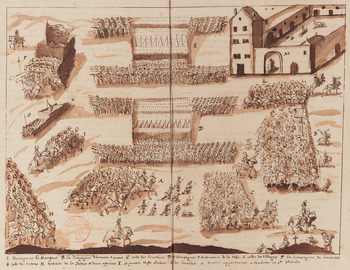
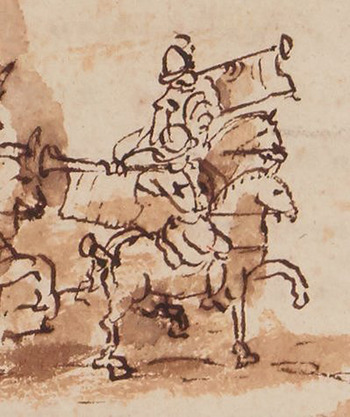
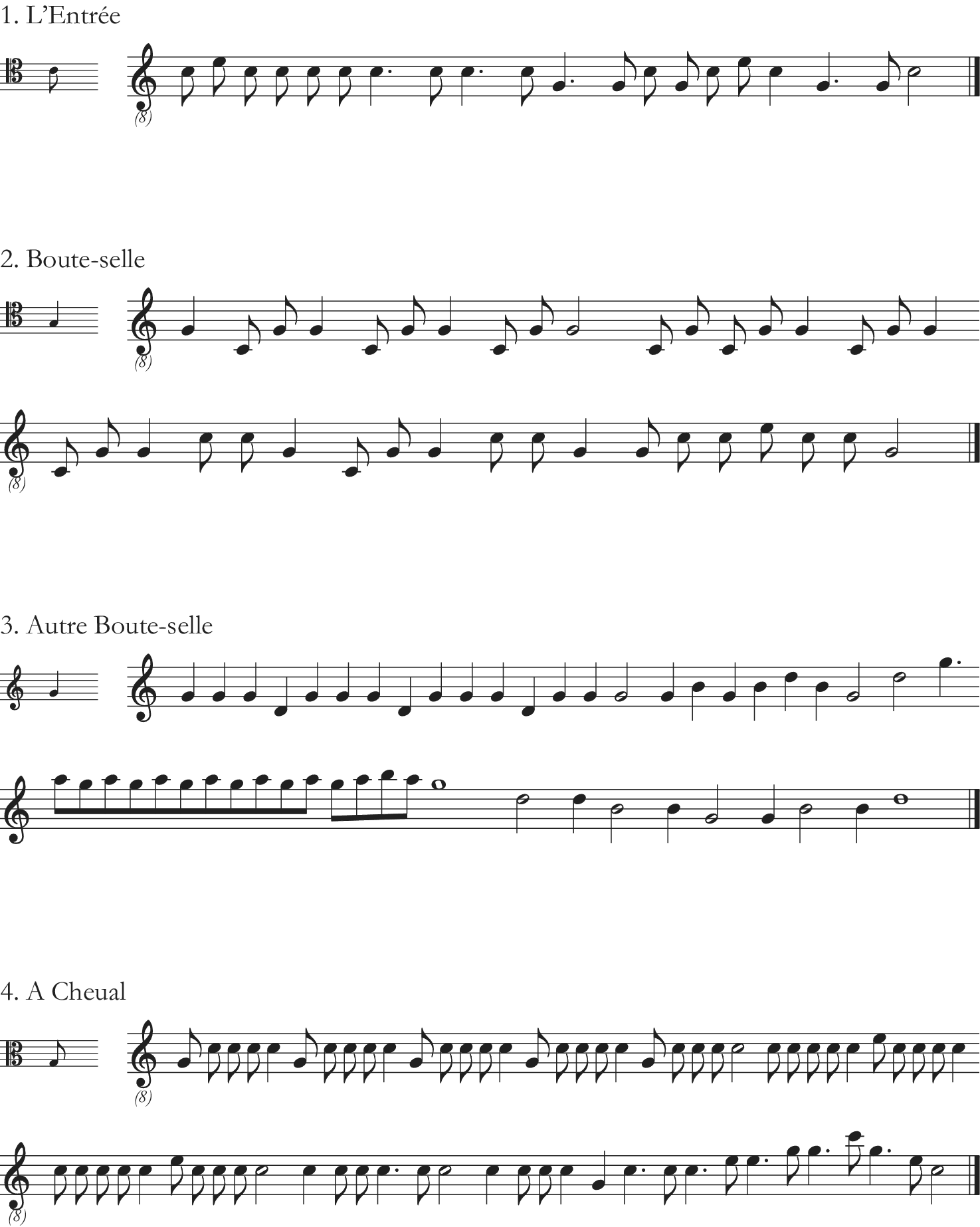
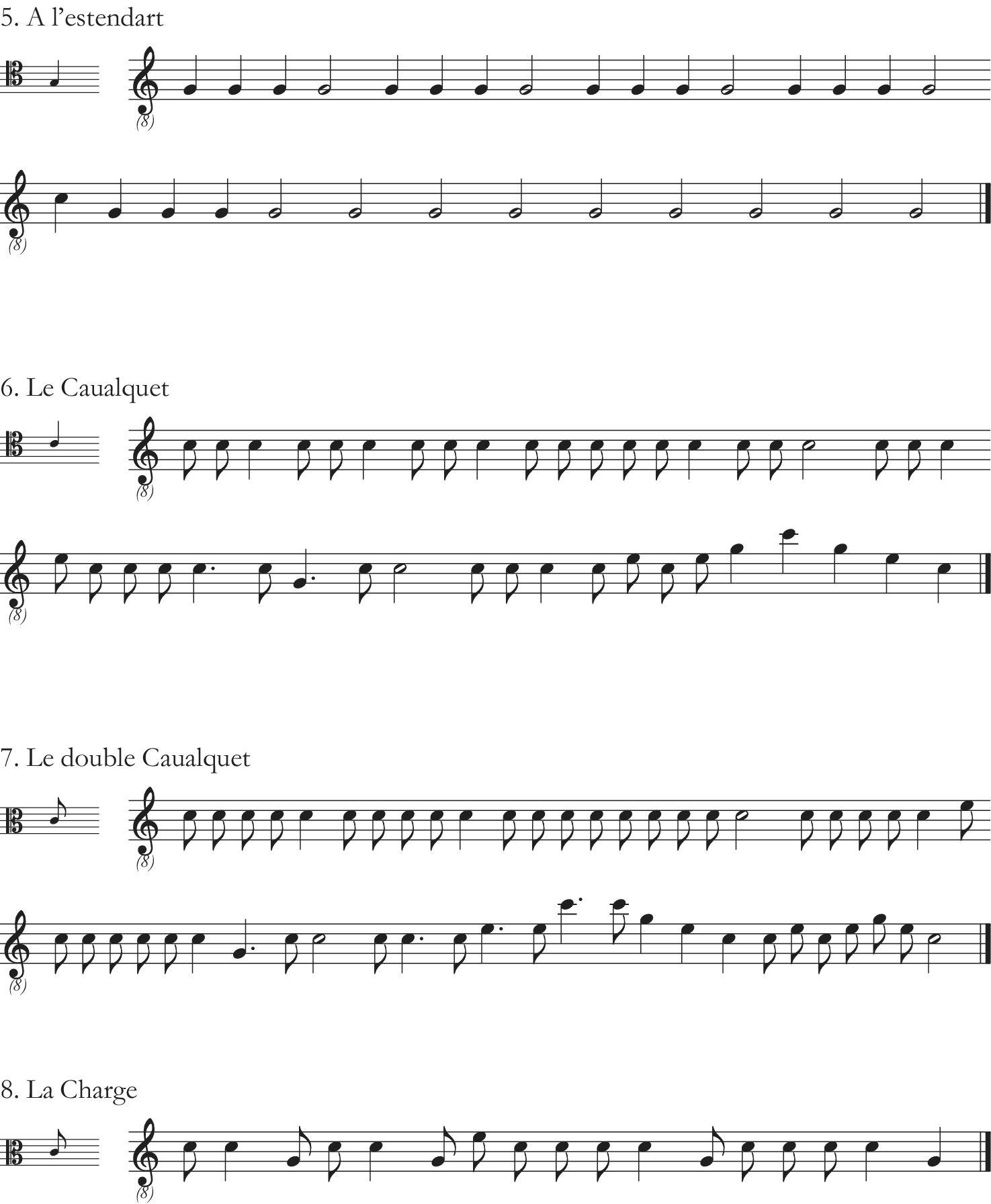
Trumpeters probably figured as horse-mounted musicians;Footnote 22 indeed, this is occasionally confirmed by documentation directly relating to these events (see Figures 2a and 2b).Footnote 23 They probably sounded signals and other military calls on folded shape instruments, which were not only the most commonly used trumpets at this time but which, on occasion, even figure in the depictions of entries. Such instruments consisted of straight and bended tubes that were separated from the bell by a wooden block, while woollen cords (called ‘binding’ or ‘cordage’) held the various sections of the trumpet together.Footnote 24 Describing the components that typified royal entries in Orleans, for example, Le Maire states that the procession generally included 100 city children (‘enfans d’honneur’) led by various splendidly dressed captains on horseback ‘accompanied by drums and trumpets who, with their fanfares and bellicose sounds, seem to animate and excite them [i.e. the captains and city children] to do the duty which obliges them to salute their Majesties’.Footnote 25 Entries of non-royal figures clearly followed suit. Hence, a handwritten description of the above-mentioned Metz entry of the Duke of Épernon and the Marquis de La Valette states that ‘trumpets sounded fanfares’ as the marquis admired one of the dressed-stone triumphal arches at the porte Saint-Thiébaut.Footnote 26 Where several trumpeters participated – as in the Lyons entry on 21 November 1608 of Charles de Neufville (1566–1642), the Marquis of Villeroy and Alincourt, which involved at least six such musicians – they presumably played mostly in unison or in alternation with one another.Footnote 27 Examples of the fanfares and signals that formed the core repertoire of trumpeters in France at this time are recorded in Marin Mersenne’s Harmonie universelle (1636). These short pieces – which are mostly written for an instrument in C (as with Cesare Bendinelli’s Tutta l’arte della trombetta of 1614)Footnote 28 and which are characterized by repeated notes and oscillating tonic–dominant intervals, predominantly in the lower range of the trumpet’s natural harmonic series – were intended to be easily understood by the military forces for whom they were conceived. They comprise, among other things, calls to encourage the troops before riding (like the ‘Boute-selle’), signals for the cavalry to mount their horses (‘A Cheual’) or to line up to their standard (‘A l’estendart’), and calls to charge (‘La Charge’) or retreat (‘La Retraite’). Like other early sources of trumpet signals, Mersenne also includes a table of military symbols (in numbers) to aid memorization (see Example 1).Footnote 29
Pen and ink drawing of the various troops (plus trumpeters on horseback) involved in the Metz entry of Jean Louis de Nogaret de La Valette, the Duke of Épernon, and Bernard de Nogaret, the Marquis de La Valette (7 November 1613). Taken from [D. Jacquet], ‘Le discours de l’entree de Messeigneurs le duc DEspernon et marquis de La Vallette en la ville de Metz auec les pourtraits des arcs Triumphaux’ (1614). Paris, Bibliothèque Nationale de France, MS Fr. 24103, fols. 4v–5r. © Bibliothèque Nationale de France, Paris, Département des Manuscrits, Français 24103.

Detail of Figure 2a showing some of the trumpeters on horseback.

Examples of trumpet fanfares and signals in Marin Mersenne, Harmonie Vniverselle, contenant la theorie et la pratiqve de la mvsiqve, où il est traité de la nature des Sons, & des Mouuemens, des Consonances, des Dissonances, des Genres, des Modes, de la Composition, de la Voix, des Chants, & de toutes sortes d’Instrumens Harmoniques (Paris: Sebastien Cramoisy, 1636), livre v, 264–5.

(cont.)

(cont.)

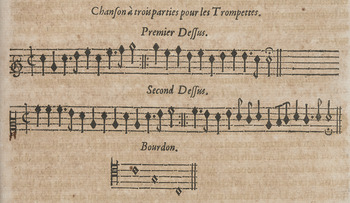
Nevertheless, trumpeters may also have improvised simple polyphonic ensemble pieces on occasion, particularly where they are described as having formed part of a ‘band of trumpets and clarions’ (as in the Count of Soissons’s Rouen entry in December 1610) or where words like ‘concert’ are used to describe their music (as in the Prince of Condé’s 1595 Orleans entry discussed earlier).Footnote 30 As Peter Downey has observed, several French sources from this period support this possibility, notably Jean Nicot’s Thresor de la langve francoyse (1606), which states that clarions ‘previously served as a dessus to several trumpets sounding the taille or bassecontre’.Footnote 31 Moreover, alongside the examples of fanfares and signals which he gives, Mersenne states that skilled trumpeters compared favourably with other instrumental virtuosos, and he even provides a ‘Chanson à trois parties pour les Trompettes’ (see Figure 3) as proof of what such musicians were capable of playing.Footnote 32 Interestingly, this piece contrasts noticeably with the style of other European trumpet ensemble music from around 1600, which utilized a grandiose texture dominated by tonic pedals rather than the more Baroque aesthetic (of melody plus active bass part) that is evident here.Footnote 33 This reminds us that, alongside certain commonalities, European festivals at this time were characterized by national (or even regional) differences between one another, a point that is worth remembering when comparisons are made between spectacles across different geographical and temporal contexts in the early modern period.
‘Chanson à trois parties pour les Trompettes’ in Marin Mersenne, Harmonie Vniverselle, contenant la theorie et la pratiqve de la mvsiqve, où il est traité de la nature des Sons, & des Mouuemens, des Consonances, des Dissonances, des Genres, des Modes, de la Composition, de la Voix, des Chants, & de toutes sortes d’Instrumens Harmoniques (Paris: Sebastien Cramoisy, 1636), livre v, 269. © The British Library Board.

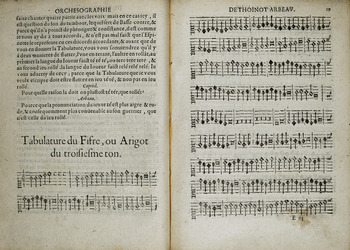
Trumpets and drums evidently constituted the most frequent expression of martial music in these events. Nonetheless, these instruments could also be reinforced (or even replaced) by fifes and/or shawms. Such was the case with the Prince of Condé’s Toulouse entry on 7 September 1611, when the procession to the cathedral of Saint-Étienne included six shawm players on foot who took part alongside the trumpeters in front of the prince’s canopy (poële); they played in alternation with these latter musicians for the entirety of the journey.Footnote 34 Likewise, archival documents confirm that 21 fife and drum players accompanied the six armed companies of the bourgeoisie who were present during the Nancy entry of Henri II, the Duke of Lorraine (20 April 1610).Footnote 35 Similar observations can be made regarding the magnificent reception provided by Henri IV for a delegation of 42 Swiss ambassadors in 1602.Footnote 36 For their entry into the capital on 14 October, the procession – perhaps unsurprisingly, given the nationality of the visiting dignitaries – included various city sergeants and officers accompanied by ‘the king’s Swiss guard with their drum and fife playing’.Footnote 37 A few days later (on 21 October), a sumptuous banquet was held at the Hôtel de Ville to mark the signing of the Treaty of Soleure, during which ‘sounding drums, trumpets and shawms’ appeared between the courses; according to the Parisian diarist Pierre de L’Estoile (1546–1611), this music was again formed of ‘large numbers of drums, fifes and musical instruments’ to please the guests.Footnote 38 Alternating groups of trumpets, fifes and drums also figured in the celebrations connected with the Rouen entry of Charles de Bourbon (1566–1612), the Count of Soissons, where they appeared in the procession (on 19 December 1610) to the hall within which the banquet took place.Footnote 39 For an insight into the musical functions of fife and drum players at this time, Thoinot Arbeau, in his well-known dance treatise Orchésographie (1588), is instructive. Much of Arbeau’s discussion inevitably dwells upon the military importance of these instruments, particularly regarding their utility in helping soldiers to march to certain rhythms.Footnote 40 In light of the events discussed here which specifically mention the Swiss Guard, however, it is notable that he also distinguishes between French and Swiss drumming styles.Footnote 41 As for the fife players’ repertoire, while this was typically improvised by the musicians themselves (often in the supposedly ‘warlike’ Phrygian mode), an extract given to Arbeau by the organist Isaac Huguet fortuitously affords us an idea of what their music probably sounded like in such events (see Figure 4).Footnote 42
Extract of the fife music provided in Thoinot Arbeau, Orchésographie: Traité en forme de dialogue par lequel toutes personnes peuvent facilement apprendre et pratiquer l’honnête exercice des danses (Langres: Jehan des Preyz, 1588), fols. 18v–19r. © The British Library Board.

Other instrumental music
Although instruments connected with the martial aspect of these events are often the only ones specified in the sources, it would be erroneous to assume that other musicians were not also involved in them. In some cases, these latter figures are simply referred to in a generic fashion. This is true of the entry made by Catherine de Bourbon, Henri IV’s sister, into Bordeaux in November 1592: here, Pierre-Victor Palma Cayet merely states that Catherine was taken by barge to La Bastide accompanied by ‘all sorts of instruments’, and it seems reasonable to assume that this scenario resembled the one that featured in the Prince of Condé’s entry into this same city on 2 July 1611 – whereby players of shawms, trumpets, clarions and other instruments appeared in the boats.Footnote 43 Likewise, for the Duke of Pastrana’s Parisian entry on 13 August 1612, the official French account simply lists ‘five musicians’ alongside the four shawm players and two trumpeters.Footnote 44
For certain entries, the sources provide more detail about what role these musicians actually served. Thus, for Giovanni de’ Medici’s arrival into Beauvais on 30 June 1605, we know that ‘musicians played various instruments during the dinner’ which closed the proceedings.Footnote 45 Instrumentalists also played during the banquet that formed part of the festivities for the Count of Soissons’s Rouen entry (8 December 1610): on that occasion (19 December), trumpets and clarions heralded the different courses, while the music at the end of the meal was provided by a group of cornettists and lutenists.Footnote 46 Much the same can be said for the French entries made between December 1599 and March 1600 by Charles Emmanuel I (1562–1630), the Duke of Savoy, which were undertaken while he was trying to resolve the dispute surrounding the marquisate of Saluzzo.Footnote 47 As in the aforementioned Bordeaux entries of Catherine de Bourbon and the Prince of Condé, Charles Emmanuel’s arrival into Orleans (14 December 1599) was anticipated by the Duke of Nemours and the city corps positioned in several ornate boats, ‘some of which had drums, trumpets and city instrumentalists’;Footnote 48 the following day, the duke dined in the Hôtel de Ville’s great hall, where ‘there was a concert during the meal’.Footnote 49 On the other hand, for his Dijon entry (8 March 1600), violinists and shawm players performed when he reached the king’s lodgings (now the Palace of the Dukes and Estates of Burgundy), where they ‘played for a long time, some on the terrace of the said King’s House when His Highness arrived, others on the theatre in the great hall, then in his chamber’.Footnote 50 City musicians playing shawms and violins likewise figured in the Nevers entry of Charles III (1580–1637), the Duke of Rethel (later Charles I Gonzaga, the Duke of Mantua), where one imagines they fulfilled a similar function.Footnote 51
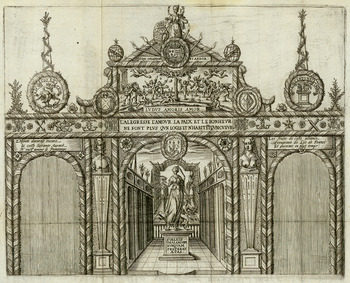
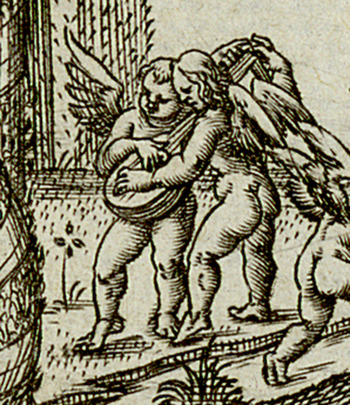
Documentation relating to the music used in the Lyons entry of Antoinette de Daillon, Madame de La Guiche, on 27 April 1598 is even more informative. This event had two key aims: first to celebrate the marriage of Philibert de La Guiche, the Governor of Lyons, with Antoinette, the daughter of Guy de Daillon, the Count of Lude; and secondly to mark the signing (in that same month) of the Edict of Nantes, which sought to achieve civil unity by granting certain rights to French Huguenots.Footnote 52 The official account of this entry confirms that music reinforced the idea of a symbolic union between the governor, his king and the Lyonnais inhabitants – a theme, incidentally, which occurred in other ceremonial entries from late Renaissance France (including royal ones).Footnote 53 On the ledge of one of the gateways, for example, an Amour was shown holding a lute while another tuned it; together, they represented ‘the harmony of a holy and perfect friendship, just as the Romans did with a lyre, which if it wasn’t well tuned, rendered a troublesome murmuring in place of a sweet symphony’ (see Figures 5a and 5b).Footnote 54
Triumphal arch from the Lyons entry of Antoinette de Daillon, Madame de La Guiche (27 April 1598). Included as a foldout in [Pierre Matthieu], L’accveil de Madame de La Gviche a Lyon. Le Lundy vingt-septiesme d’Auril, M. D. XCVIII (Lyons: Jaques Roussin, 1598), 2. © Collection Bibliothèque Municipale de Lyon, Rés 355894.

Detail of Figure 5a showing the two Amours on the triumphal arch, one holding a lute while the other tunes it.

Yet music was not just used in a metaphorical fashion in Madame de La Guiche’s entry. Thanks to documents held in the Archives Municipales de Lyon, we know that several groups of musicians participated in this event. Unsurprisingly, this included five trumpeters – among them Jean Glatard, the ‘trompette ordinaire de la ville’ – who played at the Vaise drawbridge gate and near the governor’s house.Footnote 55 These musicians almost certainly played fanfares in the days prior to the entry as well, thereby serving to alert the populace to Madame de La Guiche’s imminent arrival.Footnote 56 During the entry itself, in the cortège procession which went from the porte de Pierre-Scize (the main city gate) to the governor’s house (on rue Saint-Jean), the various city representatives and 200 harquebusiers were accompanied by eight drummers and fife players, plus the ‘fife of the Swiss [guards]’.Footnote 57 These instrumentalists, paid 20 sols each for their participation, are identified in the ‘rolle des musiciens’, although (curiously) certain city drummers whose names appear more frequently in municipal accounts around this time do not appear here.Footnote 58 The fife and drum players were joined by a further 16 musicians divided into two distinct groups, many of whom are again specified by name and each of whom received 30 sols. The first group, placed on a gallery with the city’s insignia located near to the governor’s house, consisted of various stringed instruments: violins in different sizes, a bass viol and a spinet.Footnote 59 The second, positioned near an arch adorned with flowers and Henri IV’s heraldry at the porte de Pierre-Scize, was formed of six shawm players led by ‘Jehan Jaquet’.Footnote 60
Several points of interest arise from these references. First, regarding the group of shawm players: these instruments were frequently used for outdoor events because of their loud, penetrating tone. Arbeau, who makes this observation in his Orchésographie, also notes that shawms were often used in stately music like pavans, sometimes in conjunction with sackbuts or tabors.Footnote 61 Other writers throughout the seventeenth century (such as Trichet) confirm that shawms were deemed appropriate across France for ‘the greatest solemn, splendid and magnificent events, for banquets and games, both public and private’.Footnote 62 That the shawm band consisted of six players in Madame de La Guiche’s entry is also noteworthy, for this supports Peter Holman’s argument that wind ensembles were often associated with six-part music, as opposed to string bands (which more typically played in five parts).Footnote 63 Examples of the pieces probably played by shawm bands in events like this can be found in the so-called Philidor manuscripts (BNF, MS Rés. Fr. 494). Compiled posthumously in around 1690 by André Danican Philidor (c.1650–1730), this collection contains numerous dances from the reigns of Henri IV and Louis XIII that are specifically designated for shawms, among them a six-part ‘Pauane pour les hautbois fait au Sacre du Roy le 17e Octobre 1610’.Footnote 64
The string ensemble that performed in Madame de La Guiche’s entry also merits consideration. Interestingly, with the exception of the spinet, the ‘rolle des musiciens’ specifies only various sizes of violin (dessus, ‘tallia’ and basse), whereas the description of the event itself states that a bass viol player also participated.Footnote 65 At first glance, one might suppose that this was played by one of the six named musicians whose instrument is unspecified in the ‘rolle’. On the other hand, it is noteworthy that violinists seem most often to have played in bands (that is, whole consorts) in France at this time; indeed, court records unequivocally suggest that they were considered as a distinct group in themselves, unlike viols, which are usually listed alongside other soft instrumentalists in the chamber (and thus presumably played most frequently in mixed consorts).Footnote 66
In fact, there is good reason to think that the mention of a bass viol at this point simply arose from error. First, the ‘rolle’ confirms that a ‘basse de violon’ (and not a bass viol) was played by Gabriel Sousin in this entry, a designation which is repeated in other archival documents concerning this musician. Secondly, it is simple to understand how a chronicler could have confused these two instruments, especially if he was not musically inclined, and other sources from this period also reveal the same difficulty of distinguishing violins from viols.Footnote 67 Moreover, as Ian Woodfield has shown, the construction of French viols at this time appears to have been influenced by violins, a point seemingly confirmed by surviving iconographical sources.Footnote 68 Jacques Cellier’s drawing of a viol from about 1585 is particularly notable in this regard, since the accompanying caption actually states that viols differed from violins only in that they were tuned in fourths (not fifths) and had larger bellies (because they were played near the foot).Footnote 69 Incidentally, biographical details about several other musicians (apart from Sousin) involved in Madame de La Guiche’s entry can be reconstructed from surviving Lyonnais archival documents. Significantly, several of these figures primarily found employment in professions outside music, a trend apparent for other musicians known to have contributed to the musical life of Lyons during the Renaissance period (see Table 2).Footnote 70
BIOGRAPHICAL INFORMATION ON CERTAIN MUSICIANS INVOLVED IN MADAME DE LA GUICHE’S LYONS ENTRY (27 APRIL 1598)
| Details provided by sources relating to the entry itself | Information concerning these musicians found in other archival sources (notably municipal accounts and notarized contracts) |
|---|---|
| MILITARY MUSICIANS | |
| Jean Glatard, city trumpeter a | Jean Glatard (Glattard), civic trumpeter and guard (1582–94); b ‘trompette’ or ‘trompette ordinaire de la ville’ (1582–1602).c He was dead by 1606, for his wife (Francoise Billioud) is designated as being widowed by that date. d |
| Estienne Fargues, listed among the fife and drum players e | Étienne Farge (Farges), baker (1597–1608) f |
| Iehan Faure, listed among the fife and drum players e | Several references in civic accounts in Lyons mention a ‘Jean Faure’, some or all of which probably relate to this musician. A reference from 1586 mentions ‘Jean Faure’ as a city prosecutor, and he surfaces again in 1602 as having been married to Catherine Sonneyre. In 1603, he is cited as the treasurer of Lyons Cathedral, at which time he is mentioned in conjunction with a fraud committed over the wine allowance. In 1607, Jean was employed as a clerk to François Faure, also a city prosecutor. g |
| OTHER INSTRUMENTALISTS | |
| ‘Maistre Clément’, spinet e | Jean Clement, unspecified musician and ‘joueur d’espinette’ (1569–98) h |
| Berthelemy de Bargues, ‘dessus de violon’ e | Member of a musical dynasty that included Mayet Desbargues, an unspecified ‘joueur d’instruments’ (1575), i and Martial Desbargues (Marçial de Bargues), a ‘joueur de violin’ (1574–80) j |
| Jehan de Ladvis, ‘tallia de violon’ e | Jean La Vis, ‘violon’ (1571–2); k Jean de La Vyte, ‘violon’ (1586); l Jean de Lavy, unspecified ‘joueur d’instruments’ (1581–6) m |
| Gabriel Sousin, ‘basse de violon’ e | Gabriel Sourcin, unspecified musician and ‘basse de violon’ (1575–97) n |
| Me Jaques Buisson, unspecified musician e | Jacques Buisson is listed as one of two ‘rois des arquebusiers’ in 1605 (alongside Antoine Baud). o He is probably the same figure as Jacques Boisson, ‘contrôleur du vin de la porte Saint Just’ (1603–9) p |
| Me Gabriel Gontret, unspecified musician e | Probably the same figure as Gabriel Gaulteret, an unspecified musician (1588–97) q |
| Me Pierre Masson, unspecified musician e | Probably the same figure as Pierre Masser, a string manufacturer and dealer (‘Fabbricant de cordes à boyau[d]’) listed in 1599 r |
a AML, CC 1503, fol. 19, and CC 1521–2, fol. 22.
b Frank Dobbins, Music in Renaissance Lyons (Oxford: Clarendon Press, 1992), 293–4. Dobbins states that Jean Glatard was succeeded in this role in 1594 by Jehan Chrestien; however, archival documents confirm that the former was still employed as a civic trumpeter until around 1602, when he seems to have been succeeded by Jacques Glatard (AML, CC 1559 [1602–3], pp. 20–3). See below, note c.
c In addition to the AML sources listed in Dobbins, Music in Renaissance Lyons, 294, see also AML, CC 1321 (1583–4), 1324 (1583–4), 1469-2 (1594–6), 1470-2 (1595–6), 1471 (1595–6), 1485 (1596–7), 1503 (1597–8), 1511 (1598–9), 1518-1 (1596–9), 1518-2 (1596–9), 1518-3 (1596–9), 1518-4 (1596–9), 1521-2 (1596–9), 1524-2 (1599–1600), 1526 (1599–1600), 1538 (1600–1), 1544-1 (1599–1601) and 1550 (1601–2).
d AML, CC 1587-1 (1605–6), fols. 70–78.
e Information taken from the ‘Rolle des musiciens de lentrée de Mme de la Guiche’ (Comptes d’Antoine Larchier et Actes Consulaires in Lyon, fol. 94v, cited in Allut, L’accveil de Madame de la Gviche, 46–7). See also AML, CC 1502-1, pp. 23–4; CC 1518-4, fols. 43v–54r; and CC 1521-1, fols. 17r–18v.
f Ibid., CC 1495 (1597–8) and CC 1496 (1597–8) (Council deliberation agreeing fees of 13⅓ écus due from Étienne Farge to Cesard Camet for the purchase of ‘d’ung bas rière bas de maison ayant ung arc de bouticque de pierre sur la rue, scize en la rue du Bourchanin’); CC 1600 (1607–8) and CC 1601 (1607–8), fols. 19–20 (records royalties paid by Étienne Farges both to the city and to Pierre Labruyère, the royal notary, on what he inherited from Louise Balloffin, his wife).
g Ibid., CC 1357 (1586–7); 1561 (1602–3), fols. 51–52; 1574 (1603–4), fols. 1–2; 1593-3 (1607–8), fols. 79–83; 1599-2 (1607–8), fols. 41–43. In addition to these references, several others also mention a ‘Faure’ without providing the first name; see CC 1486 (1596–7), 1544-1 (1599–1601), 1550 (1601–2), 1559 (1602–3), 1571 (1603–4), 1579-2 (1604–5), 1583 (1604–5), 1589 (1605–6), 1594 (1606–7), 1596 (1606–7), 1608 (1608–9). However, while some of these citations may concern Jean Faure, note that many other figures with this surname (particularly François Faure) also appear in these municipal accounts.
h Dobbins, Music in Renaissance Lyons, 299.
i Ibid., 300.
j Ibid., 290.
k Ibid., 291.
l Ibid.
m Ibid., 300.
n Ibid., 286, 291.
o AML, CC 1585 (1605–6), fols. 22–23.
p Ibid., CC 1569-2 (1603–4), fols. 111–128; 1579-2 (1604–5), fols. 64–78; 1590 (1605–6), fol. 23; 1593-1 (1607–8), fols. 1–10; 1593-3 (1607–8), fols. 84–100; 1597 (1606–7), fols. 1–7; 1599-1 (1607–8), fols. 1–7; 1603 (1607–8), fol. 1; 1605-1 (1608–9), fols. 1–11.
q Dobbins, Music in Renaissance Lyons, 286.
r Ibid., 303.
Vocal music
While the focus so far has been exclusively on instrumental music, it should be noted that vocal works also figured in many entries. Nevertheless, given what has been observed throughout this article, it may not come as a surprise to discover that references to this aspect of the programme are often vague as well. A representative example is the Lyons entry made on 5 July 1600 by Pomponne de Bellièvre (1529–1607), the Chancellor of France, with his son Albert (who had just been elected archbishop). Although canons are known to have sung ‘their devotions’ during the procession, no further information about what this entailed or about what else they may have sung during this event is indicated by the main source for this occasion – a situation which is replicated by other descriptions of this entry.Footnote 71 That said, vocal works undoubtedly featured in the services that formed part of an entry’s proceedings, and the Mass was also performed polyphonically on at least some occasions (as in the Duke of Savoy’s Dijon entry of 1600 alluded to earlier).Footnote 72 For the Count of Soissons’s Rouen entry in 1610, we know that a motet was sung ‘for thanksgiving to God’ by musicians and members of the cathedral choir.Footnote 73 Moreover, in the ensuing banquet held on 19 December (that is, about 10 days after the entry itself took place), the feast opened with a polyphonic motet in praise of the count that was accompanied by lutes and viols.Footnote 74 Sources for other events likewise confirm that choristers participated frequently in the closing banquet, particularly in the ceremonial entries made into Rouen. For example, when the Count of Soissons’s wife made her own entry into that city a year later, the banquet (held on 27 November 1611) comprised polyphonic motets, chansons and other airs performed by an ensemble of singers, viols, lutes and cornetts.Footnote 75 Two decades earlier, in the context of the Duke of Épernon’s entry there on 3 May 1588, choristers sang ‘a polyphonic setting of Benedicite at the beginning of the dinner, Graces at the end and, during the meal itself, a few motets, some in his praise’.Footnote 76
Vocal music also figured in the entry proper, where it served either to clarify the allegory deployed at the tableaux vivants or to stress the visiting dignitary’s virtues. Typical in this regard is Madame de La Guiche’s 1598 Lyons entry, where a choir accompanied by ‘all sorts of instruments’ sang verses (Le ciel vous ayme) in celebration of her marriage to the Governor of Lyons.Footnote 77 Much the same can be observed for the Lyons entry of 21 November 1608 made by Charles de Neufville (1566–1642), the Marquis of Villeroy and Alincourt, following his nomination as governor there after Philibert de La Guiche’s death (4 June 1607).Footnote 78 On that occasion, as the marquis arrived in front of a rocky scene, a choir situated in a gallery sang two motets, the first (Retentis de liesse) in praise of Charles, the second (Lyon reçoy ceste perle) addressed to his wife. According to the official account, these were directed by ‘monsieur l’Espine, an excellent musician’.Footnote 79 If biographical details about this obscure figure are currently unknown, it is possible that future research will ultimately yield more information about him.Footnote 80
The most important vocal piece in an entry was arguably the Te Deum. Even in cases where virtually nothing else is known about the music, sources often confirm that this hymn was intoned during the proceedings. A representative example is the Duke of Savoy’s Lyons entry of 4 December 1599: here, with the exception of a mention of the Te Deum sung in the Église de l’Ordre des Célestins (the site of the present day Théâtre des Célestins), Pierre Matthieu’s brief description of this event ignores music entirely.Footnote 81 In much the same vein, this hymn is the only musical item specified in the sources relaying the Duke of Montpensier’s Caen entry (15 August 1588), the Prince of Condé’s Bayonne entry (18 September 1611) and the Clermont entry of François de Daillon, the Count of Lude (4 September 1614).Footnote 82 Entries that were predominantly martial rather than ceremonial in character also reiterate this trend, a point which lends support for the assumption that contemporaries considered this hymn to be more important than other music incorporated into these spectacles. Thus, when Charles Emmanuel de Savoie (1567–95), the Duke of Nemours, took control of Vienne in 1592, his entry into that city on 10 July culminated at the cathedral of Saint-Maurice, where the clergy, carrying a crucifix and holy water, sang a Te Deum.Footnote 83
Although precise details about the Te Deum’s execution are often omitted from the sources, there are some exceptions to this trend. For example, we know that it was sung polyphonically on certain occasions, as in the Toulouse entry (16 May 1601) of Henri I de Montmorency (1534–1614), the Marshall of France, as well as in the Prince of Condé’s entries into Bordeaux (2 July 1611) and Toulouse (7 September 1611).Footnote 84 Much the same can be said of the Swiss ambassadors’ Parisian entry and visit in 1602. Here, the various festivities included a service at Notre-Dame Cathedral on 20 October, where a polyphonic setting of this hymn was sung to organ accompaniment by members of the king’s musicians, positioned on two scaffolds near the high altar.Footnote 85 If Pierre de L’Estoile is reliable, the Te Deum was one of many polyphonic items incorporated into this service; indeed, shortly before it was sung, ‘there was very good and excellent music of voices, lutes and viols, which lasted a good quarter of an hour’, and this continued while the Prince of Condé and the Prince of Conti, at Henri IV’s request, went looking for the Protestant deputies (who had remained in the nave during the celebration of the Catholic Mass).Footnote 86 Similarly, during the Metz entry of the Duke of Épernon and the Marquis de La Vallette in November 1613, the Te Deum formed part of a concert of ‘soft and gentle vocal and instrumental music’, where it served to mark these dignitaries’ visit to the city.Footnote 87
Given its capacity to enhance the grandeur of such occasions, the incorporation of polyphonic music into an entry’s closing service is not especially surprising. Nonetheless, it should be noted that such music probably served as much to underline the dignitary’s status as it did to mark their visit. After all, as Vincenzo Borghetti has pointed out, the increasing promotion of polyphonic music in princely chapels during the fifteenth and sixteenth centuries was directly connected to the use of display and ritual to enhance the power and sacral dignity of the upper echelons of society.Footnote 88 On occasion, contemporaries denouncing polyphonic music in the liturgy even did so via terminology that stressed its courtliness.Footnote 89
Of even greater interest for the present discussion is the fact that certain scholars have interpreted the use of polyphonic Te Deums with instruments as representing a deliberate attempt to secularize its text and glorify the French monarchy instead, particularly during Henri III’s reign.Footnote 90 If correct, this reading has potentially important implications for the entries of figures like Anne de Batarnay de Joyeuse – a ‘minion’ of Henri III whose power was so great that he wore royal colours at court and even governed the duchies of Anjou and Alençon in the king’s name. Perhaps significantly, the only musical element specified by chroniclers for this duke’s entry into Caen (5 April 1583) is the Te Deum.Footnote 91 Furthermore, in the case of the Prince of Condé’s entry into Bordeaux in July 1611, the polyphonic Te Deum was actually followed by a setting of Domine in virtute tua laetabitur rex. Footnote 92 This psalm had strong links with rites stressing the sacral nature of kingship, and it was frequently sung alongside the Te Deum in coronations and celebrations marking a royal birth.Footnote 93 It may be that the combination of these two pieces was deliberately intended to underline the Prince of Condé’s close proximity to the king, thereby acknowledging his status as head of the senior-most cadet branch of the Bourbon royal house. As these examples thus demonstrate, contemporaries may well have understood polyphonic music in non-royal entries to be reflective of the idea that ‘honor consistit in signis extereoribus’ – particularly when it was used in the closing service (see Table 3).Footnote 94
SUMMATIVE TABLE OF MUSICAL ITEMS KNOWN FOR THE ENTRIES OF NOBILITY AND OTHER DIGNITARIES IN LATE RENAISSANCE FRANCE
| Entry | Trumpets/drums | Fifes/drums | Other instrumental music | Vocal music/Te Deum |
|---|---|---|---|---|
| Anne de Batarnay de Joyeuse, Duke of Joyeuse (Caen, 5 April 1583) | ✓ | ✓ (Te Deum) | ||
| Jean Louis de Nogaret de La Valette, Duke of Épernon (Rouen, 3 May 1588) | ✓ | ✓ (motets and other polyphonic items sung during closing dinner) | ||
| Jean Louis de Nogaret de La Valette, Duke of Épernon (Caen, 14 May 1588) | ✓ | ✓ | ||
| François de Bourbon, Duke of Montpensier (Caen, 15 August 1588) | ✓ (Te Deum) | |||
| Charles Emmanuel de Savoie, Duke of Nemours (Vienne, 10 July 1592) | ✓ (trumpeter as a messenger) | ✓ (Te Deum) | ||
| Catherine de Bourbon, Regent of Béarn (Bordeaux, November 1592) | ✓ (unspecified) | |||
| Claude de La Chastre, Baron de La Maisonfort (Orleans, 15 August 1593) | ✓ | ✓ (unspecified instruments with the trumpets and drums) | ||
| Henri II de Bourbon, Prince of Condé (Orleans, 26 November 1595) | ✓ | |||
| Antoinette de Daillon, Madame de La Guiche (Lyons, 27 April 1598) | ✓ | ✓ | ✓ (two separate groups – one of string players, one of shawm players) | ✓ (verses sung in celebration of her marriage) |
| Charles Emmanuel I, Duke of Savoy (Lyons, 4 December 1599) | ✓ (Te Deum) | |||
| Charles Emmanuel I, Duke of Savoy (Orleans, 14 December 1599) | ✓ | ✓ (unspecified; played during the closing dinner) | ||
| Charles Emmanuel I, Duke of Savoy (Dijon, 8 March 1600) | ✓ (violins and shawms) | ✓ (polyphonic Mass sung by the singers of the Sainte-Chapelle, Dijon) | ||
| Pomponne de Bellièvre, the Chancellor of France, with his son, Albert, Archbishop of Lyons (Lyons, 5 July 1600) | ✓ (unspecified) | |||
| Henri I de Montmorency, Marshal of France (Toulouse, 16 May 1601) | ✓ (polyphonic Te Deum) | |||
| Entry and reception for 42 Swiss ambassadors (Paris, 14–21 October 1602) | ✓ (in the banquet at Hôtel de Ville on 21 October, to mark the Treaty of Soleure) | ✓ | ✓ (polyphonic Te Deum, sung in Notre-Dame Cathedral, 20 October; before that, vocal works with lutes and viols were also performed) | |
| Charles III, Duke of Rethel (the future Charles I Gonzaga, Duke of Mantua) (Nevers, 30 October 1603) | ✓ (city musicians playing shawms and violins) | |||
| Giovanni de’ Medici (Beauvais, 30 June 1605) | ✓ (unspecified; played during closing dinner) | |||
| Charles de Neufville, Marquis of Villeroy and Alincourt (Lyons, 21 November 1608) | ✓ | ✓ (motets in praise of Charles and his wife) | ||
| Henri II de Lorraine, Duke of Lorraine (Nancy, 20 April 1610) | ✓ (21 players with the six armed companies of bourgeoisie) | |||
| Charles de Bourbon, Count of Soissons (Rouen, 8 December 1610) | ✓ | ✓ (during the banquet on 19 December) | ✓ (lutes and cornetts played during the banquet on 19 December) | ✓ (motet sung in the cathedral; a motet in praise of Charles was also sung in the banquet on 19 December, accompanied by lutes and viols) |
| Henri II de Bourbon, Prince of Condé (Bordeaux, 2 July 1611) | ✓ (in the boats with the other musicians) | ✓ (shawms and other musicians in the boats that carried the prince and his entourage) | ✓ (polyphonic Te Deum and Psalm 20, Domine in virtute tua) | |
| Henri II de Bourbon, Prince of Condé (Toulouse, 7 September 1611) | ✓ | ✓ (shawms) | ✓ (polyphonic Te Deum) | |
| Henri II de Bourbon, Prince of Condé (Bayonne, 18 September 1611) | ✓ (Te Deum) | |||
| Anne de Montafié, Countess of Clermont-en-Beauvaisis and Countess of Soissons (Rouen, 12 November 1611) | ✓ (motets, airs and chansons in praise of Anne sung during the banquet on 27 November, with lutes, viols and cornetts) | |||
| Ruy III Gomez de Silva Mendoza y la Cerda, Duke of Pastrana (Paris, 13 August 1612) | ✓ | ✓ (shawms and other unspecified instrumentalists) | ||
| Jean Louis de Nogaret de La Valette, Duke of Épernon, and Bernard de Nogaret, Marquis de La Valette (Metz, 7 November 1613) | ✓ | ✓ (Te Deum; part of a concert of soft vocal and instrumental music) | ||
| François de Daillon, Count of Lude (Clermont, 4 September 1614) | ✓ (Te Deum) |
Conclusion
Referring to the ceremonial entries made by provincial governors in Valois France (1328–1589), Neil Murphy has recently argued that historians have all but overlooked these impressive urban spectacles.Footnote 95 Arguably, this assessment applies with even greater force to musicologists, and it is not confined to France or to the events specifically organized for provincial governors either. Indeed, music’s role in the ceremonial entries made by members of the nobility and political elite during the entire early modern period in Europe is a subject that remains almost completely unexplored. Yet as this investigation has demonstrated, there is potentially much fascinating material which awaits discovery in the documentation relating to these important civic events at this time.
On a broad level, it is clear that the entries of nobility and other dignitaries in late Renaissance France (c.1585–c.1615) comprised many different types of music, from fanfares to instrumental items to vocal works. Some of these pieces undoubtedly helped to underline the key themes or symbolism deployed at the various arches or tableaux vivants, as is evident from the choral contributions heard in the Lyons entries of Madame de La Guiche (1598) and Charles de Neufville (1608). Other musical items – notably the instrumental dances performed in the banquet or at various points en route – were, by contrast, purely functional in nature. Falling somewhere between these two groups are those musical elements which seemingly straddled a midpoint, of which the trumpet fanfares and the Te Deum are perhaps the most conspicuous components. On the one hand, these can be read as simply providing an essential aspect of the pageantry or the closing service in the cathedral; on the other, they can be interpreted as reflecting a conscious, symbolic effort to remind spectators of the visiting dignitary’s status and role as the monarch’s representative. Taken together, the various types of music heard in these events thus mirror almost exactly those items which seem to have characterized royal entries during Henri IV’s reign.Footnote 96 Perhaps this should not surprise us; after all, as Murphy observes when speaking of governors’ entries in Renaissance France more generally, such spectacles reached the point where they were ‘almost indistinguishable’ from those of their royal counterparts.Footnote 97
Given the above, it may reasonably be asked to what extent (and in what ways) royal and non-royal entries differ from one another on a musical level. One key respect in which they do is that, in a few cases, specific extant pieces can actually be connected with certain royal entries, something which is partially explained by the extravagant nature of the most important of these types of event. Maria de’ Medici’s Avignon entry of 1600 is particularly notable in this regard, although it is not an isolated example.Footnote 98 That said, this does not mean that surviving music sources give no insight into what was probably heard in non-royal entries, as the examples of military music in Arbeau and Mersenne amply demonstrate. Furthermore, it is clear that important dignitaries were sometimes offered entries which were more opulent than those of some of their princely counterparts; royal entries, likewise, on occasion provided the literal basis for non-royal equivalents – the Avignon one offered to Cardinal Pietro Aldobrandini (28 January 1601) being a case in point.Footnote 99
For the purposes of conclusion, the lack of precise detail about music in much of the documentation relating to these events is something which merits consideration. As this article has highlighted, scanty or stereotyped music references in the official sources cannot necessarily be taken as proof per se that this art form had a limited or even non-existent role in entries, be they royal or non-royal; on the contrary, what they do reveal is that the sources are not always entirely reliable when it comes to determining exactly what was heard during these entries.Footnote 100 In a sense, this is connected with the fact that music possibly mattered less than other aspects of the ceremonial to many of those attending and describing these festivities. In spite of this, however, music was undoubtedly perceived to be an essential component of such events, given both its capacity to reinforce the messages projected throughout the proceedings and its utility for enhancing the splendour of these occasions. Were the opposite true, how else could we explain music’s frequent presence in ceremonial entries at this time – including in ones destined not for royalty, but for members of the nobility and political elite?