Introduction
Impulsivity is a core symptom of several psychiatric disorders including borderline personality disorder (BPD) and attention deficit hyperactivity disorder (ADHD; Sebastian et al. Reference Sebastian, Jung, Krause-Utz, Lieb, Schmahl and Tüscher2014). Key components of impulsivity involve difficulties in controlling attention and motor responses (‘response dis-inhibition’), a preference of immediate reward over delayed larger reward [‘delay discounting’ (DD)], a lack of perseverance and premeditation, sensation seeking, and a tendency to act rashly under distress (‘negative urgency’) (Moeller et al. Reference Moeller, Barratt, Dougherty, Schmitz and Swann2001; Mischel et al. Reference Mischel, Ayduk, Berman, Casey, Gotlib, Jonides, Kross, Teslovich, Wilson, Zayas and Shoda2011; Whiteside & Lynam, Reference Whiteside and Lynam2001; Stahl et al. Reference Stahl, Voss, Schmitz, Nuszbaum, Tüscher, Lieb and Klauer2014).
In BPD, impulsivity is typically expressed in potentially self-harming acts such as excessive substance abuse, reckless driving, gambling, and risky sexual behavior (APA, 2012). Despite these clear clinical expressions of impulsivity, previous research in BPD revealed discrepant findings (Bornovalova et al. Reference Bornovalova, Lejuez, Daughters, Rosenthal and Lynch2005; Sebastian et al. Reference Sebastian, Jacob, Lieb and Tüscher2013). While the majority of studies found more DD in BPD (Völker et al. Reference Völker, Spitzer, Limberg, Grabe, Freyberger and Barnow2009; Lawrence et al. Reference Lawrence, Allen and Chanen2010; Coffey et al. Reference Coffey, Schumacher, Baschnagel, Hawk and Holloman2011; Barker et al. Reference Barker, Romaniuk, Cardinal, Pope, Nicol and Hall2015), only some studies observed impaired response inhibition in BPD patients compared to healthy participants (Leyton et al. Reference Leyton, Okazawa, Diksic, Paris, Rosa, Mzengeza, Young, Blier and Benkelfat2001; Rentrop et al. Reference Rentrop, Backenstrass, Jaentsch, Kaiser, Roth, Unger, Weisbrod and Renneberg2008; McCloskey et al. Reference McCloskey, New, Siever, Goodman, Koenigsberg, Flory and Coccaro2009). Other studies did not find significant deficits in BPD patients compared to healthy controls (HC) (Jacob et al. Reference Jacob, Gutz, Bader, Lieb, Tüscher and Stahl2010, Reference Jacob, Zvonik, Kamphausen, Sebastian, Maier, Philipsen, van Tebartz Elst, Lieb and Tüscher2013; Barker et al. Reference Barker, Romaniuk, Cardinal, Pope, Nicol and Hall2015) and clinical controls (McCloskey et al. Reference McCloskey, New, Siever, Goodman, Koenigsberg, Flory and Coccaro2009) including patients with ADHD (Lampe et al. Reference Lampe, Konrad, Kroener, Fast, Kunert and Herpertz2007; Krause-Utz et al. Reference Krause-Utz, Sobanski, Alm, Valerius, Kleindienst, Bohus and Schmahl2013).
ADHD is a highly prevalent co-occurring condition in BPD (Fossati et al. Reference Fossati, Novella, Donati, Donini and Maffei2002; Philipsen et al. Reference Philipsen, Limberger, Lieb, Feige, Kleindienst, Ebner-Priemer, Barth, Schmahl and Bohus2008) sharing a considerable number of symptoms (impulsivity, affective instability) (Matthies & Philipsen, Reference Matthies and Philipsen2014). Response-inhibition deficits are thought to underlie many characteristics of ADHD, persisting into adulthood (Epstein et al. Reference Epstein, Johnson, Varia and Conners2001; Hervey et al. Reference Hervey, Epsten and Curry2004; Lijffijt et al. Reference Lijffijt, Kenemans, Verbaten and Engeland2005; Dibbets et al. Reference Dibbets, Evers, Hurks, Marchetta and Jolles2009; Cubillo et al. Reference Cubillo, Halari, Ecker, Giampietro, Taylor and Rubia2010, Reference Cubillo, Halari, Smith, Taylor and Rubia2012; Depue et al. Reference Depue, Burgess, Bidwell, Willcutt and Banich2010; Carmona et al. Reference Carmona, Hoekzema, Ramos-Quiroga, Richarte, Canals and Bosch2012; Sebastian et al. Reference Sebastian, Gerdes, Feige, Klöppel, Lange, Philipsen, Tebartz van Elst, Lieb and Tüscher2012; Hart et al. Reference Hart, Radua, Nakao, Mataix-Cols and Rubia2013; Schecklmann et al. Reference Schecklmann, Ehlis, Plichta, Dresler, Heine, Boreatti-Hümmer, Romanos, Jacob, Pauli and Fallgatter2013). Likewise, delay-related impulsivity has been critically implicated in etiological models of ADHD (Antrop et al. Reference Antrop, Stock, Verte, Wiersema, Baeyens and Roeyers2006; Bitsakou et al. Reference Bitsakou, Psychogiou, Thompson and Sonuga-Barke2009; Marco et al. Reference Marco, Miranda, Schlotz, Melia, Mulligan and Muller2009; Scheres et al. Reference Scheres, Tontsch, Thoeny and Kaczkurkin2010, Reference Scheres, Tontsch and Thoeny2013; Demurie et al. Reference Demurie, Roeyers, Baeyens and Sonuga-Barke2012), persisting into adulthood (Plichta et al. Reference Plichta, Vasic, Wolf, Lesch, Brummer, Jacob, Fallgatter and Grön2009; Carmona et al. Reference Carmona, Hoekzema, Ramos-Quiroga, Richarte, Canals and Bosch2012; Dai et al. Reference Dai, Harrow, Song, Rucklidge and Grace2013). There is preliminary evidence that impulsivity under non-stress conditions in BPD may partly be related to co-morbid ADHD, as discussed below (Lampe et al. Reference Lampe, Konrad, Kroener, Fast, Kunert and Herpertz2007; Krause-Utz et al. Reference Krause-Utz, Sobanski, Alm, Valerius, Kleindienst, Bohus and Schmahl2013).
Furthermore, typical expressions of impulsivity in BPD (e.g. excessive substance use, gambling) occur primarily under acute distress (APA, 2012) and may be regarded as attempts to immediately reduce negative feelings and/or increase positive feelings, with oftentimes devastating consequences on long-term goals and physical/mental health (Chapman et al. Reference Chapman, Leung and Lynch2008; Carpenter & Trull, Reference Carpenter and Trull2013). It has been proposed that the combination of impulsivity and disturbed emotion/stress regulation may be uniquely linked to BPD (New & Siever, Reference New and Siever2002; Crowell et al. Reference Crowell, Beauchaine and Linehan2009; Sebastian et al. Reference Sebastian, Jacob, Lieb and Tüscher2013). Numerous studies provided evidence for an impact of disturbing stressful material (e.g. pictures, words) on inhibitory control in BPD patients compared to HC (Arntz et al. Reference Arntz, Appels and Sieswerda2000; Domes et al. Reference Domes, Winter, Schnell, Vohs, Fast and Herpertz2006; Sieswerda et al. Reference Sieswerda, Arntz, Mertens and Vertommen2007; Silbersweig et al. Reference Silbersweig, Clarkin, Goldstein, Kernberg, Tuescher, Levy, Beutel, Epstein, Kernberg, Thomas, Posner and Stern2007; Wingenfeld et al. Reference Wingenfeld, Rullkoetter, Mensebach, Beblo, Mertens, Kreisel, Toepper, Driessen and Woermann2009; Krause-Utz et al. Reference Krause-Utz, Oei, Niedtfeld, Bohus, Spinhoven, Schmahl and Elzinga2012, Reference Krause-Utz, Elzinga, Oei, Spinhoven, Bohus and Schmahl2014; Holtmann et al. Reference Holtmann, Herbort, Wüstenberg, Soch, Richter, Walter, Roepke and Schott2013; Prehn et al. Reference Prehn, Schulze, Rossmann, Berger, Vohs, Fleischer, Hauenstein, Keiper, Domes and Herpertz2013).
To our knowledge, however, only a few studies have investigated whether acute experimental stress has an effect on objective measures of impulsivity which is specific to BPD compared to ADHD.
In a previous study (Krause-Utz et al. Reference Krause-Utz, Sobanski, Alm, Valerius, Kleindienst, Bohus and Schmahl2013), we assessed performance on a Go/NoGo task [Immediate Memory Task (IMT)] before and after an experimental stress induction in BPD patients without co-morbid ADHD (‘BPD’), ADHD patients without co-morbid BPD (‘ADHD’), women with both BPD + ADHD, and female healthy controls (‘HC’). Under both conditions, ADHD and BPD + ADHD showed significantly more commission errors, while BPD did not differ from HC. In BPD and BPD + ADHD but not in ADHD, subjective impulsivity was significantly increased under stress. In BPD, significantly better response inhibition was observed after stress induction. Yet, a predominantly cognitive stressor (mental arithmetic under time pressure) was used inducing only moderate stress. Moderate stress may have enhancing effects whereas high stress can have detrimental effects on neuropsychological performance (Yerkes & Dodson, Reference Yerkes and Dodson1908; Lupien et al. Reference Lupien, Maheu, Tu, Fiocco and Schramek2007; Henderson et al. Reference Henderson, Snyder, Gupta and Banich2012).
In a follow-up study (Cackowski et al. Reference Cackowski, Reitz, Ende, Kleindienst, Bohus, Schmahl and Krause-Utz2014) we aimed to induce higher stress levels, using the Mannheim Multicomponent Stress Task (MMST) – a simultaneous exposure to cognitive, affective, sensory, and motivational stressors (Kolotylova et al. Reference Kolotylova, Koschke, BäR, Ebner-Priemer, Kleindienst, Bohus and Schmahl2010). In this study, BPD patients showed significantly impaired performance on a Stop-Signal task (GoStop Task) under stress while performing equally well under baseline compared to HC, when including ADHD symptoms as a statistical covariate. However, co-morbid ADHD was not defined as an exclusion criteria and no clinical control group was included. Therefore, results might not have been specific to BPD. Moreover, there is evidence that Go/NoGo and Stop-Signal tasks capture different aspects of response inhibition (action withholding v. action cancelation): While Go/NoGo tasks assess the ability to withhold responses to stimuli not matching the target, Stop-Signal tasks requires a later control process, i.e. the cancelation of already initiated actions, when a Stop signal appears (Stahl et al. Reference Stahl, Voss, Schmitz, Nuszbaum, Tüscher, Lieb and Klauer2014). To our knowledge, no experimental study so far has investigated the effect of acute stress on both tasks in BPD compared to ADHD.
Likewise, the effect of stress on DD remains unclear. To our knowledge, no study in adult ADHD and only one study in BPD so far investigated DD in the context of negative affective states: Lawrence et al. (Reference Lawrence, Allen and Chanen2010) applied a DD task before and after the Cyberball Paradigm. DD was significantly more pronounced in BPD than HC under both conditions. Yet, co-morbid ADHD was not explicitly excluded and it remains unclear whether a more global experimental distress task other than a predominately social stress task has an effect on DD which is specific to BPD compared to ADHD.
Here, we aimed to investigate the effect of acute experimental stress on DD and response inhibition (action withholding, action cancelation) in BPD, ADHD, and HC. We expected a significant effect of stress on impulsivity measures in BPD but not in ADHD. ADHD patients were expected to show overall more behavioral impulsivity than HC (replication).
Method
Sample
Ninety-six women participated, including 34 BPD patients (‘BPD’), 30 ADHD patients (‘ADHD’) both according to DSM-IV (APA, 2000) criteria and without respective co-morbidities, and 32 female HC.
Participants were recruited via advertisements in newspapers/websites and/or referred from the outpatient unit of the Department of Psychiatry at the Central Institute of Mental Health (CIMH) in Mannheim, Germany, in the context of a larger project designed to investigate impulsivity and provoked aggression in BPD (Ende et al. Reference Ende, Cackowski, Van Eijk, Sack, Demirakca, Kleindienst, Bohus, Sobanski, Krause-Utz and Schmahlin press).
General inclusion criteria were age between 18–46 years and female gender. General exclusion criteria were pregnancy, psychotropic medication within 2 weeks prior to the study, significant neurological and/or somatic illness, and magnetic-resonance-imaging related criteria (brain injury, metal implants, left-handedness, claustrophobia).
We excluded HC with a lifetime history of mental disorders. Exclusion criteria for both patient groups were current diagnoses of major depressive disorder, substance abuse within the last 6 months, lifetime history of bipolar I affective disorder and psychotic disorder, current suicidal crisis, mental deficiency, and developmental disorder. BPD patients with a diagnosis of ADHD, and vice versa, were excluded.
All participants underwent diagnostic assessments with the Structured Clinical Interview for DSM-IV Axis I (SCID-I, First et al. Reference First, Spitzer, Gibbon and Williams1997) and International Personality Disorder Examination (IPDE, Loranger, Reference Loranger1999) (inter-rater-reliability: κ = 0.77). BPD symptom severity was assessed with the Borderline Symptom List-23 (BSL-23; Bohus et al. Reference Bohus, Kleindienst, Limberger, Stieglitz, Domsalla, Chapman, Steil, Philipsen and Wolf2009). In all participants, ADHD symptoms in childhood (Wender Utah Rating Scale – short version, WURS-k, Rösler et al. Reference Rösler, Retz-Junginger, Retz and Stieglitz2008) and in adulthood [ADHD checklist for DSM-IV criteria (Rösler et al. Reference Rösler, Retz-Junginger, Retz and Stieglitz2008); Connor's Adult ADHD Rating Scales (CAARS, Conners et al. Reference Conners, Erhardt and Sparrow1999)] were assessed. ADHD diagnosis was additionally verified/excluded by the Wender Reimherr Interview (Rösler et al. Reference Rösler, Retz-Junginger, Retz and Stieglitz2008).
In two HC, drug abuse and current dysthymia were detected after study participation (data were excluded). One BPD patient canceled participation. Data from three BPD patients could not be fully obtained due to technical problems. Data from one ADHD patient was excluded because of significant somatic illness detected after study participation. The final sample comprised 30 HC, 30 BPD patients, and 28 ADHD patients.
In all participants, general intelligence was assessed using the Mehrfach-Wortschatz-Intelligenztest (MWT; Lehrl, Reference Lehrl2005) and Standard Progressive Matrices Test (Horn Reference Horn2009). Further clinical assessments comprised scales on childhood trauma history (Childhood Trauma Questionnaire, CTQ, Bernstein et al. Reference Bernstein, Stein, Newcomb, Walker, Pogge, Ahluvalia, Stokes, Handelsman, Medrano, Desmond and Zule2003), trait dissociation (Dissociative Experiences Scale, DES, Bernstein & Putnam, Reference Bernstein and Putnam1986), state dissociation (Dissociation Stress Scale-4, DSS-4, Stiglmayr et al. Reference Stiglmayr, Schmahl, Bremner, Bohus and Ebner-Priemer2009), depression (Beck Depression Inventory – II, BDI-II; Beck et al. Reference Beck, Steer and Brown1996), and anxiety (State Trait Anxiety Inventory, STAI, Spielberger, Reference Spielberger1996). Difficulties in Emotion Regulation were assessed by Difficulties in Emotion Regulation Scale (DERS, Gratz & Roemer, Reference Gratz and Roemer2004, German version: Ehring et al. Reference Ehring, Fischer, Schnülle, Bösterling and Tuschen-Caffier2008: Higher scores indicate better emotion regulation capacities).
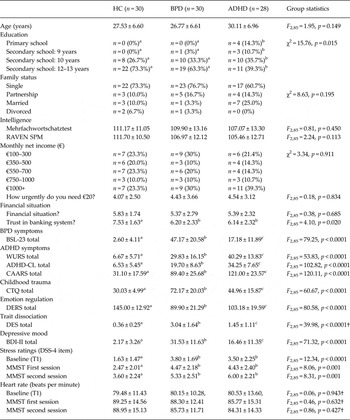
Means with standard deviations (s.d.) of these measures are reported in Table 1. As expected, BPD patients scored significantly higher on the BSL-23, while ADHD patients scored significantly higher on the ADHD-CL, WURS-k, and CAARS total than the other groups. Groups did not differ significantly regarding age and estimated IQ. There were significant differences in education level due to lower education in ADHD.
Demographics and clinical variables in healthy controls (HC), borderline personality disorder (BPD), and attention deficit hyperactivity disorder (ADHD)

BSL-23, Borderline Symptom List 23; WURS, Wender Utah Rating Scale; ADHD-CL, ADHD Checklist; CAARS, Conners’ Adult ADHD Rating Scales; CTQ, Childhood Trauma Questionnaire; DERS, Difficulties in Emotion Regulation Scale; DES, Dissociative Experiences Scale; BDI, Beck Depression Inventory; MMST, Mannheim Multicomponent Stress Test; SPM, Standard Progressive Matrices Test.
Values are presented in means ± standard deviation or frequencies (n = absolute number and % = percentage).
Groups with different superscripts (a, b, c) differ significantly (p < 0.05).
† Indicates missing values in the BPD group (for BDI-II: n = 1, for heart rate data: n = 2).
Measures of impulsivity
An overview of impulsivity measures is provided in Supplementary Table S1.
Self-reports of impulsivity
Trait impulsivity was assessed with the Barratt Impulsiveness Scale 11 (BIS 11; Patton et al. Reference Patton, Stanford and Barratt1995) and the Urgency (lack-of)-Premeditation (lack-of)-Perseverance-Sensation-Seeking-Impulsive-Behavior Scale (UPPS; Whiteside & Lynam, Reference Whiteside and Lynam2001).
The BIS-11 consists of 30 items, related to the subscales Motor Impulsiveness, Non-planning Impulsiveness, and Attentional Impulsiveness (all 1 = ‘rarely/never’ to 4 = ‘always’).
The UPPS comprises 45 items (all 1 = ‘very applicable’ to 4 = ‘very inapplicable’) measuring four dimensions of impulsivity: Negative urgency describes a tendency to act rashly during negative affective states. (Lack of) Premeditation refers to difficulties in anticipating consequences of an act before executing it. (Lack of) Perseverance assesses the ability to maintain task-related attention when frustrated. Sensation Seeking measures the tendency to seek exciting and potentially dangerous experiences.
State impulsivity was measured by the State Impulsivity Questionnaire (STIMP; Wingrove & Bond, Reference Wingrove and Bond1997), a self-report scale with 18 items, introduced by the sentence ‘I am in the sort of mood in which I …’ with a 4.5-cm visual analog scale with one end describing an impulsive reaction and the other end indicating a non-impulsive reaction. In the present study, an 11-point Likert scale was used instead of the visual analog scale (see Krause-Utz et al. Reference Krause-Utz, Sobanski, Alm, Valerius, Kleindienst, Bohus and Schmahl2013; Cackowski et al. Reference Cackowski, Reitz, Ende, Kleindienst, Bohus, Schmahl and Krause-Utz2014).
Laboratory measures of impulsivity
Response inhibition tasks
IMT (Dougherty et al. Reference Dougherty, Marsh and Mathias2002)
To measure action withholding, we used the IMT. Series of black five-digit numbers are displayed on a white background on a computer screen for 500 ms. Participants are instructed to compare these successive stimuli (separated by 500 ms) and to click a mouse button every time two identical five-digit numbers are presented in succession. Sequences of numbers and values/positions of mismatching digits are generated randomly. As the main outcome variable, we used the ‘IMT ratio’, i.e. proportion of commission errors to correct responses, which controls for basic differences in attention and task accuracy (e.g. memory). In our sample, the IMT showed good internal consistency (α = 0.80).
GoStop Task (Dougherty et al. Reference Dougherty, Mathias, Marsh and Jagar2005)
To measure action cancelation, we used the GoStop. Series of randomly generated black five-digit numbers are subsequently presented on a computer screen for 500 ms. When targets do not match the previous number exactly, participants are instructed to withhold responding (Novel trials, 50%). When targets match the previous number, participants are instructed to press a mouse button as quickly as possible (No-Stop trials, 25%). In Stop trials (25%), the color of matching targets changes from black to red (Stop Signal, occurring between 50–350 ms after stimulus onset). In this case, participants are instructed to inhibit their already initiated response. Percentage of failed inhibitions during Stop trials was regarded as main outcome measures. In our sample, the GoStop showed good internal consistency (α = 0.81).
DD Task (Plichta, Reference Plichta2009)
The DD Task was a validated inter-temporal choice paradigm consisting of 40 trials.
In each trial, participants have to choose between two monetary reward options differing with respect to the amount of money and the delay of money delivery. Each trial consists of an immediate smaller reward (always presented on the left side of the computer screen) and a larger delayed reward (right side). The immediate reward option is randomly selected from a Gaussian distribution with a Mean of €20 and s.d. of €10. The amount of the delayed reward option was set to be €100 and delay to delivery of the immediate reward was set to be the same day. The delay between the immediate and delayed option is either 2 or 4 weeks (trials with delayed options of more than 6 weeks were skipped). Time for decision making is not constricted. For each trial, decision times and selected choices are recorded for calculation of DD parameters and fit indices, data of participants who met the a-priori-defined fit index of r 2 > 0.3 were included (Plichta, Reference Plichta2009; Plichta et al. Reference Plichta, Vasic, Wolf, Lesch, Brummer, Jacob, Fallgatter and Grön2009). In the present version, participants were instructed to carefully weigh up each decision as if the money would be paid to the participant at the end of the experiment. They were informed, however, that they would not receive the real money after the experiment. The following economic variables were assessed on a 10-point Likert-scale (from 0 = ‘not at all’ to 9 = ‘extremely’): (1) ‘How urgently do you need to earn €20?’ (2) ‘How good is your financial situation?’, (3) ‘How much do you trust the banking system?’. Participants were further asked to report their monthly net income. Significant group differences were only observed for trust in the banking system: both patient groups reported lower trust than HC (Table 1). In our sample, the DD Task showed good internal consistency (α = 0.85).
Stress induction (MMST)
Stress was induced by the MMST (Kolotylova et al. Reference Kolotylova, Koschke, BäR, Ebner-Priemer, Kleindienst, Bohus and Schmahl2010), a simultaneous exposure to a cognitive stressor [calculation under time pressure: Paced Auditory Serial Addition Task – Computerized version (PASAT-C)], affective stressor (aversive pictures), sensory stressor (white noise displayed over headset), and motivational stressor (loss of money). While performing the PASAT-C, participants received feedback for wrong responses in terms of a startling acoustic sound (explosion sound). During a first training run, the experimenter additionally gave negative feedback, informing the participant they should try harder in order to prevent loss of money due to calculation errors. Subjective stress was assessed with the 10-point Likert Scale of the DSS-4 (from 0 = ‘none’ to 9 = ‘extreme’) (Stiglmayr et al. Reference Stiglmayr, Schmahl, Bremner, Bohus and Ebner-Priemer2009). In addition, heart rate was continuously assessed.
Procedure
The study was approved by the Ethics committee of the University of Heidelberg in accordance with the Declaration of Helsinki. All participants were informed about the background and procedure of the study and signed written informed consent. The experiment took place at a laboratory of the CIMH on two separate days within a 3-day interval, the order was randomized. On one day (‘baseline’), participants completed all self-report scales and behavioral tasks under resting conditions. At the beginning (T1) and end (T2) of this session, the STIMP and DSS-4 were applied. The order of IMT (action withholding), GoStop (action cancelation), and DD was randomized to avoid order effects.
On the other day (‘stress’) baseline heart rate was assessed for 5 min. Afterwards, instructions for the MMST were given and participants trained the PASAT-C. To ensure that participants were willing to tolerate the kind of pictures presented during the MMST, four exemplary pictures were shown and participants were informed that they could cancel study participation at any time. While participants performed the MMST, heart rate was continuously measured. After the MMST, participants performed the first impulsivity task. To ensure that stress levels remained high, participants performed the MMST once more after this impulsivity task. They completed the DSS-4 and STIMP at the beginning of the session (T1), before (T2) and after first MMST session (T3), before (T4) and after the second MMST session (T5) and after the last task (T6). At the end of the experiment, participants were debriefed, thanked, and paid for participation.
Statistical analyses
Normal distribution was checked using the Kolmogorov–Smirnov test. Significance threshold was set at p < 0.05, two-tailed. STIMP scores and DSS-4 (stress) ratings assessed at different time points were aggregated to yield single scores for ‘baseline’ and ‘stress’.
Manipulation check of stress induction. 3 × 2 repeated-measures analyses of variance (rm-ANOVAs) with group (HC, BPD, ADHD) as between-subject factor and condition (baseline, stress) as within-subject factor were computed for stress ratings as well as heart rate after the first and second MMST session separately.
Trait impulsivity. Separate multivariate analyses of variance (MANOVAs) with group as fixed factor and BIS-11 and UPPS subscales as dependent variables were performed. Significant group effects were followed-up using post-hoc Tukey's HSD tests (corrected for multiple comparisons).
State impulsivity and behavioral measures. 3 × 2 rm-ANOVAs for STIMP, IMT ratio, GoStop, and DD parameters were performed separately after testing assumptions of variance equality (Levene's tests) and sphericity (Mauchly's test, applying Greenhouse-Geisser corrections in case of p < 0.05). Significant between-group effects were followed-up using Tukey's HSD tests, for within-group effects post-hoc paired t tests were computed.
Pearson correlations between self-report and behavioral measures in the three groups separately are reported in Supplementary Table S2.
Results
Manipulation check of stress induction
Means with s.d. of stress ratings and heart rate are reported in Table 1.
For stress ratings, there was a significant condition effect (F 1,84 = 128.01, p < 0.0001, η p 2 = 0.60) with higher ratings after first MMST session than baseline and a significant group effect (F 2,84 = 16.37, p < 0.0001, η p 2 = 0.28) with higher ratings in BPD and ADHD than HC (interaction: F 2,84)= 1.51, p = 0.227). Similar effects were found for the second MMST session (condition effect: F 1,84 = 50.03, p < 0.0001, η p 2 = 0.37; group effect: F 2,84 = 15.83, p < 0.0001, η p 2 = 0.27; interaction: F 2,84 = 0.97, p = 0.385).
For heart rate, there was a significant main effect of condition (F 1,84 = 70.29, p < 0.0001, η p 2 = 0.46) with higher heart rates during first MMST session compared to baseline (group effect: F 2,84 = 0.08, p = 0.924; interaction effect: F 2,84 = 2.07, p = 0.133). Similar effects were found for the second MMST session (condition effect: F 1,84= 34.87, p < 0.0001, η p 2 = 0.29; group effect: F 2,84 = 0.17, p = 0.847; interaction effect: F 2,84 = 2.54, p = 0.085).
Self-reported trait impulsivity
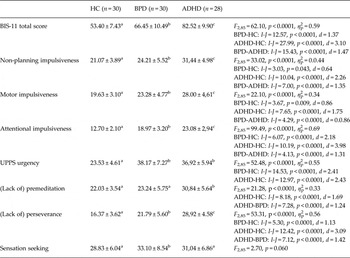
Means with s.d. and MANOVA results for BIS-11 and UPPS are reported in Table 2.
Scores on the Barratt Impulsiveness Scale 11 (BIS-11) and the UPPS Impulsive Behavior Scale in healthy controls (HC), patients with borderline personality disorder (BPD), and patients with attention deficit hyperactivity disorder (ADHD)

Parameters are reported in means ± standard deviations (s.d.).
Groups with different superscripts (a, b, c) differ significantly from each other.
BIS-11. Significant differences were observed for all scales with higher scores in BPD as well as ADHD than HC and in ADHD than BPD.
UPPS. Significant differences in Negative urgency, (Lack of) Premeditation, (Lack of) Perseverance, and a trend for Sensation Seeking were observed. Both patient groups reported significantly higher Negative urgency and (Lack of) Perseverance than HC. ADHD scored higher on (Lack of) Premeditation than HC and BPD and reported higher (Lack of) Perseverance than BPD.
Self-reported state impulsivity
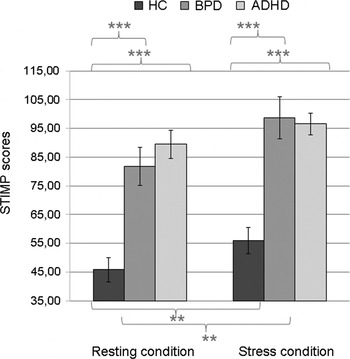
Means with s.e.m. of STIMP scores are shown in Fig. 1. The rm-ANOVA revealed a significant main effect of condition (F 1,85 = 16.63, p < 0.0001, η p 2 = 0.16) with higher scores under stress compared to baseline in HC. Further, there was a significant group effect (F 2,85 = 23.38, p < 0.0001, η p 2 = 0.36) with higher scores in both patient groups than HC but no significant differences between patient groups (interaction effect: F 2,85 = 1.10, p = 0.351).
Subjective state impulsivity (STIMP scores) in healthy participants (HC), patients with borderline personality disorder (BPD), and patients with attention deficit hyperactivity disorder (ADHD). Means with standard errors of the mean for scores on the State Impulsiveness Questionnaire (STIMP) are presented. Significant differences are indicated by asterisks: *p < 0.05, **p < 0.01, ***p ⩽ 0.001.

Behavioral impulsivity
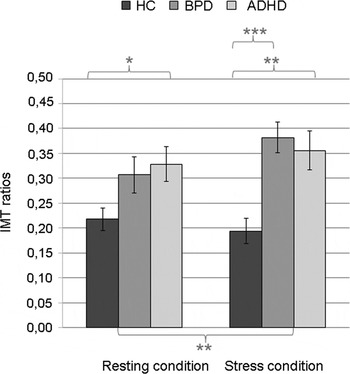
IMT (action withholding). Means with s.e.m. of IMT ratios are depicted in Fig. 2.
Parameter of the Immediate Memory Task (IMT, action withholding) in healthy participants (HC), patients with borderline personality disorder (BPD), and patients with attention deficit hyperactivity disorder (ADHD). Means with standard errors of the mean for the proportion of commission errors to correct responses (IMT ratio) are displayed. Significant differences are indicated by asterisks: *p < 0.05, **p < 0.01, ***p ⩽ 0.001.

The rm-ANOVA effects of group (F 2,85 = 7.63, p = 0.001, η p 2 = 0.15) and group × condition (F 2,85= 3.35, p = 0.040, η p 2 = 0.07) were significant (condition effect: F (1,85) = 2.73, p = 0.102). Post-hoc Tukey tests for the group effect indicated higher IMT ratios in ADHD than HC (p = 0.004) and in BPD than HC (p = 0.003). There were no significant group differences between patient groups (p = 0.996). In BPD, IMT ratios were significantly higher under stress than baseline (t 29 = 2.08, p = 0.046, d = 0.36), for HC (t 29 = 1.2, p = 0.233) and ADHD (t 27 = 1.24, p = 0.226) these within-group differences were not significant.
GoStop (action cancelation). Means with s.d. of GoStop parameters are reported in Supplementary Table S3. There were no significant rm-ANOVA effects for percentage of failed response inhibition in ‘Stop trials’ (condition effect: F 2,85 = 0.17, p = 0.686; group effect: F 2,85 = 0.82, p = 0.444; interaction effect: F 2,85= 1.14, p = 0.324) or any other parameter, except for a group effect for omission errors (F 2,85 = 4.17, p = 0.019, η p 2 = 0.09) with more errors in ADHD than HC.
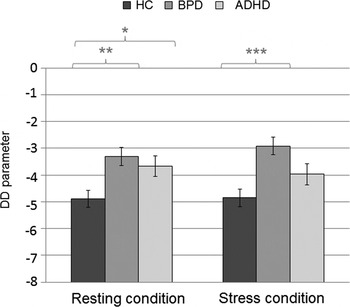
DD Task. Twenty-four HC, 25 BPD patients, and 18 ADHD patients meeting the a-priori-defined fit index of r 2 > 0.3 were included. This subsample showed no significant differences in age (F 2,64 = 1.08, p = 0.346) and intelligence (F 2,64 = 0.31, p = 0.737). Means with s.e.m. of DD parameter are depicted in Fig. 3. There was a significant group effect (F 2,64 = 8.23, p = 0.001, η p 2 = 0.21) with higher DD in BPD than HC (p < 0.001) and a trend for higher DD in ADHD than HC (p = 0.078). The condition effect (F 1,63 = 0.11, p = 0.742) and interaction effect (F 2,67 = 1.84, p = 0.167) were not significant.
Parameter of the Delay Discounting (DD) Task in healthy participants (HC), patients with borderline personality disorder (BPD), and patients with attention deficit hyperactivity disorder (ADHD). A subsample of 24 HC, 25 BPD patients, and 18 ADHD patients met the a-priori-defined fit index of r 2 > 0.3 and was included in the analysis. Means with standard errors of the mean for DD parameter are presented. Higher values indicate a stronger preference of the immediate reward option over the delayed larger reward option. Significant differences are indicated by asterisks: *p < 0.05, **p < 0.01, ***p ⩽ 0.001.

Discussion
This study aimed to investigate the effect of acute experimental stress on DD and response inhibition (action withholding, action cancelation) in BPD and ADHD. Main findings are:
-
• IMT (action withholding). BPD showed significantly more impairments under stress than baseline, which was not observed in the other groups.
-
• GoStop (action cancelation). No significant effects of group/stress on action cancelation.
-
• DD Task. No significant effects of stress on DD. Stronger preference of immediate over delayed larger reward in BPD than HC.
-
• Self-reported impulsivity. Elevated levels of state/trait impulsivity in both patient groups compared to HC. Higher trait impulsivity in ADHD than in BPD.
Both patient groups reported higher impulsivity than HC. Consistent with earlier studies which excluded patients with co-morbid BPD + ADHD, we observed higher BIS-11 scores in ADHD than BPD (Lampe et al. Reference Lampe, Konrad, Kroener, Fast, Kunert and Herpertz2007; Krause-Utz et al. Reference Krause-Utz, Sobanski, Alm, Valerius, Kleindienst, Bohus and Schmahl2013). Moreover, individuals with BPD experienced lower (Lack of) Premeditation and (Lack of) Perseverance than those with ADHD but similar levels of negative urgency (UPPS). UPPS Urgency was found to be the strongest predictor for BPD features in earlier studies, suggesting that this facet might be strongly associated with BPD (Tragesser & Robinson, Reference Tragesser and Robinson2009; Peters et al. Reference Peters, Upton and Baer2013; Fossati et al. Reference Fossati, Gratz, Maffei and Borroni2014).
BPD patients showed a significant stress-dependent impairment on the IMT (action withholding), which was not detected in the other groups. This finding suggests that alterations in objective (behavioral) measures of impulsivity may become evident especially under emotional stress, in line with clinical expression of impulsive behavior in individuals with the disorder. This might also partly explain while some studies, measuring behavioral impulsivity at baseline, were not able to find abnormalities in BPD (McCloskey et al. Reference McCloskey, New, Siever, Goodman, Koenigsberg, Flory and Coccaro2009; Jacob et al. Reference Jacob, Gutz, Bader, Lieb, Tüscher and Stahl2010, Reference Jacob, Zvonik, Kamphausen, Sebastian, Maier, Philipsen, van Tebartz Elst, Lieb and Tüscher2013; Barker et al. Reference Barker, Romaniuk, Cardinal, Pope, Nicol and Hall2015).
In a previous study, we observed impaired IMT performance (action withholding) both during baseline and stress conditions in ADHD and BPD + ADHD but not in BPD when compared to HC (Krause-Utz et al. Reference Krause-Utz, Sobanski, Alm, Valerius, Kleindienst, Bohus and Schmahl2013). In this previous study, we found significantly better IMT performance (action withholding) under stress in BPD, contrary to our present finding of impaired performance under stress. Yet, in our previous study we used a predominantly cognitive stressor which induced only moderate stress, while participants in the present study were exposed to multiple stressors, leading to a considerably high increase of heart rate and subjective stress.
With respect to action-withholding deficits (IMT), present findings partly confirm our a-priori hypothesis that acute experimental stress has an impact on impulsivity in BPD, providing further evidence for a link between disturbed emotion/stress regulation and impulsivity (New & Siever, Reference New and Siever2002; Crowell et al. Reference Crowell, Beauchaine and Linehan2009; Sebastian et al. Reference Sebastian, Jacob, Lieb and Tüscher2013).
We did not observe the expected stress-related impairments for the GoStop (action cancelation); however. Here, no significant group differences were found for percentage of failed response inhibition. ADHD patients demonstrated more omission errors than HC, replicating earlier findings (e.g. Hervey et al. Reference Hervey, Epsten and Curry2004). BPD patients did not differ from HC on any GoStop parameter. In a previous study (Cackowski et al. Reference Cackowski, Reitz, Ende, Kleindienst, Bohus, Schmahl and Krause-Utz2014) we found significantly more action cancelation deficits on the GoStop under stress in BPD than HC. However, in this previous study co-morbid ADHD was not defined as an exclusion criterion. It is possible that BPD patients without co-morbid ADHD may have difficulties in action withholding (IMT) but not in action cancelation (GoStop) when exposed to high levels of stress. To further elucidate this, future studies should investigate the impact of acute experimental stress on both tasks in BPD, ADHD, and patients with BPD + ADHD.
Further, we found no stress effect for DD. Individuals with BPD showed significantly more DD than HC, in line with earlier research (Völker et al. Reference Völker, Spitzer, Limberg, Grabe, Freyberger and Barnow2009; Lawrence et al. Reference Lawrence, Allen and Chanen2010; Coffey et al. Reference Coffey, Schumacher, Baschnagel, Hawk and Holloman2011; Barker et al. Reference Barker, Romaniuk, Cardinal, Pope, Nicol and Hall2015). Previous studies in BPD, however, did not consistently exclude co-morbid ADHD. In this respect, our findings extend earlier research, suggesting that DD is more pronounced in BPD patients even when excluding co-morbid ADHD. Our findings further suggest that DD in BPD without ADHD is not altered after exposure to multiple stressors. Still, more research is needed to replicate these novel findings and to gain deeper insight into other factors (e.g. positive emotions) that may contribute to DD in BPD (Dixon-Gordon et al. Reference Dixon-Gordon, Chapman, Weiss and Rosenthal2014).
For ADHD, we observed a trend for higher DD. Since only 18 ADHD patients met the inclusion criterion (fit index) for this task, this sub-sample might have been statistically under-powered to detect significant impairments, observed in previous research (Plichta et al. Reference Plichta, Vasic, Wolf, Lesch, Brummer, Jacob, Fallgatter and Grön2009; Carmona et al. Reference Carmona, Hoekzema, Ramos-Quiroga, Richarte, Canals and Bosch2012; Dai et al. Reference Dai, Harrow, Song, Rucklidge and Grace2013).
To our knowledge, this is the first study investigating the impact of acute experimental stress on objective measures of DD and response inhibition (action withholding, action cancelation) in BPD and ADHD (excluding BPD patients with ADHD and vice versa).
Some limitations need to be addressed. Experimental stress (MMST) may not represent the kind of stress encountered in everyday life and effects of stress on impulsive behavior in BPD may be specifically related to emotional/interpersonal stressors. Future studies comparing emotional/interpersonal to cognitive stressors may help to further elucidate this relationship. Likewise, a well-established, validated DD paradigm was used, which might nevertheless have limited ecological validity for BPD. Future studies could investigate impulsivity in daily social situations, e.g. using ambulatory monitoring (Tomko et al. Reference Tomko, Lane, Pronove, Treloar, Brown, Solhan, Wood and Trullin press). Furthermore, we decided to only include female participants, as women account for about three-quarters of documented cases of BPD (APA, 2000). Studying stress-related impulsivity in male patients remains an important research topic (Mancke et al. Reference Mancke, Herpertz and Bertsch2015). We excluded certain co-morbidities related to impulsivity, yet, the presence of other co-morbidities might have influenced our results. Lastly, it is possible that previous or current treatment (e.g. stress tolerance training) might have had an impact on findings in our patient samples. Future studies may investigate the impact of treatment on behavioral measures of impulsivity under baseline and stress conditions.
In conclusion, our study highlights the multifaceted nature of impulsivity and the importance of taking possible effects of stress into account. In BPD patients without co-morbid ADHD, response inhibition deficits may be partly related to acute stress. Psychoeducation and training in stress tolerance (Linehan, Reference Linehan1993) may help preventing action withholding deficits in these patients. DD appears to be a more fundamental feature of BPD (independent of co-morbid ADHD and acute experimental stress), possibly underlying typical expressions of impulsive behavior in the disorder.
Supplementary material
The supplementary material for this article can be found at http://dx.doi.org/10.1017/S0033291716001677.
Acknowledgements
This work was funded by a grant of the German Research Foundation (Deutsche Forschungs Gemeinschaft, DFG, grant no. SCHM 1526/13-1, EN 361/12-1). We thank all participants of this study for their collaboration in this study and Dr Nikolaus Kleindienst for consultation on statistical analyses.
Declaration of Interest
None.