This article addresses whether beginning nonnative learners of Chinese can use semantic and phonological properties of radicals to learn new Chinese characters and to what extent their character learning ability predicts word reading. Unlike alphabetic languages that use letters as basic units and represent speech sound, stroke patterns (radicals) are important functional orthographic units in the recognition of Chinese characters for both child and adult learners of Chinese (e.g., Anderson et al., Reference Anderson, Ku, Li, Chen, Wu and Shu2013; Chen, Allport, & Marshall, Reference Chen, Allport and Marshall1996; Feldman & Siok, Reference Feldman and Siok1997). About 80% of Chinese characters are phonetic compound characters that comprise a semantic radical, providing a semantic clue and a phonetic radical giving a pronunciation clue (Zhou, Reference Zhou1980). The importance of semantic and phonetic radical knowledge in Chinese children's reading development has been widely recognized in literature (Ho & Bryant, Reference Ho and Bryant1997; Shu & Anderson, Reference Shu and Anderson1997).
Most previous research involving Chinese as a foreign language (CFL) learners has examined the relationship between semantic radical awareness and reading development and found a moderate association between semantic radical awareness and character knowledge and vocabulary acquisition (Shen & Ke, Reference Shen and Ke2007; Su, Reference Su2010). Despite the varying reliability of the phonetic radicals in providing pronunciation cues of characters, using phonetic information to predict the pronunciations of new Chinese characters is a useful strategy in learning to read Chinese (Anderson, Li, Ku, Shu, & Wu, Reference Anderson, Ku, Li, Chen, Wu and Shu2003; He, Wang, & Anderson, Reference He, Wang and Anderson2005). Little is known whether beginning CFL learners can use phonetic radical information to learn to pronounce new Chinese characters. Few studies have addressed the character learning process and the role of character learning in reading development in CFL learners. Using a paired associate learning paradigm, the goals of the present study are to investigate the implicit use of semantic and phonetic radical information on trial-by-trial character learning and the contributions of semantic and phonological aspects of character learning to word reading in beginning CFL learners. The results will not only reveal similarities and differences in reading development between native and nonnative Chinese learners but also yield implications for teaching Chinese as a foreign language.
CHARACTERISTICS OF THE CHINESE WRITING SYSTEM
To help readers better understand the current study, we will first introduce the unique properties of the Chinese writing system. Chinese orthography is often described as a morphosyllabic writing system. Distinct from alphabetic languages, the most prominent characteristics of Chinese lie in its complicated orthography and the relationships among visual symbols, speech sounds, and semantic meanings. The units of orthographic structure in Chinese include strokes (丶, 丨, and 丿), radicals or recurrent patterns of strokes (犭 and 苗), and characters (猫, /mao1/, and cat). Components of Chinese characters are arranged side-by-side (e.g., 打), top to bottom (e.g., 呆), or inside–outside (e.g., 困 and 迈) in a rectangular layout. Each character is a salient perceptual unit that differs from thousands of others in terms of individual strokes or the overall spatial configuration.
Chinese writing does not reflect the segmental structure of speech, and one Chinese character maps to a whole morpheme or syllable. There is some phonology information available in compound characters that comprise a phonetic radical and a semantic radical. For example, in the compound character, 烤, /kao3/, to burn, the right part, 考, /kao3/, exam, is a phonetic radical that gives a cue to the pronunciation of compound character, and the left part, 火, /huo3/, fire, is a semantic radical that gives a cue to the character meaning. These semantic–phonetic compound characters, sometimes called phonetic compounds, make up 72% of the characters Chinese children learn during the 6 years of elementary school (Shu, Chen, Anderson, Wu, & Xuan, Reference Shu, Chen, Anderson, Wu and Xuan2003).
Clues to pronunciations in phonetic components, however, are not always trustworthy. According to Zhou's (Reference Zhou1980) estimate, phonetic radicals provide accurate sound information for only about 40% of the phonetic compound characters. That is, these characters (e.g., 清, /qing1/), called regular phonetic compound characters, have exactly the same pronunciations as their phonetic radicals (e.g., 青, /qing1/). Phonetic radicals in a large additional group of compound characters provide either partial or no information about the pronunciation of the whole character. Phonetic radicals (e.g., 青, /qing1/) provide partial sound information of the whole characters (e.g., 精, /jing1/), called semiregular phonetic compound characters, because they share the same rime (–ing) and tone (denoted as number 1) but different onsets. Phonetic radicals (e.g., 台, /tai2/) provide no sound information of the whole characters (e.g., 怡, /yi2/), called irregular phonetic compound characters. About 39% of characters in the language arts textbook for Chinese elementary schools are regular characters (Shu et al., Reference Shu, Chen, Anderson, Wu and Xuan2003).
Semantic radicals mostly occupy a habitual position in a compound Chinese character: left or top. Many semantic radicals are themselves simple characters with independent meanings and pronunciations (e.g., 火, fire). Some radicals are bound forms that never appear alone, but only as semantic components of compound characters (e.g., the animal radical, 犭, in the character, 猫, cat). In general, the semantic radical in a Chinese character signifies the semantic category of the character. There are different degrees of semantic transparency for different semantic radicals. A transparent semantic radical gives a reliable cue for the meaning of a character (e.g., the semantic radical, 女, female, in the character, 妈, mother), but an opaque semantic radical does not (e.g., the semantic radical, 女, female, in the character, 始, beginning). About 58% of compound characters in all Chinese characters taught in elementary schools are semantically transparent (Shu et al., Reference Shu, Chen, Anderson, Wu and Xuan2003).
RADICAL KNOWLEDGE AND READING DEVELOPMENT IN NATIVE AND NONNATIVE CHINESE LEARNERS
Research has shown that the radical is an important orthographic unit in character recognition and writing for native Chinese children and adults (e.g., Anderson et al., Reference Anderson, Ku, Li, Chen, Wu and Shu2013; Feldman & Siok, Reference Feldman and Siok1997; Shen & Bear, Reference Shen and Bear2000). Position and function of radicals largely determine how a radical affects character recognition in skilled and beginning Chinese readers (Ho, Ng, & Ng, Reference Ho, Ng and Ng2003; Li, Shu, McBride-Chang, Liu, & Peng, Reference Li, Shu, McBride-Chang, Liu and Peng2012).
Chinese children develop implicit knowledge about the functional regulations of phonetic radicals at an early age. Children as young as first and second graders were found to name phonologically regular Chinese characters better than irregular ones (Ho & Bryant, Reference Ho and Bryant1997; Shu, Anderson, & Wu, Reference Shu, Anderson and Wu2000). Second- and fourth-grade Chinese children were able to use partial information of phonetic radicals to decode the pronunciations of Chinese characters (Anderson et al., Reference Anderson, Li, Ku, Shu and Wu2003) and infer the pronunciations of new characters by using an analogy strategy (He et al., Reference He, Wang and Anderson2005; Ho, Wong, & Chan, Reference Ho, Wong and Chan1999).
Semantic radical awareness is considered an important aspect of morphological awareness (i.e., understanding of words as combinations of the smallest meaning units) and is closely related to Chinese reading development (Shu & Anderson, Reference Shu, Anderson, Wang, Inhoff and Chen1999). Third and fifth graders were better able to use the semantic radicals to derive the meanings of unfamiliar characters than were first graders (Shu & Anderson, Reference Shu and Anderson1997). Going beyond the previous research, which failed to separate a reader's awareness of the function of radicals and knowledge of the specific sound value or semantic category of the radicals, Ho, Ng, et al. (Reference Ho, Ng and Ng2003) assessed radical knowledge and positional and functional knowledge of semantic and phonetic radicals separately in kindergarten and primary school children in Hong Kong. Results showed that children started acquiring the knowledge of character structure, position, semantic category, and sound value of radicals from Grade 1; however, they did not understand that the function of semantic radicals is to provide meaning cues in reading until Grade 3, consistent with the findings in Shu and Anderson (Reference Shu and Anderson1997). The processing of a radical's specific information, position, and function was significantly correlated with Chinese word reading, sentence reading comprehension, and word spelling.
There is correlational evidence of the importance of semantic radical knowledge for nonnative Chinese learners’ word acquisition (e.g., Shen & Ke, Reference Shen and Ke2007; Su, Reference Su2010). Shen and Ke (Reference Shen and Ke2007) investigated the developmental trend of semantic radical knowledge, radical perception (decomposition of compound characters to radicals vs. random strokes), and semantic radical knowledge application skills (choosing radicals given meanings of compound characters) and their relation to vocabulary acquisition among adult nonnative learners at different Chinese proficiency levels. Results showed a linear growth of semantic radical knowledge across 4 years of Chinese learning experience, and a positive moderate correlation between semantic radical knowledge application skills and vocabulary across two beginning levels (the 1-year group and the 2-year group). Following Ho, Ng, et al. (Reference Ho, Ng and Ng2003), who studied classification of positional and functional aspects of radical awareness, Su (Reference Su2010) found that four types of semantic radical awareness (explicit and implicit awareness of semantic radical position and function) significantly predicted word recognition among adult nonnative learners after controlling for their Chinese proficiency levels.
Previous research has reported a facilitative role of semantic radicals in character learning among adult nonnative Chinese learners (Taft & Chung, Reference Taft and Chung1999; Wang, Liu, & Perfetti, Reference Wang, Liu and Perfetti2004; Wang, Perfetti, & Liu, Reference Wang, Perfetti and Liu2003; Williams, Reference Williams2013). Taft and Chung (Reference Taft and Chung1999) asked adult CFL learners to learn 16 character-meaning associations over three trials under four conditions: radicals before, radicals early, radicals late, and no radicals. The radicals before group was taught the radicals 15 min before seeing the characters. The radicals early group was taught the radicals at the first learning trial, and the radicals late group was not taught the radicals until the third learning trial. The no radical group was told nothing about the radials at all. Results showed that presenting radicals, especially at the early stage of character learning, enhanced the memory of character–meaning associations.
Wang, Liu, and Perfetti (Reference Wang, Liu and Perfetti2004) investigated beginning Chinese learners’ implicit and explicit learning of the orthographic component function of Chinese characters. A character identification task was used to elicit the meanings of 18 unknown characters. Each target character contained two radicals that students encountered in the curriculum before. Without any probing, these learners had difficulty in making use of the functional cues of the known semantic radicals. With probing, they visually identified the majority of target semantic radicals. They demonstrated implicit knowledge of meaning cues of the semantic radicals by making more appropriate meaning inference on high-frequency radicals than on low-frequency ones. After receiving explicit instruction, the students extracted significantly more meaning information from the known semantic radicals. The results are in line with the findings of the radicals late versus no radical group in Taft and Chung's (Reference Taft and Chung1999) study. The reason that students had difficulty in making use of the semantic radicals to infer character meanings without probing was perhaps due to the decontextualized character identification task. A limitation of Wang et al.'s (Reference Wang, Liu and Perfetti2004) study was that radicals encountered in the curriculum did not necessarily mean known radicals. Without explicit teaching, the radicals could be simply unknown to participants.
Taken together, previous studies have focused on semantic radicals and character or word acquisition among adult CFL learners. There is a scarcity of research examining the phonetic radical knowledge and its role in word reading in nonnative Chinese learners. Research shows that beginning learners of Chinese are aware of the orthographic units (semantic and phonetic radicals) within a compound character, even with little knowledge of Chinese radicals (Shen & Ke, Reference Shen and Ke2007; Wang et al., Reference Wang, Perfetti and Liu2003). When being taught explicitly, beginning learners of Chinese developed function awareness of semantic radicals and can also use semantic radicals to learn the meanings of new characters. It remains unknown whether beginning Chinese learners are able to use phonetic radicals in learning pronunciations of new characters, or learning orthography–phonology mappings in Chinese, without explicit teaching of function of phonetic radicals.
Given the variability in the phonological relationship between phonetic radicals and the whole compound characters, Taft and Chung (Reference Taft and Chung1999) speculated that knowing the pronunciation of a phonetic radical is likely to be more of a distraction than an advantage in learning the character that contains it; thus, a different impact of phonetic radicals on character pronunciation learning than the effect of semantic radicals on character meaning learning would be expected. The findings in Williams' (Reference Williams2013) study support Taft and Chung's (Reference Taft and Chung1999) speculation: intermediate- to high-proficiency adult CFL learners predominantly use semantic strategies in character recognition, but their phonological strategy is not yet a reliable means of character identification. It remains unclear whether the finding will apply to beginning nonnative Chinese learners because they have limited knowledge of the Chinese writing system. Strategies of CFL learners may largely depend on the features of the Chinese writing system, rather than their first language experience. If this is the case, beginning CFL learners may rely more on semantic strategies, rather than phonetic strategies, to learn Chinese characters. A traditional notion in teaching Chinese as a foreign language is that, given the low reliability of phonetic radicals as pronunciation cues for compound characters, it is not wise to encourage CFL learners to guess the pronunciations of new characters from phonetic radicals. Findings of the current study will inform the best practice of teaching Chinese as a foreign language.
THE ROLE OF PAIRED ASSOCIATE LEARNING IN WORD READING
Across writing systems, learning the arbitrary links among orthography, phonology, and semantics is essential to word learning, especially at the beginning stages of learning to read (Hulme, Goetz, Gooch, Adams, & Snowling, Reference Hulme, Goetz, Gooch, Adams and Snowling2007). The process of learning to associate printed words (orthography) to their pronunciations (phonology) and meanings, stimulus–response association formation, can be measured by an experimental paradigm called paired associate learning (PAL). Research suggests that visual–verbal PAL between abstract visual symbols or unfamiliar objects and spoken nonwords contributes to English word reading skills, independent of phonological awareness and decoding skills (e.g., Hulme et al., Reference Hulme, Goetz, Gooch, Adams and Snowling2007; Messbauer & de Jong, Reference Messbauer and de Jong2003; Windfuhr & Snowling, Reference Windfuhr and Snowling2001). PAL skills accounts for unique variance in the children's reading of both regular and irregular words (Nilsen & Bourassa, Reference Nilsen and Bourassa2008). Although the Chinese writing system is well known for its visual complexity and often labeled “logographic” because Chinese characters more clearly map onto morphemes, or meaning units (and corresponding syllables), than to phonemes, Chinese children are able to learn the associations between abstract visual symbols and pronunciations, and this ability is associated with Chinese word reading (Li, Shu, McBride-Chang, Liu, & Xue, Reference Li, Shu, McBride-Chang, Liu and Xue2009).
Research on word learning in English has manipulated phonological regularity (spelling–sound consistency) and semantic properties (concreteness and imageability) and found that spelling–sound consistency, concreteness, and imageability affect word reading among beginning readers. Children learn to read regular, concrete, and imaginable words more successfully than irregular, abstract, and unimaginable words. Children can make use of semantic and phonological properties in later learning trials compared to early trials (Duff & Hulme, Reference Duff and Hulme2012; Nilsen & Bourassa, Reference Nilsen and Bourassa2008). These findings can be explained by the triangle model of reading aloud (Plaut, McClelland, Seidenberg, & Patterson, Reference Plaut, McClelland, Seidenberg and Patterson1996) and the lexical quality hypothesis (Perfetti, Reference Perfetti2007). Phonological output can be generated either directly from orthographic input or indirectly via semantic representations. Words with good lexical quality have all orthographic, phonological, and semantic information in a stable and integrated way, and should yield an orthographic processing advantage, relative to words with poor lexical quality.
Children's early attempts in reading often involve a nonanalytic stance toward whole-word recognition (Ehri, Reference Ehri, Gough, Ehri and Treiman1992). This may be particularly true in Chinese, where phonological information is relatively arbitrary to begin with (Shu et al., Reference Shu, Chen, Anderson, Wu and Xuan2003). However, as children progress in developing a sight vocabulary, the process of learning to associate printed words (orthography) and their pronunciations (phonology) by rote memory becomes ineffective because there are simply too many words to keep in mind. As a result, children must give up on rote learning strategies and progress toward the abstract and transfer basic rules of orthography–phonology correspondences within a given writing system. In learning to read Chinese, it means to take the advantage of the phonetic radical to remember the sound of a character and use the sematic radical to infer the meaning of the character (e.g., Anderson et al., Reference Anderson, Li, Ku, Shu and Wu2003; Ho, Ng, et al., Reference Ho, Ng and Ng2003; Ho et al., Reference Ho, Wong and Chan1999; Ho, Yau, & Au, Reference Ho, Yau, Au, McBride-Chang and Chen2003). However, the extent to which the same learning mechanisms might apply to nonnative Chinese learners is not intuitively obvious.
THE PRESENT STUDY
The current study is among the first attempts to investigate the joint effects of phonetic regularity and semantic transparency on trial-by-trial character learning, and the contributions of semantic and phonological aspects of character learning to word reading in learners of Chinese as a foreign language. Specifically, two questions were addressed:
1. Can beginning nonnative Chinese learners use phonetic and semantic radicals to learn sounds and meanings of new characters?
2. To what extent do beginning Chinese learners’ knowledge of semantic and phonetic radicals and PAL (orthography–pronunciation, orthography–semantics) ability predict their Chinese word reading?
The visual–verbal PAL task in the current study represents both orthography–pronunciation and orthography–semantics associations, and can elucidate the mechanism of visual–verbal PAL in word reading. Students will learn compound pseudocharacters varying in semantic transparency and phonetic regularity of radicals. The radicals were high frequency and taught to students prior to the character learning task. Based on previous findings, we hypothesized that beginning CFL learners can learn the meanings of transparent characters more successfully than opaque characters. Beginning CFL learners may show an advantage in learning to read regular characters and have particular difficulties in learning to read irregular characters. The ability to learn the associations between character orthography and semantics and between orthography and phonology would predict word reading in CFL learners.
Given the lack of research on the role of PAL in word reading in a second language, the study can fill the gap by extending the findings from the first language to the second language. This is of great interest given the maximum contrast between Chinese and English. Different from previous studies, which exclusively involve adult nonnative Chinese learners, middle school students participated in the current study. It remains an interesting question whether the radical knowledge development and character learning process of adolescent CFL learners would differ from those of adult CFL learners.
METHOD
Participants
Thirty-four seventh- and eighth-grade beginning learners of CFL from a middle school in the southern United States participated in the study. They were recruited from two elective Chinese classes, one in seventh grade (n = 19) and one in eighth grade (n = 15). There were 15 female and 19 male students. There were 26 (76%) native English speakers, 6 (17%) Spanish speakers, 1 Bosnian speaker, and 1 Vietnamese speaker. The average age was 13.2 years old. According to a brief language background survey students filled out, on average, these students had learned Chinese for 4 months. Three students had been to Chinese-speaking countries, and the length of stay ranged from 1 to 3 months.
At the time of the study, all students had received a 50-min daily Chinese lesson taught by the same instructor for one semester. The Chinese teacher was trained by the Overseas Volunteer Chinese Language Teacher program sponsored by Hanban, China. The curriculum, Happy Chinese, is designed for secondary school children who learn Chinese as a foreign language. The content is closely related to children's daily life and in order to arouse student's interest and improve their communication ability in Chinese. Analysis of the textbook corpus suggests that students had learned about 150 new words by the time of the study. According to the teacher, the instruction focuses more on oral conversation in Chinese and cultural exposure, rather than reading and writing.
Materials and procedure
All students completed a paired associate character learning task and three measures: semantic radical knowledge, phonetic radical knowledge, and word reading. Students also filled out a brief language background survey about their demographic information and Chinese learning experience. Research assistants fluent in Chinese and English administered the three individual tasks in the same order: paired associate character learning, word reading, and phonetic radical knowledge, in a quiet room in the school on the same day. It took about 25 min to administer all individual tests. The semantic radical knowledge measure and the survey were administered in groups on a different day.
Paired associate character learning task
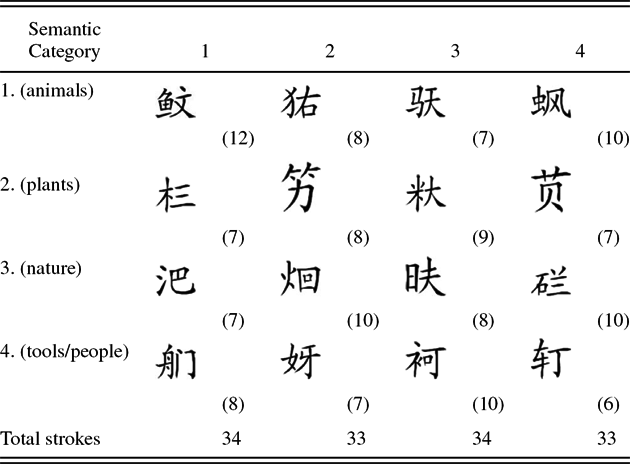
In PAL paradigms (e.g., Hulme et al., Reference Hulme, Goetz, Gooch, Adams and Snowling2007; Li et al., Reference Li, Shu, McBride-Chang, Liu and Xue2009; Windfuhr & Snowling, Reference Windfuhr and Snowling2001), students learned to associate 16 compound pseudocharacters with their sounds and meanings in the character learning task. Pseudocharacters are novel combinations of orthographic units (radicals) in their legal positions but are nonexistent in Chinese. Sixteen high-frequency semantic radicals and 16 high-frequency phonetic radicals were selected. The semantic radicals were balanced on semantic categories: animals, plants, nature, and tools or people. Five of these were bound semantic radicals, which cannot appear alone and are not pronounceable. All phonetic radicals were simple and high-frequency characters. The formed compound characters had a similar orthographic complexity and numbers of strokes. All of the pseudocharacters are listed in Table 1. Given students’ limited character knowledge, the advantage of using pseudocharacters over real characters in this task was to ensure that all compound characters were made up of familiar semantic and phonetic radicals and unknown to all participants, while the semantic transparency and phonetic regularity of radicals could be manipulated for the same character.
Pseudocharacters used in the character learning task

Before the character learning task, students were taught the selected 16 semantic radicals and 16 phonetic radicals in two Chinese class sessions per week, with about 10–15 min per session, over a 4-week period. Students were taught the pronunciations and meanings, but not function of these radicals. The teaching was spread over a 4-week period because it was not possible for students to remember 32 characters in one or two intensive training sessions. One day before the character learning task, 32 radicals were reviewed.
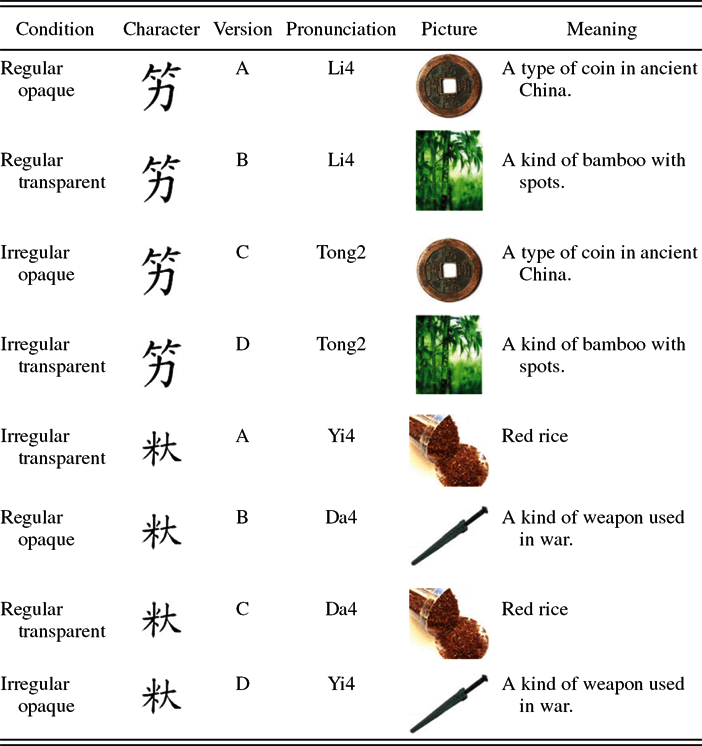
In the PAL task, the transparency of semantic radicals and regularity of phonetic radicals of the 16 compound pseudocharacters were manipulated. Items were taught in each of four conditions: regular phonetic radicals and transparent semantic radicals, regular phonetic radicals and opaque semantic radicals, irregular phonetic radicals and transparent semantic radicals, and irregular phonetic radicals and opaque semantic radicals. The associations of each pseudocharacter and the four learning conditions were counterbalanced in four versions. See the sample stimuli in Table 2. For example, the pseudocharacter  is pronounced as /yi4/ and means red rice in Version A, and has a irregular phonetic radical, 大, /da4/, and a transparent semantic radical, 米, rice. In Version B, the same pseudocharacter is pronounced as /da4/ and means a kind of weapon used in war, and has a regular phonetic radical, 大, /da4/, and an opaque semantic radical, 米, rice. Each student learned one version of all 16 items.
Examples of stimuli in the character learning task
Note: The art in the Picture column is color online.
The 16 items were divided in two PAL sessions, with 8 items in each session, to minimize the working-memory load. A maximum of three learning trials were administered in each session. The learning trials and test trials were alternated. In the learning phase, participants were told to learn some “made-up” characters and presented with a Chinese character with its pronunciation and a novel picture depicting its meaning. A short description of the character meaning was orally presented. The novel pictures were used to introduce the meanings because they made the novel concepts real and understandable for second language learners. Students were asked to remember the pronunciation and meaning of each character. In the test phase, participants were presented with the characters only and asked to orally produce the sound and meaning of each character. The accuracy of sound and meaning production in each test trial was recorded. Correct onsets and rimes were counted as correct pronunciations because tones are particularly challenging for second language learners. Correct responses of meaning categories (e.g., rice for in Version A) were recorded as correct meanings. The character learning task lasts about 10–15 min for each student.
Semantic radical knowledge task
Among four picture choices, students were asked to choose the picture that depicted the meaning of a semantic radical. A total of 28 semantic radicals with increasing difficulty were used. Sixteen of these radicals appeared in the target characters of the character learning task.
Phonetic radical knowledge task
Students were asked to name 30 simple characters. Sixteen of these characters were used as phonetic radicals in the stimuli of the character learning task. Correct onsets and rimes were counted as correct pronunciations. Tones are especially difficult for second language learners and were omitted from scoring.
Word reading task
This is a curriculum-based task. Students were asked to read aloud 60 single-character or multicharacter Chinese words with increasing difficulty. All words were selected from the Chinese textbook Happy Chinese. Correct right onsets and rimes were counted as correct pronunciations. Students were called to stop the test if there were six consecutive errors.
RESULTS
Paired associate character learning
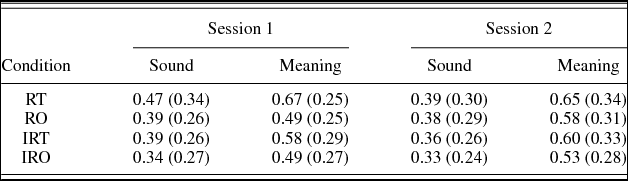
Table 3 presents the proportion accuracy of orthography–meaning and orthography–sound PAL outcomes in two sessions across four conditions. Three-way (phonetic regularity, semantic transparency, and session) repeated measures analyses of variance (ANOVAs) of sound and meaning performance showed no main effect of session or no two-way or three-way interactions associated with session (ps > .05). Thus, session was not reported in further analyses and proportion accuracy in the two sessions was combined. It should be noted that because the dependent variable (proportion accuracy) is bounded, raw scores are subject to an arcsine transformation (Kirk, Reference Kirk1968, p. 66). The results with transformed data basically remained the same, and the current study reported the raw score results.
Means (standard deviations) of proportion accuracy of characters learned over three trials in two experimental sessions (N = 34)
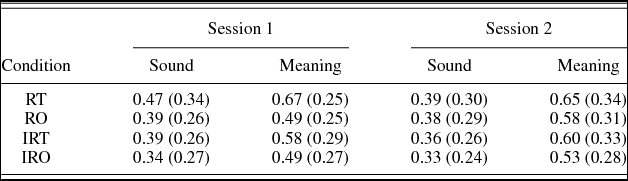
Note: RT, Regular phonetic, transparent semantic; RO, regular phonetic, opaque semantic; IRT, irregular phonetic, transparent semantic; IRO, irregular phonetic, opaque semantic.
Two-way repeated measures ANOVA (phonetic regularity: regular vs. irregular; semantic radical transparency: transparent vs. opaque) of the two-session combined data on meaning production suggested that the main effect of semantic radical transparency was significant, F (1, 33) = 28.84, p < .001, ηp2 = 0.46, the main effect of phonetic radical regularity was not significant, F (1, 33) = 3.19, p = .08, ηp2 = 0.08, and no interaction was found. The results showed that students were able to use semantic radicals to learn the meanings of new Chinese characters. It should be noted that there was a nonsignificant trend (p = .08) that regular phonetic radicals helped CFL learners to learn character meanings.
A similar two-way repeated measures ANOVA with the two-session combined sound performance found no significant phonetic radical regularity effect, F (1, 33) = 2.87, p = .09, ηp2 = 0.08, no significant semantic radical transparency effect, F (1, 33) = 3.12, p = .08, ηp2 = 0.08, or no interaction. There were nonsignificant trends that CFL students benefited from not only regular phonetic radicals but also transparent semantic radicals in learning the pronunciations of new characters. Taken together, the results suggest that beginning adolescent CFL learners are more able to use semantic radicals to learn character meanings, but are less able to utilize the phonetic clues to learn character pronunciations.
Figures 1 and 2 display the mean proportions accuracy of performance on meaning and pronunciation production over three trials in each condition. A 3 (learning trials: 1 vs. 2 vs. 3) × 2 (phonetic regularity: regular vs. irregular) × 2 (semantic radical transparency: transparent vs. opaque) repeated measures ANOVA was conducted for meaning and sound production performance, respectively. For the meaning recall, the results showed a significant interaction between semantic radical transparency and trial, F (2, 66) = 3.98, p = .02, ηp2 = 0.10, a significant main effect of semantic radical transparency, F (1, 33) = 28.86, p < .001, ηp2 = 0.46, a significant main effect of trial, F (2, 32) = 177.24, p < .001, ηp2 = 0.91, and a marginal significant main effect of phonetic radical regularity, F (1, 33) = 3.23, p = .08, ηp2 = 0.08. Simple effect analyses suggested that the semantic transparency effect was significant in the learning Trials 1 and 2 (ps < .05), but diminished in the learning Trial 3 when the performance approached a ceiling effect (p > .05). These results indicate an early adoption of the semantic radical strategies to learn the meanings of new characters.
Mean proportions accuracy of character orthography: semantics paired associate learning by trial and condition. RT, Regular phonetic radicals and transparent semantic radicals; RO, regular phonetic radicals and opaque semantic radicals; IRT, irregular phonetic radicals and transparent semantic radicals; IRO, irregular phonetic radicals and opaque semantic radicals.
Mean proportions accuracy of character orthography: pronunciation paired associate learning by trial and condition. RT, Regular phonetic radicals and transparent semantic radicals; RO, regular phonetic radicals and opaque semantic radicals; IRT, irregular phonetic radicals and transparent semantic radicals; IRO, irregular phonetic radicals and opaque semantic radicals.
For the sound recall, the results showed that the main effect of phonetic radical regularity was not significant, F (1, 33) = 3.06, p = .08, ηp2 = 0.08, and the main effect of trial was significant, F (2, 66) = 73.89, p < .001, ηp2 = 0.69. No significant main effect of semantic radical transparency, two-way or three-way interactions was found. Students learned the character sound rapidly over three trials. Again, there was a nonsignificant trend (p = .08) that students learned the pronunciations of new characters with regular phonetic radicals consistently better than those with irregular phonetic radicals.
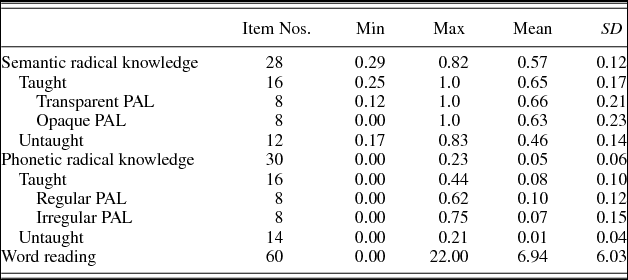
Table 4 presents the descriptive statistics of semantic and phonetic radical knowledge, and word reading measures. To examine whether the teaching of radicals prior to the PAL task was effective, semantic radical and phonetic radical knowledge performance were broken down into being taught versus untaught. Radicals being taught appeared as the components of the target characters in the PAL task. Paired-samples t tests showed that, students performed significantly better on the taught radicals than on the untaught radicals prior to the character learning task for both semantic and phonetic radical knowledge tests, t (33) = 4.99, p < .001; t (33) = 4.16, p < .001. However, the phonetic radical knowledge showed a floor effect. This suggests that the short and intensive teaching of phonetic radicals was not sufficient for beginning CFL learners to remember their pronunciations.
Descriptive statistics of radical knowledge and word reading measures
Note: PAL, Paired associate learning.
It is possible that the characters assigned opaque meanings and irregular pronunciations in the PAL task may provide misleading semantic or phonetic cues and would negatively affect the knowledge of the radicals appearing in the subsequent radical knowledge tests. To rule out such a possibility, the 16 taught semantic radicals were broken down into transparent and opaque PAL conditions and the 16 taught phonetic radicals were broken down into regular and irregular PAL conditions. Table 4 presents the descriptive statistics of proportion correct of the knowledge of the radicals that appeared in each of the four PAL conditions: transparent, opaque, regular, and irregular. A paired-samples t test found no significant difference in the semantic radical knowledge between radicals that appeared in the transparent and opaque PAL conditions, t (33) = 0.45, p > .05. No significant difference in the phonetic radical knowledge was found between radicals that appeared in the regular and irregular PAL conditions, t (33) = 0.90, p > .05. These results suggest that learning new characters that had opaque meanings and irregular sounds did not affect the performance of the subsequent radical knowledge tests.
Relationships among semantic and phonetic radical knowledge, paired associate character learning, and word reading
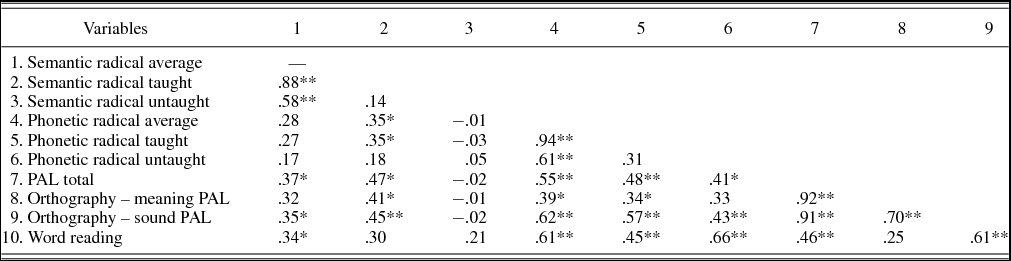
Table 5 displays the Pearson correlation coefficients among all measures. Semantic and phonetic radical knowledge was generally significantly associated with character learning. Specifically, knowledge of phonetic radicals, regardless of being taught or not taught before the PAL task, was significantly correlated with orthography–pronunciation PAL. Knowledge of semantic radicals taught before the PAL task was significantly associated with orthography–semantics PAL. These results suggest a facilitative role of radical knowledge in learning new characters in CFL learners.
Pearson correlation coefficients among measures (N =34)
Note: PAL, Paired associate learning.
*p < .05. **p < .01.
Orthography–pronunciation PAL and phonetic radical knowledge were significantly correlated with word reading. However, orthography–semantics PAL had no significant association with word reading in Chinese. These findings indicate the importance of learning orthography–phonology mappings in learning to read Chinese for nonnative Chinese learners.
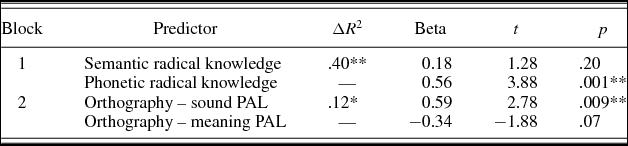
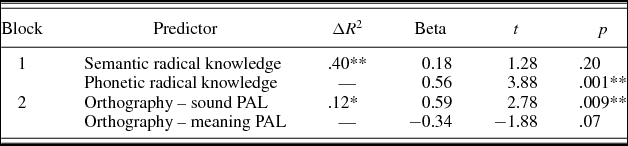
To further investigate whether orthography–phonology PAL plays a unique role in word reading beyond radical knowledge in beginning CFL students, hierarchical linear regression analyses were conducted. Results are summarized in Table 6. Semantic and phonetic radical knowledge were entered in the first block, followed by two PAL measures (total correct meaning items and total correct pronunciation recall) in the second block. Results showed that semantic and phonetic radical knowledge together explained a large proportion of variance (R 2 = .40) in word reading. Phonetic radical knowledge significantly predicted word reading (p < .01). Two processes of paired associate character learning (orthography–pronunciation, and orthography–semantics) made a significant contribution to word reading (R 2 = .12) after controlling for semantic and phonetic radical knowledge. Orthography–pronunciation PAL (total correct sound items) made a strong and unique contribution to word reading (p < .05) beyond semantic and phonetic radical knowledge. Altogether, these results suggest that, similar to the findings in alphabetic languages, the ability to associate orthography with phonology is particularly important for the word recognition skills in beginning learners of CFL.
Hierarchical linear regression predicting word reading from semantic and phonetic radical knowledge, and character learning
Note: PAL, Paired associate learning.
*p < .05. **p < .01.
DISCUSSION
The major finding of the current study is that beginning nonnative learners of Chinese can use transparent semantic radicals to learn the meanings of new characters, and they are less able to use regular phonetic radicals to learn the pronunciations of new characters. Consistent with the developmental pattern in Chinese children (Ho, Ng, et al., Reference Ho, Ng and Ng2003) and previous findings with CFL learners with varying levels of Chinese proficiency (Wang et al., Reference Wang, Liu and Perfetti2004; Williams, Reference Williams2013), a predominant use of implicit semantic strategies rather than phonological strategies in character learning was found in beginning CFL learners. It is worth noting that, without explicit teaching of the function of semantic radicals or probing, beginning CFL learners spontaneously used the semantic radical strategy in early learning trials, and the semantic transparency effect disappeared in the third trial. This finding is discrepant from Wang et al. (Reference Wang, Liu and Perfetti2004), who found that beginning Chinese learners had difficulty in making use of the functional cue of the known semantic radicals without probing.
The better use of semantic properties than phonological properties of radicals obtained in the current study can be explained in several ways. First, semantic radicals are more visually distinct and more reliable than phonetic radicals in the Chinese writing system (Ho, Ng, et al., Reference Ho, Ng and Ng2003; Shen & Ke, Reference Shen and Ke2007). Shu et al. (Reference Shu, Chen, Anderson, Wu and Xuan2003) suggests that the semantic cueing function of the semantic radical in a Chinese character is stronger than the phonological cueing function of the phonetic radical. Semantic radicals are typically high transparency, high frequency, and have a large family size. There are about 200 semantic radicals and 800 phonetic radicals in Chinese (Hoosain, Reference Hoosain1991). Therefore, it may be easier for Chinese learners to learn the abstract rules of orthography–semantics correspondences than orthography–pronunciation mappings. In contrast, the predictive accuracy of the pronunciation of a compound character from its phonetic radical is about 39%, while the predictive accuracy of a character meaning from its semantic radical is about 58% (Shu et al., Reference Shu, Chen, Anderson, Wu and Xuan2003). Therefore, it is reasonable that Chinese learners rely more on sematic radicals than on phonetic radicals in learning new characters.
Second, the better performance on orthography–semantics PAL than orthography–pronunciation PAL in the current study can be explained by the dual coding theory (Sadoski & Paivio, Reference Sadoski and Paivio2013). Because each character was presented with a novel picture, a verbal code (a short oral description of the character meaning) and a nonverbal code (the picture) have addictive effects on the meanings recall of new characters and the nonverbal code may be mnemonically stronger or contribute more to the additive effect than the verbal code, but students had only one verbal code (orally presented character pronunciation) to learn the pronunciations of new characters. However, the imaginability of pictures is less likely to affect the results because the same picture appears in four learning conditions in the counterbalanced design. Third, beginning CFL learners have limited character knowledge and understanding of the function of phonetic radicals. Their semantic strategies or implicit knowledge of semantic radicals are better developed than their phonological strategies or knowledge of phonetic radicals.
A novel finding of the current study is that not only phonological properties but also semantic information plays a role in learning to read Chinese characters among nonnative Chinese speakers. Despite the nonsignificant effects, there was a trend that CFL learners learned to read regular and transparent characters more successfully than irregular and opaque characters. The effect sizes of the phonetic regularity and semantic transparency in pronunciation recall were the same (ηp2 = 0.08). According to Plaut et al.'s (Reference Plaut, McClelland, Seidenberg and Patterson1996) triangle model of reading aloud, when encountering a written word, readers may take a phonological pathway (orthography–phonology [OP]) or a semantic pathway (orthography–semantic–phonology) to generate the phonological representation of the word. The extent to which semantics play a role in word reading will depend on the properties (e.g., print–sound consistency) of the words themselves. Because the OP mappings are sufficient for the regular words, semantics may have little aid in word reading. However, when OP mappings are less efficient for irregular words, semantics will have a greater opportunity to influence the word naming process via the orthography–semantic–phonology route, which will result in a larger semantic effect for irregular words than for regular words. Similar to previous research involving beginning readers in English (Duff & Hulme, Reference Duff and Hulme2012; Nilsen & Bourassa, Reference Nilsen and Bourassa2008), no interaction between phonetic regularity and semantic transparency was found in learning to read characters in beginning nonnative Chinese learners. Phonological and semantic properties have additive effects on character reading for beginning readers because the OP connections are inefficient, and thus semantics always have the potential to support the learning of both regular and irregular words (Nilsen & Bourassa, Reference Nilsen and Bourassa2008). This is particularly true in learning to read Chinese because OP mappings are more complex and less regular in Chinese, and Chinese CFL learners have difficulties learning character orthography–phonology associations as shown in the present study.
One limitation of the current study is the insufficient teaching of phonetic radicals and the floor effect of the phonetic radical knowledge. Given a larger sample size and more intensive instruction of phonetic radicals, the phonetic regularity effect on learning to read characters may approach significance. Future study should include CFL learners with varying levels of Chinese proficiency, and see if the current patterns hold true or if there is an interaction between semantic transparency and phonological regularity in learning to read characters. Because the orthography–phonology mappings are on a continuum, future research should include semiregular characters in the character learning task and see if CFL learners can use partial information to learn the pronunciations of new characters.
Contradictory with Taft and Chung's (Reference Taft and Chung1999) view that knowing the pronunciation of a phonetic radical is likely to be more of a distraction than an advantage in learning the character that contains it, the current study found a facilitation trend of regular phonetic radicals in learning to read new characters. Knowledge of phonetic radicals, regardless of being taught or not taught prior to the PAL task, was significantly correlated with orthography–pronunciation PAL. Knowing phonetic radicals turns out to be an advantage, rather than a disadvantage, in learning to read new characters. Knowledge of semantic radicals taught before the PAL task was also significantly associated with orthography–semantics PAL. These findings suggest that beginning Chinese learners implicitly use radicals in learning character meanings.
Orthography–pronunciation PAL played a more important role in Chinese word reading than did orthography–semantics PAL. Orthography–pronunciation PAL and phonetic radical knowledge were significantly correlated with word reading. However, orthography–semantics PAL had no significant association with word reading in Chinese. Orthography–pronunciation PAL made a unique and significant contribution to word reading beyond semantic and phonetic radical knowledge. One possible explanation of this strong link is the overlapping phonological processing demands in visual–verbal PAL and word reading. However, previous research suggests that the link between visual–verbal PAL and word reading can be explained by the creation of lexical connections between written words and their pronunciations in memory (Ehri, Reference Ehri2005; Perfetti, Reference Perfetti2007), but not the shared phonological processes (Windfuhr & Snowling, Reference Windfuhr and Snowling2001) or a general-purpose associative learning process (Hulme et al., Reference Hulme, Goetz, Gooch, Adams and Snowling2007). Thus, PAL appears to tap a basic mechanism in learning to read Chinese.
Taken together, the correlational findings are consistent with the literature in alphabetic languages and support the view that learning orthography to phonology mappings is an important skill for developing word recognition in reading, especially at the early stages of learning to read (Hulme et al., Reference Hulme, Goetz, Gooch, Adams and Snowling2007). The findings extend the previous evidence of the importance of phonological form learning in alphabetic languages to Chinese, a nonalphabetic and orthographically nontransparent language. The findings also go beyond previous research with native Chinese speakers by showing the prominence of PAL ability in learning Chinese as a second language.
To summarize, the current study demonstrates a facilitative role of semantic radicals in learning the meanings of new characters and suggests the importance of phonetic radical knowledge and character orthography–pronunciation PAL in Chinese word reading in beginning CFL learners. The additive effects of phonological regularity and semantics transparency on character reading suggest that beginning Chinese learners establish parallel connections between orthography and phonology and between orthography and semantics. The results provide important insights into the processes involved in learning to read Chinese as a foreign language.
The findings yield implications for curriculum development and instructional practices in teaching Chinese as a second language. First, Chinese reading instruction should build on nonnative learners’ strength of semantic strategies. Organizing characters by groups that share a semantic radical is an effective way to minimize memory load for Chinese learners (Marton, Tse, & Cheung, Reference Marton, Tse and Cheung2010). Second, although beginning learners of Chinese have underdeveloped phonological strategies in character learning and phonology information in Chinese is relatively unreliable, the teacher can teach simple and high-frequency characters or radicals, then explicitly teach the positional constraints and function of these radicals, and encourage educated guesses of pronunciations and reinforce visual–verbal association strategies when encountering new compound characters. Stimulating learners’ sensitivity to radicals via explicit instruction of the positional constraints and function of semantic and phonetic radicals is a promising approach to enhance learning strategy and interest in learning Chinese as a second language.
ACKNOWLEDGMENTS
We thank the participating school, students, and parents. We also thank the undergraduates from the Chinese Flagship Program at Western Kentucky University for their assistance in data collection and data entry. This research project was supported by a grant from the Western Kentucky University Office of Research (to J.Z.).