Introduction
Understanding what influences older adults’ perceived wellbeing is an increasingly important topic for low- and middle-income countries (LMICs) (Ralston et al., Reference Ralston, Schatz, Naidoo and Kowal2017). South Africa's population over age 65 is projected to nearly triple between 2020 and 2060, making it one of the fastest ageing countries in the region (United Nations, 2015). The South African government, like many other LMIC governments, is beginning to recognise the need to help this population ‘age well’, including enhancing individuals’ subjective wellbeing (Muldoon et al., Reference Muldoon, Barger, Flory and Manuck1998; Jivraj et al., Reference Jivraj, Nazroo, Vanhoutte and Chandola2013). The context in which older persons age influences their ability to age well (Hughes and Waite, Reference Hughes and Waite2002). For older adults who do not ‘age’ in an institutional setting but in households, as is true for the majority of Black South Africans, this context includes regular interactions with family, which may have a positive effect or may increase stress, underscoring the need for more research to understand better if and how such arrangements impact older Black South Africans’ perceived quality of life.
The World Health Organization (WHO) defines quality of life as ‘the individual's perception of their position in life in the context of the culture and value systems in which they live and in relation to their goals, expectations, standards and concerns’ (WHOQoL Group, 1993). The link between older adults’ perceived quality of life and their living arrangements could be understood through the lens of social roles that they play in the household. The relationship may also change with age as older adults’ ability to complete activities of daily living and to conduct care-work for others within the household declines. Studies of living arrangements and quality of life among older persons in LMICs are limited, perhaps in part due to an assumption that perceived quality of life only gains importance once economic needs are met (Steptoe et al., Reference Steptoe, Deaton and Stone2015). Most research on living arrangements of older adults assumes multigenerational households are homogeneous and beneficial (Silverstein and Giarrusso, Reference Silverstein and Giarrusso2010). In addition, studies lack a gendered lens when considering the influence of living arrangements on wellbeing, which is particularly problematic in LMICs given the gendered division of labour within households (Cliggett, Reference Cliggett2005; Schatz and Seeley, Reference Schatz and Seeley2015). Descriptive studies have highlighted the patterns of living arrangements in South Africa (Bongaarts and Zimmer, Reference Bongaarts and Zimmer2002; Zimmer and Dayton, Reference Zimmer and Dayton2003, Reference Zimmer and Dayton2005; Kautz et al., Reference Kautz, Bendavid, Bhattacharya and Miller2010; Zimmer and Das, Reference Zimmer and Das2014; Schatz et al., Reference Schatz, Madhavan, Collinson, Gómez-Olivé and Ralston2015), yet the literature is missing studies examining the influence of living arrangements on quality of life.
We focus on three questions in this paper: (a) Are older persons’ living arrangements associated with their perceived quality of life? (b) Does this relationship differ by sex? (c) Does age moderate the relationship between living arrangements and quality of life similarly for men and women? We use longitudinal census data from the Agincourt Health and Socio-Demographic Surveillance Site (HDSS) and survey data from the WHO Study of Global Ageing and Adult Health Survey (WHO-SAGE). In earlier work from the same site, Schatz et al. (Reference Schatz, Madhavan, Collinson, Gómez-Olivé and Ralston2015) developed a typology of older persons’ living arrangements based on the generational make-up of households. A key feature of this typology is that the types include both single-generational and multiple-generational arrangements. Employing this typology, we are able to provide a more nuanced picture of the relationship between older South Africans’ living arrangements and perceived quality of life.
Background
Households are an important social environment for older adults, where interpersonal and intergenerational dynamics influence and are influenced by social roles, norms, histories and emotions, and serve as a context for the exchange of financial and social support (Hughes and Waite, Reference Hughes and Waite2002; Hoffman, Reference Hoffman2003). In South Africa, older adults commonly live with dependent children and/or with grandchildren in multigenerational arrangements (Hosegood and Timaes, Reference Hosegood and Timaes2005). As a result of spiritual and cultural beliefs that dominate Black South African society, there is an expectation of intergenerational support and interaction (Hoffman, Reference Hoffman2003). Older adults have an expectation of being taken care of by family members quite often in the context of co-residential living arrangements (Aboderin and Hoffman, Reference Aboderin and Hoffman2015), but there is evidence that intergenerational co-residence may not always be possible or desirable (Cliggett, Reference Cliggett2005; Madhavan et al., Reference Madhavan, Schatz and Collinson2017).
Living arrangements are heterogeneous in terms of composition and the resources and assistance they provide for and ask from older persons. The practice and patterns of interdependency and reciprocity may play out differently based on household generational make-up (Schatz et al., Reference Schatz, Madhavan, Collinson, Gómez-Olivé and Ralston2015). Parker and Short (Reference Parker and Short2009) call for work in sub-Saharan Africa to move beyond looking at headship as a defining factor of living arrangements, instead assessing how intergenerational components impact members’ wellbeing. In households where an older person's adult children are present, the older person may be in a more dependent role, being taken care of by other household members, regardless of disability status. This relationship may shift, however, if the adult children are not working or if they need assistance from the older person with care-work for their children (Schatz et al., Reference Schatz, Madhavan, Collinson, Gómez-Olivé and Ralston2015). In these latter cases, as well as when adult children are missing but young children are present (skipped generation) or the household is comprised of only older individuals (single generation), older persons are likely to be important productive members of the household, providing the household and its members with resources and physical assistance (Case and Menendez, Reference Case and Menendez2007; Schatz et al., Reference Schatz, Madhavan, Collinson, Gómez-Olivé and Ralston2015).
Most studies do not differentiate among different types of multigenerational households and primarily draw comparisons of older adults living alone with those living with family, which may not be nuanced enough to capture variation in care-giving and support, and may not reflect cultural norms (for an exception from Asia, see Samanta et al., Reference Samanta, Chen and Vanneman2015). To date, multigenerational households have largely been viewed as homogeneous (Silverstein and Giarrusso, Reference Silverstein and Giarrusso2010), and little attention has been paid to how different configurations may affect perceptions of wellbeing. The heterogeneity of multigenerational living arrangements, and the implications of them, are essential to unpacking wellbeing and quality of life among older persons.
Living arrangements and perceived quality of life
Results from research examining the impact of living arrangements on wellbeing remain mixed depending on place, group and the measure of wellbeing that is used (Hays, Reference Hays2002). Because norms related to living with adult children differ greatly across LMICs (Bongaarts and Zimmer, Reference Bongaarts and Zimmer2002), it would be expected that there is variation in the effects of living arrangements on older persons’ perceived quality of life. Chen and Short (Reference Chen and Short2008) found that living alone is associated with lower subjective wellbeing and co-residence with a child's spouse is associated with higher subjective wellbeing in China. Among South Korean elderly (age 65 or older) with physical disabilities, those living with a spouse reported better life satisfaction than those living with others or living alone (Kim et al., Reference Kim, Hong and Kim2014). Additional evidence from Korea also shows significantly better physical health status, self-esteem and family support among those who live with family compared to those who live alone (Sok and Yun, Reference Sok and Yun2011).
A limited number of studies in Africa have investigated the relationship between living arrangements and health and wellbeing. With a sample spanning 15 countries across sub-Saharan Africa, McKinnon et al. (Reference McKinnon, Harper and Moore2013) found older adults reported a higher prevalence of depressive symptoms when they were living in single-generation households compared to multigenerational households, but there was no reporting difference for skipped-generation households compared to multigenerational households. Møller (Reference Møller1998) suggests, in a review of survey research from South Africa, that smaller but still multigenerational households are associated with better quality of life for older adults due to increased economic and social support. A study in rural Tanzania did not find age composition of a household influenced older adults’ quality of life (Mwanyangala et al., Reference Mwanyangala, Mayombana, Urassa, Charles, Mahutanga, Abdullah and Nathan2010). Our previous work suggests that older people living in single-generation and complex-linked multigenerational households are likely to be involved more in physical and emotional labour for members of the household and themselves (Schatz et al., Reference Schatz, Madhavan, Collinson, Gómez-Olivé and Ralston2015) and that these positions do not change much over time (Madhavan et al., Reference Madhavan, Schatz and Collinson2017). Further, our previous work also found that older persons in single-generation and complex-linked multigenerational households report higher levels of disability (Schatz et al., Reference Schatz, Ralston, Madhavan, Gómez-Olivé and Collinson2018). In this paper, we examine the relationship between the living arrangements and respondents’ perceived quality of life. Based on the literature outlined above, we hypothesise that:
• Hypothesis 1: Older persons in single-generation and complex-linked multigenerational arrangements will report lower perceived quality of life than older persons living in linear-linked arrangements.
Age and perceived quality of life
Extant research suggests that reports of quality of life change with age and that living arrangements may moderate this relationship. Two studies from LMICs suggest a negative relationship between perceived quality of life and age (Chen, Reference Chen2001; Deaton, Reference Deaton2008). A national study of older South Africans shows a negative relationship between age and quality of life; however, when controlling for a set of household characteristics, the relationship became non-significant (Ralston et al., Reference Ralston, Schatz, Naidoo and Kowal2017). A study of care-givers in Nairobi, Kenya suggests that persons in early old age (fifties and sixties) may be able to perform expected household tasks but in advanced old age (70+) poor health may prevent them from performing tasks, and that the ability to perform tasks influences older adults’ quality of life (Mudege and Ezeh, Reference Mudege and Ezeh2009). Therefore, the household environment in which the older person lives, and expectation to complete household tasks, may influence the relationship between quality of life and age. The household environment in which people age, the social roles expected of them and their desire/ability to fulfil those roles may be a pathway shaping older persons’ perceived quality of life. As age increases, older persons’ abilities generally decline, which may lead to role strain, i.e. not being able to complete expected roles in productive arrangements, which in turn may lead to lower perceived quality of life. Therefore, we hypothesise:
• Hypothesis 2: Age will have a moderating effect between living arrangements and perceived quality of life.
Gender and social roles within the household
Social roles within households – frequently gendered – are created through relationships with other household members. Whether a person is reliant upon others or provides assistance to others depends on their own resources, the needs of others in their household and the composition of the household (Schatz and Seeley, Reference Schatz and Seeley2015; Schatz et al., Reference Schatz, Ralston, Madhavan, Gómez-Olivé and Collinson2018). Their satisfaction with their roles, among other factors, is likely to be reflected in reports of quality of life. Moreover, given the existing literature showing the importance of an individual's sex in terms of both living arrangements (Oppong, Reference Oppong2006; Calasanti, Reference Calasanti2010; Schatz et al., Reference Schatz, Madhavan, Collinson, Gómez-Olivé and Ralston2015; Madhavan et al., Reference Madhavan, Schatz and Collinson2017) and quality of life (Gómez-Olivé et al., Reference Gómez-Olivé, Thorogood, Clark, Kahn and Tollman2010; Nyirenda et al., Reference Nyirenda, Chatterji, Falkingham, Mutevedzi, Hosegood, Evandrou, Kowal and Newell2012; Schatz et al., Reference Schatz, Gómez-Olivé, Ralston, Menken and Tollman2012), it is essential to focus in on how sex, as expressed through older adults’ gendered social roles within households, influences perceived quality of life.
A study of Demographic and Health Survey data from 22 African countries shows that HIV is impacting household living arrangements by potentially decreasing older adults’ familial support, while increasing their co-residence with children and others for whom they likely provide care (Kautz et al., Reference Kautz, Bendavid, Bhattacharya and Miller2010). This places more older adults, particularly women, in potentially productive roles in the household. A person's gender often determines their role in their household, particularly in the division of labour for care-work and being a ‘breadwinner’ (Schatz and Seeley, Reference Schatz and Seeley2015). The burdens related to care-giving and financial responsibilities are increasingly being shouldered by older populations due to shifting family roles (Schatz and Ogunmefun, Reference Schatz and Ogunmefun2007; Bohman et al., Reference Bohman, van Wyk and Ekman2011). Westaway et al. (Reference Westaway, Olorunju and Rai2007) investigated the relationship between two life-evaluation measures, happiness and quality of life, in a sample of 710 older South Africans. They found that care-giving responsibilities negatively affect quality of life and happiness. They found older adults living in households where they have care-giving responsibilities were likely to report lower quality of life compared to older adults living in households where they have none. The ability to fulfil these needs and the experience of trying to meet them may be felt differently by older men and women (Calasanti, Reference Calasanti2010).
Research has suggested that because older men do not gain the skills to perform tasks in the household at younger ages, they are at a greater disadvantage in older age when they have to perform household chores (Mudege and Ezeh, Reference Mudege and Ezeh2009). Limited research has documented the influence of care-giving in later life on men. Research from Nairobi, Kenya found older male care-givers were significantly more likely to report worse disability and worse health compared to male non-care-givers (Chepngeno-Langat et al., Reference Chepngeno-Langat, Madise, Evandrou and Falkingham2011). The authors posit a variation in coping strategies, citing that men less frequently seek support from networks in the way their female counterparts do. Men who are care-givers may also may feel additional strain as they are not able to live up to the societal expectations while experiencing care-giver burden (Mudege and Ezeh, Reference Mudege and Ezeh2009; Chepngeno-Langat et al., Reference Chepngeno-Langat, Madise, Evandrou and Falkingham2011). Gendered social norms suggest while these men struggle, it is women who conduct more of the physical and emotional care-work in the household. Recent qualitative research reveals that when thinking about the burdens they face in daily living in South Africa, older women described their emotional states using the terms worry and sadness (Bohman et al., Reference Bohman, van Wyk and Ekman2011; Schatz and Gilbert, Reference Schatz and Gilbert2012). Given these gender dynamics, we hypothesise:
• Hypothesis 3: Women's perceived quality of life will be more impacted by living arrangements than men's.
Data and methods
We use two longitudinal data sources collected in rural South Africa – the Agincourt HDSS census and WHO-SAGE survey. The Agincourt HDSS census, run by the Medical Research Council/University of the Witwatersrand Rural Public Health and Health Transitions Research Unit, has collected data prospectively, annually, since 1992 from households in the Agincourt sub-district. As of 2010, the site covered 27 villages – approximately 15,600 households and 89,000 individuals. In 2006 and 2010, in addition to the census, an abbreviated WHO-SAGE survey focused on older persons’ health and wellbeing was conducted in the site with individuals aged 50 and older. In 2006, 4,085 Agincourt HDSS residents aged 50+ completed the WHO-SAGE questionnaire (response rate of about 65%; for more details of the 2006 sample and data collection, see Gómez-Olivé et al., Reference Gómez-Olivé, Thorogood, Clark, Kahn and Tollman2010). In 2010, the survey was conducted a second time; the response rate was about 60 per cent, with only 0.4 per cent refusing, 35 per cent were not found, 4 per cent ineligible and 1.6 per cent had died since the previous survey. The resulting 2010 sample was 5,980 individuals age 50+; our final analytical sample for 2010 is 5,779, accounting for missing information. The longitudinal sub-sample, those who were interviewed as part of the WHO-SAGE in both 2006 and 2010, included 2,613 individuals. We match the 2010 sample and 2006 sample to the AHDSS to provide information on older persons’ living arrangements, nationality, education and socio-economic status (SES). About a quarter of each WHO-SAGE sample were male and three-quarters female. This skewed distribution is due to high male labour migration, even at older ages, and women's greater life expectancy in the site (Kahn et al., Reference Kahn, Garenne, Collinson and Tollman2007).
Variables
The dependent variable is a WHO constructed composite measure of perceived quality of life (WHO-QoL). The measure is based on eight questions (each on a five-point Likert scale) referring to the four broad domains of quality of life, including satisfaction with one's physical, psychological, social and environmental circumstances (Schmidt et al., Reference Schmidt, Mühlan and Power2006). The individual questions investigated whether respondents felt they had enough energy for daily life, enough money to meet needs, their satisfaction with health and self, ability to perform daily activities, personal relationships, condition of living space and overall quality of life. The measure is converted to a 0–100 scale with a higher score indicating a higher reported quality of life (α = 0.84). The 2006 WHO-QoL variable (used as a control) is dichotomised: those in the bottom two WHO-QoL score quintiles are classified as having ‘poor quality of life’ (Gómez-Olivé et al., Reference Gómez-Olivé, Thorogood, Clark, Kahn and Tollman2010).
Our primary explanatory variable is household living arrangements. This variable is constructed using household relationship codes related to the household head to generate five living arrangement categories (Schatz et al., Reference Schatz, Madhavan, Collinson, Gómez-Olivé and Ralston2015). Single-generation households capture older persons living alone, couples and siblings living together. Two-generation households include households with a married or single older household head living with their children, step-children, or a younger household head living with their parents. Households with three or more generations living together are disaggregated into linear-linked multigenerational, complex-linked multigenerational and other. Linear-linked arrangements include households in which there is a married couple of the ages 15–49, the traditional productive working age, and there is no break in the generations. This category is capturing the ‘traditional’ extended family of grandparents, parents and children. Complex-linked multigenerational arrangements include households with an older head, their unmarried children and/or fostered/orphaned grandchildren, or configurations that include an older person in a household with a younger head, their siblings, nieces/nephews and/or aunts/uncles and/or (parents/daughters/sons)-in-law. Also included in this category are ‘skipped-generation’ households (middle generation is missing). The other category captures all the remaining types of living arrangements that are too small to comprise categories on their own (Schatz et al., Reference Schatz, Madhavan, Collinson, Gómez-Olivé and Ralston2015). We are particularly interested in how the relationship between WHO-QoL and living arrangements varies by sex and age. Age is measured as a continuous variable and sex is coded as female = 1 and male = 0.
The control variables include individuals’ education level and self-identified nationality, and household size and household SES. Education, which is limited in this population, is categorised as no formal education or some education (reference group). About a third of the population in Agincourt is of Mozambican-origin (Kahn et al., Reference Kahn, Collinson, Gómez-Olivé, Mokoena, Twine, Mee, Afolabi, Clark, Kabudula, Khosa, Khoza, Shabangu, Silaule, Tibane, Wagner, Garenne, Clark and Tollman2012), so South African captures self-identification as South African = 1 or Mozambican = 0. While a range of household sizes in all but the single generation category is revealed in the descriptive analysis, we do not include household size in the regression analyses as it is correlated with living arrangements. The SES variable is a household asset score derived through principal component factor analysis of 34 variables collected in 2009 (including information about the type and size of dwelling, access to water and electrical appliances, livestock owned and transport available) (Houle et al., Reference Houle, Stein, Kahn, Madhavan, Collinson, Tollman and Clark2013).
Analysis
We first present descriptive statistics of the 2010 sample. We then show differences in living arrangements by sex, before assessing mean quality of life score and mean age by living arrangements separately for women and men. We conduct t-tests to assess difference of means. Next, we examine whether a relationship between quality of life and living arrangements remains in single-sex ordinary least-squares (OLS) regression models with and without individual and household control variables, clustering by household. The regression tables display unstandardised and standardised regression coefficients and robust standard errors. We report results from models with linear-linked multigenerational arrangements as the reference category because we see this as the ‘ideal’ for ageing South Africans, as in this arrangement older persons are most likely to be taken care of by other household members (Schatz et al., Reference Schatz, Madhavan, Collinson, Gómez-Olivé and Ralston2015, Reference Schatz, Ralston, Madhavan, Gómez-Olivé and Collinson2018). We test for interaction effects between age and living arrangements in the separate models for men and women, and report significant interactions. In the 2010 sample, we only found significant age interactions for women but not men.
Finally, we assess and control for possible endogeneity between quality of life and living arrangements with an analysis of the 2006 and 2010 longitudinal sub-sample. We control for past quality of life and key individual and household covariates. Previous research shows significant stability (over half) of older persons remaining in the same living arrangement over time, and of those who move, a quarter are lost to follow-up (Madhavan et al., Reference Madhavan, Schatz and Collinson2017), indicating fixed-effects modelling would not yield more information.Footnote 1
Results
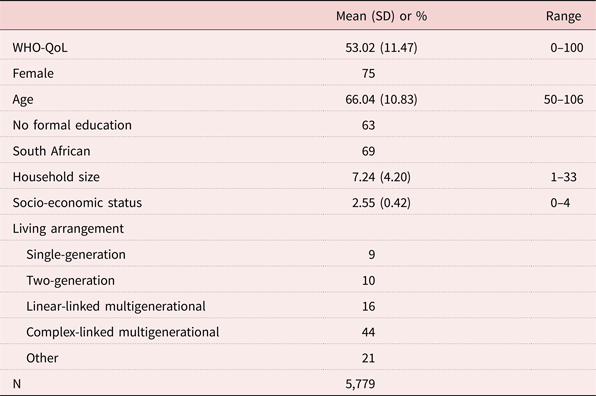
Table 1 shows descriptive statistics for our sample of adults aged 50+ . The mean quality of life score is about 53 with a standard deviation of 11.47, which is lower than the average score of 67.8 found from the national WHO-SAGE conducted in 2007 (He et al., Reference He, Muenchrath and Kowal2012; Phaswana-Mafuya et al., Reference Phaswana-Mafuya, Peltzer, Schneider, Makiwane, Zuma, Ramlagan, Tabane, Davids, Mbelle, Matseke and Phaweni2012). Overall, the sample is majority female (75%), with no formal education (63%) and South African (69%). The overall mean household size is about seven persons with a range of 1–33 household members. The average age of the sample is 66 years with a range of 50–106. Over 40 per cent (44%) of the sample live in complex-linked multigenerational arrangements, and another 9% of older persons live in single-generation arrangements, signalling that the majority of older persons live in arrangements where they likely contribute to households’ care-work and/or financial needs. Ten per cent of older persons live in two-generation arrangements, another 16 per cent live in linear-linked multigenerational arrangements; in these two arrangements, older adults are theorised to be more likely receiving than providing care.
Descriptive statistics for persons aged 50+ in 20101

Notes: 1. Information about respondents sex, age, nationality, household size, socio-economic status and living arrangements comes from the Agincourt Health and Socio-Demographic Surveillance System (HDSS) census and perceived quality of life (WHO-QoL) comes from the World Health Organization Study of Global Ageing and Adult Health Survey (WHO-SAGE). SD: standard deviation.
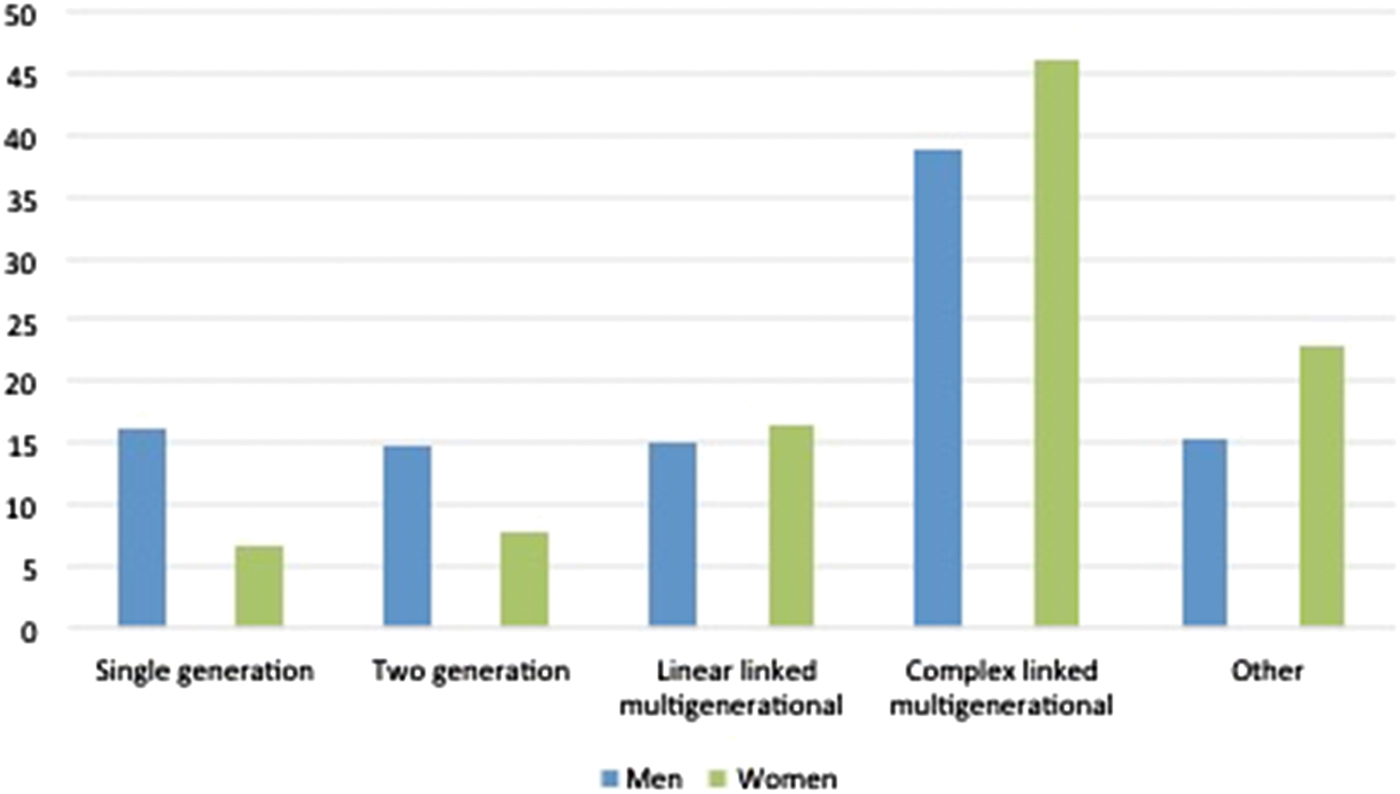
Figure 1 shows the distribution of living arrangements in our sample separately for men and women. More men live in single-generation and two-generation arrangements compared to women (16.2% versus 6.8%, and 14.7 versus 7.8%, respectively). About 15% of men and women live in linear-linked multigenerational arrangements (15.0% versus 16.4%). While complex-linked multigenerational arrangements are the most prevalent among men and women, a lower percentage of men (38.9%) than women (46.1%) live in this type of arrangement. There is a significant difference between men and women for all living arrangements except for linear-linked multigenerational arrangements.
Percentage of older people (50+) by living arrangement and sex.

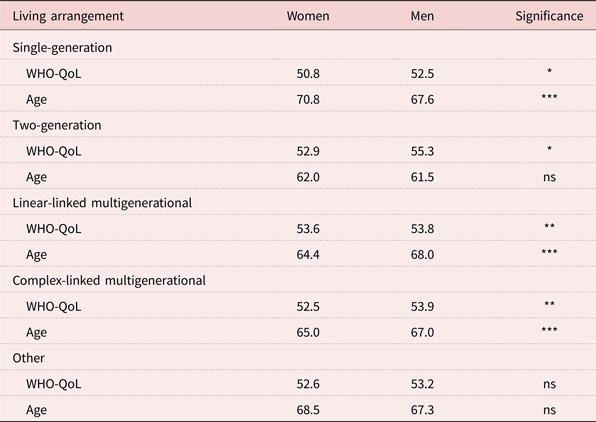
Table 2 shows within living arrangement categories the average quality of life score and mean age by sex. We test for statistical differences by sex for mean WHO-QoL and for age within the same type of living arrangement. We find statistically significant differences between men and women in quality of life within each of the four main living arrangement categories. Women in all living arrangements report the same or lower quality of life than men: women report worse quality of life in single-generation arrangements (50.8 versus 52.5) and in two-generation arrangements (52.9 versus 55.3). The difference is small in complex-linked multigenerational arrangements, but women reported lower quality of life than men (52.4 versus 53.9). Only in linear-linked multigenerational arrangements are the reports about the same (53.6 versus 53.8). The difference in mean age is statistically significant between men and women for single-generation, linear-linked and complex-linked multigenerational arrangements. In single-generation arrangements, women are on average older than men; in all other living arrangements, on average women are younger than men.
Mean quality of life score (WHO-QoL) and age by living arrangement for women and men separately aged 50+ in 20101

Note: 1. The sample for this table includes all 2010 Agincourt Health and Socio-Demographic Surveillance System (HDSS) and World Health Organization Study of Global Ageing and Adult Health Survey (WHO-SAGE) respondents.
Significance levels: * p < 0.05, ** p < 0.01, *** p < 0.001, ns: not significant (differences in mean between men and women from one-tailed t-test).
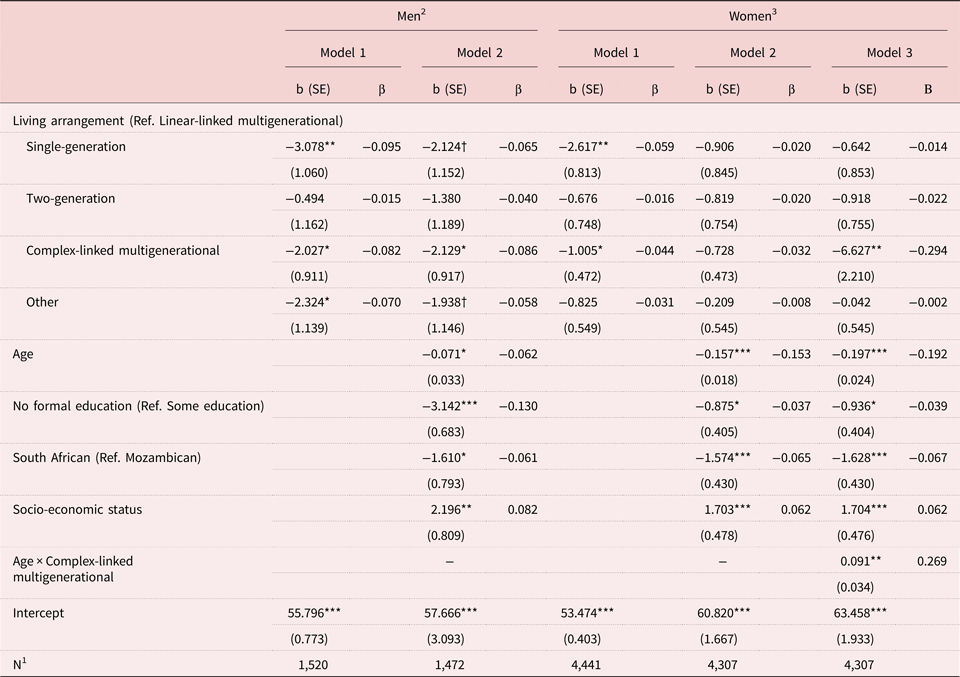
Table 3 shows results for OLS regression of living arrangements (and individual and household controls) on quality of life for men and women separately, clustering by household. Model 1 includes living arrangements only; Model 2 adds in individual and household-level controls. For women, we include a third model that adds an interaction term between age and complex-linked multigenerational arrangements, which is significant. For men, Model 1 shows that living in a single-generation, complex-linked multigenerational or other arrangements compared to a linear-linked multigenerational arrangement is associated with reporting significantly lower quality of life. As shown in Model 2, older age, being poor, having no education and being South African are associated with significantly lower reported quality of life among men. A one-unit increase in SES is associated with a 2.196 increase in men's reported quality of life. Including the individual and household controls in Model 2 slightly diminishes the effects of living arrangements found in Model 1, but the significant effect of men living in complex-linked multigenerational arrangements reporting lower quality of life than those in linear-linked multigenerational arrangements remains (p < 0.05).
Regression models for quality of life for women and men separately aged 50+ in 20101

Notes: SE: robust standard error. Ref.: reference category. 1. Agincourt Health and Socio-Demographic Surveillance System (HDSS) and World Health Organization Study of Global Ageing and Adult Health Survey (WHO-SAGE). 2. The original sample of 1,520 for men was reduced due to missing data on several variables including education and socio-economic status. 3. The original sample of 4,441 for women was reduced due to missing data on several variables including education and socio-economic status.
Significance levels: † p < 0.1, * p < 0.05, ** p < 0.01, *** p < 0.001.
Next, we turn our attention to the women in the sample. The living arrangement effects are muted for women compared to men. Women in single-generation (2.6 points lower) and complex-linked multigenerational arrangements report quality of life 1.0 point lower than those in linear-linked multigenerational arrangements in the bivariate model; however, this effect is no longer significant when individual and household controls are included in Model 2. Similar to the men, women's older age, having no education, having a lower SES and being South African are associated with significantly lower reported quality of life.
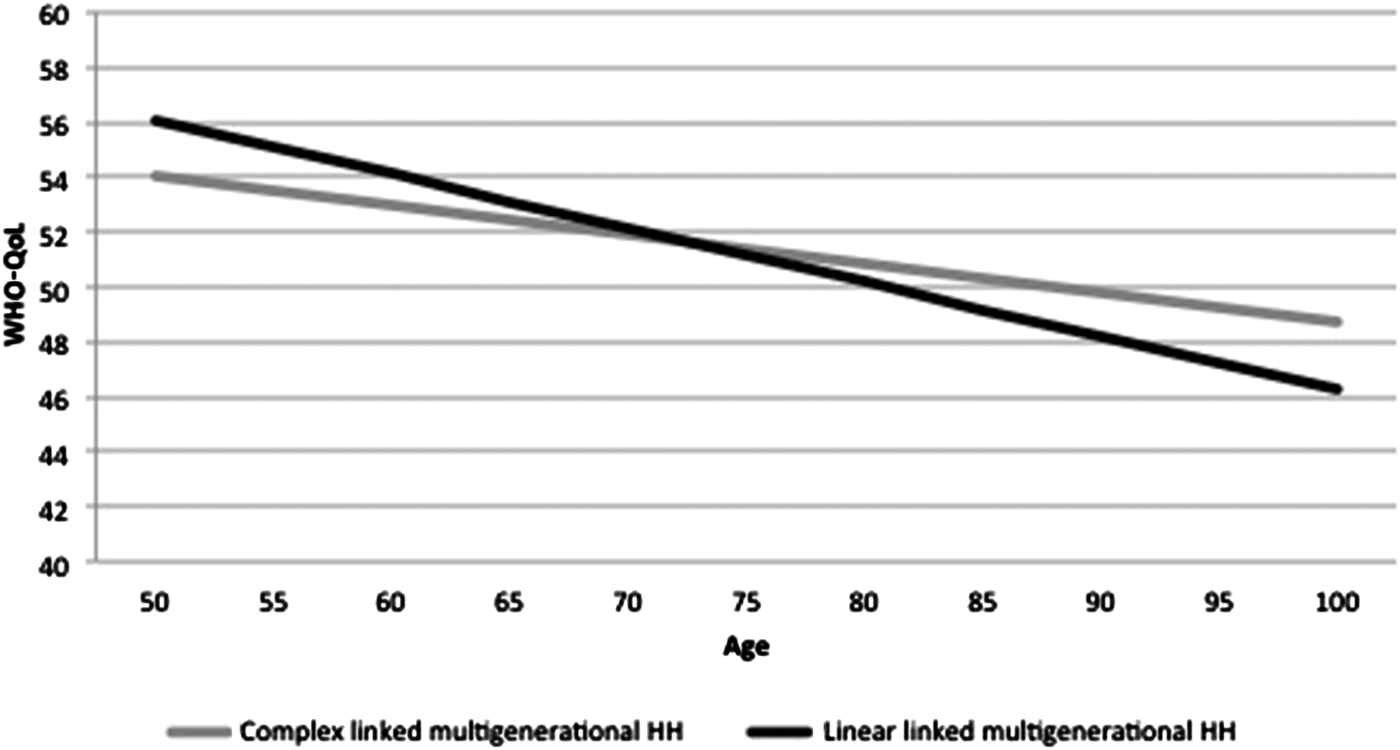
Model 3 shows a significant interaction between age and complex-linked multigenerational arrangements for women. The interaction is depicted in Figure 2. The interaction was confirmed using a Wald's test (F(3, 4,172) = 27.65; Prob > F = 0.0001) signifying a difference in slope for women living in complex-linked multigenerational arrangements compared to linear-linked multigenerational arrangements. Women's quality of life scores decrease as they age in both types of multigenerational arrangements; however, the slope for linear-linked multigenerational arrangements is much steeper compared to complex-linked mutigenerational arrangements. At younger ages, women in linear-linked arrangements report higher quality of life scores than women living in complex-linked arrangements. At age 50, women living in linear-linked arrangements are predicted to have a quality of life score of 56.1, while those living in complex-linked arrangements are predicted to have a slightly lower score of 54. Women in linear-linked arrangements continue to have a higher quality of life score than women living in complex-linked arrangements until about age 75, at which point the score is almost equal (51.4 complex versus 51.2 linear). Among the oldest women, those living in complex-linked arrangements report higher quality of life than those living in linear-linked arrangements. As women age, their reported quality of life decreases – the decrease is sharper for women living in linear-linked arrangements than complex-linked arrangements. The difference in quality of life score for women from age 50 to age 95 in complex-linked arrangements is 4.7 points, whereas it is 8.9 points for women living in linear-linked arrangements.
Predicted values of perceived quality of life scores for women by living arrangement and age.

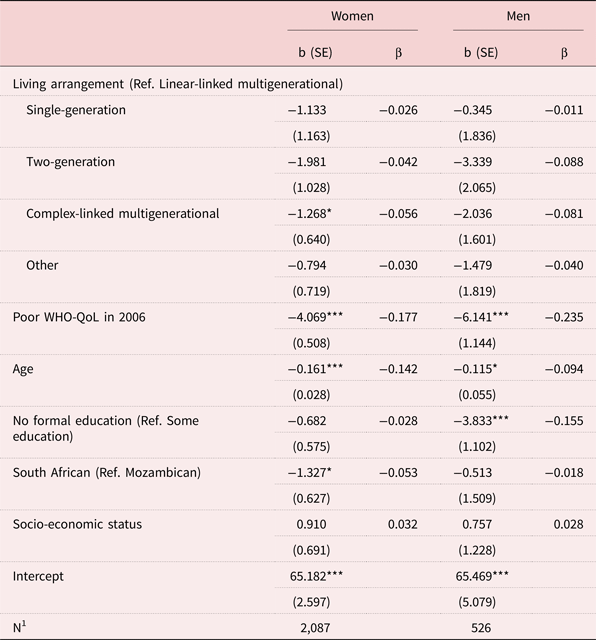
Finally, Table 4 presents regression results for the longitudinal sub-sample, which includes perceived quality of life information from 2006 and 2010, with separate models for men and women. This analysis tests for possible endogeneity between living arrangements and quality of life, while controlling for key individual and household-level controls. This sub-sample regression analysis shows that women living in complex-linked arrangements as compared to linear-linked arrangements report lower quality of life, even when controlling for past quality of life and key covariates. Additionally, the moderation between age and complex-linked arrangements remains for women when controlling for past quality of life (model not shown). For men, no differences between living arrangements and quality of life remain significant when controlling for past quality of life and key covariates. Table 4 shows that while past quality of life was a significant predictor of current quality of life, an important and significant relationship between living arrangements and quality of life remains for women.
Regression models for 2010 quality of life for women and men separately, aged 50+Footnote 1

Notes: SE: robust standard error. Ref.: reference category. WHO-QoL: World Health Organization measure of perceived quality of life. 1. Longitudinal sub-sample 2006/2010, Agincourt Health and Socio-Demographic Surveillance System (HDSS) and World Health Organization Study of Global Ageing and Adult Health Survey (WHO-SAGE).
Significance levels: * p < 0.05, *** p < 0.001.
Summary of results
In summary, we find support for our first hypothesis and partial support for Hypotheses 2 and 3. Older persons in single-generation and complex-linked multigenerational arrangements report lower quality of life than older persons living in two-generation or linear-linked multigenerational arrangements. We found this to be true for both men and women in the 2010 data; however, when controlling for past quality of life (in 2006), the result remains significant only for women. Although we did not find a significant sex and living arrangement interaction, we found that women report lower quality of life than men, and there are significant differences in men's and women's living arrangements. Finally, we found age to have a moderating effect between living arrangements and quality of life for women, but not for men.
Discussion
The increased rate of population ageing in LMICs has led to amplified scholarly interest into older adults’ living arrangements (Silverstein and Giarrusso, Reference Silverstein and Giarrusso2010), with a new recognition of the need for research in diverse populations. Using quality longitudinal data from rural South Africa, we have augmented the literature exploring the relationship between living arrangements and older adults’ reported quality of life. In this paper, we provide evidence that older persons’ living arrangements are related to their reported quality of life; however, this differs by sex and by age.
First we asked, ‘Are older persons’ living arrangements associated with their reported quality of life?’ We provide evidence that for both men and women, there are net positive effects of living in a linear-linked multigenerational arrangement when controlling for important individual and household covariates. Yet, this relationship remains significant only for women when controlling for past quality of life status. In addition, the relationship changes with age. South Africa is a collective society where multigenerational arrangements are preferred for ageing (Møller, Reference Møller1998); however, we find the type of multigenerational arrangement that is beneficial to older persons’ quality of life differs based on age and sex.
Second, we asked ‘does the relationship differ by sex?’ In many HIV-endemic settings, older persons, women in particular, take on care-giving roles related to HIV in their networks of adult children, or fostered or orphaned grandchildren (Parker and Short, Reference Parker and Short2009; Schatz and Seeley, Reference Schatz and Seeley2015); thus, several studies have considered the relationship between care-work and quality of life. For example, Nyirenda (Reference Nyirenda2014) found that older persons who reported care-giving activities reported worse emotional wellbeing than non-care-givers. The care-givers in this study were primarily women, reflecting the gendered social roles leading to the expectations of women to take on more care-work than men (Schatz and Seeley, Reference Schatz and Seeley2015). The gendered expectation of care might may be why, after controlling for past quality of life, the effects of living arrangements only held for women and not men.
Lastly, we asked ‘Does age moderate the relationship between living arrangements and quality of life similarly for men and women?’ Older persons in our sample report lower quality of life than younger individuals. This matches past studies of subjective wellbeing and age in LMICs. Unlike in high-income countries, where the relationship is U-shaped, in LMICs the relationship between life satisfaction and age has been found to be negative (Deaton, Reference Deaton2008). However, we find that older women in linear-linked multigenerational arrangements begin reporting worse quality of life soon after turning 75, compared to women living in complex-linked multigenerational arrangements who begin reporting worse quality of life at earlier ages. We not only find that the influence of living arrangements on quality of life is different for men and women, we also find that the relationship changes in advanced age for women in a way that it does not for men. This might say something about women being taken care of in their old age or the connection between care networks and perceptions of health and wellbeing. Women may have an advantage in older age as they have most likely perform care-work throughout their lives, unlike their male counterparts (Mudege and Ezeh, Reference Mudege and Ezeh2009). This relationship may be explained by the significant bivariate relationship between household size and quality of life. Both men and women report higher quality of life in larger households. This might help to explain the significant interaction between age and complex-linked multigenerational arrangements for women. These arrangements are on average larger than linear-linked arrangements; therefore, at advanced ages (75+) older women in larger households may have access to more assistance and resources to help with activities of daily living, thus resulting in reports of better quality of life. Therefore, this research adds to the debate of the relationship between age and subjective wellbeing and reinforces recent research that posits that subjective wellbeing needs to be understood in ecological terms (Cramm et al., Reference Cramm, Møller and Nieboer2012; Ralston, Reference Ralston2018) and this includes the household environments.
Our results demonstrate that the impact of living arrangements on older adults’ quality of life must be understood in terms of the society's cultural context. Our findings may be applicable to other LMICs where older adults do not traditionally live in institutional care facilities but rather families are primarily responsible for care. In high-income settings, the expectation may be to live with a partner or alone as independence is valued when ageing. However, rural populations in South Africa align more with notions of a collective society and therefore linear-linked multigenerational arrangements, or other multigenerational arrangements, may be preferred as individuals age (Møller, Reference Møller1998; Aboderin and Hoffman, Reference Aboderin and Hoffman2015). However, as HIV/AIDS has hollowed the middle generation, it presents a barrier to older adults living in the ‘ideal’ living arrangement and is impacting older adults’ quality of life (Schatz and Gilbert, Reference Schatz and Gilbert2012). Moreover, this demand for care often initiates a drastic disruption in older persons’ living arrangements, resulting in widespread consequences ranging from crowded sleeping arrangements, abandoned gardens (sources of supplemental nutrition), selling off personal property, and a negative impact on social engagement and relationships – particularly marital relations for which prolonged absences related to care-giving were straining, infusing them with misunderstanding and distrust (Ssengonzi, Reference Ssengonzi2009). Moreover, HIV-related care-giving appears to result in a perceived cost to the emotional, physical and psychological health of elderly care-givers (Schatz and Seeley, Reference Schatz and Seeley2015; Ssengonzi, Reference Ssengonzi2009). This is much different from work focused on the family in the United States of America that highlights these multigenerational households wherein both children and parents are adults resulting in relationships that have, in later life, become more like ‘friendships’ (Blieszner and Mancini, Reference Blieszner and Mancini1987), or instances when children report a role-reversal wherein they have become the primary caretakers of their parents (Fischer, Reference Fischer, Peterson and Quadagno1985).
Individuals in our rural sample reported an average quality of life score of 53, which is lower than the national score of 67.8. In the national WHO-SAGE study, rural individuals in both Ghana and South Africa on average reported poorer quality of life than urban individuals (He et al., Reference He, Muenchrath and Kowal2012). Additionally, recent research posits that perceived quality of life assessments are influenced by contextual or environmental factors (Ralston, Reference Ralston2018), which may explain the lower quality of life score in this rural setting. In addition, our individual and household controls were in line with previous research. However, interestingly we found that South Africans report lower quality of life compared to Mozambicans. Previous studies from Agincourt have not found nationality to be a significant predictor of quality of life (Gómez-Olivé et al., Reference Gómez-Olivé, Thorogood, Clark, Kahn and Tollman2010; Schatz et al., Reference Schatz, Gómez-Olivé, Ralston, Menken and Tollman2012). One might expect South Africans to report better quality of life than Mozambicans because on average in our data South Africans have better SES; however, recent research has shown that SES may not be a prevailing indicator of subjective wellbeing (Lloyd-Sherlock and Agrawal, Reference Lloyd-Sherlock and Agrawal2014). Our findings could be a result of comparison groups – older South Africans in this setting may see themselves as worse off than other South Africans, whereas older Mozambicans may see themselves better off than other Mozambicans.
This research does have limitations. Although we attempt to address possible selection bias by controlling for past quality of life using a longitudinal sub-sample, it is still likely that we have not fully addressed this issue. We cannot determine the direction of causality; it is possible that quality of life determines living arrangements rather than living arrangements impacting quality of life. Also, we are limited by our smaller sample of men but have partially addressed this by running analyses separately by sex.
The influence of living arrangements on the quality of life of older adults in LMICs is an important area of research. Quality of life is not only a concern in high-income countries but also in LMICs, and older adults in LMICs face a unique set of challenges that may impact their quality of life. Living arrangements, as a measure of the composition of households, highlights how these configurations might help some members and burden others. Particularly for a region impacted by HIV, the flow of resources between generations seems to be a reversal of what is seen in places where the disease is absent, with resources continuing to flow downwards even at older ages (Case and Deaton, Reference Case and Deaton1998; Duflo, Reference Duflo2003).
We conclude that not all multigenerational arrangements positively influence older adults’ reported quality of life, in part due to expectations and roles within households. The results suggest the necessity to understand how older adults’ expectations for and ability to receive and provide care change with age and influence how they view their quality of life. Future research should include qualitative interviews to investigate older adults’ social roles in different types of living arrangements, and how these map to perceptions of quality of life. Understanding the flow of resources between older adults and other household members in terms of care, and financial and emotional support, may be other key factors influencing older adults’ perceived quality of life. Finally, understanding more about who older adults use as their comparison group, and how that impacts their reported quality of life in LMICs, is an important question to explore in future work. In addition, studies that examine the determinants of quality of life for the oldest old (aged 75+) in LMICs are needed. As Chen and Short (Reference Chen and Short2008) alluded to in their study of older Chinese persons, the relationship between quality of life and living arrangements is influenced by societal norms and context. More work is needed to understand the societal and family contexts and the influences they have on older persons’ quality of life in African and other LMIC contexts (McGregor and Sumner, Reference McGregor and Sumner2009; Pritchett, Reference Pritchett2010; Kroll, Reference Kroll2015).