


1 Introduction
Old English (OE) conjunct clauses (i.e. main clauses introduced by a coordinating conjunction, mostly and ‘and’ and ac ‘but’) have an unclear status in the syntactic accounts of the language. On the one hand, some older studies claim that OE conjunct clauses resemble subordinate clauses in their visible preference for the V-final (VF) order (Mitchell Reference Mitchell1985: §1685; Traugott Reference Traugott and Hogg1992: 277). On the other hand, Bech (Reference Bech2001, Reference Bech2017) quite convincingly shows that the proportion of VF clauses among OE conjuncts is actually relatively small. Nevertheless, it is true that the VF order is more frequent in conjunct than in ordinary main clauses, and the reasons for this phenomenon are not entirely clear. Bech (Reference Bech2012) proposes a pragmatic or functional explanation: VF conjunct and non-conjunct main clauses appear in a similar set of discourse contexts; they attract similar verb types and the end-weight principle has an impact on their use. Since Bech's (Reference Bech2012) study is based on a relatively small sample of 214 VF clauses from 9 OE texts, and her discourse analysis is based on 87 VF clauses from The Anglo-Saxon Chronicle and Orosius, this interesting theory calls for more data support. Zimmermann (Reference Zimmermann2017) proposes a syntactic analysis of VF conjunct clauses, claiming that OE coordinating conjunctions could sometimes occupy the same syntactic position as subordinating conjunctions, which blocks verb movement and results in the VF order, but his study does not aim to answer the question why and and ac would behave in two different ways (sometimes being pure logical connectors, and sometimes functioning as complementisers), and what factors influenced this variation. The only variable that Zimmermann (Reference Zimmermann2017) identifies as significant is diachrony, since VF conjunct clauses are more frequent in early OE texts, but Cichosz (Reference Cichosz2021) shows that this result is skewed by Latin influence since early OE VF conjuncts are largely restricted to two translations, i.e. Bede's Historia Ecclesiastica and Orosius’ Historiae adversus paganos. Nevertheless, even though Latin influence must be an important factor inflating the frequency of the pattern, VF conjuncts are also found in non-translated texts so foreign transfer cannot be the only explanation for the phenomenon in OE syntax in general.
All in all, the current state of research offers two interpretations of the syntactic status of OE conjunct clauses: Bech's (Reference Bech2001, Reference Bech2012, Reference Bech2017) studies suggest they should be treated as main clauses because coordination simply corresponds to the discourse functions performed by VF main clauses in general, while Zimmermann (Reference Zimmermann2017), following earlier studies such as Mitchell (Reference Mitchell1985: §1685) or Traugott (Reference Traugott and Hogg1992: 277), interprets VF conjuncts as syntactically subordinate, with pragmatic factors, if present, playing a secondary role in the variation. Naturally, these two perspectives, distinct as they sound, are not mutually exclusive since the complexity of OE word and constituent order is known to be the result of an interplay between syntax and information structure (e.g. Taylor & Pintzuk Reference Taylor and Pintzuk2012; van Kemenade & Westergaard Reference Kemenade and Westergaard2012). Nonetheless, even if we assume that the clause-final position of the finite verb in OE conjunct clauses is neither completely dependent on pragmatic factors nor purely syntax-based, it is still important to determine whether OE VF conjunct clauses should be seen as a subtype of main or subordinate clauses.
The aim of this study is to analyse available corpus data in order to establish whether VF conjunct clauses are closer to VF main or VF subordinate clauses. The examination focuses on a few variables identified as significant in this respect on the basis of smaller-scale corpus investigations (verb weight, verb type, discourse function). In addition, the analysis explores the possibility of syntactic priming as the mechanism underlying the frequent use of the VF order in OE conjunct clauses, which makes it possible to explain the seemingly random distribution of the structure in the corpus of OE prose.
2 OE conjunct clauses and the V-final order
The fact that OE main and subordinate clauses show different constituent order tendencies is well known and discussed in numerous studies of OE syntax (Mitchell Reference Mitchell1985; van Kemenade Reference Kemenade1987; Pintzuk Reference Pintzuk1999; Fischer et al. Reference Fischer, van Kemenade, Koopman and van der Wurff2000; Ringe & Taylor Reference Ringe and Taylor2015). In general, OE has been compared to modern West Germanic V2 languages: ‘Whereas main clauses often have word orders that are reminiscent of the Verb Second (V2) property, subordinate clauses have frequent verb-final orders’ (Haeberli & Ihsane Reference Haeberli and Ihsane2016: 502). After many years of thorough, data-driven research we know that the resemblance of OE to its modern Germanic cousins is limited since the OE V2 has its specificity (van Kemenade & Westergaard Reference Kemenade and Westergaard2012), and it is not impossible to find a VF main clause in OE: even though the pattern is ‘generally on the low side’ (Ringe & Taylor Reference Ringe and Taylor2015: 406), its frequency ‘is much higher than previously acknowledged’ (Pintzuk & Haeberli Reference Pintzuk and Haeberli2008: 367). Nevertheless, the asymmetry between main and subordinate clauses is an established fact. What we do not know, however, is the place of OE conjunct clauses in this dichotomy.
Fischer et al. (Reference Fischer, van Kemenade, Koopman and van der Wurff2000: 53) report that ‘although a small number of main clauses have no Verb-Second … the number of coordinate main clauses lacking it is far greater (even ones starting with a topic) and they often have the verb-final orders usually associated with subordinate clauses’. Recently, however, Bech's (Reference Bech2017: 5) investigation of the entire YCOE corpus of OE prose has shown that ‘conjunct clauses are more frequently verb-final than main clauses are, but that is different from saying that they are frequently verb-final’ (in her study only 11 per cent of OE conjunct clauses are reported to be VF). According to Bech's earlier small-scale study (Reference Bech2012: 74–5), there are four factors promoting the use of VF in OE main declarative clauses, including conjuncts:
• Information structure: In VF main clauses the subject usually conveys given information, though it is not necessarily pronominal.
• Weight: Heavy verbs are often placed clause-finally; around 37 per cent of verbs in Bech's sample of VF (SXV) clauses have three syllables, while the result for SVX clauses is only 4.5 per cent.
• Verb type: Verbs in VF (SXV) clauses are punctual rather than durative and copula verbs are rare, while in SVX clauses they constitute around 40 per cent of the sample.
• Discourse function: While ‘no clear contrast between word orders has been found’ (Bech Reference Bech2012: 82), VF clauses mostly fulfil a coordinating discourse function, i.e. they operate ‘on the main level of the text hierarchy’ (Bech Reference Bech2012: 67).
In short, Bech (Reference Bech2012) suggests no difference between main and conjunct clauses in their use of VF. If we take Bech's (Reference Bech2017) larger quantitative data as the basis for the whole discussion, the difference between main non-conjunct and conjunct clauses in OE is indeed small enough for such an interpretation to be plausible. Nonetheless, the difference may be more substantial if the VF order is defined in a different way, and there are great discrepancies in the definitions of the VF order between scholars working within various theoretical frameworks, which have an impact on the interpretation of the data.
On the one hand, there are numerous studies which do not assume the existence of any derivational processes, following the what-you-see-is-what-you-get approach observed, for instance, by Construction Grammar (Goldberg Reference Goldberg2006). For such linguists a VF clause simply has a finite verb in the absolute clause-final position. This, however, is often not enough since such VF clauses are often very short and composed of relatively light constituents, as in (1). Therefore, usually there are some additional criteria, e.g. for Mitchell (Reference Mitchell1985: §3911), who writes about S…V instead of VF, noting that it is sometimes called ‘the subordinate order’, the element intervening between the subject and the verb must be a nominal object, a nominal or adjectival complement or a participle or infinitive, and it definitely cannot be a personal pronoun (Mitchell Reference Mitchell1985: §3916). Thus, clauses qualifying as VF would be like (2), where a nominal object is placed between the subject and the verb, and (3), where an infinitive is the intervening phrase.

For descriptive studies, the starting point for any additional restrictions, though, is the presence of a verb at the end of the clause. This is also the basis for the investigations of Bech (Reference Bech2001, Reference Bech2012, Reference Bech2017), who – while recognising the problem of defining the VF order – decided to follow Mitchell's (Reference Mitchell1985) definitions of element order patterns to make her results comparable to older descriptive studies. Interestingly, since the subject is an obligatory element of Mitchell's (Reference Mitchell1985) VF (SXV), this approach automatically excludes clauses without overt subjects such as (4), even if they contain relatively heavy elements. This decision may be problematic for the analysis of conjunct clauses, where subjects are regularly omitted. I will come back to this issue in section 4.1.
Generative studies, on the other hand, aim to establish the underlying structure of the OE clause, and derivational process are at the heart of the analysis. According to numerous formal studies of OE syntax, OE was a mixed OV/VO (or head-initial/head-final) language, with some of the surface orders derived from the former and some from the latter underlying structure (Pintzuk Reference Pintzuk1999, Reference Pintzuk2005; Fuß & Trips Reference Fuß and Trips2002). As a result, scholars working within the generative framework focus on constituent orders which may be used as a diagnostic for an underlying OV or VO structure, and many attested patterns turn out to be ambiguous, i.e. they may be derived by various possible movement processes from either base. Thus, the result is that in the generative approach the only clear diagnostic for an underlying VF (OV, head-final) order is represented by (3), where a non-finite verb form immediately precedes a finite verb form. The alternative arrangement, however, is not a diagnostic for a head-initial structure since it may be derived from a VF base by means of verb-raising (van Kemenade Reference Kemenade1987), which clusters two verb forms as in (5), or its variant, known as verb-projection raising (Pintzuk Reference Pintzuk1996), which affects the whole verb phrase, e.g. a non-finite verb and its object as in (6). Even though these processes are optional in OE subordinate clauses (Haeberli & Pintzuk Reference Haeberli, Pintzuk, Jonas, Whitman and Garrett2012), they do account for a large amount of data.

The problem is that for generative linguists (5) and (6) may be interpreted as VF structures, while in a descriptive study they would never be treated as such. Next, it should be noted that generative accounts do take into consideration clauses with simple VPs, but the identification of head-final structures is assumed to be ‘more difficult’ there (Ringe & Taylor Reference Ringe and Taylor2015: 406). Zimmermann (Reference Zimmermann2017) includes in his study SXV clauses with an intervening VP-constituent such as a non-pronominal object, a non-finite verb or a particle. For Pintzuk (Reference Pintzuk1999, Reference Pintzuk2005), any clause with at least two heavy pre-verbal constituents is considered VF, which indicates that (4) could safely be treated as such even though it does not contain an overt subject. Since a large number of OE conjunct clauses lack overt subjects, this approach will also be followed in this study, as explained in detail in the following section.
In short, OE conjunct clauses are viewed differently by different scholars, and the discussion becomes quite complicated as a result of the differences in our understanding of VF. This study aims to provide data which would be convincing to linguists working within different theoretical frameworks, testing the closeness between conjunct and main as well as conjunct and subordinate clauses in their use of the VF order.
3 Study design
The aim of the study is to determine whether OE VF conjunct clauses bear closer affinity to VF subordinate or VF main clauses. Thus, the first hypothesis tested in this study is that despite their atypical constituent order, VF conjuncts are still a subtype of main clauses. This would entail that in both conjunct and non-conjunct main clauses the clause-final placement of the verb should be seen as a pragmatic device, signalling continuation in discourse, and since conjunct clauses are particularly well suited for this purpose, it is natural that they follow this order more willingly than non-conjunct main clauses. If this hypothesis holds, we should be able to observe a clear functional consistency of VF conjunct and main clauses, their collocability with similar verbs and verb types, and a similar impact of weight on the verb's position in the clause.
The other hypothesis to be tested is that VF order of conjunct clauses is a signal of their syntactic subordination, which entails closeness between VF conjunct and subordinate clauses. For this hypothesis to hold, the functional resemblance of VF conjuncts to VF main clauses should be limited or (perhaps) inconsistent, VF conjunct clauses should attract all sorts of verbs and verb types (or at least the same verbs and verb types as VF subordinate clauses), and the clause-final placement of the verb should be relatively insensitive to weight (or sensitive to the same degree as in subordinate clauses).
In order to determine which of these two hypotheses finds more support in the textual data, the study focuses on VF and non-VF main, conjunct and subordinate clauses extracted from the syntactically annotated York–Toronto–Helsinki Parsed Corpus of Old English Prose (YCOE, Taylor et al. Reference Taylor, Warner, Pintzuk and Beths2003). The queries were written in CorpusStudio (Komen Reference Komen2009) using Xquery and executed on xml versions of YCOE psd files. Next, the results, annotated for a number of features crucial for the analysis, were imported into a CESAX database (Komen Reference Komen2011), which made it possible to filter them according to numerous variables discussed below.
Since it is impossible to come up with a unified treatment of VF and non-VF clauses with simple and complex VPs, the study is based on the more numerous and more evenly distributed clauses with simple VPs (initial searches revealed 784 VF conjunct clauses with simple VPs, rather evenly distributed among different texts, and 501 V-Aux conjuncts, 187 (37 per cent) of which are found in only two texts, Bede and Orosius). In order to make the results as convincing as possible, at least two heavy elements preceding the clause-final verb were necessary to treat the clause with a single VP as unambiguously VF. In this study, four types of heavy elements were selected: a nominal subject (an NP with a noun, in most cases modified by some pronouns and/or adjectives), a nominal object (the same restriction), a prepositional phrase (governing an NP with a noun) or a non-light adverb (short and frequent adverbs, such as ða ‘then’, ðær ‘there’, eac ‘also’, eft ‘again’, na ‘not at all’, swa ‘so’, þonne ‘then’, þider ‘thither’, þanon ‘thence’, ðus ‘thus’, nu ‘now’ and þeah ‘though’, were excluded). Therefore, if a clause contained a nominal subject, it was enough for it to have a nominal object or a non-light adverb preceding the clause-final verb to qualify for the study. Naturally, some other elements could also appear in the clause. Examples (7) and (8) are representative of a VF conjunct clause with a nominal subject considered in this study.

In the case of clauses with pronominal and null subjects, two of the three possible heavy phrases had to precede the clause-final verb, as in (9) and (10).

If the same elements were present in the clause, but the verb was not placed in the clause-final position, the clauses were classified as non-VF, as in (11)–(13) featuring a nominal subject, a pronominal subject and a null subject respectively.

The results returned were filtered and divided into clause types (main, conjunct, subordinate) and two competing orders: VF or non-VF. In the case of clauses with nominal subjects, the study focuses on the variation between SXV and SVX (X being defined as a heavy constituent), while in clauses with null and pronominal subjects it is about the variation between (S)XXV and (S)VXX/(S)XVX. Other (minor) subject types (e.g. demonstratives and other pronouns) were not taken into account.
Among VF clauses I also included those which fulfilled all of the abovementioned conditions but the clause-final verb was immediately followed by a subordinate clause, such as (14). The logic behind this decision was that no variation was possible in such a case; the subordinate clause could not be placed anywhere else.

After manual inspection of the results, a number of conjuncts with ne ‘nor’ were identified in the study sample. Since they are not clearly associated with ac- and and-conjuncts in the literature of the subject, they have also been excluded from the study sample.
All in all, the methodological approach followed in the study design was very restrictive since the idea behind this analysis is to provide data that would be useful and convincing to scholars working within different theoretical frameworks.
4 Results
4.1 Corpus distribution
As shown in table 1 based on the whole YCOE corpus, the quantitative data confirm that while conjunct clauses differ from main clauses in their stronger preference for VF, in subordinate clauses this order is still twice as frequent.
General results for clauses with simple VPs

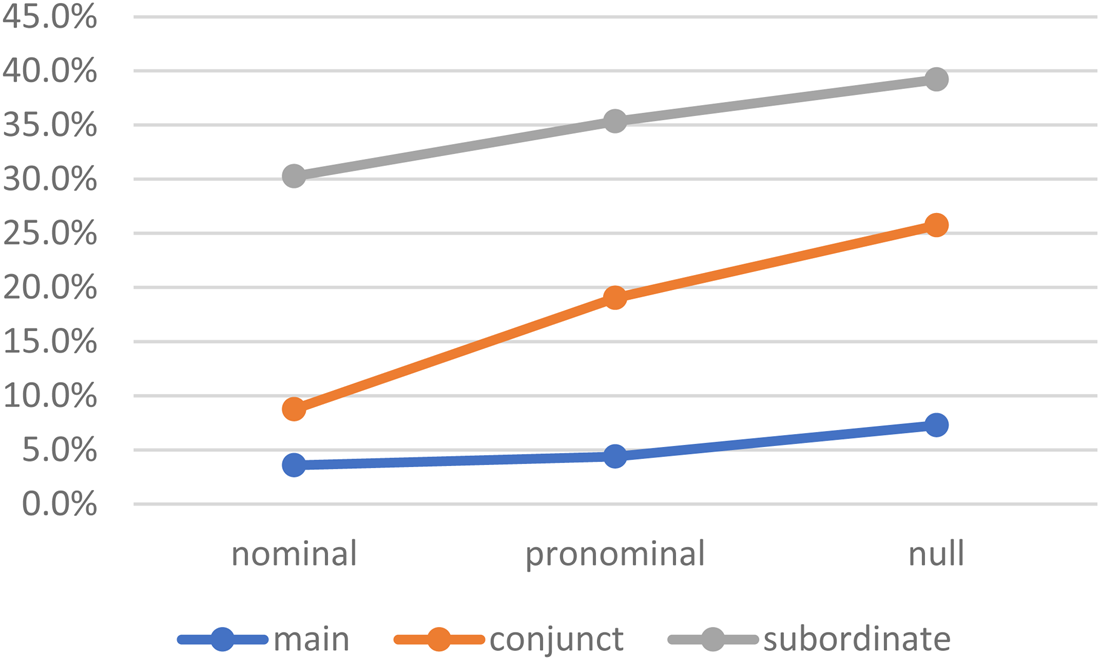
The tendency is similar for all the three subject types taken into account in the study (tables 2a–2c), but it is interesting to observe that conjunct clauses are rather close to main clauses when the subject is nominal (4% vs 9%), when it is pronominal the tendency for VF increases to 19 per cent, while in clauses with null subjects it soars up to 26 per cent.Footnote 3
General results for clauses with nominal subjects

General results for clauses with pronominal subjects

General results for clauses with null subjects

While it is true that the frequency of VF is highest with null subjects for all three clause types (see figure 1), the difference is most pronounced with conjunct clauses.Footnote 4
The proportion of VF in clauses with different subject types
All in all, the specific syntactic behaviour of conjunct clauses, placing them somewhere between ordinary main and subordinate clauses, is confirmed by the numbers. Interestingly enough, in some texts conjuncts are very close to subordinate clauses; see table 3. For instance in Bede, VF is present in 47 per cent of conjunct clauses and 54 per cent of subordinate clauses, while the Vercelli Homilies show practically no difference between the clause types, though the frequency of the VF order is generally on the low side (18% vs 19%).
Proportion of the VF order in conjunct, main and subordinate clauses in the longest YCOE texts (clauses with simple VPs)
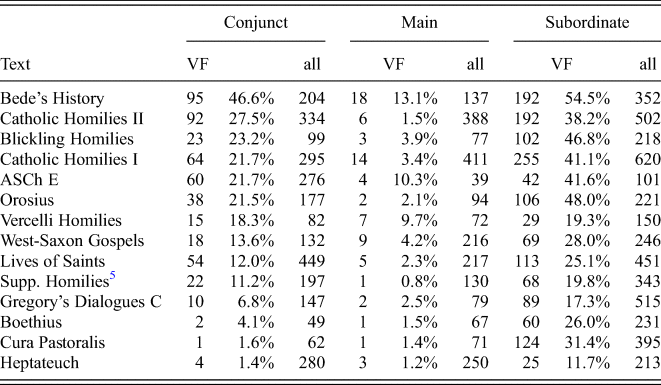
In most texts conjuncts are clearly between main and subordinate clauses. In some other texts, however, conjunct clauses are extremely close to main clauses, as e.g. in the Heptateuch and Cura Pastoralis (around 1–2 per cent of VF for both clause types). Thus, whatever the motivation for the use of the VF order in conjunct clauses, it cannot be universal but rather text-specific since this pattern was clearly avoided by some OE writers and translators.
The following sections present the impact of weight, lexical tendencies and the place of VF clauses in a larger context.
4.2 Weight
For Bech (Reference Bech2012), weight of the verb is one of the crucial factors promoting the use of the VF order in main and conjunct clauses, and weight in general is recognised as an important variable influencing word and constituent order in OE (Mitchell Reference Mitchell1985; Pintzuk & Taylor Reference Pintzuk, Taylor, van Kemenade and Los2006). Table 4 shows that length of the finite verb (measured in number of characters) has a very clear impact on the order of clauses regardless of clause type.
The average length of the finite verb in all the analysed groups of clauses

It turns out that in VF main, conjunct and subordinate clauses the verb is visibly longer than in non-VF contexts, and this difference (though relatively largest in main and smallest in subordinate clauses) proves statistically significant in all three cases (independent samples T-Test, p<0.001). Thus, even though Bech's (Reference Bech2012) observation is confirmed beyond any doubt, it does not help us decide whether VF conjunct clauses are closer to VF main or to VF subordinate clauses since subordinates follow the same tendency as main clauses, placing the finite verb at the end more eagerly if the verb is relatively heavy. Examples (15)–(17) illustrate the typical clause-final placement of relatively long verb forms for all the clause types.

In short, this part of the analysis proves inconclusive since the impact of weight does not give a clear indication of the syntactic motivation for the use of the VF order in OE conjunct clauses. Weight turns out to be a universal phenomenon influencing all clause types in a similar way. Thus, it seems necessary to take a look at individual verbs and examine the collocational range of each clause pattern before any final conclusions are drawn.
4.3 Verbs attracted to the VF order
This section is based on collostructional methods used to measure the collocational range of syntactic structures, i.e. the collexeme analysis (Stefanowitsch & Gries Reference Stefanowitsch and Gries2003), which identifies lexical items attracted to and repulsed from the analysed construction in a statistically significant way, and the distinctive collexeme analysis (Gries & Stefanowitsch Reference Gries and Stefanowitsch2004), which focuses on competing structures, checking which variant is strongly preferred by which lexical element. The tests produce the so-called collostructional strength measure (CollStr), which is significant at p<0.01 if the result is 3 or higher.
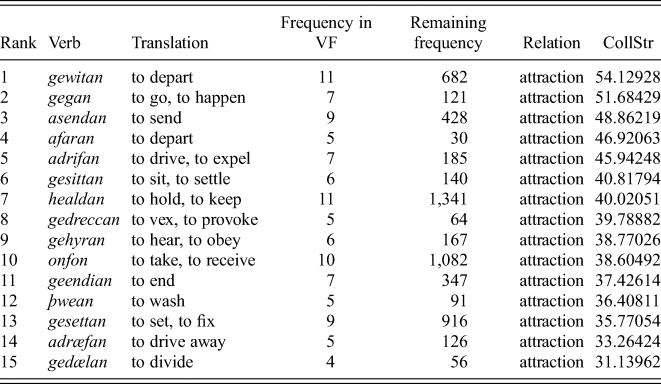
When only absolute frequencies are reported, the most powerful verbal collocate of the VF conjunct clause is the verb wesan ‘to be’ (13 occurrences), closely followed by gewitan ‘to depart’ (11) and healdan ‘to hold, to keep’ (11). Nonetheless, when the data are fed into a collexeme analysis calculator (Gries Reference Gries2022), which checks this against the overall corpus frequency of the verbal lexemes, it turns out that wesan ‘to be’ is not attracted to the analysed pattern and its high frequency in the VF conjuncts is a by-product of its generally high frequency in YCOE (35,867 instances; see Cichosz et al. Reference Cichosz, Pęzik, Grabski, Karasińska, Adamczyk, Rybińska and Ostrowska2022).
Table 5 shows that the verbs strongly attracted to the analysed structure (gewitan ‘to depart’, gegan ‘to go, to happen’, asendan ‘to send’, afaran ‘to depart’, adrifan ‘to drive, to expel’) are indeed dynamic and punctual, and many of them are verbs of movement. The most frequent collocate, wesan, is actually repulsed from the construction with the CollStr measure of 2.02, which is significant at p<0.05.
The verbs most strongly attracted to the VF conjunct clause
In the case of VF main clauses, the numbers are of course much lower given the rarity of the structure, but the strongest collocate is cuman ‘to come’ (7 occurrences), closely followed by gewitan ‘to depart’ (5), which is an interesting overlap with VF conjuncts.
The collexeme analysis (presented in table 6) confirms the strong association between gewitan ‘to depart’ and the VF order, observed for both main and conjunct clauses and illustrated with (18)–(19). Other strong collocates of VF in main clauses are ateon ‘to draw out’, cuman ‘to come’, mætan ‘to have a dream’ and afeormian ‘to cleanse’.

The verbs are also mostly dynamic and punctual, so the lexemes attested in both main and conjunct VF clauses follow the tendency described in Bech (Reference Bech2012). Subordinate clauses, however, diverge from this pattern, showing no clear semantic limitation as to the verbal collocates appearing in the VF structure.
The verbs most strongly attracted to the VF main clause

Table 7 shows that these are both very dynamic and punctual verbs such as underfon ‘to receive’, becuman ‘to become, to happen’, onfon ‘to take’ or cuman ‘to come’ and stative and durative verbs such as habban ‘to have’, lufian ‘to love’ or even wesan ‘to be’, with the latter group illustrated by (20)–(21).

Such examples are much more difficult to find in main and conjunct VF clauses, though a careful comparisonFootnote 6 of a larger group of verbs attracted to each of the three clause types revealed numerous overlaps illustrated in figure 2.
The verbs most strongly attracted to the VF subordinate clause

Overlaps in the verbs attracted to the VF pattern (see Appendix for a translated version)
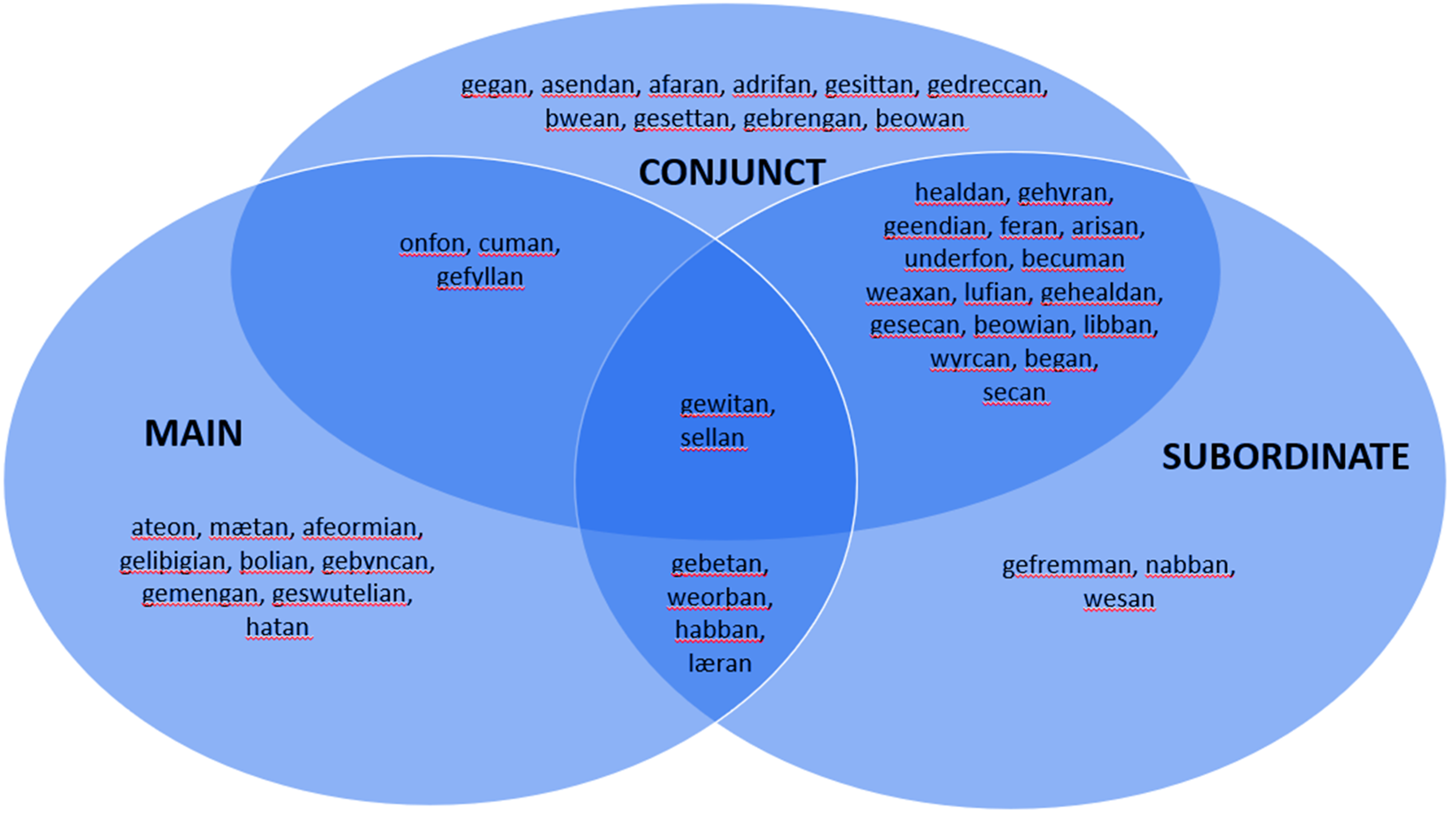
When a larger number of verbs is taken into account, the tendency described by Bech (Reference Bech2012) becomes less clear since the shared collocates of conjunct and subordinate VF clauses include lufian ‘to love’ and libban ‘to live’, while main and subordinate clauses both attract habban ‘to have’, but it is true that all the verbs illustrated in the graph are predominantly non-stative and non-durative. What is more, despite numerous shared verbal lexemes, wesan remains a specific collocate of the VF subordinate clause, repulsed from the VF conjunct and main clauses.
Nonetheless, the picture is not complete yet. So far, we have only looked at VF structures, but there is another test which may shed more light on the situation, i.e. the distinctive collexeme analysis, which compares the frequency of lexemes between competing structures, checking which of them are preferred by either variant. In this case, the test allows us to model the competition between VF and non-VF order in particular clause types, as illustrated by tables 8a–8c (the rows where VF is the preferred variant are shown in bold to make the results clearer).
Results of the distinctive collexeme analysis for conjunct clauses (20 most significant results)

Results of the distinctive collexeme analysis for main clauses (10 most significant results)

Results of the distinctive collexeme analysis for subordinate clauses (20 most significant results)

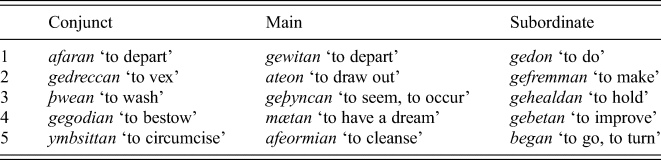
One basic observation to be made on the basis of the data is that while punctual non-durative verbs are not consistent in their preferences (e.g. cweþan ‘to say’ prefers the non-VF order, while geendian ‘to end’ selects VF), the VF pattern is almost never preferred by stative durative verbs regardless of clause type. In order to highlight the striking lexical similarities between the clause types, tables 9 and 10 group the verbs which most significantly prefer one variant over the other.
Verbs preferring the VF over the non-VF order in particular clause types
Verbs preferring the non-VF over the VF order in particular clause types
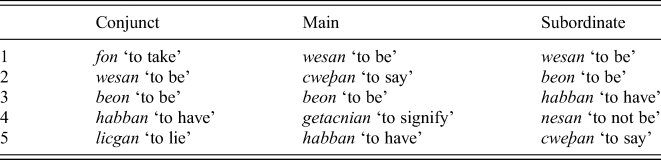
It is quite striking that in all the three clause types punctual and dynamic verbs show the strongest preference for the VF order, while stative and durative verbs such as wesan ‘to be’, beon ‘to be’ and habban ‘to have’ belong to the strongest collocates of non-VF. Interestingly, despite the general attraction of wesan to the VF subordinate clause, when the choice is limited to VF and non-VF, the lexeme shows definite preference for the latter. Thus, the lexical distance between main, conjunct and subordinate VF clauses is largely diminished: they all seem to favour punctual and dynamic verbs and clearly disprefer statives.
All in all, the analysis shows that the lexical preferences of verbs observed in VF main, conjunct and subordinate clauses are strikingly similar, which means that collocational range is not a factor that may help us determine whether the OE VF conjunct clauses are closer to main or subordinate clauses following the same order.
4.4 Place in discourse and syntactic priming
So far, the factors taken into account in the analysis have failed to answer the basic research question of this study, i.e. whether the VF order is used in conjunct clauses in a way similar to main or subordinate clauses. The last variable which was expected to provide some hints as to the syntactic status of VF conjuncts was discourse function, which was supposed to be similar for VF main and conjunct clauses (Bech Reference Bech2012). Such a detailed analysis of function required a more qualitative approach. For this purpose, I have extracted samples of VF and non-VF conjunct and main clauses from each text where the proportion of the VF order in conjunct clauses was higher than 15 per cent (see table 3): Bede's History, Catholic Homilies I and II, Blickling Homilies, the Anglo-Saxon Chronicle E, Orosius and Vercelli Homilies. The samples were supposed to consist of 10 clauses from 4 clause types (conjunct VF, conjunct non-VF, main VF and main non-VF), i.e. 40 clauses per text, but this approach turned out to have its limitations in the case of VF main clauses since most of the texts showed fewer instances of the pattern, so the overall number of VF main clauses taken into account in the qualitative analysis is 42 instead of the expected 70 (see tables 12 and 14).
Since the basis of this investigation is Bech's (Reference Bech2012) observation that VF conjunct and non-conjunct main clauses function in a similar way in OE discourse, the same methodology was followed in this study, with the analysis based on the Segmented Discourse Representation Theory (Asher & Lascarides Reference Asher and Lascarides2003; Asher & Vieu Reference Asher and Vieu2005). Accordingly, the analysed clauses were categorised as representing coordinating or subordinating discourse relations. In the former case, the clause belongs to the main line of narrative, pushing the story forward. In the latter, it is placed in a substructure of the text, presenting background, providing additional information, comments or explanations. Even though Bech (Reference Bech2012: 81–2) admits that there is no straightforward relation between word order and discourse structure in OE, her study shows that VF clauses rarely represent subordinating relations: their basic function is to continue and develop the main storyline.
As shown in tables 11 and 12, the analysis confirms both Bech's (Reference Bech2012) findings and her reservations: while VF conjunct and main clauses are indeed used to introduce events from the main line of narration, they are hardly exceptional in this respect since this is the main function of the great majority of all clauses taken into account in the analysis.
Discourse function of VF and non-VF conjunct clauses

Discourse function of VF and non-VF main clauses

Therefore, even though there is a functional similarity between VF conjunct and non-conjunct main clauses, it is not a convincing discriminator since it transpires that in some texts or text types (especially clearly narrative texts such as chronicles, as admitted by Bech Reference Bech2012: 81), subordinating discourse relations are underrepresented and the main storyline is developed by a number of different constituent order patterns.
Nonetheless, while the initial aim of this qualitative investigation was to inspect the discourse function of VF clauses, what I noticed quite quickly looking at the clauses in larger context was a striking tendency of VF structures to accumulate in one passage. Example (22) is representative of the phenomenon, with all clause-final finite verbs highlighted.

This huge stacking of VF clauses in certain fragments of various prose texts suggests syntactic priming as a possible mechanism strengthening the use of the VF order in the investigated group of clauses.
Priming is a well-known phenomenon according to which speakers tend to repeat syntactic structures that they have recently heard or produced, and it has been convincingly supported with experimental evidence (Hilpert Reference Hilpert2019: 146). In other words, if syntactic alternatives exist, the speaker's choice is affected by the structure they have used or heard before (Reitter et al. Reference Reitter, Keller and Moore2011) since ‘the more frequently a node or relation is activated, the more readily it may become activated in the future’ (Traugott & Trousdale Reference Traugott and Trousdale2013: 54–5). In order to check if the VF order could have been primed by a preceding VF clause, I have looked at all the clauses (regardless of type, i.e. including subordinates) directly preceding the sampled clauses, and did the same for the control group of non-VF clauses to check if any interesting differences surface. Only clauses placed immediately before the investigated clause were taken into account, though of course priming effects may be more long lasting (Reitter et al. Reference Reitter, Keller and Moore2011).
As shown in table 13, the difference between VF and non-VF clauses in the proportion of preceding VF clausesFootnote 7 is quite striking in most of the analysed texts. Only the Vercelli Homilies do not follow this tendency, but let us recall that in this text the frequency of both conjuncts and subordinates following the VF order is relatively low (see table 3), which means that priming could not have played an important role in this text because the number of VF trigger clauses is limited. Regardless of this exception, for the whole dataset shown in table 13 (N=140) the Fisher exact test confirms that the difference between VF and non-VF conjuncts with respect to the proportion of preceding VF clauses is highly significant (p< 0.00001).Footnote 8 What the analysis shows is that a VF conjunct clause is more likely to be preceded by a VF clause (of any type) than a non-VF clause, and (23)–(26) are relevant examples of the phenomenon. The clause in bold is one of the sampled clauses; the preceding clause-final verb is underlined.

The order of clauses directly preceding VF and non-VF conjunct

A similar tendency can be observed for main clauses shown in table 14 (and again with the Vercelli Homilies as the only exception), and the difference between VF and non-VF main clauses in this respect is confirmed by the Fisher exact test (p< 0.00001).Footnote 9
The order of clauses directly preceding VF and non-VF main clauses

Examples (27)–(29) illustrate the phenomenon.

In general, priming is in line with Pintzuk (Reference Pintzuk1999: 224), who observed that VF conjuncts are more frequent when the first of the conjoined clauses is VF as well, but the present interpretation goes even further, suggesting no type restriction on the preceding VF clause. Considering the difference in the proportion of VF clauses between main and conjunct clauses, it is not enough for the second conjunct to repeat the order of the first main clause since we do not have enough VF main clauses to trigger such a high number of VF conjunct clauses. If we assume (as I do in this study) that subordinates could also be triggers and that the clauses did not have to be syntactically linked (i.e. it is enough to have any VF structure preceding the conjunct), the quantitative data make more sense, especially since the impact of preceding clauses could also be strengthened by transfer from Latin, where the VF order was the default option in most texts.Footnote 10
Naturally, the question is why syntactic priming is more readily applied to conjunct than to main clauses. If the phenomenon operated without any restrictions, we should expect a similar proportion of VF in both clause types. Here, Zimmermann's (Reference Zimmermann2017) analysis may be a useful starting point. If the VF order is ‘the subordinate order’ related to the presence of a subordinating conjunction (complementiser) at the beginning of the clause, perhaps the priming effect is lexically limited, i.e. a lexical element in the form of a conjunction enables the order to be activated more readily. If there is no conjunction, a VF clause would mostly fail to trigger a VF structure in the following clause, hence the low number of VF non-conjunct main clauses. Since and and ac, as coordinating conjunctions, are in a sense functionally similar to subordinating conjunctions (i.e. both are used to link clauses), they could have been used or perceived by OE speakers as a viable replacement and thus also (indirectly) associated with ‘the subordinate order’. This would be in line with Zimmermann's (Reference Zimmermann2017) double interpretation of and and ac, which could sometimes be located in C just like subordinators. This could have happened only if speakers of OE could treat both subordinating and coordinating conjunctions as functionally related items. The potential interchangeability of coordinating and subordinating conjunctions could have been strengthened by the fact that coordinating conjunctions may also link subordinate clauses, both in contemporary (30) and Old English (31).

Such examples, especially if there is no overt subject is the second conjunct, would usually be interpreted as examples of VP coordination rather than clause coordination, but an alternative analysis is also an option (Huddleston & Pullum et al. Reference Huddleston and Pullum2002: 1348–9). Therefore, it is possible to see some analogy between examples such as (31) (with the VF conjunct subordinate clause shown in bold) and VF main conjunct clauses discussed in this article, represented by (32).

Whether or not either of the clause-initial conjunctions may or should be interpreted as a complementiser in C is a question that I will leave open, but the surface similarity between conjunct main and conjunct subordinate clauses is quite clear. This, in turn, could enable speakers to form a simple generalisation, associating the VF order with a clause of any type starting with a conjunction (subordinating or coordinating). Such and- or ac-subordinates could perhaps function as a bridging context, facilitating the transfer of the generally subordinate VF order to main conjunct clauses via conjunct subordinate clauses. As a result, a conjunct clause is better suited for a clause-final placement of the finite verb than a regular main clause, where no lexical element could enable such a generalisation.Footnote 11 Variables such as weight, verb type or type of discourse relation could make the use of the pattern more probable, but they are not the actual reasons for it, functioning rather as additional factors.
5 Conclusion
The aim of the investigation was to determine whether conjunct clauses show a particularly high frequency of the VF pattern because their function links them to a special subgroup of main clauses following this order (Bech Reference Bech2012, Reference Bech2017), or because in some contexts OE coordinating conjunctions occupy the same place as subordinating conjunctions in the clause structure and therefore VF conjuncts are syntactically subordinate (Zimmermann Reference Zimmermann2017). The analysis presented in this article shows that VF conjuncts are close to both VF main and VF subordinate clauses in their preference for longer verb forms as well as punctual and dynamic verbs (as opposed to their clear dispreference for stative and durative verbs). The study suggests that the crucial phenomenon responsible for the use of the VF order in OE conjunct clauses is syntactic priming, with the VF order activated by a trigger clause (in most cases a subordinate) and then transferred to the following conjunct clause, especially if the verb form was relatively long and the verb was not stative. Thus, it turns out that the phenomenon is psycholinguistic rather than syntactic or pragmatic, though it may of course be interpreted syntactically as the presence of and or ac in C, which is primed by a preceding clause, and it does not exclude some additional and more subtle pragmatic or functional motivations, which would require further, in-depth qualitative analyses of a larger number of VF conjuncts in various OE texts.
APPENDIX
(translated). Overlaps in the verbs attracted to the VF pattern



