Introduction
The larger grain borer (LGB) Prostephanus truncatus Horn (Coleoptera: Bostrichidae) was accidentally introduced into Africa in the late 1970s from its area of origin in Mexico, where it had been recognized as an occasional pest of stored maize (Markham et al., Reference Markham, Wright and Rios Ibarra1991). LGB is now widely recognized as the most destructive pest of farm-stored maize and dried cassava in Africa (Boxall, Reference Boxall2002). Losses to stored maize vary from 9 to 45% depending on periods of storage (Pantenius, Reference Pantenius1988; Markham et al., Reference Markham, Wright and Rios Ibarra1991; Schneider et al., Reference Schneider, Borgemeister, Sétamou, Affognon, Bell, Zweigert, Poehling and Schulthess2004; Gueye et al., Reference Gueye, Goergen, Badiane, Hell and Lamboni2008).
The maize weevil (MW) Sitophilus zeamais Motschulsky (Coleoptera: Curculionidae) is an important pest of stored maize in the tropics, particularly when maize is stored on-farm, with no control of moisture content and without chemical protectants. Grain weight loss of 12–20% is common, and up to 80% loss may occur for untreated maize grain stored in traditional structures (Mutiro et al., Reference Mutiro, Giga and Chetsanga1992; Boxall, Reference Boxall2002). There is also a health risk associated with consumption of weevil-infested maize grain, as damaged grain is prone to contamination by aflatoxins (Kankolongo et al., Reference Kankolongo, Hell and Nawa2009).
Application of synthetic insecticides has been recommended to protect grain against LGB and MW attack during storage. However, in addition to the health risk associated with insecticide use, these chemicals are frequently unavailable or too expensive for subsistence farmers in Africa (Golob, Reference Golob2002; Dhliwayo and Pixley, Reference Dhliwayo and Pixley2003). Biological control is a suitable strategy, and two populations of Teretrius nigrescens Lewis, a histerid predator, were introduced into several African countries, among them Kenya, with varying degrees of success (Schneider et al., Reference Schneider, Borgemeister, Sétamou, Affognon, Bell, Zweigert, Poehling and Schulthess2004). Developing high-yielding maize varieties with resistance to LGB and MW has been regarded as a potential option to minimize the overall cost of production and storage of maize. Such varieties may also reduce the potential risk associated with consumption of treated maize with insecticides (Mugo et al., Reference Mugo, Mulaa, Likhayo and Gichuki2008). Genetic variability exists among maize varieties for resistance to MW (Dobie, Reference Dobie, Brady, Brower, Hunter, Jay, Lum, Lund, Mullen and Davis1974; Serratos et al., Reference Serratos, Arnason, Nozzolillo, Lambert, Philogene, Fulcher, Davidson, Peacock, Atkinson and Morand1987; Tipping et al., Reference Tipping, Rodriguez, Poneleit and Legg1988; Arnason et al., Reference Arnason, Gale, Conilh de Beyssac, Sen, Miller, Philogene, Lambert, Fulcher, Serratos and Mihm1993; Derera et al., Reference Derera, Giga and Pixley2001; Garcia-Lara et al., Reference Garcia-Lara, Bergvinson, Burt, Ramputh, Pontones and Arnason2004; Bamaiyi et al., Reference Bamaiyi, Dike and Onu2007) and LGB (Kumar, Reference Kumar2002; Mugo et al., Reference Mugo, Mulaa, Likhayo and Gichuki2008; Mwololo et al., Reference Mwololo, Mugo, Okori, Tefera and Munyiri2010).
In an effort to design effective and efficient methods to control LGB and MW, the Insect Resistant Maize for Africa project was launched in 1999 by the International Maize and Wheat Improvement Center (CIMMYT) and the Kenya Agricultural Research Institute (KARI), with the aim of developing and deploying resistant, high yielding and adaptable maize hybrids through conventional breeding. Inbred lines, hybrids and open-pollinated varieties (OPVs) were developed and have been evaluated in preliminary trials and in the national performance trials, and seven hybrids and three OPVs were released for various maize growing ecologies of Kenya. The released hybrids and the current experimental hybrids originated from a cross between ‘CubaGuard’ and ‘Kilima’ as described by Derera et al. (Reference Derera, Giga and Pixley1999). This paper reports on the level of resistance of new experimental maize hybrids to P. truncatus and S. zeamais.
Materials and methods
Development of parental lines and hybrid formation
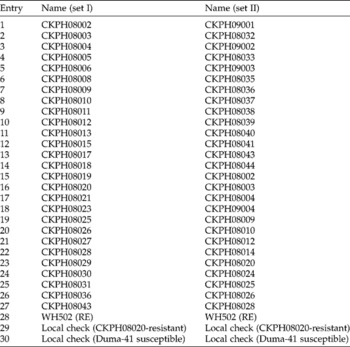
Two susceptible elite inbred lines, CML 202 and CML 204, were crossed to 27 MW and LGB resistant advanced lines to obtain 54 single crosses (SC). The 54 SC served as parents in crosses with either CML 202 or CML 204 to obtain 54 three-way crosses hybrids (Table 1). The 27 selected lines were elite or advanced lines in the CIMMYT breeding programme, having above average resistance to MW in previous experiments (T. Tefera et al., unpublished data). These resistant lines were developed from a cross between ‘CubaGuard’ and ‘Kilima’. ‘Kilima’ is a Tanzanian OPV that has resistance to LGB (Derera et al., Reference Derera, Giga and Pixley1999), whereas ‘CubaGuard’ was formed at CIMMYT in 1993 from the seed regeneration nursery of Caribbean landraces that had undergone more than four cycles of selection and inbreeding under infestation with LGB.
List of entries evaluated for resistance to the maize weevil and to the larger grain borer

Field trial design and management
Two trials composed of 30 hybrids each were planted at Kiboko in Kenya, in 2009. Each trial involved 27 experimental hybrids, the parental lines carrying genes for resistance against S. zeamais and P. truncatus, along with a reference check (entry 28), a resistant check (entry 29) and a susceptible check (entry 30) (Table 1).
Kiboko is a semi-arid area located at latitude 2°1′S, longitude 37°7′E and altitude 975 masl. The trials were laid out in 6 × 5 alpha lattice designs with three replications. Two maize seeds were planted per hill in a row of 5 m length and thinned to one seedling per hill 2 weeks after emergence. There were two rows per plot spaced 75 cm apart with plant-to-plant distance of 25 cm to attain a population density of 53,000 plants/ha. Fertilizers were applied at the rate of 60 kg N and 60 kg P2O5/ha as recommended for the area. Nitrogen was applied in two splits. Supplemental irrigation was applied when needed. The fields were kept free of weeds by hand weeding.
Preparation of insects for infestation
Adults of S. zeamais and P. truncatus were obtained from KARI's Kiboko Postharvest Insect Pest Laboratory. Maize grains (400 g) were placed in 1-litre glass jars and covered with perforated lids. About 200 unsexed adult insects of the two species were separately introduced into the glass jars. After 10 days of oviposition, all adult insects were removed. Each glass jar was kept for progeny emergence. Progeny emergence was monitored daily and those emerged on the same day were transferred to fresh grain in glass jars with lids and kept at the experimental conditions until sufficient numbers of insects were obtained.
Preparation of grains and infestation with LGB and MW
The F2 grain was used to evaluate resistance because this represents the generation that is stored by farmers and will be vulnerable to attack by MW and LGB. At harvest, a random bulk of about 500 g of grains was taken from each plot and fumigated with Phostoxin® for 7 days to disinfest from any possible sources of infestation. The grains were sieved to remove any dirt, dust or broken grains. The moisture content of grains varied from 11 to 12%. About 100 g grains of each variety were kept in a glass jar at room temperature for 24 h before infestation with insects.
Single (no-choice) and multi-choice (free choice) tests were carried out. In the single choice test, thirty 7- to 10-day-old, unsexed MW or LGB adults were introduced into a glass jar containing 100 g grains of each hybrid. The insects were removed after 10 days of oviposition and feeding. The glass jars were covered with a lid made of wire mesh to allow adequate ventilation and prevent escape of the insects. The treatments were arranged in a completely randomized design with three replications kept on wooden shelves in a laboratory at 28 ± 2 °C and 65 ± 5% relative humidity (RH).
For the multiple choice test, de-husked but unshelled cobs, free from insect damage and cob rot, were fumigated in a plastic drum for 7 days with Phostoxin® tablets. There were three replications per entry, and three cobs per replication were labelled and put in a plastic net bag and hung about 2 m above the ground on a timber rail roof of a 2 × 3 m room. A total of 1000 adult insects, 500 individuals of each of the two species, were released on a plastic tray placed on the floor of the room, at three equidistant positions, with the supposition that the insects would crawl or fly to search the host of their choice. Small-scale farmers in Africa often store their maize cobs on the roof of their houses, where they are simultaneously exposed to an array of pests including LGB and MW. This method was, therefore, introduced to reflect a local practice. In the two tests, the mean temperature and RH were 28 ± 2 oC and 65 ± 5%, respectively. The treatments were incubated for 90 days.
Data collection and statistical analysis
In the single choice test, 90 days after incubation, the glass jars were opened, and the content was separated into grains, insects and dust using 4.7 and 1.0 mm sieves (Endecotts Ltd, UK). The number of live and dead insects and weight of the dust produced were recorded. The dust or flour produced due to insect feeding and the grains were weighed on a precision electronic scale. Dust weight was expressed as a percentage of the initial grain weight. Grain weight loss was determined using the bulk density method (Boxall, Reference Boxall2002). The percentage reduction in grain weight loss among the entries relative to the susceptible check was calculated as: 100 (% weight loss of entry − % weight loss of susceptible check) per % weight loss of susceptible check.
The number of insects was log transformed (log10), while dust production and weight loss were angular transformed (arcsine proportion). Significant differences among the means were detected using the t-test (P < 0.05). Data transformed back to original values are presented in the Tables. The susceptibility parameters (number of insects, % weight loss and % dust) were integrated to define the resistance reaction of the experimental hybrids. Therefore, selection index based on the three susceptibility parameters was done by summing the ratios between values and overall mean and dividing by 3 (number of parameters). The hybrids with selection index values less than 0.8 are regarded as resistant and those with a selection index greater than 0.8 as susceptible (Bergvinson et al., Reference Bergvinson, Vasal, Singh, Panwar, Sekhar, Srinivasan, Zaidi, Prasanna, Gonzalez and Lesnick2004).
In the multiple choice test, the cobs were removed from the net bag and assessed for the insects' feeding damage based on a 0–10 visual scoring scale, where zero equals no visible damage and 10 equals 100% of the cobs totally damaged. Cobs with a scale of 0–2 were regarded highly resistant, 2.1–4 as resistant, 4.1–6 as moderately resistant, 6.1–8 as susceptible and 8.1–10 as highly susceptible (Kumar, Reference Kumar2002).
Results
No-choice test
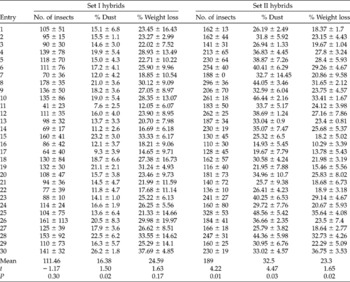
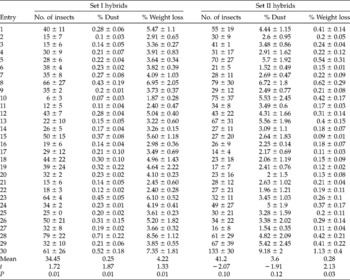
There were significant differences among hybrids included in set I for LGB in % dust (Table 2). Entries 11 and 17 produced the lowest dust. There were also significant differences among hybrids in set II in number of insects, % dust produced and % grain weight loss due to LGB (Table 2). The lowest % grain weight loss of 1.8–2.9% was recorded for entries 2, 10, 11, 16, 21 and 22. On the other hand, entries 28 and 30 suffered relatively higher weight loss compared with the rest of the entries. Entries 16, 17 and 19 had lowest % dust production of 14.9–21% and weight loss of 10.2–15.4%; on the contrary, entries 8, 10, 25, 28 and 30 produced the highest % dust of 44.3–48.5% and weight loss of 31.6–35.6% due to LGB feeding. Fewer insects and lower percentages of dust and weight losses were observed in MW-infested entries (Table 3). The susceptible check (entry 30) harboured large numbers of insects and produced relatively high percentages of dust and weight losses.
Number of larger grain borers (LGB), % dust produced and grain weight loss 90 days after LGB artificial infestation of the seeds harvested for plants grown at Kiboko (Kenya)
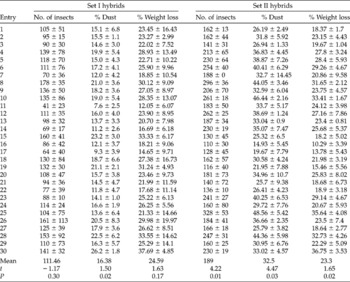
Number of maize weevils (MW), % dust produced and grain weight loss 90 days after MW artificial infestation of the seeds harvested for plants grown at Kiboko (Kenya)

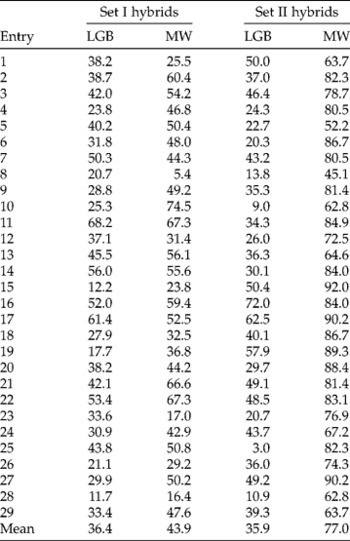
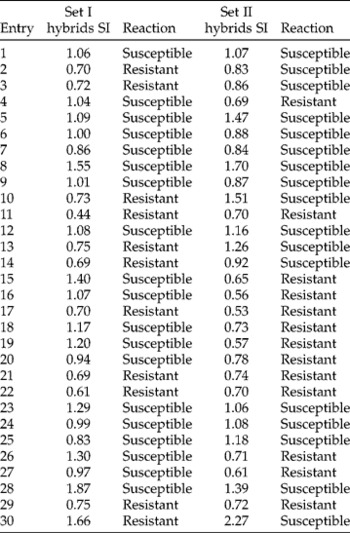
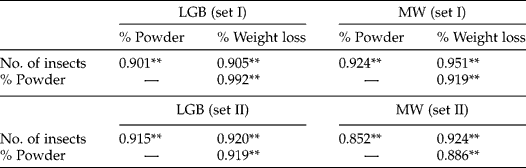
Among the set I hybrids, reduction in grain weight loss over the susceptible check was 61.4–68.2% for entries 11 and 17 against LGB (Table 4). Entries 2, 10, 11, 21 and 22 had 60.4–74.5% reduction in weight loss against MW (Table 4). In the set II hybrids, entries 16, 17 and 19 had 72, 62.5 and 57.9% reduced weight loss over the susceptible check against the larger grain borer, respectively (Table 4). The set I hybrids appeared to be more tolerant to MW than LGB with over 90% reduction in grain weight losses for entries 15, 17 and 27. When the selection index was calculated, entries 2, 3, 10, 13, 14, 17, 21, 22 and 29 were resistant for set I hybrids, while entries 4, 11, 15, 16, 17, 18, 19, 20, 21, 22, 26 and 27 were resistant for set II hybrids (Table 5). The number of insects, % dust production and grain weight loss were highly correlated (Table 6).
Percentage reduction in grain weight loss over the susceptible check

LGB, larger grain borer; MW, maize weevil.
Selection index (SI) and reaction of set I and set II maize hybrids against larger grain borer and maize weevil

Correlation between number of insects, % dust production and weight loss
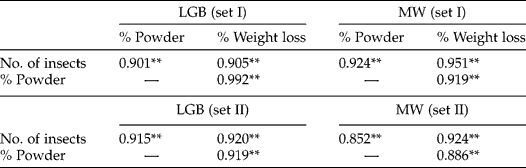
LGB, larger grain borer; MW, maize weevil. **Significant at P < 0.01.
Multi-choice test
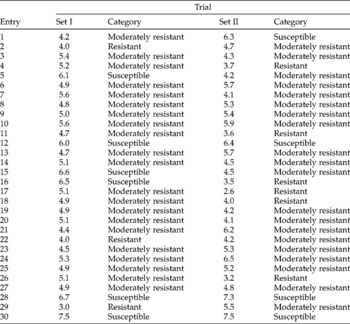
The majority of the hybrids were moderately resistant when subjected to feeding by mixed populations of the two beetles on unshelled cobs (Table 7). The resistant hybrids include entries 2, 22 and 29 from set I and entries 4, 16, 17, 18 and 26 from set II.
Ear damage to maize hybrids by the larger grain borer and maize weevil 90 days after incubation of ears from two sets of trials

Rating is on a 0–10 scale, with 0–2, highly resistant; 2.1–4, resistant; 4.1–6, moderately resistant; 6.1–8, susceptible; 8.1–10, highly susceptible.
Discussion
This study demonstrated differences in resistance levels among maize hybrids with respect to number of insects, seed damage, seed weight loss and the susceptibility rating. These differences in the susceptibility of the hybrids indicate the inherent ability of a particular hybrid to resist P. truncatus and S. zeamais attack. Out of the 54 experimental hybrids tested against LGB and MW, eight hybrids were resistant, six were susceptible and the remaining 40 hybrids were moderately resistant using visual cob damage score. However, 37 hybrids were regarded susceptible and 23 were resistant using the selection index. The resistant hybrids showed considerably less % grain weight reduction for both beetles, suggesting that they contained genes that confer resistance to the two pests co-existing in farmers' stores. Resistance of stored maize to insect attack has been attributed to physical factors such as grain hardiness, pericarp surface texture and nutritional factors such as amylose, lipid and protein content (Dobie, Reference Dobie, Brady, Brower, Hunter, Jay, Lum, Lund, Mullen and Davis1974; Tipping et al., Reference Tipping, Rodriguez, Poneleit and Legg1988) or non-nutritional factors, especially phenolic compounds (Serratos et al., Reference Serratos, Arnason, Nozzolillo, Lambert, Philogene, Fulcher, Davidson, Peacock, Atkinson and Morand1987). The role phenolics play in resistance formation in these surface tissues may be both related to structural components and antibiosis factors (Arnason et al., Reference Arnason, Gale, Conilh de Beyssac, Sen, Miller, Philogene, Lambert, Fulcher, Serratos and Mihm1993; Garcia-Lara et al., Reference Garcia-Lara, Bergvinson, Burt, Ramputh, Pontones and Arnason2004). For Sitophilus oryzae (L.), grain hardiness has been reported as the main resistance parameter (Bamaiyi et al., Reference Bamaiyi, Dike and Onu2007). Although resistance is governed primarily by genetics, physical and biotic factors in the environment also influence its expression (Altieri and Nicholls, Reference Altieri and Nicholls2003). The studied hybrids are currently being tested under different maize growing agroecologies in eastern and southern Africa to select best adaptive hybrids across environments.
Resistance to MW was reported for Mexican landraces, notably Si Naloa 35 and Yucatan-7 (Arnason et al., Reference Arnason, Baum, Gale, Lambert, Bergvinson, Philogene, Serratos, Mihm and Jewell1994), for the Tanzanian OPV ‘Kilima’ (Derera et al., Reference Derera, Giga and Pixley1999), for tropical inbred lines Hi41, Hi34, ICA L29, KU1409, Hi39 and ICA L221 (Kim et al., Reference Kim, Brewbaker and Hallauer1988) and for temperate inbred lines B37, B68, R805 and T220 (Tipping et al., Reference Tipping, Rodriguez, Poneleit and Legg1988). Grain factors reported to contribute to resistance include increased grain hardiness and sugar content (Sing and McCain, Reference Sing and McCain1963).
The differences recorded among the hybrids in rating damage during the free-choice test indicated that LGB and MW preferred some hybrids relative to others. While our study did not investigate the chemical basis of the grain's non-preference resistance, Garcia-Lara et al. (Reference Garcia-Lara, Bergvinson, Burt, Ramputh, Pontones and Arnason2004) and Derera et al. (Reference Derera, Giga and Pixley2001) reported that non-preference was based on the lack of feeding stimulants in the resistant grains. Our results suggest that it is possible to develop hybrids with improved resistance to P. truncatus and S. zeamais. There existed differences and similarities between the two ways of grouping (visual scoring and selection index) the genotypes into resistant and susceptible categories. For instance, from the set I hybrids, entries 2, 5, 12, 15, 16, 22, 28 and 29 and entries 1, 4, 11, 12, 16, 17, 18, 26, 27 and 30 from set II hybrids were grouped under the same category in the two tests. Since the two methods complement each other, we recommend advancing those hybrids that are consistently resistant in both tests. Although the free-choice test is relatively simple and cost-effective, the distribution of the insects might not be uniform and this could probably lead to escape by a few genotypes. The no-choice test set-up represents a rigorous exposure, in which the insects have no choice other than subsisting on a given genotype. In no-choice tests, confining insects with lower ranked hosts induces deprivation. Deprivation can induce some insects to accept a genotype it may reject if not deprived (Withers, Reference Withers1997). Therefore, complete or partial acceptance of genotypes by an insect in no-choice tests does not necessarily reflect a lack of field specificity.
The number of insects and % dust produced for LGB exceeded that of MW, indicating that P. truncatus converts grain into powder within a short period of time. The extensive tunnelling in maize grain by LGB adults allows it to convert grain into flour within a short time. The flour produced during the insects' feeding consists of insect eggs, excreta and exuviae that are unfit for both livestock and human consumption. LGB belongs to the wood-boring family of Bostrichidae with strong mandibles (Hill et al., Reference Hill, Borgemeister and Nansen2004). P. truncatus has a remarkable ability to tunnel through hard materials including plastic thickness of 35 mm (Li, Reference Li1988).
The significant correlation among the number of insects, % dust and grain weight loss indicate that resistance in maize against LGB and MW can be expressed in terms of any of the three measured parameters. Resistant hybrids produced less powder, suffered less grain weight loss and had less multiplication of the two beetles. Grains from the resistant hybrids were not attractive to LGB and MW to feed on and reproduce as freely as the susceptible check, indicating that antibiosis was a mechanism of resistance operating within the resistant hybrids. In the present study, we used de-husked cobs although some farmers in Africa practice storing maize with husks. Demissie et al. (Reference Demissie, Tefera and Tadesse2008) stated that an exposed cob is more vulnerable to MW than one enclosed in the husk, and good husk cover is considered key to protecting the cob from insect and fungi attack.
Abraham (Reference Abraham1991) indicated that the extent of damage during storage depends on the number of emerging adults during each generation and the duration of each life cycle, and grains permitting more rapid and higher levels of adult emergence will be more seriously damaged. Several maize varieties, including local land races, have been characterized as sources of resistance to MW (Giga and Mazarura, Reference Giga and Mazarura1991) and some sources of resistance have been incorporated into elite maize lines (Bergvinson, Reference Bergvinson and Pandey2001). Those hybrids with low rates of susceptibility can be stored for relatively longer periods of time. Resistant varieties, therefore, can be utilized as an environmentally friendly way to reduce damage by P. truncatus and S. zeamais under traditional storage conditions. The parental lines of the resistant hybrids identified in the present study can also be used as a source of resistance in breeding programmes to diversify the basis of resistance to the two pests. Low grain weight loss, powder production and low insect multiplication on resistant grains will reduce the negative impact of LGB and MW. Therefore, host plant resistance can be used as a vital component of an integrated pest management strategy against the two beetles. Large numbers of germplasm should be screened to identify more sources of resistance, particularly against P. truncatus.
Acknowledgements
We thank Christine Wavinya for her assistance during experimental set-up and data collection. The assistance of John Gakunga in data analysis is acknowledged. This paper contributes to the developing maize resistant to stem borer and storage insect pests for Eastern and Southern Africa – IRMA III Conventional (2009–2013), funded by the Syngenta Foundation for Sustainable Agriculture.