One plausible explanation for why Homo sapiens acquired a large brain has focused on variability in social demands in an open savanna environment.Reference Dunbar1 The visual and frontal cortices, which distinguish human brain size from that of other primates, afford a propensity for cooperation in survival and reliance on visual social cues to navigate the social environment.Reference Barton2 It might be time to consider the media-saturated habitat of contemporary Homo sapiens as a new environmental challenge, for which some persons might be better suited than others. A great many of us spend most of our days in the mediated world, using multiple types of media concurrently.3 Much of this time is spent on audiovisual platforms using media that are increasingly focused on the lives of ordinary people, which enable media consumers to identify with, compare themselves to, and engage with mediated others. Social media and reality shows are obvious examples of this populist focus. Moreover, the so-called human interest focus in journalistic storytelling is becoming a notable standard,Reference De Vreese4 which is likely to have considerable consequences for social-cognitive maneuvering during mediated experiences.
The fusion of sociological and biological literature supports an expectation that the processing of social objects (social content) will vary between genders and among individuals of different education levels. Specifically, the interaction of biological and experiential factors serves as a framework in this study for interpreting these potential differences. From evolutionary and cognitive perspectives, gender variance in social attentive tendencies and visual processing abilities serve survival-relevant functions.Reference Hampson, Van Anders and Mullin5,Reference Rehnman and Herlitz6 Education levels have also been tied to social processing. Social skills are strongly linked to school performance among children and information processing skills among adults.Reference Gaziano7 This correlation implies that education levels and social ability might be reciprocally related. However, the intersection of gender and education as variables in social processing is practically uncharted territory. Built on transdisciplinary insights, the experiment reported here tested the influence of gender and education on the visual processing of social and inanimate objects in audiovisual news, to understand how humans navigate mediated experience. An important but mostly unexplored area of study concerns the long-term effects of processing differences on the stability of potential memory across education and gender groups. Recognition and salience (cued recall) measures at two different time points were employed to this end.
News as real-life experience
More often than not, researchers in the social sciences (e.g., psychology, political science, and cognitive science) use mediated stimuli as a proxy for the physical world. Although a conventionally acceptable practice, this type of methodology shows little acknowledgment for the mediated nature of stimuli. Media researchers, on the other hand, are preoccupied with how the process of mediation affects respondents. Unsurprisingly, these researchers put a high premium on the ecological validity of stimuli, treating these messages as a proxy for the mediated world. The study reported here is positioned between these approaches as it takes the ecological validity of audiovisual news messages seriously while, at the same time, regarding these messages as a proxy for cognition in the physical world.
There are obvious advantages to testing audiovisual media content instead of still or text-based news. News users increasingly prefer audiovisual media content to text.8 This shift in user preferences might be consequential in how seamlessly news users can live a dual existence in physical and mediated worlds. In addition, the lifelike full-motion characteristics of video support the goal to study nonsocial and social processing. Research has shown that regions of the social brain respond to biological motion (as opposed to robotic movement or lack of motion), which makes still images less conducive to detecting the contours of social processing and memory.Reference Lloyd-Fox, Blasi, Volein, Everdell, Elwell and Johnson9
News is one of the most lifelike genres of media content, distributing survival-relevant information to its users,Reference Grabe and Craig Roberts10,Reference Shoemaker11 and thereby serving a surveillance function.Reference Wright12 Indeed, Shoemaker13 argues that contemporary journalists serve a specialized function in human societies by surveying the environment and warning against potential survival threats. In early human societies, watchmen sitting in treetops or on hills performed this function. Around the 16th century, this task became known as “news gathering” and the audience appetite for this type of information has remained remarkably stable since then.
Demographic factors, such as gender and socioeconomic status (SES), have been shown to drive variation in the reception of news messages. Both survey and experimental research on the knowledge gap have documented that citizens with higher SES acquire news information at a faster rate than citizens with lower SES.14,Reference Grabe, Lang, Zhou and Bolls15,Reference Grabe, Yegiyan and Kamhawi16,Reference Hwang and Jeong17 Education level is considered a viable indication for SES and was used as a proxy for it in most of those studies. When it comes to gender, most studies show that men outperform women in memory tests for news.Reference Findahl and Hoijer18,Reference Gunter, Furnham and Gietson19,Reference Vettehen, Hietbrink, Renckstorf, Renckstorf, McQuail and Jankowski20 However, most of these demographic studies employed verbal recognition tests of memory, which have been shown to favor men and high-education groups. In particular, men are more likely than women to guess answers to forced-choice questions.Reference Mondak and Anderson21
In response to the apparent demographic biases in measures and the contemporary news user’s preference for audiovisual information, this study incorporated a number of visual memory measures to assess how different demographic groups absorb information in a lifelike mediated context.
Demography and memory for social images
Sex, gender, and social memory
The human brain is better at forming memory records for social than inanimate objects both in terms of quantity and quality of memories.Reference Mitchell, Macrae and Banaji22 Social maneuvering is a fairly complex operation that requires distinguishing faces from other objects, recognizing individual faces, understanding facial expressions of others, and responding in an appropriate manner. When discussing differences between men and women, some researchers focus on biological explanations (i.e., sex) whereas other researchers focus primarily on the influence of gender-specific socialization.Reference Deaux23 The current paper aims to integrate biological and environmental perspectives; therefore, the term gender is the more appropriate one to use.
Regarding gender differences in social processing, the bulk of recent evidence shows that females outperform males in facial recognition tasks and identification of facial expressions.Reference Herlitz and Lovén24,25 Evolutionary explanations recognize that females, in their traditional role as primary caretakers, are endowed with the critically important skill to quickly and accurately interpret subtle changes in facial expressions of preverbal infants.Reference Babchuk, Hames and Thompson26 Thus, from this macro view, the biological propensity of women to be socially skilled serves the reproductive course of Homo sapiens. This macroview informs our first hypothesis:
H1: After viewing audiovisual news stories, women will display more memory accuracy and salience for social images than men.
Interactive specialization and the course of social skill development
A growing body of neuroscience evidence supports the idea that social processing tendencies are shaped by social experiences early in life. Johnson and de Haan argue that brain specialization coacts with environmental influences and call this process interactive specialization.Reference Johnson and de Haan27 Cortical brain regions initially function as a dispersed network. From there, the brain specializes dynamically through interaction with the environment, so that specific regions gradually obtain specific functions.
Interactive specialization is not an uncontested theory. It merges views that are traditionally deemed incompatible. Specifically, it finds middle ground in the nature-nurture debate, drawing from two contrasting views on neurodevelopment: maturation and skill-learning.28 Maturation holds that the specialization of brain regions is shaped by evolutionary processes. The onset of brain activity in these regions and their subsequent development are mostly dependent on biological predispositions. Conversely, the skill-learning perspective supposes that the environment drives brain specialization—that is, experience molds the relevant brain regions. The theory of interactive specialization integrates these two perspectives by acknowledging that the brain specializes at biologically set points in time but also by treating brain function as a process of dynamic network interactions with the environment. This perspective is used in the study reported here as a framework to explore potential demographic differences in nonsocial and social processing. Johnson, Grossmann, and Kadosh have applied interactive specialization to the development of social cognition.Reference Johnson, Grossmann and Kadosh29 In support of this multifaceted process a network of brain regions, dubbed the social brain, is activated during social perception. For example, the fusiform face area (FFA) is thought to be involved in facial processing and the superior temporal sulcus (STS) seems to respond mostly to biological motion, as opposed to nonbiological motion and still imagery.30 Eventually, interactions between the specialized regions result in a social brain fine-tuned to navigate its specific environment.
As soon as 30 minutes after birth, infants can distinguish objects that resemble faces from other objects.Reference Farroni, Johnson, Menon, Zulian, Faraguna and Csibra31 At six months of age, humans are equally able to discriminate between individual faces of both humans and monkeys; however, at around nine months of age, we can only tell individual human faces apart.Reference Pascalis, de Haan and Nelson32 Social encounters before the ninth month seem to shape skills and preferences later in life. Motion also plays an important role in shaping social processing skills.Reference Montague and Walker–Andrews33 Infants show habituation, an indicator of learning, to emotional facial expressions mainly when the faces are paired with sound and motion. Gestures, language, emotions, and vocal prosody are all important contributors in the process of embodying social perception.Reference McClure34
Despite this critical developmental stage in which social perception adapts toward what is most familiar, the human social brain also remains somewhat pliable. For example, the bias for recognizing own-race faces, associated with early development, can be unlearned later in life. In fact, the skill to differentiate between other-race faces was acquired in a laboratory setting, held up over time, and even transferred to nontrained other-race faces.Reference Tanaka, Heptonstall and Hagen35 This evidence for social brain plasticity implies that social encounters after critical early developmental phases continue to affect social processing later in life. Family settings, school, and work are the main determinants of the type, quantity, and diversity of social interactions acquired over a lifetime.Reference McPherson, Smith-Lovin and Cook36
Looking at family life, parents are central to facilitating the social skills of their children. For example, a child’s interpretation of emotional facial displays depends on the frequency and type of facial expressions that the parents use. Children of parents who combine displaying and explaining negative emotions are more likely to use supportive social behavior in accommodating the negative emotion of others than children who are not exposed to the pairing of display and explanation. Some parents use minimal emotional expressions, which results in an initially slow learning curve for their children in reading emotional expressions of others but affords the detection of subtle emotions later in life.37 When it comes to gender, parents tend to socialize daughters more than sons to focus on social-emotional interactions.38 As a result, in socially challenging situations, girls tend to opt for prosocial solutions whereas boys revert to more antisocial (e.g., aggressive) behaviors. Regardless of gender, aggression is more than twice as likely to occur among children from socioeconomically challenged backgrounds as among children raised in economically advantageous environments.Reference Webster-Stratton and Reid39
Several studies have shown that the quality of early social experiences of elementary school children with their peers predicts subsequent school performance.40 Social withdrawal and poor school adjustment are initial negative effects of unsuccessful social interactions. Longitudinal studies have consistently linked social maladjustment to a wide variety of challenges later in life, such as dropping out of school, criminality, and psychopathology.Reference Parker and Asher41 Studies that report strong positive correlations between education level and SES also confirm the association between social skills and social position later in life. Also noteworthy, high-SES groups have more elaborate and diverse social networks than low-SES groups.42 As noted earlier, research has shown that education level is a reliable approximation of SES, particularly in self-report studies such as the one described in this article.43,Reference Liu and Eveland44 Taken together, these findings about education levels and SES lead to the following hypothesis:
H2: After viewing audiovisual news stories, high-education groups will display more memory accuracy and salience for social images than low-education groups.
The question remains if, and to what extent, life experiences related to education might contribute to gender differences in social processing. Lacking existing evidence to make a prediction, we formulated our first research question to test for gender and education interaction effects:
RQ1: Do education and gender interact on accuracy and salience of memory for social images that appeared in audiovisual news stories?
Demography and memory for inanimate images
There is some momentum in developmental research to pinpoint separate neural pathways for processing faces, objects, and places.Reference Golarai, Gharemani, Whitfield-Gabrieli, Reiss, Eberhardt, Gabrieli and Grill-Spector45,Reference Scherf, Behrmann, Humphreys and Luna46,Reference Southgate, Csibra, Kaufman and Johnson47 The areas of the brain activated when we recognize images of buildings and landscapes may be distinct from those activated when we recognize human and animal faces.Reference Maguire, Frith and Cipolotti48
When it comes to gender, differences in visual processing of nonsocial objects and places can be argued to have adaptive value. Parental investment theoryReference Trivers and Campbell49 assigns women to the historical role of primary care giver, which usually restricted their mobility to their immediate surroundings. Men, on the other hand, adapted for long-distance travel in open spaces to secure resources.Reference Buss50 Thus, women became endowed with traits to navigate immediate, up-close environments, mostly within a social context, and men habituated to panoramic views. Reflecting the parental division of labor, men have better visuo-spatial perception than women, as shown by performance of mental rotation tasks.Reference Andreano and Cahill51,Reference Halpern52 However, visuo-spatial memory studies show that women are better at identifying missing objects from a previously complete display.Reference Halpern and Lamay53
Meyers-Levy explains gender differences in processing skills in terms of strategies.Reference Meyers-Levy, Cafferata and Tybout54 Men rely on heuristics to filter and organize visual information from the world around them, making self-relevant information most salient. Conversely, women take on more comprehensive processing strategies, paying attention to objects related to the self as well as others. Using this approach, McGivern and colleagues found that men performed at equal levels with women during an object-recognition task only when that task concerned male-centered objects, such as a football and a truck.Reference McGivern, Huston, Byrd, King, Siegle and Reilly55 Self-relevance processing coincides with the concept of interactive specialization. Gender differences in nonsocial memory might depend on what objects are most often encountered to achieve the status of self-relevance. Gender socialization coacting with biologically predetermined factors likely influences which type of objects are most frequently encountered by men and women. If environmental factors shape gender variation in self-relevance (and interactive specialization) during processing, it is reasonable to expect that lived reality, at different levels of the socioeconomic hierarchy, would also influence this process. No previous studies have addressed this matter directly. The study reported here explores the following set of research questions:
RQ2: Do men and women differ in the accuracy and salience of memory for inanimate images that appeared in audiovisual news stories?
RQ3: Do high- and low-education groups differ in the accuracy and salience of memory for inanimate images that appeared in audiovisual news stories?
RQ4: Do education and gender interact on accuracy and salience of memory for inanimate images that appeared in audiovisual news stories?
Time and memory
Traditional time-based memory models predict that, all other conditions being equal, memory will decrease over time.Reference Bartlett56,Reference Page and Norris57 Cognitive science yields evidence for this argument.Reference Cowan, Nugent, Emily and Geer58 However, some conditions can limit or even reverse the impact of time on forgetting.Reference Jonides, Lewis, Nee, Lustig, Berman and Moore59,Reference Lewandowsky, Duncan and Brown60,Reference Nairne61 It is plausible that our acuity for social processing may produce such curbing effects, enabling the formation of stable memory records for social visuals, but we lack evidence to support this supposition.
In the context of news, little research has been devoted to test the influence of time on the rate of forgetting. In line with traditional models, studies have shown memory decay for news stories over time.Reference Dixon, Simon, Nowak and Hultsch62,63,Reference Meeter, Murre and Janssen64 However, methods for measuring memory decay in news research vary considerably, which hinders straightforward comparisons across studies. Time delays range from 48 hoursReference Eveland, Seo and Marton65 to a week,Reference Bas and Grabe66 to several years.67 Also, memory measures (e.g., recognition, cued free recall, and comprehension) vary across studies. These dependent variables notably differ in their sensitivity to capture decay. For example, recognition-memory measures, seen as a particularly judicious measure of encoding, produce more persistent time-based decay effects than free recall of topics.Reference Eveland, Marton and Seo68,69,Reference Tremayne and Dunwoody70 Implementing an assortment of memory measures when studying memory decay seems fruitful in building a body of research that will allow cross-study comparisons.
Research that tests demographic differences in news-memory decay is particularly sparse. When it comes to education, most findings demonstrate stronger memory decay for low-education groups than for high-education groups.71 Graber used a panel study to test gender differences in long-term memory (three to nine months) for news and found that women recalled fewer stories and story details than men.Reference Graber72 However, evidence is insufficient to formulate a prediction of how news-memory decay would play out in main effects and interactions among the independent and dependent variables of the experiment reported in this article. Thus, we formulated a final research question to guide a comprehensive account of time effects:
RQ5: What are the influences of time delay on memory accuracy and salience of nonsocial and social images among and across gender and education groups?
Methods
Design
A 2 (gender)  $\times$ 2 (level of education)
 $\times$ 2 (time) mixed-factorial design was employed in this experiment. Gender and education level were between-subjects factors. Time was a within-subjects factor, accounting for memory decay. One measure was administered immediately after exposure to news stories; the other a week later. Participants saw television news stories in one of four randomized story orders. A repeated measures analysis of variance (ANOVA) was carried out for dependent variables.
Participants
Eighty adults (40 men and 40 women) took part in the study. In line with existing knowledge-gap research,Reference Chew and Palmer73,Reference Gaziano and O’Leary74,Reference Grabe, Kamhawi and Yegiyan75 equal numbers of high-education (holding at least a master’s degree) and low-education (with a maximum of 2 years of vocational training) participants were recruited across gender groups. All participants lived in a small Midwestern U.S. city. Their ages ranged from 25 to 55 years ( $M=34$ years). Participants were recruited via craiglist.com, local charity organizations, email distribution lists, and the university community.
Stimuli
The data reported here were collected as part of a multistep endeavor to understand cognitive and emotional responses to news.76 Eight news stories were built and used as stimuli in this project. Five of these stories served the process of testing hypotheses and finding answers to the research questions formulated here. The results reported here are therefore based on the five stories that allowed measurement of both social and nonsocial processing at two time points, one week apart.
The news stories were constructed from ABC News audiovideo content presented by a single journalist. All of the stories were in-depth investigative reports about socially important news issues and featured experts and ordinary people in soundbites. The topics were selected based on their potential resonance with both men and women as well as individuals with high and low levels of education. The topics of the five stories were Toyota’s cover-up of malfunctioning automobile brakes, abusive and illegal debt collection practices, migrant child labor on blueberry farms, sexual harassment of teenagers who work in fast-food restaurants, and corruption in the administration of public housing. The average length of the stories was 2 minutes and 48 seconds, and all stories were introduced by means of a voiceover by the same journalist. Together, the five stories represented a typical investigative news report, characterized by a continuous mixture of displays of people and objects and varying in camera angles and shot types (from close-ups to wide shots).
Variables
Visual recognition (accuracy): At each time point, two multiple-choice questions were asked for each news story, resulting in a total of four unique questions per story. Half of the questions assessed social recognition (images of faces), whereas the other half evaluated nonsocial recognition (inanimate images). Participants had to choose a correct image from five options. One point was assigned to each correct answer, leading to a maximum score of 20 points (10 for social recognition, and 10 for nonsocial recognition). An overall sum score was computed for visual recognition  $(M=16.01,SD=3.29)$ and then broken down into scores for social recognition
 $(M=7.61,SD=2.44)$ and nonsocial recognition
 $(M=8.40,SD=1.80)$.
Visual cued recall (salience): Offering a memory prompt, participants were asked to describe in writing any images they remembered from each story. The answers of this cued recall question were content-analyzed to identify the salience of social and nonsocial images. The data required collaborative coding instead of the traditional content-analysis approach used for analyzing media messages. The coding of open-ended, self-report responses from a finite number of subjects varies markedly from message coding based on samples drawn from large populations of media messages. Specifically, when the number of questionnaires is fixed, cases cannot be oversampled for the purpose of training and pre- and postreliability checks. Therefore, we followed procedures designed by GraberReference Graber77 and used by others in similar research contexts.Reference Grabe, Bas, Pagano and Samson78,Reference Lynch and Martins79 For each of the 5 stories, 4 coders coded 20 percent of the open-ended answers in collaborative sessions. Once consensus on the sample was reached, one coder continued coding with consultation and collaborative decisions being done for cases that did not clearly fall within the operational definitions established during the initial consensus coding phase.
References to people by name, facial characteristics, or another description that unmistakably indicated a human were counted as cued recall of social objects. Specific examples were “the mean guy,” “the debt collector,” or “children in the garden.” If a participant made a social reference in the plural (e.g., “children”), the description was counted as two separate cases because it indicated memory of at least two social images. When a participant mentioned a specific number in reference to social objects (e.g., “three children”), that specific number was counted for social images retained in memory. Based on these codings, a sum score was calculated. Overall cued recall scores of social objects ranged between 5 and 37 for the 5 stories together  $(M=16.30,SD=7.26)$.
Nonsocial recall was coded for mentions of objects and places, consistent with studies in cognitive literature attempting to distinguish social and nonsocial brain regions.80,81,82 Examples of nonsocial objects that appeared in open-ended comments were “table,” “blueberry,” and “house.” References that counted as places included “in the kitchen,” “at the mall,” or any description of a scene, such as “the man standing next to a bridge.” The latter example shows that one sentence could contain social images as well as inanimate objects and places. Also for nonsocial cued recall, a sum score for the five stories was calculated ( $M=19.11,SD=9.25$; range 1–44). In addition, a composite score (social and nonsocial combined, ranging between 6 and 73 references) was calculated for visual recall
 $(M=35.41,SD=15.68)$.
Procedure
Data were collected from participants individually. The experiment started asking participants questions about their familiarity with social issues. After that, participants watched the audiovisual news stories on a desktop computer. Distractor tasks (i.e., questions regarding the participant’s demographic characteristics and media use) were administered before the participant’s memory was tested. One week later, participants returned to answer more memory questions and received $50 for participation.
Findings
Overall, visual recognition produced no gender differences  $(F[1,76]=1.54;p=0.219)$, but a main effect for education appeared (
 $F[1,76]=29.14;p<0.001$;
 ${\it\eta}^{2}=0.10$). High-education participants had better visual recognition
 $(M=17.70,\mathit{SE}=0.44)$ than low-education participants
 $(M=14.33,\mathit{SE}=0.44)$. No interaction between gender and education was found
 $(F[1,76]=2.43;p=0.123)$. A gender difference was found for the other dependent variable, recall of images (salience): Women listed more images
 $(M=38.75,\mathit{SE}=2.30)$ than men
 $(M=32.08,\mathit{SE}=2.30)$, suggesting that images were generally more salient to women. Moreover, the high-education group
 $(M=40.50,\mathit{SE}=2.30)$ mentioned more images than the low-education group
 $(M=30.33,\mathit{SE}=2.30)$. No interactions of gender by education emerged. Subsequently, both dependent variables, recall and recognition, were parsed (social and nonsocial components) to test hypotheses and answer research questions. A summary of all
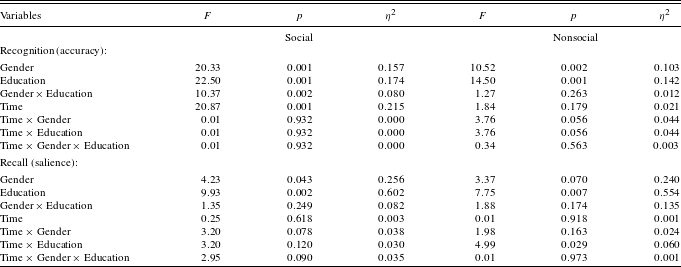
 $F$-tests can be found in Table 1.
 $F$-test results for (social and nonsocial recognition and recall measures.
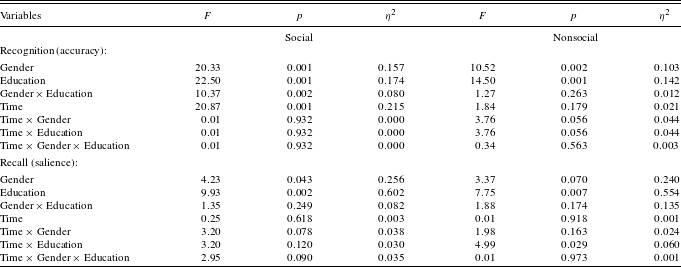
Notes: df  $=$ 1.
Social images
According to our first hypothesis (H1), it was expected that women would recognize and recall more social images in news stories than men would. Findings for recognition confirmed that women ( $M=4.29$,
 $\mathit{SE}=0.15$) had better visual accuracy for faces in the stories than men
 $(M=3.33,\mathit{SE}=0.15)$. Additional support for H1 appeared in cued recall outcomes, with a significant main effect for gender (see Table 1). Women listed more social images
 $(M=8.93,\mathit{SE}=0.53)$ than men
 $(M=7.38,\mathit{SE}=0.53)$. Our second hypothesis (H2) predicted a main effect for education on memory accuracy and salience of social objects. As can be seen in Table 1, this hypothesis was supported. The high-education group recognized more faces (
 $M=4.31$,
 $\mathit{SE}=0.15$) than the low-education group (
 $M=3.30$,
 $\mathit{SE}=0.15$) and listed more social images (
 $M=9.34$,
 $\mathit{SE}=0.53$) than the low-education group (
 $M=6.96$,
 $\mathit{SE}=0.53$).
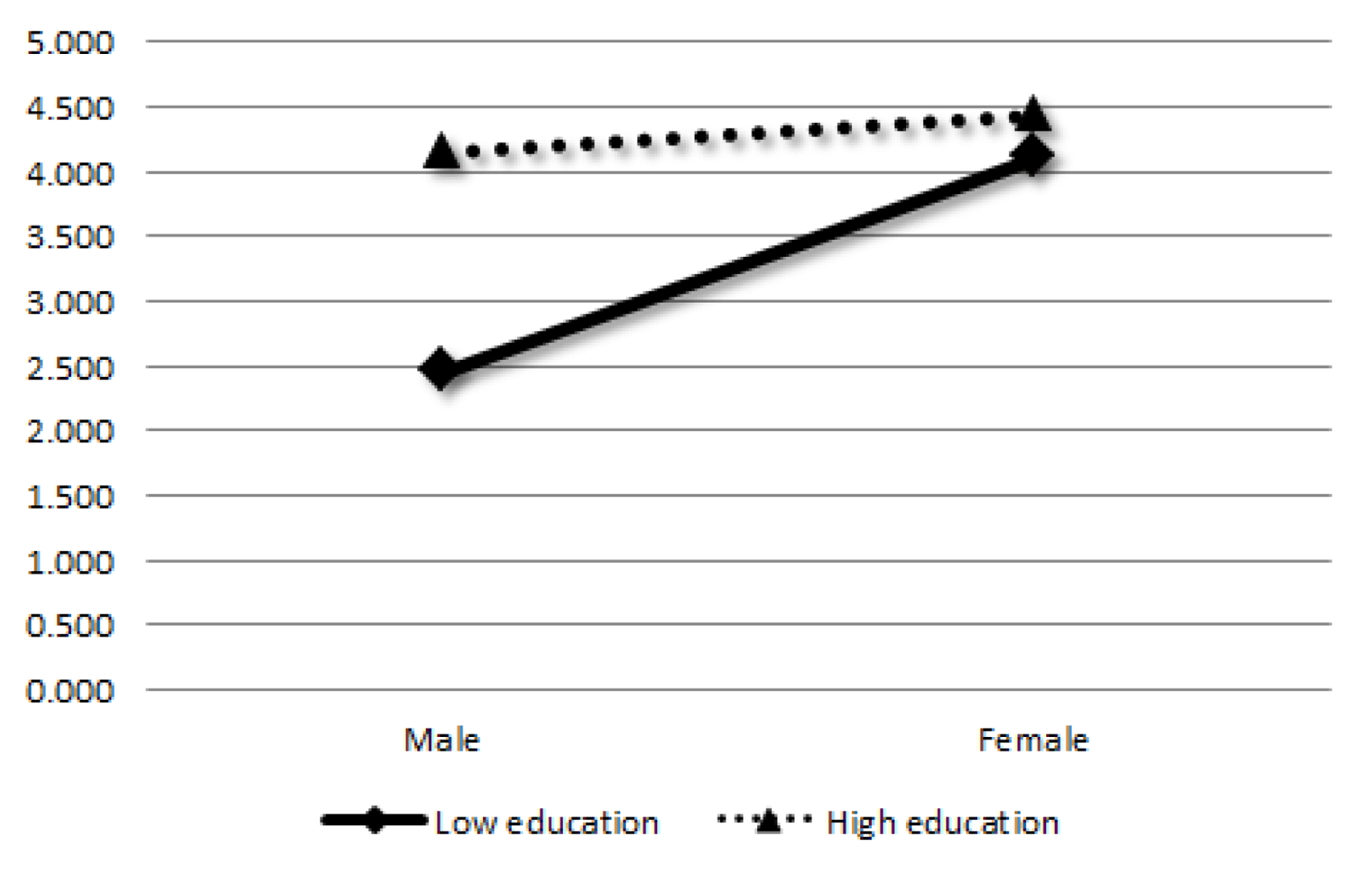
Two-way interaction for gender by education on recognition of faces.

Our first research question (RQ1) prompted a test for an interaction effect between gender and education on both dependent variables. A significant interaction effect was found for the recognition data. Figure 1 demonstrates that men in the low-education group drove the interaction effect. These men had significantly lower  $(t[38]=-4.36;p<0.001)$ social recognition
 $(M=2.48,\mathit{SE}=0.36)$ than high-education men
 $(M=4.18,\mathit{SE}=0.15)$. In addition, the low-education men recognized fewer social images (
 $t[38]=-4.24$;
 $p<0.001$) than low-education women (
 $M=4.13$,
 $\mathit{SE}=0.14$). However, no interaction effect was found for the recall (salience) of social visuals. The answer to RQ1 is that this data set produced a gender-by-education interaction effect for encoded (recognition measure) social images but not for the salience (cued recall measure) of social images.
Nonsocial images
Our second research question (RQ2) asked for an investigation of gender differences in memory for nonsocial imagery, in terms of accuracy and salience. In contrast to the social recognition results, men  $(M=4.49,\mathit{SE}=0.13)$ outperformed women (
 $M=3.91$,
 $\mathit{SE}=0.13$) on recognizing nonsocial images (see Table 1). For the salience measure, a gender main effect approached significance. However, the means indicate a different direction than the recognition results, with women listing more nonsocial images (
 $M=4.33$,
 $\mathit{SE}=0.35$) than men
 $(M=5.22,\mathit{SE}=0.35)$. Given the opposing direction of means for the recognition and salience measures by gender, the answer to RQ2 is that gender differences surfaced but without consistency across the two dependent variables. This finding offers an early indication that memory, in all its varied forms and functions, might have gender-specific adaptive charge.
The answer to RQ3, which prompted a test for education differences, is clear. First, there was a main effect for education on nonsocial recognition, with high-education participants  $(M=4.54,\mathit{SE}=0.13)$ outperforming low-education participants
 $(M=3.86;\mathit{SE}=0.13)$. Second, education also significantly influenced the cued recall of nonsocial content, with high-education groups listing more images
 $(M=10.91,\mathit{SE}=0.97)$ than low-education groups
 $(M=8.20,\mathit{SE}=0.97)$. In summary, across both dependent variables, low-education participants remembered fewer nonsocial images than those in the high-education group.
Our fourth research question (RQ4) called for an assessment of statistical association between education and gender on both dependent variables. As is clear from Table 1, neither nonsocial recognition nor recall interactions were statistically significant.
Time
Our fifth research question (RQ5) asked for several tests to assess the effects of time delay on both accuracy and salience of nonsocial and social memory variables across gender and education groups. Table 1 provides an overview of all these  $F$-tests. The one significant main effect for time that surfaced involved social recognition. As can be expected, participant recognition performance decreased from Time 1
 $(M=4.13,\mathit{SE}=0.12)$ to Time 2
 $(M=3.48,\mathit{SE}=0.14)$. This finding suggests that the accuracy of recognizing faces of people who appeared in the news stories deteriorated over time while the salience of their appearances did not.
Two-way interactions between time and gender/education on recognition of social images were not statistically significant. However, salience (cued recall) of social images produced two-way and three-way interactions that approached significance. First, a two-way interaction effect for gender by time ( $F[1,76]=7.67$;
 $p=0.007$) was driven by women
 $(M=9.15,\mathit{SE}=0.56)$ listing more social visuals at Time 1 than men
 $(M=6.98,\mathit{SE}=0.56)$. However, this difference disappeared at Time 2 (women:
 $M=8.70,\mathit{SE}=0.62$; men:
 $M=7.78,\mathit{SE}=0.62;F[1,76]=1.12;p=0.293$). Second, a subsequent three-way interaction of gender by time by education approached statistical significance (see Table 1). High-education women (
 $M=10.80$,
 $\mathit{SE}=0.79$) mentioned more social visuals than low-education women
 $(M=7.50,\mathit{SE}=0.79)$ at Time 1
 $(F[1,76]=8.82;p=0.004)$, and at Time 2, (high-education women:
 $M=10.3,\mathit{SE}=0.87$; low-education women:
 $M=7.10,\mathit{SE}=0.87$;
 $F[1,76]=6.71$;
 $p=0.012$). On the other hand, high-education men
 $(M=9.10,\mathit{SE}=0.87)$ listed more visuals than low-education men
 $(M=6.45;\mathit{SE}=0.87)$ at Time 2 only
 $(F[1,76]=4.60;p=0.035)$.
A notable post hoc finding is that high-education men mentioned more social visuals over time (Time 1:  $M=7.15,\mathit{SE}=0.77$; Time 2:
 $M=9.10,\mathit{SE}=0.87$). High-education men were the only group for whom the salience of social images increased over time
 $(F[1,76]=7.76;p=0.007)$. The other three demographic groups (low-education men, low-education women, and high-education women) listed social images with similar regularity at both time points.
Nonsocial memory yielded a number of noteworthy interactions between time and demographics. Both gender and education were associated with close to significant two-way interactions with time on nonsocial recognition. Post hoc tests indicated accuracy (recognition) decay for men over time (Time 1:  $M=4.70,\mathit{SE}=0.11$; Time 2:
 $M=4.26,\mathit{SE}=0.14;t[39]=3.98$;
 $p<0.001$), whereas women’s recognition memory remained stable over time (Time 1:
 $M=3.88,\mathit{SE}=0.21$; Time 2:
 $M=3.95,\mathit{SE}=0.18;t[39]=-0.31;p=0.755$). In terms of education, the low-education group showed decay from Time 1 to Time 2 (Time 1:
 $M=4.08,\mathit{SE}=0.20$; Time 2:
 $M=3.65,\mathit{SE}=0.19;t[39]=2.21;p=0.033$), whereas the high-education group recognized an equal amount of nonsocial images at both times (Time 1:
 $M=4.50,\mathit{SE}=0.15$; Time 2:
 $M=4.58,\mathit{SE}=0.08;t[39]=-0.42;p=0.674$).
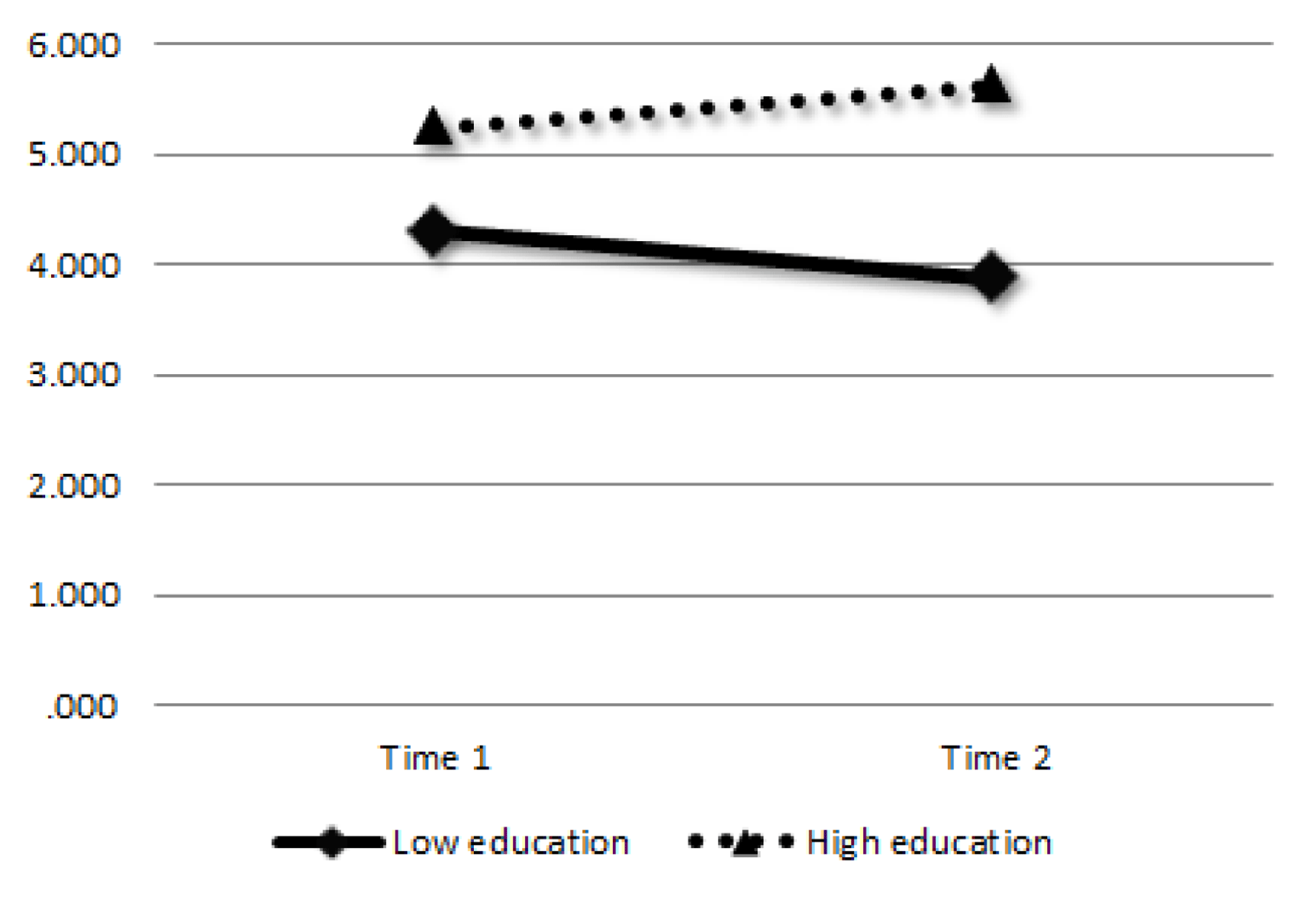
The salience measure (cued recall) produced a statistically significant interaction effect for time by education on nonsocial images, as depicted in Figure 2. Post hoc comparisons showed that this interaction was driven by high-education participants recalling more nonsocial images at Time 2  $(M=11.30,\mathit{SE}=0.74)$ than low-education participants
 $(M=7.78,\mathit{SE}=0.74;F[1,76]=11.30;p=0.001)$. Relating these findings back to RQ5, time seems to negatively affect the recognition levels of nonsocial images for men as well as low-education participants. With regard to salience, time mainly enhances a gap between low- and high-education groups.
Two-way interaction for education by time on nonsocial recall.
Conclusions
The current study explored the remarkable human capacity for social processing across demographic division and in a mediated lifelike news context. The cognitive developmental concept interactive specialization was used as theoretical ground for exploring biologically endowed and socially acquired processing skills. When assessing individual differences in memory, the interactive specialization framework allows interpretations about the plasticity as well as the rigidity of humans.
Gender differences that emerged from the recognition and cued recall data tentatively line up with evolutionary and developmental explanations. Compared with men, women demonstrated higher aptitude for processing social visuals in this study’s mediated setting. At the same time, men outperformed women on nonsocial recognition. Taken together, these findings offer evidence in line with adaptive gender-specialization. Women are better equipped than men to encode social visuals (faces) in accord with the historical role of women as primary caretakers who are socially oriented. Conversely, men showed better disposition than women for encoding nonsocial visuals—which is perhaps a sign of men’s historical adaptation for focused hunting practices that require sharp memory for traversing expansive vistas with precision.
As is evident from Table 1, the education variable delivered robust main effects with large effect sizes. The association of consistent weaker memory with low-education levels may, perhaps too easily, be attributed to differences in processing abilities. In fact, the intersection of education with gender produced results that qualify our interpretation of the education divide. Social recognition differences between men and women were mainly driven by low-education group men, whereas women’s social recognition skills were unaffected by formal education. Women might have a natural aptitude for social perception. However, men seem to acquire social perception skills through education, perhaps to navigate the social realm. Existing literature points to social processing competencies as a requirement for being successful in school and in related achievements (such as income level) later in life. Formal education may enhance social perceptual skills of men to the natural acuity level of women. This observation might, in part, offer insight into patterns of social hierarchy formation. Social processing is arguably a central ingredient for successful social networking and politicking, which have grown exponentially in survival-relevance over the course of human evolution. Through socialization in subtle daily lived experience and through formal education, high-education men might be gaining competencies to forge social connections that open access to levels of the social hierarchy that are out of reach for lower education males.
Entering time into the demographic equation provided additional insights in processing differences and similarities. In terms of recognition memory, gender and education groups did not vary over time on social images. However, men and women and low- and high-education groups were dissimilarly affected by time—at close to significant levels—on nonsocial recognition (see Table 1). This finding might indicate that the social brain of Homo sapiens favors social over nonsocial encoded details in making longer-term memory records. On nonsocial recognition, the gender gap closed (with men recognizing fewer nonsocial images over time), while the education gap widened over time (with the low-education group showing progressive decay). A significant two-way interaction on nonsocial image salience lines up with this recognition memory finding for education. Indeed, the education gap widened on salience of nonsocial images. In aggregate, these findings offer evidence that low-education groups have significantly poorer memory (accuracy and salience) for social images than high-education groups; however, over time, low-education groups retain memory for social images at the same rate as high-education groups. Notably, a time-driven education gap dilated on nonsocial images—with low-education groups exhibiting weaker retention on both accuracy and salience measures than high-education groups. Formal education might extend nonsocial navigation skills, perhaps instilling interest in and opening opportunities for encountering a wide range of spaces and objects.
The current experiment offers an initial exploration of demographic influence on memory for social and nonsocial images. Intrinsic to experimental research is the limitation on generalizing findings generated by this method. More experimental work and methodological triangulation in future explorations of demography’s role in nonsocial and social memory are required to shore up the external validity of the findings reported here. Furthermore, prospective studies may consider including alternative measures of SES. Research has, for example, shown that education loses its predictive value for SES at older ages, particularly in the United States.Reference Robert and House83 The exploration of the influence of other relevant individual differences, such as political ideology, on memory for social and nonsocial images is also worth pursuing.
If there are broad patterns to be found in the current data set, they point to demographic variance in nonsocial and social memory—perhaps as adaptive responses to environmental demands. First, social processing skills seem to be more natural to women, whereas men have some advantage for nonsocial processing. At the same time, the human brain is well equipped for retaining social images. This conclusion can be discerned from the finding that, across demographics, memory did not fade on social measures, whereas nonsocial measures were sensitive to decay. Second, despite potential biological predispositions in memory functions, cognitive skills are acquired to support contemporary navigation practices. In this regard, the current study serves as a reminder that nonsocial and social cognition should be understood in its ecological context. Memory has survival-relevant importance, serving navigational functions that vary across environmental demands and zigzag through gender and education clusters. These pathways are observable in a mediated ecosphere. Given the centrality of media in contemporary life, it might be of immediate pertinence to choose mediated environments to observe variations in nonsocial and social memory functions across demographics.
News media researchers are not known for favoring biological approaches in studying media. When they have used this type of methodology, they have focused on tracking physiological changes to84,Reference Wise, Bolls and Schaefer85 and testing memory of highly arousing, negatively compelling content.Reference Newhagen86,Reference Newhagen and Reeves87 In doing so, it became clear that the lifelike news environment can elicit automatic processing outcomes. The study reported here departs from this body of research, focusing on the daily navigation of humans through the complexities of the social landscape rather than automatic responses in life-threatening scenarios. Social information might have high and lasting relevance to news users compared to the negatively compelling scenes of violence and destruction that dominate news agendas. Both journalism’s early muckraking stories and its more contemporary human-interest stories—in which people and their emotional concerns are central—reflect this social sensibility. There are signs that the news industry is moving toward more personalized reportage; news scholarship might therefore need a pragmatic shift of its own by investigating imagery that resonates with the majority of people, such as visuals with a social character. An interdisciplinary approach—involving neurosciences, evolutionary psychology, other subfields of psychology, and mediated communication—to how the nonsocial and social brain is engaged in an audiovisual media environment will enhance knowledge on how to inform the public in its broadest sense. This approach is likely to inform research that overcomes predictable ontological fracture lines along micro- versus macrolevels of analysis and social versus biological explanations for the extraordinary visual acuity of Homo sapiens.
Acknowledgements
This work was supported by Indiana University grant-in-aid funding.