“Clinton Eclipses Obama and Edwards on Leadership” a Gallup Poll report headlined in January 2007. Gallup chose eight characteristics to determine this assessment, including being most qualified to be president, is the strongest leader, would be the best in a crisis, would manage the government most effectively, and would work the best with Congress.Footnote 1 In a summary of its findings, the report concludes: “Among the characteristics and qualities tested, Clinton's strong points are almost uniformly related to presidential leadership. She holds a formidable lead on many items in this category, including being qualified to be president and being a strong leader” (Saad Reference Saad2007).
The presidency historically has been perceived both implicitly and explicitly as a masculine institution. Candidates for that office “must exhibit both the knowledge and skills necessary for the job and should appear to be strong, assertive, and dominant” (Han Reference Han, Watson and Gordon2003).
The presence in the 2008 election of the most viable female candidate for president cannot help but challenge orthodox views of this institution. This research effort explores one aspect of that challenge: traits attributed to presidential candidates. It examines traits through a gendered lens based on an analysis of survey questions public opinion researchers have asked about presidential candidates' traits and characteristics. Specifically, it explores three areas: What traits have our major public opinion pollsters queried the public about? Has Hillary Clinton's entrance in the presidential primary process led them to ask about different traits? And, have pollsters asked the public to evaluate Senator Clinton on certain traits or characteristics but not other, male, candidates? This research operates under the premise that pollsters reflect contemporary culture in the questions to which they seek answers. At the same time, by the questions they ask, they frame conversations and perspectives about candidates and, therefore, provide a window on the gendered nature of presidential politics. They cue readers to think of and evaluate presidential candidates in certain terms or frames by emphasizing particular traits in their surveys. This analysis should, therefore, help to make visible the masculine nature of the presidency and explore its possible transformation into a more gender-neutral leadership position and office.
Polling in Presidential Elections
Public opinion polls are an integral part of the political and social landscape and are becoming ever more prominent even as getting people to respond to surveys has become more difficult. “They pervade all stages of the presidential selection process,” political scientist Herbert Asher tells us (Reference Asher2007, 160). For the 2008 election, polls about potential presidential candidates began immediately following the vote tally for the 2004 election. For example, a poll Opinion Dynamics conducted for Fox News on November 16–17, 2004, reported that 49% would vote for Rudy Giuliani and 38% would vote for Hillary Clinton in a 2008 possible matchup.
According to Asher, election polls do much more than simply reflect the current standings of the candidates in the presidential contest. “The polls and the reporting of them shape the very course of the campaign” (Reference Asher2007, 160). Traugott and Lavarkas provide a normative perspective on how the information election polls produce serves democracy-enhancing functions. Among other things, for example, they state that:
When the media report “horse-race findings” showing which candidate is leading before a primary or general election or when they report their poll findings about the public's awareness levels and evaluations of candidates and their policy positions, they are providing an important measure of a candidate's viability. We can think of few better ways that public accountability for candidates and their policy stances can be achieved than by the routine reporting of election polls. (Reference Traugott and Lavrakas2000, 6)
Much of social science discussion of polls and the election process focuses on the horse race nature of the polls—who is ahead, who is falling behind, who is supporting whom. Who seems to have the “big mo”? But pollsters have also attempted to gauge the public's perception of candidate characteristics and traits and their strengths and weaknesses as candidates. Little research has been conducted on this aspect of the role of polls in our national elections. As Page has pointed out, “In a presidential system like that of the United States, where a single individual is directly elected the highest office, the personal traits and characteristics of candidates pay a critical part in voters' decisions and in the outcome of elections” (Reference Page1978, 232). This focus on traits, attributes, and candidate characteristics that call attention to political leadership speaks especially to the gendered aspects of our national elections and political leadership as women become viable candidates for that office. A lens on the racial aspects of the 2008 election can also be explored through this trait analysis.
The Presidency as a Masculine Institution
Beyond the general literature on polling in presidential campaigns and the studies of voters' perceptions of women as political leaders, Georgia Duerst-Lahti's work on masculinity and the presidency informs this research on public opinion polling of candidate traits and Hillary Clinton's quest for the presidency with its focus on the gendered aspects of presidential politics and leadership. According to Duerst-Lahti, categories of men and masculinity are frequently central to analyses, “yet they remain taken for granted, hidden and unexamined” (Reference Duerst-Lahti, Carroll and Fox2006, 17; see also Duerst-Lahti Reference Duerst-Lahti and Rosenthal2002). She states that:
Masculinity has been embedded through the traditions that dominate the presidency, but inside those traditions lie more implicit assumptions that make presidential elections masculine space: the test of executive toughness, a preference for military heroes, the sports and war metaphors of debates, and more. Implicit in the gendering of presidential election space is the common belief that the election picks a single leader and commander in chief of “the greatest nation on earth.” (Duerst-Lahti Reference Duerst-Lahti, Carroll and Fox2006, 22)
According to Page, “A cluster of traits almost universally desired in leaders is strength, decisiveness, and potency” (Reference Page1978, 250). The research of Kinder et al. depicts the ideal president as honest, knowledgeable, and open-minded, but neither power hungry nor unstable (Reference Kinder, Peters, Abelson and Fiske1980).Footnote 2 Women's contestation for the presidency makes the masculine nature of that institution and quests for its leadership visible. Duerst-Lahti tells us that gender analysis makes visible what she considers to be not very obvious disqualifiers for women, that of experience, for example. She has also found that “tough” appeared more often in presidential election coverage than any other masculinity word. Tough has not been a word used to describe the distinctiveness of women's candidacies. Women in general are stereotyped as more compassionate and gentle than men; men are typically seen as tougher and more aggressive than women (Huddy and Terkildsen Reference Huddy and Terkildsen1993). Duerst-Lahti bolsters her ideas about the masculinity of the presidency through a content analysis of news media articles on the presidential election process. The research undertaken here on the traits pollsters deem important to ask the public about complements her research.
Duerst-Lahti, building on the work of R.W. Connell, defines two major forms of contemporary masculinity—dominance and technical expertise: “Dominance masculinity is preoccupied with dominating, controlling, commanding, and otherwise bending others to one's will … expertise masculinity emerges from capacity with technology or other intellectualized pursuits” (Reference Duerst-Lahti, Carroll and Fox2006, 28–9). In addition, to simplify, Duerst-Lahti also views gender as having two prominent and equivalent modes, masculinism and feminalism. Feminalism is defined as an ideology that begins from and generally prefers that which is associated with feminality, the feminale and females. She uses the term feminale, which derives from the word female, or qualities associated with females, rather than feminism, because conservative women's political thought can then be incorporated into a single woman-based framework that also includes feminist women. Feminine is not used as it elicits a certain stereotypical perspective that we would like to avoid. Masculinism and feminalism are concepts that will anchor this research into trait survey measurement by presidential opinion polling.
To examine the gendered nature of public opinion surveys on trait questions, I compiled a database of all of the traits and characteristics pollsters queried the public about regarding presidential candidates in the year preceding the election for the 2000 and 2008 campaigns. The traits are categorized into domains and masculine, feminale, and neutral frames. I used the survey archives of the Roper Center at the University of Connecticut to compile the sets of trait questions. I then examined the years 1999 and 2007 for all trait questions asked about George W. Bush and Al Gore (1999) and Hillary Clinton, Barack Obama, John Edwards, John McCain, Mitt Romney, and Rudy Giuliani (2007), the leading candidates in each party during those timeframes. I chose these years immediately preceding the actual election year as they represent the period in which candidates are introducing themselves to the public, and particularly in 2007 when so much of the 2008 election campaign activity was already advancing very publicly.Footnote 3 These pre-election years are also the time in which pollsters would be most free in their selection of traits to survey about and thus contribute to a framing of the election regarding presidential character.
In this research effort I have compiled only questions that clearly ask about traits.Footnote 4 The traits asked about here are grouped into categories informed by the work of Duerst-Lahti, various gender stereotype studies such as Huddy and Terkildsen's in 1993, and face validity.Footnote 5 Women candidates, for example, have been stereotyped as more likely to be compassionate and honest, and male candidates are more likely to be strong leaders and knowledgeable. So we would want to assess this database to determine what traits pollsters have focused on in querying the public about presidential candidates and whether the presence of Hillary Clinton, a woman in the 2008 presidential race, stimulated a distinctive set of trait inquiries that expand possible presidential qualities to include more feminale characteristics.
The constructed database takes the following form for analysis purposes. (In the database, rows or records are a trait question; columns are the candidates.) A question about a trait was considered one record (or row) in the data set in any of the following situations: (1) if a particular candidate was evaluated on a specific trait with no reference to other candidates; (2) if respondents were to rate comparatively a number of candidates on a particular trait, for example, “Regardless of who you may support for the 2008 Democratic candidate for president, who do you think has the best experience to be president—Clinton, Obama, or Edwards?” (one question, each candidate gets a rating on it); or (3) if a set of candidates were rated separately on a particular trait. (For example, a Time magazine survey in November 2007 asked a sample of registered voters: “Thinking about Arizona Republican Senator John McCain, in your opinion how well do each of the following describe this candidate for president in 2008 … strong moral character?” The same question was asked of former Republican Massachusetts governor Mitt Romney.) Thus, the number of ratings (each candidate on each trait) is larger than the pool of trait questions for each year.
1999 and 2007 Trait Question Queries
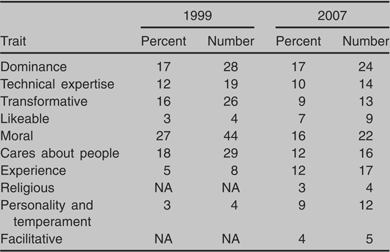
For the 2000 election in 1999, 162 items rated George Bush and/or Al Gore on various traits. In 2007, a total of 138 items asking about Democrats Hillary Clinton, Barack Obama, and John Edwards and Republicans John McCain, Rudy Giuliani, and Mitt Romney—the major contenders for their party's 2008 presidential nomination at that time—were coded as trait questions. They group into 10 categories.Footnote 6 Table 1 shows the categories and their distribution for both elections. Two of the categories fall into masculine domains: dominance and technical expertise. Three of the categories could be considered as more feminale in nature: likeable, moral, and cares about people. The categories of transformative, experience, and personality and temperament would be considered more neutral traits. The facilitative trait that appears in 2007 might fall into the feminale domain based on its relationship to Cindy Simon Rosenthal's integrative style of leadership that women legislators exemplify in which leaders “educate, listen, empower others” and “facilitate the discovery of shared goals” (Reference Rosenthal1998, 22; see also Kathlene Reference Kathlene1994). The religious category that emerged in 2007 only consisted of four items of which three were asked of the Republican candidates.
Trait Questions, 1999 and 2007

In 1999, the moral category was the modal category that consisted of a variety of items as indicated in its description. What is most intriguing about the population of trait questions asked by survey researchers in the year leading up to the 2000 election is that masculinity as reflected in the dominance and expertise categories did not dominate. Together the moral, cares about people like you, and the likeable domain constituted about half of the inquiries about each candidate. We seem to find a disjuncture between the focus of media assessments of the presidency and the attention of pollsters who may be drawing their cues even at the early stages of the campaign from voter concerns about the potential candidates and their particular personas.
Comparing and contrasting the trait domains and their distribution between 1999 and 2007, we see that Hillary Clinton's presence in the race in 2007 did not seem to enhance attention to masculine traits. For example, in both years dominance traits comprised 17% respectively of the questions. At the same time, moral questions declined nine percentage points and cares about people decreased by eight points suggesting less attention to the feminale aspect of the presidency. The three feminale categories together declined to 35% from 48%. However, if we add in facilitative as a feminale characteristic it increases the overall feminale categories in 2007 to 39%, still somewhat lower than in 1999. Experience increases in 2007. Interestingly, transformative trait questions decline from 16% to 9% between 1999 and 2007, although as will be shown later, transformative trait questions rise sharply in the early months of 2008 most likely in response to Barack Obama's surge in the Democratic primaries with his message of “change.”
Candidates and Trait Questions
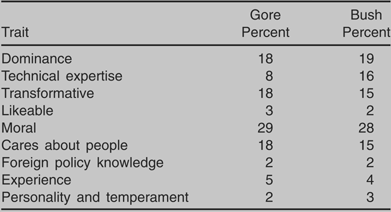
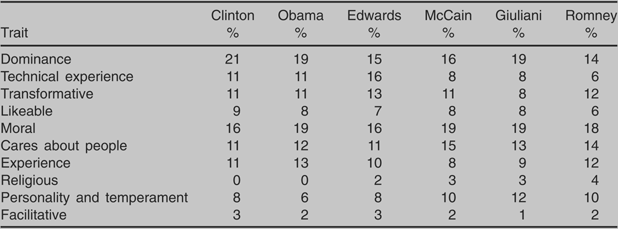
In 1999, a total of 129 questions rated Al Gore on various attributes and George Bush was queried 108 times. In 2007, Hillary Clinton led in the number of queries about traits with 105. She was followed by Barack Obama with 86. Rudy Giuliani was evaluated on personal characteristics about 75 times while John McCain and John Edwards had 62 ratings and Mitt Romney had 49. Tables 2 and 3 show the distribution for all of these candidates across the trait categories.
Trait Questions, Al Gore and George Bush, 1999

Trait Questions by Candidate, 2007

The first conclusion one can make from an examination of the percentages across candidates is that in each election candidates were not especially distinguished by the type of traits they were rated on. When pollsters decided to ask about a trait they tended not to focus on a single candidate but to ask for ratings across candidates. Thus, for purposes of this paper, what is meaningful is that Senator Clinton was not singled out for testing on a particular set of traits, whether masculine or feminale.Footnote 7
Curiously, given the stress in the literature on the presidency of being “tough,” the public in 1999 was only asked twice about the toughness of Bush or Gore. In separate questions in September, Gallup asked respondents whether being tough enough for the job applied to Al Gore (50% said it did apply and 45% said it did not apply) and whether it applied to George Bush (76% applies, 17% does not apply). In June, a Time/CNN poll asked whether the description “tough enough for the job” applied to Al Gore or George Bush (47% said Bush and 30% said Gore).
Asked in a September 2007 Pew Poll “who comes to mind when the word ‘tough’ is said—Hillary Clinton, Barack Obama or John Edwards,” 67% picked Clinton, 14% chose Obama, and 7% said Edwards. Pew also asked in an October poll question whether respondents thought of Hillary Clinton as tough; 78% respondent said yes. Her Democratic opponents were not rated in this poll but 39% rated Rudy Giuliani as tough, 26% John McCain, and 18% Fred Thompson. Thus, at least early in the campaign Hillary Clinton seemed to be passing the masculine “tough test” for the presidency.
I have pulled out four traits for more intensive inspection because of their relevance to masculine and feminale leadership characteristics beyond tough: commander in chief, strong leader, honest and trustworthy, and likeable. I use these traits to compare Senator Clinton on the campaign trail for the presidency to her male predecessors and her male counterparts.
The candidates were not asked about their qualifications to be commander in chief during 1999 except in one poll in the context of military action in Serbia. An NBC News/Wall Street Journal poll in April 1999 asked respondents how much confidence they would have in Al Gore or George Bush as commander in chief during this period of military action (in Serbia)—“a great deal, quite a bit, just some, or very little?” Only 21% expressed a great deal or quite a bit of confidence in Gore while 43% expressed such confidence in Bush.
The biggest difference in attention to particular traits between the two candidates were in the areas of technical expertise, where rating Bush on this trait was more pervasive than Gore, and the moral and cares about people domains, in which pollsters had more questions about Gore. Pollsters may have presumed that Gore possessed technical expertise given his background and focus in the policy area whereas questions about Bush's competence to be president swirled around his quest for the office.
Pollsters asked the public 12 times whether the characteristic “strong leader” applied to or described Al Gore. He did not rate particularly high on this masculine trait. His highest score of 54% was obtained in December in an ABC/Washington Post poll while 41% said it did not apply to him. Bush tended to receive higher scores on being a strong leader throughout 1999. (The public was queried 16 times about whether the strong leader trait applied to him.) In terms of leadership qualities, 71% responded that he possessed these in a May Newsweek poll.Footnote 8 Bush tended to out rate Gore on this trait in comparative matchups. For example, asked in June 1999 whether they thought the description “a strong and decisive leader” applied more to Al Gore or George W. Bush, 53% said Bush and 27% said Gore. In a November matchup, Bush was described as more powerful than Gore by 55% to 27%.
Focusing on items that directly asked about honesty, trustworthiness, and morals, 14 questions asked the public to rate Al Gore and 10 questions asked them to rate George W. Bush. Over 60% of respondents tended to quite consistently rate Bush as being honest and trustworthy or having a high moral character. Al Gore also averaged a 60% rating on being honest and trustworthy. In a November Fox News poll comparative matchup, 48% thought that a likeable person better described George Bush while 29% thought it better described Al Gore. In separate Pew Center questions in October 63% thought Al Gore impressed them as personally likeable and 74% thought George Bush was personally likeable.
Turning to the 2008 campaign, regarding the role of commander in chief, the public was asked five times in 2007 to rate Senator Clinton. Two of these questions were in a comparative context with her two main rivals. The public was continually split in their ratings of her as commander in chief, but consistently throughout this period her positive ratings outpaced her negative ratings and she beat her opponents (Table 4).
Ratings of Hillary Clinton as Commander in Chief, 2007

NA = not applicable
Page tells us that “Americans generally seek personal warmth in their presidents, and most especially so after traumatic times of civil discord or foreign failure” (Reference Page1978, 243).Footnote 9 The trait of likeability captures this characteristic most closely in these polls. That trait became a focal point in the primary election when in a New Hampshire debate Clinton was asked why people seemed to like Obama more than her. “ ‘Well, that hurts my feelings,’ she said. The audience laughed. ‘But I'll try to go on. He's very likeable. I agree with that. I don't think I'm that bad.’ ‘You're likeable enough,’ Obama replied” (Lightman Reference Lightman2008). The Obama response was viewed as being somewhat petulant in news commentaries. Obama consistently beat Clinton in likeability in the polls in 2007. In two matchups, Obama was rated 10% more likeable than Clinton. In a separate rating in June, 56% said Clinton was likeable, 64% said McCain was likeable, and 76% said Obama was likeable. Here are indications of her strength in terms of the masculine dimensions of the presidency but some weakness on the more feminale aspects. This finding continues when we examine poll questions on honesty.
Asked three times whether Clinton was honest and trustworthy, respondents tended to split about 50-50 in their responses whereas Obama tended to get about a two to one positive split. In eight matchups, Obama outpolled Clinton in five of the polls while Clinton had the edge in three.
Experience was by far the outstanding trait for Clinton to exploit in her run for the presidency as she did with her message of “ready on Day One.” Throughout 2007 she bested her opponents when asked who had the “right experience” and the “best experience.” For example, in a December 2007 ABC News/Washington Post poll, 73% said Clinton, 8% said Obama, and 17% said Edwards when asked “who has the best experience to be president?”
2008
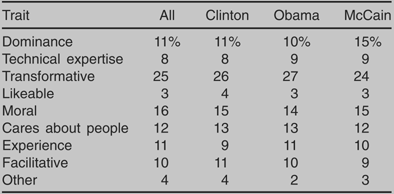
The main point of this research has been to explore the construction of presidential traits by pollsters in the formative period of presidential elections. Thus, particular attention has been paid to trait questions in the year preceding the election. But in this section, as the 2008 primary season for the Democrats remained hotly contested during the first half of the year, I analyze whether the particular aspects of the candidates' campaigns caused pollsters to change their questions in response to campaign dynamics. As Table 5 shows, dominance declines while transformative and facilitative characteristics increase in the first three months of 2008. Transformative attributes reflect Obama campaign's emphasis on change. The transformative questions center on whether the candidate was seen as being inspiring, would bring about change, or had a vision for the future. The facilitative trait questions primarily focus on “uniting the country.” Few trait questions were asked of only one candidate, although pollsters queried about John McCain (59 questions) less often than Hillary Clinton (85 questions) or Barack Obama (88 questions).
Trait Questions, January–March 2008

Inspiring, having a vision for the country's future, and able to bring about change were the primary transformative items in 2008. Obama far outpaced Clinton in terms of being inspiring—70% tended to find him inspiring compared with Clinton's rating of 49% (with an equal percentage saying she was not inspiring). McCain suffered in comparison with Obama, also with only 48% in January 2008 rating him as inspiring and 48% not aspiring in the one poll. Interestingly Obama and Clinton scored nearly the same when the public was asked whether they had a vision for the country's future with about 70% consistently responding positively for both candidates. Obama did outpace Clinton by 10 points in the one comparative matchup about the future.
If we trace Hillary Clinton's ratings on the different categories of presidential traits focusing on strong leader, honest, likeable, and experience, we find little variance over time. For example 69% rated her as a strong leader in January of 2007 and 68% gave her the same rating in March of 2008; 47% rated her as honest in June 2007 and 44% gave her that rating in March of 2008; 56% said she was likeable in June 2007 and 44% found her likeable in March 2008. Finally, regarding having the right experience, she scored 59% in January 2007 and 60% in March 2008. The traits she scored highly on at the beginning of the campaign she scored highly on after months of voting, debating, and facing various storms. The traits she had more mixed ratings on in early 2007 were the same traits she had mixed ratings on at the end of the first quarter of 2008.
Conclusion
Candidate traits weigh importantly in the decisions voters make when choosing a president. We learn about the public's perceptions of our would-be national leader from the many surveys taken during presidential campaigns that ask about candidate traits, attributes, and characteristics. By choosing a set of trait questions, asking the public to rate candidates on them, and publicizing the results, pollsters frame this significant aspect of the election. The pollsters serve as independent actors in the electoral process. They are free to define the leadership characteristics that serve as the basis of voter decision making. One would expect them to enhance the masculine nature of the office by stressing masculine traits and how candidates are rated on them. This study has tested that assumption. I have found that the pollsters have queried the public about masculine traits, feminalist traits, and gender-neutral or mixed characteristics in the 2000 and 2008 presidential elections. Hillary Clinton was not singled out for special attention on any of these domains. She was rated on masculine, feminale, and neutral traits, as was Barack Obama and John McCain in the 2008 campaign. I did not find pollsters continuously asking samples of voters to rate Senator Clinton on her toughness or readiness to be commander in chief but not querying the public about the other contenders for the presidency on these traits. Nor did pollsters focus disproportionate attention on feminalist traits in regard to Senator Clinton. If anything, the 2000 campaign saw greater attention in the polls to feminale characteristics than the 2008 campaign. The polls have provided us with a range of characteristics that voters might seek in their leaders. They seem to provide a broader perspective on what presidential leadership consists of than more general media focus as reflected in Duerst-Lahti's work. On the other hand, McCain only received 59 queries on traits compared to 85 for Clinton and 88 for Obama, perhaps in part because of McCain's early capturing of the Republican nomination. While Obama's personal traits might be seen as unknown to the public, the same could hardly be said for the “well-known” Clinton. This pattern suggests that pollsters indeed were testing the public for gender and race reactions to the president, a spot in which traits and stereotypes were difficult to disentangle. This attention in turn suggests that white males, especially high-profile white males, remain the norm for judging the presidency.
I have found that Hillary Clinton did better on masculine traits than feminale traits. While pollsters do not successfully cue contradictions between feminale expectations and those of the presidency, reactions to her “tear up” moment in New Hampshire suggest some aspects of personal and institutional gender remain in play. One place where gender seems to enter problematically is, as Carol Hardy-Fanta has stated, that Clinton was forced in a potential contraction “to prove not only that she is serious and tough but also likeable” (Milligan Reference Milligan2008).
The end of the Democratic primary season in June 2008 has heightened discussion, debate, and editorial comments on the extent to which sexism and misogyny played a role in the 2008 nomination process. There is also much speculation about whether Hillary Clinton's campaign for the presidency and responses to it has hurt or helped women in expanding their presence in political leadership positions. Would her campaign stimulate more girls to view the presidency, and political leadership more generally, as an option for themselves or discourage them because of how Clinton was treated? Will the cruel comments she faced along the campaign trail as well as some evidence of media bias discourage younger women?
Extrapolating from the polling on traits investigated in this piece suggests important improvements from Clinton's performance in the campaign. Competency, strength, and experience, which once were viewed as the biggest hurdles for women candidates to surmount in the minds of the public, proved not to be the disadvantage they once were. This finding should empower women. Rather the problem for Clinton seemed to be that of the Catch-22 of combining positive assessments on those traits while maintaining an advantage on the more feminalist traits. This combination likely will be the hurdle for future female seekers of the presidency.