1 Introduction
Dependency parsing is the problem of assigning dependency structures to sentences that represent their syntactic properties. Dependency structures are typically trees such that all words but the root of the sentence, typically the main verb, have unique syntactic heads. The dependencies between heads and dependents are typically labeled by grammatical functions, such as subject, object or modifier. Consider, for example, the dependency structures in Figure 1.
Derived dependency structures from the Penn-III treebank of English and the TIGER treebank of German.

In the relative clause in the English sentence, for example, the head of the word advertising is the verb works. This can be seen from following the in-coming edge from advertising. The dependency label indicates that advertising is the subject of the verb. Note that the main verbs also have heads. The main verbs are roots of the sentences, but they are attached to an artificial root node so that we can think of parsing as the problem of assigning a syntactic head to every word (in a way that avoids producing cycles). Note also the difference between the English and German structures. The German structure contains crossing edges; this property is referred to and formally defined below as non-projectivity.
In supervised dependency parsing, parsing models are learned from large collections of sentences annotated with dependency structures (treebanks), but in this paper we consider the more difficult problem of unsupervised dependency parsing, which is the problem facing us when we want to parse languages for which no treebanks are available.
Unsupervised dependency parsers do not achieve the same quality as supervised or semi-supervised parsers, but in some situations precision may be less important compared to the cost of producing manually annotated data. Moreover, unsupervised dependency parsing is attractive from a theoretical point of view as it does not rely on a particular style of annotation and may potentially provide insights about the difficulties of human language learning.
Unsupervised dependency parsing has seen rapid progress recently, with error reductions of almost 30% on English in six years (Schwartz et al. Reference Schwartz, Abend, Reichart and Rappoport2011) and better results for other languages (Gillenwater et al. Reference Gillenwater, Ganchev, Graca, Pereira and Taskar2010; Naseem et al. Reference Naseem, Chen, Barzilay and Johnson2010), but results are still far from what can be achieved with small seeds, language-specific rules (Druck, Mann and McCallum Reference Druck, Mann and McCallum2009) or using cross-language adaptation (Smith and Eisner Reference Smith and Eisner2009; Spreyer and Kuhn Reference Spreyer and Kuhn2009; McDonald, Petrov and Hall Reference McDonald, Petrov and Hall2011; Søgaard Reference Søgaard2011).
The standard method in unsupervised dependency parsing is to optimize the overall probability of the corpus by assigning trees to its sentences that capture general patterns in the distribution of part-of-speech (POS). This happens in several iterations over the corpus. This method requires clever initialization, which can be seen as a kind of minimal supervision. State-of-the-art unsupervised dependency parsers, except Seginer (Reference Seginer2007) and Spitkovsky et al. (Reference Spitkovsky, Alshawi, Chang and Jurafsky2011a), also rely on manually annotated text or text processed by supervised POS taggers. Since there is an intimate relationship between POS tagging and dependency parsing, the POS tags can also be seen as a seed or a partial annotation. Inducing a model from the corpus is typically a very slow process.
This paper presents a new and very different approach to unsupervised dependency parsing. The parser does not induce a model from a big corpus, but only considers the sentence in question.Footnote 1 The obvious advantage of not relying on training data is that we do not have to worry about whether the test data reflect the same distribution as the target data (sample bias), and since our models are much smaller, parsing will be very fast.
The parser assigns a dependency structure to a sequence of words in two stages. It first decorates the n nodes of what will become our dependency structure with word forms, constructs a directed acyclic graph from the nodes and ranks them using iterative graph-based ranking (Brin and Page Reference Brin and Page1998). Subsequently, it constructs a tree from the ranked list of words using a simple  (n 2) parsing algorithm.
Our parser is evaluated on the selection of twelve dependency treebanks also used by Gillenwater et al. (Reference Gillenwater, Ganchev, Graca, Pereira and Taskar2010), and we compare our results to state-of-the-art in multilingual unsupervised dependency parsing (Gillenwater et al. Reference Gillenwater, Ganchev, Graca, Pereira and Taskar2010; Naseem et al. Reference Naseem, Chen, Barzilay and Johnson2010). Evaluation and error analysis are presented in Sections 4 and 5. In Section 6, we also evaluate a version of our parser that is not at all informed by POS.
1.1 Preliminaries
The observed variables in unsupervised dependency parsing are a corpus of sentences s = s 1,. . ., sn where each word wj in si is associated with a POS tag pj. The hidden variables are dependency structures t = t 1,. . ., tn where si labels the vertices of ti. We assume that dependency structures are trees. Each vertex has a single incoming edge, possibly except one called the root of the tree. In this work and in most of the other works in dependency parsing, we introduce an artificial root node so that all vertices decorated by word forms have an incoming edge.
The dependency structures in Figure 1 are trees decorated with labels and augmented with a linear order on the nodes. Each edge (i, j) is referred to as a dependency between a head word wi and a dependent word wj and sometimes written as wi → wj. Let w 0 be the artificial root of the dependency structure. We use →+ to denote the transitive closure on the set of edges. Both nodes and edges are typically labeled, but in unsupervised dependency parsing, edge labels are typically ignored. Since a dependency structure is a tree, it satisfies the following three constraints: A dependency structure over a sentence s: w 1,. . ., wn is connected, i.e.

In other words, there is a path from the root to all nodes. A dependency structure is also acyclic, i.e.

This formula says, you can never reach the same node following a non-empty path, which also implies that all paths are finite. Finally, a dependency structure is single-rooted, i.e.

The last formula says that the artificial root node only has a single dependent. If we also require that each vertex other than the artificial root node has an incoming edge, we have a complete characterization of dependency structures. In sum, a dependency structure is a tree with a linear order on the leaves where the root of the tree for practical reasons is attached to an artificial root node. The artificial root node makes it easier to implement parsing algorithms.
Finally, we define projectivity, i.e. whether the linear order is projective with respect to dependency tree, as the property of dependency trees that if wi → wj, it also holds that all words in-between wi and wj are dominated by wi, i.e. wi →+wk. Intuitively, a projective dependency structure contains no crossing edges. Projectivity is not a necessary property of dependency structures. Some dependency structures are projective, others are not. Most if not all previous works in unsupervised dependency parsing have focused on projective dependency parsing, building on work in context-free parsing, but our parser is guaranteed to produce well-formed non-projective dependency trees. Our parser will only be able to produce a subclass of all possible non-projective dependency trees; we return to this issue later on. Non-projective parsing algorithms for supervised dependency parsing have, for example, been presented in McDonald et al. (Reference McDonald, Pereira, Ribarov, and Hajič2005) and Nivre (Reference Nivre2009). Unsupervised learning algorithms for non-projective dependency parsing have been introduced in McDonald and Satta (Reference McDonald and Satta2007) and Cohen, Rodriguez and Satta (Reference Cohen, Rodriguez and Satta2011b).
1.2 Related work
Dependency Model with Valence (DMV) by Klein and Manning (Reference Klein and Manning2004) was the first unsupervised dependency parser to achieve an accuracy for manually POS-tagged English above a right-branching baseline.
Dependency model with valence is a generative model in which the sentence root is generated and then each head recursively generates its left and right dependents. For each si ∈ s, ti is assumed to have been built the following way: The arguments of a head h in direction d are generated one after another with the probability that no more arguments of h should be generated in direction d conditioned on h, d and whether this would be the first argument of h in direction d. The POS tag of the argument of h is generated for given h and d. Klein and Manning (Reference Klein and Manning2004) use expectation maximization (EM) to estimate probabilities with linguistically biasing initialization.
Smith and Eisner (Reference Smith and Eisner2005) use contrastive estimation instead of EM, while Smith and Eisner (Reference Smith and Eisner2006) use structural annealing to penalize long-distance dependencies initially, gradually weakening the penalty during training. Cohen, Gimpel and Smith (Reference Cohen, Gimpel and Smith2008) use Bayesian priors (Dirichlet and Logistic Normal) with DMV. All of the above approaches to unsupervised dependency parsing build on the generative model introduced by Klein and Manning (Reference Klein and Manning2004) with different additional assumptions based on linguistic intuition.
In a similar way Gillenwater et al. (Reference Gillenwater, Ganchev, Graca, Pereira and Taskar2010) try to penalize models with a large number of distinct dependency types by using sparse posteriors. They evaluate their system on eleven treebanks from the CoNLL 2006 Shared Task and the Penn-III treebank and achieve state-of-the-art performance.
Headden, Johnson and McClosky (2009) extended the DMV model with additional valence and lexical information.
An exception to using linguistically biased priors is Spitkovsky, Alshawi and Jurafsky (Reference Spitkovsky, Alshawi and Jurafsky2009), who use predictions on sentences of length n to initialize search on sentences of length n + 1. In other words, their method requires no manual tuning and bootstraps itself on increasingly longer sentences.
A very different, but interesting, approach is taken in Brody (Reference Brody2010), who use methods from unsupervised word alignment for unsupervised dependency parsing. In particular, he sees dependency parsing as directional alignment from a sentence (possible dependents) to itself (possible heads) with the modification that words cannot align to themselves; following Klein and Manning (Reference Klein and Manning2004) and the subsequent papers mentioned above, Brody (Reference Brody2010) considers sequences of POS tags rather than raw text. Results given below are state-of-the-art, but in some cases better than the DMV model.
2 Ranking dependency tree nodes
The main intuition behind our approach to unsupervised dependency parsing is that the nodes near the root in a dependency structure are in some sense the most important or the most central ones. Semantically, the nodes near the root typically express the main predicate and its arguments. Iterative graph-based ranking (Brin and Page Reference Brin and Page1998) was first used to rank webpages according to their centrality, and now the technique has found wide applications in natural language processing. Variations of the PageRank algorithm presented by Page and Brin (1998) have been used in keyword extraction and extractive summarization (Mihalcea and Tarau Reference Mihalcea and Tarau2004), word sense disambiguation (Agirre and Soroa Reference Agirre and Soroa2009) and abstractive summarization (Ganesan, Zhai and Han Reference Ganesan, Zhai and Han2010). In this paper we use it as the first step in a two-step unsupervised dependency-parsing procedure to rank words by centrality.
The parser assigns a dependency structure to a sequence of words in two stages. In the first step, it ranks the words in the input sentence using iterative graph-based ranking. In the second step, it constructs a tree from the ranked list of words using a simple (n 2) deterministic parsing algorithm. This section describes the graph construction step in some detail and briefly describes the used iterative graph-based ranking algorithm.
2.1 Edges
The graph over the words in the input sentence is constructed by adding directed edges between the word nodes. The edges are not weighted, but multiple edges between nodes will more likely make transitions between these nodes in iterative graph-based ranking.
Some of the edge assignments discussed below may seem rather heuristic. The edge template was developed on development data from the English Penn-III treebank (Marcus, Marcinkiewicz and Santorini 1993). Our edge selection was incremental considering first an extended set of candidate edges with arbitrary parameters and then considering each edge type at a time. If the edge type was helpful, we optimized any possible parameters (say context windows) and went on to the next edge type, otherwise we disregarded it. Following Gillenwater et al. (Reference Gillenwater, Ganchev, Graca, Pereira and Taskar2010), we apply the best setting of English to all other languages.
Short edges. Eisner and Smith (Reference Eisner and Smith2005) used soft constraints to favor short dependencies. Guided by a similar intuition, we add links between all words and their neighbors. This makes probability mass flow from central words to their neighboring words. It also guarantees that the final graph is connected (which will be important, since we use iterative graph-based ranking without random restarts).
Function words. We use a keyword extraction algorithm without stop word lists to extract function or non-content words. The algorithm is a crude simplification of TextRank (Mihalcea and Tarau Reference Mihalcea and Tarau2004) that does not rely on linguistic resources so that we can easily apply it to low-resource languages. Since we do not use stop word lists, highly ranked words will typically be function words.Footnote 2 For the fifty most highly ranked words, we add additional links from their neighboring words. This will add additional probability mass to the function words. This is relevant to capture structures, such as prepositional phrases, where the function words take content words as complements.
Morphological inequality. If two words, wi,wj, have different prefixes or suffixes, i.e. the first two or last three letters, we add an edge between them.
Verb edges. All words are attached to all words with a POS tag beginning with ‘V. . .'. This captures the fact that verbs are syntactically and semantically important in all languages that we know. We then add links from all verbs to all nouns. While this obviously gives semantics to the POS of verbs and nouns, we note that this is very similar in spirit to the approach to unsupervised dependency parsing taken in Naseem et al. (Reference Naseem, Chen, Barzilay and Johnson2010), to which we return later on, except much simpler. In a way, the verb edges encode the universal dependency rules root→verb and verb→noun (see Figure 5).
The verb edges are the only edges that rely on POS. So these edges are left out when we evaluate in Section 7 an unsupervised dependency parser that is not at all informed by POS.
2.2 Ranking
Given the constructed graph, we rank the nodes using the algorithm of Page and Brin (1998), also known as PageRank. The PageRank algorithm proceeds as a random walk on the graph. The analogy of the determined web surfer tirelessly clicking hyperlinks on web pages comes from the original paper introducing this algorithm (Brin and Page Reference Brin and Page1998). A different analogy would be that of a no less determined drunkard touring the bars and pubs of his home town. The drunkard dutifully writes down the number of times he has visited different places. His route is not planned ahead. Each bar keeps a list of suggested places to visit, and whenever he decides to leave a bar, he picks a destination off of that bar's list at random. The PageRank value of a bar is the number of visits the bar gets out of the total number of bar visits. In most applications, the web surfer restarts with some probability; in our analogy, the drunkard experiences a blackout. The damping factor is the probability of not randomly restarting. However, in our experiments the damping factor is set to 1.0, meaning there are no random restarts. Since our graphs are connected, we will never get trapped anywhere in our word graphs.
More formally, the input to the PageRank algorithm is any directed graph G = 〈 E, V〉 and the output is an assignment PR: V →  of a score, also referred to as PageRank, to each vertex in the graph such that all scores sum to 1. A simplified version of PageRank can be defined recursively as follows:
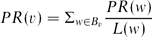
where Bv is the set of vertices such that (w, v) ∈ E, and L(w) is the number of outgoing links from w, i.e. |{(u, u′)|(u, u′) ∈ E, u = w}|. Page and Brin (1998), as already mentioned, introduces a damping factor (typically 0.85) to reflect that fact that Internet users do not continue crawling web sites forever, but restart, returning to random web sites. This influences centrality judgments and therefore should be reflected in the probability assignment. Since there is no obvious analogue of this in our case, we simplify the PageRank algorithm and do not incorporate random restarts (or equivalently, set the damping factor to 1.0).
Note that although our graphs are non-weighted and directed, like a graph of web pages and hyperlinks (and unlike, for example, the text graphs in Mihalcea and Tarau Reference Mihalcea and Tarau2004), several pairs of nodes may be connected by multiple edges, making a transition between them more probable. Multiple edges provide a coarse weighting of the underlying minimal graph.
2.3 Example
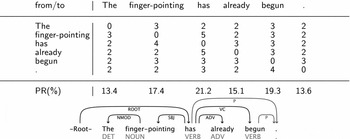
In Figure 2, we see an example graph of word nodes, represented as a matrix, and a derived dependency structure.Footnote 3 We see that there are three edges from The to finger-pointing and two from The to has, for example. We then compute the PageRank of each node using the algorithm described in Page and Brin (1998); see also Figure 2. The PageRank values rank the nodes or the words. In Section 3, we describe a method for building a dependency tree from the ranking of nodes. This method will produce the correct analysis of this sentence except for punctuation (see Figure 2). This is because the PageRank scores reflect syntactic superiority; the root of the sentence typically has the highest rank, and the least important nodes are ranked lowly.
Graph, pagerank (PR) and predicted dependency structure for sentence 7 in PTB-III Section 23.

3 From ranking of nodes to dependency trees
Our non-projective parsing algorithm makes reference to the universal dependency rules introduced in Naseem et al. (Reference Naseem, Chen, Barzilay and Johnson2010). The rules are in fact what make our parsing algorithm non-projective. In order to apply universal dependency rules to all languages, we replace POS tags with the corresponding tags in the twelve-tag ‘universal’ POS tagset presented in Petrov, Das and McDonald (2011); see the tags that decorate the nodes in Figure 2. However, we first introduce our parsing algorithm without universal rules. The algorithm described in the first subsection thus only produces projective dependency trees.
3.1 Without universal rules
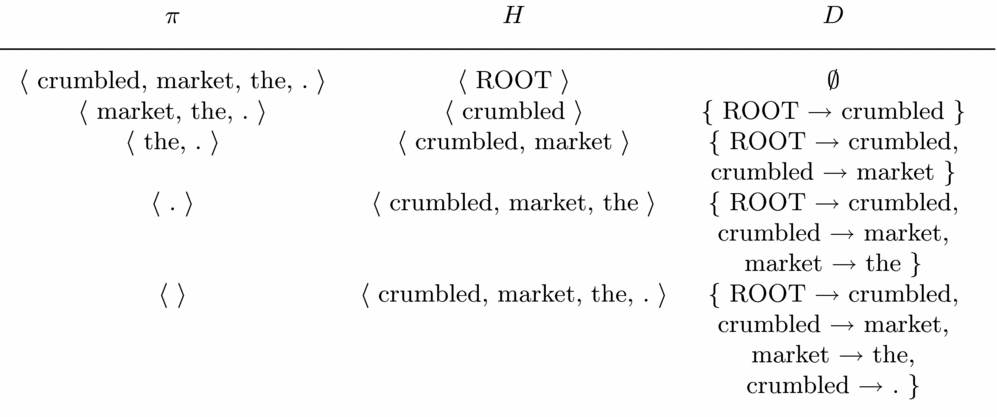
Consider again the example given in Figure 2. Once we have ranked the nodes in our dependency structure, we build a dependency structure from the ranking using the parsing algorithm in Figure 3. The input of the graph is a list of ranked words π = 〈 n 1,. . ., nm〉, where each node ni corresponds to a sentence position n pr2ind(i) decorated by a word form w pr2ind(i), where pr2ind: {1,. . ., m} → {1,. . ., m} is a mapping from rank to sentence position. Note that H[c:] is list slice notation used to indicate that when c = 1, the first element on the list H is ignored.
Parsing algorithm without universal dependency rules.

The interesting step in the algorithm is the head selection step. Each word is assigned a syntactic head taken from all the words that were already assigned heads. Of these words, we simply select the closest possible head. While this is not stated explicitly in the pseudocode, if two possible heads are equally close, we select the one with the highest PageRank.
Our parsing algorithm runs in (n 2), since it runs over the ranked words in a single pass considering only previously stored words as possible heads, and guarantees connectivity, acyclicity and single-rootedness, and thus produces well-formed non-projective dependency trees. To see this, remember that well-formed dependency trees are such that all nodes but the artificial root nodes have a single incoming edge. This follows immediately from the fact that each node is assigned a head (line 11). Furthermore, the dependency tree must be acyclic. This follows immediately from the fact that a word can only attach to a word with higher rank than itself. Connectivity follows from the fact that there is an artificial root node and all words are attached to this node or to nodes dominated by the root node. Finally, we ensure single-rootedness by explicitly disregarding the root node once we have attached the node with the highest rank to it (lines 6–7). Our parsing algorithm also guarantees projectivity, however, since we always select the closest possible head. Say we have a dependency from w 2 to its dependent w 5, where wi is the word in the ith position. If we were to select a head for w 3 now, it would not be possible to select w 1 or w 6, since w 2 is already in the set of possible heads H that we have to consider.
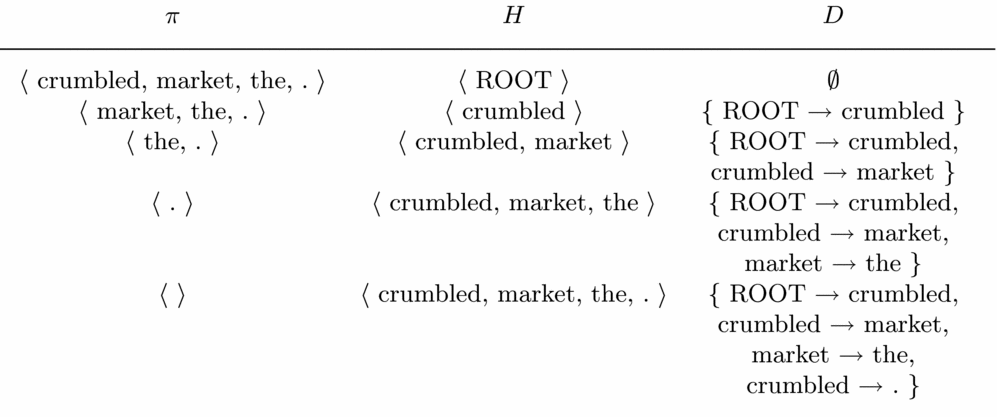
The derivation of a simple Penn-III sentence ‘The market crumbled.’ is given in Figure 4.
Example derivation.
3.2 With universal rules
Naseem et al. (Reference Naseem, Chen, Barzilay and Johnson2010) introduced universal dependency rules as linguistic priors or soft constraints in unsupervised dependency parsing. The intuition is that we should be able to make use of what we know languages have in common. The universal dependency rules proposed in their paper are presented in Figure 5 with few revisions.
Universal dependency rules (Naseem et al., Reference Naseem, Chen, Barzilay and Johnson2010) with our revisions.

Converting the universal dependency rules to the tagset proposed by Petrov et al. (Reference Petrov, Das and McDonald2011) caused one rule to fall out, since the tagset does not have a category for aux; see the discussion in Petrov et al. (Reference Petrov, Das and McDonald2011). In addition, the rule verb → pron, encoding a preference for pronouns to be headed by verbs, was removed during development on English data. Finally, we added rules for the remaining POS (conj (conjunctions), adp (adpositions) and num (numerals)), and we also added verb → det, since some treebanks, such as the Danish treebank, have determiners as heads of nouns phrases.
We will now modify the above parsing algorithm in the following simple way: When selecting a head for any word on the ranked list, we first see if we can find a head such that the head-dependent pair is an instantiation of one of our universal dependency rules. More precisely, we select the closest head that enables us to instantiate a rule. Only if that is not possible, say if the current word belongs to the category num and H = {verb, adp}, we will select the nearest possible head in H, as we did before. For all the above reasons, our new parsing algorithm produces well-formed non-projective dependency trees, but now we no longer have a guarantee that structures are also projective. In particular, we can have crossing edges that are instantiations of universal dependency rules.
Note on expressivity: The introduction of preference for universal dependency rules allows our parser to produce non-projective dependency structures with arbitrary gap-degree (Maier and Søgaard Reference Maier and Søgaard2008), meaning that any number of words occurring between a head h and one of its dependents can be dominated by a node dominating the head h. It is nevertheless not possible to generate all possible non-projective dependency trees. First of all, given a sentence with POS information, any crossing edge has to be licensed by one of our universal dependency rules. So the number of crossing edges can be ruled out in advance. Moreover, we cannot generate all tree structures either, since we have a fixed bound on the number of POS tags (i.e. twelve). Consequently, we cannot have a dependency with gap-degree k with k > 12 without some of the gap words sharing syntactic heads.
4 Experiments
We use exactly the same experimental set-up as Gillenwater et al. (Reference Gillenwater, Ganchev, Graca, Pereira and Taskar2010). The edge model was developed on development data from the English Penn-III treebank (Marcus et al. Reference Marcus, Marcinkiewicz and Santorini1993), and we evaluate on Section 23 of the English treebank and the test sections of the remaining eleven treebanks, which were used in the CoNLL-X Shared Task (Buchholz and Marsi Reference Buchholz and Marsi2006). Gillenwater et al. (Reference Gillenwater, Ganchev, Graca, Pereira and Taskar2010) for some reason did not evaluate on the Arabic and Chinese treebanks also used in the shared task. We also follow Gillenwater et al. (Reference Gillenwater, Ganchev, Graca, Pereira and Taskar2010) in only evaluating our parser on sentences of at most ten non-punctuation words and in reporting unlabeled attachment scores excluding punctuation. This is standard in unsupervised dependency parsing, but for completeness, we also report scores on full-length sentences.
We first consider baselines and upper bounds on performance. The baseline that is relevant to evaluate the algorithm that constructs the ranking of words is to use a random ordering of the input words instead, or simply use the linear order they originally appeared in. The lines with bullet points and circles (rand, randUR, lin and linUR) in Figure 6 present these baselines. The upper bound on performance is using an ordering of input words chosen by an oracle. Searching all possible orderings is of course not feasible in general, but instead we use orders that are consistent with the partial orders defined by the gold dependency trees. This does not give us the actual upper bound, but a very good approximation. The lines with crosses (tree and treeUR) in Figure 6 are the upper bounds on performance.
Upper and lower bounds: rand(UR) is parsing with randomly ranked words, with or without universal rules; lin(UR) is parsing with linear order and tree(UR) is parsing with order consistent with partial orders defined by the gold dependency trees.

It is interesting to note that the our upper bound (treeUR), which averages around 75%, is only a couple of percentage points lower than the upper bound on DMV-based approaches (Cohen, Das and Smith Reference Cohen, Das and Smith2011a). In that sense, our two-stage approach is as promising as the original model proposed by Klein and Manning (Reference Klein and Manning2004).
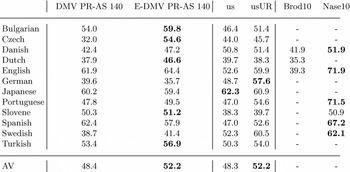
We present results on sentences of at most ten non-punctuation words in Figure 7 with usUR referring to our results. DMV PR-AS 140 is the best performing model in Gillenwater et al. (Reference Gillenwater, Ganchev, Graca, Pereira and Taskar2010) using posterior regularization and DMV, and E-DMV PR-AS 140 is the best performing model using posterior regularization and the extended model from Headden et al. (Reference Headden, Johnson and McClosky2009).
Unlabeled attachment scores (in %) on sentences of length of at most 10 ignoring punctuation.

Our model is on average considerably better than DMV PR-AS 140 and as good as E-DMV PR-AS 140. It is better than E-DMV PR-AS 140 on five languages with absolute improvements of as much as 15%. However, our model is consistently worse than Naseem et al. (Reference Naseem, Chen, Barzilay and Johnson2010). On the other hand, we believe that the results are very promising for a radically new model, and they are considerably better than the results presented in Brody (Reference Brody2010), who also presents a model that is very different from the DMV-inspired models. Note also that universal dependency rules, in general, help considerably, e.g. for English and German, but in a few cases hurt (Dutch and Japanese). Interestingly, the average improvement obtained by using universal dependency rules is about the same as the improvement obtained in Gillenwater et al. (Reference Gillenwater, Ganchev, Graca, Pereira and Taskar2010) moving to the extended model.
We present results on full-length sentences in Figure 8. None of the above-mentioned authors present results for full-length sentences, so here we compare ourselves to the best model in Spitkovsky, Alshawi and Jurafsky (Reference Spitkovsky, Alshawi and Jurafsky2011b) instead, which also uses the extended model from Headden et al. (Reference Headden, Johnson and McClosky2009). Note that our parser performs better than Spitkovsky et al.'s (Reference Spitkovsky, Alshawi and Jurafsky2011b) parser on average, even without universal dependency rules.
Unlabeled attachment scores (in %) on full-length sentences. Averages disregard English, since Spitkovsky et al. (Reference Spitkovsky, Alshawi and Jurafsky2011) do not report results for Section 23 of Penn-III.

5 Error analysis
In our error analysis, we focus on the results for German and Turkish. We first compare error distributions relative to POS of our German parsers with and without universal dependency rules. The numbers below are accuracies attaching dependents with a particular POS:

The universal dependency rules do not seem to help us attaching verbs, but note also that the parser without rules is already very good at attaching verbs. The rules considerably improve attachment of adpositions, but improvements are also observed with nouns, determiners and adjectives.
See Figure 9 for an example of where universal dependency rules help us attach correctly an adposition. The verb and direct object words have higher rank than the adposition, and the adposition is forced to attach to the direct object unless there is a dependency rule licensing an attachment further away. However, we do have a universal rule that licenses dependencies from verbs to adpositions (verb → adp), which is why we predict correct analysis in Figure 9(b). Figure 9(a) is the prediction made without universal dependency rules.
Predicted dependency structures for a sentence in the German test section with and without dependency rules. Red arcs indicate wrong predictions.

The rules allow us to attach dependents to candidate heads further away, so we predict more long dependencies. This also leads to a considerable absolute improvement of 15% in f-score for long dependencies (to words at least seven positions away).
Improvements with long dependencies are primarily due to better recall.
For German, improvements were observed with nouns and adjectives, while the accuracy of attaching verbs did not improve by using universal dependency rules. A similar pattern is observed in the Turkish data, but perhaps less dramatically so that
Increase in f-score is again higher with longer dependencies:
The parsers predict fewer long dependencies for Turkish than for German (< 3% of the dependencies cover more than seven words); precision is reasonable (25% without universal dependency rules; 28.5% with rules), but recall is very low.
6 Unsupervised dependency parsing without POS
In the Introduction, we mentioned that POS, which can be seen as partial annotation, makes unsupervised dependency parsing considerably easier. A simple way for us to build an unsupervised dependency parser that does not rely on information about POS at all is by removing verb edges in the graph construction step and not use the universal dependency rules. We call this parser ‘usnP’ and compare it with ‘us’ and ‘usUR’ and our baselines with random ranking (on full-length sentences), leaving out English for comparability with Spitkovsky et al. (Reference Spitkovsky, Alshawi and Jurafsky2011b):
Note that our results with POS are on average better than those reported by Spitkovsky et al. (Reference Spitkovsky, Alshawi and Jurafsky2011b) and considerably better than our baselines with random order. Somewhat surprisingly, results are better without POS for Danish and Japanese.
7 Conclusion
We have presented a new approach to unsupervised dependency parsing. The key idea is that a dependency structure also expresses centrality or saliency, so by direct modeling of centrality we obtain information that can be used to build dependency structures. Our unsupervised dependency parser thus works in two stages: it first uses iterative graph-based ranking to rank words in terms of centrality, and then constructs a dependency tree from the ranking. Our parser was shown to be competitive to state-of-the-art unsupervised dependency parsers. Finally, we showed that our parser also obtains promising results in the absence of information about POS.