Introduction
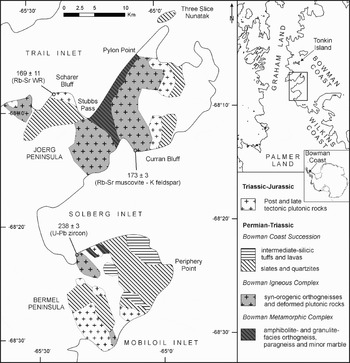
The Trinity Peninsula Group (TPG) of northern Graham Land, a weakly metamorphosed thick sequence of predominantly quartz- and feldspar-rich greywacke, has tentatively been correlated with metasedimentary rocks exposed along the Bowman Coast of Graham Land (Stubbs Reference Stubbs1968). The base of the TPG is not observed but the Bowman Coast rocks, here newly defined as the Bowman Coast Succession (BCS), is proximal to high-grade gneisses, which may represent the local basement. Recent geological mapping along the Bowman Coast has allowed a revision of the local geology (Fig. 1) and this note focuses on the relationship of the BCS with the adjacent gneisses.
Geological sketch map for the Bowman Coast showing the location and age of previously dated rocks.

Bowman Coast Succession
The BCS varies from being relatively undeformed to intensely folded slates and all of the sequence was later hornfelsed. These factors combined with intermittent exposure and poor rock accessibility hinder detailed stratigraphy. The base of the sequence was not observed. Stratigraphically, the lowest beds consist of slates, originally mudstones and siltstones with rare, thin and persistent quartz-rich sandstone beds. Up-stratigraphy the quartz-sandstone beds become thicker and more frequent. The sequence abruptly becomes dominated by buff-weathering, moderately thickly bedded, laminated, graded and cross-laminated southerly-derived quartz-sandstones and quartzites. This unit also displays soft sediment dewatering and lode structures. Water-lain tuffs conformably overly these sandstones and isolated exposures of intermediate and silicic lavas are thought to occupy the upper-most part of the BCS. The succession is interpreted as initial marine distal turbidites that give way to more proximal, possibly non-marine, deposits with thick volcanic units. Lithologically, the BCS resembles TPG and an association of intermediate volcanic rocks with soft sediment is also recorded within the main TPG outcrop at Mount Cardinal. Assuming a tectonic setting comparable to the TPG, sedimentation may record arc migration through accretionary sediments and the emergence of volcanism in the area. The BCS may be more extensive as similar lithologies outcrop on the Wilkins Coast (Fraser & Grimley Reference Fraser and Grimley1972).
Age of the succession and contact relationships
A contact is not observed between the BCS and the gneisses. The BCS is extensively intruded by unfoliated granitoids which have hornfelsed the already deformed sedimentary rocks. None of the cross cutting granitoids is reliably dated. Recalculations from Hole (Reference Hole1986) and Hole et al. (Reference Hole, Pankhurst, Saunders, Thomson, Crame and Thomson1991) suggest the pink granite at Scharer Bluff is 169 ± 11 Ma (whole-rock Rb–Sr isochron). When considered together with adamellite from the same locality an errorchron of 176 ± 5 Ma results. Whilst this age may be erroneous through isotopic disequilibrium between the two rock types, it is in agreement with the 164–169 Ma ages for more reliably dated plutons reported further north on the east coast (Pankhurst et al. Reference Pankhurst, Riley, Fanning and Kelley2000).
Muscovite and K feldspar from a foliated granite yields a Rb–Sr mineral age of 173 ± 3 Ma. This intrusion does not cut the Curran Bluff metasediments as claimed by Hole (Reference Hole1986). Unfoliated granite does, itself cutting the dated foliated intrusion and obscuring, over a distance of several hundred metres, the relationship between foliated granite and metasediment. The 173 ± 3 Ma age is valid in that it either records the thermal effect of the later granite intrusion or cooling of the whole assembly. The BCS is therefore likely to be older than 173 ± 3 Ma and correlate with the TPG as the TPG has yielded Triassic metamorphic ages (Smellie & Millar Reference Smellie and Millar1995), rather than the Late Jurassic back-arc metasedimentary rocks of north-east Palmer Land (Meneilly et al. Reference Meneilly, Harrison, Piercy, Storey and McKenzie1987). Gneisses do occur in close proximity to the BCS. Granitic gneisses from Solberg Inlet yield a protolith age of 238 ± 3 Ma, an age widely recorded in Palmer Land (Flowerdew et al. Reference Flowerdew, Millar, Vaughan, Horstwood and Fanning2006). This fieldwork identifies that much of the orthogneiss, including the dated 238 Ma rock, are variably foliated and compositionally banded coarse-grained basic to acidic intrusions with extensive, late, or unrelated injection and veining in places. The term igneous complex is therefore given for these rocks.
Paragneisses are associated with extensive late leucocratic granite and aplite veining. The paragneisses contain garnet- or amphibole-bearing leucosomes, are extensively intruded by granitoids and the whole assembly, here termed metamorphic complex, was folded and foliated during which amphibolite-facies metamorphic minerals grew. The metamorphic complex in many ways resembles that at Auriga Nunataks, north-west Palmer Land (Vaughan et al. Reference Vaughan, Millar and Thistlewood1999), with which they may correlate. The age of the metamorphism affecting the Bowman Coast metamorphic complex is not directly dated. However, the pre-metamorphic granitoids cutting the paragneiss are texturally and compositionally similar to the 238 ± 3 Ma igneous complex and are likely to be co-magmatic. The sedimentary protolith has alternating quartz-rich psammite and pelite bands, in many ways resembling a high-grade BCS. Indeed, paragneiss within the metamorphic complex between Stubbs Pass and Pylon Point (Fig. 1) becomes more schistose, contains fewer (mostly not garnet-bearing) leucosomes, is mylonitised by south-east dipping high strain zones and gives the impression of decreasing metamorphic grade eastwards. Rocks of a similar nature are mapped along small parts of Solberg Inlet and on Tonkin Island.
Paragneiss within the metamorphic complex and the BCS may in fact represent different parts of the same sedimentary protolith, different crustal levels of an accretionary prism through which a Triassic magmatic arc has developed. Granitoid - BCS contacts the represent the highest crustal levels while the igneous and metamorphic complexes document the interaction of voluminous arc plutonism with the sedimentary protolith host at a lower crustal level. To some extent, therefore, an oblique cross section through the middle crust of a Triassic arc is exposed at the Bowman Coast. Uplift from lower crustal levels is evident from decompression textures such as plagioclase corona around garnet in some paragneisses, and was further facilitated by ductile shear zones and by ascent within the late plutons. Future work will test the validity of this model by determining whether or not the metamorphic complex is older and unrelated to the BCS and Triassic arc and whether or not the BCS is a correlative of the TPG.
Acknowledgements
This work could not have been achieved without the tireless work of the operations and air unit staff at Rothera research station and field assistant Catrin Thomas. Discussions with Teal Riley and insightful reviews by John Smellie and Alan Vaughan are greatly appreciated. This is a contribution to the east coast mapping project of LTMS-G.