Introduction
Virtually all antidepressants directly affect one or more of the monoamine neurotransmitter systems.Reference Stahl1 However, although antidepressants cause an immediate increase in monoamines, they do not have immediate therapeutic effects. In fact, clinical improvement with these agents is typically delayed by several weeks compared to the acute changes in monoamine levels.Reference Stahl1 This has led to the suggestion that the therapeutic effects of antidepressants may occur because the initial rise in monoamines leads to downstream changes in protein synthesis. In particular, depression may be caused by reduced synthesis of proteins involved in neurogenesis and synaptic plasticity, and antidepressant treatment may increase the synthesis of those proteins.Reference Duman2–Reference Malberg, Eisch, Nestler and Duman4 Indeed, research suggests that patients who show response to antidepressant treatment (both pharmacological and nonpharmacological) have concomitant increases in neuroplasticity and neurogenesis, including modulation of growth factors and intracellular signaling cascades involved in neuroplastic processes.Reference Murrough and Charney5 There is, specifically, evidence that brain-derived neurotrophic factor (BDNF), which is important for neuronal survival, is reduced in depression and restored by successful antidepressant treatment.Reference Duman2–Reference Malberg, Eisch, Nestler and Duman4 In addition, the N-methyl-d-aspartate (NMDA) antagonist ketamine, which has recently been discovered to have rapid antidepressant actions, can trigger signaling pathways that lead to an increased density of dendritic spines.Reference Li, Lee and Liu6, Reference Li, Liu and Dwyer7 Thus, current research now supports replacement of the “monoamine hypothesis of depression” with the “neurotrophic” or “neuroplasticity” hypothesis of depression.Reference Duman and Aghajanian8
As the conceptualization of the pathology of depression evolves, so too does the investigation into new therapeutic treatments and targets. In this article, we review agents in development or recently released for the treatment of depression, including agents that exploit the monoaminergic link to depression, as well as experimental agents with novel mechanisms of action.
Triple Reuptake Inhibitors
Triple reuptake inhibitors (TRIs), or serotonin–norepinephrine–dopamine reuptake inhibitors, are being developed based on the premise that targeting all three monoamines may provide earlier or more robust efficacy than targeting only one (ie, selective serotonin reuptake inhibitors) or two (ie, serotonin–norepinephrine reuptake inhibitors).Reference Guiard, El Mansari and Blier9, Reference Prins, Olivier and Korte10 There are few agents available for depression that act on dopamine; thus, triple reuptake inhibitors may provide a therapeutic advance, especially for patients with symptoms hypothetically linked to dopamine (eg, cognitive symptoms, sexual dysfunction).Reference Stahl1
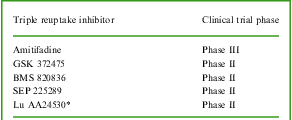
Triple reuptake inhibitors that are currently in clinical trials are shown in Table 1. These agents vary with respect to their activity at each of the three monoamine transporters; in addition, some have additional pharmacological properties that may contribute to therapeutic efficacy.Reference Connolly and Thase11 It is not yet clear what the ideal potencies at the three transporters might be; in particular, clinical trials must identify the degree of dopamine reuptake inhibition that is sufficient to contribute to therapeutic effects without the risk of abuse potential.Reference Guiard, El Mansari and Blier9
Triple reuptake inhibitors in development as antidepressants
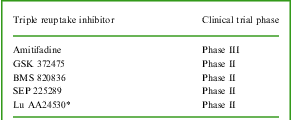
*This agent also has actions at 5HT2C, 5HT3, 5HT2A, and alpha 1A receptors.
Multimodal Agents
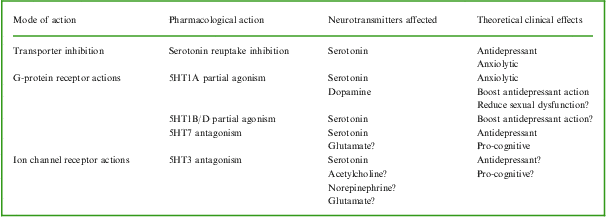
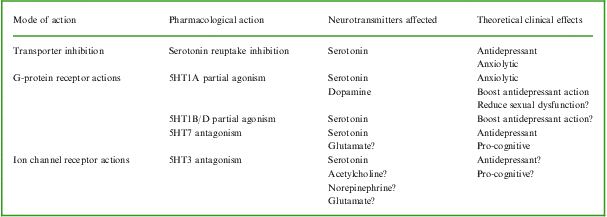
It may be that combining different modes of action could enhance efficacy for some patients with depression. Thus, agents that target not just transporter inhibition but also actions at G-protein receptors [eg, serotonin (5HT) 1A receptors] and/or ion-channel receptors [eg, 5HT3 receptors, N-methyl-d-aspartate (NMDA) receptors] are under investigation. One such agent, vortioxetine, has just been approved by the U.S. Food and Drug Administration (FDA). Vortioxetine combines actions at all three modes, with a total of five pharmacological actions: inhibition of the serotonin transporter, actions at G protein receptors (5HT1A and 5HT1B partial agonism and 5HT7 antagonism), and actions at ion channels (5HT3 antagonism).Reference Bang-Anderson, Ruhland and Jorgensen12, Reference Westrich, Pehrson and Zhong13 Through these various actions, vortioxetine seems to increase the release of five different neurotransmitters: the three monoamines serotonin, norepinephrine, and dopamine, as well as acetylcholine and histamine.Reference Bang-Anderson, Ruhland and Jorgensen12, Reference Mork, Montezinho and Miller14 Theoretically, enhancing neurotransmission, not just of multiple monoamines but also other neurotransmitters as well, could likewise enhance therapeutic efficacy compared to agents with fewer modes of action and effects on fewer neurotransmitters (Table 2).
Multimodal actions of vortioxetineReference Stahl1, Reference Bang-Anderson, Ruhland and Jorgensen12–Reference Mork, Montezinho and Miller14
Glutamatergic Targets
The discovery of rapid antidepressant effects following subanesthetic infusions of the NMDA receptor antagonist ketamine is perhaps the most dramatic development in depression research in years.Reference Berman, Cappiello and Anand15, Reference Zarate, Singh and Carlson16 Unfortunately, the effects of ketamine infusions are short-lived; however, the discovery has opened avenues of research into other glutamatergic approaches to the treatment of depression.
Ketamine acts as an open channel inhibitor of NMDA receptors, which leads to downstream glutamate release.Reference Stahl1 This stimulates two other types of glutamate receptors: α-amino-3-hydroxy-5-methyl-4-isoxazolepropionic acid (AMPA) receptors and metabotropic glutamate receptors.Reference Stahl1 It is not yet known if ketamine's antidepressant effects are due directly to its NMDA antagonism or to its downstream stimulation of AMPA receptors. One hypothesis is that activation of AMPA receptors leads to activation of the ERK/AKT signal transduction cascade, which in turn triggers the mammalian target of the rapamycin (mTOR) pathway.Reference Stahl17, Reference Duman and Voleti18 This causes the expression of synaptic proteins and leads to an increased density of dendritic spines, which has been seen with ketamine administration in animals.Reference Li, Lee and Liu6, Reference Li, Liu and Dwyer7 Hypothetically, this increase in dendritic spines causes the rapid antidepressant effect.
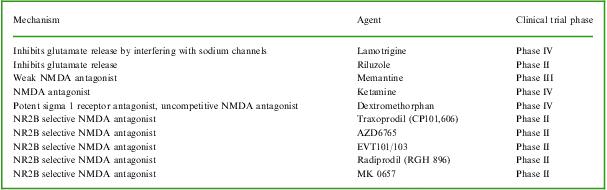
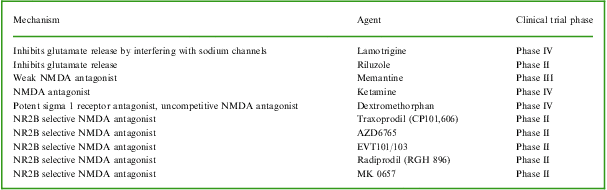
Investigators are looking for other agents that can trigger the same pharmacological changes that ketamine induces, but with sustained efficacy (Table 3). One such agent is dextromethorphan, a cough medicine that acts weakly on NMDA receptors and is also a sigma 1 receptor agonist—a property that ketamine also shares.Reference Stahl17, Reference Stahl19 Whether the sigma receptor properties of ketamine contribute to its antidepressant effects is not known, but selective sigma 1 agents could theoretically represent another novel avenue of research for depression treatment.Reference Stahl17
Glutamatergic targets
Hypothalamic–Pituitary–Adrenal (HPA) Axis Targets
In depression, abnormalities of the HPA axis have long been reported, including elevated glucocorticoid levels and insensitivity of the HPA axis to feedback inhibition.Reference Stahl1 Some evidence suggests that HPA axis dysfunction associated with chronic stress could lead to reduced synaptic plasticity and neuronal atrophy.Reference Liu and Aghajanian20–Reference Liu, Lee and Li22 The hippocampus is particularly vulnerable to stress because it has a high expression of glucocorticoid receptors, receives input from numerous stress-activated brain regions, and releases endogenous corticotropin releasing factor (CRF) in response to stress.Reference McClelland, Korosi and Cope23 Consistent with this, animal models of severe early life stress demonstrate persistent effects on hippocampal functioning, including disrupted long-term potentiation, upregulated CRF expression, and dendritic atrophy.Reference Brunson, Kramar and Lin24, Reference Ivy, Rex and Chen25 In humans, brain imaging studies show that patients with depression have reduced volume of the hippocampus and prefrontal cortex.Reference Duman and Monteggia26, Reference Videbech and Ravnkilde27 Correspondingly, BDNF levels in the hippocampus and prefrontal cortex are low in depressed patients.Reference Dwivedi, Rizavi and Connley28
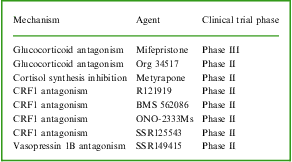
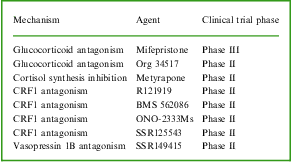
Neurons from the hippocampal area normally suppress the HPA axis; thus, if stress causes hippocampal cell loss, then this in turn could contribute to overactivity of the HPA axis, creating a vicious cycle. A number of agents that target stress and the HPA axis are in clinical testing, including glucocorticoid antagonists, corticotropin-releasing factor 1 (CRF-1) antagonists, and vasopressin-1B antagonists (Table 4).
HPA-axis targets
Additional Treatment Strategies
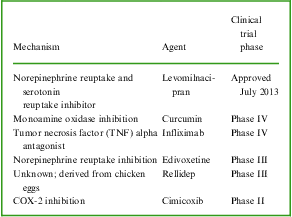
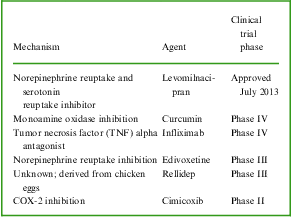
Other agents in late-stage clinical development are listed in Table 5. These include traditional monoaminergic strategies, such as the recently approved levomilnacipran (active enantiomer of milnacipran) and the norepinephrine reuptake inhibitor edivoxetine, as well as novel approaches, including agents that target anti-inflammatory pathways.Reference Connolly and Thase11
Additional antidepressant treatment strategies in development
Conclusion
Recent research into the pathology of depression indicates that inadequate neuroplasticity, potentially related to abnormal glutamate and/or HPA axis function, may be a key factor in the development of this disorder. Currently available antidepressants, which act on monoaminergic systems, seem to lead to downstream improvement in neuroplasticity. Investigation into new treatments for depression both extends the current emphasis on a monoaminergic link (eg, triple reuptake inhibitors) and expands the focus to include directly targeting glutamatergic neurotransmission or the HPA axis.
Disclosures
Meghan M. Grady has no financial relationships to disclose. Stephen M. Stahl receives research support from Avanir, CeNeRx, Forest, Genomind, Lilly, Janssen, Mylan, Mylan Specialty, Otsuka, Pamlab, Servier, Shire, Sunovion, and Takeda; is a consultant/advisor to Avanir, BioMarin, Depomed, Forest, Genentech, Genomind, GlaxoSmithKline, Jazz, Merck, Navigant, Novartis, Noveida, Neuronetics, Orexigen, Otsuka, Pamlab, Reviva, Roche, Shire, Sunovion, Taisho, Teva, and Trius; is on the speakers bureaus of Arbor Scientia, Genomind, Janssen, Lilly, Pamlab, Pfizer, Sunovion, and Takeda; and is a board member at Genomind and RCT Logic.
No writing assistance was utilized in the production of this article.
CME Posttest and Certificate
CME Credit Expires: November 30, 2016
CME Posttest Study Guide
NOTE: The posttest can only be submitted online.The below posttest questions have been provided solely as a study tool to prepare for your online submission. Faxed/mailed copies of the posttest cannot be processed and will be returned to the sender. If you do not have access to a computer, contact customer service at 888-535-5600.
1. Nichole is a 31-year-old patient with treatment-resistant depression. She has failed trials with various SSRIs and is having only partial response to her current treatment with the SNRI, duloxetine. You are considering switching this patient to the most recently approved antidepressant agent, levomilnacipran. Levomilnacipran has antidepressant properties due to its action as a:
A. Triple reuptake inhibitor
B. Glutamate antagonist
C. Serotonin and norepinephrine reuptake inhibitor
D. Glucocorticoid antagonist
2. The novel antidepressant metyrapone is one of the non-monoaminergic antidepressant agents currently in development. The antidepressant effects of metyrapone are due to:
A. Antagonism of NMDA receptors
B. Agonism of AMPA receptors
C. Cortisol synthesis inhibition
D. Antagonism of TNF-alpha
3. Peter is a 65-year-old patient with a long history of treatment-resistant depression. He has tried nearly every FDA-approved antidepressant treatment currently available with very little success. Various combinations of antidepressant agents have been marginally more helpful for this patient, but he is getting discouraged and asks you about some of the antidepressants that are in later stages of development. You explain that vortioxetine is an antidepressant in late-stage development and its mechanism of action includes:
A. Serotonin reuptake inhibition
B. 5HT1A partial agonism
C. 5HT7 antagonism
D. 5HT3 antagonism
E. All of the above
F. None of the above
CME Online Posttest and Certificate
To receive your certificate of CME credit or participation, complete the posttest and activity evaluation, available only online at http://www.neiglobal.com/CME under “CNS Spectrums.” If a passing score of 70% or more is attained (required to receive credit), you can immediately print your certificate. There is no posttest fee. Questions? Call 888-535-5600 or email customerservice@neiglobal.com.