Introduction
The Caatinga biome is the most representative biome of the north-eastern region of Brazil and has a comparatively rich herpetofauna (Leal et al., Reference Leal, Tabarelli and Silva2003; Rodrigues, Reference Rodrigues, Leal, Tabarelli and Silva2003). However, studies on the parasitic fauna of lizards from this biome represent only about 25% of known species.
The lizard Tropidurus hispidus (Spix 1825) is widespread in South America, occurring from Venezuela to south-eastern Brazil (Rodrigues, Reference Rodrigues1988; Ávila-Pires, Reference Ávila-Pires1995; Ávila-Pires et al., Reference Ávila-Pires, Hoogmoed, Vitt, Nascimento and Oliveira2007). In spite of its wide distribution throughout several biomes, knowledge on parasitic fauna associated with this host species is patchy and has been reported for only a few localities along its range of distribution. The parasites so far reported infecting T. hispidus are Physaloptera retusa (Rudolphi 1819) in a host population from Venezuela (Prieto, Reference Prieto1980) and Oswaldofilaria petersi Bain and Sulahian 1974 (Silva & Kohlsdorf, Reference Silva and Kohlsdorf2003), Parapharyngodon sceleratus (Travassos 1923) (Lopes et al., Reference Lopes, Silva, Dantas and Almeida2009) and the pentastomid Raillietiella mottae Almeida, Freire and Lopes Reference Almeida, Santana, Viera, Wanderley, Freire and Vasconcellos2008 (Almeida et al., Reference Almeida, Santana, Viera, Wanderley, Freire and Vasconcellos2008) in specimens from Brazil.
The studies focusing on parasite biodiversity have recently increased around the world (Poulin & Morand, Reference Poulin and Morand2004) and the research on widely distributed host species can bring us new data and insights about how parasites are distributed in the geographic area or if there are localities where the component community of parasites is richer (Poulin & Morand, Reference Poulin and Morand2004). Here we present data on infection parameters (prevalence, intensity of infection, richness and aggregation) of a population of T. hispidus from the Caatinga biome. These data give us knowledge on the helminth fauna and help us understand the community structure in this key host species from the Caatinga biome.
Materials and methods
Study site
Fieldwork was carried out on the lower slopes of the Chapada do Araripe mountain range (07°16′S and 39°26′W) within the limits of the environmental protection area (EPA) of Chapada do Araripe, municipality of Crato, Ceará State, Brazil. The vegetation of the sampled area is secondary forest, composed mainly of abundant palm trees (Arecaceae) that surround the undisturbed rain forest. The area has been subjected to anthropogenic alteration due to occupation and use of the land for agricultural activities, the harvesting of natural products and real estate speculation. The Crato municipality is located at a moist and fertile portion of the Chapada do Araripe, favouring a mild climate in relation to surrounding regions. The area has higher levels of annual precipitation, favoured by the effect of the orographic rains of the plateau, due to its windward position on the slope of the state. The average annual temperature of the Araripe basin varies between 21 and 27°C (Fundação Araripe, 1998).
Collection and examination of lizards
Lizards were collected with rubber bands or by hand, preferably in microenvironments inhabited by this species, including tree trunks, rocks and above the ground (Vitt, Reference Vitt1995). Some specimens were also captured in human dwellings. We measured their snout–vent length (SVL) to the nearest 0.05 mm with a caliper. Lizards were euthanized by the injection of sodium thiopental solution. They were then fixed in 10% formalin, stored in 70% alcohol and deposited in the herpetological collection of the Laboratório de Zoologia da Universidade Regional do Cariri (LZ-URCA 200–244; 300–311). Lizards were identified according to Rodrigues (Reference Rodrigues1987) based on the characteristics of structures called bag mites. Those lizards with the highest SVL values were considered to be sexually mature and therefore adults. A total of 57 lizards were necropsied including 26 adult females, 27 adult males and 4 juveniles.
Gastrointestinal tracts were removed and examined for the presence/absence of parasites under a stereomicroscope. Nematodes were preserved in 70% ethanol and identified according to Vicente et al. (Reference Vicente, Rodrigues, Gomes and Pinto1993), Anderson et al. (Reference Anderson, Chabaud and Willmott2009) and Gibbons (Reference Gibbons2010). Parasites were cleared with lactophenol and analysed using the Leica Qwin Lite 2.5 computerized system (Leica Microsystems, Wetzlar, Germany). For each nematode species, the prevalence and mean intensity ( ± SE) of infection were determined according to Bush et al. (Reference Bush, Lafferty, Lotz and Shostak1997).
Data analysis
A test for proportions (Z test) was used to determine whether there was a significant difference in overall prevalence between males and females (Zar, Reference Zar1999). Differences in body size and mean intensity of infection between sexes were determined using Student's t-test. A simple linear regression (Zar, Reference Zar1999) was performed to evaluate the effect of host body size (SVL) on the intensity of infection of parasites; this test was applied for adult male and adult female lizards and the values of SVL and intensity were transformed (log10). The discrepancy index (D) was calculated as suggested by Poulin (Reference Poulin1993). The index has a minimum value of zero (D= 0) when all hosts harbour the same number of parasites; if all parasites are found in a single host the aggregation reaches its maximum value (D= 1). This index was calculated with Quantitative Parasitology 3.0 software (Rózsa et al., Reference Rózsa, Reiczigel and Majoros2000; Reiczigel & Rózsa, Reference Reiczigel and Rózsa2001). The voucher specimens were deposited in the Coleção Helmintológica do Instituto de Biociências de Botucatu (CHIBB-6688–6695).
To evaluate the diversity of each infracommunity (Bush et al., Reference Bush, Lafferty, Lotz and Shostak1997) the Brillouin index (HB) of diversity (Krebs, Reference Krebs1989) was calculated with MVSP 3.0 (Kovach, Reference Kovach1998).
Results
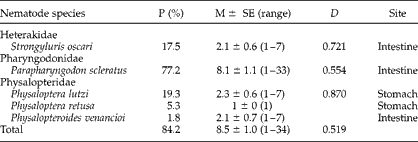
A total of five nematode species were found parasitizing T. hispidus: Parapharyngodon sceleratus (Pharyngodonidae); Physaloptera lutzi, Physaloptera retusa and Physalopteroides venancioi (Physalopteridae); and Strongyluris oscari (Heterakidae) (table 1).
Prevalence (P), mean intensity of infection (M) and aggregation (D) of gastrointestinal nematodes in the lizard Tropidurus hispidus from Crato, Ceará State, Brazil.
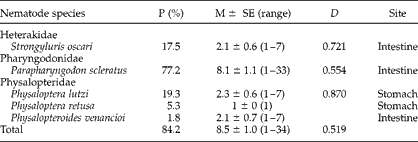
The overall helminth prevalence was 84.2% (n= 48), and no juvenile lizards were infected. The overall prevalence for adult males was 92.6% (n= 25) and the overall prevalence for adult females was 88.5% (n= 23); there was no significant difference between these values (Z C= 0.04; P= 0.96). The overall mean intensity of infection was 8.5 ± 1.1. There was no significant difference in the mean intensity of infection between male hosts (9.9 ± 1.7) and female hosts (6.9 ± 1.2) (Student's t-test, t= –1.40, df = 46, P= 0.17). The body size of adult females (mean SVL = 77.8 ± 11.9 mm, n= 26) was statistically different from that of adult males (mean SVL = 95.3 ± 13.4 mm, n= 27, Student's t-test, t= 5.02, df = 51, P< 0.01). The mean intensity of infection was influenced by the body size of male hosts (R 2= 0.17; F 1,23= 5.9, P< 0.05), while in female hosts there was no significant relationship (R 2= 0.02, F 1,21= 1.57, P>0.05).
Two species of parasites were found in the stomach (P. lutzi and P. retusa) and the mean intensity of infection in the stomach was 2.0 ± 0.5. Inside the intestine three parasite species were found (P. sceleratus, S. oscari and P. venancioi) and the mean intensity of infection in this organ was 8.0 ± 1.1. Parapharyngodon sceleratus was the most prevalent species (77%). The species with the highest mean intensity of infection was P. sceleratus (8.1 ± 1.1) (table 1). All nematode species presented a distribution biased to an aggregated distribution (D= 0.519) in this host sample (table 1). The majority of infected lizards harboured one nematode species (58.3%, n= 28), with a smaller percentage harbouring two (39.6%, n= 19) and only one host harboured three parasite species (2.1%). The mean richness of nematodes per host was 1.4 ± 0.1 and the mean diversity of infracommunity was 0.14 ± 0.02 nits/individual.
Discussion
Most lizards were parasitized by at least one nematode species. The helminth fauna of lizards has been described as isolationist and non-interactive (Aho, Reference Aho, Esch, Bush and Aho1990), and the helminth fauna of this tropidurid is no exception. Despite the low richness of infracommunities, the prevalence was high, which is more than likely due to the presence of generalist nematode species (Ávila & Silva, Reference Ávila and Silva2010) and the monoxenic life cycle of parasites (Anderson, Reference Anderson2000), since the lack of an intermediate host does not influence the acquisition of parasites.
There is an evident sexual dimorphism in this lizard host, with the males being larger in size. The males display a territorial behaviour (Prieto et al., Reference Prieto, León and Lara1976), defending a territory against other invader males. Natural selection must have favoured the larger males, resulting in this pattern of sexual dimorphism (Brattstrom, Reference Brattstrom1974). Nevertheless, larger hosts are a favourable place to be colonized by a higher number of individual parasites (Poulin, Reference Poulin2007). Lizard body size must have contributed to a higher mean intensity of infection of male hosts, but did not have an influence on the difference between prevalence in the male and female hosts. The difference in prevalence between the sexes is generally related to a differential consumption of prey, use of microhabitat or time of activity (Aho, Reference Aho, Esch, Bush and Aho1990). Though these ecological features were not studied, no significant difference in these features for males and females from this population from the Caatinga biome would be expected.
Regarding all the T. hispidus populations that have been studied (Prieto, Reference Prieto1980; Silva & Kohlsdorf, Reference Silva and Kohlsdorf2003; Ávila et al., Reference Ávila, Anjos, Ribeiro, Morais, Silva and Almeida2012; Pereira et al., Reference Pereira, Sousa and Lima2012), the highest prevalence of parasites was found in the present study. However, the highest richness was reported by Ávila et al. (Reference Ávila, Anjos, Ribeiro, Morais, Silva and Almeida2012), and this could be related to a greater number of localities sampled within the Caatinga biome, thus leading to an effect of species × area relationship (Poulin & Morand, Reference Poulin and Morand2004). In the present study, we found a local richness of five species of nematode (α diversity) and low parasite richness per host, corroborating the statements of Aho (Reference Aho, Esch, Bush and Aho1990) of low richness of helminths associated with reptiles. Although the lizards were sampled from an EPA, the anthropogenic pressures surrounding the EPA of Chapada do Araripe could reflect on the higher mean intensity of infection compared with those values reported by Ávila et al. (Reference Ávila, Anjos, Ribeiro, Morais, Silva and Almeida2012), since undisturbed areas usually have a higher diversity of helminth communities and the hosts are infected by a lower parasitic load (Thomas et al., Reference Thomas, Renaud and Guégan2005; McKenzie, Reference McKenzie2007).
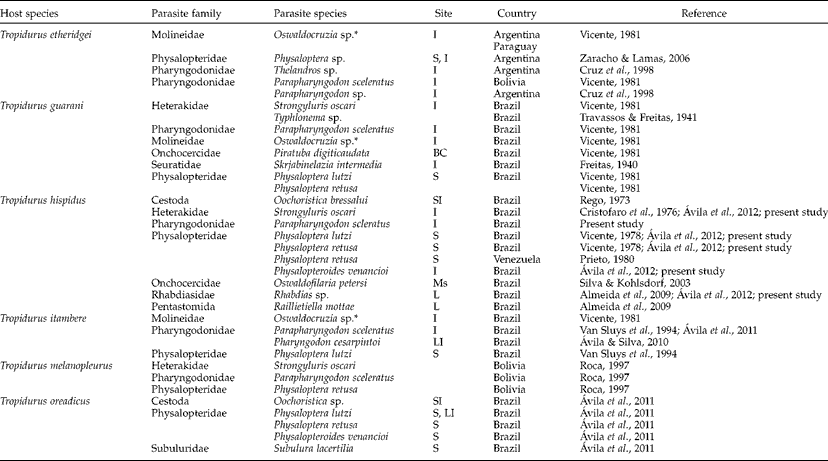
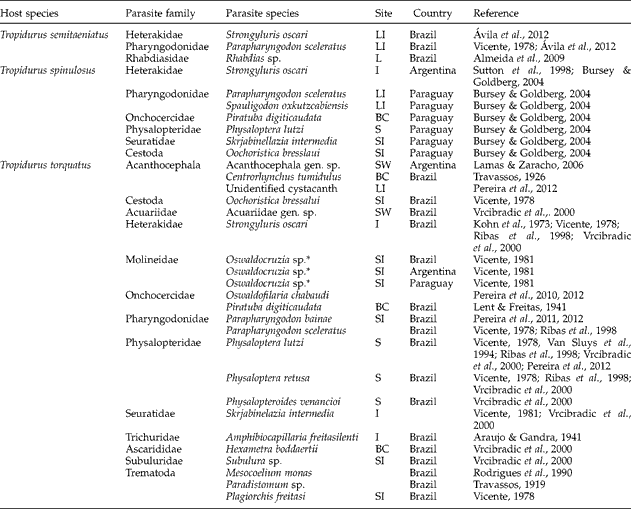
The genus Tropidurus has been revised by Rodrigues (Reference Rodrigues1987), who divided the taxon then called Tropidurus torquatus into several species, and later by Frost et al. (Reference Frost, Crafts, Fitzgerald and Titus1998). In tables 2 and 3 we present a reviewed and updated list of parasites of Tropidurus, and parasitological works (Vicente, Reference Vicente1978, Reference Vicente1981) earlier than these revisions have been updated.
Helminth parasites of Tropidurus etheridgei, T. guarani, T. hispidus, T. itambere, T. melanopleurus and T. oreadicus (Squamata: Tropiduridae) from South America.

BC, Body cavity; I, intestine; LI, large intestine; Ms, muscle; S, stomach; SI, small intestine; SW, stomach wall.
* Oswaldocruzia mazai has been considered species inquirenda by Durette-Desset et al. (2006).
Helminth parasites of Tropidurus semitaeniatus, T. spinulosus and T. torquatus (Squamata: Tropiduridae) from South America.
BC, Body cavity; I, intestine; LI, large intestine; Ms, muscle; S, stomach; SI, small intestine; SW, stomach wall.
* Oswaldocruzia mazai has been considered species inquirenda by Durette-Desset et al. (Reference Durette-Desset, Anjos and Vrcibradic2006).
The Pharyngodonidae family is the most rich and diverse amongst nematode parasites of squamata reptiles (Vicente et al., Reference Vicente, Rodrigues, Gomes and Pinto1993; Ávila & Silva, 2010). Parapharyngodon sceleratus can be considered a core species in this helminth community and has been found in all sampled Tropidurus species. Nevertheless, despite the wide distribution of T. hispidus, this nematode had not been recorded in previous studies (Rego, Reference Rego1973; Cristofaro et al., Reference Cristofaro, Guimarães and Rodrigues1976; Vicente, Reference Vicente1978; Prieto, Reference Prieto1980; Silva & Kohlsdorf, Reference Silva and Kohlsdorf2003; Almeida et al., Reference Almeida, Ribeiro, Santana, Vieira, Anjos and Sales2009; Ávila et al., Reference Ávila, Anjos, Ribeiro, Morais, Silva and Almeida2012).
The richness of the helminth fauna of lizards in the genus Tropidurus (tables 2 and 3) ranges from three species in T. melanopleurus (Roca, Reference Roca1997) and T. semitaeniatus (Almeida et al., Reference Almeida, Ribeiro, Santana, Vieira, Anjos and Sales2009; Ávila et al., Reference Ávila, Anjos, Ribeiro, Morais, Silva and Almeida2012) to 21 species in T. torquatus (Travassos, Reference Travassos1919, Reference Travassos1926; Travassos et al., Reference Travassos, Freitas and Kohn1969; Kohn et al., Reference Kohn, Pinto and Fernandes1973; Cristofaro et al., Reference Cristofaro, Guimarães and Rodrigues1976; Vicente, Reference Vicente1978, Reference Vicente1981; Vicente et al., Reference Vicente, Rodrigues, Gomes and Pinto1993; Ribas et al., Reference Ribas, Rocha, Teixeira and Vicente1998; Vrcibradic et al., Reference Vrcibradic, Cunha-Barros, Vicente, Galdino, Hatano, Van Sluys and Rocha2000; Lamas & Zaracho, Reference Lamas and Zaracho2006; Pereira et al., Reference Pereira, Lima and Bain2010, Reference Pereira, Sousa and Lima2012). The two tropidurid species T. torquatus and T. hispidus, which are the most widely distributed, present the richer helminth fauna. According to Poulin & Morand (Reference Poulin and Morand2004), the higher distribution range of the host could contribute to a higher richness of its associated helminth fauna.
Although the richness of infracommunities of Tropidurus lizards is depauperate, the total diversity of parasites associated is high, reflecting the diversity of environments, biomes and ecological aspects of several species of Tropidurus surveyed.
Finally, the sampling of several T. hispidus populations throughout their range of occurrence helps us to understand the overall pattern of helminth richness associated with this lizard and the effects of both local environment and local lizard community on the composition and patterns of infection by helminth communities.
Acknowledgements
This study was supported by research grants from Fundação Cearense de Apoio ao Desenvolvimento Científico e Tecnológico (BPI – FUNCAP), Conselho Nacional de Desenvolvimento Científico e Tecnológico (CNPq), Coordenação de Aperfeiçoamento de Pessoal de Nível Superior (CAPES) and Fundação de Amparo à Pesquisa do Estado de São Paulo (FAPESP 2008/50417-7). The licence for collecting lizards was provided by IBAMA (IBAMA 02007.001009/2004). We thank Geraldo Saraiva Ribeiro for providing his home as a base for field and laboratory work, and Francisco N. Pereira Jr and Morgana M.S. Delfino for field assistance. We thank Chris Bedford for reviewing our use of English.