INTRODUCTION
Family Lumbrineridae Schmarda, 1861 are polychaetes widely distributed in muddy and sandy bottoms of continental shelves and intertidal coastal areas, with more than 200 valid species being recognized worldwide (Carrera-Parra, Reference Carrera-Parra2006a), 24 of them in the Iberian coasts (Martins et al., Reference Martins, Carrera-Parra, Quintino and Rodrigues2012b), including the most recent species described for the north of Spain, Kuwaita hanneloreae Arias & Carrera-Parra, Reference Arias and Carrera-Parra2014. Several new genera and species within Family Lumbrineridae have been erected or described worldwide in this century (e.g. Carrera-Parra, Reference Carrera-Parra2001a, Reference Carrera-Parrab, Reference Carrera-Parra2006a, Reference Carrera-Parrab; Aguirrezabalaga & Carrera-Parra, Reference Aguirrezabalaga and Carrera-Parra2006; Hernández-Alcántara et al., Reference Hernández-Alcántara, Pérez-Mendoza and Solís-Weiss2006; Carrera-Parra et al., Reference Carrera-Parra, Çinar and Dagli2010; Cai & Li, Reference Cai and Li2011a, Reference Cai and Lib; Martins et al., Reference Martins, Carrera-Parra, Quintino and Rodrigues2012b; Arias & Carrera-Parra, Reference Arias and Carrera-Parra2014; D'Alessandro et al., Reference D'Alessandro, Cosentino, Giacobbe, Andaloro and Romeo2014). The Mediterranean Sea is not an exception, where several polychaete species have been first reported, most of them classified as non-indigenous (NIS) and thus representing a potential threat for endemic species (Coll et al., Reference Coll, Piroddi, Steenbeek, Kaschner, Lasram, Aguzzi, Ballesteros, Bianchi, Corbera, Dailianis, Danovaro, Estrada, Froglia, Galil, Gasol, Gertwagen, Gil, Guilhaumon, Kesner, Kitsos, Koukouras, Lampadariou, Laxamana, Cuadra, Lotze, Martin, Mouillot, Oro, Raicevich, Rius-Barile, Saiz-Salinas, San Vicente, Somot, Templado, Turon, Vafidis, Villanueva and Voultsiadou2010). Several reasons have been contributing to this trend, namely the increasing maritime traffic intensity related to the Suez Canal opening in the 19th century, on- and offshore farming activities and its particular biogeographic characteristics with connections to the Atlantic Ocean, Red Sea and Black Sea (Galil & Zenetos, Reference Galil, Zenetos, Leppäkoski, Gollasch and Olenin2002).
The present study reports four new records of Lumbrineridae species for the Mediterranean Sea, and aims to provide new insights on taxonomy, ecology and biogeographic preferences and an updated key to Iberian specimens of the family Lumbrineridae.
MATERIALS AND METHODS
Samples were collected in 2013 and 2014, at 17 sites along the north-eastern and southern Spanish continental shelf (from 41°24′N 2°15′E, off Barcelona, to 37°12′N 7°07′E, off Huelva; Figure 1), in the scope of several seasonal environmental monitoring programmes of artificial reefs, sewage outfalls and ports, at water depth ranging from 19 to 53 m. Samples were taken with a Van Veen grab (0.04 m2), one replicate to determine grain-size and total organic matter content and three replicates for macrofaunal analysis, these being sieved over 500 µm mesh size and preserved with 70% ethanol.
Map of the western Mediterranean Sea showing the studied area: the southern (Huelva and Málaga) and north-eastern (Valencia-Barcelona) Spanish continental shelf. Black bars show geographic distribution range along Europe of four Lumbrineridae species firstly recorded in the studied area (adjacent areas with probable species occurrence are represented by a grey gradient).

Sediment grain-size was determined by wet and dry sieving following the standard ASTM D422 and expressed as weight percentage of gravel (particle diameter >2 mm), sand (2–0.063 mm) and fines (<0.063 mm) (ASTM, 2007). Total organic matter content (TOM) was quantified by the loss-on-ignition method following the standard ASTM D2974 and expressed as percentage of sample weight loss after combustion in comparison with the initial dried sediment (ASTM, 2000).
Macrofaunal samples were sorted and identified up to species level; lumbrinerids were classified according to D'Alessandro et al. (Reference D'Alessandro, Cosentino, Giacobbe, Andaloro and Romeo2014) and Martins et al. (Reference Martins, Carrera-Parra, Quintino and Rodrigues2012b), and morphologically studied following Carrera-Parra (Reference Carrera-Parra2006a, Reference Carrera-Parrab). Studied specimens were compared with type specimens deposited in the collections from the DBUA – Department of Biology, University of Aveiro (Biological Research Collection) and the Laboratory of Biodiversity, ISPRA Institute for Environmental Protection and Research. A set of best-preserved specimens was deposited in the DBUA formal collection and the remaining specimens properly stored and labelled in the first author's own collection.
In addition to the environmental data, predicted benthic habitats were provided for each sampling site, according to the information available on the website http://www.emodnet-seabedhabitats.eu, which compiles an updated pan-European Nature Information System (EUNIS) habitat classification.
Abbreviations used in text and figure captions: Ch: chaetiger; CMHH: composite multidentate hooded hooks; ind: individuals; SBHH: simple bidentate hooded hooks; SMHH: simple multidentate hooded hooks; MI−IV: maxillae I to IV; TL: total length; W10: width at ch. 10, excluding parapodia; PCS: Portuguese continental shelf.
RESULTS AND DISCUSSION
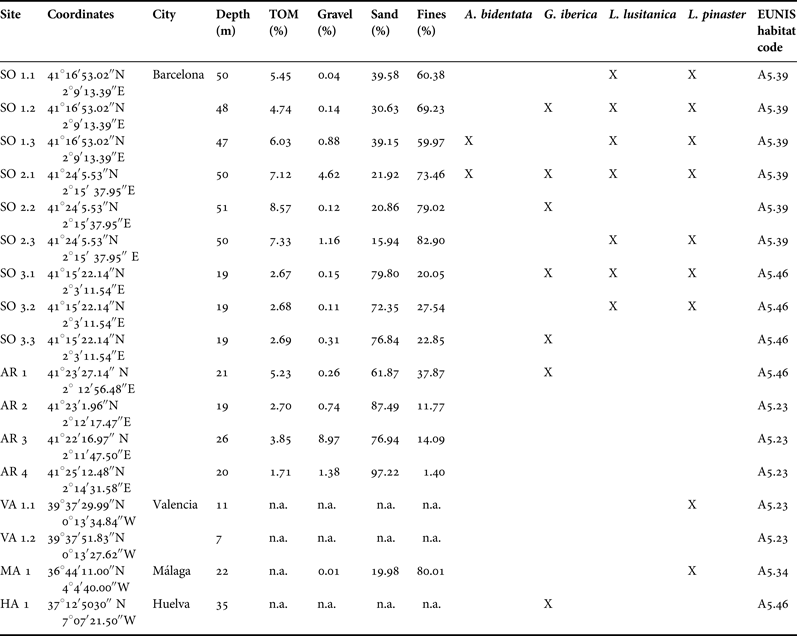
A total of 66 lumbrinerid specimens were found in all studied samples. Four lumbrinerid species from three different genera are firstly reported along the Spanish coast and in the western Mediterranean Sea: Abyssoninoe bidentata D'Alessandro et al., Reference D'Alessandro, Cosentino, Giacobbe, Andaloro and Romeo2014, Gallardoneris iberica Martins et al., Reference Martins, Carrera-Parra, Quintino and Rodrigues2012b, Lumbrineris lusitanica Martins et al., Reference Martins, Carrera-Parra, Quintino and Rodrigues2012b and Lumbrineris pinaster Martins et al., Reference Martins, Carrera-Parra, Quintino and Rodrigues2012b. Table 1 shows the location, depth and environmental characterization of the sites where the specimens were collected. Figure 1 illustrates the current known biogeographic distribution of those four species. Figures 2 & 3 illustrate key diagnostic characters of the four species herein reported.
Abyssoninoe bidentata D'Alessandro et al. (Reference D'Alessandro, Cosentino, Giacobbe, Andaloro and Romeo2014), adult: (A) Ch 9, dorsal view; (B) limbate SMHH, Ch 4; (C) SMHH, Ch 19; (D) M III; (E) M IV. Scale bars: A, 0.050 mm; D, E, 0.020 mm; B, C, 0.010 mm.

Comparative illustration of M III and M IV (dorsal view) of the following species: (A) Gallardoneris iberica; (B) Lumbrineris lusitanica; (C) Lumbrineris pinaster. Scale bars: A, 0.5 mm; B, 0.05 mm; C, 0.025 mm (figures adapted from Martins et al., Reference Martins, Carrera-Parra, Quintino and Rodrigues2012b).

Sampling sites environmental characterization.

SO, sewage outfall; AR, artificial reef; VA, coastal area off Valencia; MA, coastal area off Málaga; HA, coastal area off El Rompido (Huelva); X, occurrence of species; TOM, total organic matter content; gravel, particles diameter >2 mm; sand, particles diameter between 2 and 0.063 mm; fines, particles diameters <0.063 mm; n.a., non-available data; EUNIS predicted habitat codes (based on information available at http://www.emodnet-seabedhabitats.eu): A5.23, Infralittoral fine sands; A5.34, Infralittoral fine mud; A5.39, Mediterranean biocoenosis of coastal terrigenous muds; A5.46, Mediterranean biocoenosis of coastal detritic.
SYSTEMATICS
Class POLYCHAETA Grube, 1850
Order EUNICIDA Dales, 1962
Family LUMBRINERIDAE Schmarda, 1861
Genus Abyssoninoe Orensanz, 1990
Abyssoninoe bidentata D'Alessandro et al., Reference D'Alessandro, Cosentino, Giacobbe, Andaloro and Romeo2014
(Figure 2)
TYPE MATERIAL
Incomplete specimen, 38 ch., LT 9.4, W10 0.4 mm; Barcelona, NE Spain, coordinates: 41°24′5.53″N 2°15′37.95″E, water depth: 50 m, sandy mud (DBUA001458.01); DBUA collection, 28 March 2014. Four additional specimens were deposited in the first author's collection.
COMPARATIVE MATERIAL EXAMINED
Holotype ISPRA-MLPM_MIP1.01.01; site MIP1, Giammoro, NE Sicily, Italy, coordinates: 38°12′50.00″N 15°18′29.02″E, water depth: 30 m depth, silty sediment; ISPRA collection, 2013.
DIAGNOSIS
Prechaetal lobes always shorter than postchaetal lobes, apart from median parapodia lobes that are similar in size; postchaetal lobes shape changes from triangular in anterior (Figure 2A) and median parapodia to digitiform in posterior parapodia; transitional limbate SMHH in ch 1–20 (Figure 2B); SMHH with 7 teeth, proximal tooth largest, from ch. 21 (Figure 2C); pygidium with two pairs of anal cirri, dorsal three-fold longer than ventral pair; MIII bidentate (Figure 2D) and MIV unidentate with a pointed tooth and a well-developed plate (Figure 2E).
REMARKS AND VARIATIONS
The number of teeth of SMHH in the Spanish specimens (6–7) was higher compared with the Italian specimens (5–6) (D'Alessandro et al., Reference D'Alessandro, Cosentino, Giacobbe, Andaloro and Romeo2014). No additional morphological differences were reported. Size-dependent characters varied as follows: transitional limbate SMHH were found in the 12–20 most anterior parapodia; first SMHH were found between ch. 13 and 21; in both cases, results are in agreement with the variations reported in the original description (D'Alessandro et al., Reference D'Alessandro, Cosentino, Giacobbe, Andaloro and Romeo2014). No mature specimens were found.
DISCUSSION
The most noteworthy character to distinguish A. bidentata from the close European species, A. scopa (Fauchald, 1974) and A. hibernica (McIntosh, 1903), is the MIII shape, which is exclusive within the Abyssoninoe genus and therefore key to recognizing this species.
ECOLOGY AND DISTRIBUTION
Specimens were found associated with the Mediterranean biocoenosis of coastal terrigenous mud (EUNIS habitat A5.39). Organisms were collected in organically enriched sandy mud (TOM content = 6–7%; mud content = 60–73%), in warm, sheltered and shallow waters (<50 m water depth) from the western Mediterranean Sea, around sewage outfalls off Barcelona. This species was originally found in anthropogenically influenced muddy sediments with a low degree of contamination by metals and/or organic compounds, associated with industrial, harbour and sewage outfall activities (D'Alessandro et al., Reference D'Alessandro, Cosentino, Giacobbe, Andaloro and Romeo2014). According to a study carried out in the last decade, the activity of Barcelona sewage outfalls created, in the past, sludge deposits rich in organic matter and contaminants, some of them resulted from sludge flash pyrolysis (e.g. sterenes and steranes) and others derived from surfactant residues (e.g. alkylbenzenes and trialkylamines) and bacterial biomass activity (e.g. alkylnitriles and alkylamides) (Kruge et al., Reference Kruge, Permanyer, Serra and Yu2010). In this study, low to moderate volumes of organic matter were found in most samples, which created the appropriate conditions for the establishment of this species.
The species A. bidentata was recently described off Sicily (Italy) (D'Alessandro et al., Reference D'Alessandro, Cosentino, Giacobbe, Andaloro and Romeo2014). According to the available knowledge, it corresponds to a native species from the Mediterranean Sea, which distribution ranges from the central (D'Alessandro et al., Reference D'Alessandro, Cosentino, Giacobbe, Andaloro and Romeo2014) to the most western sector (present study) of this biogeographic region. This new occurrence may reflect misleading identifications of Abyssoninoe specimens in past studies, as suggested by D'Alessandro et al. (Reference D'Alessandro, Cosentino, Giacobbe, Andaloro and Romeo2014) and by other authors for other Polychaeta species, since new species and new records were recently reported in south-western Europe, particularly in the Iberian Peninsula coasts (e.g. Simboura & Zenetos, Reference Simboura and Zenetos2005; Aguirrezabalaga & Carrera-Parra, Reference Aguirrezabalaga and Carrera-Parra2006; Pires et al., Reference Pires, Paxton, Quintino and Rodrigues2010; Ravara et al., Reference Ravara, Cunha and Pleijel2010; Martins et al., Reference Martins, Carrera-Parra, Quintino and Rodrigues2012b, Reference Martins, San Martín, Rodrigues and Quintinoc, Reference Martins, Magalhães, Peter, San Martín, Rodrigues and Quintino2013a, Reference Martins, Quintino and Rodriguesb, Reference Martins, Sampaio, Quintino and Rodriguesc; Arias & Paxton, Reference Arias and Paxton2014; Jourde et al., Reference Jourde, Sampaio, Barnich, Bonifácio, Labrune, Quintino and Sauriau2015).
Genus Gallardoneris Carrera-Parra, Reference Carrera-Parra2006a
Gallardoneris iberica Martins et al., Reference Martins, Carrera-Parra, Quintino and Rodrigues2012b
(Figure 3A)
TYPE MATERIAL
Complete specimen, 78 ch., LT 8.2, W10 0.4 mm; Barcelona, NE Spain, coordinates: 41°23′27.14″ N 2°12′56.48″E, water depth: 21 m, muddy sand (DBUA001457.01); DBUA collection, deposited in 28 March 2014. Four additional incomplete specimens were deposited in the DBUA collection (DBUA001457.02). Five additional specimens were deposited in the first author's collection.
COMPARATIVE MATERIAL EXAMINED
Holotype MNHN TYPE 1538; site MESH 3B, NW PCS, coordinates: 39°48.584′N 9°13.773′W, water depth: 100.5 m depth, fine sand; Muséum National d'Histoire Naturelle, Paris, deposited in 2011.
DIAGNOSIS
Auricular postchaetal lobe in ch. 1–17, and digitiform in remaining parapodia, shorter than posterior prechaetal lobes, from ch. 59; CMHH in ch. 1–7, with short blade and 7 teeth, proximal tooth largest; SMHH from ch. 8, with short hood and 7 teeth, proximal tooth largest; pygidium without anal cirri; 4 maxillae, MIII edentate and MIV edentate plate, with whitish central area (Figure 3A).
REMARKS AND VARIATIONS
No major morphological differences were found. Size-dependent characters varied as follows: last CMHH were found between ch. 7 to 9, first SMHH was present between ch. 8 to 10 and first postchaetal lobe shorter than prechaetal lobe was found in ch. 59 to 88. The first two characters are within the range presented by Martins et al. (Reference Martins, Carrera-Parra, Quintino and Rodrigues2012b) and Bertasi et al. (Reference Bertasi, Lomiri, Vani, Trabucco and Lamberti2014). The present findings demonstrate that the first prechaetal lobe longer than postchaetal lobe may appear earlier in smaller organisms, taking into account the descriptions of Portuguese specimens (ch. 82; Martins et al., Reference Martins, Carrera-Parra, Quintino and Rodrigues2012b) or specimens from the Adriatic Sea (ch. 65; Bertasi et al., Reference Bertasi, Lomiri, Vani, Trabucco and Lamberti2014). Since no mature specimens were found, this difference may be related to the size of organisms that may be junior specimens or immature adults with lower size and thus morphological characters can occur earlier.
DISCUSSION
No other species from this genus are recognized in European waters. Maxillae shape and colour, chaetal lobes and chaetae shape and distribution are very distinctive which can be combined with its typical translucent whitish body colour (when preserved in formalin) and its smaller size when comparing with other Lumbrineridae species (Martins et al., Reference Martins, Carrera-Parra, Quintino and Rodrigues2012b).
ECOLOGY AND DISTRIBUTION
Organisms were widely distributed in the north-eastern and south-western Spanish coast, in the Mediterranean Sea, in shallow waters (19–51 m water depth), in sediments close to sewage outfalls, artificial reefs or coastal shelf areas. In terms of substrate, specimens were found in muddy sand with moderate fine content (20–40%) or sandy mud with organic matter content ranging from 2.67 to 8.57% (Table 1). This species was found in association with a macrofauna community ecologically dominated by warm water polychaetes preferring organically enriched sediments, without opportunistic species (e.g. genus Capitella, Heteromastus), in the EUNIS habitats A5.39 and A5.46 (Mediterranean biocoenosis of coastal detritic). Similarly, Martins et al. (Reference Martins, Quintino and Rodrigues2013b, Reference Martins, Sampaio, Quintino and Rodriguesc) found G. iberica preferably associated with the community Euchone rubrocincta, Nematonereis unicornis and other warmer water species, in muddy sand and sandy mud of the southern and sheltered PCS, strongly influenced by anthropogenic coastal activities. This species was also found in muddy sand from the northern Adriatic Sea with a TOM content ranging between 3.6 and 11.9% (Bertasi et al., Reference Bertasi, Lomiri, Vani, Trabucco and Lamberti2014), confirming its preference for coastal and shelf sediments having a relevant quantity of fine particles and organic matter.
The biogeographic distribution of G. iberica extends from the Lusitanian biogeographic province to the eastern Mediterranean Sea biogeographic province (Figure 1). It is now recognized in Portuguese waters, in the Atlantic Ocean (Martins et al., Reference Martins, Carrera-Parra, Quintino and Rodrigues2012b), in Italian waters, in the northern Adriatic Sea (Bertasi et al., Reference Bertasi, Lomiri, Vani, Trabucco and Lamberti2014) and in the north-eastern and south-eastern Spanish coast, in the western Mediterranean Sea (this study). Future studies reporting its occurrence inside and outside the Mediterranean Sea may contribute to a deeper discussion regarding its classification as a native or non-indigenous species in the Mediterranean Sea, since three reports seem insufficient. This new occurrence reflects misleading identifications in past studies following an increasing interest in Polychaete taxonomy that culminated in the description and/or first record of several species in south-western Europe, particularly in the Iberian Peninsula coasts (e.g. Aguirrezabalaga & Carrera-Parra, Reference Aguirrezabalaga and Carrera-Parra2006; Pires et al., Reference Pires, Paxton, Quintino and Rodrigues2010; Ravara et al., Reference Ravara, Cunha and Pleijel2010; Martins et al., Reference Martins, Carrera-Parra, Quintino and Rodrigues2012b, Reference Martins, San Martín, Rodrigues and Quintinoc, Reference Martins, Magalhães, Peter, San Martín, Rodrigues and Quintino2013a, Reference Martins, Quintino and Rodriguesb, Reference Martins, Sampaio, Quintino and Rodriguesc; Arias & Paxton, Reference Arias and Paxton2014; Jourde et al., Reference Jourde, Sampaio, Barnich, Bonifácio, Labrune, Quintino and Sauriau2015).
Genus Lumbrineris de Blainville, 1828
Lumbrineris lusitanica Martins et al., Reference Martins, Carrera-Parra, Quintino and Rodrigues2012b
(Figure 3B)
TYPE MATERIAL
Incomplete specimen, 39 ch., LT 10.1, W10 0.7 mm; Barcelona, NE Spain, coordinates: 41°24′5.53″N 2°15′37.95″E, water depth: 50 m, sandy mud (DBUA001455.01); DBUA collection, 28 March 2014. Seven additional specimens were deposited in the first author's collection.
COMPARATIVE MATERIAL EXAMINED
Holotype MNHN TYPE 1540; site R16, NW PCS, coordinates: 41°27.557′N 8°51.866′W, water depth: 52.3 m depth, fine sand; Muséum National d'Histoire Naturelle, Paris, deposited in 2011.
DIAGNOSIS
Digitiform median and posterior prechaetal lobes, always shorter than postchaetal ones that are digitiform wide basally in anterior and median parapodia and digitiform in posterior parapodia (confirmed in specimens classified as additional material); CMHH with short blade and 7 teeth, proximal tooth largest, in ch. 1–12; SMHH with short hood and up to 7 teeth, proximal tooth largest, postacicular hook half of the preacicular hook, present from ch. 13; dorsal limbate chaetae in ch. 1–39; ventral limbate chaetae in ch. 1–12; MIII unidentate, followed by a knob and MIV unidentate, with a pointed tooth (Figure 3B).
REMARKS AND VARIATIONS
No major morphological differences were found compared with the original description (Martins et al., Reference Martins, Carrera-Parra, Quintino and Rodrigues2012b). Size-dependent characters varied as follows, however, values were within the range presented by Martins et al. (Reference Martins, Carrera-Parra, Quintino and Rodrigues2012b): last CMHH and ventral limbate chaetae were found between ch. 10 to 12, first SMHH was present between ch. 11 to 14.
DISCUSSION
This species can be distinguished from L. pinaster (other new record in Spain) mainly by the CMHH blade size (short in L. lusitanica; long in L. pinaster), and the anterior postchaetal lobes (digitiform wide basally in L. lusitanica; auricular in L. pinaster). Both species differ from other known Lumbrineris species in Iberian waters by having MIII unidentate followed by a knob and/or yellow aciculae.
ECOLOGY AND DISTRIBUTION
Specimens of L. lusitanica were distributed around the Barcelona sewage outfalls, from 19 to 50 m water depth, mostly in sandy mud and muddy sand with organic matter content ranging from 2.67 to 7.33% (Table 1). This species was found in both A5.39 and A5.46 EUNIS habitats, in association with a macrofauna community ecologically dominated by warm water polychaetes, such as other lumbrinerids, preferring organically enriched sediments, but without opportunistic species typically found in polluted areas (e.g. genus Capitella, Heteromastus). A similar soft-bottom benthic habitat was also reported in the south of Portugal (Martins et al., Reference Martins, Quintino and Rodrigues2013b, Reference Martins, Sampaio, Quintino and Rodriguesc), with a high diversity of polychaetes, including L. lusitanica, inhabiting organically enriched muddy sand and sandy mud. In Portuguese waters, L. lusitanica preferred to inhabit sediments with lower fine content (77.5 ± 19.3%) and TOM (2.6 ± 1.6) compared with the present study, demonstrating the adaptability of the species to inhabit distinct soft-bottom habitats as suggested by Martins et al. (Reference Martins, Azevedo, Mamede, Sousa, Freitas, Rocha, Quintino and Rodrigues2012a, Reference Martins, Carrera-Parra, Quintino and Rodriguesb).
The species L. lusitanica were recently described in Portuguese waters (Martins et al., Reference Martins, Carrera-Parra, Quintino and Rodrigues2012b) and therefore this study extends its biogeographic distribution range from the Lusitanian to the western Mediterranean biogeographic province (Figure 1). Future studies may consolidate its natural occurrence in both provinces.
Lumbrineris pinaster Martins et al., Reference Martins, Carrera-Parra, Quintino and Rodrigues2012b
(Figure 3C)
TYPE MATERIAL
Incomplete specimen, 41 ch., LT 10.6, W10 0.5 mm; soft-bottom close to a sewage outfall off Barcelona, NE Spain, coordinates: 41°24′5.53″N 2°15′37.95″E, water depth: 50 m, sandy mud (DBUA001456.01); DBUA collection, 28 March 2014. One additional specimen was deposited in DBUA collection (DBUA001456.02) and 41 specimens were deposited in the first author's collection.
COMPARATIVE MATERIAL EXAMINED
Holotype MNHN TYPE 1541; site PC115, W PCS, coordinates: 38°35.368′N 9°25.567′W, water depth: 97.7 m depth, mud; Muséum National d'Histoire Naturelle, Paris, deposited in 2011.
DIAGNOSIS
Auricular postchaetal lobes in ch. 1–12, becoming gradually digitiform, always longer than prechaetal lobes; CMHH with long blade, up to 7 equal teeth, present in ch. 1–11; SMHH with long hood and 7 teeth, in ch. 11–22, afterwards SMHH with short hood and 5 teeth, proximal tooth largest; dorsal limbate chaetae in ch. 1–40; ventral limbate chaetae in ch. 1–11; pygidium with two pairs of anal cirri (confirmed in complete specimens from the additional material); MIII unidentate followed by a knob and MIV unidentate with a well-developed plate (Figure 3C).
REMARKS AND VARIATIONS
No major morphological differences were found compared with the original description (Martins et al., Reference Martins, Carrera-Parra, Quintino and Rodrigues2012b). Size-dependent characters varied as follows, however values were within the range presented by Martins et al. (Reference Martins, Carrera-Parra, Quintino and Rodrigues2012b): last auricular postchaetal lobe in ch. 11–12, last CMHH and ventral limbate chaetae in ch. 9–12 and first SMHH in ch. 10–12.
DISCUSSION
Lumbrineris pinaster is distinguishable from L. lusitanica mostly by the blade size of CMHH (short in L. lusitanica; long in L. pinaster) and the anterior postchaetal lobes (auricular in L. pinaster; digitiform wide basally in L. lusitanica). Both species differ from other known Lumbrineris species in Iberian waters by having MIII unidentate followed by a knob and/or yellow aciculae.
ECOLOGY AND DISTRIBUTION
The species L. pinaster was widespread in the north-eastern and south-eastern Spanish coast, being found in sediments around sewage outfalls off Barcelona (33 ind.) and in coastal sandy areas off Valencia (four ind.) and Málaga (six ind.). Organisms were collected from 11 to 50 m water depth, in sand, muddy sand, sandy mud and fine mud around sewage outfalls with TOM content ranging from 2.67 to 7.33%. This species was found in several Mediterranean habitats typified in EUNIS, namely infralittoral fine sand (A5.23) and fine mud (A5.34) as well as both A.5.39 and A5.46, co-habiting with lumbrinerids and other warm-water polychaetes in organically enriched sediments. Present findings are in agreement with Martins et al. (Reference Martins, Azevedo, Mamede, Sousa, Freitas, Rocha, Quintino and Rodrigues2012a, Reference Martins, Carrera-Parra, Quintino and Rodriguesb, Reference Martins, Quintino and Rodrigues2013b, Reference Martins, Sampaio, Quintino and Rodriguesc) in terms of bathymetry, sedimentary preferences and habitat types.
Similarly to G. iberica and L. lusitanica, the species L. pinaster was recently described in the Portuguese continental shelf (Martins et al., Reference Martins, Carrera-Parra, Quintino and Rodrigues2012b). Thus, the present study extends its biogeographic distribution from the Lusitanian to the western Mediterranean biogeographic province (Figure 1). Future studies are expected to confirm this extension towards the Mediterranean Sea, confirming the importance of this region as one of the most important hotspots of biodiversity worldwide.
KEY FOR THE FAMILY LUMBRINERIDAE RECOGNIZED IN IBERIAN WATERS
The recent taxonomic effort allowed also the creation or update of several taxonomic keys appropriate to the Iberian Peninsula macrofauna (e.g. Aguirrezabalaga & Carrera-Parra, Reference Aguirrezabalaga and Carrera-Parra2006; Pires et al., Reference Pires, Paxton, Quintino and Rodrigues2010; Ravara et al., Reference Ravara, Cunha and Pleijel2010; Martins et al., Reference Martins, Carrera-Parra, Quintino and Rodrigues2012b, Reference Martins, San Martín, Rodrigues and Quintinoc, Reference Martins, Magalhães, Peter, San Martín, Rodrigues and Quintino2013a; Arias & Carrera-Parra, Reference Arias and Carrera-Parra2014). The major novelties of this study are the increase to 25 in the number of known lumbrinerid species in the entire Iberian Peninsula as well as providing an updated taxonomic key for the Family Lumbrineridae for the Iberian waters (adapted from Martins et al., Reference Martins, Carrera-Parra, Quintino and Rodrigues2012b), including now the recent new species recognized in the north of Spain, K. hanneloreae, and the new record in the Iberian Peninsula, A. bidentata, as follows:
-
1 Maxillary apparatus with four pairs of maxillae2
-
– Maxillary apparatus with five pairs of maxillae6
-
-
2 Both CMHH and SMHH present3
-
– Only simple hooded hooks4
-
-
3 Antennae present; MI and MII with attached lamella; mandible with both anterior and posterior end divergent … (Augeneria)11
-
– Antennae absent; MI and MII without attached lamella; mandible with wide distal end narrowing to the posterior end, totally fused … (Gallardoneris) … Prechaetal lobe longer than postchaetal lobe in posterior parapodia; postchaetal lobe auricular in anterior parapodia, digitiform in posterior ones; CMHH with short blade Gallardoneris iberica
-
-
4 With limbate SMHH; MIV as a broad rectangular lamella with a lateral protuding expansion… (Abyssoninoe)12
-
– Without limbate SMHH; shape of MIV different from above5
-
-
5 Carriers joined to 1/2 of base of MI and longer than MI; MIV multidentate; mandible fused up to 3/4 of its length … (Lumbrineriopsis)…MIII unidentate; SBHH from Ch 1Lumbrineriopsis paradoxa Footnote 1
-
– Carriers joined to entire base of MI and as long as MI; MIV with up to one tooth; mandibles completely fused … (Lumbrinerides)14
-
-
6 Anterior parapodia with postchaetal branchiae, MIV multidentate … (Ninoe) … MIII multidentate, distal tooth largest; SMHH with long hood in branchial region, with short hood in postbranchial regionNinoe armoricana 1
-
– Anterior parapodia without postchaetal branchiae, MIV with up to two teeth7
-
-
7 MII half as long as MI8
-
– MII as long as MI10
-
-
8 With only SMHH, with three antennae and nephridial papillae on posterior segments … (Kuwaita) … MIII bidentate with distal tooth bigger; SMHH from Ch 39, anterior ones with long hood, posteriors with short hood; with very small nephridial papillaeK. hanneloreae 1
-
– With both SMHH and CMHH, without antennae and nephridial papillae9
-
-
9 With composite spinigers … (Lumbricalus) … Aciculae black; postchaetal lobe in anterior parapodia digitiform wide basally, digitiform in posterior ones, with up to 2−3 spinigers per Ch; CMHH with long blade Lumbricalus campoyi 1
-
– Without composite spinigers … (Hilbigneris) … MIII unidentate, with prominent tooth followed by an expanded base; CMHH with long blade; aciculae yellow Hilbigneris gracilis 1
-
-
10 With only SMHH … (Scoletoma)16
-
– With both SMHH and CMHH … (Lumbrineris) 17
-
-
11 With dark aciculae; with up to eight antennae Augeneria riojai 1
-
– With yellow aciculae; with up to three antennae Augeneria algida 1
-
-
12 MIII unidentate 13
-
– MIII bidentateAbyssoninoe bidentata
-
-
13 Prechaetal lobe inconspicuous in anterior parapodia; digitiform, and well-developed in posterior parapodia; postchaetal lobe in anterior parapodia small and conical being more developed in posterior parapodia Abyssoninoe hibernica 1
-
– Prechaetal lobe inconspicuous in all parapodia; postchaetal lobe well developed in all parapodia … Abyssoninoe scopa 1
-
-
14 MI with internal accessory tooth15
-
– MI without internal accessory tooth Lumbrinerides acuta sensu Ramos, Reference Ramos1976 1,Footnote 2
-
-
15 MII with three teeth; prostomium cylindrical, very elongatedLumbrinerides carpinei 1
-
– MII with four teeth; prostomium acorn-shaped Lumbrinerides amoureuxi 1
-
-
16 MIII unidentate; aciculae black; SMHH from Ch 15 Scoletoma fragilis 1
-
– MIII bidentate; aciculae yellow; SMHH from Ch 1−5Scoletoma impatiens 1, Footnote 3
-
-
17 MIII unidentate 18
-
– MIII unidentate followed by a knob20
-
– MIII bidentate 22
-
– MIII tridentateLumbrineris inflata 1 , Footnote 4
-
-
18 Prechaetal lobe in posterior parapodia longer than postchaetal lobeLumbrineris nonatoi 1
-
– Prechaetal lobe always shorter than postchaetal lobe 19
-
-
19 Postchaetal lobe auricular in anterior parapodia; all aciculae straight Lumbrineris aniara 1
-
– Postchaetal lobe digitiform wide basally in anterior parapodia; aciculae distally curved in median and posterior parapodiaLumbrineris luciliae 1
-
-
20 CMHH with short bladeLumbrineris lusitanica
-
– CMHH with long blade 21
-
-
21 Aciculae yellow; postchaetal lobe auricular in anterior parapodiaLumbrineris pinaster
-
– Aciculae black; postchaetal lobe digitiform in anterior parapodiaLumbrineris futilis 1
-
-
22 CMHH with short blade; SMHH of two sizes, preacicular bigger; postchaetal lobe digitiform in all parapodia; prostomium roundedLumbrineris coccinea 1
-
– CMHH with long blade, SMHH of similar size; postchaetal lobe digitiform wide basally in anterior chaetigers; prostomium conicalLumbrineris latreilli 1
-
CONCLUSIONS
Four lumbrinerid species are firstly reported in the western Mediterranean Sea as well as in the eastern Spanish coast: A. bidentata, G. iberica, L. lusitanica and L. pinaster. Now, a total of 25 species are recognized in the Iberian Peninsula coast. These new occurrences reinforce the high diversity of the Mediterranean Sea, a hotspot of marine biodiversity (Coll et al., Reference Coll, Piroddi, Steenbeek, Kaschner, Lasram, Aguzzi, Ballesteros, Bianchi, Corbera, Dailianis, Danovaro, Estrada, Froglia, Galil, Gasol, Gertwagen, Gil, Guilhaumon, Kesner, Kitsos, Koukouras, Lampadariou, Laxamana, Cuadra, Lotze, Martin, Mouillot, Oro, Raicevich, Rius-Barile, Saiz-Salinas, San Vicente, Somot, Templado, Turon, Vafidis, Villanueva and Voultsiadou2010).
ACKNOWLEDGEMENTS
Jesús Díez Castro, Juan José Vázquez Lupión, Ignacio Entralla Ruiz and Jordi Bueso Pla are kindly acknowledged by providing some of the studied specimens or by collecting them from the field.
FINANCIAL SUPPORT
R. Martins (SFRH/BPD/93225/2013) and R. Freitas (SFRH/BPD/92258/2013) benefited from a Post-Doctoral grant awarded by the Portuguese Science Foundation (FCT), funded by the Human Potential Operational Programme (POPH) through QREN and European Social Fund (ESF) and by national funds through the Portuguese Ministry of Education and Science.