1 Background, aims and organization
In the present article we discuss the semantic development of present participial converb clauses in English. A converb is a nonfinite verb form whose main function is to mark adverbial subordination, i.e. it is the head of an adverbial subclause (Haspelmath Reference Haspelmath1995: 3). By extension, a present participial converb clause is a clause which has a present participle as head. For brevity's sake we will refer to such clauses simply as ‘converb clauses’. Some examples are given in (1)–(5) below.
(1) The door opened and Skullion came in, holding his bowler hat in one hand. (Sharpe: 39; cited in Kortmann Reference Kortmann1991: 170) (addition/accompanying circumstance)
(2) Mr Needham, elected in 1979 and known as a rather amiable wet . . ., plays the familiarity card, slapping the odd farmer on the back as he comes in and casually tossing out an occasional derogatory quip as the others go through the routine (The Guardian, 9 June 1987: 63; cited in Kortmann Reference Kortmann1991: 167) (exemplification/specification)
(3) Closing the window, Henry watched the children in the garden. (Kortmann Reference Kortmann1991: 2) (time)
(4) Looking ahead to pragmatic matters . . . we shall also want to insist that . . . (Traugott et al. Reference Traugott, Meulen, Reilly and Ferguson1986: 175; cited in Kortmann Reference Kortmann1991: 159) (condition)
(5) The coach being crowded, Fred had to stand. (Kortmann Reference Kortmann1991: 1) (cause)
The present participle is native to the Indo-European languages, but among the Germanic languages only English uses them in the manner shown in (1)–(5), although they exist in, for instance, Norwegian and German in highly marked formal language (see e.g. Faarlund et al. Reference Faarlund, Lie and Vannebo1997: 472). Presumably Germanic present participles were originally adjectival (Curme Reference Curme1913: 159) or adjectival-verbal hybrids (Mustanoja Reference Mustanoja1960: 551; Brinton & Traugott Reference Bybee, Joseph and Janda2005: 113, 121). However, they were also used in adverbial-like function in earlier Germanic, as shown in the Old Norse examples in (6) and (7). In such cases they were typically derived from an intransitive verb and headed a phrase-like structure rather than a clause (Callaway Reference Callaway1901: 351). The relevant participles typically referred to an accompanying circumstance or manner, as in (6), or appeared in close conjunction with verbs such as come, as in (7).
(6)

(7)
- (8)
(a) Sie ging lächelnd nach Hause. (German)
(b) Hun gikk smilende hjem. (Norwegian)
(c) She went home smiling.

As shown in (8), both English and the other Germanic languages still use present participles in the presumed original way. But English has moved beyond this stage. Until a few centuries ago, constructions resembling those in (1)–(5) were widely used as a stylistic device and a syntactic ‘translation equivalent’ in Latin-influenced texts in all the Germanic languages (Callaway Reference Callaway1901: 351; Mustanoja Reference Mustanoja1960: 555; Swan Reference Swan and Hladky2002, Reference Swan2003; cf. the discussion in Killie Reference Killie2006, Reference Killie, Elspass, Langer, Scharloth and Vandenbussche2007). However, they do not seem to have become grammaticalized in any Germanic language other than English.Footnote 2 When we say that converb clauses have become grammaticalized in English, this is because they represent the development of explicit grammatical coding of clauses that function as satellites to a nucleus proposition. We come back to this point in section 7.
This article, then, discusses the grammaticalization of converb clauses in English, focusing on the semantic aspects of this development. The sentences in (1)–(5) provide examples of various semantic relations that Present-day English (henceforth PDE) converb clauses may express. We present evidence showing that the use of converb clauses was very restricted in Middle English (ME). Frequencies are low, and the only types that occur with some frequency are the types illustrated in (1) and (2) above, viz. clauses denoting an addition/accompanying circumstance and exemplification/specification (henceforth referred to as ‘add/acc’ and ‘ex/spec’ clauses). The semantic relations illustrated in (3)–(5) are rarely expressed by way of -ing clauses in ME. However, this situation changes dramatically in the course of the Early Modern English (EModE) period when temporal and causal clauses become very frequent. (‘Causal’ is defined here in a wide sense, as explained in section 3.1 below.) We argue that temporal and causal clauses represent a further development of add/acc and ex/spec clauses. More specifically, we make the following claims:
(i) The only types of converb-like clauses which occur with some degree of productivity in ME are add/acc and ex/spec clauses.
(ii) Add/acc and ex/spec clauses are not prototypical subordinate clauses, but are less integrated into the clause than are truly subordinate clauses (see the discussion in section 4). It follows that ME did not really have a category of converb clauses.
(iii) Add/acc clauses – and probably also to some extent ex/spec clauses – were in certain contexts reinterpreted as temporal and causal clauses. This process involved a syntactic reanalysis and hence the grammaticalization of participial clauses as converb clauses.Footnote 3
(iv) The grammaticalization of converb clauses involves subjectification.
(v) The grammaticalization process was probably also ‘fed by’ other types of -ing constructions, notably participial relative clauses (cf. section 6), the gerund and the progressive (cf. section 7), and possibly also nonclausal participles with an adverbial function (i.e. the type exemplified in 6–8). All these functions came to be marked by the same suffix after the coalescence of the participial -ende suffix and the nominal -ing suffix in the late ME period.
The organization of the present article is as follows. In section 2 we comment on our corpus and methodology, while in section 3 we introduce our semantic taxonomy and present the data. In sections 4 and 5 we argue that PDE converb clauses are the result of the grammaticalization and subjectification of ME add/acc and ex/spec clauses. In section 6 we consider another potential source of converb clauses, viz. participial relative clauses, while section 7 provides a summary and discussion.
2 Corpus and methodology
Our data come from the Helsinki Corpus and cover all the Middle and Early Modern English subperiods. The following construction types are excluded from our data:
(A) Nonclausal uses such as those in (6)–(8).
(B) Clauses which are syntactically indeterminate between a converb clause and a relative clause, as in (9) below:
(9) The (∧Portugals∧) striving to possess themselves of (∧Muschat∧), were put to such stress, that had not their (∧Armado∧) come to their relief, they must have desisted their Enterprize: . . . (EModE3, Fryer: A new account of East India and Persia, being nine years’ travels, 1672–1681) (?‘who were striving . . .’; ?‘while they were striving’)
In other words, only clauses which are clearly not adjectival or nominal, but which are adverbial or adverbial-like, have been included in the database. Clauses such as that in (9) are nevertheless considered as a potential source of converb clauses (see Kohnen Reference Kohnen1996, Reference Kohnen, Kastovsky and Mettinger2003 and Reference Kohnen2004 and the discussion in section 6).
(C) Prepositional uses of participles such as seeing and considering.
(D) -ing constructions which are taken to be formulaic, such as God willing, and uses of verbs of saying, such as that in (10) below.
(10) þa þe engel hire brohte þe blisfulle tidinge. þus queþende . . . (ME1, Lambeth homilies)
Uses like the one in (10) occur relatively frequently in all the subperiods under study, except the last one, EModE3. However, they are mainly restricted to biblical texts and seem to be formulaic rather than productive. Hopper & Traugott (Reference Hopper and Traugott2003: 187) analyse such uses of saying as complementizers.
3 The semantic classification of converb clauses and the distribution of the various types in the corpus
3.1 Taxonomy
Before we look at the data concerning semantic category, we should explain which semantic categories are included in the study. Our taxonomy is based on that proposed by Kortmann (Reference Kortmann1991, Reference Kortmann1995), which includes the following categories: time, condition, concessional condition, concession, cause, contrast, instrument, manner, purpose, result, addition/accompanying circumstance, exemplification/specification, and ‘other relations’ (but note that we have conflated a number of these categories, cf. section 3.2). While most of these relations are well-known adverbial relations that require no further explanation, a few words are in order concerning the categories addition/accompanying circumstance and exemplification/specification. These two groups do not belong to the usual set of adverbial relations, but they figure prominently in our account below.
According to Kortmann (Reference Kortmann1991: 169), clauses denoting an addition/accompanying circumstance
denote an event/state separate from the event or, . . ., state in the matrix clause, but do not provide details as to the specific circumstances (i.e. time, causes, conditions, etc.) under which the matrix proposition obtains. Rather, what is described in the complex sentence are two situations that hold true side by side, with no constraints on the nature of these situations whatsoever. For instance, the matrix proposition may also denote a non-event or a negative state (see Pusch Reference Pusch1980: 160) . . . The only condition on propositions between which a relation of accompanying circumstance holds seems to be unity of space and, particularly, time (see also Pusch Reference Pusch1980: 163f.). This is also mirrored by the fact that, in paraphrasing a free adjunct or absolute expressing this relation, a while-introduced clause may sometimes represent the most appropriate solution, though without introducing a time interval relative to which the matrix proposition must be interpreted, as it is the case for the semantic relation ‘same time’.Footnote 4
With regard to the category exemplification/specification, a clause of this type ‘adds detail to the matrix proposition, or some part of it, in order to contribute to its better understanding or to heighten the degree of its imagination by the hearer/reader’ (Kortmann Reference Kortmann1991: 166–7). According to Kortmann, exemplification and specification are ‘just different facets of the same basic relation’ (Reference Kortmann1991: 123), namely the relation referred to by Halliday (Reference Halliday1985: 203) as ‘elaboration’:
In ELABORATION, one clause elaborates on the meaning of another by further specifying or describing it. The secondary clause does not introduce a new element into the picture but rather provides a further characterization of one that is already there, restating it, clarifying it, refining it, or adding a descriptive attribute or comment. The thing that is elaborated may be the primary clause as a whole, or it may be just some part of it – one or more of its constituents.
Ex/spec clauses can normally be glossed by way of expressions such as for example/e.g., that is/i.e., in that, namely/viz., in particular, more exactly, in fact, indeed, etc. (Kortmann Reference Kortmann1991: 167). An example of an ex/spec clause was given in (2) above. The function of the relevant -ing clauses is to explain or specify in what sense Mr Needham can be said to be playing the familiarity card. Some further examples of ex/spec clauses are given in (11) (from Kortmann Reference Kortmann1991: 167).
- (11)
(a) Mr Nyerere again attacked the International Monetary Fund, calling it ‘an instrument of the capitalist powers’ . . . (International Herald Tribune, 13 July 1987: 2)
(b) West Germany resisted the broadening of the treaty, contending that the proposed accord would provide for removal from Europe of all the superpowers’ groundbased nuclear missiles . . . (International Herald Tribune, 13 July 1987: 1, 6)
(c) Mr Brian Raymond . . . took a neutral position, arguing that Mr Ruddockwelcomed the inquiry and wanted to set the record straight (The Guardian, 9 June 1987: 3)
What all ex/spec uses have in common is that they refer to the same situation as the matrix clause. By contrast, add/acc clauses (like clauses expressing prototypical adverbial relations) introduce a new event into the picture. However, the distinction between add/acc clauses and ex/spec clauses is sometimes blurred, making it difficult to determine whether the event denoted in the participial clause is meant to represent a new event, or simply to elaborate on the event in the previous clause (Behrens & Fabricius-Hansen Reference Behrens and Fabricius-Hansen2005: 9).
3.2 The data
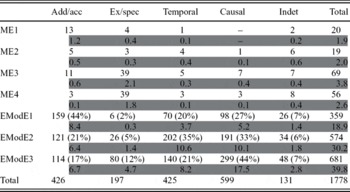
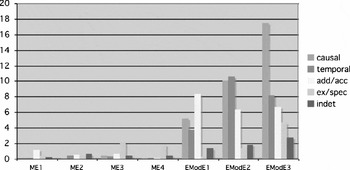
The result of the semantic analysis is shown in table 1.Footnote 5 The first row within each period shows frequencies in terms of token numbers. For the EModE data we have also given percentages, but not for the ME data since the numbers here are so low. The figures in the shaded rows give frequencies per 10,000 words. Figure 1 is a graphical representation based on these normalized frequencies.
The semantic category of the corpus clauses

The semantic category of the corpus clauses

Note that table 1 conflates a number of categories. Thus, the category ‘Causal’ does not refer to cause in the narrow sense of the word. It includes mostly cause proper, but also ‘relations involving notions of cause’ (Kortmann Reference Kortmann1995: 218), viz. purpose, result, instrument, etc. We also include condition, concession and contrast clauses, i.e. the so-called ‘CCC relations’. CCC relations are said to be ‘in the widest sense causal, conditional and concessive’ (Kortmann Reference Kortmann1997: 137; cf. also König & Siemund Reference König and Siemund2000 and Verhagen Reference Verhagen2000).Footnote 6 ‘Indet’ refers to clauses which are clearly adverbial (i.e. rather than nominal or adjectival), but which are indeterminate between various adverbial interpretations. (The category manner is not represented in the table because the relation manner is represented either by a nonclausal participle or by a prepositional gerund.)
The most striking fact about table 1 is perhaps the quite dramatic rise in the use of converb clauses between the last ME and the first EModE period. Given that grammaticalization leads to increased frequency (Bybee Reference Bybee, Joseph and Janda2003 and Reference Bybee2006; Brinton & Traugott Reference Brinton and Traugott2005: 126–30), the figures suggest that the reanalysis of converb clauses began around this time. The initial increase is followed by sharp rises also between each of the subsequent EModE subperiods, suggesting that the grammaticalization process continued to gather momentum throughout EModE.
Kohnen (Reference Kohnen2004) also shows that there has been a general increase in the use of converb clauses; however, his figures are somewhat different from ours as they demonstrate a rather large increase in the use of converb clauses already in the fifteenth century, followed by an even steeper increase in the sixteenth century and a drop in the seventeenth. Kohnen's figures are also larger than ours overall. The differences between our figures and those of Kohnen can probably be attributed to a difference in corpus composition. Kohnen's aim is to study to what extent genre plays a role in the development of participial and gerund constructions, and for this reason he focuses on six genres: narrative prose, chronicles, religious tracts, homilies/sermons, petitions/statutes and private letters. He uses the Helsinki Corpus, but not the entire corpus; instead he adds other texts. Most importantly, he has added a substantial proportion of text from the genres narrative prose and chronicles – and these genres show dramatically higher rates of converb clause use than do the other genres he investigates. Our study, by contrast, is based on the Helsinki Corpus as a whole and does not aim to study genre-related differences.
With regard to semantic relations, we see that only add/acc and ex/spec clauses occur at some level of frequency in ME. The figures are not very high, but we should perhaps bear in mind that there is a fairly large group of uses of the type shown in (10) above. As mentioned in section 2, we removed these sentences from the data as they appear to be formulaic. They also skew the data. For example, the figure from ME1 would have been doubled if we had included examples of the type in (10). It is nevertheless not unlikely that such uses may have served as one of the sources for English converb clauses. If we add the large proportion of indeterminate participial relative clauses (see the discussion in section 6), the number of indeterminate participial clauses which could have become reanalysed as ‘prototypical’ converb clauses becomes rather large.
In EModE, there is some fluctuation in the number of ex/spec clauses. Towards the end of the period, however, there is a sharp rise. By contrast, the frequency of add/acc clauses increases dramatically between ME and EModE. There is also a marked rise in temporal and causal clauses, and in particular the latter category becomes more and more frequent in the course of the EModE period, both in absolute and in relative terms. In sections 5 and 6, we explain these facts in terms of the reanalysis and grammaticalization of add/acc clauses, ex/spec clauses and participial relative clauses as temporal and causal clauses. However, before we turn to this issue, we focus on the syntactic properties of add/acc and ex/spec clauses, arguing that the relevant clause types are not truly subordinate clauses. Our discussion also involves a discussion of the nature of clause combining.
4 Syntactic gradience and the semantic reinterpretation of add/acc clauses
On the basis of the data presented in table 1, we claim that converb clauses represent a further development of add/acc, and to some extent also ex/spec, clauses. The latter two sets of clauses are seen as different from prototypical converb clauses, both syntactically and semantically. The reader may have noticed that we have several times referred to add/acc and ex/spec clauses as ‘converb-like clauses’ rather than simply as ‘converb clauses’. The reason is that we do not regard such clauses as prototypical instantiations of subordination, like ‘proper’ converb clauses, but rather as exemplars of a clause linkage type which lies in between subordination and coordination.Footnote 7 Such a claim of course involves a scalar view of clause combining. We argue that clause combining can be thought of in terms of a cline, with prototypical cases of coordination at one pole and prototypical cases of subordination at the other opposite. In between these poles, there are intermediate types.Footnote 8
Apart from those sources which are discussed below, there is a dearth of literature where clause types relevant to the present article are discussed on a more detailed level; however, for general accounts of the cline coordination–subordination, see, for instance, Quirk et al. (Reference Quirk, Greenbaum, Leech and Svartvik1985: 918 ff.; see also Hopper & Traugott Reference Hopper and Traugott2003: 176–84).
Callaway (Reference Callaway1901) provides a scalar analysis of ‘appositive participles’, i.e. participial constructions in which be and the participle do not form a VP together. Callaway divides appositive participial clauses into three subsets: (I) Dependent Adjectival (Relative) clauses; (II) Dependent Adverbial (Conjunctive) clauses; and (III) Independent clauses. The latter type ‘either (1) denotes an accompanying circumstance or (2) repeats the idea of the principal verb’ (1901: 268). Callaway's category of Independent clauses thus includes our categories of add/acc and ex/spec clauses. According to Callaway, Independent clauses are clearly different from Dependent Adverbial clauses:
Doubtless, as Gildersleeve holds (Latin Grammar, §664, Remark 1), an ultimate analysis would show every participle to be dependent in nature; but the dependence here is so slight that it may be ignored. Certainly the function of the participles under this head is so radically different from that of those under I. and II. as to demand separate consideration. (1901: 268–9)
Johansson & Lysvåg (Reference Johansson and Lysvåg1987) provide a very similar account. They distinguish between ‘Adverbial clauses’ and ‘Supplementive clauses’. Adverbial clauses are clauses which express well-known adverbial relationships such as time, cause, condition, purpose, etc. Such clauses are seen as dependent and integrated into the overall clause structure. Supplementive clauses, which apparently correspond to Callaway's Independent clauses, are different, both syntactically and semantically. The syntactic label given to this type of clause linkage is ‘-ing coordination’ (1987/1: 135; 1987/2: 285) because the relevant -ing clauses are ‘combined with their matrix clauses in a way that resembles coordination’ (1987/1: 368). It is further claimed that Supplementive clauses ‘occupy an intermediate position between coordination and subordination’ (1987/1: 135). The semantic and functional status of the relevant clauses is said to mirror their syntactic status. They are referred to as ‘supplementive’ because ‘[w]hen they are appended to the superordinate clause, they seem merely to add more peripheral information, typically about the referent of the Subject in the finite clause’ (1987/1: 177). Thus, in contrast to Adverbial clauses, Supplementive clauses are clauses ‘with no obvious relation to the superordinate clause’ (1987/1: 177).
In the same vein, Behrens & Fabricius-Hansen (Reference Behrens and Fabricius-Hansen2005), discussing add/acc clauses, find that such clauses represent an intermediate category. They are like coordinated clauses in ‘inducing an interpretation by event (predicate) summation corresponding to the effect of ordinary conjunction by and’ (Reference Behrens and Fabricius-Hansen2005: 11). This, it is argued, explains why the relevant clause type is frequently translated by way of and coordination in languages that do not have participial add/acc clauses. On the other hand, add/acc clauses behave like subordinate clauses in that they obey the ‘Right Frontier Constraint’, which prescribes that ‘[o]nly the right edge branches are available as attachment points’ (2005: 6, 11).Footnote 9 From a discourse organization viewpoint, it is found that add/acc clauses are downgraded in relation to the matrix event, which is more salient (2005: 10).
Kohnen (Reference Kohnen2004: 55) also points out that add/acc and ex/spec clauses (he does not use the relevant terms, but his examples fit into those categories) can often be paraphrased by way of and coordination, in spite of the fact that they have an adverbial meaning. Kohnen's conclusion is not, however, that the relevant clauses are a hybrid between subordination and coordination, but that the paraphrase itself is useless.
Except for Kohnen, then, all the above-mentioned scholars see add/acc (and ex/spec) clauses as a hybrid between coordinated and subordinate clauses, perhaps being closest to the coordination pole of the clause-linkage gradient.Footnote 10 The borderline between such clauses and converb clauses is far from clear-cut. Thus, Johansson & Lysvåg note that it can be hard to distinguish between PDE Adverbial clauses and Supplementive clauses as ‘[t]he integration of a nonfinite clause into a superordinate clause is a matter of degree’ (1987/2: 285). Further, ‘nonfinite Adverbials . . . merge into the non-integrated clauses, where the meaning approaches mere addition of information’ (1987/1: 183). This fluidity in the clause-linkage system was probably a prerequisite for the reinterpretation of add/acc and ex/spec clauses as subordinate – i.e. adverbial – clauses. We hypothesize that due to the scalar nature of clause combining, clause types can move along the relevant cline, coordinated clauses being reanalysed as subordinate ones. This is very likely what happened to add/acc and ex/spec clauses in English. More specifically, such clauses were – on the basis of the context – assigned specific, adverbial meanings, and this reinterpretation also resulted in a change in syntactic status, a semi-independent clause being reanalysed as a dependent one. This change in syntactic status is reflected in a positional shift. As shown in Killie (in prepReference Killie), the converb-like clauses in the ME corpus almost without exception occur clause-finally, while EModE converb clauses frequently occur sentence-initially. The reason is probably that once the relevant clauses had acquired subordinate status, they came to serve the same types of textual functions as subordinate clauses typically serve. Important functions here are the reader-orienting and text cohesive functions, which are typically associated with initial position. That add/acc and ex/spec clauses are not true subordinate clauses is shown by the fact that they very rarely occur sentence-initially (cf. the data in Kortmann Reference Kortmann1991: 138). Apparently, such clauses are not naturally used in reader-orienting and text cohesive functions, as are ‘proper’ adverbial clauses.
The reinterpretation and reanalysis of add/acc and ex/spec clauses as adverbial clauses must have crucially depended on their frequent vagueness and ambiguity. The frequent indeterminacy of English -ing clauses is first and foremost due to the fact that such clauses typically lack conjunctions. They are thus underspecified semantically, and this allows a range of inferences to be made, as we will see below. What happened from the late ME period onwards, then, was that the relevant interclausal relation came to be reanalysed as, and grammaticalized as, one of subordination. Another prerequisite for this development is the fact that the original add/acc and ex/spec clauses were – in spite of their apparent semantic independence – nevertheless already syntactically dependent. Their dependency was (and is) due to their reduced syntactic form. Because converb clauses are both ‘deranked’, i.e. the VP lacks a finite verb (Stassen Reference Stassen1985), and lack an overt subject in the majority of cases, they depend on the matrix clause for their interpretation. In spite of their relatively independent semantic status, they therefore show a relatively high degree of syntactic integration with their matrix clause.
What we believe happened in Old and Middle English is the following. Appositive participial constructions (including all the types discussed by Callaway) were introduced into Old English (OE) as a Latin-inspired stylistic device. While converb clauses never became an integral part of Old and Middle English grammar, add/acc and ex/spec clauses were allowed to remain in the language precisely because they were not syntactically and semantically integrated into the framework of the native clause. In time, the syntactic dependence of add/acc and ex/spec clauses was taken to imply that there must be semantic dependency as well (cf. the concept of ‘diagrammatic iconicity’, Hopper & Traugott Reference Hopper and Traugott2003: 178–9), and the relevant clauses were reinterpreted as expressing diverse adverbial relations. In the next section, we discuss possible contexts and mechanisms for such a reinterpretation. The focus of our exposition is add/acc clauses, as we believe these have the greatest potential for reinterpretation and hence may represent the main source of converb clauses. This is a natural assumption given that add/acc clauses refer to an additional event, while ex/spec clauses refer to the same event as the matrix clause predicate. An additional event can presumably be interpreted as being in a causal relationship with the matrix clause event, or as being cotemporaneous with it. With ex/spec clauses, such a reinterpretation can only occur if the ex/spec clause is taken to refer to an additional event rather than repeating and elaborating on the event referred to in the matrix clause. Given that there is occasional indeterminacy between add/acc clauses and ex/spec clauses (cf. section 3.1), such reinterpretations may have occurred, but they are not likely to have occurred frequently enough to represent an important source of converb clauses. However, as we will see below, ex/spec clauses do have some potential for reinterpretation. For example, they have a fuzzy border with instrument clauses.
5 Subjectification in the grammaticalization of add/acc and ex/spec clauses
In this section, we explore the semantico-pragmatic aspects of the grammaticalization of add/acc clauses as converb clauses. We argue that the reanalysis of such clauses involves the conventionalization of conversational implicatures and point to possible ‘critical contexts’ (Diewald Reference Diewald1999) or ‘bridging contexts’ (Heine Reference Heine, Wischer and Diewald2002). These are contexts which ‘trigger an inferential mechanism to the effect that, rather than the source meaning, there is another meaning, the target meaning, that offers a more plausible interpretation of the utterance concerned’ (Heine Reference Heine, Wischer and Diewald2002: 84). According to Heine (Reference Heine, Wischer and Diewald2002: 85), such contexts – or rather, the inferences that arise in such contexts – ‘may, but need not, give rise to conventional grammatical meanings’. Whether this happens or not normally depends on frequency. Below we show that in the case of -ing clauses, the same types of implicatures arise again and again – and that they have done so all through the (written) history of English. The relevant implicatures may therefore well have become conventionalized (or ‘semanticized’). In addition to discussing potential bridging contexts, we discuss possible grammaticalization paths for converb clauses. A major claim here is that the grammaticalization of such clauses crucially involves subjectification.
Traugott (Reference Traugott, Lehmann and Malkiel1982, Reference Traugott, Adamson, Law, Vincent and Wright1987, Reference Traugott1989, Reference Traugott, Stein and Wright1995) defines subjectification as the process ‘whereby meanings become increasingly based in the speaker's subjective belief state/attitude toward the proposition, in other words, towards what the speaker is talking about’ (Traugott Reference Traugott, Stein and Wright1995: 31). A common trajectory is the following:
(12) (I) propositional > (II) textual > (III) expressive
A well-known example of a construction/lexeme that has gone through all the three steps in (12) is hwile as in OE þa hwile þe ‘at the time that’ (exemplified in (13) below), which evolved from noun to time conjunct and finally to a concessive conjunct.
(13)
Traugott concludes that ‘the overall shift of while is from reference to a relatively concrete state of affairs (a particular time) to expression of the speaker's assessment of the relevance of simultaneity in describing events, to assessment of contrast and unexpected relations between propositions’ (Reference Traugott, Stein and Wright1995: 42). Traugott (Reference Traugott1989: 31) analyses this change in the following way:
‘At the time that’ refers to a temporal situation viewed as part of a verifiable state-description and in this sense is ‘propositional’ (cf. Lyons Reference Lyons1977: 51). While in the sense of ‘during’ signals a cohesive time relation not only between two events in the world, but also between two clauses, and therefore has a textual as well as a temporal function. And while in the concessive sense of ‘although’ is primarily expressive of the speaker's attitude.
The development of while, then, clearly involves subjectification. Below we argue that converb clauses have gone through a process of subjectification: a clause type that was propositional in nature has been adopted – and increasingly used – both as a textual device and as a means for expressing speaker attitude. Reinterpretations such as those proposed by Traugott for while clauses do not depend on specific lexemes (such as while), but can operate also at a more abstract level. That semantic relationships can be established between clauses or propositions without the aid of a mediating connective has been pointed out before. Thus Hopper & Traugott (Reference Hopper and Traugott2003: 79) argue that such unconnected clauses tend to become ‘interpretatively enriched as having some coherence, that is, relevance to each other, simply because they are uttered in sequence’. The mechanism here is conversational implicatures, as is the case with the evolution of while. Hopper & Traugott give the examples in (14) (which correspond to their examples 4a, b):
- (14)
(a) The earthquake hit at 8 a.m. A four-car crash occurred.
(b) A four-car crash occurred. The earthquake hit at 8 a.m.
Discussing the two examples, Hopper & Traugott (Reference Hopper and Traugott2003: 80) note that:
Typically the relationship inferred will be that of temporal sequence and even causal connection if the clauses are action/event clauses and connectable in terms of encyclopedic or world knowledge, as in (4a) [i.e. our 14a, KK&TS]; however, no such relationship is likely to be inferred if the sequence is incoherent in terms of world knowledge, as in (4b) [i.e. our 14b, KK&TS], where inference of a causal connection is unlikely, and even close temporal connection may be in doubt . . .
As mentioned above, conversational inferences can, if they occur frequently enough, become semanticized, i.e. become a part of the semantics of the clause-combining relationship. Such conversational implicatures most likely played a crucial role in the development of converb clauses in English. One possible path of development is that add/acc clauses were reinterpreted as time clauses, which were in turn reinterpreted as expressing both concessive/adversative relationships (much like while) and other types of causal relationship. This scenario fits well with our claim in section 4 above that add/acc clauses merely add another proposition to the one expressed in the matrix clause, without establishing any specific relationship between the two propositions. Thus, an add/acc clause, just like þa hwile þe, ‘refers to a temporal situation viewed as part of a verifiable state-description and in this sense is “propositional”’ (Traugott Reference Traugott1989: 31; cf. section 5). We also saw in section 4 that the only requirement on add/acc clauses is the unity of space and time. Such clauses may therefore be said to have an implicit time relation of simultaneity with the matrix clause. This time element probably at some stage came to be utilized as a means of arranging events temporally in discourse, i.e. -ing clauses came to be used as a time frame for the event referred to in the matrix clause, in much the same way as finite while clauses are. While the example in (15) below represents a ‘prototypical’ – and hence propositional – add/acc clause, the excerpt in (16), which is from the earliest subperiod of the ME corpus, ME1, possibly provides both an example of the original add/acc type and an early example of a time clause. Thus, heriende on heh hire healent in heouene may refer to an event that simply accompanies the main event, ‘without introducing a time interval relative to which the matrix proposition must be interpreted’ (Kortmann Reference Kortmann1991: 169; see the discussion in 3.1). However, it is also possible to interpret the relevant clause as a time clause. Again we notice the fuzziness found in this area of the grammar. The second highlighted clause in (16), lokinde up-on hire riht half, is more straightforward. This clause clearly serves as a temporal background against which the matrix clause seeing event takes place. The clause highlights the relevance of simultaneity, and is thus textual.
(15) On þan twelften dæige eorneð mænn geond eall middeneard byfigende & drædende Cristes tocyme to demene cwican & deaden, . . .
‘On the twelfth day men will run through all the earth shivering and dreading Christ's coming to judge the living and the dead, . . .’ (ME1, Vespasian homilies)
(16)
‘And that humble girl, wholly unmarred, without any spot, went out of his stomach, loudly praising her saviour in Heaven. Looking to her right, she saw an extraordinary monster, a great deal blacker than any black person.’ (ME1, Margarete, The Katherine group)
The -ing clause in (17) also locates the matrix clause speaking event in relation to some temporal background, i.e. the agent uttered his words in English while laughing.
(17) he sat longue in þouƷhte, And al leiƷhinde on Englichs: þeos wordes forth he brouƷhte: ‘Men seggez þat game goth in wombe: ake i segge game goth in heorte.’ (ME2, The life of St Edmund)
The example in (17) illustrates how clause-initial placement may disambiguate the meaning or function of participial clauses, making us interpret them as truly subordinate.Footnote 11 Initial clauses, then, tend to be time clauses rather than add/acc clauses. However, the opposite does not necessarily hold; final clauses are functionally more ambivalent. Whether a final clause is interpreted as a time clause or not seems to depend on an evaluation of the (relative) importance of the event referred to in the relevant clause. Thus, walking down the street represents an appropriate temporal background to another activity and the clause in (18) below therefore functions as a time clause regardless of position. By contrast, predicates such as wearing a black tie or feeling bad do not refer to events that represent appropriate temporal backgrounds and would hence be interpreted as add/acc clauses. (Feeling bad could, however, function as a cause in initial position, if the main clause allows such an interclausal interpretation.) In general, overt activities seem to make good temporal backgrounds (but not always), while covert activities/mental processes and states, on the other hand, do not. But things are more complicated than that. For example, clauses such as living in London, which refer to a state, represent a much-used temporal background. A close study is clearly needed for any decisive conclusions to be drawn in this area.
- (18)
(a) Walking down the street he met his ex-wife.
(b) He met his ex-wife walking down the street.
In many cases it is unclear how the relation between two clauses is to be interpreted. It is for example difficult to tell whether the information about postures provided in the -ing clause in (19) below is meant to provide additional information, or if it is a time clause (it may also be said to resemble the clause in 18b).Footnote 12 This semantic fuzziness is presumably the main reason why add/acc clauses came to be reinterpreted as time clauses in the first place.
(19) And the pask of the Jewis was niƷ, and many of the cuntrey wenten vp to Jerusalem bifor the pask, to halewe hem silf. Therfor thei souƷten Jhesu, and spaken togidere, stondynge in the temple, . . . (ME3, Wycliffe's New Testament)
We have seen that English -ing clauses have over time developed a textual function. However, whereas temporal clauses enable us to see two clauses – and hence two events – in relation to each other, they do not impose any specific causal interpretation on the relationship between the two events. The fact that converb clauses have come to express causal relationships shows that they have developed uses which are truly subjective, i.e. ‘expressive’. (Of course, causal clauses can be textual in addition to being expressive; see section 7.) It may well be that many such uses are historically derived from, i.e. represent reinterpretations of, temporal uses. This hypothesis gains support from the fact that the corpus contains a considerable number of converb clauses which are indeterminate between a temporal and an expressive reading. For example, the clauses in (20) and (21) below can be interpreted either as time or cause clauses. (The -ing clause in (21) possibly allows an add/acc reading as well.) The clauses in (22) and (23) allow both paraphrases with when and if and must therefore be seen as indeterminate between a time and a condition reading.
(20) The Chaplain had dream't that such a day he should die, but being by all the Family put out of the belief of it, he had almost forgot it; till the Evening before at Supper, there being Thirteen at Table; according to a fond conceit that one of these must soon die, One of the young Ladies pointed to him, that he was to die. He remembering his Dream fell into some disorder and the Lady (∧Warre∧) reproving him for his Superstition, he said, He was confident he was to die before Morning, but he being in perfect health, it was not much minded. (EModE3, Burnet: History of my own time)
(21) I have endeavour'd to direct the Reader by true Rules, which if observed, he would not fall into those vulgar Errors which are frequent in practice; but because for want of warning, some people may continue in them, thinking they have a further knowledge or better Judgment, I shall endeavour to refute those I have most taken notice off in use. (EModE3, Langford: Plain and full instructions)
(22) There were two Principles in his natural temper, that being heighten'd by that heat carried him to great excesses: . . . (EModE3, Burnet: Some passages of the life and death of the right honourable John, Earl of Rochester)
(23) For 'tis known, that Heat, by agitating the parts of a fit Body, solicites it as it were to send forth its (∧Effluvia∧), as is obvious in odoriferous Gums and Perfumes, which, being heated, send forth their fragrant steams, both further and more copiously than otherwise they would. (EModE3, Boyle: Electricity and magnetism)
Kohnen (Reference Kohnen2004: 63) discusses two sixteenth-century examples which are both indeterminate between a temporal reading and several causal readings, showing that the fuzziness in this area is extensive (cf. also Lamprecht Reference Lamprecht1989: 343–4). Assuming that the first real converb clauses were time clauses (add/acc clauses not being subordinate clauses and hence not real converb clauses), and observing the frequent indeterminacy between time interpretations and different types of causal relationships, we hypothesize that time clauses represent one important source of expressive converb clauses. What were intended as temporal uses most probably invited inferences of a causal nature, and these inferences gradually became conventionalized. Thus, English converb clauses may have evolved along the following path:
(24) (I) add/acc > (II) time > (III) cause, condition, etc.
Here stage (II) involves the development of textual uses of converb clauses, while the meanings derived at stage (III) are expressive meanings. (Of course, expressive clauses may serve textual functions, too.) On this analysis, converb clauses show a rather similar development to OE þa hwile þe.
There is copious evidence that the path sketched in (24) represents a very common one (see, for example, König & Traugott Reference König, Traugott, Hüllen and Schulze1988: 113f.; Edgren Reference Edgren1971: 226f.; González-Cruz Reference González-Cruz, Lenker and Meurman-Solin2007). An important study in this respect is Kortmann's crosslinguistic 1997 study, where he investigates the semantic properties of adverbial subordinators in fifty-nine languages. Kortmann investigates semantic affinities between his four semantic networks – viz. temporal, CCC, modal, and ‘other relations’ (see section 3.2 and footnote 6). He argues that the highest degree of semantic affinity is found between the networks of temporal and CCC relations. This has the following consequences for semantic development:
that temporal relations generally give rise to CCC relations (but not vice versa), that both locative and modal relations feed into the TIME network and, partly via the latter, to the CCC network (but not vice versa). It is crucial to stress that for none of these links does the reverse hold, i.e. neither are CCC subordinators found to develop temporal, locative or modal readings, nor do temporal subordinators come to serve as locative or modal markers. From this we can draw another interesting conclusion: the links between any pair or set of interclausal relations belonging to different semantic networks appear to be generally unidirectional . . . (1997: 178; see also 188, 209 and ch. 7 in general)
Similarly, having assessed the available evidence, Hopper & Traugott (Reference Hopper and Traugott2003: 82) conclude that the inference of causality from temporal sequence is a ‘standard’ or ‘stereotypical’ inference.Footnote 13
We do not believe, however, that the development sketched in (24) represents the only path in the development of converb clauses. It hardly represents more than one strand in a grammaticalization and subjectification process that must have been multifaceted. Thus, many of the ambiguous -ing clauses do not involve a time reading at all, and if we assume, as we have done so far, that the development of new ‘semantic types’ of converb clauses (or perhaps more correctly, of new types of semantic relationships between an -ing clause and a matrix clause) involves the reinterpretation of ambiguous clauses, we must also allow for other paths of development than that suggested in (24). The clause in (25) below, for example, seems to allow both an add/acc reading and a causal reading. On the former interpretation, it simply expresses an accompanying feeling. Alternatively, the protagonist's belief may be seen as his motivation for carrying out the activity referred to in the matrix clause. The clause in (26) could be intended as a mere add/acc clause, again expressing an accompanying thought/feeling, but a concession reading seems to be possible as well (‘although he does not know the words’).
(25) It haveing been an inconvenience that my owne natural constitution disposed me to, I would have been glad of a cure. Not findeing it in books I set my thoughts on worke beleiveing that greater changes then that might be made in our bodys if we tooke the right course and proceeded by rationall steps. (EModE3, Locke: Directions concerning education)
(26) . . . but he commends the song, not knowing the words, but says the ayre is good, and believes the words are plainly expressed. (EModE3, The diary of Samuel Pepys)
The examples in (25) and (26) suggest that some add/acc clauses may have been interpreted as expressive clauses directly, i.e. without the intermediate temporal/textual stage which is baked into the diagram in (24).
As mentioned above, ex/spec clauses, which have also been shown to be relatively frequent in the early data, show less potential for reinterpretation than do add/acc clauses. Nevertheless, such clauses are occasionally ambiguous and thus to a certain extent allow reinterpretations to be made. For example, the -ing clause in (27) below may be interpreted as an ex/spec clause, which further specifies the verb excused in the matrix clause. On the other hand, it seems to allow an instrument reading, in which case it can be paraphrased by way of by.
(27) But Solon very well replyd to a fond parent that would not have his child corrected for a perverse trik but excused it saying twas a small matter, ay said Solon but custome is a great one (EModE3, Locke: Directions concerning education)
Instrument and exemplification/specification are inextricable notions in relation to examples such as that in (27). It is also arguable that the ex/spec clauses in (11a) and (11b) above approach instrument clauses in meaning. Further, the clause in (28) may be seen as specifying the predicate in the matrix clause; yet, a causal interpretation seems to be available, too.
(28) In these Two (∧Munsels∧) we only meet with these Servitors, in other Places Men appear alone, not allowing their Women that Freedom; . . . (EModE3, Fryer: A new account of East India and Persia)
Again we are witnessing unclear boundaries between semantic categories of converbial -ing clauses, but as we will see below, ex/spec clauses first and foremost have fuzzy borders with relative clauses.
6 Participial relative clauses as a source of converb clauses
According to Kortmann (Reference Kortmann1995), the distinction between participial relative clauses and ex/spec clauses is anything but clear-cut. Rather, ‘participial clauses in postnominal position . . . neutralize the difference between nonrestrictive (or: nondefining) postmodifying clauses and detached adverbial participles . . .’ (Reference Kortmann1995: 201). A similar observation is made by Quirk et al. (Reference Quirk, Greenbaum, Leech and Svartvik1985: 1123–5). There may also be indeterminacy between converb-like clauses and sentential relatives. Discussing the examples in (29), which correspond to his examples (32a, b), Kortmann observes that ‘a number of free adjuncts/absolutes closely associated with those exemplifying or specifying (some part of) the matrix proposition have been grouped separately because the nearest gloss they may receive is that of a nonrestrictive relative (32a) or sentential (32b) relative clause’ (Reference Kortmann1991: 134).
- (29)
(a) Only Skullion, standing alone in the Musician's Gallery, heard him and his face was dark with anger. (TS, 14)
(b) Four British players . . . have been given ‘wild card’ entries into the men's singles at Wimbledon saving them from having to qualify. (GUA, 32)
Note that even though Kortmann (Reference Kortmann1991) finds that the clauses in (29) are indeterminate between a relative clause reading and an ex/spec reading, there seem to be other possible readings as well. Thus, in (29a), the temporal element present in the participle could well be foregrounded, leading to a temporal interpretation of the clause (‘while he was standing . . .’), while in (29b), a result interpretation appears to be available.
Relative clauses often refer to a ‘verifiable state-description’ (as in (29a) and in (33) below), and are in such cases propositional. But it is interesting to note that the potential ex/spec clause in (29b) serves a subjective function: it allows the speaker to intrude to give us his/her interpretation of the consequences of the event referred to in the matrix clause. In other words, such clauses enable the speaker to comment on a causal relationship.Footnote 14 This is a discourse function that ex/spec clauses and sentential relatives have in common; thus, Quirk et al. (Reference Quirk, Greenbaum, Leech and Svartvik1985: 1112, 1117, 1120) note that sentential relative clauses are semantically comment clauses, i.e. parenthetical disjuncts. Sentential relatives, then, may represent one source of subjective converb clauses. Non-restrictive relative clauses may have a rather similar function; see the discussion of the clauses in (31) and (32) below.
Given the degree of fuzziness just described, it is not unlikely that clauses which were intended as relative clauses may have been interpreted as converb (or converb-like) clauses. This assumption gains support from the fact that indeterminacy between relative clauses and ex/spec clauses is relatively frequent in the corpus. As explained in section 2, we have excluded such uses from our statistics, which only include participial clauses that are unambiguously adverbial. However, the examples in (30)–(32) below may serve to demonstrate that indeterminacy between relative clause readings and ex/spec readings was not uncommon in earlier English. Thus, in (30) it is unclear whether the -ing clause is meant to refer back to the NP a greet multitude of sike men, in which case it is a relative clause, or if it refers back to the verb lay, further specifying it, in which case it is an ex/spec clause.
(30) Jhesus wente vp to Jerusalem. And in Jerusalem is a waissynge place, that in Ebrew is named Bethsaida, and hath fyue porchis. In these lay a greet multitude of sike men, blynde, crokid, and drie, abidynge the mouyng of the watir. (ME3, Wycliffe's New Testament)
The -ing clauses in (31) and (32) are somewhat similar. In both cases we may have relative clauses which simply characterize the sermon and the mockers. However, it is also possible that the clause in (31) functions to explain or define what is meant by honest, while the clause in (32) provides the writer's grounds for calling the people in question mockers. On an ex/spec interpretation, the clauses here function as metalinguistic comments and hence have a subjective function.
(31) our Lecturer, preached on 97:Psal:1. a very honest Sermon, shewing our duty to God for the many signal deliverances of his Church, without entering into the politics. (EModE3, The diary of John Evelyn)
(32) There shall come in the last days mockers, walking after their own ungodly lusts, sensual, not having the spirit. (EModE3, Tillotson: Sermons)
Whether ex/spec clauses are entirely a result of the reinterpretation of relative clauses is unclear. Ex/spec clauses are relatively frequent in ME. In the early ME corpus, some of them, as mentioned above, involve a verb of saying and seem to be formulaic. While these have been excluded from our data, it is nevertheless possible that such formulaic use could have served as a basis for the development of a more productive pattern.
Indeterminacy involving potential relative clauses does not necessarily involve ex/spec readings. There are also cases of participial clauses which seem to be indeterminate between a relative clause reading and a time reading, suggesting that relative clauses may give rise also to temporal clauses. For example, in (33) the proposition in the -ing clause either functions to characterize the referent of the preceding NPs further, or it provides a temporal background for the event referred to in the following clause. Note the parallel with the PDE clause in (29a).
(33) Thence home, and upon Tower hill saw about 3 or 400 seamen get together; and one, standing upon a pile of bricks, made his sign with his handkercher upon his stick, and called all the rest to him, and several shouts they gave. (EModE3, The diary of Samuel Pepys)
Indeterminacy between a relative clause reading and a causal reading also occurs. The -ing clause in (34) below, for example, could be seen as merely qualifying the preceding NP, but there is a potential causal link here, and the causal element may easily be perceived as pragmatically more important.
(34) he now late cam to oon Jonet, þat was þe wyfe of Janyn Cook of Estchepe, seing that he was a sothseyer, and trewely wolde telle here where cc.li. and more was be-come, with a litel cofre closed be her housbond in his life, was beried in þe ground, if it so were þat she wold paye as well for the sotell inst[{r{]umentes þat longen to his craft, as for his mete and drinke that he spended al þe mene while þat he were in this toun, and with that also þat she wolde ensure him to be wedded to him; which Jonet, nat knowyng his falsnesse and disceit, paied at his byddyng for his instrumentes and mete and drinke xls. and more onward; . . . (ME3, Usk: A book of London English: Judgements, London)
Kohnen (Reference Kohnen2004: 60) also points out that -ing clauses can be indeterminate between a causal and a relative clause reading. As explained earlier, we do not provide quantitative data showing degree of use of relative clauses, neither indeterminate uses nor clear-cut ones. However, Kohnen (Reference Kohnen1996, Reference Kohnen, Kastovsky and Mettinger2003, Reference Kohnen2004) provides figures showing that participial relative clauses are frequent in the fifteenth and sixteenth centuries. In his 2004 monograph, he also provides frequencies for uses which are indeterminate between an adverbial and a relative reading. Interestingly, such uses show a marked increase in the fifteenth century, and their numbers continue to rise, reaching a high point in the sixteenth century, when they begin to fall again. In other words, the quantitative development of such clauses closely mirrors the development of converb clauses (see the discussion in section 3.2). The number of indeterminate uses is relatively high, reaching 10 occurrences per 10,000 words in the sixteenth century. The genre that has the highest frequencies of participial relative clauses by far is statutes. There are also a fair number of such clauses in the chronicles, but not so many in the other genres under study (2004: 149; cf. also Kohnen Reference Kohnen, Kastovsky and Mettinger2003). The function of relative clauses explains their frequent occurrence in the statutes. According to Kohnen (Reference Kohnen, Kastovsky and Mettinger2003: 176), ‘the predominance of postmodifications . . . reflects a striving after precision in reference, which is a typical characteristic of curial prose (Burnley Reference Burnley1986: 596). The persons and situations to whom the laws apply need to be qualified unambiguously.’ Participial relative clauses represent a way of doing this in a syntactically compact, and hence economical, way. For our purposes, it is important to note that this compactness is obtained at a cost: the omission of the relative pronoun potentially makes the reference of the clause indeterminate, neutralizing the distinction between relative clause function and adverbial function. Again we see that the underspecification of a type of -ing clause causes ambiguity. Our hypothesis, then, is that the relevant ambiguity has caused reinterpretations to occur, and that such reinterpretations represent another source of converb clauses.
7 Summary and discussion
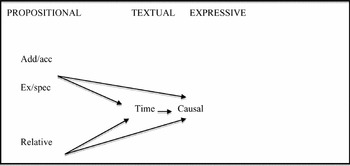
We have seen that there is a fuzzy border not only between different types of converb(-like) -ing clauses, but also between relative clauses and converb(-like) clauses. Given this fact, it is likely that some types may have given rise to other types through reinterpretation. The crucial mechanism here is pragmatic inferencing. It is of course impossible to determine the exact paths of development for converb clauses, but we have argued in favour of some possible paths. In (24) above, we proposed that a number of add/acc clauses were reinterpreted as time clauses, which were in turn reinterpreted as various types of causal clauses. However, we have also argued that add/acc and ex/spec clauses can give rise to causal interpretations without an intermediate step. We have also claimed that participial relative clauses represent a likely source of converb clauses. The relevant hypotheses were formed on the basis of two types of evidence: (1) the corpus data, as well as the data presented in Kohnen (Reference Kohnen2004), which show that a substantial proportion of -ing clauses are indeterminate either between different adverbial readings, or between a relative clause reading and one or more adverbial readings; and (2) empirical investigations of what inferences are typically made between unconnected clauses or propositions. Of such inferences, the inference from temporal ordering to causal connection is by far the most common one. The examples discussed in the previous sections suggest that there are many possible lines of development, and it is more likely that the grammaticalization of converb clauses involves several paths than one single, orderly pattern.Footnote 15 The possible trajectories discussed above are sketched in figure 2. (Note that this diagram does not necessarily exhaust the possibilities.) Importantly, all the paths suggested involve subjectification, either in the sense of increased textualness, or in the sense of increased expressivity, or both.
The development of converb clauses

As can be seen, causal clauses are placed both under ‘textual’ and ‘expressive’ in figure 2. We have done this deliberately as such clauses may of course serve textual functions in addition to expressive ones. That time and causal clauses serve important textual functions is shown by their occurrence in initial position. The clauses which occur in initial position are almost exclusively temporal and causal ones, and a large proportion of the temporal and causal clauses in the corpus are found here. Thus, in EModE3, two thirds of the temporal and one third of the causal clauses occur sentence-initially. In this position, they serve to link the sentence to the previous discourse, or they function as ‘guideposts’ (Chafe Reference Chafe1984; cf. the discussion in Killie in prep). Additional evidence that converb clauses have developed at least partly out of add/acc and ex/spec clauses may come from Callaway's (Reference Callaway1901) data. Callaway finds that add/acc and ex/spec clauses frequently have objects, while the clearly adverbial clauses as a rule do not (Reference Callaway1901: 285).
In addition to relating the development of converb clauses to the use of add/acc clauses, participial relative clauses, and possibly ex/spec clauses, it is quite possible that other developments in the use of -ing forms may have played a role. It is presumably no coincidence that the grammaticalization of the gerund, the progressive and converb clauses took place around the same time (cf. Killie Reference Killie2006 and Reference Killie, Elspass, Langer, Scharloth and Vandenbussche2007 for discussion). The grammaticalization of all these -ing constructions produced a great deal of output containing verbal -ing forms, i.e. ‘verbal’ in the sense of (the -ing form) taking NP complements. In addition to such syntactic parallels, there are semantic and functional similarities between some of these constructions. For example, prepositional gerunds and converb clauses both function as adverbials.Footnote 16 Interestingly, Koma (Reference Koma1987) shows that the majority of prepositional gerunds function as time adverbials. Further, the semantics of the progressive participle may have played a role. Kortmann (Reference Kortmann1991), noting that the unmarked reading of a temporal clause is that of ‘same time’, relates this fact to the ‘temporal properties of the present participle’ (Reference Kortmann1991: 122–3), and hence to the meaning or function of the progressive. What can be said to distinguish add/acc clauses from time clauses is that while add/acc clauses require unity of time, but do this only implicitly, temporal clauses – like the progressive – foreground the temporal dimension of the present participle. In this connection, it is also interesting to note that the complements of perception verbs have been increasingly realized by -ing forms from late ME onwards, at the expense of bare infinitives – or to put it differently, the aspectual contrast between -ing forms and to infinitives in such complements has been increasingly grammaticalized (see the account and references in Miller Reference Miller2002: 264–6). These various developments are most likely interrelated, and they must have led to an increasing proportion of aspectual -ing forms in speakers’ input. This may have reinforced the simultaneity component of the -ing form in add/acc clauses, causing such clauses to become reinterpreted as temporal clauses. Given the various overlaps in meaning, function and syntactic properties in the various participial constructions, it may well be the case that the different constructions have influenced and reinforced each other in various ways, leading to an increase in the use of them all.
The claim that the development of converb clauses is an instance of grammaticalization is a controversial one. The main counter-argument against such an analysis seems to be that the resulting construction type does not display any degree of semantic bleaching, but rather the opposite, viz. semantic enrichment. We are aware of this fact, but we have nevertheless chosen to retain our position, believing that the notion of grammaticalization has been defined too narrowly in some accounts. Our position has been much inspired by Mathiessen & Thompson (Reference Mathiessen and Thompson1988), which discusses the relation between the rhetorical structure of a text and its grammatical organization. Mathiessen & Thompson distinguish between two basic types of rhetorical relation, viz. ‘those in which one member of the related pairs is ancillary to the other . . . and one in which neither member of the pair is ancillary to the other’ (Reference Mathiessen and Thompson1988: 289). The former is referred to as the ‘Nucleus-Satellite’ relation and the latter as the ‘List’ relation. The Nucleus-Satellite distinction is crucial in any text as all parts of the texts cannot be equally central; rather, ‘certain portions realize the central goals of the writer, while others realize goals which are supplementary or ancillary to the central goals’ (Reference Mathiessen and Thompson1988: 289). Adverbial relations such as those studied in the present article are ‘supplementary or ancillary to the central goals’ and hence satellites. They are ‘enhancing relations’, i.e. they circumstantially relate the nucleus proposition to an aspect of the physical world (time, space, cause, instrument, etc.). It is in principle possible to code both nuclei and satellites in the same way, i.e. as main clauses, which are either not explicitly linked, or which are linked by way of co-ordinate conjunctions such as and. This is common in speech, and especially in the speech of children. (This is one reason why it can be so difficult to understand what children mean to say: all the information they produce is presented as equally important.) Earlier texts typically have less grammatical marking of the satellite relation, hence the common observation that older texts have more parataxis than more recent ones. However, there is a diachronic tendency to code the satellite relation explicitly, i.e. grammatically. In other words, grammatical devices have developed in order to mark the satellite relation, and this includes the enhancement relation (Mathiessen & Thompson Reference Mathiessen and Thompson1988: 301). Mathiessen & Thompson (Reference Mathiessen and Thompson1988: 304) argue that there are basically two ways in which satellites are marked: (1) by way of connectives, or (2) by way of finiteness, the satellite being marked as nonfinite and hence dependent on the main clause. It thus appears that the reanalysis of semi-coordinated -ing clauses (which, we assume, were originally modelled on Latin participial clauses) as converb clauses represents one way of grammaticalizing the satellite – or enhancement – relation in English. It is difficult to see how the development of a grammatical device such as this could ever involve semantic bleaching; we nevertheless see this as an instance of grammaticalization. Other factors that support a grammaticalization scenario are the diversification of adverbial meanings, the sharp increase in frequency, and the fact that -ing clauses have become so mobile, like converb clauses in general.
As noted in section 1, participial clauses do occur in (at least some of) the other Germanic languages. However, in those languages, such clauses are highly infrequent; thus, Faarlund et al. (Reference Faarlund, Lie and Vannebo1997: 472) claim that they are ‘marginal’ in Norwegian (see also Killie Reference Killie2006: 452 note 8). Converb clauses represent a stylistic device which is restricted to use in literary styles – an ‘exploratory’ device, in current linguistic parlance (see Fischer & van der Wurff Reference Fischer, Der Wurff, Hogg and Denison2006). Interestingly, it appears that, at least in Norwegian, such clauses typically appear postverbally with an add/acc reading. Converb-like clauses in Norwegian – and presumably also in the other Germanic languages – thus resemble converb-like clauses in Middle English. But while the relevant clause type has become grammaticalized in English – having been adopted as a means of coding the satellite (enhancement) relation – a similar process never took place in the other Germanic languages. To use the wording of Blatt (Reference Blatt1957: 47), the case at hand is an example of Latin style having become syntax in English, but not in the other Germanic languages.