INTRODUCTION
Multiple ionization of gas targets impacted by charged particles have been investigated widely. The underlying physics is of major importance not only for basic research in astrophysics (Indriolo et al., Reference Indriolo, Fields and Mccall2009), plasma physics (Kowalewicz et al., Reference Kowalewicz, Boggasch, Hoffmann, Jacoby, Laux, Miyamoto, Stockl and Weyrich1996), and biophysics (Olivera et al., Reference Olivera, Caraby, Jardin, Cassimi, Adoui and Gervais1998), but also for technological applications such as in material science (Zeng et al., Reference Zeng, Xu, Zhao, Wang, Wang, Cheng, Zhang, Ren, Zhou, Wang, Lei, Li, Yu, Liu, Xiao and Li2012).
In this article, we concentrate on the multiple ionization of complex noble gases near Bragg peak energies since the multiple ionization effect and energy loss are important in this energy range (Zhao et al., Reference Zhao, Hu, Cheng, Wang, Peng, Golubev, Zhang, Lu, Zhang, Zhou, Wang, Xu, Ren, Li, Lei, Sun, Zhao, Wang, Wang and Xiao2012). When ionization processes turn the gas into plasma, multiple-ionization of gas targets caused by projectiles will lead to higher charge state plasma, whose thermodynamic evolution (Kahlbaum et al., Reference Kahlbaum and Forster1990) as well as X-ray emission characteristics is different from the single ionization case (Wang et al., Reference Wang, Macfarlane and Moses1994; Mei et al., Reference Mei, Zhao, Zhang, Ren, Zhou, Wang, Lie, Liang, Li and Xiao2012). Therefore, we think that detailed investigation of multiple ionization processes are necessary for an in depth understanding of multi electron stripping of ions traversing plasma (Mueller et al., Reference Mueller, Grisham, Kaganovich, Watson, Horvat, Zaharakis and Peng2002; Nardi et al., Reference Nardi, Fisher, Roth, Blazevic and Hoffmann2006; Boine-Frankenheim et al., Reference Boine-Frankenheim and Stockl1996).
Various theoretical works are available for the high energy multiple ionization problem, such as the plane wave born approximation (PWBA) (Mukoyama et al., Reference Mukoyama1986), first-order semi-classical approximation (SCA) (Ben-Itzhak et al., Reference Ben-Itzhak, Gray, Legg and Mcguire1988), statistical energy deposition (SED) model (Russek et al., Reference Russek and Thomas1958; Kabachnik et al., Reference Kabachnik, Kondratyev, Roller-Lutz and Lutz1997; Reference Kabachnik, Kondratyev, Roller-Lutz and Lutz1998), and continuum distorted wave-eikonal initial state (CDW-EIS) approximation (Galassi et al., Reference Galassi and Rivarola2007). When it comes to collisions near Bragg peak energies, first-order perturbation theories are not valid. The n-body CTMC method can give good results (Olson et al., Reference Olson, Ullrich and Schmidt-Bocking1989), but it is very time consuming, which limits its application to more complicated cases. Though the non-perturbative quantum calculations are in agreement with experiments basically, the knowledge of the physical scenario about multiple ionization in such energy range are still inadequate (Kirchner et al., Reference Kirchner and Horbatsch2001; Reference Kirchner, Horbatsch and Ludde2002; Reference Kirchner, Santos, Luna, Sant'anna, Melo, Sigaud and Montenegro2005).
On the other hand, the subsequent evolution of ionized plasma is a series of complicate processes (Stockl et al., Reference Stockl, Boine-Frankenheim, Roth, Suß, Wetzler, Seelig, Kulish, Dornik, Laux, Spiller, Stetter, Stowe, Jacoby and Hoffmann1996), the sophisticate theories cannot meet the requirement of computational time; and multiple ionization effect near Bragg peaks will significantly influence on the plasma properties, i.e., plasma composition, the degree of ionization, and mean charge. Thus, a simple model to get the charge state distributions of gas targets induced by heavy ions near Bragg peak energies in very short computational times is needed.
In this work, we extend our previous work of COBI model to calculate the multiple ionization cross-sections of noble gases not far from Bragg peak energies (10–800 keV/amu). The details of the model are presented in Section 2; the results will be discussed and compared with experiments and other theories in Section 3.
SIMPLE MODEL CALCULATION
The present model used to calculate multiple ionization cross-sections of complex targets is based on our previous work of COBI model (Shao et al., Reference Shao, Chen, Zou, Wang and Lou2008; Reference Shao, Zou, Chen, Zhou and Qiu2011) and also on Bohr's over barrier (OB) model (Bohr et al., Reference Bohr and Lindhard1954). In this paper, COBI model will be reviewed very briefly.
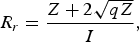
In OB, two important ion-atom distances are introduced. The first is the release distance R r, in which the electron can be released for the Coulomb potential barrier between projectile and target is lower than the energy of target electron. The release distance R r is
 $$R_r=\displaystyle{{Z+2\sqrt {qZ} } \over I}\comma \;$$
where I is the target ionization energy, q and Z are the charges of projectile and of target core.
The second is the capture distance R C, in which the electron's potential energy in the ionic field of projectile is larger than its kinetic energy in projectile's frame; and R C satisfies
 $$R_C = \displaystyle{{2q} \over {v^2 }}.$$
Where v is the velocity of projectile. Eqs. (1) and (2) indicate that electron will be captured only if release occurs within the capture distance R C; otherwise release is temporary.
In OB and its extensions (Barany et al., Reference Barany, Astner, Cederquist, Danared, Huldt, Hvelplund, Knudsen, Liljeby and Rensfelt1985; Niehaus et al., Reference Niehaus1985), the released but uncaptured electrons will go back to the target after the collision. The energy of the released electron is  $I+\displaystyle{q \over {R_r }}$, ionization energy increased by Stark energy of projectile.
In COBI, we had focused on the released but uncaptured electrons. These electrons are continuously accelerated by the approaching projectile. At some distance R I, where the Stark-energy transferred to kinetic energy of released electron is larger than its ionization energy, the electron can escape from target. Meanwhile, it is uncaptured, ionization will occur. The ionization distance R I is
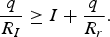 $$\displaystyle{q \over {R_I }} \geq I+\displaystyle{q \over {R_r }}.$$
Thus, electrons released in R C will be captured; those released between R r and R C will not be ionized until the ion approaches the ionization distance R I.
Because release and capture do not take place instantly but are gradually, the corresponding one-electron probabilities P r, P c, and P I for release, capture, and ionization have to be taken into account. The probabilities at any collision parameter are obtained as ratio of collision duration, in which release capture and ionization take place, to orbital period of target electron.
As a result, one-electron probabilities are
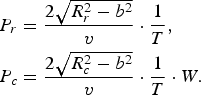 $$\eqalign{P_r &= \displaystyle{2\sqrt{R_r^2 - b^2} \over v} \cdot \displaystyle{1 \over T}\comma \; \cr P_c &= \displaystyle{2\sqrt{R_c^2 - b^2} \over v} \cdot \displaystyle{1 \over T} \cdot W.}$$
Where the weight W is the probability of released electron which is eventually captured by the projectile (Niehaus et al., Reference Niehaus1985). In detail, W is estimated as
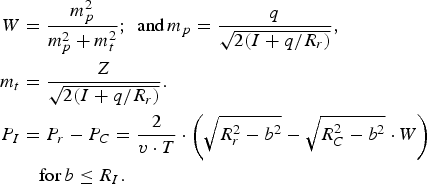 $$\eqalign{W &=\displaystyle{m_p^2 \over m_p^2+m_t^2}\semicolon \; \, \hbox{and}\, m_p = \displaystyle{q \over \sqrt{2\lpar I + q/R_r \rpar }}\comma \; \cr m_t &= \displaystyle{Z \over \sqrt{2\lpar I + q/R_r\rpar }}. \cr P_I &=P_r - P_C=\displaystyle{2 \over {v \cdot T}} \cdot \left({\sqrt {R_r^2 - b^2 } - \sqrt {R_C^2 - b^2 } \cdot W} \right)\cr &\quad \hbox{for}\, b \leq R_I.}$$
In the present work, multi-electron probabilities are extracted from the one-electron probabilities by using the method of independent event model (IEVM) (Illescas et al., Reference Illescas, Errea, Mendez, Pons, Rabadan and Riera2011). For multi-electron targets, investigations have found that IEVM is more adequate (Mendez et al., Reference Mendez, Errea, Illescas, Rabadan, Pons and Riera2008) than IPM, which ignored the considerable change of ionization energy with the charge state of recoiled ion (Kabachnik et al., Reference Kabachnik, Kondratyev, Roller-Lutz and Lutz1997) and led to wrong probabilities for high stage ionizations.
For this reason, we distinguish the outer shell electrons with subscript j, and R rj, R cj, R Ij are the distances for the jth released electron. The inner-shell electrons, for example, the 1s electron of Ne and the 2s2p electrons of Ar, are not taken into account, for the ionization cross-section decreases as I −2. The distances of the outer shell electrons satisfy the equations of
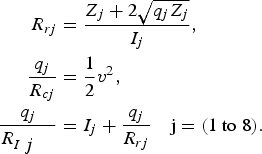 $$\eqalign{R_{rj} &=\displaystyle{{Z_j + 2\sqrt {q_j Z_j } } \over {I_j }}\comma \; \cr \displaystyle{{q_j } \over {R_{cj} }} &= \displaystyle{1 \over 2}v^2 \comma \; \cr \displaystyle{{q_j } \over {R_{I\matrix{ j & {} \cr } } }} &= I_j + \displaystyle{{q_j } \over {R_{rj} }}\quad {\rm j} = \lpar 1 \;\rm to\; 8\rpar .}$$
Where I j is the jth ionization energy of the released electron, and q j and Z j are the charges of projectile and the target seen by the jth released electron. The released electrons are assumed to stay at the quasi-molecular states surrounding the target and projectile core from outside; they lose their screen abilities to both nucleuses (Niehaus, Reference Niehaus1985). Thus,  $q_j=q_{He^+} \approx 1.4\comma \; Z_j \approx n\sqrt {2 \cdot I_j }\, .$
RESULTS AND DISCUSSION
In this section, multiple-ionization cross-sections of Ne, Ar, and Kr atoms impacted by He+ ions at energies from 10 to 800 keV/amu are calculated and compared with the existing experimental data. The reason for calculating the case of He+ is that this charge state is the one that energetic alpha particles have as they penetrate in gases not far from Bragg peak energies.
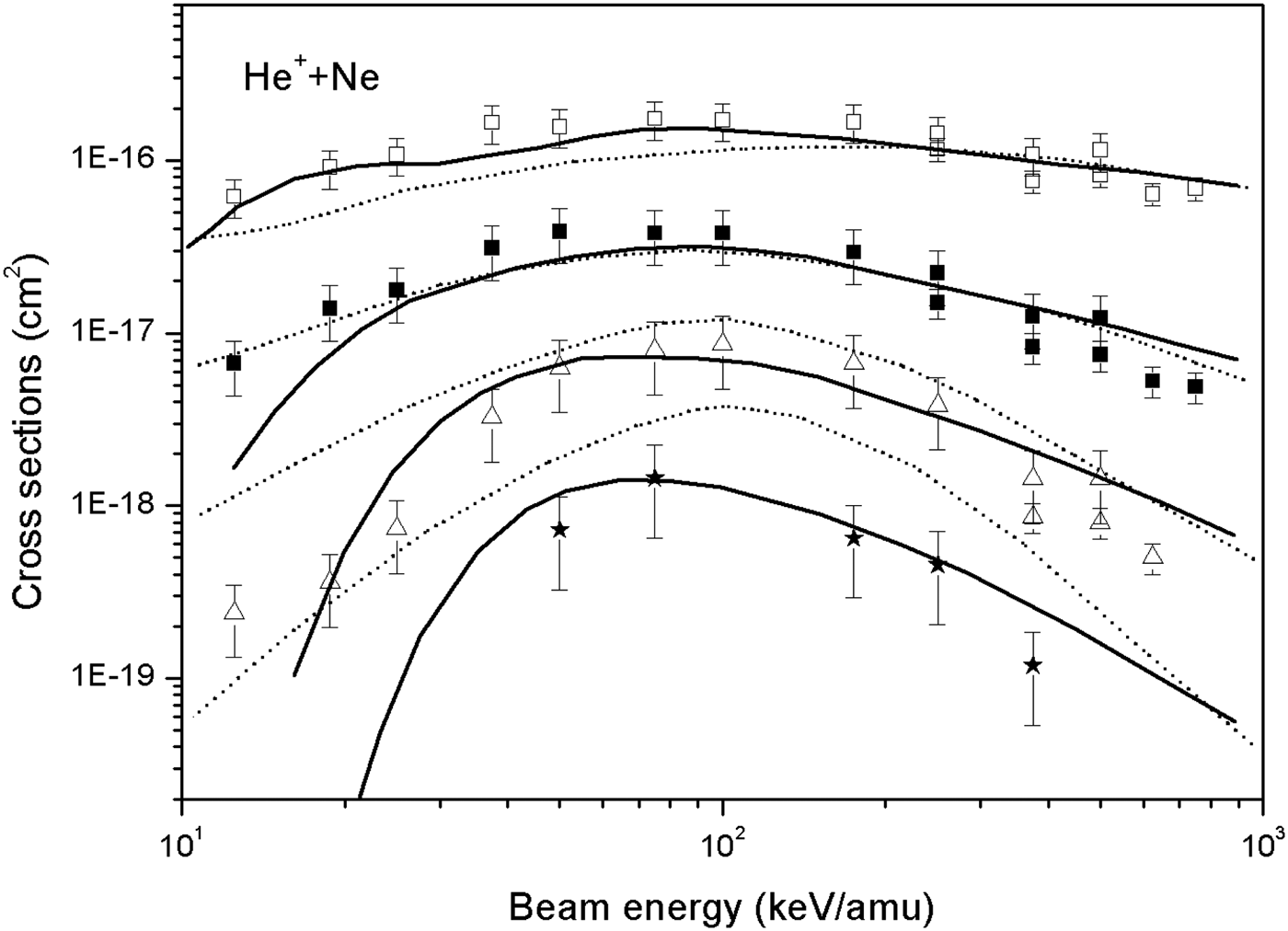
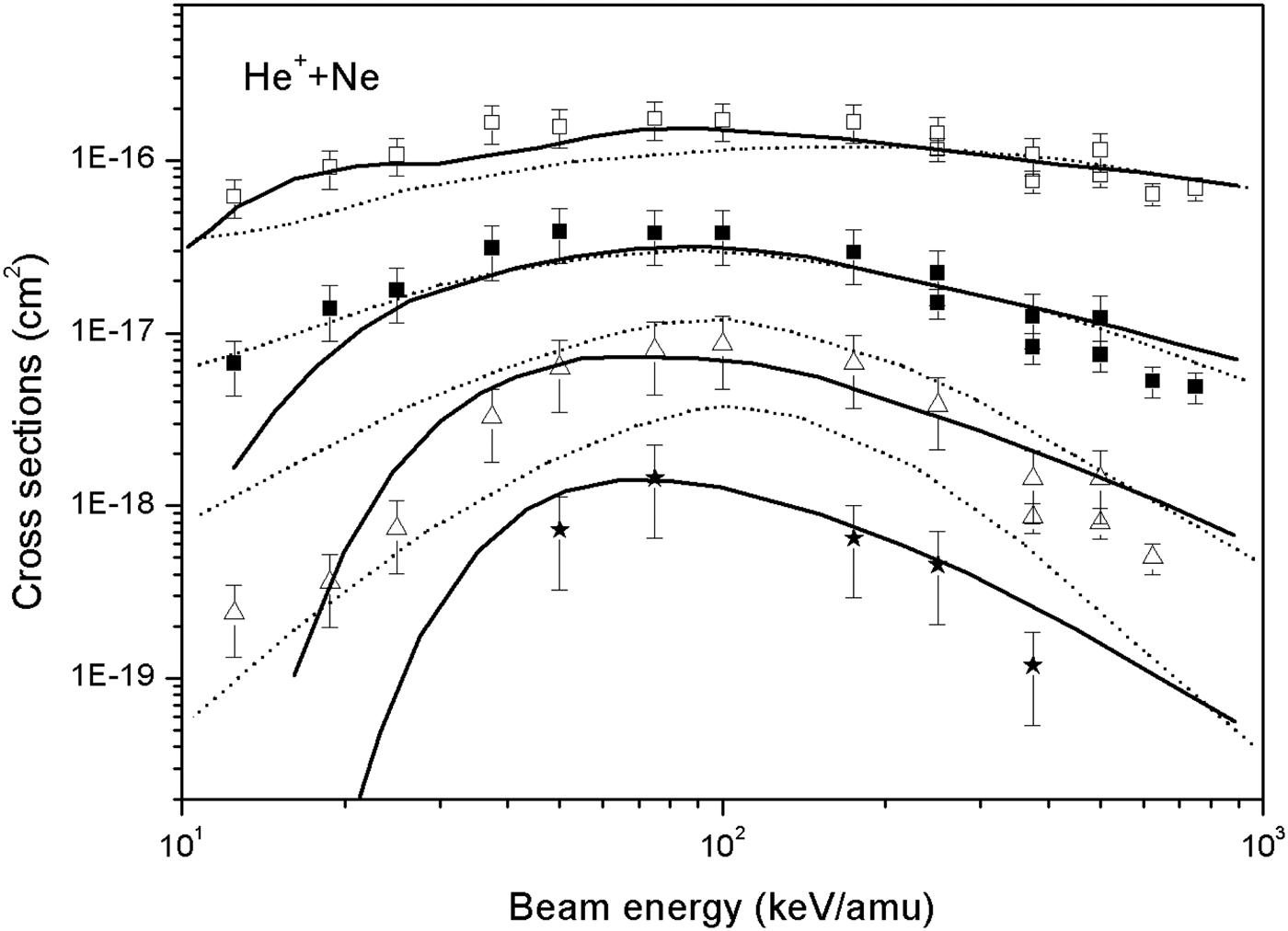
In Figure 1, we compare the k-fold (k = 1–4) ionization cross-sections of Ne impacted by He+ ions at energies from several to hundreds keV/amu. It is observed that the present model results are in good agreement with the experimental data (Dubois, Reference Dubois1989; Santos et al., Reference Santos, Melo, Sant'anna, Sigaud and Montenegro2001). For single ionization, the overall agreement is excellent; the model gives a good description of the shape of single ionization cross-section. For double and triple ionization, the agreement is also good. For energies lower than 50 keV/amu, double and triple ionization cross-sections both increase rapidly. They reach their maxima at about 100 keV/amu and then drop slowly. At energies higher than 300 keV/amu, the model somehow over-estimates the data taken from Santos's work, but is in close agreement with Dubois's data. Even for quadruple ionization, the model still gives a good description of the data. In addition, the calculation results given by the present model are also compared with the only existing quantum calculation results (Kirchner et al., Reference Kirchner and Horbatsch2001). We can see that the present results are as good as those of Kirchner's to give quite good description to the experimental data. Moreover, the computation time consumed by our simple model is extremely short as about several seconds.
Multiple-ionization cross-sections of Ne impacted by He+ ion. The dotted lines are taken from Kirchner et al. (Reference Kirchner and Horbatsch2001) for comparison; the solid lines are present model results.
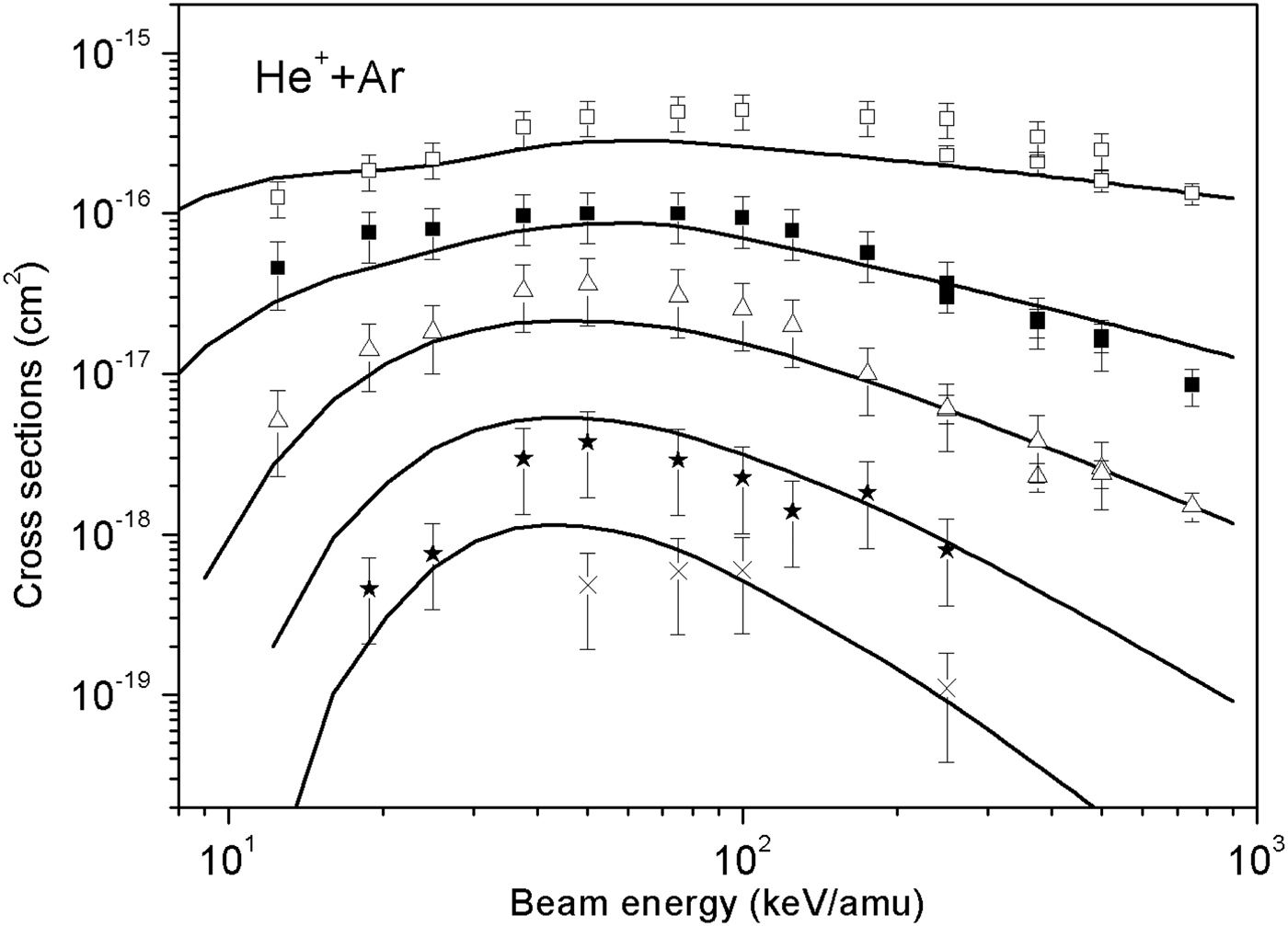
In Figure 2, multiple-ionization cross-sections of Ar up to k = 5 is calculated and compared with the experimental data (Dubois, Reference Dubois1989; Santos et al., Reference Santos, Melo, Sant'anna, Sigaud and Montenegro2001). Again, we find a very good agreement between the model and data. For single ionization, the model describes well the low energy data below 80 keV/amu and under-estimates Dubois's high energy data, while it is in good agreement with Santos's high energy data. For double ionization, the overall agreement is also good. The model gives a good description of the low and high energy data of triple ionization, but slightly under-estimates the data near the maxima. For four- and five-fold ionization, the agreement is also good and their trend is well described by the model.
Multiple-ionization cross-sections of Ar impacted by He+ ion.
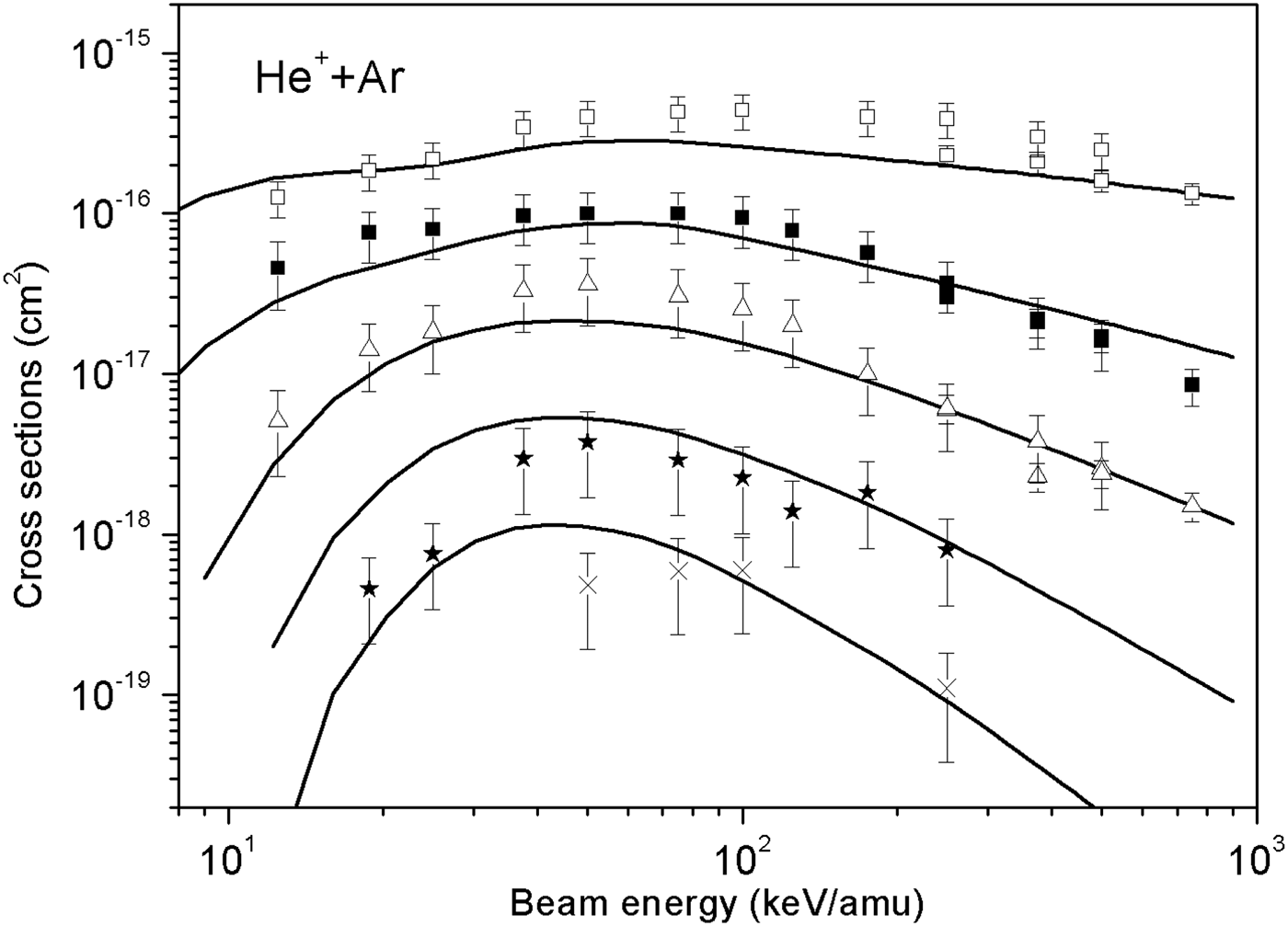
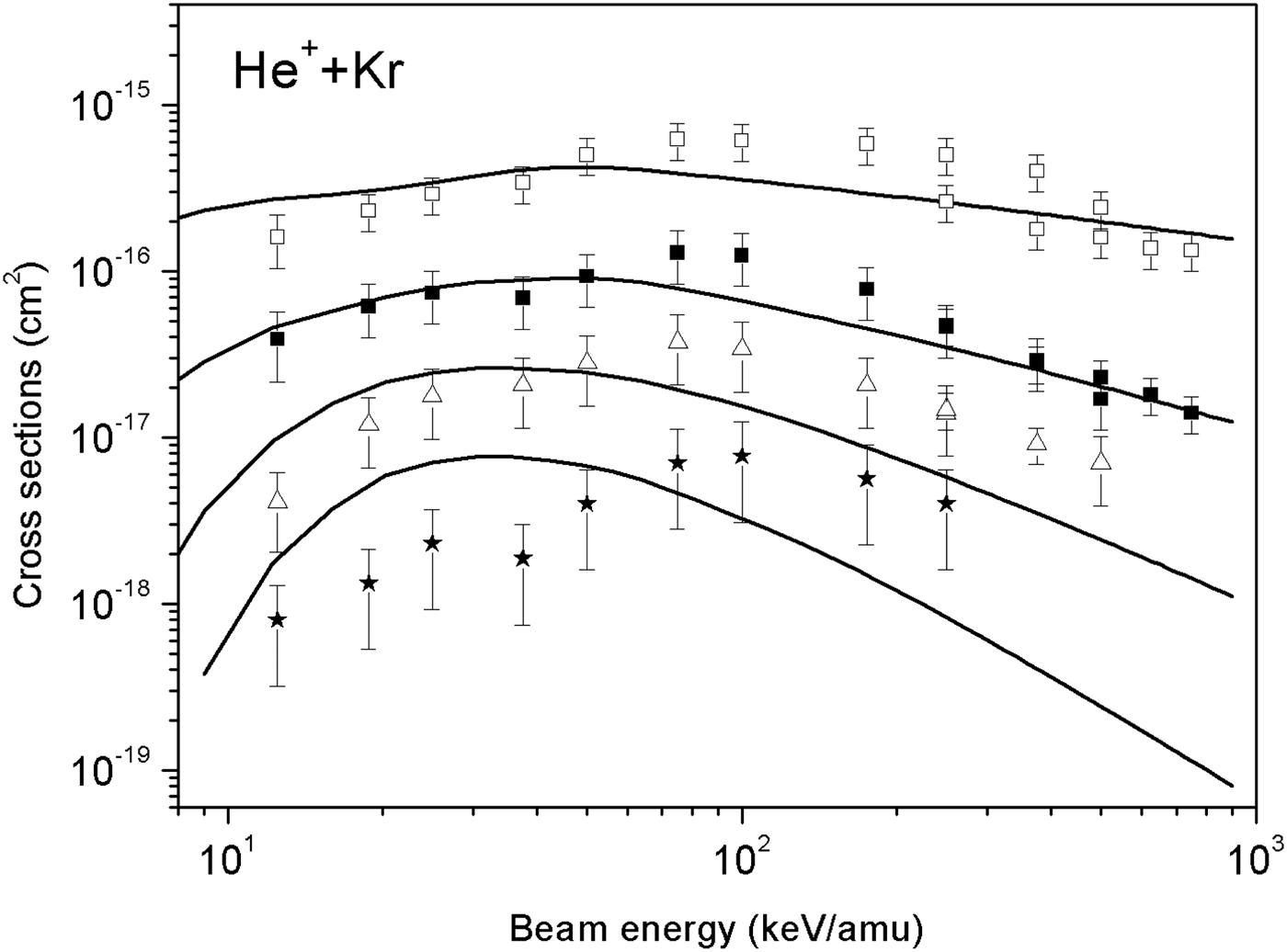
Figure 3 shows a comparison between the model and experimental data for Kr (Dubois, Reference Dubois1989; Santos et al., Reference Santos, Melo, Sant'anna, Sigaud and Montenegro2001). For single ionization, the overall agreement is good, but the model under-estimates the high energy data from Dubois. On the contrary, the agreement with Santos's high energy data is good. For double ionization, low and high energy data are both well described, and the data near maxima are slightly under-estimated. For triple ionization, the agreement is reasonable. Low energy data below 50 keV/amu are close to the model, but the model under-estimates the data by a factor of 2 at high energies. For quadruple ionization, the agreement is adequate or not bad over the entire energy range. Low energy data are overestimated at some degree and high energy data are underestimated within a factor of 3.
Multiple-ionization cross-sections of Kr impacted by He+ ion.

From Figure 1 to Figure 3, we find that multiple-ionization cross-sections of Ne, Ar, and Kr increase for energies below 50 keV/amu, reach the maxima at 50–100 keV/amu, and then drop slowly for high energies. This behavior can be understood qualitatively by the model. Since the shape of ionization cross-section is similar to that of ionization probability P I, we will discuss the energy dependence of P I at b = 0.
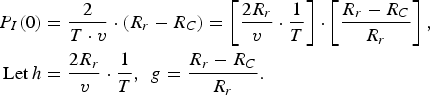 $$\eqalign{P_I \lpar 0\rpar &= \displaystyle{2 \over {T \cdot v}} \cdot \left({R_r - R_C } \right)= \left[{\displaystyle{{2R_r } \over v} \cdot \displaystyle{1 \over T}} \right]\cdot \left[{\displaystyle{{R_r - R_C } \over {R_r }}} \right]\comma \; \cr {\rm Let}\, h &= \displaystyle{{2R_r } \over v} \cdot \displaystyle{1 \over T}\comma \; \, g=\displaystyle{{R_r - R_C } \over {R_r }}.}$$
h is the ratio of collision duration  ${{2R_r } \over v}$ to the period T of the target electron. Obviously, h is the release probability during the collision; it is equal to the unit at low energies and decreases as 1/v for high energies. g is the uncaptured fraction of the released electrons,
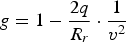 $g=1 - {{2q} \over {R_r }} \cdot {1 \over {v^2 }}$, which increases strongly as v 2 and is close to the unit for high v.
The uncaptured fraction of the released electrons g increases as v 2; this is the main reason for the increase of ionization cross-sections at low energies. The interaction time h decreases as 1/v, causing the ionization cross-sections to also decrease slowly at high energies. At intermediate energies, the uncaptured fraction g increases while the interaction time h decreases. The competition between them leads to the appearance of maximum ionization cross-sections.
From Eq. (7), the maximum position is E max≈ 6q/R r·25 kev/amu. For the 1st to 4th ionized electrons of Ne, Ar, and Kr, the calculated E max are within the energy range from 30 to 80 keV/amu. This is in qualitative agreement with the experimental data, where the multiple-ionization cross-sections reach their maxima at 50–100 keV/amu.
Since the electrons produced in the first-step ionization of gases can lead to the following sequential ionizations, the number of emitted electrons in ionization should be considered. In Figure 4, the number of emitted electrons from the recoiled ion is calculated and compared with the experiments (Dubois, Reference Dubois1989; Santos et al., Reference Santos, Melo, Sant'anna, Sigaud and Montenegro2001). It is clear that the model gives an excellent description of the experimental data. The number of emitted electrons increase at low energies and reach their maxima at 20–30 keV/amu for Ar and Kr, and at 40–80 keV/amu for Ne; then they drop monotonously for higher energies.
(Color online) Numbers of emitted electrons from recoiled ions induced by He+ ion.
According to Eq. (6), the energy at which secondary electron emission reaches the maximum is roughly proportional to the ionization energy I. The ionization energies of Ar and Kr are almost the same, and they are about one half of the ionization energy of Ne. Thus, Ar and Kr reach their maxima at about energy E and Ne will reach its maximum at 2E.
Near the maxima, the number of emitted electrons is obviously larger than the unit, being about 1.25 for Ne, 1.3 for Kr, and 1.4 for Ar. This indicates that, even for the low charge state ion as He+, multiple-ionization still make significant contribution to total secondary electron emissions. Therefore, near Bragg peak energies, the subsequent evolution of gas plasma should not ignore the influence from multiple ionization events. For energies close to 1 MeV/amu, the electrons emitted in per-ionization drop to about 1.0–1.1 and the effect of multiple-ionization is expected to be minor.
CONCLUSION
In the present work, we introduce a relatively simple model to calculate the heavy ion induced multiple ionization cross sections and the mean charge states of noble gases at low to intermediate energies. The calculation is very short time consuming and the results are in good agreement with the experimental data. This means that the model is useful within the energy range not far from Bragg peaks, where the mean charge state of the heavy ion induced gas plasma is much larger than one, and where the first-order perturbation theories are not valid.