


A photograph of the dining room in James McNeill Whistler's house at 2 Lindsay Row, Chelsea, shows a large framed print of John Everett Millais's painting, Waking (Grieve 219). Waking (Perth Museums and Art Gallery) is no. 101 in the catalogue to the recent exhibition, simply entitled Millais, under review here. While Whistler's admiration for Millais's art is well documented, the appearance of this particular print in one of Whistler's “aesthetic” interiors nonetheless comes as something of a surprise. It represents a pretty little girl with shining, wide-open eyes, sitting up amidst the immaculate white linens of her bed, her fair-haired doll on the pillow beside her – exactly the kind of Millais that has long seemed embarrassingly sentimental, or “chocolate-boxy,” made to sell rather than to challenge conventional tastes. At the very least, there seems to be a clash of styles between the comfortable bourgeois interior represented in the print and the spare, proto-modernist elegance of the dining room in which it hangs. When it first appeared in public, at the Royal Academy exhibition of 1867, Waking was paired with another picture of a little girl, Sleeping (private collection), suggesting just the sort of anecdote that Whistler, at this date, was firmly repudiating in his own work, along with the extraordinary precision of detail for which Millais's superb painting technique was renowned, and which represented solid value-for-money to his bourgeois clientele. Nothing could seem farther from the experimental pictures Whistler showed at the same Royal Academy exhibition of 1867: Symphony in White, No. 3 (Barber Institute of Fine Arts, University of Birmingham), its musical title defiant in its refusal to specify a narrative pretext for the two enigmatic female figures, and Sea and Rain (Museum of Art, University of Michigan, Ann Arbor), among the most abstract of Whistler's landscapes.
Nothing could seem farther from the experimental pictures – except perhaps the representation of white-on-white in the bedclothes and the little girl's spotless nightdress. This is the same technical tour de force that characterizes Whistler's three Symphonies in White of the 1860s, and which the art critic Philip Gilbert Hamerton, in an influential article of 1865, used to exemplify “the Principle of Art for Art” (341), the emerging slogan of the artistic vanguard of the 1860s. A generation ago, the art of the Pre-Raphaelite Brotherhood was revived in a series of pioneering exhibitions valuable precisely for their opposition to dominant accounts of artistic modernism, based on the French Impressionists and their legacy, to which Whistler's art was seemingly allied. Now, after more than two decades of art-historical “revisionism,” it is time for another reassessment. As the high modernist battle between avant-garde and traditional art recedes into distant memory, it has become possible to recover the affinities, as well as the differences, that characterized the complex and increasingly internationalized art world of the later nineteenth century.
The exhibition Millais, shown in 2007–08 at Tate Britain in London, the Van Gogh Museum in Amsterdam, and two venues in Japan, belongs to a new wave of Pre-Raphaelite exhibitions, a second generation in the revival of Victorian art. The pioneering exhibitions of a generation ago established a canon of Pre-Raphaelite masters, with comprehensive monographic showings of Ford Madox Brown in 1964, Millais in 1967, William Holman Hunt in 1969, Dante Gabriel Rossetti in 1973, and Edward Burne-Jones in 1975, followed by the definitive Tate exhibition of 1984, The Pre-Raphaelites, which centred largely on the same masters.
The new wave of exhibitions, which began in the 1990s and is still under way, differs in several significant respects. First, there has been a notable expansion of the canon, with important group shows on the Pre-Raphaelite women artists, the landscape painters associated with the movement, and the succeeding generation dubbed “British Symbolists,” as well as monographic shows on figures of more recent interest. These include the Jewish homosexual artist Simeon Solomon; Frederic Leighton, the contemporary of the Pre-Raphaelite group whose reputation for traditionalism proved the hardest to dislodge from modernist prejudice; and John William Waterhouse, a popular favourite disdained by the twentieth-century art establishment whose retrospective of 2008–09 is the longest overdue of all. There is an expansion, too, in international visibility. Whereas the first wave of Pre-Raphaelite exhibitions appeared exclusively in British galleries, led by the enterprising curator Mary Bennett at the Walker Art Gallery, Liverpool, each of the new exhibitions (with the regrettable exception of Leighton) has been able to attract international partners. At the same time, the canonical figures of the first wave are being given a second chance: Millais was preceded by Edward Burne-Jones: Victorian Artist-Dreamer in 1998 and Dante Gabriel Rossetti in 2003–04, and followed by William Holman Hunt and the Pre-Raphaelite Vision in 2008–09, while plans are afoot for a new exhibition on Ford Madox Brown. These shows are notably smaller and more focussed than the first, comprehensive retrospectives, and they are premised, at least notionally, on a perceived need to tell a new story about each of the major figures in the light of the dramatic expansion in research that has followed the first wave of exhibitions.
To an extent, these differences from the first wave reflect more general changes in museum practice in an increasingly globalized market for exhibitions of historic art. Nonetheless, it is important that British nineteenth-century art, for the first time, is regarded as a credible participant in the international museum world. Millais, with its international tour and its checklist of 139 exhibits (as opposed to the 397 displayed in 1967), is typical, and its new story is overtly revisionist. As the curator, Jason Rosenfeld, puts it in his catalogue essay, “Millais's works can now be seen to function powerfully in the cultural diversity of the modern Europe of the second half of the nineteenth century” (10). In a sense, then, the show is designed to explode the conventional wisdom that makes the print of Waking seem incongruous in Whistler's dining room. Within the limitations of its monographic format – a crucial caveat to which we shall return – the exhibition makes a triumphant success of telling its new story. The reviews in the newspaper press of the Tate showing proved this, although sometimes in roundabout fashion. The critics invariably referred to the stock two-stage narrative about Millais's career, in which a phase of radical innovation as a member of the Pre-Raphaelite Brotherhood is followed by a conservative backlash as the artist “sells out” to fame and fortune in the heyday of the British Empire. Yet while some critics clung for dear life to this admittedly dramatic, but also depressingly hackneyed, story-line, the show itself forced them to reconsider the much longer, and surprisingly more varied, second stage, after the putative “sell-out.”
The square and oblong spaces of Tate Britain's suite of exhibition rooms encouraged a focus on self-contained groups of works such as the portraits and late landscapes, which accordingly featured in most reviews whether they were approved or disdained. The more flexible spaces at the Van Gogh Museum were better adapted to presenting a narrative of continuous experimentation and innovation, as a complex sequence of diagonal and curving walls kept the visitor constantly on the move. Thus the two showings presented two slightly different versions of the artist: at Tate Britain an artist who could work in a variety of different genres or modes, at the Van Gogh Museum an artist of restless mutability.
Neither Millais is that stock figure, the artist of two stages; on the other hand, neither is he an artist of the kind favoured in traditional art history, whose career displays a coherent and consistent development. Certainly there is an overall transition from the tight and controlled work of the early years to a large and loose style that bears some affinity to the notion of a “late style,” as in Turner, Titian, or Rembrandt, but unlike those art-historical exemplars of steady evolution the pattern in Millais's work is zigzagging and unpredictable. Thus the meticulously painted Waking comes four years after what is perhaps the most astonishing work in the show, The Eve of St Agnes of 1863 (no. 88; Figure 32), a night scene of a moonlit interior with a background sketchier than anything in French painting of similar date. Again, the startlingly summary brushwork of Souvenir of Velázquez of 1868 (no. 103) is followed five years later by a reminiscence of the portraiture of Ingres, in Mrs Bischoffsheim (no. 111), and in the meantime by a homage to Constable in the densely wrought landscape, Flowing to the River of 1871 (no. 126). Perhaps the closest parallel to this extreme stylistic flexibility is Picasso, an artist like Millais of such technical dexterity that he could embark on a wholly new direction at a moment's notice, and seemingly without effort or preparation. Like Picasso, too, Millais responds to, or perhaps initiates, virtually all of the myriad developments in a contemporary art world of dizzying complexity – something that the monographic exhibition, by its very nature, cannot capture. Thus the exhibition and its catalogue give us only one voice – that of Millais – in an artistic conversation that must have involved countless interlocutors over a period of half a century; the dialogue with Whistler is just one of numerous examples that remain to be detailed in future research.
John Everett Millais, The Eve of St. Agnes. Oil on canvas, 1863. Courtesy of the Royal Collection © 2008 Her Majesty Queen Elizabeth II.
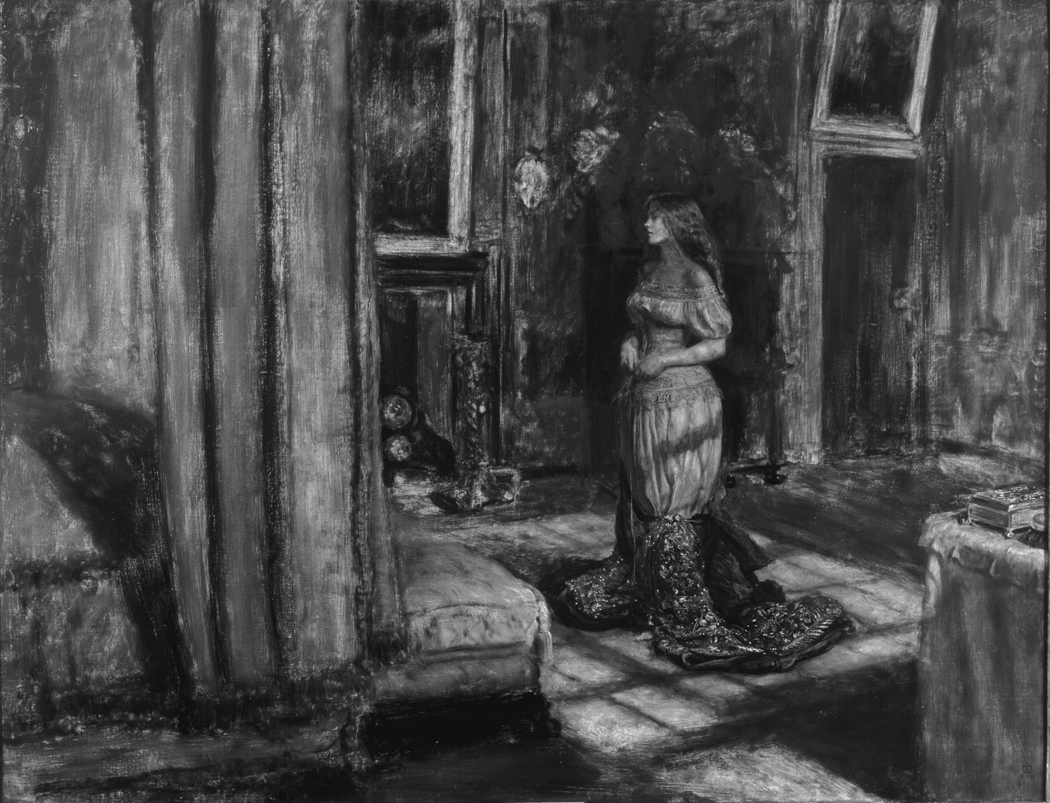
The Eve of St Agnes makes a particularly revealing case. It was extravagantly admired, first by Whistler at the Royal Academy in 1863, then by French critics and artists at the Paris Exposition Universelle in 1867; its memory is still resonant in Joris-Karl Huysmans's novel À rebours of 1884. For the Symbolist generation, the apparition of the figure in moonlight perhaps suggested mysterious realms of dream or imagination. Yet the painting has been virtually unknown in recent years; formerly in the collection of Her Majesty Queen Elizabeth the Queen Mother, it is now in the Royal Collection, but has not been seen in public since the Tate Pre-Raphaelite exhibition of 1984. Thus the new exhibition offers a welcome opportunity to assess its fascination for the French avant-garde. It is without any obvious precedent in recent contemporary art; perhaps the jewel-like highlights of the dress, emerging from the background shadows, recall early Rembrandt. Yet for all its darkness, it is not a tonal picture, constructed around contrast of light and shade; the brown background and blue moonlight are fully coloured. Thus its extreme sketchiness is consistent with a design principle that is diametrically at odds with the entire Western academic tradition, based on a clear separation of drawing from colour: it is conceived in colour, not as a drawing coloured in. Although it dates from after Millais's supposed abandonment of Pre-Raphaelite radicalism, it may demonstrate an even more thoroughgoing originality, and one highly likely to interest French painters of the Impressionist generation.
If there is any artistic idea that informs all of Millais's production, it is this basis in color, constant through the startling changes of hue from the Pre-Raphaelite vividness of the early work through to the vibrant earth colours of the late Scottish landscapes. Thus the exhibition presented a coherent artistic project despite its diversity of theme and style, and the magnificent array of constantly shifting colour no doubt accounts for its popularity (it attracted over 150,000 visitors in London). Yet the ways in which this complex artistic project interacted with the wider international arena for modern art remain underexplored, and without such context neither Millais's own work nor his impact can be fully understood. There is scope, then, for a third wave of exhibitions to integrate the canonical Pre-Raphaelites into the larger story of modern art.
It might well be argued that the art historian's primary task is to articulate the intelligibility of images for our own time. In the case of the recent exhibition of Victorian photographs at the Metropolitan Museum, Impressed by Light: British Photographs from Paper Negatives, 1840–1860, this articulation could be drawn from a single work to be seen there. Titled The Reading Establishment (Figure 33), this work comprises two salt prints made from calotype negatives, joined together to form a single panoramic diptych. Although this pair of images has often been reproduced, we know surprisingly little about it. We do not know, for example, who took these two pictures, or the identities of most of the people featured in them, when they were made, or what their exact purpose was. And yet in many ways this diptych offers a view of photography that is startlingly modern, so modern in fact that it seriously challenges the way the history of photography has been hitherto represented.
William Henry Fox Talbot and Nicolaas Henneman, The Reading Establishment. Salted paper prints, 1846. Courtesy of the Metropolitan Museum of Art, New York.

The photograph shows nine figures, four in the left panel and five in the right, arrayed in the foreground like a sculptural frieze in front of a glass house and brick building. Each figure is engaged in a different activity related to the making of photographs for money, then a new kind of business enterprise. The Reading Establishment was intended to exploit the patented discoveries of William Henry Fox Talbot, an English landed gentleman who in January 1839, after six years of experiments, had announced a paper-based photogenic drawing process. This announcement had been prompted by the news that a Frenchman, Louis Daguerre, had introduced a metal-based photographic process immodestly named after himself. Given its slow exposure times and hazy images, Talbot's initial discovery was unable to compete in the marketplace with the sharp and detailed images recorded in daguerreotypes. So Talbot continued his experiments and soon came up with a new process altogether, which he named the calotype.
When Talbot announced the details of his invention of this calotype process in June 1841, he heralded a potential revolution in the practice of photography. His invention involved two major breakthroughs. The first concerned the making of a latent image, such that a piece of paper soaked in his solution of silver salts and gallic acid responded to light, but remained blank until the paper was soaked in a further developing solution. The second was a consequence of the first, allowing an amplification of the hidden image into full visibility and a significant increase in light sensitivity compared to his earlier photogenic drawing process. As he claimed in a letter to the Literary Gazette, dated February 13, 1841, “a better picture can now be obtained in a minute than by the former process in an hour.” Although Talbot had already made positive prints from a negative using his earlier process, the speed of the calotype made multiple reproductions from negatives a viable commercial proposition for the first time.
Curated primarily by English scholar Roger Taylor, the Met's exhibition was the first to survey the British photography that Talbot's invention made possible. Guided by the museum's policy of showing only rare prints in perfect condition, the 118 photographs on display were the best examples available, often by already acknowledged masters of British photography such as David Hill and Robert Adamson, Roger Fenton, Benjamin Brecknell Turner and John Murray. However, Taylor also selected works by a number of previously unknown photographers he discovered during his research, identifying no less than 500 British calotypists in his accompanying catalogue. Landscape and architecture were the primary subjects of this type of photography, although a variety of figure studies was also featured. What were not shown were any faded prints, a constant problem that hindered the medium's success in the 1840s, or multiple prints from a single negative, arguably the calotype's most distinctive attribute. The inclusion of The Reading Establishment picture was, therefore, the only reference in the exhibition to the realities of the production of photographic prints.
Keen to make money from his invention, Talbot sold licenses for the use of the calotype to professional London-based photographers Henry Collen in 1841 and Antoine Claudet in 1844. Despite their inability to turn a profit from the calotype, he also encouraged the formation of a photographic printing business, established in late 1843 in the town of Reading by his former valet Nicolaas Henneman, the man in the diptych shown taking a photograph of a statuette. During its three years of operation, the so-called Reading Establishment produced over 30,000 photographs from paper calotype negatives, primarily for two of Talbot's own publications (The Pencil of Nature and Sun Pictures in Scotland), but also for the Art-Union, a journal which issued 7,000 photographs to its readers in June 1846. Unfortunately for Talbot, many of these salted paper prints faded over time, creating a public relations disaster. In the midst of the uncertain economic times of the 1840s, the calotype process was still unable to compete in the commercial market with the more reliable daguerreotype.
The calotype negatives from which this diptych was printed were made during this period, presumably as way of promoting Henneman's business. The negatives have survived, as have six sets of prints from these negatives, most of which have faded (the right-hand print in the Met's diptych was in fact intensified by Harold White in the 1940s, hence its unusually fine state of preservation). One set has even been hand-colored. The fact that this picture is a panoramic composite print from two negatives, and that at least one of them was hand-colored, suggests the involvement of Calvert Richard Jones, who was among the first to practice both of these genres and who knew Talbot and Henneman well. Jones was also very much involved in the plans for the Reading Establishment, sending Henneman negatives to print from and suggesting ways to make a profit from them. Talbot even invited him to manage the business. However, Jones first visited the Reading Establishment only on about December 1st, 1846, and makes no mention of taking this picture (in any case, the winter of 1846 was an unusually cold one and the scene in this diptych shows no snow or frost on the ground, making it unlikely it was shot in December).
In fact no one mentions this picture in any surviving letters. It is often said that the central figure, shown making a portrait of a seated man supported by a metal headrest, is Talbot himself, but it seems odd that Talbot would want to be seen taking a commercial portrait, something he never did in practice. Indeed, Talbot had carefully funded the Reading Establishment as a separate institution under Henneman's control, precisely so that he would keep “trade” at a safe distance from himself, a landed gentleman. Why then would he want to associate himself with it so overtly here? In the 1850s the Photographic Society of London, seeking to maintain a clear division between those “in trade” and those “in society,” decided to ban from its exhibitions any photographs that had already been displayed in a shop window. Talbot would have been well aware of such class prejudices, and may even have shared them.
Perhaps the central figure operating the portrait camera is in fact Benjamin Cowderoy, a local Reading businessman whom Talbot had hired as a manager for his photography business in early 1846 (firing him in December of that same year). Cowderoy busily set about promoting the Reading Establishment and it is possible, as I have said, that this picture was meant as an advertisement to be placed in the windows of booksellers and other businesses that might also sell Henneman's photographs. By the end of 1846, Cowderoy has succeeded in establishing such outlets in London, eleven other English towns, and even in Malta, as well as at the local Reading bookshop. According to Talbot scholar Larry Schaaf, “all known printed ephemera from the Reading Establishment can be traced to Cowderoy's reign in 1846” (Schaaf 33).
According to Cowderoy's own reminiscence, written in 1895 in Melbourne, Australia, where he had emigrated in 1853, he worked part-time for Talbot to conduct “all correspondence, issue licenses under the patents, and attend generally to the business of supervising the distribution and sale of the pictures.” He also remarks that the “stock of pictures grew to inconvenient proportions in the hands of such a gentleman as Mr Talbot, occupying a high position in aristocratic society,” reminding his readers that “in those days” the “younger sons of dukes” did not “enter into mercantile offices.” Talbot was no duke's son, but his family certainly aspired to that sort of social status. As a consequence, Cowderoy says, Talbot experienced “perplexity and embarrassment through the accumulation of merchantable products which the usages of society would not allow him personally to ‘liquidate’ “(Schaaf 33). Hence Talbot's employment of Cowderoy to do that dirty work for him. In short, Cowderoy reminds us that this is a picture both of work and of workers, and that it is also therefore a picture about class difference, and at a time when such differences really mattered. Whether or not he took the picture himself, or is indeed its central figure, Cowderoy and the conduct of “mercantile” labor are at its conceptual heart.
Whatever the details of its making and makers, the image is clearly a tableau vivant staged to demonstrate the range of activities being undertaken at the Reading Establishment; from the left, the reproduction of existing art works (in this case for an 1847 publication by Sir William Stirling titled Annals of the Artists of Spain, the fourth volume of which consisted of 67 calotype prints made by Henneman's business); the preparation, in the glasshouse, of sensitized paper to be used by others; the taking of commercial portraits; the printing out, in the uncertain English sunlight, of photographs from negatives (we see at least 20 prints being made simultaneously); the reproduction of a sculpture of the Three Graces from Talbot's own collection (note the prominent clocks on the cameras to time the exposures); and the use of new-fangled technologies to judge exposure or focus, a device probably invented by Antoine Claudet.
Beyond all that, the image reminds us – is insistent about – the collective nature of photographic labor, that making photographs is labor. We know the names of some of these workers, even if we don't know exactly which is which – Nicholas Henneman and Charles Porter, both former servants of Talbot's, Alfred Harrison and John Henderson, who had previously worked at Lovejoy's bookstore in Reading, a man named Murray, and Thomas Augustine Malone, a local chemist. Plus two “boys” or “lads,” as they are referred to in the correspondence. In other words, they all (all but for Talbot, the boss) represent the class aspirations of the petit bourgeoisie, shopkeepers and domestic staff leaving more traditional employment to join a start-up company in a new, risky high-tech industry with a view to eventually becoming middle-class business-owners themselves. And they are seen here engaged in a laborious hand-craft activity (it took 72,000 discrete steps to manufacture 6000 prints) that nevertheless aspired to meet the conditions of industrial production, with Henneman aiming to manufacture at least 400 prints per week. This included breaking down that production into some of the discrete steps represented here and instituting a strict division of labor in which some workers operated cameras, others prepared paper, others put exposed prints in frames, others did the selling, and so on.
All this is laid out before our eyes in this panorama, itself probably a collective product (conceived by one party, shot by perhaps two different photographers, printed by the collective labor of these nine workers, and then distributed and displayed by yet further people). From this panorama, then, we might begin to tell a different kind of story about the development of photography in the nineteenth century, perhaps even a different kind of story about photography today. But this is precisely the story not told in most histories of photography produced within museums, which continue to be dominated by the prejudices of a sadly out-dated version of art history. Impressed by Light, as I have already said, showed only single prints of the highest quality. Every image was presented as a singular act of personal expression, and therefore as artistic rather than capitalist in aspiration. Beholden to a masterpiece-driven form of narrative long since discredited in the academy, exhibitions of photographs of this sort consistently suppress evidence of either social struggle or the economics of photographic practice (such as multiple reproduction), seeking to foster the illusion that art transcends such brute realities. The end result is a deeply conservative view of both past and present, denying viewers the possibility of an informed engagement with their own cultural history.
The Reading Establishment photograph is a reminder that another kind of history of photography is possible and necessary, if this medium is at last to be represented in all its social and cultural complexity. As much as anything else, this will involve telling the story of photography as a business and a manufacturing practice within an emerging industrial and capitalist context. The question is, how do you switch from an historical model based on the interests and values of those “in society” (then, and now) to one attuned to the motivations of those “in trade”? That is precisely the challenge before us.
In the exhibition Art & Emancipation in Jamaica: Isaac Mendes Belisario and His Worlds curated by Tim Barringer, Gillian Forrester, and Barbaro Martinez-Ruiz, the Yale Center for British Art moved productively from the metropolis to the periphery to enhance our sense of the complexity of nineteenth-century visual culture, in particular the mix of control and subversion, of hybridity and creolization in nineteenth-century Jamaica. At the center of the exhibit was the visual art of Isaac Mendes Belisario (1795–1849), a Sephardic Jew working in Jamaica, with the focus on his remarkable set of hand-tinted lithographs, Sketches of Character, In Illustration of the Habits, Occupations, and Costume of the Negro Population in the Island of Jamaica (1837). In keeping with the contextual force of the exhibition, the viewer moved through galleries showing the “worlds” of cultural formations – British, African, Jewish, to name a few – registered in these images of the carnivalesque performances of the newly emancipated slaves. Furthermore, the exhibition carried the viewer backward and forward through time, from the African origins of nineteenth-century art and performance in Jamaica to the continuing presence of such influences in the Caribbean, the United States, and England.
The show, as well as the superb, richly detailed scholarly catalogue edited by the curators, highlighted what they describe as the complex process of “art and emancipation” in nineteenth-century Jamaica. The art certainly records the often violent process that brought emancipation, as in the paintings of The Attack of the Rebels on Montpelier Old Works Estate (1833) by Adolphe Duperly (1801–64). Of equal if not more interest is the sense of art not only as record, but as agent. The exhibition succeeded in calling attention to the complex ways that visual art in nineteenth-century Jamaica naturalized the dominant Anglo social order while also subverting that order in emancipatory gestures within the art itself.
If Belisario's Sketches freeze a moment of hybrid performance, the exhibition reminded us that such creolization is a process continuing over time. Quite brilliantly the curators opened the exhibit experience with a masquerade performance in the near present captured in the moving image. The visitor first saw a film loop in black and white of dance in Haiti in 1991 in which dancers dressed in glitter pants and seen by firelight take turns carrying on their heads a large model of a mansion. The house is then torn to pieces, the pieces cast into the flames, a nice opening touch of mystery since the dance and the house will only be understood as the viewer moves through Belisario's worlds to his Sketches, particularly that of John Canoe (Figure 34).
Isaac Mendes Belisario, “Jaw-Bone, or House John-Canoe.” Plate 3 from Sketches of Character: In Illustration of the Habits, Occupations, and Costume of the Negro Population, in the Island of Jamaica. Color lithograph, 1837. Courtesy of the Yale Center for British Art, Paul Mellon Collection.

In keeping with the recent critical move to the social analysis of landscape painting, the exhibition first took up the world of low morals and high living of the Jamaican plantocracy in satirical cartoons of the eighteenth century and in nineteenth-century adaptations of the conventions of British country house painting to slave-holding Jamaican estates. As Barringer notes in his essay on the ideological work of the picturesque in Jamaican representation, landscapes commissioned by the planters transform their plantation slaves to shepherds in a pastoral idyll. Such paintings as the scenes of the Holland Estate (1820–21) by James Hakewell (1778–1843) represent a calm, slow, orderly life for the slaves that denies the insurrectionary energies that periodically erupted and the brutality that enforced control. But the exhibition does a good job of pointing to the reality of power beyond the margins of the picturesque art work by showing the material objects of iron shackles and an ethnography of Negro physiognomy that calmly includes heads with horrific iron punishment masks.
As typical of the colonial artist, Belisario supported himself with commissions from Anglo planters as in such works as his Cocoa Walk Estate (c. 1836–42). Yet his “House with Walled Garden” (1844), a commissioned work within the genre of the urban house portrait, presents his characteristically ambiguous mix of acceptance and subversion. An expensive house stands in the background, an enclosed orderly garden in the foreground. In the bottom right, the urban calm is disrupted as a well-dressed boy gestures with his arm held straight out as if to command the black gardener. Such an intrusive gesture in a house portrait can be read in several ways – as a sign that the stately calm of the house depends on firm control of the blacks, as the heir to the home has already learned, or as a covert suggestion of the inequality of power even after emancipation in 1833.
The inclusion of such emancipatory gestures lifts Belisario beyond the status of a mere journeyman recorder of places and events. Such attentiveness to subversion in the world he painted, as the exhibition and the fine catalogue essays by Kriz and Snyder argue, is surely related to one of Belisario's most important worlds, the cosmopolitan nineteenth-century world of Sephardic Jews. Born in Kingston, Belisario moved as a young man to the Sephardic community of London, represented in the exhibition in rather pro forma fashion by scenes of London synagogues not painted by Belisario, then back to Jamaica. Strikingly, the emancipation of the Jamaican slaves in 1833 came only two years after Jews in Jamaica were accorded full civil rights. During Belisario's career, both the free blacks and the Jews still occupied marginal positions in the society. Without written evidence from Belisario, the intentions of his art remain opaque. His empathy with free people of color and the newly emancipated slaves pictured in the Sketches could be attributed to a displacement of his unease at his continuing marginalization even after Jewish emancipation. Or, as in the case of his commissions from planters, the ethnographic quality of the Sketches could be an effort to assimilate with the Anglo ruling class by emphasizing the savage customs that justify domination of the black race.
Whatever Belisario's motivation, Sketches of Character, In Illustration of the Habits, Occupations, and Costume of the Negro Population in the Island of Jamaica, in his words, “Drawn from Life,” provides a dazzling record of an early nineteenth-century moment of colonial carnival, two years after emancipation went into effect. In showing the annual Christmas masquerade of 1836, the hand-tinted lithographs give in vivid, detailed color the elaborate decoration of the “Costume of the Negro Population.” The poses, stop-action stills of moments of performance, capture the motion, vitality, and emancipatory energy of masquerade. In all, the Sketches show us carnival as the world turned upside down through subversive gestures often of complex mimicry.
The Sketches generally provide one image of a single performer without a background and one of the group in performance on the street. There is the individual female “QUEEN of ‘MAAM’ of the Set-Girls” in green and red decorated petticoat carrying a riding crop and a sketch of her group, the dancing “RED SET-GIRLS, and JACK-IN-THE-GREEN,” women lifting their yellow and red petticoats around Jack-in-the-Green, a figure of African origin totally cloaked in palm fronds. There are the “FRENCH SET-GIRLS” with African headdress dancing with a male in striped pants and jacket.
“JAW-BONE, or HOUSE JOHN-CANOE” (Figure 34) is paired with his “BAND of the JAW-BONE JOHN-CANOE,” a group of roughly dressed men beating drums and a conch shell within the Christmas Jonkonnu masquerade, the African name anglicized into “John-Canoe.” Belisario catches the performer in a difficult dance moment, his crossed feet poised en pointe. Wearing a white mask, the figure, as Belisario notes with some descriptive sympathy, is in “half-military, half-mountebank attire” that becomes subversive through mimicry of the dominant culture. To Belisario, the striped pants represented the British Merry Andrew figure, although they might also suggest nautical wear, as sailors were often seen as revolutionary figures. The jacket is that of the British West Indian Regiment, one of the main forces of British control.
The elaborately decorated house balanced on the dancer's head illustrates the creolization of the African to create an emancipatory gesture. Belisario quite rightly saw this masquerade as continuing African traditions in modified form: “Africans may still be found enjoying their song and dance.” As the detailed essays by Bilby, Martinez-Ruiz, and Thompson elaborate, the provenance of the icon lies in the central African religious rite of Jonkonnu, where, as confirmed by the models in the exhibition gallery devoted to the African world, it has among many meanings the sheltering role of the spirit. In early nineteenth-century Jamaica, the house of the spirit has morphed into the mansion of the planter. Here, in the reversals of power in carnival the colonial house of the master is carried by the dominated and finally destroyed. And the viewer now realized that this African John-Canoe house transformed into an image of rebellion has continued, as in the introductory film loop of Haitian dancers balancing the colonial mansion before casting it into the flames.
In another pair, “KOO, KOO, or ACTOR-BOY” (Figure 35), a single figure standing without background on what appears to be a stage, is linked with a street scene of actor-boys standing, interestingly, in front a Kingston shop owned by a Jewish merchant. In a dazzling example of mimicry as subversion, in Jamaica black actor boys competed by reciting passages from Shakespeare, Richard III an apparent favorite. Again in the image of Koo, Koo, Belisario is attuned to the inversion of norms in the carnivalesque. The subordinate becomes the dominant; male and female merge. The whip and the fan held by the newly emancipated black actor-boy reference African ceremonial instruments, yet also clearly work as emblems of the cruelty and opulence of the plantocracy as represented so vividly in other parts of the exhibition. The ornate headdress and long curls clash with the masculine boots peeping out under the decorated petticoats. In a significant and complex performative moment chosen by Belisario, Koo, Koo lifts his white mask to reveal the black face, a moment anticipating Frantz Fanon's formulation of “black skin, white masks” that draws from the contradictions of Caribbean culture that continue into the present.
Isaac Mendes Belisario, “Koo, Koo, or Actor-Boy.” Plate 6 from Sketches of Character: In Illustration of the Habits, Occupations, and Costume of the Negro Population, in the island of Jamaica. Color lithograph, 1837. Courtesy of the Yale Center for British Art, Paul Mellon Collection.

Watching a pale and haunted Johnny Depp gaze across the murky Thames as he sang of Victorian London's wretchedness in the opening scenes of Tim Burton's Sweeney Todd: The Demon Barber of Fleet Street (2007), I overheard the young woman in front of me exclaim to her friend, “It's a musical! Did you know it's a musical? It's a musical!” The astonishment of Johnny Depp fans and Tim Burton aficionados experiencing the genre of movie musical suggests that this dark film crosses barriers in a way that slasher flicks rarely do. We've had plenty of great horror films based on Victorian novels – Nosferatu (1922) for starters – and Victorian novels have supplied the source for many excellent musicals, perhaps the best known and most frequently performed being Oliver! (1968). But often musical horror movies tend to campiness, affectionately ridiculing both the musical and the horror genres, such as Rocky Horror Picture Show (1975) and Little Shop of Horrors (1986). (In a way, Burton's own animated Nightmare before Christmas, 1993, could be included in this list.) But the film Sweeney Todd takes its horror and its music as seriously as its entertainment value. While supplying a steady stream of cynical wit and a heartbreakingly beautiful score, Sondheim's musical – on film and stage – merges Victorian melodrama with a fascinating juxtaposition of beauty and horror.
The title of a documentary investigating Todd's origins on the Burton DVD (2008) announces that “Sweeney Todd is Alive.” While the special feature flirts with the popular misconception that the fictional Sweeney Todd once lived and worked as a real barber in London, the title does hint at a different sort of truth: this Victorian bogeyman, and in particular Stephen Sondheim's version of him, continues to thrive. Not only has the recent movie musical inspired a choir of reviewers to sing its praises internationally, but also the major stage revival directed and designed by Richard Doyle (which opened on London's West End in 2004 and on Broadway in 2005) received glowing praise from critics as it continued on tour through summer 2008. Between the film's success with audiences and newspapers and the stage musical's perennial revivals, certainly Sondheim's Sweeney Todd is alive and well and living all over the world.
The character originated in The String of Pearls: A Romance (1846–47), which first appeared without an author's attribution in the penny paper The People's Periodical and Family Library, one of many edited by Edward Lloyd for a working-class readership. The now nearly forgotten novel introduced Todd, an avaricious loner who robbed and – in his trademark phrase – “polished off” his customers, while laughing evilly. With delicious irony, Todd wears the combs and scissors of his craft stuck in his own thick-set hedge of hair. The novel also introduced his cannibal colleague, the beautiful Mrs. Lovett, whose pie shop conveniently shared cellar space with the barber's tonsorial establishment. It gives us the plucky young heroine Johanna, whose goal is to find her missing sailor boyfriend, whom she fears dead at Todd's hand; but here she is not yet Todd's daughter (Figure 36). The String of Pearls ends happily; the kind magistrate (with the help of Johanna and her beau) catches the monstrous Todd and brings him to justice.
Illustration from The String of Pearls: A Romance. People's Periodical and Family Library 1.7 (21 Nov. 1846), front page.

Despite plot flaws, such as threads that go nowhere and a rushed conclusion, The String of Pearls has spawned wildly successful adaptations for over 163 years. As in the case of many Victorian serial novels, a pirated adaptation appeared on stage a few weeks before the print run concluded on March 20, 1847. George Dibdin Pitt's melodrama, first performed in February 1847 for working-class audiences at the Britannia Theatre, gave us both the subtitle The Fiend of Fleet Street and the marketing rumor that the play derived from fact (Richards 147). The role of Sweeney Todd remained so popular for the next century that the serendipitously named actor Tod Slaughter (1885–1956) famously played the cackling villain on stage over 4,000 times, in addition to his recreating the role for George King's 1936 cinema classic entitled, like Sondheim's musical, Sweeney Todd: The Demon Barber of Fleet Street (Morely 92–93). Many different stage plays, four films, two made-for-TV movies (one with Ben Kingsley in the title role), radio plays, even a ballet and a comic music hall ditty “Sweeney Todd: The Barber” (recorded in 1956 by Stanley Holloway) testify to the endurance of Sweeney Todd. Like Dracula and Frankenstein's monster, this nineteenth-century creation is here to stay.
By far the most aesthetically powerful version of Sweeney Todd is Stephen Sondheim's, which opened on Broadway in 1979. Directed by Hal Prince and starring Len Cariou and Angela Lansbury, it won eight Tony awards, including best musical. Based on Christopher Bond's 1973 play, which gave Todd a tragic revenge motive and the audience's sympathy, Sondheim's play stars an anti-hero who differs significantly from the fun, over-the-top Victorian melodrama villain in The String of Pearls. In the novel, Todd is a mercenary brute who murders for his victims’ hats, canes, and jewels. Besides having an evil laugh and a squint, he terrorizes his apprentice, and even dogs hate him. We expect purely evil villains in melodramas, which – as Juliet Johns says – are “pre-realistic” (10), not bound by realistic conventions to show characters’ moral ambiguity. In contrast, the twentieth-century musical's barber starts as a loving family man whose life is wrecked by the corrupt judge who has falsely sent him to a penal colony for life in a plot to rape the innocent man's wife. Piling injury on top of unbearable injury, the crooked jurist has stolen Todd's baby daughter Johanna to raise as his ward; now that she is a young woman, the old man plans to marry her. Having, upon returning to London, discovered the extent of the judge's perfidy, Todd has an overwhelmingly good case for revenge. He at first plans retribution only against the judge and his henchman; audiences want him to succeed.
Because they pity his loss and identify with his desire for vigilante justice, Sweeney Todd's rise and fall – even after he becomes a hardened serial murderer – takes on the grandeur of tragedy, allowing Sondheim's extraordinary music to enter the opera repertoire. Opera companies began performing Sondheim's Sweeney Todd in 1984 (a joint Houston Grand Opera/New York City Opera production), and it remains a standard both for theaters and for opera companies. Sondheim's seventieth birthday in 2000 sparked a series of highly regarded concert performances of Sweeney Todd, first at Lincoln Center in New York and then in London and other major cities. Their success paved the way for the two examples of Sondheim's work that I am reviewing here: Richard Doyle's innovative stage revivals and Tim Burton's film.
The most unusual feature of Doyle's 2004/2005 New York/London productions is that the ten-actor cast is also the ten-musician orchestra, with no other supporting musicians. In other words, the actors take turns playing instruments on stage (rather than in the orchestra pit) while others in the cast sing. Often they sing and play at the same time. This is an amazing feat. For example, the ingénue Johanna (Lauren Molina on Broadway and on tour), who must keep up a demanding, high soprano for most of her role, at times simultaneously sings, acts, and plays the cello on stage. Her instrument is not part of the plot; she genuinely supplies vital instrumentals while acting her part in the drama. The same is true for everyone on stage. Sometimes actors stop playing their instruments long enough to carry out a dramatic or particularly difficult scene requiring significant stage movement (others sustain the instrumental load at that time). Overall they seem seldom to face one another, perhaps because in order to play instruments together they must look at the conductor. At one point, the young lovers, Johanna and Anthony (Benjamin Magnuson on Broadway and on tour), sing “Kiss Me” while playing their cellos together, figuring through instrumental metaphor what the original staging acted out; unlike the previous staging in 1979, they do not kiss in this production (Headrik 477). The effect of Doyle's innovation is in line with the Brechtian elements inherent in Sondheim's play in that it alienates the audience from the action as they marvel at the virtuoso performances rather than lose themselves in the melodramatic plot.
Other changes from the 1979 Broadway production (which I believe will remain definitive) downplay the Victorian ambiance of Sondheim's Sweeney Todd. The abandonment of the Victorian set and costumes reduces its political-economic commentary. In the 1979 Broadway show, director Harold Prince erected an enormous scaffolding from “actual nineteenth-century foundries shipped from Rhode Island” to emphasize “the soullessness of the industrial age” (Kantor 361–64). In contrast Doyle employs a set composed of a few chairs, some shelves decorated with knickknacks, and a coffin. While Prince's actors dressed in Victorian clothes and many in the large chorus played laborers or the ragged poor, Doyle's twentieth-century costumes include nothing to suggest the working class. The score calls for a steam whistle to blow when Sweeney Todd kills someone, but in Doyle's production it no longer seems to refer to the factory as a partner in murder because the suggestion of class conflict has disappeared. One reviewer describes it as a police whistle (Headrik 477).
There is some irony in the fact that the expensive middle-class, middle-brow amusement of the musical, as produced in 1979, criticizes class hierarchy and the mistreatment of the working man, but the original working-class entertainment of the 1846–47 penny dreadful The String of Pearls does not. While Sally Ledger points out that the aesthetics of melodrama serve the aesthetics of class protest in Pickwick and Oliver Twist (101), the same does not appear to be true for The String of Pearls. In the novel, most of Todd's victims, like himself, are small tradesmen, shop-keepers, farmers, and service providers, instead of corrupt judges and deceitful beadles. Law and justice coincide; the criminal barber is caught by the brave and clever magistrate, who serves the public faithfully and at personal risk. Public health is insured; order is restored. This is not a radical aesthetic.
Another difference between the musical's original Broadway production in 1979 and the recent revival is echoed in Burton's film, and that is blood, buckets of blood. Doyle represents each murder Todd commits by having a character on center stage pour a large pail of blood into another pail. Each new victim puts on a blood-stained white lab coat and continues to perform by singing, acting, or playing an instrument, as a small but ever-growing chorus of ghostly performers replaces other characters. Reinforcing this obsession with blood in Doyle is a vampire quality found neither in the musical's original 1979 production nor in The String of Pearls. In Doyle, Todd first rises out of a coffin that remains on stage throughout the play, serving a variety of other functions: Mrs. Lovett's rolls her meat pies on it; the vile judge uses it as his bench to dispense injustice; Todd's apprentice avenges Mrs. Lovett's death by killing Todd on top of it; ultimately Todd lies down in the coffin as he dies. The finale precisely repeats the opening to suggest an eternal cycle of living death, clinching the symbolic vampirism. In this sense, too, Sweeney Todd is alive (or at least undead).
This sharper focus on blood is appropriate to Sondheim's vision, based on the sanguinary traditions of Grand Guignol theater, a late nineteenth- and early twentieth-century French genre so notorious for sensational gore that the proprietors claimed they kept a doctor on hand to treat anyone overcome by the show. Sondheim “saw some Grand Guignol in Paris in the 1960s” with “lots of blood and outlandishness” that influenced his ideas for Sweeney Todd (Gerould 4–5). The plethora of blood in Doyle's production connects it to Tim Burton's Sweeney Todd, which uses film to make the experience even more graphic. With each slice of Johnny Depp's razor, vermillion spurts, smears, and surges into the gutters or splatters the screen. Sheets of blood twenty feet high constitute part of what makes this a successful adaptation to the medium of cinema. Human viscera grinding into meat pies are depicted in tight close-ups on film, but merely suggested from a safe distance in live theater, like the mimed bugs that the stage Mrs. Lovett appears nonchalantly to flick off the table while rolling out her pies. In contrast, the movie cockroaches star larger than life, skittering titanically across the projection and into each viewer's optic nerve.
While Sondheim's direct inspiration came from Grand Guignol, The String of Pearls and Pitt's initial adaptation provide different kinds of gore. Neither includes the signature throat-cutting that we now associate so firmly with Sweeney Todd. In the novel, part of the mystery depends on the readers not knowing until the end precisely how Todd's victims die; the conclusion reveals they have been dropped twenty feet onto their heads by his trick chair and only subsequently baked into pies. Nothing is depicted outright. But also in the final installment, Johanna's beau escapes from Mrs. Lovett's bakehouse and, leaping into her pie shop, shouts out to the hordes of hungry pie-lovers, “Mrs. Lovett's pies are made of human flesh!” Much of the reader's horror comes from identifying with the inadvertent cannibalism of the hapless restaurant-goers. In Pitt's 1847 playscript, Todd simply stabs his victims with a dagger, perhaps to simplify staging; but in later published versions of the play, the trick chair re-emerges. Although Victorian illustrations often show Todd with his razor, titillating readers and theater-goers with potential throat-slicing, once inside the novel or play, no buckets of blood flood the Victorian tonsorial parlor.
But the most significant way in which Burton's vision of Sweeney Todd differs from Doyle's is that, like the stage musical's first generic cross-over to the opera house, Doyle's pared-down virtuoso production is a highbrow experience. In contrast, using Johnny Depp's star power, Burton returns Sweeney Todd's story to mass audiences; he brings Sondheim's gorgeous music to them as well, riding the recent wavelet of popular movie musicals (Chicago in 2003, Rent in 2005). Attracting the same young and cult movie-goers that flock to Pirates of the Caribbean and From Hell, Burton's Sweeney Todd foregrounds mood and acting over singing, even though it remains almost entirely sung through. Gone are the rich voices that the score can sustain and that makes the musical experience alone a pleasure (Depp, Bonham-Carter, and most of the cast simply do not have the same kind of vocal instruments that Michael Cerveris and Patti Lupone boast), but they sound good enough in the movie theater despite their thinner tone.
A light-hearted transformation from the theatrical to the cinematic medium occurs in “By the Sea,” which Burton adapts brilliantly. It would have been hard to outdo Angela Lansbury's Mrs. Lovett as she revels in the new-found bourgeois respectability that successful partnership with Todd has brought them, symbolized by the slightly singed harmonium – salvaged from burned-out church – that she plays, while singing and then picturing for Todd a contented middle-class married life. The film presents this song in a brightly lit and very funny fantasy sequence, visually at odds with the dim atmosphere of the rest of the movie. A stiff, pale-faced Depp remains entirely and comically passive throughout. Todd and Lovett's relationship has not become physical in the way that the stage couple's has. When Lansbury sings in her own parlor of how a wedding would legitimate her “rumpled sheets,” we know that the couple really are sleeping together, but Carter renders her line in voice-over for the speculative scenario, suggesting intimacy remains wishful thinking. She pictures their demonic family group (with Toby, the apprentice, as their child) in a vividly colored and cartoon-like montage of impossibly cheerful scenes: a hollow-eyed Carter promenading in garish polka dots, a skinny Depp in Victorian bathing costume lolling uncomfortably on the glaring sands, even a chatty dinner party of incongruously normal guests in the wicker-filled seaside cottage.
None of this comes from the Victorian sources. No romance exists between Todd and Lovett in The String of Pearls as novel or play. These works include no urge to middle-class domestic respectability. Todd's murders have amassed fabulous wealth; Lovett plans to split the proceeds. But Burton's film does return to the novel's conception of Lovett in one respect: unlike the lusty but clearly middle-aged actresses associated with Sondheim's stage musical, the novel's Mrs. Lovett, like the film's fetching Helena Bonham Carter, is a gorgeously youthful widow; she entices starving young men to slave in her cellar as much by her good looks as by a promise of all the pies they can eat. Burton appeals to his mass audience through the femme fatale in the same way that the sex appeal of Edward Lloyd's villainess plays to the readership of his periodicals.
To shorten the film, Burton – in collaboration with Sondheim – cut some songs and pruned others. Most significant of the film's cuts is the “Ballad of Sweeney Todd” (retained as underscoring), the dramatic opener with reprises throughout, which in the musical play belongs to the chorus. This is a major modification because Sondheim's stage musical uses it as a Greek chorus to comment on the plot and analyze Todd's actions. Yet the notion of a chorus for Sweeney Todd is not original to Sondheim. In the 1847 Pitt melodrama manuscript, a chorus introduces Act I by singing the virtues of Mrs. Lovett's pies before going into her shop to buy them. But its function is primarily humorous, offering no moral analysis and no disturbance of the fourth wall. Burton's removing Sondheim's chorus from the film, with its many direct addresses to the audience, eliminates a way in which Sondheim's stage musical follows Brecht. In this refusal to break frame, Burton brings the movie-goers’ experience closer to Sweeney Todd's earliest melodramatic adaptation, even though that adaptation briefly included a chorus.
Other cuts to the film minimize and sanitize the role of Todd's wife, Lucy, who is not a character at all in the Victorian versions. Smaller too are the roles of the young lovers, Johanna and Anthony. “Kiss Me,” the duet I mentioned above, is gone. A bigger change ends the 2007 film even more desolately than the stage musical. Both center on the ghastly death of Todd, whose own throat is slit by his apprentice, trapped in the cellar. Todd cradles his wife, limp in his arms, whom he has just inadvertently murdered, when Toby comes up from behind and slits Todd's throat. But the film's denouement ignores the young lovers completely. The movie leaves Johanna (disguised as a boy come for a shave) alone in Todd's shop. He is about to kill her for having witnessed too much when he unaccountably decides to let her live before rushing off in response to screams from the basement, where a horror-struck Mrs. Lovett has recognized the corpse of Lucy. We never see the young couple again. We are left to assume, perhaps, that they reunite. In Sondheim's play, however, Todd was still bent on killing Johanna before dashing downstairs. The stage Johanna and Anthony appear together at the basement door to investigate, holding each other, horrified. Although they must be traumatized, we know that they are together. The film gives us no such assurances, dropping their plot without a thought.
While Burton shifts the story closer to its melodramatic roots by eliminating Brechtian elements, he also moves farther away in that the genre of melodrama typically ends by restoring order. Both stage and screen musical punish evil (all adult murderers, rapists, and accomplices in both versions die), but good does not really triumph over evil as it does in The String of Pearls in print and on stage. In the novel, Todd's poor apprentice escapes, goes to the magistrate, and in this entirely legal and wholesome manner helps bring Todd to justice at Newgate. Johanna and her beau joyfully reunite when he emerges unscathed from Mrs. Lovett's cellar. The villainess dies the instant her meat source is revealed, having just been poisoned by Todd so he will not have to split profits with her. In both the play and the novel, almost everyone we like lives, and everyone who deserves to die, dies.
This thoroughly happy ending is very different from the musical in either medium, which includes the lyric, “We all deserve to die” (101). But the film musical offers an even bleaker conclusion than the stage musical. In addition to abandoning the young couple, Burton further darkens the fate of the apprentice Toby. In the stage musical, when the older adolescent Toby (generally played by a youngish-looking adult) unexpectedly gives Todd his comeuppance, it seems a tragically appropriate gesture: justice is served; he saves his own life, he avenges Mrs. Lovett, and becomes a demented, victimized man. But in the movie, even more depressingly and disturbingly, we see a much younger, angel-voiced Toby learn to kill. The actor Ed Sanders was only 14 when the film premiered. Sliding his age downward affects the ending in a most dismal way. We have gone from The String of Pearls, in which authorities dispense genuine justice (Figure 37) to the stage musical, in which Todd avenges a particular injustice with mass murder but the new generation comes into a society rid of both perpetrator and vigilante, to the film, in which, because of overweening retribution, the young lovers become irrelevant and even the child is vitiated.
Illustration from The String of Pearls: A Romance. People's Periodical and Family Library 1.8 (28 Nov. 1846), front page.
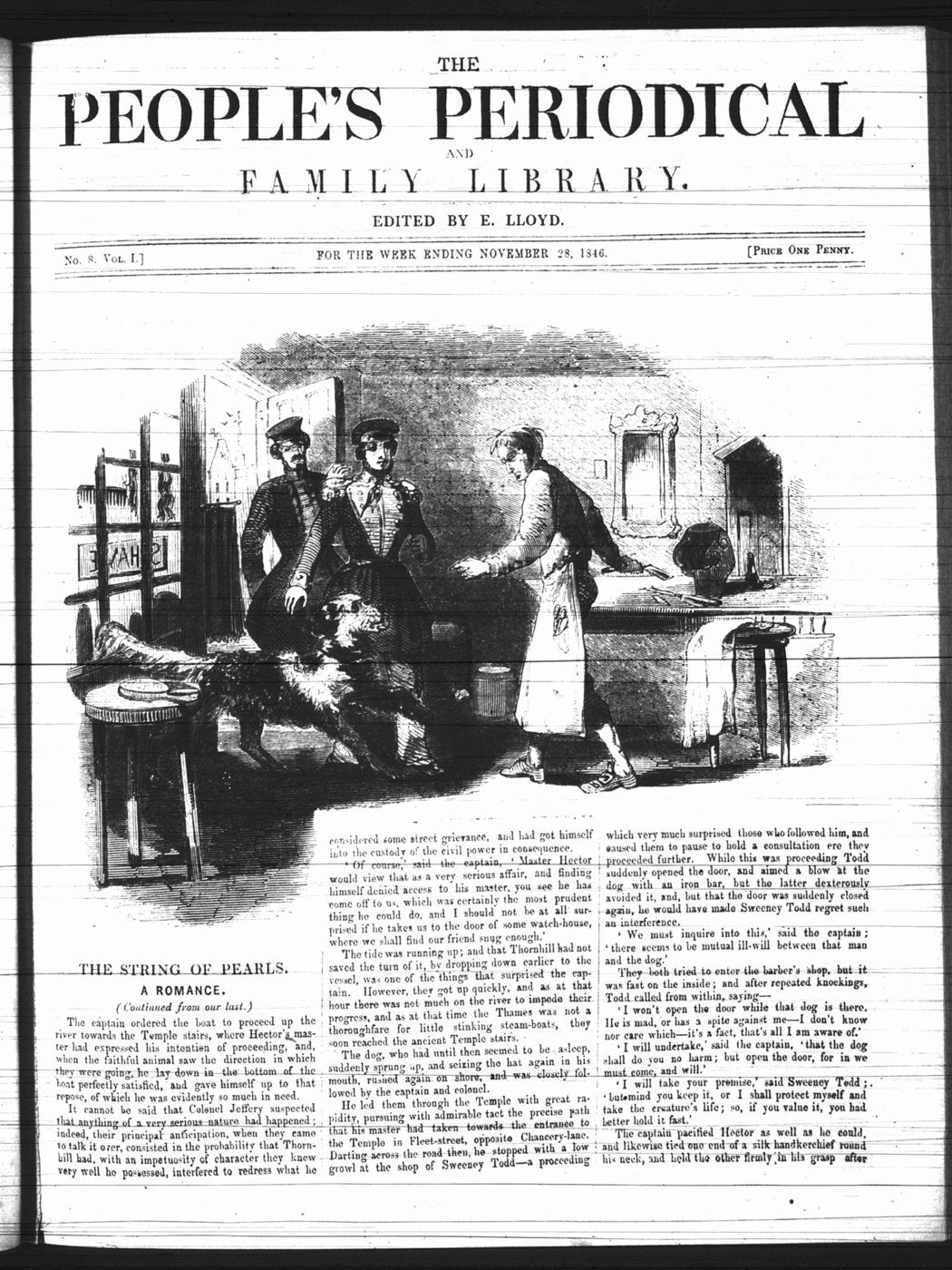
Since 2000, we have seen an upsurge of interest in Sweeney Todd: the Lincoln Center concerts, the Doyle productions, Burton's film and DVD. But there's much more: even the otherwise dreadful movie Jersey Girl (2004), starring Ben Afleck and Jennifer Lopez, revolves brilliantly around the little girl Gertie's obsession with the gruesome and utterly inappropriate Sweeney Todd. She insists her father (Afleck) perform Todd to her Lovett in the elementary school talent show; her number is the only one not from Cats. Other examples include many (some quite accurate) websites devoted to the musical and Todd's origins. But most interestingly, the original 1846–47 text of The String of Pearls has recently seen two print editions, the first ever between covers, Wordsworth (2005) and Oxford (2007); the latter, timed to coincide with the Burton film's release, features Johnny Depp on the cover. This renewed attention to Sweeney Todd suggests that the Victorian tale speaks to contemporary tastes and concerns. Burton in particular has tapped into a collective thirst for gothic horror that, through the vehicle of Sondheim's soaring music, crosses over from Victorian pulp fiction to high brow opera, and back to the mass culture of horror film, bridging the nineteenth and twenty-first centuries.


