Introduction
Interspecies somatic cell nuclear transfer (iSCNT) is a useful tool for the conservation of endangered species by cloning and for preclinical or basic studies using iSCNT-derived embryonic stem (iSCNTES) cell lines (Tecirlioglu et al., Reference Tecirlioglu, Guo and Trounson2006; Beyhan et al., Reference Beyhan, Iager and Cibelli2007). At present, it is much more difficult to support full-term development with iSCNT than with intraspecies somatic cell nuclear transfer (SCNT), therefore the main focus of iSCNT is to produce blastocysts and establish iSCNTES cell lines (Tecirlioglu et al., Reference Tecirlioglu, Guo and Trounson2006; Beyhan et al., Reference Beyhan, Iager and Cibelli2007). Because specific cell types like neurons, pancreatic beta cells and cardiomyocytes obtained from patients' biopsies may be abnormal, differentiated cell types derived from iSCNTES cell lines could be useful for preclinical testing of new drugs (Minger, Reference Minger2007). Furthermore, the use of iSCNTES cell lines could be a valuable tool for studies on nucleus–mitochondrion (mt) interaction mechanisms during early embryonic development (Tecirlioglu et al., Reference Tecirlioglu, Guo and Trounson2006; Beyhan et al., Reference Beyhan, Iager and Cibelli2007; St John et al., Reference St John, Armstrong, Minger and Campbell2008).
Thus far, only a few phylogenetically close interspecies offspring have been born (Tecirlioglu et al., Reference Tecirlioglu, Guo and Trounson2006; Beyhan et al., Reference Beyhan, Iager and Cibelli2007). Interspecies to interclass blastocysts were produced by iSCNT mainly using cow or rabbit oocytes (Tecirlioglu et al., Reference Tecirlioglu, Guo and Trounson2006; Beyhan et al., Reference Beyhan, Iager and Cibelli2007). Although human with rabbit iSCNTES cell lines have been established, the technique was not reproducible until recently (Chen et al., Reference Chen, He, Liu, Wang, Mao, Chu, Lu, Fang, Shi, Yang, Chen da, Wang, Li, Huang, Kong, Shi, Wang, Xia, Long, Xue, Ding and Sheng2003). Especially for primates, there have been only a few reports of iSCNT blastocyst production: human with cow (Chang et al., Reference Chang, Lim, Kang, Lee, Moon and Hwang2003; Illmensee et al., Reference Illmensee, Levanduski and Zavos2006; Li et al., Reference Li, Cao, Zhang, Li, Chen, Fang, Xue, Chen da and Sheng2008), human with rabbit (Chen et al., Reference Chen, He, Liu, Wang, Mao, Chu, Lu, Fang, Shi, Yang, Chen da, Wang, Li, Huang, Kong, Shi, Wang, Xia, Long, Xue, Ding and Sheng2003), cynomolgus monkey with cow (Dominko et al., Reference Dominko, Mitalipova, Haley, Beyhan, Memili, McKusick and First1999) and rhesus monkey with rabbit (Yang et al., Reference Yang, Han, Wen, Sun, Zhang, Zhang, Wu, Kou and Chen2003). Although cow oocytes fused with cynomolgus monkey somatic cells supported iSCNT blastocyst development in one report (Dominko et al., Reference Dominko, Mitalipova, Haley, Beyhan, Memili, McKusick and First1999), other groups have had contradictory results (Lorthongpanich et al., Reference Lorthongpanich, Laowtammathron, Chan, Ketudat-Cairns and Parnpai2008).
Cow and rabbit oocytes have mainly been used for iSCNT (Tecirlioglu et al., Reference Tecirlioglu, Guo and Trounson2006; Beyhan et al., Reference Beyhan, Iager and Cibelli2007). Although rabbit oocytes show higher developmental competence than cow oocytes when used in iSCNT (Beyhan et al., Reference Beyhan, Iager and Cibelli2007), the oocyte retrieval procedure from rabbits is more complicated than that with cows (Yang et al., Reference Yang, Han, Wen, Sun, Zhang, Zhang, Wu, Kou and Chen2003; Kwon et al., Reference Kwon, Hong, Park, Kang, Koo and Lee2009). Rabbit oocytes have to be retrieved from oviducts by a complex surgical procedure following ovarian hyperstimulation treatment (Yang et al., Reference Yang, Han, Wen, Sun, Zhang, Zhang, Wu, Kou and Chen2003); moreover, only a few oocytes can be obtained from each animal. In contrast, immature cow oocytes are readily available from slaughterhouse ovaries and can be matured in vitro up to the metaphase II (MII) stage; they have been successfully used for interspecies to interclass SCNT as with rabbit oocytes (Tecirlioglu et al., Reference Tecirlioglu, Guo and Trounson2006; Beyhan et al., Reference Beyhan, Iager and Cibelli2007). Using this well established in vitro maturation (IVM) system, large numbers of cow oocytes can be made available for iSCNT more easily and economically than rabbit oocytes, and without using living animals. The objective of the present study was to confirm whether cow enucleated ooplasm could support blastocyst development of rhesus monkey somatic nucleus.
Materials and methods
Preparation of rhesus monkey somatic cells
The ear skin biopsy of a male 6-year-old rhesus monkey was approved by the Seoul Zoo (Gyeonggido, Korea). Primary culture of ear skin tissue was performed following the previous work of Kwon et al. (Reference Kwon, Hong, Park, Kang, Koo and Lee2009). Briefly, pieces of ear skin tissue (approximately 0.5 cm2) were minced and treated overnight with collagenase type I (Invitrogen) in a 37 °C incubator under 5% CO2 in air to isolate growing cells. One day later, isolated cells were washed and reseeded with Dulbecco's modified Eagle's medium (DMEM; Invitrogen) supplemented with 10% fetal bovine serum (FBS; Invitrogen) at 37 °C under 5% CO2 in air. After culture to confluency, the cells were cryopreserved in liquid nitrogen. At 3–4 days before iSCNT, cells were thawed and used as the donor somatic cells.
Preparation of recipient cow oocytes
Preparation of recipient cow oocytes was carried out using following the methodology of Kwon et al. (Reference Kwon, Hong, Park, Kang, Koo and Lee2009) with minor modifications. Basically, the IVM medium used was Medium-199 (Invitrogen) supplemented with pyruvate (Sigma-Aldrich), kanamycin (Sigma-Aldrich), 10% (v/v) FBS, 0.005 IU/ml follicle stimulating hormone (FSH; Sigma-Aldrich) and 1 μg/ml 17β-estradiol (Sigma-Aldrich). Incubation conditions were 39 °C with 5% CO2. Ovaries were transported from a local slaughterhouse to the laboratory in 0.9% NaCl solution at around 30 °C. After aspiration of cumulus–oocyte complexes (COCs) from the ovaries using an 18-gauge needle attached to a syringe, COCs were washed four times and cultured at 20–30 oocytes per well in a 4-well dish (SPL).
Interspecies SCNT and in vitro culture (IVC)
A total of 58 iSCNT experiments were done once or twice a week. The same batch of medium was used for IVM–IVC consecutively in two experiments per week. Methodology from Kwon et al. (Reference Kwon, Hong, Park, Kang, Koo and Lee2009) was employed in setting up iSCNT and IVC with minor modifications. Briefly, cow COCs were denuded by repeated pipetting in 0.1% hyaluronidase (Sigma-Aldrich) after 21–24 h of IVM culture. Squish enucleation was done in the presence of 5 μg/ml bisbenzimide (Hoechst 33342; Sigma-Aldrich) and 5 μg/ml cytochalasin B (Sigma-Aldrich) under UV light. After enucleation, a single rhesus monkey somatic cell was injected into the perivitelline space of an enucleated oocyte through the slit in the zona pellucida made during enucleation. Subsequently, the rhesus monkey somatic cell and cow oocyte membranes were electrically fused using an Electro-Cell Fusion apparatus (NEPA GENE, Chiba, Japan). Fusion conditions were two pulses of direct current of 34–38 V for 15 μs duration with 0.26 M calcium-free mannitol (Sigma-Aldrich) solution. Subsequently, the non-activated interspecies cloned couplets were cultured for 2h in IVM medium without hormones to allow reprogramming to occur. Then, couplets were activated using a two-step protocol consisting of treatment with 5 μM ionomycin (Sigma-Aldrich) for 4–5 min and subsequently with 2 mM 6-dimethylaminopurine (6-DMAP; Sigma-Aldrich) for 4 h. After washing without 6-DMAP in modified synthetic oviduct fluid (mSOF), activated interspecies cloned embryos (n = 1153) were cultured for 10 days in mSOF at 5–5.5% CO2 with various conditions (at 37–39 °C and 5–20% O2) to examine the effects of IVC conditions (see Table 2).
Counting nuclear number of blastocyst
iSCNT blastocysts were used for nuclear number analysis. After staining in bisbenzimide solution for 5–10 min at 37 °C, the blastocysts were examined under a UV microscope (excitation wavelength 351–364 nm). Nuclear counting was carried out three times on each iSCNT blastocyst and the average number was calculated.
Polymerase chain reaction (PCR) of rhesus monkey and cow mtDNA
DNA preparation was conducted in accordance with the manufacturer's protocol (iNtRON). Final elution volume was 50 μl per single blastocyst. For amplification of the D-loop region of mtDNA from cow and rhesus monkey, KNCF1 (RhDF2) and KNCR2000 (RhDR) primers were used (Do et al., Reference Do, Lee, Lee, Kim, Ryoo, Lee and Chung2002; Byrne et al., Reference Byrne, Pedersen, Clepper, Nelson, Sanger, Gokhale, Wolf and Mitalipov2007). The PCR reaction of cow mtDNA was carried out for one cycle with denaturation at 94 °C for 5 min (2 min for rhesus monkey) and 55 subsequent cycles with denaturation at 94 °C for 1 min (30 s), annealing at 52 °C (55 °C) for 1 min (30 s), extension at 74 °C (72 °C) for 1 min (1 min 30 s) and a final extension at 74 °C (72 °C) for 7 min (3 min). The PCR product size for cow and rhesus monkey was 960 and 544 bps, respectively.
Results
Development of rhesus monkey-cow iSCNT blastocysts
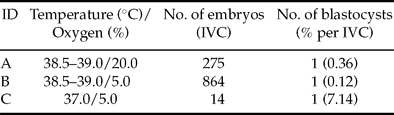
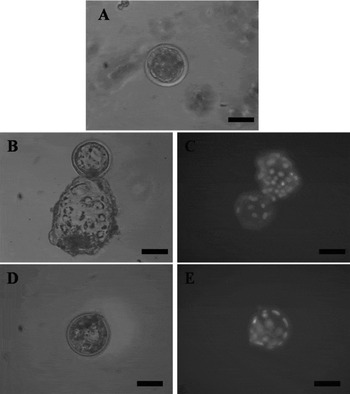
The fusion rate of rhesus monkey somatic cells and cow enucleated oocytes was 56.13% from the total injected oocytes (Table 1). Of IVC embryos (n = 1153), three blastocysts developed in vitro (Table 1, Fig. 1A,B,D). One is a hatching blastocyst (ID: B, Fig. 1B) and the other two are early blastocysts (ID: A and C, Fig. 1A,D). One iSCNT blastocyst (ID: A, Fig. 1A) shrank quickly after forming a prominent blastocoele. Figure 1A shows a pre-expansion compacted morula (CM) and it is morphologically similar to a rhesus monkey SCNT morula in a previous report (Simerly et al., Reference Simerly, Navara, Hyun, Lee, Kang, Capuano, Gosman, Dominko, Chong, Compton, Hwang and Schatten2004). The iSCNT blastocyst development rate was 0.26% of the total IVC iSCNT embryos (Table 1). The nuclear number of two iSCNT blastocysts was 51 and 24 (Table 1, Fig. 1C,E). The hatching iSCNT blastocyst shrank after exposure to bisbenzimide for nuclear counting (Fig. 1C). The use of two different oxygen concentrations (5% and 20%) and two temperatures (37 °C and 38.5–39.0 °C) during IVC of iSCNT embryos showed that all three tested conditions support iSCNT blastocyst development (Table 2).
Fusion, blastocyst development rate and blastocyst nuclear number of rhesus monkey iSCNT embryos

These experiments were replicated 58 times.
Average number of IVC embryos per replicate was 19.9.
aDays after IVC.
bNuclear number of rhesus monkey iSCNT blastocyst was counted three times and the average number was calculated.
cNot determined.
iSCNT, inter-species somatic cell nuclear transfer; IVC, in vitro culture.
Effect of temperature and oxygen concentration during IVC of rhesus monkey iSCNT embryos
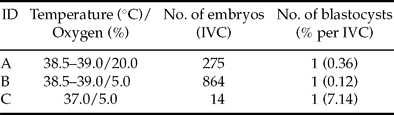
iSCNT, inter-species somatic cell nuclear transfer; IVC, in vitro culture.
Development of rhesus monkey and cow inter-species somatic cell nuclear transfer (iSCNT)-derived blastocysts. Phase contrast and bisbenzimide staining image of rhesus monkey iSCNT compacted morula (A), hatching blastocysts (B,C) and early blastocyst (D,E). The compacted morula (A) later expanded to the early blastocyst stage. (B/C) and (D/E) are not merged images. Scale bar = 100 μm

Analysis of mixed mtDNA in iSCNT blastocysts
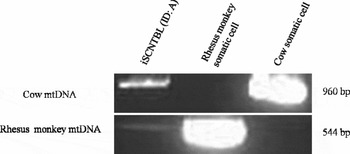
One iSCNT blastocyst had both cow and rhesus monkey mtDNA (Fig. 2). The band intensity was more dominant for cow mtDNA than rhesus monkey mtDNA (Fig. 2).
Mixed mtDNA of rhesus monkey inter-species somatic cell nuclear transfer (iSCNT) blastocyst. PCR analysis confirmed that this iSCNT blastocyst has both cow (960 bp) and rhesus monkey mtDNA (544 bp).

Discussion
The aim of this study was to confirm whether cow enucleated ooplasm could support blastocyst development of rhesus monkey somatic nucleus. This report is the first to show rhesus monkey iSCNT blastocyst development in vitro, showing prominent blastocoele cavity formation. In this experiment, we generated an iSCNT blastocyst developmental rate of 0.26% from the total IVC iSCNT embryos, and the nuclear numbers of two iSCNT blastocysts were 51 and 24. Because a hatching blastocyst appeared at around 5.5 days of IVC, it seems that iSCNT embryos follow the donor cell-specific developmental programme (Dominko et al., Reference Dominko, Mitalipova, Haley, Beyhan, Memili, McKusick and First1999) wherein monkey SCNT blastocysts appeared around days 4.5–6.0 (Simerly et al., Reference Simerly, Navara, Hyun, Lee, Kang, Capuano, Gosman, Dominko, Chong, Compton, Hwang and Schatten2004; Zhou et al., Reference Zhou, Yang, Ding, He, Xie, Hildebrandt, Mitalipov, Tang, Wolf and Ji2006) and cow SCNT blastocysts appeared around days 6.0–7.0 after activation (Dominko et al., Reference Dominko, Mitalipova, Haley, Beyhan, Memili, McKusick and First1999). Only one iSCNT blastocyst was subjected to mtDNA analysis. The mixed mtDNA data from this blastocyst showed that it originated from the fusion of an enucleated cow oocyte and a rhesus monkey somatic cell. As in previous reports (Yang et al., Reference Yang, Han, Wen, Sun, Zhang, Zhang, Wu, Kou and Chen2003, Reference Yang, Kou, Wang, Jiang, Mao, Sun, Sheng and Chen2004), the PCR band intensity of both species' mtDNA indirectly indicates that the oocyte origin cow mtDNA was dominant over the somatic cell origin rhesus monkey mtDNA. Two iSCNT blastocysts failed mtDNA analysis in the DNA preparation step. Although this report showed an extremely low blastocyst development rate, it proves that cow enucleated ooplasm can support blastocyst development driven by adult rhesus monkey somatic nucleus. This result is indirect evidence that extraordinarily phylogenetically distant species such as cow and rhesus monkey have relatively common mechanisms of nuclear reprogramming, DNA replication and gene expression in preimplantation stage embryos (Li et al., Reference Li, Cao, Zhang, Li, Chen, Fang, Xue, Chen da and Sheng2008). For direct evidence, it would be necessary to produce viable iSCNT offspring but that was beyond the aims of the present study.
In this study, we succeeded in iSCNT blastocyst development only in three experiments out of 58 iSCNT experiments. Interspecies SCNT blastocyst (ID: B and C) were produced in the consecutive one day term iSCNT experiments and were used in the same batch medium from IVM to IVC. These two iSCNT experiments showed the iSCNT blastocyst developmental rate to be 5.71% (2/35), and it is about 21 times higher than the total iSCNT blastocyst developmental rate (0.26%, 3/1153). As the micromanipulation was done by same person and the conditions of each step of iSCNT were similar in 58 experiments, this situation reflects that the medium batch used in iSCNT experiments could be a critical factor. Otherwise, oxygen concentration and temperature during IVC might be non-critical factors for the development to the blastocyst stage.
Although several data indicate that there is no clear answer about the optimal conditions of rhesus monkey iSCNT blastocyst development in vitro, it is reasonable to speculate that medium (IVM–IVC) batch could be critical whereas oxygen concentration and temperature during IVC are not. In spite of the extremely low blastocyst developmental rate, the fact that three blastocysts produced by three independent iSCNT experiments reflect that this experiment could be fairly reproducible following optimization of conditions.
In this iSCNT study, it was shown that rhesus monkey iSCNT blastocyst development is possible in vitro. However, conditions have to be adjusted to improve the blastocyst development rate and quality for future rhesus monkey iSCNTES cell line isolation. As with the consecutive establishment of monkey and human ES cell lines (Thomson et al., Reference Thomson, Kalishman, Golos, Durning, Harris, Becker and Hearn1995, Reference Thomson, Itskovitz-Eldor, Shapiro, Waknitz, Swiergiel, Marshall and Jones1998), monkey SCNT research could be a very useful preliminary tool for human SCNT research. Because the general methodology of human SCNT blastocyst development is similar to this iSCNT study (Stojkovic et al., Reference Stojkovic, Stojkovic, Leary, Hall, Armstrong, Herbert, Nesbitt, Lako and Murdoch2005; French et al., Reference French, Adams, Anderson, Kitchen, Hughes and Wood2008), this report could also be used as a model for producing high quality human SCNT blastocysts used to establish human SCNTES cell lines.
Acknowledgements
We thank to Dr Barry D. Bavister for his valuable editing of the manuscript. We also thank Seoul Zoo for providing rhesus monkey ear somatic tissue and Min Jung Kim for technical assistance in cow oocyte IVM. This study was financially supported by the Korean MEST, IPET (#109023–05–1-CG000), the BK21 program and the Research Institute for Veterinary Science, and SNU foundation (Benefactor; RNL Bio).