1. Introduction.
This book presents a unified minimalist account of a range of impersonal constructions in several Germanic languages, with emphasis on German. The data analyzed differ along two dimensions. First, the sample of languages includes V2 and non-V2 languages, VO- and OV-languages, and languages with and without verb movement. Second, the constructions under discussion have been traditionally analyzed as containing expletive elements such as an overt expletive, an expletive pro, the trace/copy of an expletive, or a quasi-argument.
Accordingly, Mohr's unified account relies on the following two components. First, Mohr proposes a uniform clausal structure, with the internal argument always merging in SpecVP. The OV and VO orders as well as other word order differences result from an interaction of checking conditions, different types of verb movement, and the cross-linguistic variation in the location of the subject of predication either in the IP- or in the CP-system. Second, Mohr argues that non-overt expletives such as pro and traces/copies of overt expletives do not exist. She further claims that overt “expletive” elements should be divided into true, or pure, expletives, event arguments, and quasi-arguments. The three types of “expletives” differ in their featural make-up, which determines in what syntactic (subject) positions they can/must appear. The properties of the three types of “expletives” are summarized in 1.

Mohr argues convincingly against the “expletive approach,” according to which expletives are universally merged in SpecIP due to the need to fill this position. She demonstrates that, despite their superficial resemblances, impersonal constructions in the Germanic languages involve different structures and different “expletive” elements. In section 2 of this review, I summarize the content of each chapter. In section 3, I discuss a number of issues that arise from Mohr's analysis.
2. Summary.
The book consists of an introduction (Part I), two major parts (Part II and Part III), and a conclusion (Part IV). In Part II, Mohr develops a theoretical framework in which the analysis is cast. In Part III, she analyzes Transitive Expletive Constructions (TECs) and other thetic constructions, impersonal passives, weather verbs, and impersonal psych verbs—in German, Dutch, Afrikaans, Yiddish, Icelandic the Mainland Scandinavian languages (Danish, Norwegian, Swedish), and English—against the theoretical background developed in Part II. Sections 2.1 and 2.2 below summarize the main points of Part II and Part III, respectively.
2.1. Part II: Clausal Architecture and the EPP.
Part II consists of six chapters, which address theoretical issues, such as clause structure, feature checking, and the nature of the EPP (Extended Projection Principle). Chapter 1, “Subject positions and the EPP: The evolution of the two concepts,” deals with the relation between the EPP and the subject position(s), and the dissociation of the EPP from the notion of subject. First, Mohr outlines the evolution of the EPP from principle to feature. Second, she discusses the emergence of a cartography approach, under which there are numerous subject positions within a structure, each of which associated with a specific feature (Kiss 1996, Bobaljik and Jonas 1996, Alexiadou and Anagnostopoulou 2001, Cardinaletti 2004, and others). Third, Mohr presents the parametrized view of the EPP: languages differ with respect to how the EPP-feature is checked. Some languages require the EPP to be checked by move/merge of a maximal projection (Germanic languages). Other languages allow the EPP to be checked by move/merge of a head (Celtic languages, Arabic, Romance languages).
In chapter 2, “The EPP and the Extension Condition,” Mohr argues that there is no inherent connection between subject positions and the EPP-feature. She proposes that the EPP-feature ensures that head movement complies with the Extension Condition, a requirement that syntactic operations extend the structure at the root (Chomsky 1995). XP-movement meets this requirement as it targets the topmost node in the structure and moves an XP into the specifier of this node, as shown in 2a. In contrast, head movement does not extend the structure at the root, but only makes if “fatter,” as shown in 2b.

Mohr proposes a refined version of the Extension Condition given in 3 that allows head movement to be integrated into the narrow syntax.

The EPP-feature ensures that any head movement is immediately followed by an operation that creates the specifier of the complex head, that is, Merge or Move of an XP. For example, under this approach, head Y in 2b must contain an EPP-feature. One consequence of this proposal is that in V2 languages, the head targeted by V2 movement (Fin in Mohr's theory) always contains an EPP-feature.
In chapter 3, “Clause structure,” Mohr proposes a universal clause structure, using insights from both the Minimalist Program and the cartographic approach (Belletti 2001, 2003, Rizzi 2002, Cardinaletti 2004). The structure is minimalist in the sense that the individual phrases can lack a specifier, whenever it is not needed, and every phrase can have at most one specifier. At the same time, the structure is cartographic because it contains numerous functional projections, each of which is associated with a particular feature. The features include purely formal ones, such as Fin, and semantic ones, such as Top, Foc, etc. The following projections comprise the three functional systems, with optional projections given in parenthesis.

Chapter 4, “Checking,” outlines the assumptions about the types of features and the checking mechanism. Mohr assumes that all features, except for the EPP-feature, come in [+] and [−] versions, and checking involves creating [+/−] pairs of matching features. Checking is done either in a spec-head or in a head-head relation. With respect to the spec-head configuration, the feature that has to be checked may be contained in the phrase that occupies the specifier of the head in question because looking into the specifier is possible. The two types of spec-head configurations are illustrated in 5.

In a head-head configuration, features are checked either by merge of a head or by movement of a head to another head position.
Mohr discusses the interaction between possible checking configurations and various types of V-movement. There are three types of V-movement: no (overt) V-movement, short V-movement to v, and long V-movement to various heads outside vP, such as T, Fin, etc. In addition, there is one type of “morphological” V-movement, in which a verb stem moves to bind verbal affixes. Mohr proposes that this latter type of movement takes place in Icelandic.
Chapter 5, “The ‘universal’ EPP on T,” discusses the featural content of T, and the ways the features on T are checked. Mohr proposes that in most cases, the EPP can be reduced to Nominative Case checking on T. The remaining instances of an EPP-feature are reduced to a subject-of-predication (sop) feature. Mohr proposes also that the sop-feature is parameterized: in non-V2 languages, a sop-feature sits in T, whereas in V2 languages, a sop-feature sits in Fin.
Finally, chapter 6 summarizes the main points of Part II.
2.2. Part III: Impersonal Constructions and Subject Positions.
Part III presents a unified account of a range of impersonal constructions—in German, Dutch, Afrikaans, Yiddish, Icelandic, the Mainland Scandinavian languages, and English—against the theoretical framework developed in Part II. Chapter 7, “The constructions to be discussed and previous accounts,” presents a summary of the most important facts about the data, illustrates the crosslinguistic differences among the Germanic languages with respect to these constructions, and reviews previous accounts. The data discussed in the chapter involve TECs and impersonal passives, illustrated by the German examples in 6a and 6b, respectively.

As suggested by the ungrammaticality of the Swedish and English examples in 7a and 7b, respectively, not all languages in the sample allow TECs.

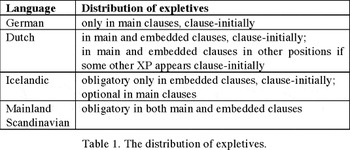
Furthermore, Mohr demonstrates that languages that allow TECs do not pattern exactly alike. First, the subject in TECs displays the definiteness effect in Dutch, Afrikaans, and Icelandic, but not in German and Yiddish. Second, German, Yiddish, and Icelandic have an expletive of pronominal origin, whereas Dutch and Afrikaans have an expletive of locative origin. Similarly, not all languages in the sample allow impersonal passives. For example, English sentences such as *There was danced/*It was danced are ungrammatical. Languages that allow impersonal passives differ in the distribution of expletives as shown in table 1.

Mohr argues that this variation may not be attributed to the licensing of subject positions. Instead, it is due to the type of expletive a given language has, and to the features associated with a certain position (for example, the sop-feature).
In chapter 8, “The derivation of presentational sentences and impersonal passives,” Mohr analyzes TECs and impersonal passives, focusing mainly on the contrast between German and Dutch. She argues that German es and Dutch er are not the same kind of element. The former is of the pronominal origin and is a pure expletive merged in SpecFinP to check the sop-feature. The latter is of locative origin and is an event argument. It carries a [+specific] feature and merges in SpecRefP, the designated position for definite subjects.
The distinction between pure expletives and event arguments is extended to TECs and impersonal passives in other languages. Mohr shows that Yiddish es and Icelandic það are of pronominal origin and pattern with German es. In contrast, Afrikaans daar and English there are of locative origin and pattern with Dutch er. In Mainland Scandinavian languages, the “expletive” element is neither a pure expletive, nor an event argument. Instead, Mohr argues that in these languages the “expletive” element is a quasi-argument, discussed in more detail in the next chapter.
In chapter 9, “Constructions involving quasi-arguments (or not),” Mohr argues that weather verbs in all languages—except for Icelandic and Yiddish—and impersonal psych verbs in German select a quasi-argument. Quasi-arguments differ from other expletive elements in that they obligatorily merge in SpecvP, and carry a Nominative Case feature and a [+specific] feature. To check these features, quasi-arguments move to SpecTP and SpecRefP, respectively, and then move to higher specifiers, if necessary. However, unlike real arguments, quasi-arguments do not have semantic content as they never spell out an agent or a causer.
Chapter 10 provides a summary of Part III.
3. Discussion.
The issues and data discussed in the book are very complex. A number of formidable syntactic topics, such as word order variation, verb movement, subject positions, the nature and syntactic distribution of expletives, and the architecture of the IP- and CP-systems are dealt with across nine languages. In addition, Mohr makes a number of original proposals, such as the New Extension Condition, and the checking of features by looking into the specifier. Due to this complexity, the discussion is sometimes hard to follow. The book would benefit from some reorganization.
In particular, it would be helpful if the precise research questions and basic theoretical assumptions were stated explicitly in the introductory Part I, and then repeated in Parts II and III, as well as in the concluding Part IV, so that the reader is reminded of the point of departure. For example, in the final paragraph of chapter 1, p. 39, Mohr states:
Among the points to be adopted or developed are the idea of the EPP as a feature, the assumption that subject properties are encoded by features and associated with particular positions as proposed in the cartographic approach, the idea that there is a relation between the traditional conception of the EPP and the V2 requirement (cf. Roberts & Roussou 1998), and last but not the least the idea that the EPP can be checked by merger of a head or by head-movement (cf. Alexiadou & Anagnostopoulou 1998).
From this passage, I conclude that Mohr adopts the assumptions in 8.

My guess regarding assumptions 8a–c is confirmed at various points throughout the book. However, Mohr does not assume 8d. In fact, in chapter 2, p. 50, note 52 she explicitly states the following:
Crucially, the EPP-feature cannot be checked by head movement in my system (contrary to A&A 1998). This restriction is due to the fact that the EPP-feature is designed as a specifier-creating feature and is not a [D]-feature.
Another organizational issue concerns the discussion of the EPP, which is scattered through chapters 1, 2 and 5. It would be helpful if the complete set of assumptions regarding the EPP were presented before the discussion of clausal structure and checking in chapters 3 and 4, respectively. For example, in chapter 2, p. 53, the EPP-feature is defined as a feature that ensures that head movement complies with the New Extension Condition. Any head not associated with any feature that triggers XP-movement automatically carries an EPP-feature. Thus, in V2 languages such as German, the head Fin carries the finiteness feature checked by V-movement. Fin also carries an EPP-feature that saves the derivation: it ensures that V-movement to Fin is immediately followed by XP-movement or by merger of an expletive into SpecFinP.
At this point, this solution appears to be a pure stipulation. However, in chapter 5 Mohr proposes that the EPP-feature can be reduced to the sop-feature, and that V2 and non-V2 languages contrast with respect to where this feature is located. In V2 languages such as German, the sop-feature is located in Fin. In non-V2 languages such as English, the sop-feature is located on T. Introducing this idea in chapter 2 would have made the discussion in the subsequent chapters more transparent.
The analysis itself raises a number of interesting questions. For example, the fine-grained distinction between the three types of “expletive” elements provides a new way of analyzing a range of impersonal constructions in the Germanic languages. The three types of “expletives” vary in their featural make-up, which determines in what syntactic positions each type can/must appear. Under the approach, where each feature is associated with a separate functional projection, a perfectly reasonable generalization arises: the more features a given “expletive” carries, the more syntactic positions are available for it.
Such a view suggests that the number and the nature of features associated with a given “expletive” should reflect its semantic content. This, in turn, poses the question about what kind of semantic content expletives can have. For example, event arguments obviously have more semantic content then true expletives, as they specify “here and now” or “there and then” of the event. However, Mohr's treatment of quasi-arguments is unclear. On the one hand, they are selected by weather and impersonal psych verbs, carry most features, and can appear in a wider range of syntactic positions. On the other hand, in chapter 9 Mohr states that “despite being associated with all these features though, the quasi-argument does not really have any semantic content as it does not spell out an Agent or a Causer” (p. 177). First, being able to spell out an agent or a causer is not the only criterion for having semantic content. Second, if quasi-arguments are semantically empty in the same sense as true expletives are, what accounts for the different featural make-up of the two elements?
Thus, Mohr's classification poses the more general question of what the term expletive means. In other words, what amount of semantic content distinguishes an expletive from a real argument? This question, however, goes beyond the scope of Mohr's work.
Another interesting consequence of Mohr's analysis concerns multiple wh-movement. Recall that Mohr proposes a clause structure, in which a phrase can have at most one specifier. If this structure is universal, the question is how multiple wh-movement can be accounted for? For example, it has been argued that in Slavic languages wh-phrases move to multiple specifiers of either CP or TP (Rudin 1988, Richards 2001). If a phrase can have at most one specifier, in languages with multiple wh-movement wh-phrases must undergo movement to the specifiers of distinct heads. One question arising here is what are the heads hosting multiple wh-phrases? Furthermore, since under Mohr's analysis, each head carries a different feature, multiple wh-phrases should vary in their featural make-up as well.
One possible way to treat multiple wh-movement within Mohr's system is as follows. Her theory of clausal architecture is compatible with the view of multiple wh-movement as obligatory focus movement (É. Kiss 1995, Horvath 1986, Stepanov 1998, Bošcović 2002). Recall that in Mohr's theory, all three systems contain a focus projection, as shown again in 9.

If the focus projection in any of the three systems is recursive, multiple wh-movement can be accounted for.
To conclude, Mohr's study provides a unified account of a wide range of impersonal constructions in the Germanic languages. Moreover, it allows us to dispense with null expletive pro and proposes a single universal clause structure with various word orders being due to syntactic movement—always a welcome result. Despite a number of organizational issues discussed above, the book is an excellent contribution to the field of Germanic syntax. As any high-quality work, it also inspires new research by raising a number of puzzling questions.