Introduction
Deforestation of natural habitats has eliminated much of the world's forest cover for agricultural and urban development, causing a reduction in the available area and the spatial isolation of the remaining populations. As a result, evolutionary processes such as genetic drift have become more striking due to population reduction and limited gene flow between fragments (Haddad et al., Reference Haddad, Brudvig, Clobert, Davies, Gonzalez, Holt, Lovejoy, Sexton, Austin, Collins, Cook, Damschen, Ewe, Foster, Jenkins, King, Laurance, Levey, Margules, Melbourne, Nicholls, Orrock, Canção and Townshend2015). The flow of genes within and between populations is the main influence on patterns of genetic differentiation, being responsible for maintaining variability within populations, reducing allelic differences between them (Hamrick, Reference Hamrick2012).
Habitat loss and fragmentation can affect tree species differently. Spatially isolated trees are not always reproductively isolated, as they are capable of maintaining gene flow even hundreds of metres apart (Martins et al., Reference Martins, Kimura, Francisconi, Gezan, Kainer and Christianini2016). Thus, the hypothesis is that trees have reproductive characteristics that make them highly resistant to anthropic processes, favouring the maintenance of high levels of genetic variability (Aguilar et al., Reference Aguilar, Quesada, Ashworth, Herrerias-Diego and Lobo2008).
However, if the gene flow is practically absent, or ecological aspects are not finding that facilitated the maintenance of the species, the isolated individuals may disappear in the fragmented populations (Fischer et al., Reference Fischer, Stott and Law2010). Thus, assessing the levels of genetic variation within and among populations is essential to understand the genetic structure of species and their pattern of local maintenance and conservation. This knowledge is important for designing strategies for in situ conservation of species and for planning seed collections and production of seedlings of native species, which can be used in ex situ conservation in forest restoration programmes and, in connection of areas (Schmidt et al., Reference Schmidt, De Urzedo, Piña-Rodrigues, Vieira, De Rezende, Sampaio and Junqueira2019).
Molecular DNA markers stand out as effective tools for studies to assess the diversity and genetic structure of species and populations (Grover and Sharma, Reference Grover and Sharma2016). Among the marker classes, Inter Simple Sequence Repeats (ISSR) it has been widely used due to their reproducibility, universality, high polymorphism, ease of use and low cost (Ng and Tan, Reference Ng and Tan2015). A collection of publications on tree species from different botanical families reveal that ISSR markers have been efficient for studies of characterization, identification of genetic variations, conservation and forest management, allowing to estimate and detect genetic variability and to characterize the divergence between individuals evaluated (Bocanegra-González and Guillemin, Reference Bocanegra-González and Guillemin2018; Fajardo et al., Reference Fajardo, Costa, Chagas and Vieira2018; Maheswarappa et al., Reference Maheswarappa, Vasudeva, Hegde and Ravikanth2019; Rajalakshmi et al., Reference Rajalakshmi, Rajalakshmi and Parida2019; Yulita et al., Reference Yulita, Atikah, Wardani and Sulita2020).
Astronium concinnum Schott ex Spreng. (Anacardiaceae), popularly known as Gonçalo-Alves, is one of the species of interest for these studies due to its economic and ecological potential. Its wood is used for confections of luxury furniture, window frames, parquet and boards for floors and external works, being also used in construction civil and naval. The species trees can be used successfully in rural landscaping and in the afforestation of parks and large gardens, and can also be used in the recovery and restoration of degraded areas (Lorenzi, Reference Lorenzi2002). In addition, some characteristics of A. concinnum, such as entomophilic pollination, anemochoric dispersion, seedlings with high germination rate and shade tolerance, suggest that, in addition to the local abundance provided by the formed seed bank, the trees may persist for long periods in affected areas by anthropic processes (Daniel et al., Reference Daniel, Reis, Maestri, Reis and Regazzi1987; England et al., Reference England, Usher, Whelan and Ayre2002).
The species has confirmed occurrence in the states of Bahia, Rio Grande do Norte, Sergipe, Espírito Santo, Minas Gerais and Rio de Janeiro (Luz et al., Reference Luz, Mitchell, Pirani and Pell2020). In the state of Espírito Santo, among the occurrences of the species, the Conservation Units (CU's) of National Forest of Pacotuba (Flona of Pacotuba) stand out with 449.72 hectares and the Private Natural Heritage Reserve of Cafundó (PNHR Cafundó) of 517 hectares. These Units are located in the south of the State and represent important areas of environmental preservation in the region. Flona of Pacotuba is integrated into the federal government's project, Network of Native Forest Seeds, which aims to identify areas of natural forests with potential for seed production through criteria of matrix selection (ICMBIO, 2011).
The two above mentioned CU's have a history of environmental disturbances due to anthropic processes such as logging for firewood, fires, pasture areas in the surrounding area with the possible penetration of cattle on the edge of forest complexes (ICMBIO, 2011). Thus, the objective was to evaluate the diversity patterns and genetic structure of the species, in these two conservation areas, answering the following questions: (1) How is the genetic diversity of A. concinnum partitioned in the Conservation Units? (2) Was the species affected by the processes of environmental modification or does it still preserve local levels of genetic diversity satisfactory for its maintenance? (3) Can the evaluated individuals be selected as future matrices for seed collections?
Materials and methods
Study area and sampling
The study was carried out in two populations of A. concinnum located in Conservation Units in the south of Espírito Santo, Brazil: The National Forest of Pacotuba (Flona of Pacotuba – 20°45′ S; 41°17′ O), and the Private Natural Heritage Reserve of Cafundó (PNHR Cafundó – 20°43′ S; 41°13′ O) (Fig. 1). Leaf samples were collected from 48 trees of reproductive age, 25 in Flona of Pacotuba and 23 in PNHR Cafundó. In the sampling, young and healthy leaves were prioritized, and a minimum distance of 50 m between individuals to decrease the probability of collecting related trees (Sebbenn, Reference Sebbenn2002).
Location map of the sampling areas of the Astronium concinnum species, showing the two Conservation Units evaluated. Espírito Santo, Brazil.
Source: The author.

DNA extraction
Genomic DNA was extracted based on the method described by Doyle and Doyle (Reference Doyle and Doyle1990), with the addition of proteinase K. After optimization tests of the species’ DNA extraction protocols, the addition of proteinase K allowed obtaining genomic material with better values in quantity and purity. The concentration and purity of the total DNA were determined by spectrophotometry in the NanoDrop apparatus (Thermo Scientifc 2000C) and evaluated according to Aguilar et al. (Reference Aguilar, López, Aceitun, Ávila, Guerreiro and Quesada2016).
PCR amplification
Eight ISSR primers developed by the University of British Columbia, Vancouver, Canada (UBC 807; 808; 818; 827; 836; 956; 868; 878), were used for the genetic analysis of the 48 samples of A. concinnum. Each amplification reaction via PCR (Polymerase Chain Reaction) presented a final volume of 20 μl containing 1× buffer [10 mmol/l of Tris-HCl (pH 8.5) and 50 mmol/l of KCl]; 2.5 mmol/l of MgCl2; 0.8 mmol/l of dNTP; 0.2 mmol/l of primer, 1 unit of Taq DNA polymerase enzyme and 50 ng of DNA. The amplifications were performed in a thermocycler (Applied Biosystems, Veriti model) programmed for 1 initial denaturation cycle at 94°C for 5 min, followed by 35 cycles consisting of three stages: (a) 45 s at 94°C, (b) 45 s at 52°C and (c) 90 s at 72°C, followed by a final extension of 7 min at 72°C. The DNA amplification products were separated by electrophoresis on a 2% agarose gel containing ethidium bromide (0.50 μg/ml) at 94 volts for 4 h. Subsequently, the gels were photographed under UV light in photodocumentation system (ChemiDoc MP Imaging System – Bio Rad). The molecular size of the fragments was determined with a molecular weight marker (Ladder) of 100 base pairs. All of these analyses were performed at the Laboratory of Biochemistry and Molecular Biology, Universidade Federal do Espírito Santo, UFES (Brazil).
Statistical analysis
The polymorphic loci were evaluated by the presence (1) and absence (0) of amplified fragments, building a binary matrix. A descriptive analysis of the data was performed by evaluating the total number of bands (TNB), number of polymorphic bands (NPB) and percentage of polymorphic bands (PPB) per primer and size variation of the fragments generated in base pairs (SVF). The genetic dissimilarity between the pairs of individuals, in the two locations, was evaluated fur the complementarity of the Jaccard coefficient. The number of genetic clusters was determined using the Unweighted Pair Group Method using Arithmetic averages (UPGMA). The cut-off point for the obtained dendrogram was established by the method proposed by Mojema (Reference Mojema1977). The cophenetic correlation coefficient (CCC) was estimated to evaluate the fit between the distance matrix and the dendrogram. All these analyses were conducted with the aid of the Genes software (Cruz, Reference Cruz2016). The genetic dissimilarity matrix obtained in the Genes programme was used for the graphical analysis of the dendrogram in the statistical software R (R Core Team, 2016) associated with the use of vegan (Oksanen et al., Reference Oksanen, Blanchet, Friendly, Kindt, Legendre, Mcglinn, Minchin, O'hara, Simpson, Solymos, Stevens, Szoecs and Wagner2018), cluster (Maechler et al., Reference Maechler, Rousseeuw, Struyf, Hubert, Hornik, Studer, Roudier, Gonzalez, Kozlowski, Schubert and Murphy2019), dendextend (Galili et al., Reference Galili, Benjamini, Simpson, Jefferis, Gallota, Renaudie, Hornik, Ligges, Spiess, Horvath, Langfelder, Loo, Vries, Gu, Ma, Hummel, Clark, Graybuck, Ho, Perreault, Hennig and Bradley2020), factorextra (Kassambara and Mundt, Reference Kassambara and Mundt2020), ggpubr (Kassambara, Reference Kassambara2020), cowplot (Wilke, Reference Wilke2019), gridExtra (Auguie and Antonov, Reference Auguie and Antonov2017).
The parameters of genetic diversity, percentage of polymorphic loci (PPL), Nei genetic diversity index (H*) and Shannon index (I*), were estimated using the Popgene 1.32 software (Yeh and Boyle, Reference Yeh and Boyle1997). The average number of migrants per generation (N m), which estimates the gene flow between populations, was also calculated using the same software. This analysis was performed indirectly from the estimates of genetic divergence between groups (G ST) as a function of N m, using the formula N m=0.5 (1−G ST)/G ST. The distribution of genetic diversity between and within Conservation Units was estimated through the analysis of molecular variance (AMOVA), using the software Arlequin version 3.5 (Excoffier and Lischer, Reference Excoffier and Lischer2010). The Structure software (Pritchard et al., Reference Pritchard, Stephens and Donnelly2000), based on Bayesian statistics, was used to define the number of groups (K) in which individuals are structured. To verify the most probable number of groups, K values ranging from K = 1 to K = 5 were tested. 20 runs were run for each K value, 250,000 burn-ins and 1,000,000 Markov Chains Monte Carlo simulations (MCMC) (Evanno et al., Reference Evanno, Regnaut and Goudet2005). The most likely K value was defined using the Structure Harvester software (Earl and Vonholdt, Reference Earl and Vonholdt2012), according to the criteria established by Evanno et al. (Reference Evanno, Regnaut and Goudet2005).
Results
The eight ISSR primers used in the 48 individuals of A. concinnum produced a total of 121 amplified fragments, among which, 89 (73.55%) presented polymorphism. The number of bands per primer varied between nine (UBC 807) and 24 (UBC 878), with an average of 15.12 bands/primer. The most informative primer was UBC 878 (75% polymorphism) and the least informative was UBC 856 (60% polymorphism) (Table 1).
Primers used and their base sequences, the total number of bands (TNB), the number of polymorphic bands (NPB), percentage of polymorphic bands (PPB) and size variation of the fragments generated in base pairs (SVF) based on 100 bp marker

A, Adenine; T, Thymine; C, cytosine; G, Guanine; Y, (C or T).
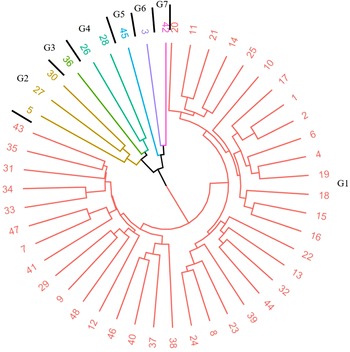
The genetic dissimilarity obtained between the trees ranged from 0.26 to 0.87. The smallest genetic distance was observed between pairs of individuals 1 and 2 and the longest distance between 40 and 42. The visual analysis of the data in the dendrogram, adopting a cutoff point of 85.23%, allowed the separation of individuals into seven distinct genetic groups (Fig. 2).
Dendrogram representative of genetic dissimilarity among 48 individuals of Astronium concinnum. Samples 1 to 25 (Flona of Pacotuba, ES), samples 26 to 48 (PNHR Cafundó, ES). The seven groups formed (G1 to G7) are identified by different colours.

Individuals 3, 36, 42 and 45 formed isolated groups on the dendrogram. Individual 3 belongs to Flona of Pacotuba and the others to PNHR Cafundó. Most individuals (from both CU's) were included in a single group (G1). The cophenetic correlation coefficient was 82% (CCC = 0.82).
The parameters of genetic diversity, Nei and Shannon index, showed similar values between the two analysed fragments. The highest values were observed when the two fragments were evaluated together (species) (Table 2).
Genetic diversity of natural populations of Astronium concinnum sampled in Flona of Pacotuba and PNHR Cafundó, Espírito Santo

Sample size (n), Nei Index (H*), Shannon Index (I*).
AMOVA indicated that most genetic diversity (92.54%) occurs within populations and 7.45% of diversity is among populations. The genetic differentiation (Φst) between the two locations was Φst = 0.074 and the gene flow of N m = 10.629 (Table 3).
Analysis of molecular variance and number of migrants per generation in natural populations of Astronium concinnum

Number of migrants per generation (N m); Genetic differentiation (Φst).
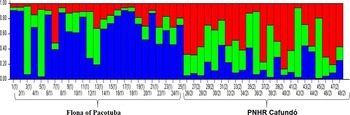
The results of the genetic structuring indicated the division of the individuals of A. concinnum into three genetic groups (K = 3) identified by three colours (blue, green and red) in the figure below (Fig. 3).
Representation of 48 individuals from two natural populations of Astronium concinnum using the Structure software. Individuals 1 to 25 (Flona of Pacotuba, ES) and 26 to 48 (PNHR Cafundó, ES) are represented by vertical bars.

Discussion
The polymorphism levels for A. concinnum followed the pattern found for natural populations and dominant markers, suggesting high genetic variability due to the PPB (73.55%). The literature provides variations in the percentage of polymorphism found among different trees studied with ISSR markers, to mention, Bouea macrophylla (50.30%) (Ghazalli et al., Reference Ghazalli, Yunus and Mohammad2015); Pistacia atlantica (74.10%) (Labdelli et al., Reference Labdelli, De La Herrán, Arafeh, Resentini, Trainotti, Halis, Adda and Merah2020) and Spondias mombin L. (64.65%) (Silva et al., Reference Silva, Rossi, Tiago, Schmitt, Dardengo and Souza2017). Thus, one can affirm the efficiency and reproducibility of ISSR markers in detecting genetic variability among individuals evaluated for A. concinnum.
When analysing the graphical representations of genetic distances (Fig. 2), a pattern of heterogeneity is observed with the formation of different genetic groups, among them, isolated groups of genetically more distinct trees. However, there was no formation of groups by forest fragment, most of the individuals (from both CU's) were included in a single group, indicating that there is no difference between the two Units evaluated.
The geographical proximity between individuals may have been a factor that influenced the levels of genetic divergence found. Tree species tend to have a pattern of population structure in families, forming demes with homogeneous allele frequencies, due to the dispersion of seeds close to the parent tree (Motta et al., Reference Motta, Teixeira and Sebbenn2004), which increases the probability of collecting related trees among 20–50 m (Sebbenn, Reference Sebbenn2002). This information explains the results found, the trees with the least divergence belong to Flona of Pacotuba and are at least 50 m apart, on the other hand, the most divergent trees (included in PNHR Cafundó), are at least 100 m away.
The genetic divergence analyses carried out allow to select, among the studied CU's, the most diversified individuals that can be used in the collection and production of seedlings, which besides guaranteeing the ex situ maintenance of the species, can be used in the conservation of environments by the processes of forest restoration and recovery (Cortelete et al., Reference Cortelete, Silva Júnior, Pereira, Miranda and Caldeira2021).
Studies carried out over the years demonstrate that the ability of a species to adapt in a new environment depends, among other factors, on a broad genetic base (Silva Júnior et al., Reference Silva Júnior, Souza, Pereira, Caldeira and Miranda2017; Cortelete et al., Reference Cortelete, Silva Júnior, Pereira, Miranda and Caldeira2021). Thus, in terms of forest restoration, the sampling of individuals for seed collection must be representative of the genetic variability of the studied population, so that future planting is maintained through crosses between individuals from the population initially established (Sebbenn, Reference Sebbenn2002).
The minimum number of trees, indicated for seed collection seeking genetic maintenance in natural populations, ranges from 10 to 20, being suggested that the collection of 13 trees would be sufficient to retain the effective size of 50 (Sebbenn, Reference Sebbenn2002). The most appropriate strategy, according to the authors, would be the selection of a minimum number of trees, based on prior knowledge about the genetic variability of individuals in a population.
Thus, for the production of seedlings for forest restoration and restoration in the study region, it is suggested the formation of seed lots from trees 3, 5, 7, 9, 10, 12, 13, 18, 20, 22, 26, 28, 30, 32, 34, 36, 38, 40, 42, 45 considered in this study as the most genetically divergent. A seed lot from these 20 trees, which have a high dissimilarity value with each other, will have genetic variability representative of the species in the two Conservation Units evaluated.
The values of the intrapopulation genetic diversity indices can be considered from moderate to high for A. concinnum. This information is confirmed when the results are compared to representatives of Anacardiaceae and species with related ecological aspects. In addition, the value of the Shannon index varies from 0 to 1, the closer to 1, the greater the genetic diversity (Lewontin, Reference Lewontin1972). In studies with Spondias mombin L. (Anacardiaceae) values of 0.26 were found for the Nei index (H*) and 0.39 for the Shannon index (I*) (Silva et al., Reference Silva, Rossi, Tiago, Schmitt, Dardengo and Souza2017). Analysis of the genetic structure and diversity of Anacardium excelsum (Anacardiaceae) revealed values of H* = 0.23 and I* = 0.38 (Bocanegra-González and Guillemin, Reference Bocanegra-González and Guillemin2018). Souza et al. (Reference Souza, Silva Júnior, Miranda, Souza, Kunz and Pereira2018) found H* = 0.38 and I* = 0.55 in their studies with Plathymenia reticulata. In analyses of the genetic diversity of Dalbergia latifolia, Yulita et al. (Reference Yulita, Atikah, Wardani and Sulita2020) obtained values of H* = 0.16 and I* = 0.25.
Although both CU's have a history of landscape modification by anthropization that can promote erosion of genetic diversity (Icmbio, 2011), it is suggested that such events have not affected the genetic diversity of A. concinnum. Longer life cycles, abundant seed bank and highly surviving seedlings prevent tree species from being affected by anthropic processes over a long period of time (England et al., Reference England, Usher, Whelan and Ayre2002). A. concinnum has seedlings with a high germination rate and tolerance to shaded environments, its seeds can overcome strong restrictions of the environment, such as water deficiency, allowing the formation of an abundant seed bank (Daniel et al., Reference Daniel, Reis, Maestri and Reis1988). These characteristics probably allowed the species to maintain high genetic diversity for its maintenance in the two Conservation Units.
The AMOVA indicated moderate genetic differentiation (Φst = 0.074), according to Wright (Reference Wright1978), between the two CU's, being observed that most of the genetic diversity (92.54%) occurs within populations. In allogamous plants such as A. concinnum, the greatest genetic variation has been observed within populations (Brandão et al., Reference Brandão, Vieira and Carvalho2011; Ferreira et al., Reference Ferreira, Lopes, Lopes, Cunha, Moreira, Barros and Matiello2012; Ramalho et al., Reference Ramalho, Rossi, Dardengo, Zortéa, Tiago and Martins2016) and, may indicate the ability to preserve genetic variability to be explored in forest genetic improvement.
Genetic differences between populations decrease as the gene flow increases via pollen and/or seeds. A. concinnun is a dioecious species of entomophilous pollination, and the dispersion of the seeds is carried out by the wind (Daniel et al., Reference Daniel, Reis, Maestri, Reis and Regazzi1987). Flona of Pacotuba and PNHR Cafundó show considerable similarity in the characteristics of the landscape and climate and are geographically very close (about 1.5 km) (Alvares et al., Reference Alvares, Stape, Sentelhas, Moraes Gonçalves and Sparovek2013). Such characteristics, combined with the reproductive and ecological aspects of the species, are certainly contributing to the exchange of genetic material between the two locations.
Therefore, the moderate differentiation found shows that there is no genetic separation between from Flona of Pacotuba and PNHR Cafundó, nor a reproductive subdivision between the two sampled locations, due to the occurrence of gene flow (N m). Wright (Reference Wright1951) described that the value of the average number of migrants per generation (N m) must be greater than 1 (N m > 1) to avoid differentiation between groups. In the species evaluated, a value of 10.62 was found for N m, indicating a high rate of gene flow between the two locations, and, consequently, less differentiation between them. This result corroborates with those obtained in the analyses of genetic dissimilarity (dendrogram), where there was no formation of groups of individuals separated by forest fragment.
It is important to point out that the genetic material evaluated corresponds to long-lived adult A. concinnun individuals, and thus, the calculated gene flow refers to a historical estimate, reflecting past events that led to current patterns of genetic structure. To understand the implications of current environmental changes on genetic diversity indexes, studies with progeny tests would be more appropriate (Kageyama et al., Reference Kageyama, Sebbenn, Ribas, Gandara, Castellen, Perecim and Vencovsky2003).
The analysis of the genetic structure reinforces the results found and indicates a greater structuring in Flona of Pacotuba, characterized by a greater distribution of the blue group (63.30%), followed by the red (18.50%) and green (18.20%) groups. In contrast, for the PNHR Cafundó the distribution was 45.70% for the red group, 36.20% for the green group and 18.10% for the blue group. Although these three distinct groups were formed (Fig. 3), between the trees and in both forest fragments there is a mixture of genetic material, where all individuals share a genome between the three groups. This structure corroborates that between the two locations there is an exchange of genetic material and that there is no great genetic difference between the Conservation Units, since there was no separation of genetic groups by location.
The moderate differentiation between the locations can also be confirmed by the groups formed. It is possible to observe a contrast of colour distribution in the graph, the blue group was more prominent in the population of Flona of Pacotuba and the red group in PNHR Cafundó. This aspect indicates that there is a moderate genetic differentiation between the two CU's, however, it was not enough to separate the two locations into different groups due to the high rates of gene flow existing between them.
Some inferences can be highlighted, from the results and the pattern of diversity and genetic structure found for A. concinnun. The use of ISSR markers can be recommended in similar research, as they were efficient in discriminating and characterizing the individuals evaluated, allowing them to estimate and detect the genetic variability between them.
The conservation units Flona of Pacotuba and PNHR Cafundó have satisfactory levels of local diversity of the species, being important sources of genetic variability that can be exploited in forest genetic improvement. The genetic diversity found can be used for the selection of individuals with the potential for seed collection for recovery and restoration of degraded environments.
The collections must be prioritized in the trees that present greater genetic dissimilarity, since from them, it will be possible to form lots of seeds that will represent the existing genetic variability. It is recommended, in future research studies, the collection of the 20 trees mentioned here, with the highest dissimilarity value, as they are representative of the genetic variability of the species in the two Conservation Units evaluated, they are in considerable geographical distance to decrease the likelihood of kinship and will allow the effective size of populations to remain high.
Conclusion
Astronium concinnum trees maintain high genetic diversity for their maintenance and potential for future use as matrixes for seed collection in the Conservation Units evaluated, these being important sites for in situ conservation of the species.
Acknowledgements
The authors would like to thank the Coordenação de Aperfeiçoamento de Pessoal de Nível Superior (CAPES) – Finance Code 001, the Fundação de Amparo à Pesquisa do Espírito Santo (FAPES) and the Universidade Federal do Espírito Santo (UFES) for granting of scientific scholarships and research support. The authors would also like to thank the Núcleo de Pesquisa Científica e Tecnológica em Meio Ambiente, Silvicultura e Ecologia (NUPEMASE) for research support.