Positive interactions (mutualism) are important to understand the role of ecological communities as they reduce physical and biotic stresses (Stachowicz, Reference Stachowicz2001). The cleaning behaviour is one of the most important forms of positive interspecific communication among reef fish (Grutter, Reference Grutter1999). During this interaction, the cleaning fish removes and consumes parasites, dead tissue and excess mucus from their clients, which benefit by being freed of parasitic cargo (Losey, Reference Losey and Cheng1971, Reference Losey1987). The mutualistic association between cleaners and clients involves several mechanisms of interactions (Losey, Reference Losey and Cheng1971; De Loach, Reference De Loach1999).
Cleaning symbiosis was well studied in the region of the reefs of the Indo-Pacific and the Caribbean (Potts, Reference Potts1973; Losey, Reference Losey1974; Côté et al., Reference Côté, Arnal and Reynolds1998; Grutter & Poulin, Reference Grutter and Poulin1998; Wicksten, Reference Wicksten1998). However, only since the 1990s has it been studied in the south-western Atlantic (Sazima et al., Reference Sazima, Gasparini and Moura1998, Reference Sazima, Moura and Sazima1999; Sazima & Sazima, Reference Sazima and Sazima2001; Francini-Filho et al., Reference Francini-Filho, Moura and Sazima2000, Feitoza et al., Reference Feitoza, Dias, Rocha and Gasparini2002).
Bodianus rufus (Linnaeus, 1758) (Labridae) reaches up to 40 cm in length, and occurs from Florida to the south of Brazil. When young this species is known to be an active cleaner (Johnson & Ruben, Reference Johnson and Ruben1988; Feitoza & Correia, Reference Feitoza and Correia2003).
In this work we report cleaning behaviour between the diurnal fish B. rufus, and the nocturnal fish, Myripristis jacobus Cuvier, 1829 (Holocentridae), Rypticus saponaceus (Bloch & Schneider, 1801) (Serranidae) and Odontoscion dentex (Cuvier, 1830) (Sciaenidae) (Froese & Pauly, Reference Froese and Pauly2009).
The observations were made during a free dive in October 2006, in the coastal reef of Tinharé Island, Bahia, Brazil. ‘Focal’ groups were used and all occurrences were recorded (Altmann, Reference Altmann1974). Individuals were identified at the species level based on Carvalho-Filho (Reference Carvalho-Filho1999). The total length (TL) of individuals was estimated. All data were recorded on plastic sheets and photographic records were made with digital cameras.
The cleaning behaviour was observed between 09:00am and 09:05am, 2 m deep where underwater horizontal visibility was 3 m.
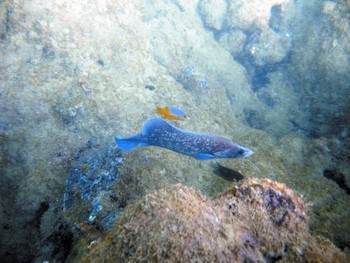
Myripristis jacobus (10 cm TL) was the first client to be cleaned by one individual B. rufus (5 cm TL) that was foraging. The next client was O. dentex (10 cm TL), followed by R. saponaceus (12 cm TL) (Figure 1). The distance between the dens of the nocturnal fish and the cleaning station did not exceed 2 m where clients moved at most 1 m away from their dens to attract the cleaner's attention. During the cleaning event disputes between clients were not observed and the most cleaned body part of clients was the flank.
Bodianus rufus cleaning Rypticus saponaceus on the coastal reef of Tinharé Island, Bahia, Brazil.

Generally, the cleaning activity takes place during the day, as this type of association depends in large part on visual signals (Losey, Reference Losey and Cheng1971). As a consequence, diurnal reef fish are the main clients (Sazima et al., Reference Sazima, Moura and Sazima1999, Reference Sazima, Sazima, Francini-Filho and Moura2000).
A few studies cite diurnal cleaner fish cleaning nocturnal fish. For instance, Johnson & Ruben (Reference Johnson and Ruben1988) recorded B. rufus cleaning M. jacobus; Sazima et al. (Reference Sazima, Moura and Sazima1999) relate young Pomacanthus paru (Pomacanthidae) in cleaning activities with Gymnothorax funebris (Muraenidae) and Holocentrus adscensionis (Holocentridae); Sazima et al. (Reference Sazima, Sazima, Francini-Filho and Moura2000) recorded Elacatinus figaro (Gobiidae) cleaning O. dentex and H. adscensionis. However, in only one published work (Sazima et al., Reference Sazima, Krajewski, Bonaldo and Sazima2005) the difference between the habits of the clients and the cleaners is emphasized, where Thalassoma noronhanum (Labridae) cleaned the night active fish Pempheris schomburgki (Pempheridae). Sazima et al. (Reference Sazima, Krajewski, Bonaldo and Sazima2005) hypothesized that the short distance between clients' dens and cleaners reduce exposure to possible predators during the cleaning activity.
Three other labrids that act as occasional cleaners are known in the coastal reefs of Tinharé Island: Thalassoma noronhanum, Halichoeres poeyi and H. penrosei (R. Maia-Nogueira, personal observation). We believe that these labrids can also act as cleaners of nocturnal fish in the reefs of Tinharé Island and that other nocturnal species are involved in this behaviour.
Recently Cheney et al. (Reference Cheney, Bshary and Grutter2008), using laboratory experiments, concluded that cleaning symbiosis also provides indirect benefits to the clients, such as the reduction of aggressions between predators in the vicinity of the cleaning stations. Our data reinforces the hypothesis raised by Sazima et al. (Reference Sazima, Krajewski, Bonaldo and Sazima2005) that the proximity of temporary cleaning stations to nocturnal fish shelters reduces the exposure of clients to potential predators.
ACKNOWLEDGEMENTS
The authors thank Soluções em Meio Ambiente (SOMA). Thanks also to Bruno Lima de Menezes for his company during the dive, and to Katie Brennan and Leo Dutra for revising the manuscript.