Lactic acid bacteria (LAB) belong to a well-known group of bacteria that presents a high biotechnological potential in food production, especially in fermented dairy products. Indeed, LAB have been used by mankind for centuries in food production due to their ability to produce desirable sensory characteristics, to improve digestibility and to inhibit pathogenic and spoilage microorganisms. They recently gained a growing interest for their use as protective cultures or for their proteolytic activities. Microbial inhibition exerted by LAB is generally due to antimicrobial compounds such as organic acids, diacetyl, acetoin, hydrogen peroxide, reuterin, antifungal peptides and bacteriocins, which make these bacteria important tools in food biopreservation (Galvez et al. Reference Galvez, Abriouel, Lopez and Ben Omar2007). Bacteriocins are ribosomally synthesized antimicrobial peptides implicated in bacteria defense strategy (Oscariz & Pisabarro, Reference Oscariz and Pisabarro2001). They represent a potential alternative to chemical food preservatives and are generally considered as safe, since they are destroyed by proteolytic enzymes in the gastrointestinal tract (Guinane et al. Reference Guinane, Cotter, Hill and Ross2005).
LAB may present antifungal activities via lactic and acetic acids production, but other antifungal substances such as phenyllactic acid, antimicrobial peptides or reuterin (among others) may also be produced. Phenyllactic acid has a broad antibacterial spectrum as well as antifungal activities and it is non-toxic to animal and human cells (Crowley et al. Reference Crowley, Mahony and Van Sinderen2013). Reuterin, produced by some Lactobacillus reuteri, L. coryniformis, L. brevis, L. buchneri and L. collinoides strains, is a low-molecular-mass broad spectrum antimicrobial substance, active against both Gram-positive and Gram-negative bacteria and fungi (Schnurer & Magnusson, Reference Schnurer and Magnusson2005). Together, these findings indicate the potential use of LAB and/or their metabolites in food preservation. Anther important feature of some LAB is the ability to hydrolyze milk proteins to obtain peptides and free amino acids necessary to support their growth in milk (Sousa et al. Reference Sousa, Ardo and McSweeney2001). Moreover, this process may promote the release of bioactive peptides and production of flavour compounds, such as aldehydes, alcohols and esters (Settanni & Moschetti, Reference Settanni and Moschetti2010).
Considering the antimicrobial properties and proteolytic activities of LAB, the aim of this study was to isolate and screen LAB from cow, buffalo and goat milk and cheeses for antimicrobial and/or proteolytic activities for potential application in fermented dairy products biopreservation and/or technological improvement.
Materials and methods
Strains and culture conditions
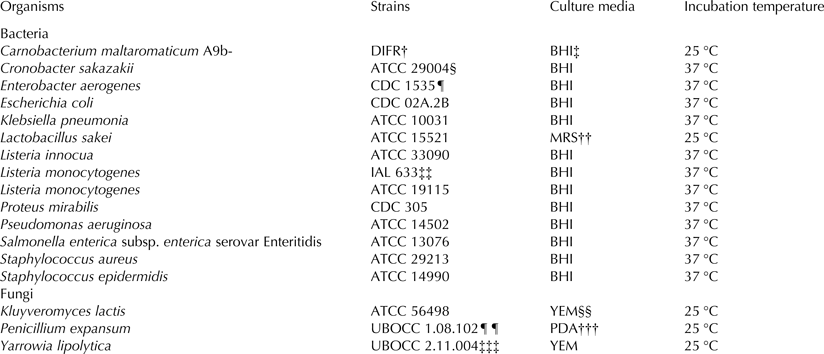
Fourteen bacteria and three fungi from different culture collections were used as indicator strains for each antimicrobial activity assays, their names and culture conditions are listed in Table 1. When incubation under anaerobic atmosphere was necessary, an atmosphere generation system (AnaeroGen™, Oxoid, UK) was used. Eight hundred and fifteen new isolates of LAB were obtained during this work from cow, buffalo and goat milk and cheese, as described below. Unless otherwise stated, isolates were subculture twice in MRS (rod-shaped isolates) or BHI (coccus-shaped isolates) broth for 24 h at 25 °C before each activity test. Some of the isolates were incubated at 37 °C once identified.
Strains used as biological indicators during antimicrobial activity assays

† Nilsson et al. (Reference Nilsson, Ng, Christiansen, Jorgensen, Grotinum and Gram2004). Danish Institute for Fisheries Research, Department of Seafood Research, Lyngby, Denmark
‡ BHI broth (Brain Heart Infusion)
§ American Type Culture Collection, Manassas, USA
¶ Centers for Disease Control and Prevention, Atlanta, USA
†† MRS broth (De Man, Rogosa, Sharpe)
‡‡ Instituto Adolfo Lutz, São Paulo, Brazil
§§ YEM broth (Yeast extract and malt, Difco, USA)
¶¶ Université de Brest Culture Collection
††† PDA – Potato Dextrose Agar
‡‡‡ Laboratory for Microbiology of the Faculty of Sciences of Ghent University
Samples
One hundred and twenty-seven samples of cow (n = 80), buffalo (n = 35) and goat (n = 12) milk were aseptically collected (Whirl Pak, Nasco, USA) in Ribeirão Preto area (São Paulo, Brazil), taken to the laboratory in insulated boxes, stored under refrigeration and analysed within 24 h. Each milk sample was collected from a single animal, and each type of milk (cow, buffalo and goat) was collected in a single farm. Twenty-nine samples of commercially available cow (n = 17), buffalo (n = 5) and goat (n = 7) cheeses (Minas, Mozzarella, Emmental, Gruyère, Gouda, Brie, Parmesan, Provolone, Gorgonzola, Reino, Curd and Ricotta) were acquired in Ribeirão Preto city (São Paulo, Brazil) and stored under refrigeration for up to 48 h before analysis.
Isolation and preliminary identification of LAB
Milk (10 ml) and cheese (25 g) samples for LAB isolation were serially diluted ten-fold in 1 g/l peptone water (pH 7, Oxoid) and homogenized for 1 min in a laboratory blender (BagMixer, Interscience, France). Serial dilutions were plated on De Man, Rogosa & Sharpe agar (MRS, pH 6·2, Oxoid) for the isolation of LAB (De Man et al. Reference De Man, Rogosa and Sharpe1960), and LAMVAB agar for the isolation of lactobacilli (Hartemink et al. Reference Hartemink, Van Laere and Rombouts1997). Inoculated plates were incubated at 25 °C for 72 h in anaerobic jars. After incubation, colonies of different morphologies were selected and re-isolated at least three times on MRS agar. Isolates where then inoculated in BHI broth (Brain Heart Infusion, Oxoid), incubated for 24 h at 25 °C and stored in BHI broth with 0·25 g/ml glycerol at −80 °C. Preliminary identifications were done by Gram staining and testing for the absence of catalase. For further tests, the rod-shaped isolates were propagated in MRS broth whereas coccus-shaped isolates were propagated in BHI broth.
Screening for antilisterial activity
A preliminary screening for antilisterial activities of Gram-positive, catalase negative new isolates was performed according to Lewus et al. (Reference Lewus, Kaiser and Montville1991). Bacterial suspensions (2 µl) of the 815 tested isolates were spot inoculated onto TSA-ye agar (trypticase soy agar supplemented with 6 g/l of yeast extract, Oxoid) plates and anaerobicallly incubated at 25 °C for 48 h. After incubation, each plate was overlaid with BHI soft agar (8 g/l agar) containing 106 CFU/ml of Listeria monocytogenes IAL 633 as indicator strain. The inhibition halos around the colonies were recorded after 24 h of incubation at 37 °C. Isolates showing inhibition halos with diameters larger than 10 mm were also tested against 7 other Gram-positive and 7 Gram-negative indicator bacteria (Table 1) to determine their inhibitory spectrum.
The proteinaceous nature of the antibacterial substances produced by the most effective isolates (diameter of the inhibition halo larger than 10 mm) was evaluated according to Lewus et al. (Reference Lewus, Kaiser and Montville1991) with slight modifications. Two microliters of each isolate culture were applied as spots on a TSA-ye agar plate and incubated at 25 °C for 48 h under anaerobiosis. Wells were made in the agar, near the producer spot, and they were filled with 20 µl of aqueous solutions (20 mg/ml) of protease type XIV from Streptomyces griseus (Sigma-Aldrich), proteinase K from Tritirachium album (Sigma-Aldrich) or α-chymotrypsin from bovine pancreas (Sigma-Aldrich). Sterilized water was used as negative control. The plates were incubated at 30 °C for 2 h and each plate was then overlaid with soft BHI agar (8 g/l agar) inoculated with 106 CFU/ml of L. monocytogenes IAL 633, followed by incubation at 37 °C for 24 h. The absence of inhibition halo in the presence of proteolytic enzymes was indicative of the production of antibacterial peptides (bacteriocins).
Rapid screening of antifungal activity in MRS agar
The first evaluation of the antifungal activity of Gram-positive and catalase negative isolates was performed with a spot-on-the-lawn assay according to Delavenne et al. (Reference Delavenne, Mounier, Déniel, Barbier and Le Blay2012). The 815 isolates were inoculated in MRS (rod-shaped isolates) or BHI (coccus-shaped isolates) broths and incubated for 24 h. Next, 2 µl of each bacterial suspension were applied as spots on MRS agar plates that were incubated at 25 °C for 48 h under anaerobiosis. The agar plates with grown LAB colonies were overlaid with soft YEM agar (Yeast extract and malt, Difco, USA, supplemented with 8 g/l agar) containing 106 CFU/ml of Kluyveromyces lactis ATCC 56498 and incubated at 25 °C for 48 h. The production of antifungal compounds was detected by clear inhibition zones of K. lactis ATCC 56498 around the bacterial colonies. Isolates showing the largest inhibition zones (inhibition halo diameter larger than 10 mm) were selected for further investigations.
Confirmation of antifungal activity in modified MRS agar
The antifungal activity of 4 pre-selected antifungal isolates (previously identified by their 16S rRNA gene sequencing, as described in item 2.7) was confirmed in modified MRS agar. These LAB isolates were previously grown on modified MRS designed to decrease the concentration (no sodium acetate) and production (low glucide concentrations) of organic acids and to promote eventual reuterin production (supplementation with glycerol) by LAB, as described by Delavenne et al. (Reference Delavenne, Mounier, Déniel, Barbier and Le Blay2012). Before use, tested isolates were subculture twice in modified MRS broth at optimal temperature for 18 h, or until they reached approximately 1·0 of optical density (OD600 nm). Ten microliters per well of each culture were deposited in 24-well plates, and mixed with 1 ml of modified MRS soft agar (8 g/l agar). After incubation at optimal temperature for 24 h, 100 spores of Penicillium expansum UBOCC 1.08.102 or 100 cells of Yarrowia lipolytica UBOCC 2.11.004 were applied on the solidified soft agar and plates were incubated at 25 °C for 2 weeks.
Evaluation of antifungal activity in fermented milk
Skim milk (Délisse UHT, France) supplemented with milk powder (0·4 g/l) and litmus (6 mg/l, RAL Reactifs, France) was heated at 85 °C for 30 min, cooled to 45 °C and distributed in 24-well plates (2 ml per well). Streptococcus salivarius subsp. thermophilus (Commercial starter STANDA laboratories, Caen, France) used as starter bacteria, and antifungal LAB isolate (previously washed with 8·5 g/l NaCl aqueous solution) were jointly inoculated in each well at a concentration of 107 CFU/ml each. Wells without antifungal isolates were used as controls. The 24-well plates were incubated at 42 °C for 24 h. After incubation, the excess of serum was withdrawn and the fungal indicator strains P. expansum (100 spores per well) or Y. lipolytica (100 cells per well) were inoculated over the curd surface of the fermented milk. The inoculated plates were then re-incubated for 2 weeks at 10 °C.
Evaluation of proteolytic activity
The evaluation of proteolytic activities of Gram-positive and catalase negative isolates was first performed on BHI agar supplemented with skim milk. Isolates showing proteolytic activity were further cultivated in skim milk, followed by electrophoresis analysis in polyacrylamide gel, as described below.
Proteolytic activity on agar plates
Proteolytic activity of Gram-positive and catalase negative 815 isolates was first evaluated in BHI agar supplemented with skim milk powder (0·33 g/ml, Oxoid) as described by Pailin et al. (Reference Pailin, Kang, Schimidt and Fung2001). Isolate suspensions were inoculated as 2 µl spots on the agar plates and incubated at 25 °C for 48 h under anaerobiosis. Translucent halos around the colonies were indicative of proteolytic activity.
Proteolytic activity on skim milk
The proteolytic activity of 123 isolates that presented hydrolysis halos larger than 6 mm on agar plates was evaluated in skim milk according to El-Ghaish et al. (Reference El-Ghaish, Dalgalarrondo, Choiset, Sitohy, Ivanova, Haertlé and Chobert2010). Samples were analysed in a vertical electrophoresis system (Mini-PROTEAN II Electrophoresis Cell, Bio-rad Laboratories, USA) using a polyacrylamide gel (12% resolving gel and 3·2% stacking gel) followed by staining with Coomassie Brilliant Blue R-250 (Sigma-Aldrich) and documentation (MiniBis UV, DNA Bio-Imagings Systems, Israel).
Genotypic identification
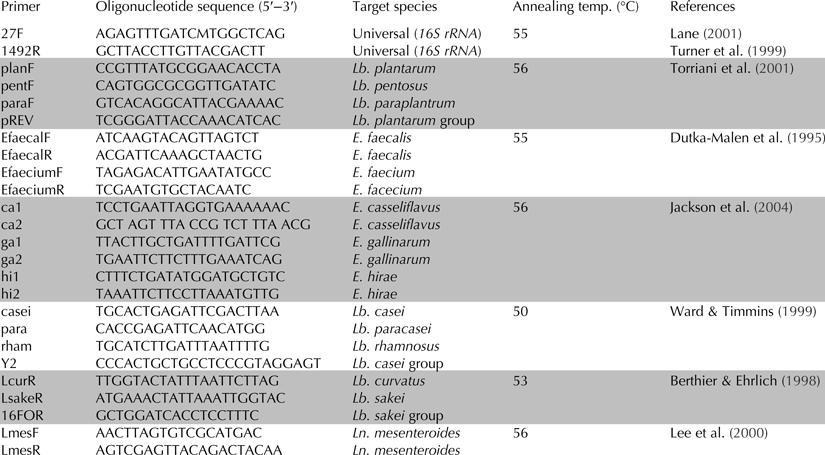
The genotypic identification of 32 isolates showing the highest antimicrobial or proteolytic activities was performed by 16S rRNA gene sequencing (Table 2). Genomic DNA was extracted and purified with an Illustra Bacteria Genomic Prep Mini Spin Kit (GE Life Sciences, Sweden) and used as template for genotypic identification. Polymerase chain reaction (PCR) was performed with 84 µl of Taq Platinum Blue (Invitrogen, USA), 30 pmol of primer 27F (Invitrogen), 30 pmol of primer 1492R (Invitrogen) and 300 ng of genomic DNA, in a total volume of 100 µl (Turner et al. Reference Turner, Pryer, Miao and Palmer1999; Lane, Reference Lane, Stackebrandt and Goodfellow2001). PCR cycles were performed with an initial denaturation step at 94 °C for 1 min, followed by annealing at 55 °C for 1 min, and extension at 72 °C for 2 min, for a total of 30 cycles. PCR products were purified using Illustra GFX PCR DNA and Gel Band Purification (GE Life Sciences). The purified PCR products were sequenced using ABI 3730 DNA Analyzer (Applied Biosystems, USA) with BigDye Terminator v3.1 Cycle Sequencing Reagent (Applied Biosystems) at The Human Genome Research Centre (HGRC) of the University of São Paulo, São Paulo, Brazil. Sequences were analysed using Chromas Lite 2.1 (Technelysium, South Brisbane, Australia) and compared with sequences available in GenBank, with the National Centre for Biotechnology Information BLASTN search program (http://www.ncbi.nlm.nih.gov/BLAST). LAB isolates that could not be distinguished by 16S rRNA gene sequencing were submitted to PCR with species-specific primers, as described in Table 2, and the thermal cycle was used as described in each reference, with slight modifications on annealing temperature. Agarose gel electrophoresis (10 g/l) was used to visualize the PCR products.
Oligonucleotide sequences of the primers used for identification of LAB isolates by 16S rRNA gene sequencing and species-specific primers
E., Enterococcus; Lb., Lactobacillus; Ln., Leuconostoc
Results
Characterization of isolates
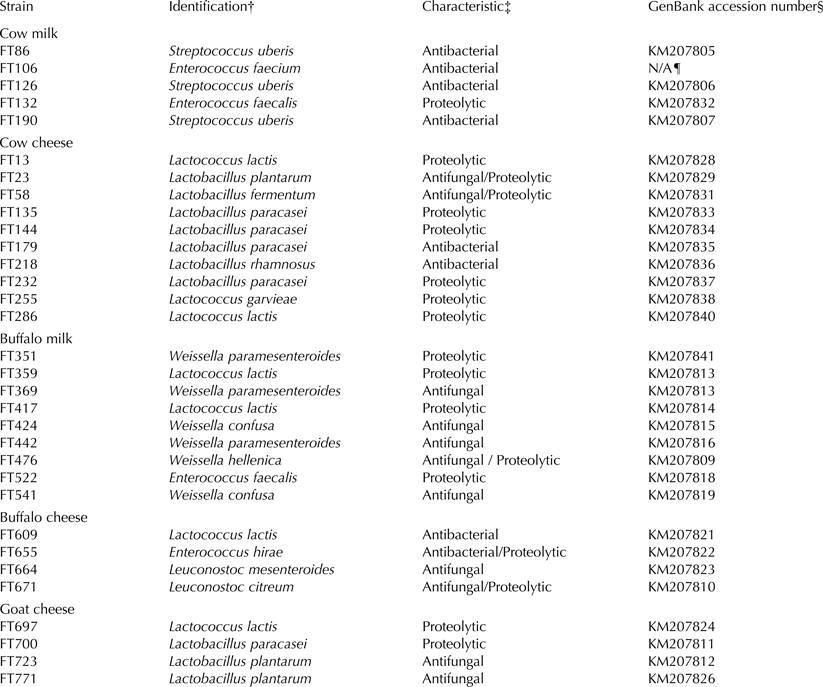
LAB isolates were obtained from the 127 collected samples of cow (n = 80), buffalo (n = 35) and goat (n = 12) milk, and from the 29 samples of cow (n = 17), buffalo (n = 5) and goat (n = 7) cheeses. Also, Gram-positive cocci and rods were isolated from 28 out of 29 cheese samples (96·5%). Together, a total of 815 colonies were obtained from MRS and LAMVAB agar plates, and most of them were Gram-positive and catalase negative isolates, a presumptive identification for LAB (Axelsson, Reference Axelsson, Salminenand and Wright1993). They were selected for further evaluation for antimicrobial and proteolytic activities, and identified as described above (Genotypic identification). Most of the isolates were identified as belonging to the genus Lactobacillus. Other isolates were identified as belonging to the genera Enterococcus, Lactococcus, Leuconostoc, Streptococcus and Weissella (Table 3).
Identification of antimicrobial and proteolytic bacteria isolated from milk and cheese
† Identification by 16S rRNA gene sequencing. Additional identification by polymerase chain reaction (PCR) with species-specific primers (Table 2) was performed when necessary
‡ Preliminary evaluation of antibacterial, antifungal and proteolytic activities as described, respectively, in items 2.4, 2.5 and 2.6.1
§ 16S rRNA sequences available at http://www.ncbi.nlm.nih.gov/genbank/
¶ N/A: not applicable – the species was determined by PCR using species-specific primers
Evaluation of antibacterial activity
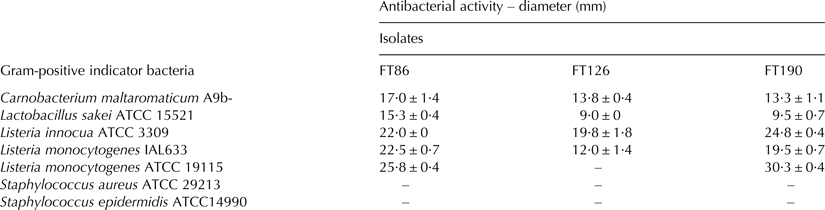
The ability to inhibit the growth of L. monocytogenes IAL633 (indicator strain) was observed in 19 isolates by the spot-on-the-lawn assay. However, only 3 isolates obtained from cow milk and cheese samples showed strong inhibitory activity against L. monocytogenes IAL 633 (diameter of inhibition halo larger than 10 mm). The antibacterial substances produced by these isolates were degraded by all proteolytic enzymes tested (protease type XIV, proteinase K, and α-chymotrypsin), indicating their proteinaceous natures (bacteriocin). These isolates were identified as Streptococcus uberis FT86, St. uberis FT126 and St. uberis FT190. Although these strains belong to the same species, they were isolated in cow milk samples from different animals. The antibacterial spectra of bacteriocinogenic isolates are shown in Table 4, and these 3 isolates showed inhibitory activities against two Listeria (L. innocua and L. monocytogenes) and two LAB species (Lb. casei and Carnobacterium maltaromaticum). St. uberis FT190 and St. uberis FT86 presented high antilisterial activity, and St. uberis FT126 was not inhibitory toward L. monocytogenes ATCC 19115. No inhibitory activity was detected against Gram-negative bacteria nor staphylococci.
Antibacterial spectra of Streptococcus uberis FT86, St. uberis FT126 and St. uberis FT190 (isolated from cow milk using MRS agar)†
† According to Lewus et al. (Reference Lewus, Kaiser and Montville1991). All the isolates were incubated at 25 °C for 48 h. Mean values of the inhibition diameters (mm) and standard deviation (n = 2) are shown.
Evaluation of antifungal activity
Antifungal activity was first detected in 198 isolates (24·3%) as described in Item 2.5. The most active strains, identified (according to Item 2.7) as Weissella confusa FT424, Weissella hellenica FT476, Leuconostoc citreum FT671 and Lb. plantarum FT723, were selected for further assays. Other strains with lower antifungal activity are presented in Table 3. During the confirmation of the antifungal activity in modified MRS agar (Item 2.5.1), W. confusa FT424 and Lb. plantarum FT723 inhibited the growth of P. expansum UBOCC 1.08.102 (Fig. 1). No inhibition of Y. lipolytica UBOCC 2.11.004 was detected. The average initial pH of the medium was 5·6, but it reached 4·4 after bacterial growth, indicating the production of organic acids. In the fermented milk assay (Item 2.5.2), Lb. plantarum FT723 only presented a slight inhibition of P. expansum UBOCC 1.08.102 after 2 weeks at 10 °C (Fig. 2). Similarly to the agar assay, no inhibition of Y. lipolytica UBOCC 2.11.004 was detected (data not shown).
Inhibition of Penicillium expansum (100 spores per well) and Yarrowia lipolytica (100 cells per well) by Lactobacillus plantarum FT723 and Weissella confusa FT424 in modified MRS agar after 5 and 14 d of incubation at 25 °C. Tests are presented as triplicates in the same plate.
Slight inhibition of Penicillium expansum (100 spores per well) by Lactobacillus plantarum FT723 (a) and Weissella confusa FT424 (b), compared with the negative control (c) after 14 d of incubation at 10 °C in the fermented milk model (with Streptococcus thermophilus as starter strain). Tests are presented as triplicates in the same plate.
Evaluation of proteolytic activity
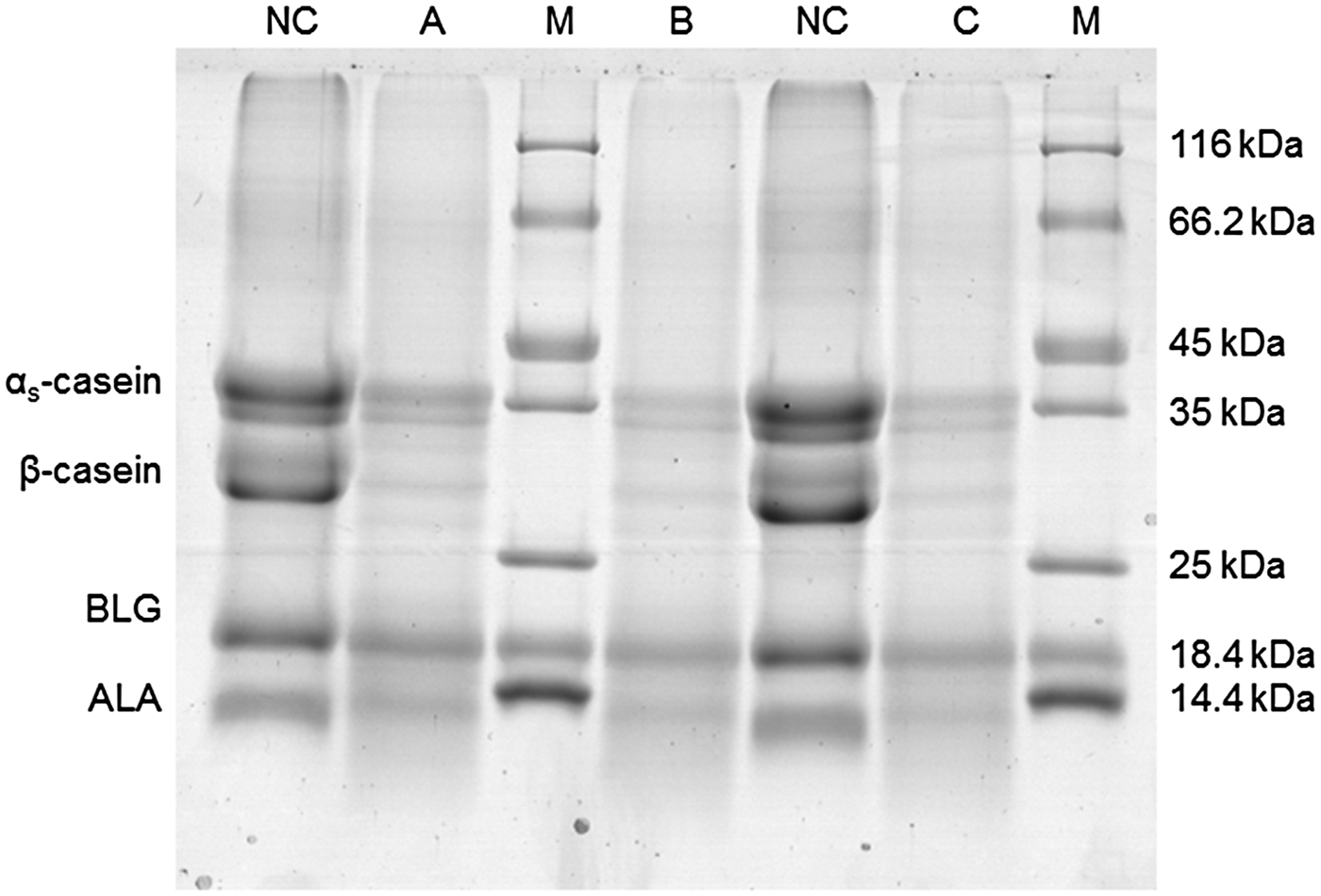
After the preliminary assessment of proteolytic activity, 123 isolates (60 Gram-positive cocci and 63 Gram-positive rods) were selected and inoculated in skim milk for subsequent determination of their proteolytic activity by SDS-PAGE. It was detected that one coccus isolated from cow milk (Enterococcus faecalis FT132), one coccus isolated from buffalo milk (E. faecalis FT522) and one rod isolated from goat cheese (Lactobacillus paracasei FT700) were moderately proteolytic, as illustrated in Fig. 3. The degradation of αs-casein, β-casein, β-lactoglobulin and α-lactalbumin was confirmed by comparison with the control (skim milk).
SDS-PAGE from samples obtained after the hydrolysis of skim milk by selected bacteria. NC: negative control (skim milk); A: E. faecalis FT132; B: E. faecalis FT522; C: Lb. paracasei FT700; M: Molecular weight marker; BLG: β-lactoglobulin; ALA: α-lactalbumin.
Discussion
Isolates were obtained from cow, buffalo and goat milk and cheese samples with the objective to select strains with antimicrobial and/or proteolytic activities for potential applications in fermented dairy food products. LAMVAB agar was used for selective isolation of lactobacilli, based on low pH (5·0) and intrinsic resistance to vancomycin (Hartemink et al. Reference Hartemink, Van Laere and Rombouts1997). Most isolates obtained in LAMVAB agar were rod-shaped, but some cocci-shaped bacteria did grow in this media. These cocci were further identified as Weissella paramesenteroides FT369 and Weissella confusa FT424 (Table 2). According to Harwood et al. (Reference Harwood, Brownell, Perusek and Whitlock2001), species belonging to the genera Leuconostoc, Pediococcus and Weissella are also intrinsically resistant to vancomycin, which can explain the isolation of Weissella spp. on LAMVAB agar. In this context, culture media may influence the isolation of different LAB species from dairy products. As a result, Lactobacillus was the most frequently isolated genus in the present work, which is explained by the use of the LAMVAB medium, a highly specific medium for the isolation of lactobacilli.
Dairy products are important resources for the isolation of bacteriocinogenic LAB. Rodriguez et al. (Reference Rodriguez, Gonzalez, Gaya, Nunez and Medina2000) obtained 1340 LAB isolates from raw cow milk, among which, 321 were bacteriocinogenic with inhibitory activities against L. monocytogenes, Staphylococcus aureus and Clostridium tyrobutyricum. The produced bacteriocins were enterocin AS-48, nisin and lacticin 481. In the present study, however, the bacteriocinogenic strains did not show antagonistic activity against staphylococci. In 2009, Nero et al. (Reference Nero, Mattos, Beloti, Barros, Ortolani and Franco2009) evaluated the occurrence of autochthonous bacteria in raw cow milk, with activity against L. monocytogenes and Salmonella enterica subsp. enterica serovar Enteritidis. Most of the isolates were identified as Lc. lactis subsp. lactis and Enterococcus faecium. Similarly, Chanos & Williams (Reference Chanos and Williams2011) analysed 40 samples of raw sheep milk using MRS, M17 and bile esculin agar. In that paper, 332 bacterial isolates were obtained, and 17 were able to inhibit L. monocytogenes. All the isolates with antagonistic activity were identified as E. faecium. In the present work, the three strains with intense antibacterial activity did not belong to the genus Lactococcus neither to the genus Enterococcus. This may be due to the number of samples analysed, to the milk microbiota or to the indicator bacteria used to detect bacteriocin production.
In the present paper, three bacteriocinogenic strains of St. uberis showed inhibitory activity towards Carnobacterium maltaromaticum, Lactobacillus sakei, L. monocytogenes and Listeria innocua, whereas S. aureus, Staphylococcus epidermidis as well as all the Gram-negative bacteria tested were not inhibited. These results are in agreement with those found by Stevens et al. (Reference Stevens, Sheldon, Klapes and Klaenhammer1991) that reported that Gram-negative bacteria were not inhibited by bacteriocins from LAB, likely due to the protection of the cell membrane by the outer membrane. S. aureus is frequently related to cow mastitis (Leigh, Reference Leigh1999), and the absence of anti-staphylococcal activity of the St. uberis strains isolated in this study may be explained by the low number of staphylococci strains used as indicator. Streptococcus uberis is one of the main agents causing clinical mastitis worldwide (Leigh, Reference Leigh1999), and the bacteriocins produced by this species have been poorly studied.
LAB with antifungal activity may be also isolated from dairy products. Voulgari et al. (Reference Voulgari, Hatzikamari, Delepoglou, Georgakopoulos, Litopoulou-Tzanetaki and Tzanetakis2010) analysed 81 isolates of LAB from cheese and other dairy products and they observed that a high percentage (38%) showed antifungal activity in MRS against molds (Penicillium spp.) and yeasts (Debaryomyces hansenii and Saccharomyces cerevisiae). However, the presence of sodium acetate in the MRS medium may have contributed to the antifungal activities observed. In our study, many isolates (24·3%) presented antifungal activity against Kluyveromyces lactis in MRS agar, and most of them were identified as Weissella spp., Leuconostoc spp. and Lactobacillus spp. The strains which better inhibited P. expansum in modified MRS agar were identified as Lb. plantarum FT723 and W. confusa FT424. In a similar study, Baek et al. (Reference Baek, Kim, Choi, Yoon and Kim2012) evaluated the antifungal activity of Ln. citreum and W. confusa in rice cakes, they found that both strains would be suitable for use as starters in that kind of food, with inhibitory activities against Penicillium crustosum due to the production of organic acids. In our study, the production of organic acids by Lb. plantarum FT723 and W. confusa FT424 may not be the main mechanism of inhibition since P. expansum is highly resistant to organic acids (Delavenne et al. Reference Delavenne, Ismail, Pawtowski, Mounier, Barbier and Le Blay2013). Concerning food safety aspects, Lb. plantarum has a GRAS status (Food and Drug Administration, 2012) and could be used for biopreservation strategies. Weissella spp. are non-spore-forming, Gram-positive, catalase negative bacteria that are present in several environments such as fermented vegetables and foods, sugar cane, and gastrointestinal tract of human and animals (Lee et al. Reference Lee, Park, Jeong, Heo, Han and Kim2012). However, until this date, no data was found concerning the innocuity of this microorganism in food products.
Some of LAB strains are also able to hydrolyse milk proteins, increasing their digestibility and contributing to the production of desirable flavours, which is of interest to the food industry. Ahmadova et al. (Reference Ahmadova, Dimov, Ivanova, Choiset, Chobert, Kuliev and Haertlé2011) isolated 147 strains from traditional Azerbaijani dairy products, but only 6 strains showed intense proteolytic activity, they were identified as E. faecalis. El-Ghaish et al. (Reference El-Ghaish, Dalgalarrondo, Choiset, Sitohy, Ivanova, Haertlé and Chobert2010) evaluated the proteolytic activities of 151 LAB (cocci) on skim milk agar and SDS-PAGE analyses after cultivation in skim milk. They observed that 24 isolates presented hydrolysis halos on skim milk agar, but only six of them (four E. faecalis and two E. faecium) were confirmed as proteolytic. These data show the importance of evaluating the proteolytic activity by polyacrylamide gel electrophoresis to confirm the results obtained in agar tests. The present study confirms the highly proteolytic capacity of E. faecalis species, as well as the Lb. paracasei strain isolated. E. faecalis is a facultative anaerobic LAB that initially colonizes the infant gastrointestinal tract (GIT) and remains present in the adult GIT (Cuiv et al. Reference Cuiv, Klaassens, Smith, Mondot, Durkin, Harkins, Foster, McCorrinson, Torralba, Nelson and Morrison2013). Despite its implication in sporadic cases of diseases (urinary tract infections, endocarditis, peritonitis, bacteremia, wound infections), E. faecalis has proven to be potentially beneficial to humans, since many strains have been used as food-starters and probiotics. One example is the E. faecalis Symbioflor 1, that has been successfully used as probiotic for more than 50 years (Fritzenwanker et al. Reference Fritzenwanker, Kuenne, Billion, Hain, Zimmermann, Goesmann, Chakraborty and Domann2013). Lactobacillus paracasei is a facultative heterofermentative member of the genus Lactobacillus, which comprises more than 130 species. The ‘Lactobacillus casei group’ (Lb. casei, Lb. paracasei and Lb. rhamnosus) comprises several well-known probiotic-marketed strains and may present probiotic traits such as acid and bile salts resistance, which are important for survival of the bacteria in the GIT (Douillard et al. Reference Douillard, Kant, Ritari, Paulin, Airi and De Vos2013).
In the present study, LAB strains were isolated from milk and cheese and selected for antimicrobial and proteolytic activities. St. uberis (strains FT86, FT126 and FT190) were characterized as bacteriocinogenic; whereas Lb. plantarum FT723 and Weissella confusa FT424 presented antifungal activities; and Enterococcus faecalis (strains FT132 and FT522) and Lb. paracasei FT700 were both proteolytic. Such traits are particularly interesting for strains selection aiming to technologically improve dairy food products, offering alternatives for better safety, longer shelf life or design of new fermented dairy products.
The authors thank the São Paulo Research Foundation (FAPESP) for fellowship to Fabrício Luiz Tulini (#2011/11983-0 and #2012/11379-8), the National Council for Scientific and Technological Development (CNPq) for financial support (#480772/2011-8 and #147785/2011-1) and Dr Vanessa Biscola (Institut National de la Recherche Agronomique – Nantes, France) for technical assessment of proteolytic activity in skim milk. This study is part of the cooperation program CAPES-COFECUB 730/11. The authors have no conflict of interest to declare.