Introduction
In order to effectively plan dementia-care services it is essential to have a good estimate of the overall number of people with dementia in the population, the number of new cases per year and the numbers in various care settings. Improving the ‘national, regional and local estimates of current and future prevalence across all care settings’ was identified as a priority in the National Dementia Strategy. People with dementia have increasing care needs as the condition progresses, making it imperative that estimates of severity mix are also available (Alzheimer Disease International (ADI), 2009). Care costs are mainly determined by the severity of the symptoms and the care setting (Schaller et al. Reference Schaller, Mauskopf, Kriza, Wahlster and Kolominsky-Rabas2015). These two elements are important considerations in health and social care planning and budget allocation decision-making.
No large-scale screening study has been carried out in Ireland on the prevalence of dementia or the severity mix of cases, making it difficult to assess current or future needs with any great accuracy. Previous estimates of the number of people with dementia in Ireland have relied on the application of European Collaboration on Dementia (EuroCoDe) prevalence rates to Irish population data (Alzheimer Europe, 2009; Pierce et al. Reference Pierce, Cahill and O’Shea2013; O’Shea et al. Reference O’Shea, Cahill and Pierce2017).
Prevalence rates depend on the methodology used to count the number of people with dementia, including diagnostic criteria and sample sizes. For example, a revision of the EuroCoDe study, which included only high quality studies and Diagnostic and Statistical Manual of Mental Disorders (DSM)-IV diagnostic criteria, estimated a 1.1% lower prevalence rate compared with the previous iteration (Galeotti et al. Reference Galeotti, Giusti, Meduri, Raschetti, Scardetta and Vanacore2013). The choice of diagnostic criteria has also been shown to have a substantial effect on prevalence rates within individual studies (Erkinjuntti et al. Reference Erkinjuntti, Østbye, Steenhuis and Hachinski1997). There are indications from a number of countries that the incidence of dementia may have declined over time due to improved lifestyle and education (Rocca et al. Reference Rocca, Petersen, Knopman, Hebert, Evans, Hall, Gao, Unverzagt, Langa and Larson2011; Satizabal et al. Reference Satizabal, Beiser, Chouraki, Chêne, Dufouil and Seshadri2016; Wu et al. Reference Wu, Fratiglioni, Matthews, Lobo, Breteler, Skoog and Brayne2016). This makes it important that such trends are reflected in any revised estimates of prevalence in Ireland.
As well as knowing the number of people living with dementia, we need to know the number of new cases, both diagnosed and undiagnosed, that are adding to the dementia population each year. The demand for diagnostic services from GPs and specialists is driven by the number of new cases seeking a diagnosis. Not everyone who has dementia seeks a diagnosis, nor are diagnostic services always available to those who want a diagnosis. Moreover, physicians are sometimes reluctant to make a diagnosis because of the absence of post-diagnostic supports for people found to have dementia. The previous estimate of the number of new cases of dementia per year in Ireland was 4000 (O’Shea, Reference O’Shea2007). This estimate is now out of date due to significant population ageing in Ireland in the past 10 years.
Given recent concerns about the quality and availability of community care for people with dementia (Donnelly et al. Reference Donnelly, O’Brien, Begley and Brennan2016), a further objective of this paper is to estimate the number of people living in the community in Ireland with dementia who have frequent care needs. A small number of studies have estimated the severity mix within the dementia population internationally (Brayne & Calloway, Reference Brayne and Calloway1989; O’Connor et al. Reference O’Connor, Pollitt, Hyde, Fellows, Miller, Brook, Reiss and Roth1989; Fratiglioni et al. Reference Fratiglioni, Forsell, Agüero Torres and Winblad1994; Andersen et al. Reference Andersen, Lolk, Nielsen, Andersen, Olsen and Kragh‐Ssrensen1997; Boersma et al. Reference Boersma, Eefsting, van den Brink, Koeter and van Tilburg1998; Helmer et al. Reference Helmer, Pérès, Letenneur, Guttiérez-Robledo, Ramaroson, Barberger-Gateau, Fabrigoule, Orgogozo and Dartigues2006; Garre-Olmo et al. Reference Garre-Olmo, Vilalta-Franch, Calvó-Perxas, Monserrat-Vila and López-Pousa2014; Matthews et al. Reference Matthews, Bennett, Wittenberg, Jagger, Dening and Brayne2016a). Dementia stage is typically categorised by an assessment of cognitive and functional symptoms. A further way of categorising dementia cases is the frequency and consistency of care needs (Kingston et al. Reference Kingston, Wohland, Wittenberg, Robinson, Brayne, Matthews and Jagger2017).
In this paper we provide revised estimates on the prevalence of dementia in Ireland, the number of new cases per year and the severity mix of people with dementia based on a functional assessment. These estimates are a necessary input for policy-makers charged with the responsibility for planning potential responses to the needs of people with dementia across all care settings.
Methods
Prevalence of dementia
We provide new estimates of the prevalence of dementia in Ireland (diagnosed and undiagnosed) using a Delphi Consensus of UK academics (Prince et al. Reference Prince, Knapp, Guerchet, McCrone, Prina, Comas-Herrera, Wittenberg, Adelaja, Hu, King, Rehill and Salimkumar2014) and two waves of a large-scale UK study, the Cognitive Function and Ageing Study (CFAS) (Matthews et al. Reference Matthews, Arthur, Barnes, Bond, Jagger, Robinson and Brayne2013). The number of people in Ireland with dementia is calculated by applying the age and gender-adjusted prevalence rates from these studies to Irish population data from the 2016 Census (Central Statistics Office, Reference Clarke, Jagger, Anderson, Battcock, Kelly and Stern2016). Prevalence estimates from the EuroCode project are also shown (Alzheimer Europe, 2009). The EuroCoDe prevalence rates, which have historically been used to generate prevalence estimates for Ireland, are based on a meta-analysis of 17 European studies published between 1993 and 2007 (Alzheimer Europe, 2009).
The CFAS longitudinal studies are high quality, large scale, studies specifically designed to detect a decline in prevalence rates should one exist over time. Matthews et al. (Reference Matthews, Arthur, Barnes, Bond, Jagger, Robinson and Brayne2013) compare the prevalence of dementia in the United Kingdom in the early 1990s and in late 2000s (CFAS I and CFAS II), using the same diagnostic criteria in both waves. What emerges is that the overall prevalence of dementia in the UK population, aged over 65, declined from 8.3% to 6.5% over a 20-year period. The second wave of the CFAS was conducted relatively recently and may give a better indication than older studies of the impact of lifestyle changes and improvements in education on dementia prevalence rates. The CFAS study does not, however, cover people under 65 years of age so we use Delphi consensus estimates reported in Prince et al. (Reference Prince, Knapp, Guerchet, McCrone, Prina, Comas-Herrera, Wittenberg, Adelaja, Hu, King, Rehill and Salimkumar2014) to calculate the prevalence in the 30–59 early-onset category and in 60–64 age category.
There are few studies internationally on the prevalence of early-onset dementia (Lambert et al. Reference Lambert, Bickel, Prince, Fratiglioni, Von Strauss, Frydecka, Kiejna, Georges and Reynish2014). Previous estimates of the number of people in Ireland with early-onset dementia are based on the EuroDEM prevalence rates (Hofman et al. Reference Hofman, Rocca, Brayne, Breteler, Clarke, Cooper, Copeland, Dartigues, Droux and Hagnell1991; Pierce et al. Reference Pierce, Cahill and O’Shea2013). However, it has to be acknowledged that EuroDEM use a small number of cases from one study to generate prevalence estimates for early-onset dementia. Prevalence rates for early-onset dementia presented in more recent reviews, which are based on registry data, are lower than suggested by EuroDEM (Lambert et al. Reference Lambert, Bickel, Prince, Fratiglioni, Von Strauss, Frydecka, Kiejna, Georges and Reynish2014; Prince et al. Reference Prince, Knapp, Guerchet, McCrone, Prina, Comas-Herrera, Wittenberg, Adelaja, Hu, King, Rehill and Salimkumar2014). However, registry studies are likely to be downward-biased creating their own difficulties for estimation. We use EuroDem estimates in our calculations, mainly to allow for comparison with earlier age-categorised work in Ireland. The prevalence rates from Lambert et al. (Reference Lambert, Bickel, Prince, Fratiglioni, Von Strauss, Frydecka, Kiejna, Georges and Reynish2014) were not included due to differences in the age coverage of the provided estimates.
Incidence
O’Shea (Reference O’Shea2007) previously estimated that there were 4000 new cases of dementia per year in Ireland. This estimate was generated by applying a Delphi consensus dementia-incidence rate estimate of 8.8 people per 1000 of those aged over 60 in the population (Ferri et al. Reference Ferri, Prince, Brayne, Brodaty, Fratiglioni, Ganguli, Hall, Hasegawa, Hendrie and Huang2006) to 2006 Irish Census population estimates. We calculate a range of new Irish incidence estimates in this paper based on four international studies (Ziegler-Graham et al. Reference Ziegler-Graham, Brookmeyer, Johnson and Arrighi2008; Launer et al. Reference Launer, Andersen, Dewey, Letenneur, Ott, Amaducci, Brayne, Copeland, Dartigues and Kragh-Sorensen1999; Matthews et al. Reference Matthews, Arthur, Barnes, Bond, Jagger, Robinson and Brayne2013; ADI, 2015).
Setting and severity of dementia cases
A significant number of people with dementia in Ireland are likely to live in nursing homes and other residential care settings. While we don’t know precisely what the prevalence rate of dementia is in long-stay care in Ireland, Cahill et al. (Reference Cahill, Diaz-Ponce, Coen and Walsh2010), in a survey of cognitive impairment (CI) in Irish nursing homes, found that 69% of residents either were moderately or severely impaired, with an mini-mental state examination score of 20 or less. Whilst moderate to severe CI is not always synonymous with dementia, the survey indicates that prevalence rates of dementia in Irish residential homes are likely to be comparable to the UK rates of between 65% and 77% (Prince et al. Reference Prince, Knapp, Guerchet, McCrone, Prina, Comas-Herrera, Wittenberg, Adelaja, Hu, King, Rehill and Salimkumar2014). In this paper, we assume a dementia prevalence rate of 72% for residents in residential care in Ireland, based on the nursing home prevalence rate found in the CFAS II study (Matthews et al. Reference Matthews, Bennett, Wittenberg, Jagger, Dening and Brayne2016a).
International studies of the severity of dementia vary by sample size, age, severity categorisation and diagnostic criteria (O’Connor et al. Reference O’Connor, Pollitt, Hyde, Fellows, Miller, Brook, Reiss and Roth1989; Clarke et al. Reference Clarke, Jagger, Anderson, Battcock, Kelly and Stern1991; Andersen et al. Reference Andersen, Lolk, Nielsen, Andersen, Olsen and Kragh‐Ssrensen1997; Boersma et al. Reference Boersma, Eefsting, van den Brink, Koeter and van Tilburg1998; Helmer et al. Reference Helmer, Pérès, Letenneur, Guttiérez-Robledo, Ramaroson, Barberger-Gateau, Fabrigoule, Orgogozo and Dartigues2006; Garre-Olmo et al. Reference Garre-Olmo, Vilalta-Franch, Calvó-Perxas, Monserrat-Vila and López-Pousa2014). Common measures of severity, such as CAMDEX and Clinical Dementia Rating, include both cognitive and functional elements. The DSM-III-R categories are based on the ability to live independently and the required level of supervision. The severity mix of cases is affected by the measurement tool used to categorise dementia cases. For example, the same data from Boersma et al. (Reference Boersma, Eefsting, van den Brink, Koeter and van Tilburg1998) shows 19% of cases being mild under the CAMDEX criteria and 53% mild under the DSM-III-R. Due to the large effect that diagnostic criteria have on the severity mix of cases, severity needs to be defined and measured consistently in both community and nursing home settings.
We have applied the CFAS II rates to estimate dementia severity in Ireland mainly because these are based on standard criteria applied equally to people with dementia living in residential care and at home in the community (Matthews et al. Reference Matthews, Bennett, Wittenberg, Jagger, Dening and Brayne2016a). In addition, the categories of functional impairment used are closely related to interval based definitions of care which are likely to be more useful than other categorisations (Kingston et al. Reference Kingston, Wohland, Wittenberg, Robinson, Brayne, Matthews and Jagger2017). The use of a functional approach to determine the severity mix of cases is particularly relevant to the Irish healthcare system. The Barthel Index, a functional measure of care needs, forms a major part of the CSARS reports used by front line staff to assess individual care needs and inform resource allocation across cases in Ireland.
In the CFAS II study, a modified Townsend scale was used to summarise functional impairment in people with dementia based on ability to carry out activities of daily living (ADL) and instrumental ADL. Individuals who could not carry heavy bags or do heavy housework were described as being mild to moderately functionally impaired. A person was described as having severe functional impairment if they needed help to wash, make a cooked meal, put on shoes or socks or get around outside of their house. This category broadly corresponds to needing care at regular times each day. The most functionally impaired group were chair or bedbound which corresponds with critical interval (24 hours) care needs. A limitation of this approach is that the severe functional impairment category is quite broad. Included in this group will be people who are mobile but will need near constant supervision due to hazards or incontinence. Also included will be people who only need help to wash all over, on a less than daily basis.
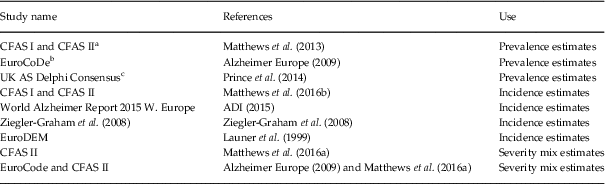
We also provide a severity distribution disaggregated for Community Health Organisations (CHO) and for Primary Care Networks across the country. These units of geography were included to inform and facilitate resource allocation decisions across CHOs and within CHOs. These estimates were generated by applying prevalence estimates from CFAS II to local demographic data from the 2016 census. Table 1 summaries the underlying studies used to generate the various estimates in this paper.
Studies used in this paper

a Cognitive, Functioning and Aging Study, wave I and wave II (Matthews et al. Reference Matthews, Arthur, Barnes, Bond, Jagger, Robinson and Brayne2013).
b European Collaboration on Dementia (Alzheimer Europe, 2009).
c UK Alzheimer Society Delphi Consensus.
Results
Prevalence of dementia in Ireland
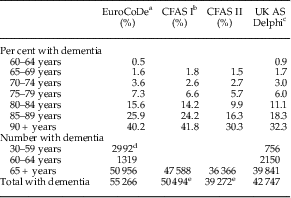
Depending on the prevalence rates used, the number of people in Ireland with dementia in 2016 ranges from 39 272 to 55 266, as shown in Table 2. Column 1 of Table 2 shows the estimates for the number of people with dementia in Ireland for 2016 based on the original EuroCoDe prevalence rates. On this basis, including cases of early-onset dementia, there are 55 266 people with dementia in the country. A revision of the EuroCode meta-analysis was conducted which included only studies deemed to be of high quality and those using DSM-IV diagnosis criteria (7 studies in total). This revision estimated a prevalence rate of 7.2% in over 65 year olds compared with 9.3% for the original EuroCoDe study (Galeotti et al. Reference Galeotti, Giusti, Meduri, Raschetti, Scardetta and Vanacore2013). However, as no breakdown on revised prevalence is available by age category, we are not able to calculate revised EuroCoDe estimates for Ireland.
Prevalence rates and estimates for number of people with dementia in Ireland

a European Collaboration on Dementia (Alzheimer Europe, 2009).
b Cognitive, Functioning and Aging Study, wave II (Matthews et al. Reference Matthews, Arthur, Barnes, Bond, Jagger, Robinson and Brayne2013).
c UK Alzheimer Society Delphi consensus (Prince et al. Reference Prince, Knapp, Guerchet, McCrone, Prina, Comas-Herrera, Wittenberg, Adelaja, Hu, King, Rehill and Salimkumar2014).
d The number of early onset cases is calculated on the basis of the EuroDEM prevalence rates to be consistent with previous Irish studies (Pierce et al. Reference Pierce, Cahill and O’Shea2013).
e Estimates for early onset dementia, based on UK Alzheimer Society Delphi consensus (Prince et al. Reference Prince, Knapp, Guerchet, McCrone, Prina, Comas-Herrera, Wittenberg, Adelaja, Hu, King, Rehill and Salimkumar2014), are added for comparison.
Columns 2 and 3 of Table 2 show the prevalence rates from the two waves of the CFAS in the United Kingdom (Matthews et al. Reference Matthews, Arthur, Barnes, Bond, Jagger, Robinson and Brayne2013) and the corresponding number of people with dementia when these rates are applied to Irish population data. On this basis, the estimated number of people with dementia in Ireland, based on the CFAS prevalence rates lies between 39 272 and 50 494 people, the former estimate generated from the more recent wave of the CFAS, reflecting a fall in incidence rates over the period of that study.
Column 4 of Table 2 shows the results of a Delphi consensus on estimated prevalence rates for people with dementia in the United Kingdom. The Delphi consensus was based on the views of 13 senior academics, conducted by the Alzheimer’s Society UK in 2014 (Prince et al. Reference Prince, Knapp, Guerchet, McCrone, Prina, Comas-Herrera, Wittenberg, Adelaja, Hu, King, Rehill and Salimkumar2014). Based on the application of these prevalence rates generated through a UK-based consensus process, there are currently an estimated 42 747 people with dementia in Ireland.
The number of people with dementia under the age of 65 is included in the above results, as shown in Table 2. Based on EuroCode/EuroDEM prevalence rates there are 4311 people in Ireland with early-onset dementia. Using UK Delphi consensus estimates (Prince et al. Reference Prince, Knapp, Guerchet, McCrone, Prina, Comas-Herrera, Wittenberg, Adelaja, Hu, King, Rehill and Salimkumar2014) there are 2906 people under 65 with dementia in Ireland, considerably less than the EuroCode/EuroDEM figures.
Incidence
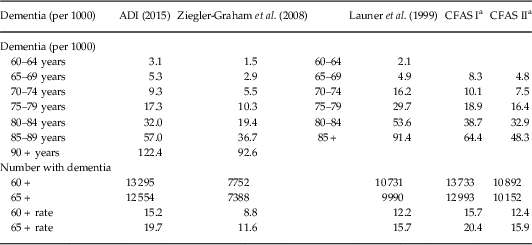
Table 3 reports incidence rates by age group determined from various meta-analyses, including the CFAS studies referenced earlier (Matthews et al. Reference Matthews, Stephan, Robinson, Jagger, Barnes, Arthur and Brayne2016b). The age-adjusted incidence rates are used to calculate an estimate of the total number of new dementia cases in Ireland in 2016. These estimates indicate that there are between 7752 and 13 733 new cases of dementia in Ireland every year based on the application of the different meta-analyses rates to people aged 60 years and over. The number of incident cases in Ireland for people aged 60 years and older, on the basis of the most recent CFAS II study, was somewhere in-between at 10 892.
Dementia-incidence rates per 1000, and number for Ireland (2016)

ADI, Alzheimer disease international.
a Cognitive, Functioning and Aging Study, wave I and wave II (Matthews et al. Reference Matthews, Stephan, Robinson, Jagger, Barnes, Arthur and Brayne2016b).
Setting and severity of dementia cases
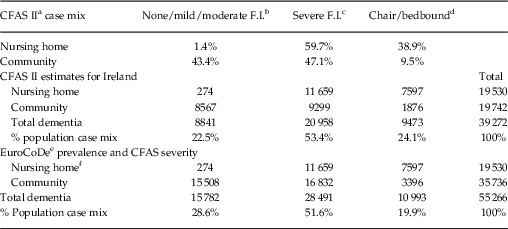
Table 4 shows estimates for the functional disabilities of people with dementia by place of residence in Ireland applied to the largest and smallest prevalence estimates in Table 2. These two sets of estimates were calculated using the case mix from the CFAS II UK study for community and nursing home populations (Matthews et al. Reference Matthews, Bennett, Wittenberg, Jagger, Dening and Brayne2016a), applied to the prevalence estimates for the number of people in each setting. When the CFAS II community severity mix is combined with the EuroCode estimate of the number of cases, the prevalence and severity of cases in the nursing home setting remains constant, while the number of cases in the community is expanded. The set of estimates based only on CFAS estimates are internally consistent; the prevalence and severity mix are all from the CFAS II study, with common definitions across all settings. The set of estimates that combines CFAS II severity mix estimates with EuroCoDe prevalence rates are based on two different studies. This, in turn, may lead to a potential overstatement in relation to the number of people with moderate and severe levels of dementia living at home in the community.
Functional severity in community and nursing home people with dementia

a Cognitive, Functioning and Aging Study, wave II (Matthews et al. Reference Matthews, Bennett, Wittenberg, Jagger, Dening and Brayne2016a).
b Mild to moderately functionally impairment is defined as not being able carry heavy bags or do heavy housework. None refers to people with a diagnosis of dementia but no functional impairment.
c Severe functional impairment is defined as needing help to wash, make a cooked meal, put on shoes or socks or get around outside of their house.
d The most functionally impaired group were chair or bedbound. None refers to people who have a diagnosis of dementia with no instrumental activities of daily living (ADL) or ADLs.
e European Collaboration on Dementia (Alzheimer Europe, 2009).
f Due to the estimation method used the number of case in nursing homes remains stable for both high and low scenarios while the number of cases in the community increases in the high scenario.
There are an estimated 27 125 occupied long stay beds in nursing homes in Ireland. This is based on a total long stay capacity of 28 255 beds in 2015 (Health Information and Quality Authority, Reference Helmer, Pérès, Letenneur, Guttiérez-Robledo, Ramaroson, Barberger-Gateau, Fabrigoule, Orgogozo and Dartigues2016) and an occupancy rate of 96%. We assume a dementia prevalence rate of 72% for residents in residential care in Ireland, based on the nursing home prevalence rate found in the CFAS II study (Matthews et al. Reference Matthews, Stephan, Robinson, Jagger, Barnes, Arthur and Brayne2016a). On this basis, there were ~19 530 people living in nursing homes with dementia in Ireland in 2016. Subtracting the number of people in residential care with dementia from various estimates of the total number of people with dementia in Table 4 provides estimates of the number of people in the community with dementia in Ireland of between 19 742 and 35 736.
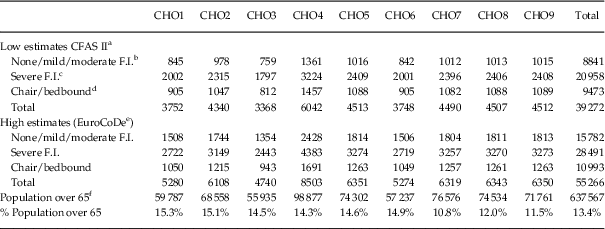
The majority of people living in nursing homes (19 256) are likely to have high levels of functional impairment. In regard to community-based residents, our estimates suggest that there are at least 11 175 people with high levels of functional impairment, 9299 people with a severe functional impairment and 1876 people who are chair/bedbound, most of whom are likely to need high levels of care and support. These people have care needs that range from care at regular times, several times a day, to critical interval (24 hours) care needs. We also provide, with less confidence due to the lack of internal consistency, an upper bound estimate. The severity mix of cases is also disaggregated for CHO and, more tentatively, for Primary Care Networks across the country (Tables 5 and online Supplementary Material). These spatial units are included in the analysis, as decision-making on resource allocation are often made for different catchment areas.
High and low estimates of the number of people with dementia by functional severity for each Community Health Organisation (CHO)

a Cognitive, Functioning and Aging Study, wave II (Matthews et al. Reference Matthews, Arthur, Barnes, Bond, Jagger, Robinson and Brayne2013).
b Mild to moderately functionally impairment is defined as not being able carry heavy bags or do heavy housework. None refers to people with a diagnosis of dementia but no functional impairment.
c Severe functional impairment is defined as needing help to wash, make a cooked meal, put on shoes or socks or get around outside of their house.
d The most functionally impaired group were chair or bedbound. None refers to people who have a diagnosis of dementia with no instrumental activities of daily living (ADL) or ADLs.
e European Collaboration on Dementia (Alzheimer Europe, 2009).
f The total population of over 65 year olds per CHO area.
Discussion
In this paper we provide revised and new estimates of the prevalence, severity and incidence of dementia in Ireland based on emerging international evidence on prevalence and incidence patterns. We provide a wide range of estimates, as there is considerable uncertainty in relation to the epidemiology of dementia internationally. It is not possible to be more precise about the estimates we provide for Ireland at this stage. However, having credible upper and lower bound estimates for the number of people with moderate or severe dementia in the community is useful for planners and those charged with making resource allocation decisions in dementia.
There is a gap of 16 000 between the highest and lowest estimates of the number people with dementia in Ireland. The difference in estimates is driven by the choice of the underlying prevalence data from abroad, the diagnostic criteria used to measure prevalence in the selected studies and the likely fall in incidence in dementia captured by more recent international studies. The largest amount of error is likely to be found in milder cases (Boersma et al. Reference Boersma, Eefsting, van den Brink, Koeter and van Tilburg1998). The difference in the number of early-onset cases is also a contributor.
We do not know what the trend in incidence is in Ireland, but it is likely that lifestyle and education improvements have resulted in some downward movement in line with other countries (Wu et al. Reference Wu, Fratiglioni, Matthews, Lobo, Breteler, Skoog and Brayne2016), but, of course, population ageing has also been occurring at a pace in this country, thereby adding to the number of new case per year, ceteris paribus. Declines in mortality rates are also occurring in Ireland (Central Statistics Office, 2013), resulting in people living longer, thereby increasing their chances of experiencing dementia and living longer with dementia.
We have provided a range of estimates for the number of new cases of dementia in Ireland, both diagnosed and undiagnosed. The number of new cases of dementia will increase every year if population ageing is increasing faster than any decline in incidence arising from lifestyle factors or changes in education. While the estimate of the number of potential new cases of dementia in Ireland is wide and uncertain, it provides a basis for analysing the extent to which diagnostic services and post-diagnostic supports need to be developed in this country to meet even the most conservative estimate of potential demand. Given the current low diagnosis rate in Ireland (Timmons et al. Reference Timmons, Manning, Barrett, Brady, Browne, O’Shea, Molloy, O’Regan, Trawley and Cahill2015), it is clear that current services and supports are not geared to address even the lowest number of incident cases shown here. Further analysis is required to estimate the level of investment required to cater for new cases of dementia.
People with dementia need different supports depending on their circumstances and the stage of the disease. For example, people in the early stages of dementia require timely diagnosis, information and emotional support (Manthorpe et al. Reference Manthorpe, Samsi, Campbell, Abley, Keady, Bond, Watts, Robinson, Gemski and Warner2011; Stokes et al. Reference Stokes, Combes and Stokes2014). As the disease progresses, cognitive and functional capacity decline and behavioural symptoms can become more pronounced, resulting in increased care needs and increased risk of nursing home admission (Garre-Olmo et al. Reference Garre-Olmo, Vilalta-Franch, Calvó-Perxas, Monserrat-Vila and López-Pousa2014; Toot et al. Reference Toot, Swinson, Devine, Challis and Orrell2016). The level of severity of people with dementia living in community-based settings and in residential care matters for care planning, priority-setting and resource allocation purposes.
We provide a severity distribution on the basis of functional impairments in people with dementia. Defining and categorising the stage of dementia is problematic; the approach we have taken here is to identify proxies for interval-based care needs. This approach is useful from a policy perspective, for example in identifying the home care needs of people with dementia in the community. The CFAS II study’s severity distribution provides a consistent severity measure in both community and residential settings. Alternative measures of dementia severity, such as the level of CI and/or behavioural symptoms would similarly need to be mapped onto a policy relevant scale such as the care interval.
There are a number of limitation to the analysis in this paper. As there has been no dementia screening study in Ireland we are relying on studies from other European countries to provide us with underlying prevalence rates. Although population and cultural factors have not been identified as a primary explanation for differences in reported prevalence rates across countries, differences in risk factors for dementia, and exposure to same, may be country specific. Similarly, data from earlier time periods may be less relevant now due to changes in risk factors such as cardiovascular health.
The approach to the severity distribution of dementia cases followed in this paper is narrow, based largely on functional ability. The level of functional severity is, of course, only one of the factors that will drive the demand for community-based services and supports. Cognitive and behavioural issues will also impact heavily on the demand for services and supports. So too will the availability of informal care, given the importance of families in supporting people with dementia to live at home.
Conclusion
Knowing the number of people with dementia is important for planning purposes, particularly when it comes to the efficiency and equity of resource allocation decision-making in the country. Incidence data is crucial for the organisation of timely diagnostic services and appropriate supports in the future. Knowledge of the severity mix of dementia in the community is also important, particularly in relation to functional incapacity, for the development of intensive home care packages designed to keep people living at home for longer. While there are different methods for measuring severity in dementia, a functional approach is directly related to the interval of care assessment and consequent resource allocation requirements. With better data we could make better estimates. With better estimates we could make better decisions. This is the best we can do for now in the absence of local and national prevalence studies.
Supplementary materials
To view supplementary material for this article, please visit https://doi.org/10.1017/ipm.2018.31
Financial Support
This project was supported by Atlantic Philanthropies, grant number 22098.
Conflicts of Interest
The authors declare that there are no conflicts of interest.
Ethical Standards
The authors assert that all procedures contributing to this work comply with the ethical standards of the relevant national and institutional committee on human experimentation with the Helsinki Declaration of 1975, as revised in 2008.