Affective states refer to short-lived feelings experienced by people, limited to hours, days or a few weeks (Totterdell & Niven, Reference Totterdell, Niven and Weiss2012), which in the work domain have been supported as important antecedents of the way people think and behave (Brief & Weiss, Reference Brief and Weiss2002). For example, affect experienced while working is substantively related to work motivation (Parker, Bindl, & Strauss, Reference Parker, Bindl and Strauss2010; Seo, Barrett, & Bartunek, Reference Seo, Barrett and Bartunek2004), job attitudes and work behavior (Weiss & Cropanzano, Reference Weiss, Cropanzano, Staw and Cummings1996). Furthermore, when considered as an outcome, affective states are key components of psychological well-being at work (Warr, Reference Warr1990), which is related to job characteristics, job demands and the quality of the social work environment (Warr, Reference Warr2007).
Generally, research on organizational behavior has mainly concentrated on describing how differences in valence of affect (positive versus negative feelings) explain work-related outcomes, paying less attention to the extent to which activation of affect (energy expenditure of feelings) also accounts for these correlates (Seo, Barrett, & Sirkwoo, Reference Seo, Barrett, Sirkwoo, Ashkanasy and Cooper2008). In contrast to this approach, recent theoretical and empirical advances have indicated that both the valence and activation dimensions are essential for understanding cognitive and behavioral implications of affect in the workplace (Bindl, Parker, Totterdell, & Hagger-Johnson, Reference Bindl, Parker, Totterdell and Hagger-Johnson2012; Seo, Bartunek, & Barrett, Reference Seo, Bartunek and Barrett2010). However, the dearth of validated instruments to measure affect at work described by the combination of valence and activation is still an important limitation in research, which has been particularly critical in languages other than English. In concrete terms, most research on affective states at work have been conducted on English-speaking samples using the Positive Affect and Negative Affect Schedule (PANAS, Watson, Clark, & Tellegen, Reference Watson, Clark and Tellegen1988). PANAS cannot account for the complexities of the circumplex of affect as a whole, because it only covers positive and negative feelings high in activation (e.g., enthusiasm, inspiration, nervousness) excluding those low in energy expenditure (e.g., calmness, tranquility, dejection, despondency).
In order to tackle these limitations, this article presents the cross-validation of the factorial invariance between the English form of a 12-item version of the Multi-Affect Indicator developed by Warr and Parker (Reference Warr and Parker2010) and its translation into Spanish. The Multi-Affect Indicator measures the four affective quadrants described by the combination of valence and activation. First, we describe the basics of the Valence of Arousal Circumplex Model of Affect with the aim of theoretically supporting the proposed instrument. Then, the results of the cross-validation between the English and Spanish language versions of the Multi-Affect Indicator, using three independent samples (one of British employees and two of Chilean employees), are presented. Finally, norms for the affective states (mean scores and standard deviations) for the Spanish sample are presented by gender, age, job role, organizational sector and industry, in order to have a reference criterion for benchmarking practices in future research.
Overall, the theory and empirical results presented in this article contribute to a finer grained understanding and approach to affect and its correlates in work settings. Furthermore, this study contributes to improving research on affective states in different national contexts, because, to the best of our knowledge, there is not a well-validated measure of affect covering the four quadrants of the circumplex of affect as a whole in Spanish.
The Circumplex Model of Affect
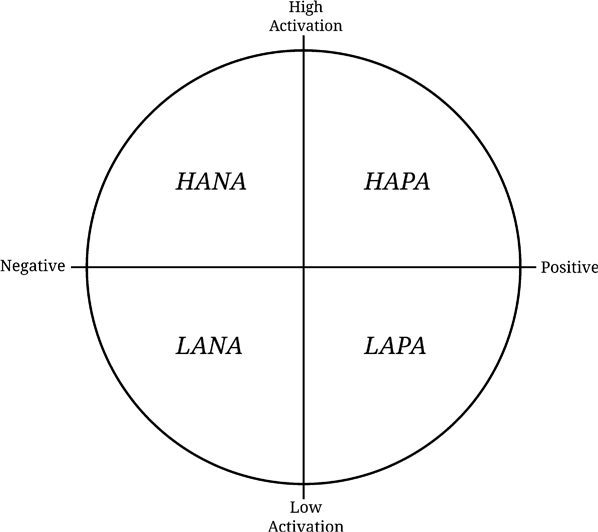
According to the Circumplex Model of Affect (see Figure 1), affective states are composed of feelings that emerge from the activity of two basic neurophysiological systems: valence (pleasure-displeasure continuum) and arousal (activation-deactivation continuum) (Posner, Russell, & Peterson, Reference Posner, Russell and Peterson2005; Russell, Reference Russell1980). While valence refers to the extent to which feelings are experienced as positive or negative in hedonic tone, activation denotes the state of readiness provided by the same feelings. The linear combination of both dimensions describes four affective quadrants (For a comprehensive discusssion about the circumplex models see Larsen & Diener, Reference Larsen, Diener and Clark1992), which organizational behavior researchers have recently labeled as: high-activated positive affect (HAPA), high-activated negative affect (HANA), low-activated negative affect (LANA) and low-activated positive affect (LAPA) (e.g. Bindl et al., Reference Bindl, Parker, Totterdell and Hagger-Johnson2012). This descriptive model has shown substantive explanatory power for several affective, cognitive and behavioral processes (Yik, Russell, & Steiger, Reference Yik, Russell and Steiger2011). For example, extrapolated into the work domain, HAPA is related to creativity and proactivity, HANA is associated with counterproductive behavior, LAPA is linked to proficiency at work, while LANA relates to disengaged actions such as organizational silence (cf. Parker et al., Reference Parker, Bindl and Strauss2010; Spector & Fox, Reference Spector and Fox2002; Van Dyne, Ang, & Botero, Reference Van Dyne, Ang and Botero2003).
The Circumplex Model of Affect. The linear combination between the valence dimension (negative-positive) and the arousal dimension (deactivated-activated) describes four affective quadrants: high-activated positive affect (HAPA), high-activated negative affect (HANA), low-activated negative affect (LANA), and low-activated positive affect (LAPA).

Drawing on the circumplex model, Warr (Reference Warr1990) developed measures to assess job-related affective states, which have been widely validated in English-speaking samples (Mullarkey, Warr, Clegg, & Stride, Reference Mullarkey, Warr, Clegg and Stride1999). Recently, a revised version of these measures, labeled the Multi-Affect Indicator (Warr & Parker, Reference Warr and Parker2010), was developed in order to better reflect the differences between valence and activation. The Multi-Affect Indicator offers four independent scales to assess the four affective quadrants represented by HAPA, HANA, LAPA and LANA. These scales exclude items based on concepts that directly refer to discrete emotions (e.g. joy, proud, anger, guilt) and attitudes (e.g. satisfaction), in order to examine only the basic dimensions of affective states. As a result, the Multi-Affect Indicator addresses limitations of other instruments available in literature, such as the Positive Affect and Negative Affect Schedule (PANAS, Watson et al., Reference Watson, Clark and Tellegen1988) that only covers both positive and negative feelings high in activation (i.e. HAPA and HANA). Furthermore, the Multi-Affect Indicator also improves on the limitations of the Job-Related Affective Well-Being Scale (JAWS, Van Katwyk, Fox, Spector, & Kelloway, 2000), because the latter includes measures of discrete emotions and attitudinal constructs (e.g. annoyance, frustration, satisfaction).
The Multi-Affect Indicator has been steadily adopted in work and organizational research (e.g. Bindl et al., Reference Bindl, Parker, Totterdell and Hagger-Johnson2012; Warr, Bindl, Parker & Inceoglu, Reference Warr, Bindl, Parker and Inceoglu2013) yet, its use has been mainly limited to English-speaking populations. Thus, with the aim of contributing to expanding research on affect at work to other national contexts, the cross-validation of the factorial structure of the Multi-Affect Indicator between English and Spanish is presented below. Spanish represents the second widest spoken language in the world (Lewis, Reference Lewis2009) with approximately three hundred and thirty million speakers in forty four countries (mainly distributed in Spain, Latin America and the United States). Thus, the instrument developed in this article could help to increase the research on affect in one of the major speaking communities in the world.
Method
Procedures and Data
Adopting the proposals of Brislin (Reference Brislin1970), two independent members of the research team translated and back-translated between English and Spanish the sixteen original items of the Multi-Affect Indicator. In cases of translation discrepancies, the two translators discussed the implications of these differences and defined together a final version for the ambiguous translations.
English and Spanish versions of the Multi-Affect Indicator were administered using Internet-based surveys to three independent samples, one of English and two of Spanish speakers. These samples represented different cultural contexts, given that the English sample were based on individuals working in the United Kingdom, while the Spanish sample comprised individuals working in Chile. The use of Internet-based surveys has been increasing in psychological research, given their lower cost of implementation (both in terms of money and time), improved access to groups targeted by research (e.g. employees working in different national contexts), and similar quality of data compared to paper-based surveys (e.g. equivalent and often improved measurement error and control of social desirability) (Birnbaum, Reference Birnbaum2004; Skitka & Sargis, Reference Skitka and Sargis2006). The latter has been also replicated in online application of affective measures. Howell, Rodzon, Kurai, and Sanchez (Reference Howell, Rodzon, Kurai and Sanchez2010), using PANAS scales, supported the validity, reliability and generalizability of affective measures applied over the Internet, showing equivalent means, standard deviations, reliabilities and factor structure to paper-based and computer-based forms.
Based on the data collected, the following strategy of analysis was conducted: (a) testing psychometric properties of the Multi-Affect Indicator (confirmatory factor analysis and reliability analysis), (b) testing factorial invariance between English and Spanish forms, (c) testing the construct validity of the model underlying the Multi-Affect Indicator and (d) testing the relative position of the translated into Spanish items in the Circumplex of Affect (their polar angles in the circular representation).
The English form of the Multi-Affect Indicator was administered to a sample of 138 individuals working in the United Kingdom (sample 1). Participants were recruited by sending an email with an invitation to participate in the study to contacts of the leading researcher that were working in organizations in the UK. This email provided the URL link to access the online questionnaire and asked participants to forward this link to their own contacts in order to develop a “snowballing” strategy. This email also described the main goal of the study, the anonymity conditions of it and provided an email address to offer comments or ask for more detailed information about the study. After deleting the responses of 35 individuals, because their ratings of affect were less reliable due to being “on holiday” or “on leave” during the two weeks before participating in the survey (this was explicitly asked at the beginning of the questionnaire), a total number of 103 UK employees were retained for the subsequent analyses. Participants were 31.7% male and the average age was 37.73 years (SD = 11.61). Participants worked as administrative or technical staff (75.8%), professional staff (6.9%) and supervision/management staff (17.2%) whilst the average job tenure was 6.54 years (SD = 7.01). These participants were employed in private (34%) and public organizations (66%).
Sample 2 comprised 149 individuals working in Chile (after the deletion of 20 cases because they were “on holiday” or “on leave”), who were recruited using the same procedure as described for the English sample. These participants were 46.6% male with an average age of 34.56 years (SD = 7.78). They worked as administrative or technical staff (4%), professional staff (61.1%), and supervision/management staff (34.9%) whilst the average job tenure was 5.02 years (SD = 5.09), and they were employed in private (48.6%) and public organizations (51.4%). Sample 3 comprised 281 participants working in Chile (after deleting 56 “on holiday” or “on leave” cases) who were 41.2% male with an average age of 34.27 years (SD = 8.62). These individuals worked as administrative or technical staff (18.1%), professional staff (56.6%), and supervision/management staff (25.3%), while their average job tenure was 5.19 years (SD = 5.28), and they were employed in private (58.4%) and public organizations (41.6%).
The English sample and the first Spanish-speaking samples (samples 1 and 2) were used to test the robustness of the measurement model and the factorial invariance of the instruments across both languages. The second Spanish-speaking sample (sample 3) was utilized to provide additional information for the construct validity of the theoretical model and the Multi-Affect indicator, through testing expected associations among measures of affective states and other related constructs. Thus, in this sample, measures of Extraversion and Neuroticism personality traits, and Job Control/Solving Demands were taken in addition to the Multi-Affect Indicator. Theory and research have indicated that these constructs are substantively related to affect at work. Specifically, extraversion disposes people to experience positive feelings high in activation, while neuroticism makes individuals prone to experience negative feelings high in activation (DeNeve & Cooper, Reference DeNeve and Cooper1998; Watson & Clark, Reference Watson and Clark1992). Furthermore, high levels of job control are experienced as resources that facilitate work performance, being substantially and positively related to positive feelings high in activation (e.g. inspiration) and negatively related to negative feelings low in activation (e.g. despondency) (Warr, Reference Warr, Kahneman, Diener and Schwartz1999, Reference Warr2007). On the other hand, high-level job demands are in general experienced as threats that can weaken performance (Karasek, Reference Karasek1979; Wall, Jackson, Mullarkey, & Parker, Reference Wall, Jackson, Mullarkey and Parker1996), being positively associated with negative feelings high in activation (e.g. worry) whilst negatively related to positive feelings low in activation (e.g. calmness).
In a final overall analysis, the two samples of Spanish speakers were merged (N = 430) with the aim of observing the relative position (polar angles) of the instrument’s items in the circumplex representation (using Circular Stochastic Modeling as detailed later). According to the Circumplex Model of Affect (Remington, Fabrigar, & Visser, Reference Remington, Fabrigar and Visser2000; Yik et al., Reference Yik, Russell and Steiger2011), items of the Multi-Affect Indicator should be placed in the circumplex representation as follow: HAPA between 0° and 90°, HANA between 90° and 180°, LANA between 180° and 270° and LAPA between 270° and 360° (see Figure 1).
Measures Footnote 1
Affective States
The 16 items of the Multi-Affect Indicator (Warr & Parker, Reference Warr and Parker2010) were used in the three samples of the study. English and Spanish translations of the items follow: During the last week, how often have you felt in your workplace…? “Enthusiastic [Entusiasmado(a)]”, “Joyful [Alegre]”, “Inspired [Inspirado(a)]” “Active [Activo(a)]” (HAPA); “Nervous [Nervioso(a)]”, “Anxious [Ansioso(a)]”, “Tense [Tenso(a)]”, “Worried [Preocupado(a)]” (HANA); “Depressed [Deprimido(a)]”; “Dejected [Decepcionado(a)]”; “Despondent [Decaído(a)]”; “Hopeless [Desilucionado(a)]” (LANA); Calm [Calmado(a)]”, “Relaxed [Relajado(a)]”, “Laid-back [Distendido(a)]”, “At ease [Tranquilo(a)]” (LAPA); (1 = never/almost never, 2 = few times, 3 = about half the time, 4 = a lot of the time, 5 = always/almost always). Reliability of these factors is presented in the results section.
Extraversion and Neuroticism
These personality traits were measured using six items from the Big-Five measures validated in Spanish by Benet-Martinez and John (Reference Benet-Martínez and John1998). Indicate how accurately each statement describes you. I see myself as someone who: “Is outgoing, sociable”, “Is talkative”, “Is sometimes shy, inhibited (reverse scored)” (Extraversion, α = .77); “Gets nervous easily”, “Worries a lot”, “Can be moody” (Neuroticism, α = .72) (1 = strongly disagree – 5 = strongly agree).
Job Resources and Demands
Job resources were measured with the five-item scale of time control, and job demands with the five-item scale of solving demands developed by Wall et al. (Reference Wall, Jackson, Mullarkey and Parker1996). Examples of items follow: Think about your job and indicate a response to the following statements: “Do you decide on the order in which you do things? (Job Resources, α = .90)”, “Are you required to deal with problems which are difficult to solve?” (Job Demands, α = .89) (1 = Not at all – 5 = A great deal).
Control Variables
Gender and age of participants were used as control variables to control for potential confounding effects in the relationships tested between personality traits, job resources/demands and affective states.
Analytical Strategy
Confirmatory factor analyses and structural equation modeling using Mplus 6 (Muthén & Muthén, 1998–2010) and Circular Stochastic Modeling with a Fourier Series using CIRCUM (Browne, Reference Browne1992) were conducted to analyze the data. A three-stage strategy was employed. In the first stage, the factorial invariance of the Multi-Affect Indicator between the English and Spanish versions was tested using Multi-group Confirmatory Factor Analysis, following the procedure defined by Byrne (Reference Byrne2012). According to this, the robustness of the baseline model (i.e. the four factors of the Multi-Affect Indicator) was tested first in each separate sample (study samples 1 and 2). Second, a configural model was tested to observe if the number of factors and factor-loading patterns were invariant between both samples. Third, the invariance of factor loadings was tested, and finally, factor variances and covariances were constrained to be the same, in order to determine if strong invariance is attributable to the model in both samples. The second stage of data analyses involved structural regressions (Kline, Reference Kline2011) conducted to test the expected associations between personality traits, job resources/demands and affective states.
The last stage aimed to observe the relative position (polar angles) of the affective measures in Spanish in the Circumplex representation Footnote 2 . Circular Stochastic Modeling with a Fourier series (CSMF) is a type of covariance structure analysis to assess circumplex structures (Browne, Reference Browne1992). Based on this, common variance among observed variables (i.e. affective measures) can be represented as points on a circumference diagram. This implies using one observed variable as a reference point in the circle, while covariances of this reference with the other observed variables are computed as polar angles (Remington et al., Reference Remington, Fabrigar and Visser2000). Thus, the correlation between any two observed variables represents a function of their angle separation. This modeling strategy was applied using CIRCUM with the data obtained by merging the two Spanish-speaking samples (sample 2 and 3, N = 430). CIRCUM is a statistical software designed to test circular stochastic models, which provides polar angles and their 95% confidence intervals for observations analyzed (e.g. affective measures). Furthermore, CIRCUM offers Root Mean Square Error of Approximation values (RMSEA) and a Discrepancy Function Footnote 3 of the model estimated, which allow assessing its goodness-of-fit.
Results
Testing the Robustness and the Factorial Invariance of the Instrument
In order to select the method of estimation in confirmatory factor analyses, normal distribution of the affective measures was tested. This was relevant considering that violation of normality and the use of inappropriate estimation method might lead to biased results in confirmatory factor analysis in general (Byrne, Reference Byrne2012), and in testing associations between affective measures in particular (Schmukle & Egloff, Reference Schmukle and Egloff2009) Footnote 4 . Implementing the procedure defined by Byrne (Reference Byrne2012), normal distribution of the 16 items of the Multi-Affect Indicator was tested in the three independent samples. Results indicated that values of skewness and kurtosis for all these measures minimally deviate from zero (interval of values for sample 1 [.09 – 1.24], sample 2 [.12 – 1.66], sample 3 [.18 – 1.26]) Footnote 5 , providing support that they do not violate the assumption of normal distribution. Based on this, Maximum Likelihood was adopted as method of estimation.
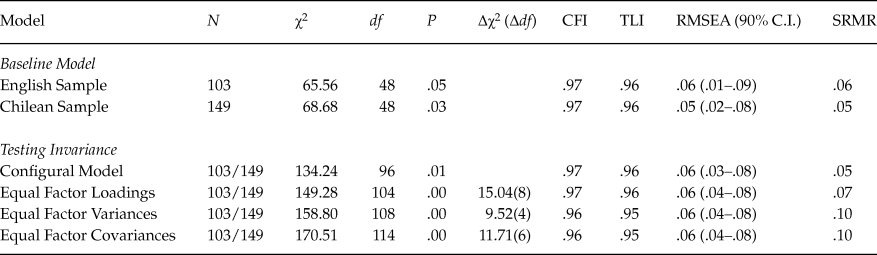
Following the procedure defined to test factorial invariance, the baseline models of the Multi-Affect indicator were firstly tested. Confirmatory factor analyses showed acceptable goodness-of-fit for the four-factor model in both British and Chilean samples (UK: χ2 = 146.41, df = 98, p < .01; RMSEA = .07; SRMR = .07; CFI = .93; TLI = .91; Chile: χ2 = 196.97, df = 98, p < .01; RMSEA = .08; SRMR = .08; CFI = .92; TLI = .90). However, inspection of the modification indices indicates problems of misspecification associated with error covariances for “hopeless” and “nervous” with other items of their respective factors in both samples. These items were removed from the measurement model because misspecification suggested that they provide redundant information. In addition, the items with the lowest factor loadings for HAPA and LAPA (active and laid-back respectively) were also removed from the model in order to define an instrument with a balanced number of items for all its four factors (three items each). Re-specified models showed greater and excellent goodness-of fit (UK: χ2 = 65.56, df = 48, p = .05; RMSEA = .06; SRMR = .06; CFI = .97; TLI = .96; Chile: χ2 = 68.68, df = 48, p = .03; RMSEA = .05; SRMR = .05; CFI = .97; TLI = .96), supporting the robustness of this baseline model in both samples.
Subsequently, analyses of factorial invariance for the 12 items retained were conducted. Results supported the configural model indicating that the number of factors and patterns of factor loadings was equivalent between British and Chilean samples (χ2 = 134.24, df = 96, p = .01; RMSEA = .06; SRMR = .05; CFI = .97; TLI = .96). Then, factor loadings invariance (Δχ2(df) = 15.04(8), p > .05), factor variances invariance (Δχ2(df) = 9.52(4), p > .05), and factor covariances invariance were supported (Δχ2(df) = 11.71(6), p > .05) (see Table 1).
Invariance of the Multi-Affect Indicator (Samples 1 and 2)

Models estimation was based on Maximum Likelihood (ML). Chi-square tests p < .01.
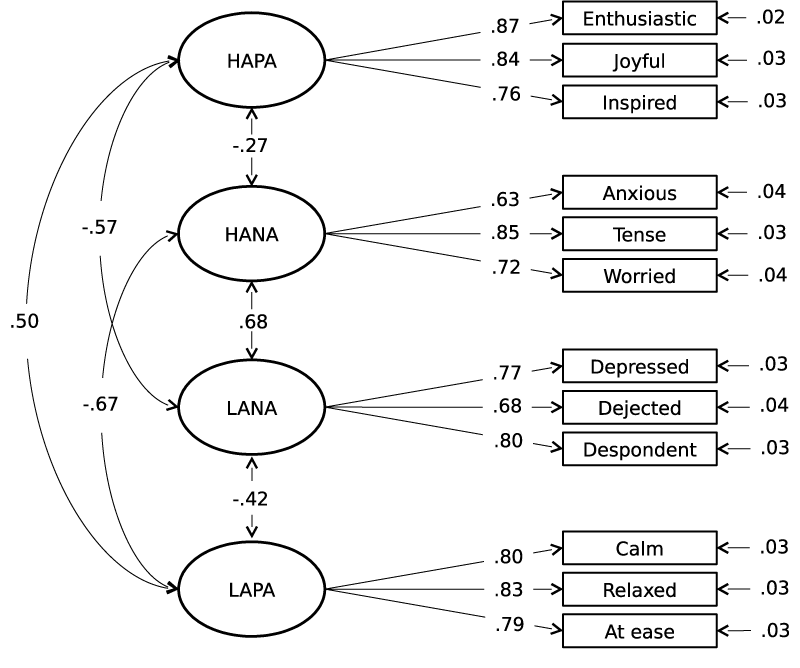
Robustness of the measurement model was replicated in sample 3 (N = 281) Footnote 6 , obtaining excellent goodness-of-fit for the 12-item form of the Multi-Affect Indicator Model (χ2 = 84.68, df = 48, p < .01; RMSEA = .05; SRMR = .04; CFI = .98; TLI = .97, see Figure 2). Furthermore, complementary analyses of internal consistency indicated good reliability for the four scales derived from the model (Cronbach’s alpha sample 1/sample 2/sample 3: HAPA (α = .82/.82/.86), LANA (α = .76/.71/.78), HANA (α = .87/.73/.78), LAPA (α = .72/.84/.85). Taken together, previous results supported the robustness, strong factorial invariance and the scales’ reliability of the Multi-Affect Indicator.
CFA Multi-Affect Indicator (N = 281, Sample 3, Spanish-speaking employees). Factor loadings, standard error of observed variables and latent correlation between factors of the model are displayed (standardized estimates). All estimates were statistically significant (p < .01).

Associations Among Affective States, Personality and Job Resources/Characteristics
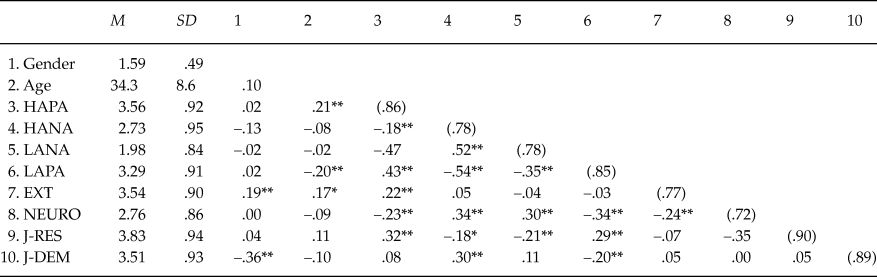
Results of structural equation modeling indicated that, as expected, after controlling for age and gender of participants, extraversion was substantively related to HAPA (b = .18, SE = .08, p < .05), while neuroticism was strongly associated with HANA (b = .46, SE = .08, p < .01). Furthermore, job control was observed as positively related to HAPA (b = .37, SE = .09, p < .01) whilst negatively related to LANA (b = –.25, SE = .08, p < .01), and job demands were substantially associated with HANA (b = .33, SE = .08, p < .01), and LAPA (b = –.26, SE = .08, p < .01) (see Table 3). These results provided complementary support for the construct validity of the Multi-Affect Indicator and the Circumplex Model of Affect Footnote 7 .
Descriptive Statistics, Correlations and Reliability (Sample 3)

HAPA: high-activated positive affect, HANA: high-activated negative affect, LANA: low-activated negative affect, LAPA: low-activated positive affect, EXT: extraversion, NEU: neuroticism, J-RES: job resources, J-DEM: job demands. Reliability of the scales is parenthesized on the diagonal. Means, standard deviations and bivariate correlations (two-tailed test). *p < .05. **p < .01.
Structural Regression among Affective States, Personality and Job Resources/Demands (Sample 3)

Model goodness-of-fit χ2 = 553.51, df = 361, p = .001; RMSEA = .04; SRMR = .05; CFI = .94; TLI = .93. Unstandardized estimators reported. Standard errors are in parentheses. Results controlled by gender and age. *p < .05, **p < .01.
Polar Angles for the Spanish Version of the Multi-Affect Indicator
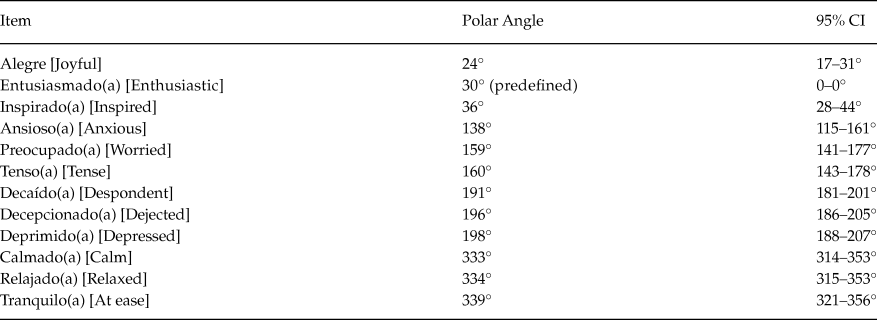
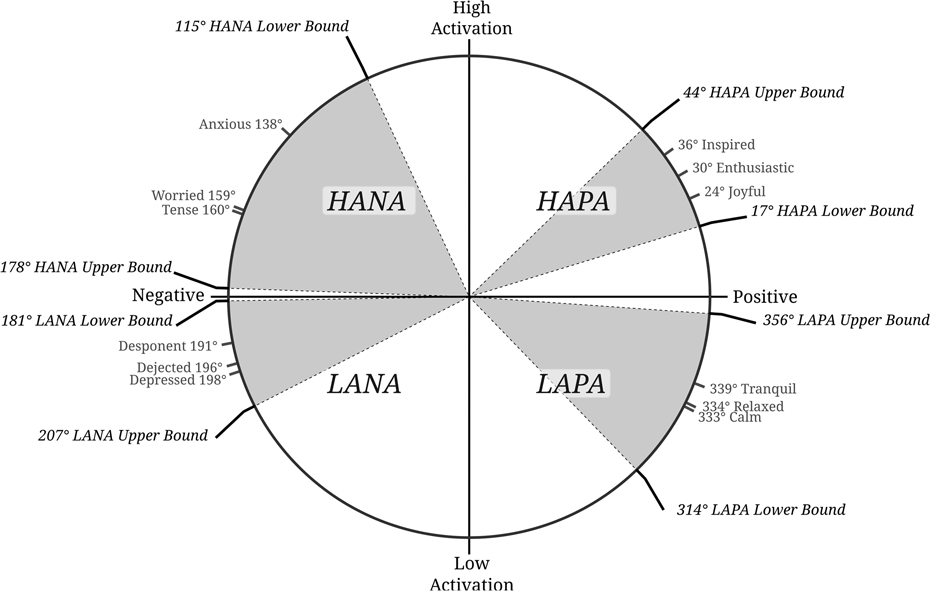
In CIRCUM, determining the polar angles of the Multi-Affect Indicator items in a circumplex representation required constraining communalities of items as equal, while leaving estimation of polar angles unconstrained. This implies that items are assumed as equidistant from the center of the circular representation, while polar angles of these items in the perimeter of the circumference are freely estimated. Furthermore, the item “entusiasmado(a) [enthusiastic]” was defined as the point of reference. Diverse studies in English samples have shown this item with a polar angle around 30° (Remington et al., Reference Remington, Fabrigar and Visser2000; Yik et al., Reference Yik, Russell and Steiger2011). Therefore, the polar angles observed in the CIRCUM analyses in this study were corrected, adding 30° to each item analyzed. The model showed very good goodness-of-fit (χ Footnote 2 = 139.85, df = 51, p < .01; χ2/df = 2.74, RMSEA = .06) Footnote 8 , indicating also that items of the Affect-Indicator have polar values in the areas of the circumplex expected according to theoretical expectations (See Table 4 and Diagram 3). For example, inspired showed a value of 36° being part of the HAPA region of the circumplex, tense showed a polar angle of 160° which is part of the HANA zone, and so on. These results offer additional evidence for the validity of the Multi-Affect indicator in Spanish.
Polar Angles for the Spanish Version of the Multi-Affect Indicator (Samples 2 and 3)

Polar angles and their confidence intervals for items of the Spanish version of the Multi-Affect Indicator. Enthusiastic was used as reference point in the estimation.
Discussion
Drawing on strong theory and advanced statistical techniques, this study provides evidence to support the factorial invariance of a 12-item Multi-Affect Indicator translated from English into Spanish. Results indicated that both versions of the instrument offer equivalent measures of the theoretical constructs described (HAPA, HANA, LANA, LAPA). Furthermore, results supported the basics of the Valence and Arousal Circumplex Model Affect (Posner et al., Reference Posner, Russell and Peterson2005; Russell, Reference Russell1980) and the framework of job-related affect proposed by Warr (Reference Warr2007) applied to non English-speaking samples of employees. Regarding the latter, affective states experienced at work were supported as substantively associated with job resources and job demands. This validated four-factor measure of affect in Spanish provides a finer grained approximation of affective life compared with measures already available, such us the Spanish form of PANAS (Robles & Paez, Reference Robles and Paez2003; Sandin et al., Reference Sandin, Chorot, Lostao, Joiner, Santed and Valiente1999) and the two bi-dimensional scales validated by Cifre and Salanova (Reference Cifre and Salanova2002).
The Spanish form of the Multi-Affect Indicator represents a valuable tool to stimulate new research on affect within Spanish speaking contexts. Furthermore, as a cross-validated instrument, the Multi-Affect Indicator also facilitates cross-cultural research based on Spanish and English samples. Results of this study support the descriptive structure of affective states as invariant between English and Spanish contexts; however, antecedents and consequences of affective states can vary depending on the cultural setting. Theoretical developments have suggested that cultural norms elicit specific affect when facing daily events (Parkinson, Reference Parkinson1996, Reference Parkinson2011). Similarly, previous research has indicated that the strength of the relationship between different forms of affect (e.g. between feeling happy and sad) may depend on cultural values (e.g. collectivistic, individualistic) (Schimmack, Oishi, & Diener, Reference Schimmack, Oishi and Diener2002). Furthermore, cultural norms may influence the extent to which affect states are displayed or not in social situations, affecting cognition and behavior embedded in interactional processes (Parkinson, Reference Parkinson1996). So, the availability of the Multi-Affect Indicator will hopefully progress research on affect in Spanish speaking cultures as well as develop cross-cultural comparative research.
Limitations of this study have to be discussed. First, inspection of the confidence interval for the polar angles observed (see Table 4 and Figure 3) indicate that with the exception of HANA, the quadrants’ areas covered by the measures of the Multi-Affect Indicator are slightly narrow. For instance, measures of LANA and LAPA are more sensitive to feelings with moderate activation; thus, the bottom part of the circumplex representation is less represented using these measures. In concrete terms, negative and positive affective states that involve very low energy expenditure are not captured by the Multi-Affect Indicator. Further research could be helpful in testing the need to include additional items to the current Multi-Affect Indicator, in order to increase its range of description for relevant affective states at work. Second, because this study relied on cross-sectional data, it was not possible to examine the longitudinal invariance of the Multi-Affect Indicator. Future studies aimed at testing these issues are necessary to determine the extent to which the measurement properties of the Multi-Affect Indicator are stable over time. Thirdly, the use of Internet-based surveys might affect the generalization of the results, due to lower representativeness of participants, higher levels of non-response rate and lack of control of response context (Birnbaum, Reference Birnbaum2004; Howell et al., Reference Howell, Rodzon, Kurai and Sanchez2010; Skitka & Sargis, Reference Skitka and Sargis2006). Regarding the latter, for example, URL links of the surveys were emailed at working time in the UK and Chile respectively, but there was no way to determine whether participants responded at work or at home. This might represent a source of uncontrolled bias, so complementary studies testing possible issues concerning completion of job-related affect measures at home are encouraged.
Polar angles estimated for the Spanish version of the Multi-Affect Indicator through CIRCUM.

Relevant implementation practices are recommended for using the Multi-Affect Indicator. Firstly, time frame of the affective measures should be clearly stated in the measure’s introduction. Affect is a dynamic phenomenon that could vary within a day or over several days (Beal, Weiss, Barros, & MacDermid, Reference Beal, Weiss, Barros and MacDermid2005). Thus, selection of an appropriate time frame depends on the specific affect construct of interest, and careful calibrations with the life span of the correlates (e.g. cognitive and behavioral processes) investigated in relation to affect. For example, some researchers may have interest on real-time or recent affective experience, such as momentary feelings and moods, while others interested on long-lasting affective experiences, such as affective well-being (Totterdell & Niven, Reference Totterdell, Niven and Weiss2012). Secondly, depending on the time frame of interest, response options should be accurately selected. Intensity ratings are more appropriate to capture real-time or recent affect, whereas frequency ratings are more suitable to measure differences in long-lasting affect (Warr, Reference Warr, Sinclair, Wang and Tetrick2013). Finally, despite the Multi-Affect Indicator being developed for work settings its use is not limited to this domain, and scope of these measures may be adjusted depending on specific research questions (Warr, Reference Warr2007). Some researchers may be interested on affective experience about life in general (context free), other in specific domains (e.g. work, school, family), while other in facets within specific domains (e.g. colleagues, classmates, parents). So, through minor adjustment of instructions, the Multi-Affect Indicator can be flexibly utilized in research topics with diverse goals (see Appendix).
Overall, this is one of the first efforts to validate an instrument of job-related affective states in Spanish oriented to measuring the four quadrants described by the Circumplex of Affect. In the appendix, norms of the mean scores observed in the Spanish-speaking samples for HAPA, HANA, LANA, LAPA are presented. This is intended to facilitate benchmarking initiatives and the interpretation of results observed in the application of the Spanish version of the Multi-Affect Indicator by researchers and practitioners who are involved in evaluating, monitoring or diagnosing affective states at work.
The authors would like to thank Professor Peter Warr for helpful comments on early versions of this manuscript, and Professor Michael Browne for advice on CIRCUM analysis.
Appendix Recommendations to the Practical Use of the Multi-Affect Indicator

The table presented below summarizes the mean scores and standard deviations of Multi-Affect Indicator measures observed for groups of people that comprised the Chilean samples used in this study (N total = 430).
Comparative Data by the Diverse Groups that Comprised the Samples of the Spanish-speaking Employees