Introduction
Carcinosarcoma is a malignant tumour with both malignant epithelial and mesenchymal components. It is extraordinarily rare in the larynx. True carcinosarcoma of the larynx and hypopharynx constitutes less than 1 per cent of all malignant neoplasms in this region.Reference Luna-Ortiz and Mosqueda-Taylor 1
Considerable controversy has long surrounded this pathological entity due to its heterogeneous terminology, rarity and disputed histogenesis.Reference Klijanienko, Vielh, Duvillard and Luboinski 2 Various terms have been used to describe this malignancy, including sarcomatoid carcinoma, pseudosarcoma, spindle cell carcinoma and carcinosarcoma.Reference Klijanienko, Vielh, Duvillard and Luboinski 2 – Reference Alexander, Walter, Varghese and Mary 4 To our knowledge, the former three terms represent different pathological types, while only carcinosarcoma denotes carcinoma occurring together with sarcoma in both primary and secondary sites.
We performed a retrospective study to review the presentation, diagnosis, treatment and outcome of a small series of patients with carcinosarcoma of the larynx seen in our hospital from 2003 to 2009; we also compare these patients' findings with the literature.
Materials and methods
Seven cases of carcinosarcoma of the larynx were identified from the files of the otolaryngology and pathology departments of the Eye, Ear, Nose and Throat Hospital of Fudan University, treated between 2003 and 2009. Clinical information regarding the presentation, immunohistochemistry, treatment and outcome was obtained from a review of patient charts. The follow-up time, until death or last contact, was determined for all patients. Haematoxylin and eosin (H&E) and immunohistochemically stained slides were reviewed and confirmed in all cases by two experienced pathologists.
Results
Patient demographics
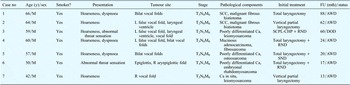
Seven patients (all male) with laryngeal carcinosarcoma were evaluated (Table I). The mean age at diagnosis was 56.9 years (range, 42–66 years). The mean duration of the disease was 5.3 months (range, 1–12 months). All patients had a history of cigarette smoking, and none had a history of exposure to environmental carcinogens (especially radiation). Presenting complaints, in order of decreasing frequency, included hoarseness, dyspnoea, and abnormal sensation of the throat for 1–12 months before diagnosis.
Laryngeal carcinosarcoma cases: clinical characteristics

No = number; y = years; Smoker = history of smoking; FU = follow up; mth = months; M = male; Bilat = bilateral; T = tumour; N = node; M = metastasis; SCC = squamous cell carcinoma; AWD = alive with disease; L = left; Ca = carcinoma; SCPL-CHP = supracricoid partial laryngectomy-cricohyoidopexy; RND = radical neck dissection; DOD = dead of disease; SND = selective neck dissection; R = right
The tumours were located in the glottic or supraglottic regions. Three patients had tumour (T) stage 2 disease and the other four had T3 disease, staged using the American Joint Committee on Cancer tumour-node-metastasis system.
Diagnosis and pathology
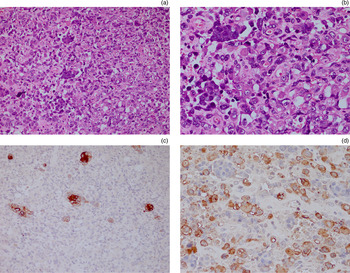
The diagnosis of carcinosarcoma was made after the initial biopsy of the neoplasm at operative microlaryngoscopy, and confirmed after complete resection, using H&E and immunohistochemical stains. Histopathologically, the tumours had both carcinomatous and sarcomatous components (Figure 1).
Photomicrographs showing the histopathological appearance of carcinosarcoma of the larynx (case six). (a) The biphasic appearance of the tumour, with a malignant epithelial component (poorly differentiated carcinoma) and a mesenchymal component (embryonal rhabdomyosarcoma) (H&E; ×200). (c) Cancer nests scattered in a sarcomatous background (H&E; ×400). (c) Intense cytoplasmic immunostaining for cytokeratin (CKpan) in the malignant epithelial component (SP; ×200). (d) Cytoplasmic immunostaining for muscle-specific actin in the malignant mesenchymal component (SP; ×400).

Due to the variety of histological features of carcinosarcoma, immunohistochemical analysis is a valuable diagnostic adjunct to histological examination, and a broad panel of antibodies is necessary to verify the diagnosis.
Treatment and follow up
The seven patients underwent various operations with curative intent (Table I). The therapeutic principles followed those for squamous cell carcinoma of the larynx. Three patients were treated with larynx-preserving approaches (two vertical partial laryngectomies and one supracricoid partial laryngectomy-cricohyoidopexy); the other four underwent total laryngectomy. Four patients underwent either radical or selective neck dissection, two of whom were confirmed to have nodal metastases. No patient received post-operative chemotherapy or radiotherapy.
The average length of follow up for these 7 patients was 40.6 (range 13–88) months. At the time of writing, six patients were alive and still being followed; two of these had suffered regional metastasis to cervical lymphatic nodes and had undergone radical neck dissections. One patient had died of multiple distant metastases (lung and pancreas) 60 months post-operatively.
Discussion
Carcinosarcoma is a rare, malignant tumour with both carcinomatous and sarcomatous components.Reference Klijanienko, Vielh, Duvillard and Luboinski 2 Four aetiological hypotheses have been proposed: (1) a carcinoma with a reactive mesenchymal proliferation; (2) a collision tumour in which carcinoma and sarcoma develop simultaneously but independently; (3) a malignancy arising in an embryonic rest of epithelial and mesenchymal tissues; and (4) double differentiation of a totipotent malignant cell into carcinomatous and sarcomatous components.Reference Wick and Swanson 5 , Reference Ernster, Franquemont and Sweeney 6 Each of the first three hypotheses has weaknesses, and the fourth is probably the most acceptable.
It is difficult to assess the true incidence of this pathological entity and to reach consensus regarding its management, because of the heterogeneous terminology used to define these tumours in the literature. With developments in histology and immunohistochemistry, we can differentiate carcinosarcoma from other terms. The terms sarcomatoid carcinoma, pseudosarcoma and spindle cell carcinoma represent the same tumour, i.e. a squamous cell carcinoma with spindle cell changes that simulate a sarcoma, in which the epithelial component is positive for cytokeratin and the sarcomatoid component is positive for cytokeratin and occasionally positive for vimentin with the coexpression of cytokeratin.Reference Luna-Ortiz and Mosqueda-Taylor 1 By contrast, the term carcinosarcoma refers to a biphasic neoplasm composed of malignant epithelial and mesenchymal components, in which the epithelial component is positive for cytokeratin and the mesenchymal component is positive for vimentin and other markers, depending on the differentiation expressed by the tumour.Reference Luna-Ortiz and Mosqueda-Taylor 1 Regarding the larynx, the terms carcinosarcoma and malignant mixed tumour used in the literature might describe the same tumour.Reference Nistal, Yébenes-Gregorio, Esteban-Rodríguez, Bernáldez and Regadera 7 Using the above criteria to make the diagnosis, we conclude that true carcinosarcoma of the larynx is extremely rare.
The clinical presentation of laryngeal carcinosarcoma does not differ from that of other laryngeal carcinomas, and its incidence may be the same in both genders.Reference Stomeo, Rocca, Bozzo, Bianchini, Meloni and Pastore 8 In their report of their large series of ‘spindle cell (sarcomatoid) carcinomas of the larynx’, Thompson et al. described the following characteristics of these tumours: male preponderance (93.0 per cent); history of heavy tobacco (87 per cent) and alcohol (48 per cent) use; hoarseness as the most frequent symptom (88 per cent); the glottis as the most common site (71 per cent); and a polypoid appearance (99 per cent) with surface ulceration.Reference Thompson, Wieneke, Miettinen and Heffner 9
However, as most reports concern laryngeal spindle cell carcinomas, we believe that the cases reviewed were more than just true carcinosarcomas. In our series, we observed a male predominance: all patients were male and heavy smokers. Hoarseness was the most frequent symptom, in 85.7 per cent (six of seven cases), and other symptoms included dyspnoea and an abnormal sensation in the throat. Regarding the primary site, four were located in the glottis and three in the supraglottis. We could not draw any epidemiological conclusions because of the small number of patients.
There is no consensus on what constitutes reasonable therapy for patients with laryngeal carcinosarcoma. We favour managing these tumours initially with surgical excision with wide margins, like most authors.Reference Luna-Ortiz and Mosqueda-Taylor 1 , Reference Stomeo, Rocca, Bozzo, Bianchini, Meloni and Pastore 8 , Reference Ianniello, Ferri, Armato, Longo and Zambenedetti 10 , Reference Marioni, Bottin, Staffieri and Altavilla 11 The specific operative approach should be based on the tumour stage, location and size, just as if these patients had conventional squamous cell carcinoma. However, we do not recommend radiotherapy because the mesenchymal component is resistant to irradiation. Although there are reports that ‘sarcomatoid carcinoma’ responds to radiation therapy, we again emphasise that this entity is, fundamentally, squamous cell carcinoma.Reference Ballo, Garden, EI-Naggar, Gillenwater, Morrison and Goepfert 12 Lymph node metastases are frequent and neck dissection is indicated. In our series, four patients underwent total laryngectomy and three underwent various forms of partial laryngectomy. Four patients underwent neck dissection and two had cervical lymph node metastasis confirmed in a post-operative biopsy.
-
• Carcinosarcoma has both malignant epithelial and mesenchymal components
-
• It is rare, and extremely rare in the larynx
-
• Its terminology and histogenesis are controversial
-
• Thorough histological and immunohistochemical evaluation is the key to correct diagnosis
-
• Complete surgical resection with wide margins, plus suitable neck dissection for cervical nodes, is reasonable therapy
The prognosis of these tumours is also controversial.Reference Nistal, Yébenes-Gregorio, Esteban-Rodríguez, Bernáldez and Regadera 7 , Reference Stomeo, Rocca, Bozzo, Bianchini, Meloni and Pastore 8 In our group, at the time of writing, two patients had suffered regional cervical lymph node metastasis and were still alive with disease after neck dissection, while one patient had died from distant metastasis. The prognosis of carcinosarcoma of the larynx seems to be worse than that of squamous cell laryngeal carcinoma, and metastasis to cervical lymph nodes seems to be more frequent.
Conclusion
Carcinosarcoma of the larynx is extraordinarily rare and prone to metastasise to the cervical lymph nodes. The term carcinosarcoma appropriately describes tumours showing both carcinomatous and sarcomatous differentiation, which might represent divergent differentiation from a totipotent precursor cell. A thorough histological and immunohistochemical evaluation is the key to correct diagnosis. Complete surgical resection of the laryngeal primary lesions with wide margins, together with suitable neck dissection of the cervical lymph nodes, constitutes reasonable therapy. Close, frequent follow up is necessary to detect local recurrence or metastatic disease.
Of course, it is essential to gather more data on the biological behaviour of these tumours, so that appropriate prognostic factors and treatment modalities can be determined.