The increasing incidence of infections associated with multidrug-resistant organisms (MDROs) is one of the most pressing public health problems globally in the 21st century, and is of importance not only in acute-care hospitals (ACHs) but also in intermediate- and long-term care facilities (ILTCFs). Reference Cohen1 Infections caused by MDROs are estimated to increase clinical and economic adverse outcomes by 2-fold compared with similar infections caused by susceptible strains of the same organism. Reference Eliopoulos, Cosgrove and Carmeli2,Reference Friedman, Temkin and Carmeli3
The healthcare environment has been identified as a major reservoir of multiple MDROs such as methicillin-resistant Staphylococcus aureus (MRSA), vancomycin-resistant enterococci (VRE), and more recently carbapenemase-producing Enterobacterales (CPE). Reference Chow, Htun and Hon4–Reference Elstrøm, Astrup, Hegstad, Samuelsen, Enger and Kacelnik9 MRSA infections have previously been successfully treated with vancomycin, a glycopeptide antibiotic, until the emergence of vancomycin-intermediate Staphylococcus aureus (VISA), followed by vancomycin-resistant Staphylococcus aureus (VRSA). Reference Liu and Chambers10 Since 1996, infections caused by VISA and heterogeneous VISA (hVISA) have been reported in tertiary-care hospitals in developed countries, including Singapore. Reference Sng, Koh, Wang, Hsu, Kapi and Hiramatsu11–Reference Weinstein and Fridkin14 VRSA occurs when MRSA acquires a vanA gene through genetic conjugation with VRE from studying the specimens collected from patients co-colonized with MRSA/VRE. Reference Noble, Virani and Cree15 In a study involving an interconnected healthcare network in Singapore, the prevalence of vanA was very high (94% of total VRE isolates) across healthcare settings. Reference Tan, Htun and Koh5 The prevalence of CPE has also been rising over the years, especially in ACHs. Reference Aung, Kanagasabai and Koh7
Many previous studies were conducted to explore the occurrence and risk factors of co-colonization, especially MRSA/VRE, in specific healthcare settings such as ACHs, LTCFs, or intensive care units. However, to date, information has been limited on the comparative epidemiology of co-colonization between patients from different healthcare settings. Thus, assessments of facility-specific determinants at which targeted interventions could be developed are lacking. Furthermore, sparse data are available for co-colonization rates of CPE in addition to MRSA/VRE.
We contemporaneously compared the epidemiology of MDROs co-colonization among patients from 7 different but interconnected healthcare facilities. We sought to identify common and differential risk factors between facility types that might serve to define at-risk groups for whom targeted infection prevention and control efforts could be implemented.
Methods
Study design, setting, and participants
We conducted a serial cross-sectional surveillance study over 6 weeks during June–July for 3 consecutive years from 2014 to 2016 in a 1,700-bed, adult, tertiary, acute-care hospital (ACH) in Singapore and its 3 closely affiliated intermediate-term care facilities (ITCFs): a 100-bed rehabilitation center, a 360-bed community hospital, and a 116-bed community hospital. This health system also includes 3 long-term care facilities (LTCFs): a 234-bed nursing home, a 164-bed chronic illness unit, and a 236-bed nursing home (open since 2015). Stratified sampling for patients admitted to the ACH with a ≥48-hour stay proportional to the bed census of the ward was performed, although we included all residents of the ITCFs and LTCFs who consented to participate in the study. The ITCFs, also known as community hospitals, provide medical, nursing, and rehabilitation care for patients who require a short period of continuing care, usually after discharge from an ACH. The LTCFs (or nursing homes) provide care for long-staying residents who require long-term assistance and nursing care with most of their activities of daily living.
Microbiological analysis
We concurrently collected the specimens including separate nasal, axillary, and groin swabs to investigate for MRSA, and we collected rectal swabs (or stool samples from participants who declined rectal swab) to screen for VRE and CPE, on the same day. Methodological details of laboratory investigations were reported in our previous publications, Reference Chow, Htun and Hon4,Reference Tan, Htun and Koh5,Reference Aung, Kanagasabai and Koh7,Reference Htun, Hon, Holden, Ang and Chow16 with a brief description provided in the supplementary methods. Participants whose specimens did not yield any bacterial isolation were classified as non-colonized. We have previously reported the risk factors in single pathogen-specific studies. Reference Chow, Htun and Hon4,Reference Tan, Htun and Koh5,Reference Aung, Kanagasabai and Koh7 In this study, we focused on the co-colonization of the pathogens and classified patients as co-colonized if they had >1 positive culture of MRSA, VRE, and/or CPE in their concurrent specimens. We classified patients as singly-colonized otherwise.
Data collection and quantitative variables
We collected several groups of study data. First, we collected demographics (age, sex, ethnicity) and comorbidities (cerebrovascular disease, congestive cardiac failure, connective tissue disease, chronic pulmonary disease, diabetes mellitus, myocardial infarction, peptic ulcer disease, peripheral vascular disease, chronic renal disease, and human immunodeficiency virus infection) to obtain the Charlson’s comorbidity index (CCI) and categorized it into ≤5 and >5. We included the use of percutaneous devices and peripheral lines in the preceding 12 months. The variables of interest from the current admission included length of stay (LOS) at the time of specimen collection, healthcare facility type, and number of beds per room. We also ascertained prior admission to intensive care unit or any healthcare facilities in the preceding 12 months; prior MRSA, VRE and carbapenemase-resistant Enterobacterales (CRE) colonization in the 12 months preceding screening. Other patient data included prior antibiotic use in the preceding 12 months including aminoglycoside, carbapenem, cephalosporin, fluoroquinolone, penicillin and vancomycin; prior emergency surgery in preceding 12 months; any type of surgical treatment in the preceding 90 days; and presence of open wounds in the preceding 12 months, based on published literature. Reference Hidron, Kourbatova and Halvosa17,Reference Young, Lye, Krishnan, Chan and Leo18 Prior antibiotic use was further categorized into 0, 1–3, 4–7, and >7 days of therapy (DOT).
Data were collected electronically from the ACH and ILTCF electronic medical records (EMRs). In the ILTCFs where EMR data were unavailable, clinical data were collected manually from paper-based medical records by trained research assistants in a standardized fashion.
Statistical analysis
Characteristics of patients were described with frequencies and percentages for categorical variables, mean and standard deviation (SD), and median and interquartile range (IQR) for continuous and ordinal variables, respectively. The differences among the non-colonized group, the single colonization group, and the co-colonized groups were compared using the Pearson’s χ2 test or the Fisher’s exact test for categorical variables. We used the one-way ANOVA test or Kruskal-Wallis test for continuous variables. Multinomial logistic regression was performed to estimate odds ratios (ORs) and calculate 95% confidence intervals (CIs). Significant variables from descriptive statistical analysis were used to build a multivariable model. Model 2 (full model) included the following variables: age >65 years, sex, year screened, CCI > 5, any percutaneous devices, peripheral line, LOS >14 days, admitted healthcare facility, number of beds per room, prior ICU admission, prior hospital/ILTCFs admission, prior carriage of MRSA/VRE/CRE, days of antibiotic therapy, prior emergency surgical care, surgical care in the past 90 days, and open wounds. Next, these variables were considered for inclusion in the subsequent multivariable model in backward stepwise selection, that is, model 3 (stepwise model). Although we adjusted for age, sex, and year in the stepwise model, other variables were retained only if P < .05. We further explored the interaction between prior carriage of MRSA/VRE/CRE and LOS >14 days in model 4 (final model) along with the variables included in model 3. Additionally, we performed a multinomial logistic regression stratified by healthcare facility (ACH vis-à-vis ILTCFs) using explanatory variables from model 4. All reported P values were 2-tailed with an α level of 0.05. All statistical analyses were performed using Stata version 13.1 software (StataCorp College Station, TX).
Ethics approval
The study was approved by the Domain Specific Research Board, National Healthcare Group (reference no. 2014/01139). Informed consent was provided by all cognitively intact participants or the legally authorized representatives (LARs) of cognitively impaired participants. A waiver of informed consent was granted for cognitively impaired participants from the ILTCFs who had no LAR.
Results
Characteristics of patients
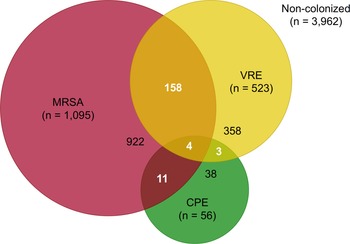
From 2014 to 2016, we recruited 5,456 patients, and 1,494 (27.4%) were colonized with 1 or more MRSA/VRE/CPE: 1,318 (24.2%) were singly-colonized versus 176 (3.2%) who were co-colonized. MRSA/VRE was the most common type of co-colonization among our study participants (n = 162, 3.0%). Period prevalence of CPE co-colonized with MRSA and/or VRE was very low (0.1%–0.3%) (Fig. 1). Single colonization was most common in ITCF patients (n = 458, 36.5%), whereas co-colonization was equally frequent among ACH patients (n = 120, 3.9%) and ITCF patients (n = 53, 4.2%) but was very infrequent in LTCF patients (n = 3, 0.3%; P < .001) (Supplementary Table 1 online).
Diagrammatic presentation of colonization status among study participants. Non-colonized (n = 3,962, 72.6%); singly-colonized with MRSA (n = 1,095, 20.1%), with VRE (n = 523, 9.6%), and with CPE (n = 56, 1.0%); and co-colonized with MRSA/VRE (n = 162, 3.0%), VRE/CPE (n = 7, 0.1%), MRSA/CPE (n = 15, 0.3%), and MRSA/VRE/CPE (n = 4, 0.1%). Note. CPE, carbapenemase-producing Enterobacterales; MRSA, methicillin-resistant Staphylococcus aureus; VRE, vancomycin-resistant enterococci.

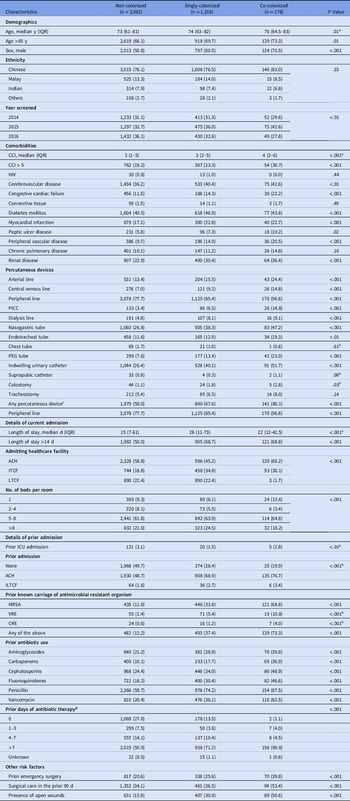
Patients with the following factors were more likely to be co-colonized: older, male, or had a higher CCI, a percutaneous device, a peripheral line, prior admission to ACH or ILTCF, prior carriage of MRSA/VRE/CRE, prior and longer DOT of antibiotics, prior emergency surgery, surgery in the preceding 90 days, and/or an open wound. A longer LOS was observed more frequently both in singly and co-colonized patients compared to non-colonized patients (Table 1).
Epidemiological and Clinical Characteristics of Patients by Status of MDRO Colonization

Note. Values are expressed in no. (%) unless indicated otherwise. MDRO, multidrug-resistant organism; IQR, interquartile range; ACH, acute-care hospital; ILTCF; intermediate or long-term care facility; MRSA, methicillin-resistant Staphylococcus aureus; VRE, vancomycin-resistant enterococci; CRE, carbapenemase-producing Enterobacterales; CCI, Charlson comorbidity index; HIV, human immunodeficiency virus; PICC, peripherally inserted central catheter; PEG, percutaneous endoscopic gastrostomy.
a Kruskal-Wallis test.
b Fisher exact test.
c Any percutaneous devices included procedures such as tracheostomy or colostomy, or insertion of any of the following: arterial line, dialysis line, peripherally inserted central catheter, endotracheal tube, chest tube, PEG tube or suprapubic catheter in the preceding 12 months.
d Prior days of antibiotic therapy included aminoglycosides, carbapenems, cephalosporins, fluoroquinolones, penicillin, and vancomycin in the preceding 12 months.
Risk factors for colonization
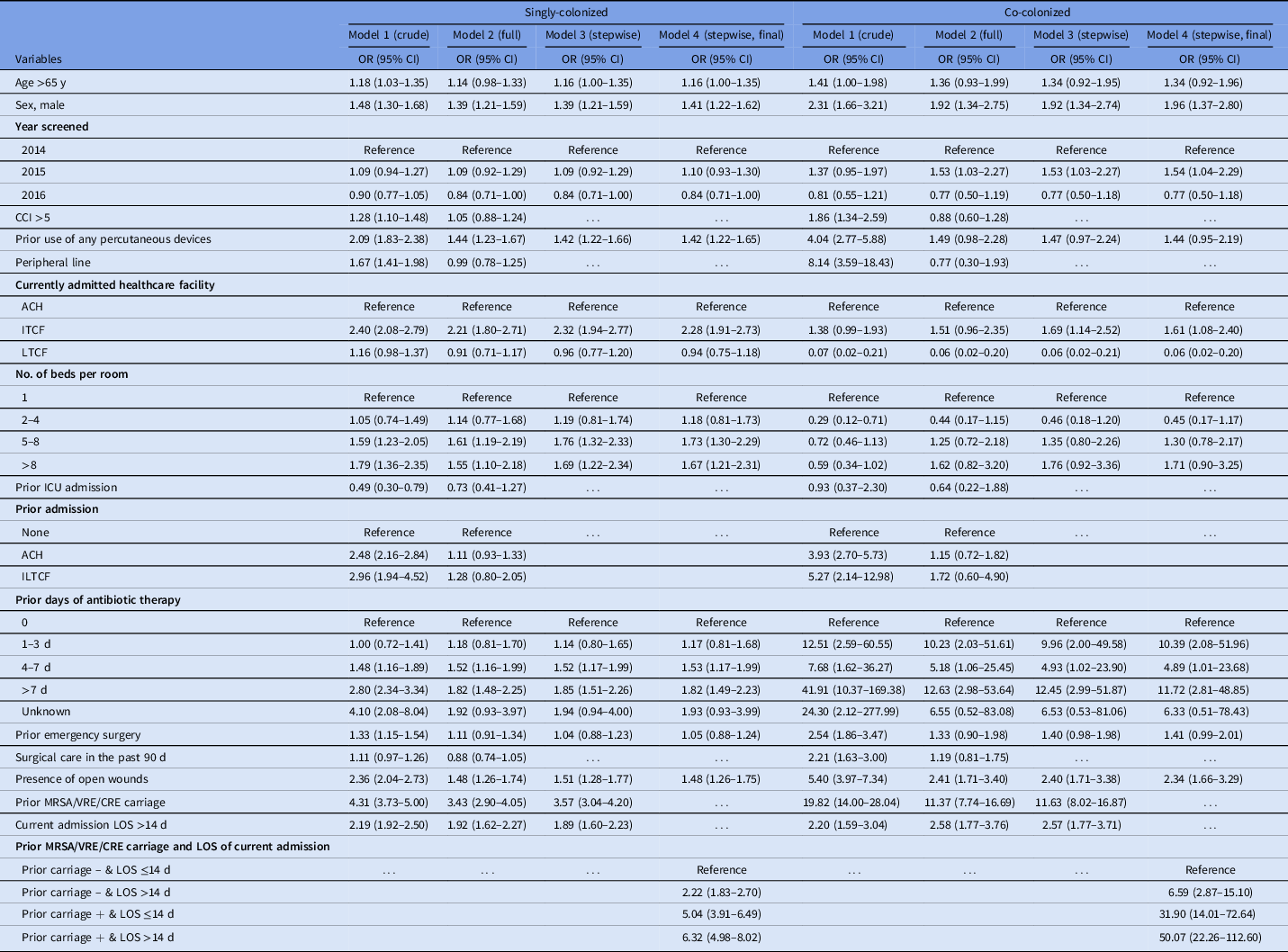
In the multinomial logistic regression analysis, the reference category was non-colonized patients. First, after adjusting for age, year of screening, healthcare facility and prior emergency surgery, the following risk factors were associated with single colonization: male sex (OR, 1.41; 95% CI, 1.22–1.62), prior use of a percutaneous device (OR, 1.42; 95% CI, 1.22–1.65), 2–4 beds per room (OR, 1.18; 95% CI, 0.81–1.73), 5–8 beds per room (OR, 1.73; 95% CI, 1.30–2.29), and >8 beds per room (OR, 1.67; 95% CI, 1.21–2.31), 1–3 DOT of antibiotics (OR, 1.17; 95% CI, 0.81–1.68), 4–7 DOT (OR, 1.53; 95% CI, 1.17–1.99), >7 DOT (OR, 1.82; 95% CI, 1.49–2.23), presence of open wounds (OR, 1.48; 95% CI, 1.26–1.75), LOS ≤14 days in the absence of prior MDRO carriage (OR, 2.22; 95% CI, 1.83–2.70), LOS ≤ 14 days in the presence of prior MDRO carriage (OR, 5.04; 95% CI, 3.91–6.49), and LOS>14 days in the presence of prior MDRO carriage (OR, 6.32; 95% CI, 4.98–8.02) (Table 2).
Multivariable Multinomial Logistic Regression Analysis of Risk Factors for Singly-colonized or Co-colonized Patients With Either MRSA, VRE or CPE a

Note. MRSA, methicillin-resistant Staphylococcus aureus; VRE, vancomycin-resistant enterococci; CRE, carbapenemase-producing Enterobacterales; ACH, acute-care hospital; CCI, Charlson comorbidity index; CI, confidence interval; ICU, intensive care unit; ILTCF, intermediate- and long-term care facility; LOS, length of stay; OR, odds ratio.
a With non-colonized as the reference category.
Next, after adjusting for age, year of screening, healthcare facility, percutaneous device and number of beds per room, odds of co-colonization increased as follows: male (OR, 1.96; 95% CI, 1.37–2.80), 1–3 DOT of antibiotics (OR, 10.39; 95% CI, 2.08–51.96), 4–7 DOT (OR, 4.89; 95% CI, 1.01–23.68), >7 DOT (OR, 11.72; 95% CI, 2.81–48.85), prior emergency surgery (OR, 1.41; 95% CI, 0.99–2.01), and open wound (OR, 2.34; 95% CI, 1.66–3.29). Interestingly, we observed an interaction between prior MDRO carriage and LOS of current admission on an additive scale. Compared to patients who had no prior MDRO carriage and an LOS ≤14 days, the odds ratio of co-colonization for patients with LOS>14 days but no carriage was 6.59 (95% CI, 2.87–15.10) and the odds ratio was 31.90 (95% CI, 14.01–72.64) for individuals with a history of MDRO carriage but LOS≤14 days, which increased to 50.07 (95% CI, 22.26–112.60) when the patients had both risk factors (Table 2).
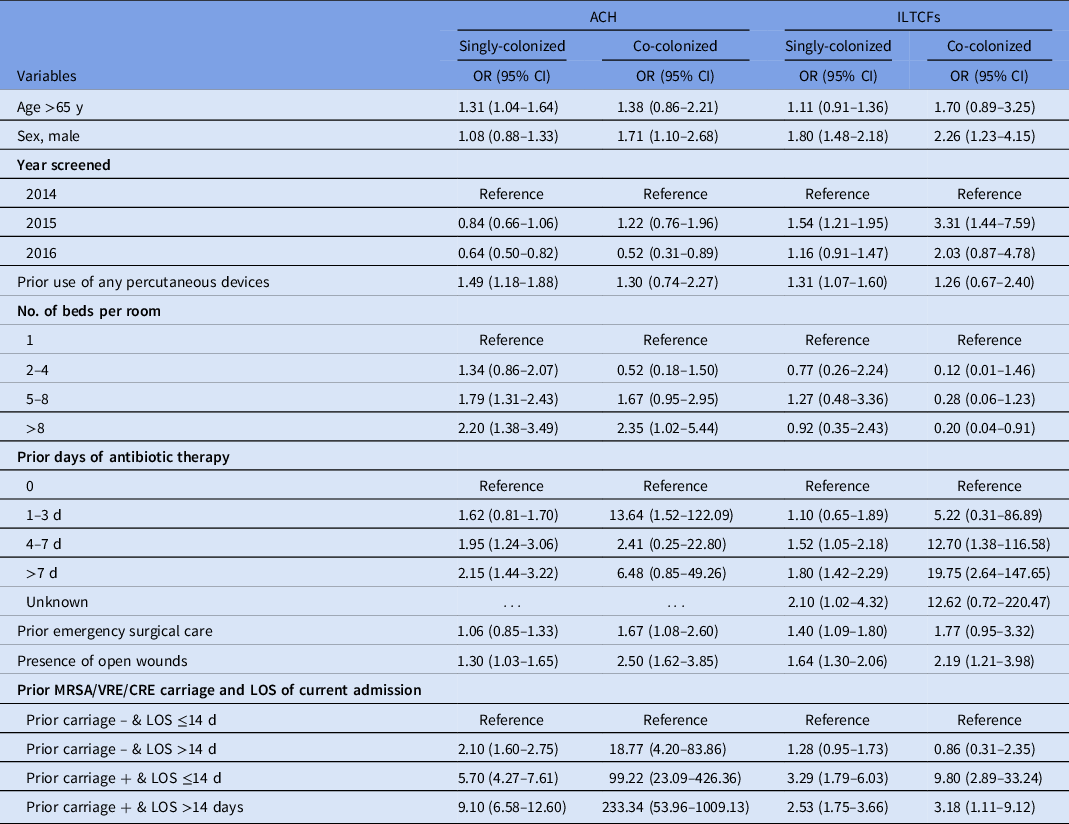
Stratified multinomial logistic regression by healthcare facility further revealed a dose–response relationship of DOT of antibiotics on co-colonization in ILTCFs: 1–3 DOT (OR, 5.22; 95% CI, 0.31–86.89), 4–7 DOT (OR, 12.70; 95% CI, 1.38–116.58), >7 DOT (OR, 19.75; 95% CI, 2.64–147.65). Additionally, a prior emergency surgery was a significant risk factor for co-colonization in ACH patients, but this factor was associated with single colonization in ILTCFs. Number of beds per room remained a significant risk factor for single colonization in ACH but not in ILTCFs. Notably, joint association between prior MDRO carriage and LOS on single colonization continued to be significant both in the ACH and the ILTCFs; however, the additive interaction was evident for co-colonization among ACH patients only (Table 3).
Stratified Multivariable Multinomial Logistic Regression Analysis of Risk Factors for Singly-colonized or Co-colonized Patients With Either MRSA, VRE or CPE a for Patients Admitted to the ACH or ILTCFs

Note. ACH, acute-care hospital; CI, confidence interval; ILTCFs, intermediate- and long-term care facilities; LOS, length of stay; OR, odds ratio.
a With non-colonized as the reference category.
Discussion
We identified healthcare setting-specific factors associated with MDRO co-colonization, and we also compared the epidemiology of MDRO co-colonization in an ACH with its closely affiliated 6 ILTCFs in a healthcare network over 3 years. We observed that both single and co-colonization were more prevalent in the ITCFs (36.5% and 4.2%) than in the ACH (19.6% and 3.9%) and LTCFs (22.8% and 0.3%). This prevalence is likely due to the high prevalence of MRSA among ITCF patients in our study population, as described previously. Reference Chow, Htun and Hon4 Although co-colonization remained infrequent, it was largely contributed by MRSA/VRE (3.0%); other types of MDRO co-colonization occurred infrequently at 0.1%–0.3%. These rates were significantly lower than the prevalence reported in other studies from the United States, Reference Hayakawa, Marchaim and Bathina19–Reference Flannery, Wang, Zöllner, Foxman, Mobley and Mody23 although a similar prevalence was observed in 2 studies conducted in intensive care units and a rehabilitation hospital. Reference Furuno, Perencevich and Johnson24–Reference Rabinowitz, Kufera and Makley26 In contrast, a German acute-care hospital reported a lower prevalence than our finding. Reference Meyer, Ziegler, Mattner, Schwab, Gastmeier and Martin27 A recent meta-analysis estimated that the pooled prevalence of MRSA/VRE co-colonization was 7% (95% CI, 5%–9%) despite the evidence of statistical heterogeneity and publication bias. Reference Wang, Oppong, Liang, Duan and Yang28 The variability of prevalence across studies can be explained by differences in study population, healthcare facility, use of surveillance or clinical specimens for identification, and definition of co-colonization.
Open wounds and prior use of antibiotics were independent risk factors for single and co-colonization in both the ACH and the ILTCFs, consistent with other studies. Reference Reyes, Malik and Moore20,Reference Heinze, Kabeto, Martin, Cassone, Hicks and Mody22–Reference Furuno, Perencevich and Johnson24 Both acute and chronic wounds, as previously studied, have the propensity to develop biofilms that are communities of microorganisms attached to a surface, Reference Flemming and Wingender29 and are often associated with increased risk of bacterial growth and infection. Reference Percival30 Inappropriate antibiotic uses are well-recognized drivers for the emergence of MDROs. Wang et al Reference Wang, Foxman, Mody and Snitkin31 reported that antibiotics not only elevated the risk of primary MDRO colonization but also increased the likelihood of colonization and infection by other MDROs among LTCFs residents. This report is reflected in our finding that the effect sizes of antibiotic use on co-colonization were significantly higher in ILTCFs patients, posing a concern to infection prevention and control practitioners because of the frequent transfers between ILTCFs and ACH in an interconnected healthcare network. Therefore, good comprehensive antibiotic stewardship programs that enforce the judicious antibiotic use are urgently required in both ACH and ILTCFs.
The prior use of any percutaneous device was a significant predictor of single colonization but was not significantly associated with co-colonization, in both the ACH and ILTCF patients in our study. In contrast, device use was a significant determinant of co-colonization in previous studies conducted in different healthcare settings. Reference Hayakawa, Marchaim and Bathina19,Reference Heinze, Kabeto, Martin, Cassone, Hicks and Mody22,Reference Sigurdardottir, Berg and Hu32,Reference Yoon, Lee and Ju33 Although the reason remains unclear, variation in anatomic sites of sampling across the studies may explain the difference. We further noted that the odds ratio for percutaneous device was attenuated when antibiotics was added to the model in our multivariable analysis of co-colonization. This finding indicates that antibiotic was a stronger predictor, which in turn supported the aforementioned observation of association between a history of antibiotic consumption and co-colonization.
In this study, emergency surgery was a risk factor in the ILTCFs and the ACH for single- and co-colonization, respectively. Surgery has previously been identified as a predictor of MRSA infection, Reference Graffunder and Venezia34,Reference Callejo-Torre, Eiros Bouza and Olaechea Astigarraga35 and it may represent a breakdown of the host defense mechanism, surgical technique, or postoperative care, and it may mandate more contact-intensive care, which creates the opportunity for new bacterial acquisition. A higher number of beds per room was associated with single colonization in ACH patients but not in ILTCF residents, which corroborates the findings from earlier studies on VRE and MRSA colonization. Reference Tan, Htun and Koh5,Reference Kibbler, Quick and O’Neill36 This association could be the result of different care models between the ACH and ILTCFs in which the residents are encouraged to ambulate and share common facilities such as the rehabilitation gymnasium.
The greater risk of MDRO colonization among LTCF residents and those who had a history of MDRO carriage has been consistently demonstrated, Reference Chow, Htun and Hon4,Reference Tan, Htun and Koh5,Reference Aung, Kanagasabai and Koh7,Reference Heinze, Kabeto, Martin, Cassone, Hicks and Mody22 but we revealed, in addition, the synergistic effects of longer LOS and prior MDRO carriage, especially on MDRO co-colonization in the ACH setting. This finding suggests that ACH is a reservoir of multiple MDROs and that targeted MDRO screening and pre-emptive precautionary measures for at-risk patients may reduce co-colonization.
Our study has several strengths. First, including the participants from different healthcare settings allowed us to concurrently assess the prevalence and compare the epidemiology of co-colonization among short- and long-stay populations in an ACH and ILTCFs, respectively, thus ensuring the generalizability of findings. Second, a large sample of patients and an 87% participation rate reduced the risk of selection bias, if any. Third, collection of stool specimen for those who refused rectal swabs minimized the underestimation of VRE and CPE colonization. Fourth, research assistants were trained to standardize data and specimen collection methods, and the identification of bacterial isolates further was confirmed by matrix-assisted laser desorption ionization-time of flight (MALDI-TOF) mass spectrometry, reducing potential measurement errors and outcome misclassifications. Finally, we demonstrated the joint effects of LOS and a history of MDRO carriage on co-colonization, especially among ACH patients. This finding gives new insights into developing infection prevention and control strategies for the at-risk population to reduce MDRO co-colonization and prevent healthcare-associated infections.
This study has several limitations. Clinical data collection was performed retrospectively through reviewing EMR or medical case notes, which might have resulted in missing data if no documentation was made. However, any exposure misclassification was likely nondifferential, moving the observed effects toward the null. Also, the epidemiology of triple-colonized patients could not be elaborated due to their very small number (n = 4). Finally, because different anatomic sites were screened for the different MDROs in accordance with the most commonly colonized sites based on local epidemiology, we could not determine the anatomic site–level prevalence of co-colonization, as revealed by a study in which the incidence of MRSA/VRE concurrent co-colonization was highest in hands, Reference Heinze, Kabeto, Martin, Cassone, Hicks and Mody22 thus warranting further studies.
In summary, we identified common and differential risk factors associated with MDRO co-colonization between an ACH and its affiliated ILTCFs. Although emergency surgery increased the odds of co-colonization in an ACH, a longer duration of antibiotic therapy was a strong risk factor in ILTCF patients. Open wounds, a prior MDRO carriage, and LOS >14 days were risk factors common to all facilities. Infection prevention and control strategies, including pre-emptive contact precautions and active screening of at-risk populations specific to the healthcare setting, could be instituted.
Supplementary material
To view supplementary material for this article, please visit https://doi.org/10.1017/ice.2022.57
Acknowledgments
We thank all patients who participated in this study and the staff who facilitated the study.
Financial support
This study was funded by the Ministry of Health’s Communicable Diseases Public Health (research grant no. CDPHRG/0008/2014). The funders had no role in study design, data collection and interpretation, or the decision to submit the work for publication.
Conflicts of interest
All authors report no conflicts of interest relevant to this article.