Introduction
Sweden-born Lourens Alström served as a common seaman aboard the Dutch merchant vessel De Vleyt [Industriousness] when in March 1781 it was taken by the British Navy, off the Cornish coast, as a (potential) prize of war. Having been brought to the coastal town of Penryn, Alström was subsequently interrogated by a clerk of the High Court of Admiralty (HCA), a standard, strictly formalized procedure aimed at determining the legality of the seizing of the ship. The seaman was questioned about various issues relating to the ship and its cargo, but also about her crew and, indeed, about himself. Alström declared that he was born in the Swedish capital of Stockholm in 1741, but for the last eight years had lived in Amsterdam in the Netherlands. From his testimony we know that he was not the only labor migrant aboard the Dutch ship. Six men came from Germany, two from Sweden (Alström included), and only one came from Holland. Two colleagues who were also interrogated also declared to have migrated to Amsterdam. The captain of the ship, Claas Eehlers, born in Cuxhaven in Germany, declared to have lived in Amsterdam since 1759; he even received official citizenship there. Jacob Faber, who like Alström also served as a common sailor aboard De Vleyt, was born in the Southern Swedish town of Kalmar, and had also moved to Amsterdam in the decade before 1781.
The migration histories of Alström, Eehler, and Faber are anything but exceptional: migration was a common feature of preindustrial societies. Because the vast majority of migrations took place within the confines of a country, a province, or even a parish, in most cases such moves occurred over relatively short distances. However, long-distance migrations, which, like in the case of the three mariners described in the preceding text, involved moves of hundreds of kilometers or more, often resulting in individuals entering foreign territories, were hardly rare (Bade Reference Bade2003; Hoerder Reference Hoerder2002; Manning Reference Manning2005; Page Moch Reference Page Moch2003; Van Lottum 2007). Recent estimates show that international mobility levels increased strongly after the medieval period, peaking in the late seventeenth century. In the latter half of the seventeenth century an estimated 8 percent of European individuals (residents of Russia excluded) could be considered an international migrant (Lucassen and Lucassen Reference Lucassen and Lucassen2009). These numbers were surpassed only during the mass migrations to the New World in the nineteenth century (Hatton and Williamson Reference Hatton and Williamson2008). Impressive as they may be, such estimates underplay the impact of international migration in economic core regions, which were invariably located in urban areas. For instance, in Amsterdam around 1700—at the time still one of early modern Europe’s key economic centers—no less than 40 percent of its population had been born abroad (Lucassen Reference Lucassen2002). In the sending countries the impact was large, too; around 1650, 1 in every 10 individuals born in Scotland was living abroad (Van Lottum Reference Van Lottum2007).
Traditionally, studies on early modern international migration in Europe focus on two groups in particular: refugees and elite migrant groups (or individuals from them).Footnote 1 Notwithstanding the substantial cultural and economic importance of these migrant groups, in reality they constituted only a fraction of Europe’s internationally mobile population (Lucassen Reference Lucassen, de Munck and Winter2012). Not unlike in the industrial (and postindustrial) era, during the early modern period international migration consisted mostly of men and women traveling from one country to another in search of work or economic betterment. This internationally mobile group included a variety of occupations that are usually labeled as unskilled or semiskilled: domestic servants, artisan journeymen, petty traders, cobblers, day laborers, soldiers as well as the group that is the focus of this study, seamen (Page Moch Reference Page Moch2003).
The international migrations of “common men and women” in preindustrial Europe have been receiving scholarly attention in recent years. Insights have been gained into the relationship between international migration and social change (Lucassen and Lucassen Reference Lucassen and Lucassen2017), into processes of integration and assimilation (Kuijpers Reference Kuijpers2005; Page Moch Reference Page Moch2003; Sogner Reference Sogner, Bardet, Lebrun and Dupâquier1993), and the mapping of key migration routes on the continent (Van Lottum Reference Van Lottum2007), but also to other parts of the world, in particular to North America (Grubb Reference Grubb2011; Wegge Reference Wegge1998, Reference Wegge1999, Reference Wegge2017, Reference Wegge2018; Wokeck Reference Wokeck1999).
In stark contrast to studies covering the nineteenth century (e.g., Baines Reference Baines1994; Hatton and Williamson Reference Hatton and Williamson2008), there are few quantitative studies analyzing the drivers of international labor migration in the preceding era. This is primarily caused by a lack of sources that allow a rigorous assessment of the causes of migration. The early modern maritime sector is one of the best documented sectors of early modern Europe (Lucassen and Unger Reference Lucassen, Unger and Unger2011; Van Royen et al. Reference Van Royen, Bruijn and Lucassen1997), characterized by substantial international migration, and as far as we are aware it is the only sector that allows the creation of migration flows between early modern European countries using a single source: the Prize Papers Archive, the collection that holds the interrogations of captured crews with which we began this article. This source offers a unique opportunity to assess the determinants of international labor mobility before the onset of the Industrial Revolution.
Migration and the Early Modern Maritime Sector
The maritime sector was a key sector of the European economy. Preindustrial Europe was still very much dependent on processes of commercialization to bring about economic growth (Acemoglu et al. Reference Acemoglu, Johnson and Robinson2005). As a result, it was highly dependent on (cheap) transport. Not surprisingly, the shipping sector was therefore a sizeable employer in most seafaring nations, and often one of the larger—if not the largest—provider of work in coastal regions. The large demand for seamen in port cities, large and small, lured not only locally raised men and boys to their ships, however. Because demand often outstripped domestic supply, from the late seventeenth century onward the sector increasingly had to rely on foreign workers (Van Royen et al. Reference Van Royen, Bruijn and Lucassen1997).
Two general features of the maritime labor market were fundamental in facilitating the international migration of seamen. First, although in some southern European countries institutional barriers existed that could prohibit foreigners from entering service, informal preferences could still hamper their career chances (cf. Rahn Phillips Reference Rahn Phillips, Royen, Bruijn and Lucassen1997). Nevertheless, overall the early modern maritime sector was characterized by relatively few obstacles to hamper maritime workers’ freedom of movement. Second, this was a sector in which free modes of recruitment were the most common; most seamen were wage laborers, and substantial wage differences provided incentives for mobility—within individual states and internationally (Lucassen Reference Lucassen, Royen, Bruijn and Lucassen1997).
Although the share of foreign labor participation changed over time and could differ substantially between countries—northwestern European countries generally had a higher proportion of immigrant workers among their crews than the Mediterranean nations—during the eighteenth century there were few labor markets that relied solely on a national labor supply. Basques served aboard English ships, Italian seamen sailed on French merchant vessels, and Norwegians, Germans, and Swedes manned the Dutch mercantile fleet in large numbers—as indeed the crew of De Vleyt illustrates.
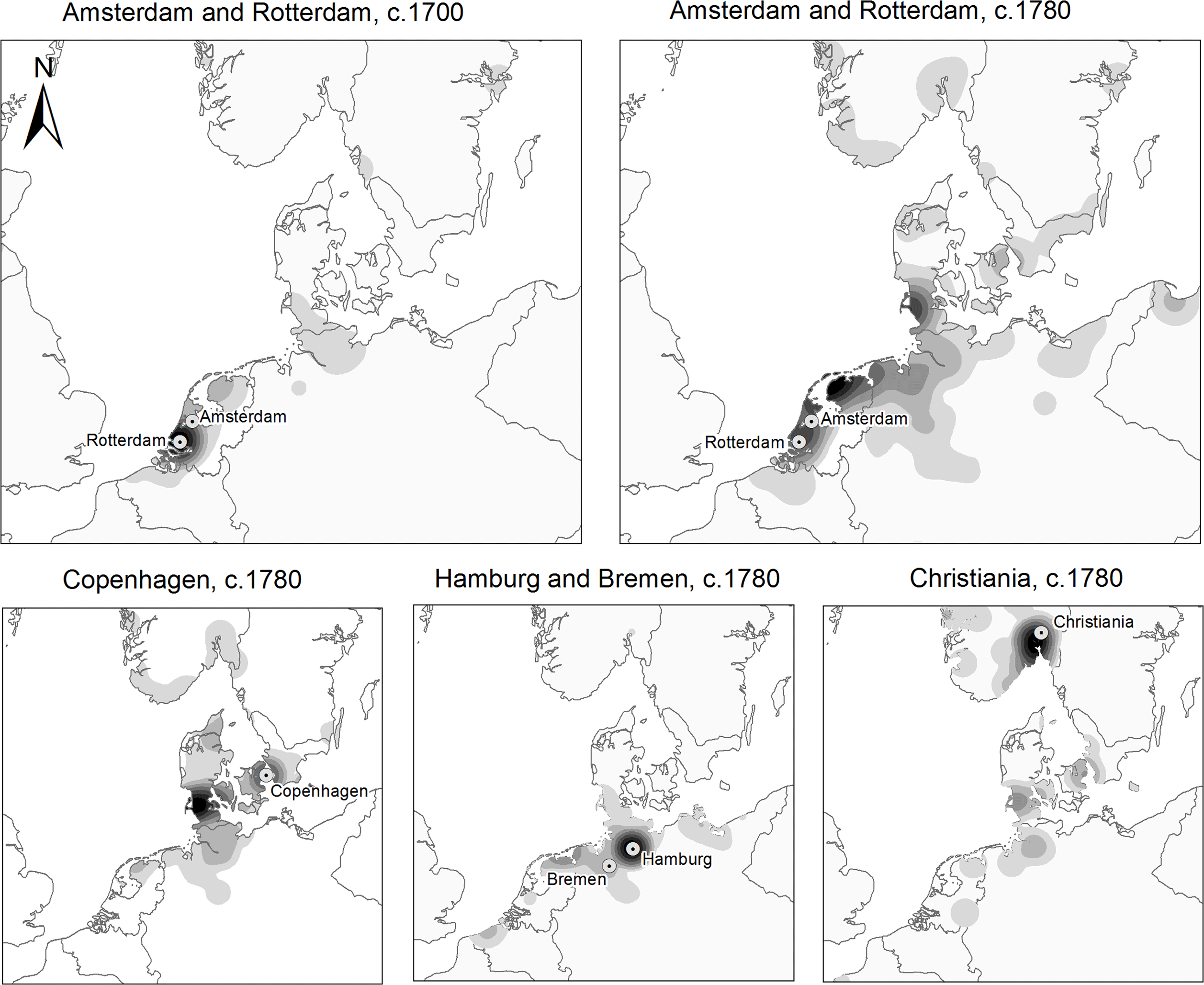
The data drawn from the Prize Paper Dataset (PPD) shows that already by 1700 domestic maritime labor markets relied to a large extent on foreign workers, but that the labor markets further internationalized throughout the century: in 1700, 24 percent of all crews consisted of nonnative-born workers, by 1800 this was 32 percent. Figure 1 provides a good illustration of the international character of the European maritime sector during the eighteenth century. The maps, which are all so-called kernel density maps (or “heat maps,” to use the colloquial term), depict the hinterlands of four important maritime hubs, with the darkest regions signifying areas of highest concentration. The upper two maps show the origins of maritime workers on ships hailing from key maritime ports in the Netherlands (Rotterdam and Amsterdam) in 1700 and 1800. The bottom three show the same information for Denmark (Copenhagen), Germany (Hamburg), and Norway (Christiania, present-day Oslo) in 1800. The two maps illustrating the hinterland Netherlands confirmed that during the eighteenth century the level of foreign labor participation could indeed change substantially. Around 1700, ships hailing from Amsterdam and Rotterdam attracted only a modest number of seamen from abroad; most came from within the nation’s borders. A century later, their hinterland had, however, expanded significantly: it attracted a large share of its labor force from (nearly all) coastal regions in northwestern Europe. The other three maritime centers show similarly expansive hinterlands around the same time. Hamburg and Bremen attracted migrants from as far as present-day Belgium; Christiania drew migrants not only from Denmark but also from the Netherlands; and Swedes, Norwegians, Germans, and Dutchmen were all employed on board ships sailing from Copenhagen.
Recruitment areas of four maritime centers in northwestern Europe.

Data Set
To uncover the drivers behind the international migration in the eighteenth-century maritime sector this article makes use of the PPD, a data set containing a variety of data relating to the eighteenth-century maritime sector. The initial data collection took place as part of the Economic and Social Research Council–funded project “Migration, human capital and labour productivity: The international maritime labour market in Europe, c. 1650–1815,”Footnote 2 and has been coded and standardized. The data set has been used in a number of studies, including assessments of human capital and labor productivity levels in the eighteenth-century maritime sector (Van Lottum and Van Zanden Reference Van Lottum and van Zanden2014). The PPD uses data derived from a section of the archive of the HCA, kept at The National Archives (TNA) in Kew Gardens, United Kingdom, concerning the interrogation of persons on board of those ships taken as “prizes” by the British Navy or private men-of-war (TNA HCA 32) (Van Lottum et al. Reference Van Lottum, van Voss, Lucassen and Unger2011). When a Royal Navy vessel or a private man-of-war captured an enemy ship, a court needed to establish whether the vessel was in fact a lawful prize: in other words, whether the ship, crew, or cargo belonged to an enemy state. To determine this, crew members were cross-examined (if necessary with the help of a sworn-in interpreter) about all matters relating to the ownership of the ship and its cargo. Commonly, like in the case of the Dutch vessel featured in our introduction, three crew members were questioned, usually a cross-section of the ranks aboard.
From the interrogations, the PPD was created, containing all the information required by the interrogation rubric and therefore consistently present in the interrogations. The database comprises two tables, one of which deals with information about the ship, such as geographical markers of its ports of origin and destination, its tonnage, the number of nationalities aboard, and information about its owner. This is linked to information about the crew because there was normally more than one crew member interrogated per vessel. The crew table includes demographic information about the individual interrogated, among other items about place (and therefore country) of birth and residence (as we will explain, we used this information to calculate migration flows), indicators of literacy, rank, and the length and nature of his relationship with the master of the vessel. The PPD contains circa 15,000 individual individuals who served aboard more than 4,000 ships in a span of time that covers different periods between 1702 and 1803. In this article we focus on two periods from the data set, each covering about a decade. Period 1 covers the start of the eighteenth century, from 1702 to 1712; period 2 begins in the last decade of the eighteenth century and extends into the nineteenth, from 1793 to 1803.Footnote 3
Given the fact that crews were interrogated during times of international conflict (interrogations indeed only exist for periods in which England [or Britain] was at war), an important issue is the extent to which the data from the PPD provides a normal representation of migratory behavior. We also believe that it does. First, the interrogations generally provided accurate information about the ships and crews. Those who were interrogated will have been aware (or made aware) that answers given in the interrogations could be verified with relative ease by the court. All ships’ papers were confiscated and used in the eventual court case at the HCA in London.
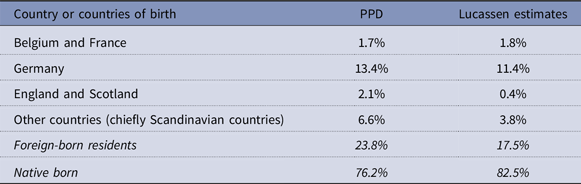
Second, although the data indeed derives from a period of war, we believe that it is comparable with the situation of the sector in peace time. Earlier research has shown that estimates of labor productivity of ships derived from the PPD were similar to those taken in peace time.Footnote 4 The same applies to levels of migration. Comparison between the general trends of international migration in early modern Europe and studies focused on international migration to specific countries show that the size and direction of migration flow match well with those constructed using the PPD. An example of the latter is provided in table 1, in which we compare data from the PPD to Lucassen’s (Reference Lucassen2002) estimates of the size of four migrant communities in the province of Holland (based a range of [in particular] civic sources). The latter study is one of the few studies that provides a reliable national estimate of immigration levels for the early modern era. Applying the same categorization as Lucassen, table 1 shows that the PPD provides largely similar figures. Not only does the overall share of foreigners in Holland match Lucassen’s estimate, but the size of the individual migration flows are also largely similar.
Countries of origin(s) of residents in eighteenth-century Dutch Republic, based on the PPD (PERIOD 2) and the Lucassen estimates

Source: Prize Paper Dataset and Lucassen Reference Lucassen2002: 22.
Note: The figures are based on the combined survey years 1700, 1750, and 1800 in Lucassen (Reference Lucassen2002) and the combined Periods 1 and 2 in the PPD.
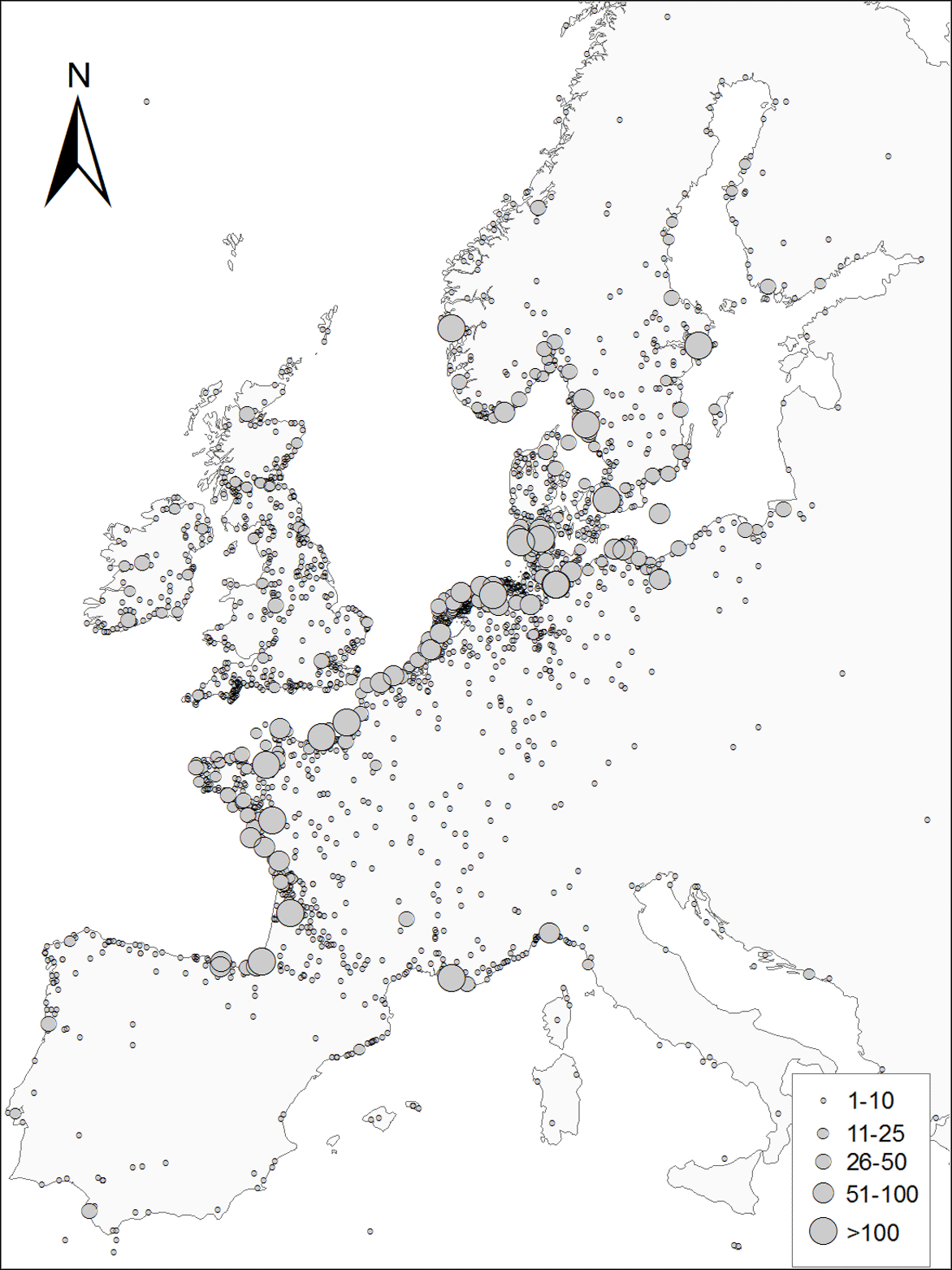
The data set covers a broad geographical range. Because ships could carry a false flag, British privateers—who operated in all European seasFootnote 5—seized nearly every ship they came across, regardless of the true nation of origin. As a result, the archive covers ships and crews from all maritime nations in the north Atlantic. This includes Britain—ships taken by enemy ships that were subsequently retaken had to follow the standard interrogation given to crew members of all other ships. As a result, the PPD covers all maritime nations in Europe. This is shown in figure 2, which depicts the places of origin of crews in the PPD born in Europe.
Place of origin of crews in the Prize Paper Database.

Immigration rates, the dependent variable in our analysis, is derived from the PPD. Based on standardized categories to register countries of birth, residence, and employment, all individuals in the PPD have been assigned a migration code: N, M, or NRM. Native maritime workers (N) lived and worked in their country of birth; migrant maritime workers (M) lived and worked in a country other than their country of birth; while nonresident migrants (NRM) resided in their country of birth but worked for foreign employers (in the migration literature they are often referred to as temporary workers) (Lucassen Reference Lucassen1987). In our analysis we focus solely on the sedentary M category, which we use to calculate the size of flows of migrant maritime workers between pairs of countries—that is, from country of birth to country of residence. The three seamen we briefly discussed in the introduction are also examples of these categories: Alström and Faber were born in Sweden, Eehler in Germany, and all three moved to Amsterdam and settled there later in their careers.
As there were significant changes in national territories between the beginning and end of the eighteenth century we have used present-day borders instead of historical ones. Despite the obvious anachronisms (Belgium, for instance, did not yet exist, nor was there a unified Germany), this will not hamper our analysis; we believe the use of modern borders allows for a more consistent comparison of the migration flows between the beginning and end of the eighteenth century. For Period 1 (c. 1700) our analysis is based on 77 country pairs, consisting of 14 recipient countries; Period 2 (c. 1800) consists of 94 country pairs and 19 recipient countries.Footnote 6
Explanatory Variables
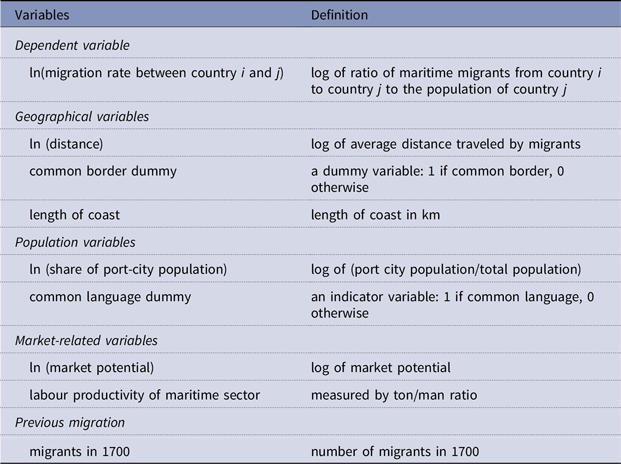
The migration of maritime workers has here been analyzed from the vantage point of the destination countries. In our regression model, the migration rates in circa 1700 and 1800, respectively, are related to nine independent variables. These can be subsumed within four broader groups of explanatory variables: market characteristics, geographical characteristics, population and linguistic characteristics, and stock of previous migrants. Table 2 offers the definitions of each variable.
Description of variables

Sources: See text.
Note: Right-hand side variables are defined from the point of view of the destination countries.
As table 2 shows, the group of market characteristics consists of two variables: labor productivity, a variable we use as a proxy for maritime wages, and market potential, an indicator that captures the economic viability and strength of the destination country’s maritime sector. Earlier we explained that the early modern maritime labor market was characterized by relatively few barriers to the international movement of workers and, by the eighteenth century, consisted chiefly of wage laborers. Based on the basic model of migration (Ravenstein [Reference Ravenstein1885] Reference Ravenstein1889; cf. Borjas Reference Borjas1989; Greenwood Reference Greenwood1975), which assumes that in such circumstances migration is driven by the attractive force exerting itself from origin to destination and is impeded by the cost of moving between the two locales, one would expect that these factors would also be important determinants of migration in the early modern maritime sector. In the next group of variables, we will touch upon the issue of cost, but the two variables in this group serve as indicators of the attractiveness of the labor market in the destination countries. In our analysis we use level of labor productivity in the maritime sector as a proxy for maritime wages, which unfortunately are very scarce for this period (Blakemore Reference Blakemore2017; Van Royen et al. Reference Van Royen, Bruijn and Lucassen1997). Labor productivity has been shown to have increased substantially during early modern times, in many cases outstripping productivity growth in other sectors (Lucassen and Unger Reference Lucassen, Unger and Unger2011).Footnote 7 Like wage levels, this new capacity for labor productivity offered opportunities for the economic betterment of incoming migrants. Market potential is also expected to have a positive effect on migration, capturing as it does the economic viability and strength of the destination country’s maritime sector, and hence its potential to enable migrants to achieve some degree of economic success. We calculate market potential as a weighted average of the population of all countries in our sample in which the weights are the inverse of the distance between the countries.Footnote 8 Research on twentieth-century Europe has shown that market potential has a positive effect on migration: migrants follow market potential (cf. Crozet Reference Crozet2004).
The group of geographical characteristics include three variables: the distance between the country of origin and the destination country, an indicator of a common border between the destination and the country of origin, and the length of coastline. The first two variables are general explanatory variables of migration, the last one is sector specific. In our analysis, migration distance is used as a proxy for the cost of migration—the second variable in the basic migration model, as mentioned previously.Footnote 9 We expect this variable to have a negative effect on migration. The second factor in this group of geographical characteristics is the existence of a common border between the origin and destination country. Empirical studies on international migration in the twentieth century find a strong positive effect exerted by countries with shared borders as compared to noncontiguous nations: common borders encourage international migration (Artuc et al. Reference Artuc, Docquier, Özden and Parsons2015; Mayda Reference Mayda2010; cf. Helliwell Reference Helliwell1997, Reference Helliwell1998). In these studies, common borders are usually treated as a proximity indicator. We expect that maritime migrants in the early modern period were also more likely to have moved to neighboring countries. However, because our data stems chiefly from maritime nations, and because travel by ship was an important mode of (long-distance) travel in the early modern period, it is also possible that our analysis will be limited in its ability to show the effect of this variable.
The third variable, the length of a country’s coastline, is used as an indicator of a nation’s maritime potential.Footnote 10 Our hypothesis is that countries with long coastlines present more possibilities for an individual employed in the maritime trade and will therefore have a positive effect on migration in this sector of the economy. For instance, one can expect countries with large coastlines to have more ports and better maritime infrastructure, and as a result they are likely to offer more employment possibilities for those engaged in this branch, thus stimulating the immigration of foreign seamen.
The first variable in the group of language and population variables is the total size of (sea)port populations.Footnote 11 Like the previous variable, this also captures a country’s maritime potential, but it investigates as well an important premise of the basic gravity model of migration: namely that, ceteris paribus, the population size of a given destination has an important (positive) effect on migrations because of the larger labor market for immigrants in more populated locales (Lewer and van den Berg Reference Lewer and van den Berg2007).Footnote 12 Because we take a sectoral approach in our analysis, in contrast to most general studies, we hone in on the population of port cities because this aspect most effectively represents the destination labor market.
Linguistic characteristics are captured by a binary variable indicating whether the destination and the country of origin share a common language.Footnote 13 Our hypothesis is that the presence of a common language has a positive effect on migration. First, a common language lowers the transaction costs of migration because it facilitates a better exchange of information, it is one of the factors that makes the settling process less burdensome. Second, fluency in the language of the host nation is also likely to make an individual more desirable for a prospective employer, as it facilitates a better transfer of one’s skills to the labor market (Adserà Reference Adserà2015). Language characteristics of origin and destination countries have received attention from studies analyzing contemporary migration (e.g., Adserà and Pytliková Reference Adserà and Pytliková2015), but not in the research on early modern migration. Some studies of early modern migrations consider the role of other migrants in the destination country who speak the same language (see, for instance, Janssen, Reference Janssen2016; Kuijpers Reference Kuijpers2005; Page Moch Reference Page Moch2003; cf. Lesger et al. Reference Lesger, Lucassen and Schrover2002). But these works primarily discuss the value of migration networks in facilitating information (something we capture with the previous migration variable, to be discussed next) rather than, specifically, the linguistic similarities between countries, as is usually the case in studies on contemporary population flows.
Our final group concerns one variable: the stock of previous migration. This variable captures the existing network of migrants in the destination country.Footnote 14 We expect the stock of previous migration to have a positive effect on later migration. This follows from both modern and early modern research. In the latter it has been identified as an important determinant of international migration flows; migrants already settled abroad are thought to have facilitated the migration and settlement of compatriots (Hoerder Reference Hoerder2002; Janssen Reference Janssen2016; Page Moch Reference Page Moch2003). However, unlike the extensive research on international migration in the nineteenth century (see in particular Hatton and Williamson Reference Hatton and Williamson1998; Wegge Reference Wegge1998), the approach to early modern migration has chiefly been qualitative. Studies have offered detailed qualitative accounts of the importance of migration networks created by previous migrants in providing information about economic possibilities in foreign destinations (Lucassen Reference Lucassen1987) and the way such information was transmitted between “home” and “abroad” (Sogner and Van Lottum Reference Sogner and van Lottum2007). Our study, however, offers the first quantitative assessment of this potentially important phenomenon for the early modern period.
Regression Analysis
Using the explanatory variables discussed in the previous section, and summarized in table 2, our regression specification is as follows:
 $$\eqalign{\rm{ln}}(migrate{s_{ij}}) = \alpha + {\beta _1}Ge{o_j} + {\beta _2}Po{p_j} + {\beta _3}Marke{t_j} + {\beta _4}PreviousMig{r_j} + {\gamma _i}} \cr +{{\delta _j} + {\varepsilon _{ij}}}$$
where migrates ij is migration rates of maritime workers from country i to country j defined as the ratio of maritime migrants from country i to country j to the population of country j; variables Geo j, Pop j, Market j, and PreviousMigr j denote the vectors of geographical, population and linguistic, market, and previous migration variables; γ i and δ j are origin and destination-country indicator variables; and ε ij is an error term. We estimate equation (1) with OLS and use heteroskedasticity-robust standard errors. The consistency of the estimator requires all variables to be exogenous. Admittedly, some of the variables related to the population, market potential, and labor productivity might be endogenous. Therefore, we decided to be conservative and will interpret our results as indicators of important multivariate correlations rather than of necessarily causal relationship.
We also consider the issue of multicollinearity among the explanatory variables. Correlation coefficients among the variables revealed that only the correlation between market potential and labor productivity in the maritime sector might give rise to the multicollinearity issue (correlation is about 0.7), therefore we estimated equation (1) with each of them separately as well as together. Correlations among other variables are low: even the correlation between market potential and distance is only about 0.4. Despite the inevitably high correlation between the market potential and the labor productivity of the maritime sector, we conjecture that they each capture different factors affecting migration flows. Market potential may be a proxy for economic opportunities opened up to the maritime sector, but these may not be immediate. Labor productivity in the maritime sector, however, captures monetary gains, which are more immediate than those gains offered by market potential.
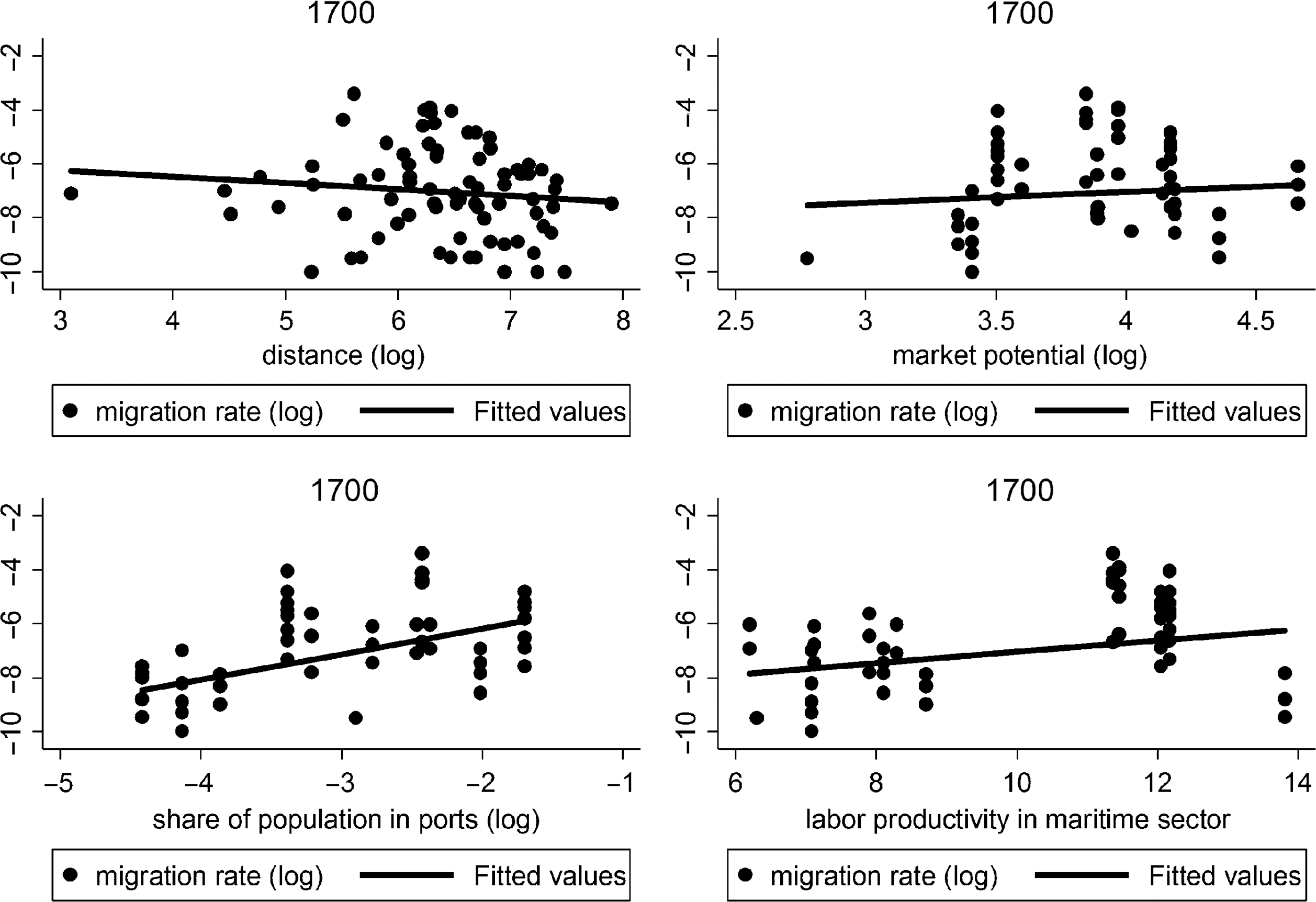
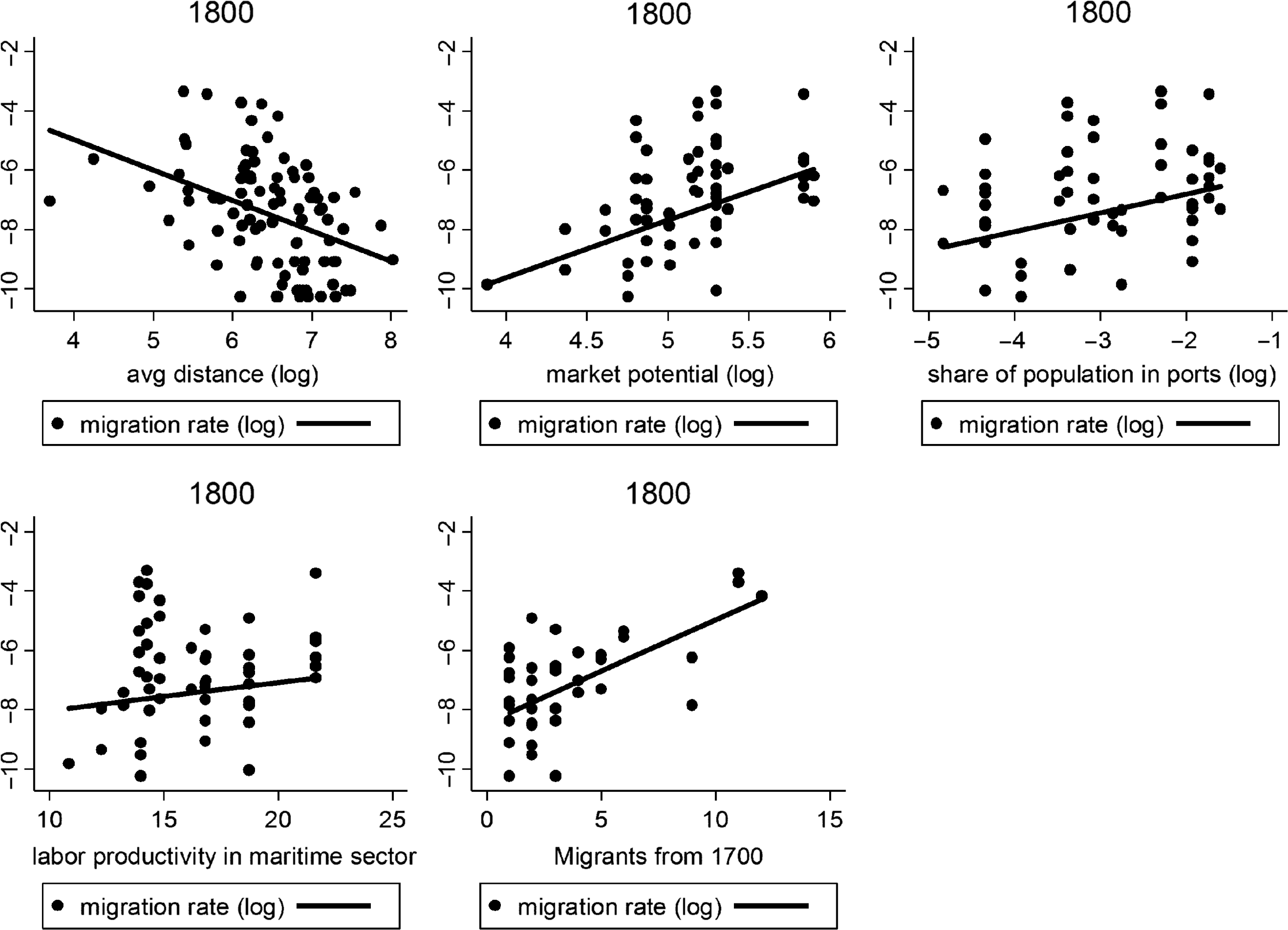
Before we present the regression results, we will discuss several graphs that outline a relationship between the migration rates and a few explanatory variables. Figures 3 and 4 show relationships between the migration rates and the distance between origin and destination countries, the share of population in ports, labor productivity in the maritime sector, market potential, and previous migration for the respective years of 1700 and 1800. We see that the migration rates are negatively related to the distance between the country of origin and that of destination, confirming our prior belief that distance inhibits migration. The share of population in ports and labor productivity is positively related to migration, which suggests that the larger the ports are, the more attractive they become for maritime migrants. We also observe a positive correlation between labor productivity and migration rates, suggesting the importance of economic betterment on the intensity of migration. Lastly, figure 4 indicates a strong relationship between the stock of maritime migrants in 1700 and migration rates in 1800. This suggests a rather impressive persistence effect of past generations of maritime migrants and onto later cohorts. Overall, figures 3 and 4 also show that despite different magnitudes, the correlations between the examined variables and migration rates have the same direction: a remarkable stability, considering the interval between the two periods under scrutiny spans about one hundred years.Footnote 15
International maritime migration in 1800, unconditional correlations.

International maritime migration in 1800, unconditional correlations.

Though important and revealing, the graphs discussed in the previous paragraph show simple, unconditional correlations. Multivariate analysis is required to gain further insight into the complexity of factors influencing maritime migration. Therefore, we use regression analysis and estimate equation (1) to shed further light on the determinant of cross-country maritime migration rates. We estimate equation (1) for the respective years of 1700 and 1800 and present various specifications to check the robustness of our findings. We will first discuss whether the estimated relationships are statistically significant and whether they are positive or negative; then we will discuss their relative importance; and, finally, in the next section, we will offer possible explanations of these results.
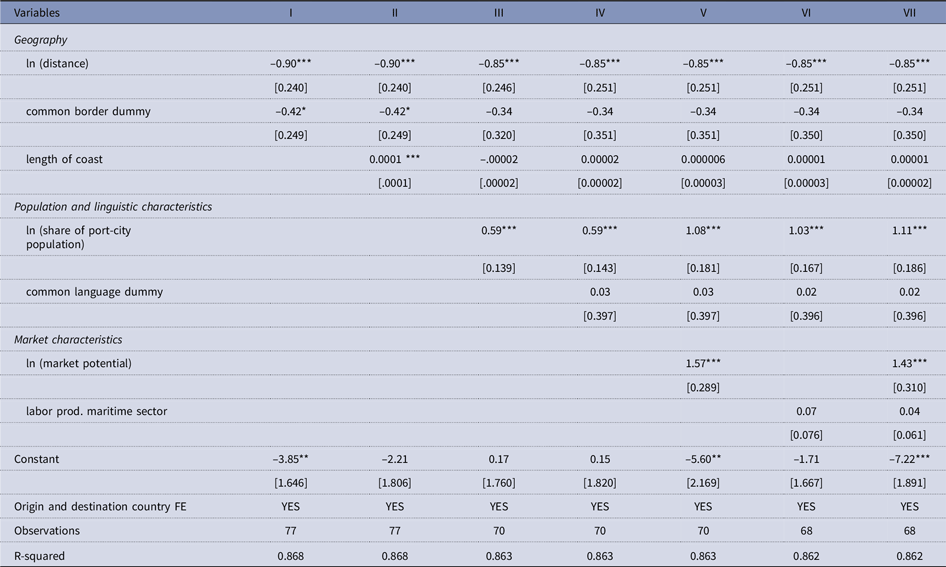
Table 3 presents the results for the year 1700. We see that distance is always statistically significant and negatively related to the migration rates, whereas other geographical characteristics—a common border and the length of coast—are mostly insignificant.Footnote 16 In the first two specifications, the presence of a common border seems to have a negative and significant effect but the statistical significance disappears in the remaining five specifications. As for the population and linguistic characteristics, the share of population living in port towns is always significantly related to maritime migration, whereas common language has no significant impact.Footnote 17 Market characteristics exhibit a similar pattern qualitatively: labor productivity does not exert a significant impact, and market potential is always positively and significantly related to maritime migration.Footnote 18
International maritime migration in 1700, regression analysis

Sources: See text. Robust standard errors in brackets, *** p < 0.01; ** p < 0.05; * p < 0.1.
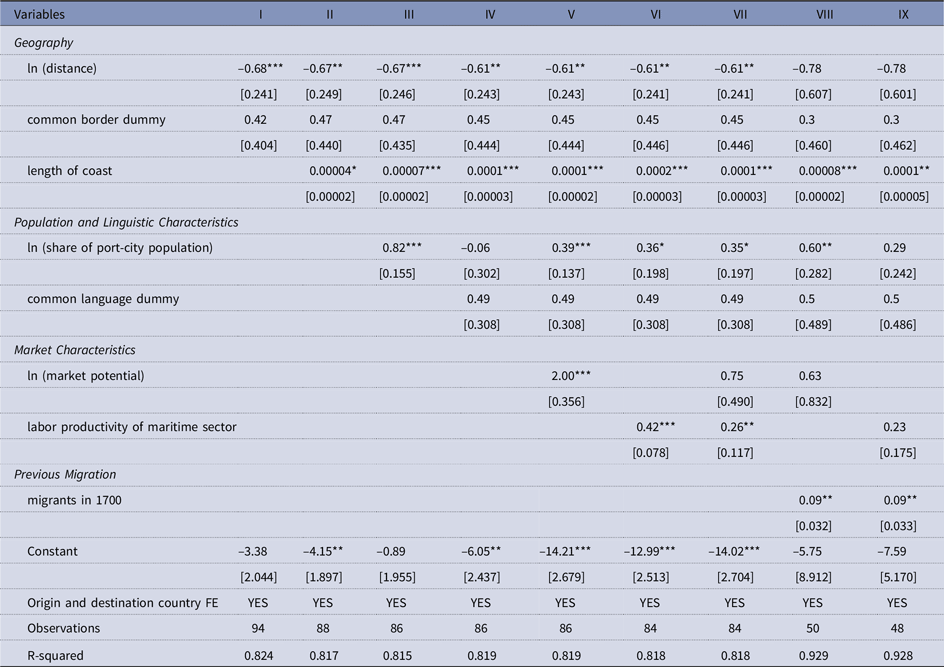
Table 4 presents the results for the year 1800. As for the geographical characteristics, we see that, again, distance has negative and significant effect on the rates of maritime migration. However, unlike in the year 1700, the length of coastline does exhibit a significant and positive effect on the migration rates. The existence of a common border remains an insignificant factor. The effect of population and linguistic characteristics remain qualitatively unchanged relative to the year 1700. Common language has no significant effect, and again the share of the population in port towns is positively related to migration, although not in all specifications. Market characteristics show very interesting and different results in comparison with the year 1700. First, labor productivity in the maritime sector becomes statistically significant, even in the specification including market potential. Market potential, however, is significant only in the specification without labor productivity, a major difference relative to 1700. Both factors—market potential and labor productivity—lose statistical significance once we include previous migration. This, capturing the effect of migration networks, is positively related to the migration flows in 1800. A word of caution is required here. As we see in table 3, because of lack of data, the number of observations in columns VII and IX drops when considering previous migration. Therefore, our conclusions need to be considered as tentative; more research is needed to firmly establish the effect of previous migrations on international migration of maritime workers in early modern times.
International migration in 1800, regression analysis

Sources: See text. *** p < 0.01; ** p < 0.05; * p < 0.1.
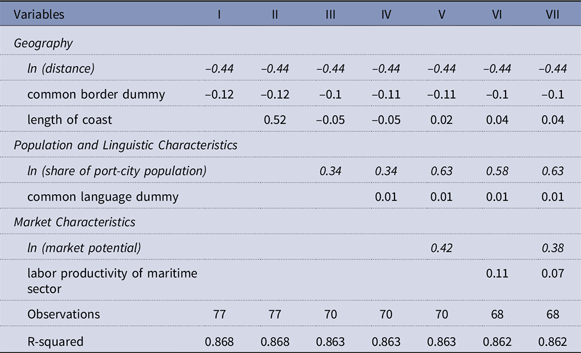
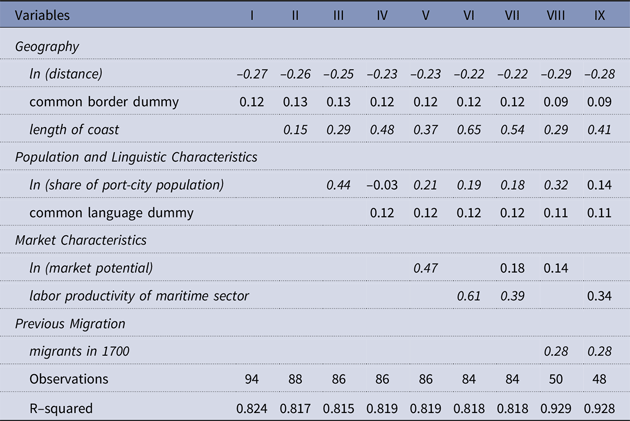
Until now, we have focused on the statistical significance and sign of the relationship between the factors influencing the migration rates. Before we discuss the results emerging from tables 3 and 4 in greater detail, it is important to establish the relative importance of each of the factors, in addition to their statistical significance. To do this, we have calculated standardized beta coefficients, which express the estimated coefficients as standardized coefficients with mean of 0 and standard deviation of 1. This allows us to compare the magnitudes of all the estimated coefficients, thus establishing their relative importance. Table 5 shows the beta coefficients for the year 1700, table 6 for the year 1800. We see that in 1700, out of the statistically significant variables (highlighted in italics), the population of port towns has the largest impact, followed by distance and then market potential. In 1800, the relative importance of variables differs across specifications, but if we consider the most advanced specifications (column IX), then the length of coastline exhibits the largest effect, followed by past migration stock and distance.
Standardized beta coefficients, international migration in 1700

Sources: See text.
Standardized beta coefficients, international migration in 1800

Sources: See text.
Discussion of the Findings
The multivariate analysis in the previous section offers insights into the factors affecting the international migration flows of maritime workers at the beginning and the end of the eighteenth century. Though we expressed some caution, our assessment showed that previous migration appears to have been an important migration factor for maritime workers at the end of the eighteenth century. This conclusion confirms studies of the transatlantic mass migrations of the nineteenth century, which regard prior migration as a key factor in explaining the size and direction of international migration (Baines Reference Baines1994; Hatton and Williamson Reference Hatton and Williamson1998). It also supports our conjecture about the role of maritime migrants who were already living in the destination country. Several reasons may account for the importance of this factor. Maritime migrants already residing in a destination country can provide information about the maritime labor market in that country, as well as local labor market conditions more broadly and information about travel costs and search costs related to the finding of work (Hoerder Reference Hoerder2002; Lucassen Reference Lucassen1987; Page Moch Reference Page Moch2003). These resident migrants can also help would-be migrants cover travel costs through remittances; the costs of looking for work in a new country can be lowered through resident migrants’ offers of lodging or monetary loans while a newcomer searches for work (Bade Reference Bade2003; Hatton and Williamson Reference Hatton and Williamson1998). Furthermore, this resident-migrant group can help with assimilation to local conditions and might also present potential marriage partners, thus lowering the emotional costs related to the relocation to a new country (Sogner and Van Lottum Reference Sogner and van Lottum2007). Our analysis shows the remarkably persistent effects exerted by migrant networks on migration patterns during the eighteenth century.Footnote 19
Apart from clarifying the effect of this specific and important variable, the general picture that emerges from our analysis is that economic opportunities and the costs of migration alike crucially affected migratory patterns. Economic opportunities were captured by a relatively direct indicator such as labor productivity (as a proxy for wage levels), but market potential, the population of ports, and the length of a country’s coastline can also be regarded as indicators of the relative attractiveness of the destination country for maritime migrants. That our analysis shows that a large share of maritime migrants acted as rational economic actors, seeking to maximize their income by moving to areas with better opportunities, supports the characterization of the early modern maritime labor market that has been provided in the field’s historiography. As explained earlier, the literature (chiefly of a qualitative nature) suggests that, facilitated by a relative paucity of migration barriers, the early modern maritime labor market predominantly comprised proletarians who sought to optimize their earnings by migrating to those areas that offered the chance for them to do so, even if these locales were situated abroad. Our regression analysis confirms this picture, and thus shows that the basic mechanisms behind a crucial sector of the preindustrial economy were not dissimilar to those of international labor markets in the modern era. This conclusion is an important finding.
When shifting our view from the general outcome of our exercise, and zooming in on the separate outcomes of our analysis for both 1700 and 1800, we find the general picture that emerges from our analysis to be, indeed, relatively uniform. But as the previous section made clear, there are also notable differences in the significance and ranking of the variables. These distinctions partly result from our inclusion of the previous migrants variable, which makes market potential and labor productivity insignificant. But even when we compare the most extensive specification in 1700 with its counterpart in 1800 there are noticeable differences. Such differences are particularly salient with regard to our finding that our proxy for wage levels, labor productivity, had a significant effect in 1800 (as we expected) but not in 1700 (which was surprising).
As (potential) wage-gain opportunities are at the core of general migration theory, and qualitative studies on the early modern period have also emphasized the importance of wage differentials in explaining international migration flows, it is indeed surprising that in 1700 our most direct indicator of the latter factor is insignificant. This might be explained by the lack of chances for (direct) economic betterment through potential higher wages, probably because there was relatively little demand in the key hubs and thus relatively little competition in the international labor market. Figure 1 showed that international migration increased substantially by the end of the eighteenth century, and competition among centers became severe (Van Lottum Reference Van Lottum2011, Reference Van Lottum2015). But the lack of chances for monetary betterment was compensated (at least to some extent) by the existence of (diverse) job opportunities in port cities and possible opportunities to trade, as captured by the port population size and variables, respectively, both of which are significant and appear in comparatively high positions in the ranking of beta coefficients for 1700.
A final issue following from our analysis that merits discussion concerns the applicability of “modern” explanatory variables to this early modern case study. From our analysis, it follows that variables such as the past migration variable, migration distance, and the population of port cities are indicators (or types of indicators) that explain international migration both in the modern and early modern contexts. Our analysis, however, also showed that common language and common borders, two factors that have been demonstrated to be important for the industrial and postindustrial eras, did not assert a significant effect on international migrations in the eighteenth-century maritime sector. This, too, is a relevant finding, which needs further discussion.
In the case of common language, we believe that its statistical insignificance has two explanations. The first is sector specific. Although sharing a common language among workers is arguably more important for highly skilled professions than for the tasks performed by semiskilled or unskilled maritime laborers (Artuc et al. Reference Artuc, Docquier, Özden and Parsons2015), as Rediker (Reference Rediker1989) argues, the labor process in the maritime sector possessed a very specific and chiefly technical vocabulary—a maritime lingua franca largely based on Dutch terms—that one needed to master to be successful in the sector. Traditional language barriers, therefore, played a lesser role as long as workers could speak this sector-specific language. Given that, as figure 2 showed, most maritime workers had been born on or near the coast in their home countries, many would have been exposed to the maritime sector, and its specific vocabulary, from an early age (cf. Bruijn Reference Bruijn, Royen, Bruijn and Lucassen1997).
The second explanation for the negligibility of common language as a factor relates to the state of European languages in the eighteenth century: compared to the nineteenth and twentieth centuries, early modern (western) European languages were not as uniform and were not so strictly demarcated from one another. Languages and dialects did not stop at their respective national borders, and because dialects could differ considerably even within countries, it was common for compatriots not to be able to communicate with one another (Heerma van Voss Reference Heerma van Voss, Roding and Heerma van Voss1996). This means that by assigning national languages to countries—as we did for the purposes of our analysis—we may have not done justice to the complexity of language in the early modern context.
In the case of insignificance of the common borders variable, the nonimportance of the presence of a common border with regard to a migrant’s decision to move is likely explained by the fact that in the early modern context it does not capture proximity effectively. As we suggested earlier, travel by sea was a very common mode of transportation in the early modern period; indeed, moving over land to a contiguous country may have been far more cumbersome and costly than traveling to another foreign destination that was easily reached by ship. For instance, from a locality in Denmark it may have been much easier (i.e., quicker, cheaper) to sail to the northern Netherlands than to travel from northern Germany. In such a case, a shared border does not accurately capture proximity as a factor.
Concluding Remarks
The three migrant seamen this article started with were anything but exceptional: they were part of an increasingly mobile population. This article represents the findings of the first rigorous quantitative analysis of the determinants of international labor migration in early modern Europe in one of its most important sectors—the maritime sector. What drove migrants such as Alström, Eehler, and Faber to take up employment in another country? To answer this question, we relied on a unique source of maritime migrants that allowed us to construct international migration flows of maritime workers. These international migration flows were then used to analyze the effects of past migrations and of the geographic, population, linguistic, and market characteristics of European countries.
Our multivariate analysis showed that the basic mechanisms driving labor migration in the early modern maritime sector were largely comparable to those found in the modern era. That factors such as a shared language and border did not have a significant effect on international migration is likely the result of the early modern context being different from that of the nineteenth and twentieth centuries. However, the general picture that emerges from our analysis is that workers in this sector largely behaved as rational actors, benefitting from economic opportunities abroad if these became available. To do so, they were facilitated by their relative freedom of movement and a free mode of recruitment. We found that variables that captured economic opportunities, such as labor productivity (our proxy for wage levels) and the relative size and population of port cities, stimulated migrations, while—as one would expect—distance deterred the international movement of labor. Moreover, also confirming studies on nineteenth- and twentieth-century international migration, we found that the stock of previous migration also appeared to have been an important factor in determining later migrations.Footnote 20
Overall, we believe our analysis to rest on three important contributions. First, we mentioned in the introduction that international labor mobility is still an underresearched topic. Studies taking a social science approach are especially rare: most research is of a qualitative nature. The outcome of our regression analysis of data stemming from the maritime sector therefore provides a much-needed quantitative perspective on the underlying mechanisms governing the movement of hundreds of thousands of labor migrants who sought better lives for themselves outside their home countries.
Moreover, it is important to note that although the maritime sector has been hailed as one of the first modern international labor markets (Lucassen Reference Lucassen, Royen, Bruijn and Lucassen1997; Rediker Reference Rediker1989), it was by no means the only sector in which wage labor was the rule, and international mobility common. Europe in the eighteenth century was undergoing rapid processes of proletarianization and (as result) experienced increasing levels of labor mobility—internal and international. One can therefore expect to find that mechanisms similar to what we revealed in our analysis of the maritime sector played a role in other sectors of the early modern economy. More research is, of course, necessary to test the validity of this hypothesis.
But there is a broader reason why we believe the outcome of our analysis matters, and here we arrive at the third important contribution of this article. In a seminal paper published in the Journal of Global History in 2009, Lucassen and Lucassen (see also Lucassen and Lucassen Reference Lucassen and Lucassen2010, Reference Lucassen and Lucassen2017) argued against what has become known as the mobility transition thesis, a theory formulated in 1971 by the geographer Wilbur Zelinsky. This theory argued that the industrial era demarcated a clear break with the early modern period; only with the advent of modernization did the European population become truly mobile. Presenting new estimates of preindustrial migration rates (Lucassen and Lucassen Reference Lucassen and Lucassen2009, Reference Lucassen and Lucassen2010), the two authors refuted this claim; they demonstrated that before industrialization, European populations had already been highly mobile and that the transition to modernization did not result in a substantial break (i.e., a take-off) in migration levels. Nevertheless, before this article there had been no rigorous analyses of the driving forces behind early modern international migration, and very little was known about whether the transition to industrialization implied any change in the nature and extent of international migration. Of course, our study showed that there were some differences between the key drivers of international migration flows in the early modern period and those of the industrial era, and more research on other sectors is necessary to draw broader conclusions. However, our analysis indicates that there was much more continuity than change between the early modern and modern eras.
Acknowledgments
The work underlying this article was made possible by a grant from the Economic and Social Research Council (ESRC) (RES-062-23-3339: “Migration, human capital and labour productivity: The international maritime labour market in Europe, c. 1650–1815”). An earlier version of this article was presented at the annual conference of the Economic History Society in London in April 2017. We would like to thank the participants in our session for their valuable input.