Introduction
Ascaris lumbricoides and Ascaris suum are important helminth parasites of humans and pigs, respectively (Roepstorff & Nansen, Reference Roepstorff and Nansen1994; Holland, Reference Holland, Cox, Wakelin, Gillespie and Despommier2005). A. lumbricoides is believed to infect approximately 1472 million people worldwide and to contribute to an estimated 11.81 million thousand disability-adjusted life years (DALYS) (Chan, Reference Chan1997; WHO, 2002).
The major impact of these infections is chronic nutritional impairment, although more acute morbidity, including intestinal obstruction, has been documented (Crompton, Reference Crompton2001). It is now well established that the presence of mature adult worms in the host intestine contributes to reduced food intake, impaired digestion, malabsorption and poor growth rates (reviewed in Crompton & Nesheim, Reference Crompton and Nesheim2002). These observations have been made in both experimental infections in pigs (Stephenson et al., Reference Stephenson, Pond, Nesheim, Krook and Crompton1980) and field-based studies in children (Hlaing, Reference Hlaing1993; O'Lorcain & Holland, Reference O'Lorcain and Holland2000). The extent of nutritional impairment is related to the intensity of infection (O'Lorcain & Holland, Reference O'Lorcain and Holland2000).
However, the impact of larval migratory ascariasis on its host is far less well understood (Cooper et al., Reference Cooper, Whyte-Alleng, Finzi-Smith and MacDonald1992). As outlined by Stephenson (Reference Stephenson, Stephenson and Holland1987), the difficulty of designing appropriate and ethical studies of larval migration in humans has impeded research into this phase of the life cycle and, consequently, the public health significance remains unclear. Larval migration can cause pneumonitis, including asthma, cough, substernal pain, fever, skin rash and eosinophilia (Coles, Reference Coles, Crompton, Nesheim and Pawlowski1985; Pawlowski & Arfaa, Reference Pawlowski, Arfaa, Warren and Mahmoud1985). These symptoms have been postulated to contribute to reduced food intake and, in the case of fever, increased nitrogen loss (Stephenson, Reference Stephenson, Stephenson and Holland1987). In the rat, infection by Nippostrongylus brasiliensis, another intestinal nematode which undergoes lung migration, induces a biphasic anorexia, the first phase associated with lung invasion, the second when worms mature in the intestine (Ovington, Reference Ovington1985; Mercer et al., Reference Mercer, Mitchell, Moar, Bissett, Geissler, Bruce and Chappell2000).
The development of a mouse model to explore susceptibility and resistance to larval ascariasis in the lungs (Lewis et al., Reference Lewis, Behnke, Stafford and Holland2006, Reference Lewis, Behnke, Cassidy, Stafford, Murray and Holland2007) provided an opportunity to observe the impact of larval migration on host growth during the course of infection. In this paper, we describe the changes in body weight observed in two strains of inbred mice, the susceptible C57BL/6j and the resistant CBA/Ca, infected with low, medium and high doses of Ascaris eggs.
Materials and methods
Experimental animals
One hundred and twenty inbred male mice, 60 C57BL/6j and 60 CBA/Ca were purchased from Harlan, UK at 7 weeks of age and were 8 weeks old on the day of infection. Animals were maintained under standard and constant conditions, as described by Lewis et al. (Reference Lewis, Behnke, Stafford and Holland2006).
Parasite
Approximately 4,000,000 embryonated ova (batch number: 8/2002) were provided by the Danish Centre for Experimental Parasitology (CEP), Copenhagen. Mice were inoculated by gastric intubation, between 08.00 and 10.00 hours, with doses of fully embryonated eggs, as described in Lewis et al. (Reference Lewis, Behnke, Stafford and Holland2006).
Experimental design and larval recovery
Fifteen mice of each strain were inoculated with one of four single-inoculum doses (100, 500, 1000 and 3000). Ten mice of each strain received a placebo dose consisting of intubation medium only. Infected mice (five mice per dose) underwent post-mortem examination on days 6, 7 and 8 post-infection. In Ascaris-infected mice, the maximum accumulation of larvae by the susceptible strain is consistently observed in the lungs on day 7 post-infection and as such, this day is suggested to be the optimum for assessing differences in susceptibility (Lewis et al., Reference Lewis, Behnke, Stafford and Holland2006). Control mice underwent post-mortem examination on day 7. These age-matched controls were maintained separately from infected mice at all times during the experiment. All mice were euthanized by cervical dislocation on the relevant post-mortem day.
Mice were weighed pre-infection (day 0) and post-infection on the day of post-mortem. At post-mortem, the lungs of each mouse were removed for enumeration of Ascaris larval burdens by means of the modified Baermann method (Lewis et al., Reference Lewis, Behnke, Stafford and Holland2006). Larval counts were performed on five, 200 μl samples taken from the product of centrifugation. These experiments were reviewed and approved by the university research ethics committee and the Department of Health and Children (Ireland).
Statistical analysis
Mouse body weight was analysed separately for each strain, as inherent strain differences might have influenced the statistical analysis. Therefore within each strain, the influence of dose of infection and day of post-mortem on the difference in host body weight (between pre-infection and the day of post-mortem) was explored by means of two-way analysis of variance (ANOVA). Least squares difference (LSD) post-hoc tests were applied to compare differences within the factor of dose. Statistical analysis was carried out at a confidence limit of 95% (α = 0.05).
Results
Larval numbers of A. suum in the lungs of susceptible and resistant strains of mice
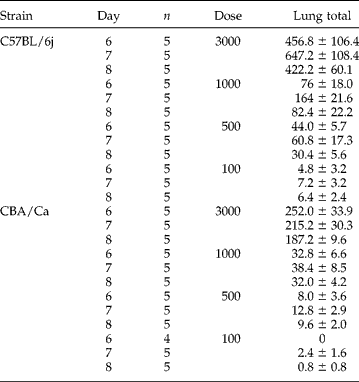
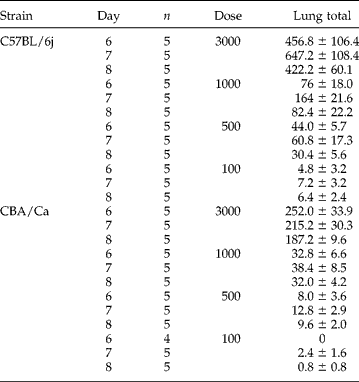
The numbers of larvae recovered from the lungs of mice of each strain at each dose and on each day of post-mortem are shown in table 1. As discussed previously, there was a highly significant positive relationship between dose of eggs administered and the larval burdens, with strain and day taken into account, suggesting a close correlation between the administered dose size and the number of larvae recovered within each strain (Lewis et al., Reference Lewis, Behnke, Stafford and Holland2006).
A comparison of the total number of worms recovered (± SEM) from the lung in both mouse strains (C57BL/6j and CBA/Ca) for each of the single-pulse infections (3000, 1000, 500 and 100 A. suum ova) on the three post-mortem days (days 6–8).
Impact of infection with A. suum on host body weight
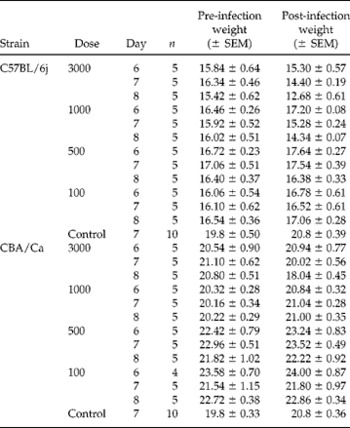
Control mice of both strains showed an increase in weight of 1 g from pre-infection to post-infection day (see table 2). In contrast, some groups of infected mice demonstrated reductions in body weight after infection with Ascaris eggs and during larval migration in the lungs.
Mean body weight (g) (± SEM) at pre-infection (time zero) and on each post-mortem day of groups of both C57BL/6j and CBA/Ca mouse strains treated with different doses of A. suum ova. Also shown are the weights of the day 7 control groups for both strains.

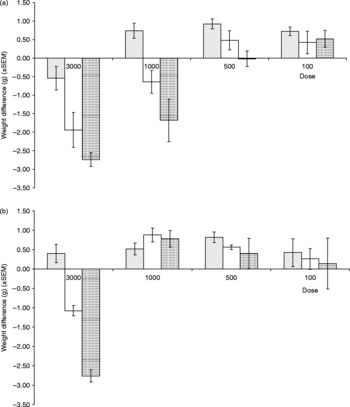
Within the C57BL/6j strain, mice infected with higher doses of Ascaris eggs experienced a reduction in body weight; for those given 3000 eggs this was on all three post-mortem days, and for those given 1000 eggs, on days 7 and 8 (fig. 1a). Statistical analysis revealed that dose had a significant influence on body weight (two-way ANOVA with dose and day as factors, model  , main effect of dose, F 3,48 = 37.2, P ≤ 0.0001). In contrast, mice infected with the lower doses generally showed an overall increase in weight. This was also reflected in the post-hoc analysis for the C57BL/6j strain, which revealed that the 3000 and 1000 dosage groups differed significantly from each other in terms of changes in body weight (P ≤ 0.0001). These higher-dose groups also differed significantly (P ≤ 0.0001) from the lower-dose groups, which did not differ from each other. There was also a significant effect of days post-infection (F 2,48 = 22.8, P ≤ 0.0001) and the interaction between dose and days post-infection (F 6,47 = 3.0, P ≤ 0.0126). With the exception of the 100 dose group, body weight declined from day 6 to day 8.
Mean body weight difference (g) ( ± SEM) between pre-infection (time zero) and the day of post-mortem ( ± SEM) in both the (a) C57BL/6j mouse strain and (b) CBA/Ca mouse strain, on each post-mortem day ( , Day 6; □, Day 7;
 , Day 8).

At all dose levels, CBA/Ca mice had significantly fewer larvae in their lungs compared to C57BL/6j (table 1). Statistical analysis did reveal a significant effect of dose on mouse body weight (two-way ANOVA with dose and day as factors, model  , main effect of dose, F 3,47 = 27.3, P ≤ 0.0001) with only mice receiving the 3000 egg dose demonstrating a reduction in body weight (fig. 1b). Post-hoc analysis revealed that the loss of body weight in mice receiving the highest dose was significantly different from all other groups (P ≤ 0.0001) which did not differ from each other. There was also a significant effect of days post infection (F 2,47 = 9.8, P ≤ 0.0001) and the interaction between dose and days post infection (F 6,47 = 7.3, P ≤ 0.0001). In contrast to the C57BL/6j mice, the effect of days post infection in CBA/Ca mice was inconsistent, with weights fluctuating up and down during the period of infection.
Discussion
This experiment provides evidence that the migration and accumulation of A. suum larvae in the lungs of mice has a significant impact upon host fitness and, specifically, host body weight. This effect is most pronounced at higher infection levels after a dose of 3000 eggs has been administered (12% and 17.8% body weight loss in C57BL/6j mice at 7 and 8 days post-infection). It is of interest to note that, albeit to a lesser extent, larval ascariasis also had an impact on the resistant CBA/Ca strain of mice, particularly on day 8 of infection (13.3% body weight loss), in those mice that received a dose of 3000 eggs. In contrast, control animals of both strains gained weight over the same time period (5% body weight gain), as did some infected mice that received lower-dose infections.
Currently, evidence from both human and porcine studies points to the presence of adult worms in the intestine contributing to nutritional impairment, including growth retardation (Stephenson et al., Reference Stephenson, Pond, Nesheim, Krook and Crompton1980; Hale et al., Reference Hale, Stewart and Marti1985; child growth studies reviewed in O'Lorcain & Holland, 2000). Furthermore, after deworming, infected children show improvements in growth and appetite (Hadju et al., Reference Hadju, Stephenson, Abadi, Mohammed, Bowman and Parker1996).
In contrast, there is a paucity of data on the impact of larval ascariasis on host fitness, including nutritional status and body weight. Part of the explanation for this relates to the difficulty of establishing a causal relationship between larval migration and pathogenesis under field conditions. Hale et al. (Reference Hale, Stewart and Marti1985) concluded that the effect of migrating larvae was less pronounced than that of adult worms, and Stephenson et al. (Reference Stephenson, Pond, Nesheim, Krook and Crompton1980) infected pigs with fourth-stage larvae and demonstrated that adult worms depressed the growth rate in the absence of larval migration. Nevertheless, fenbendazole treatment during the liver migration phase improved feed conversion ratios by 22%, and treatment during pulmonary migration improved these rates by 8% in comparison to controls (Stewart et al., Reference Stewart, Bidner, Southern and Simmons1984). The underlying mechanisms resulting in these reduced growth/feed ratios in pigs may be due to parasite-induced physiological changes. Yang et al. (Reference Yang, Gaafar and Bottoms1990) observed a reduced gastrin level during the lung migration phase and increased cholecystokinin (CCK) levels after larvae had reached the pig intestine.
In a different species, rats infected with the rodent nematode N. brasiliensis consumed dramatically less food early in infection (on day 2 after infection, which corresponds to the arrival and duration of larval stages in the lungs) (Ovington, Reference Ovington1985). Furthermore, the extent of reduced food intake was related to the dose of N. brasiliensis larvae administered, when the range of doses was expressed as numbers of larvae per gram of body weight.
The current examination of weight changes and Ascaris larval burden in two inbred strains of mice highlights the impact of host susceptibility and infective dose on host fitness. Animals with similar larval burdens, irrespective of strain, displayed analogous weight changes during the period of observation. This suggests that there is a negative impact on host fitness in relation to larval ascariasis and that this relates to larval burden and exposure to larval ascariasis, rather than primarily to host genetic status and associated host susceptibility/resistance. It also highlights the potential negative impact of nematode migration upon growth, which is most likely mediated by a reduction in food intake.
Acknowledgements
We thank the Irish Research Council for Science, Engineering and Technology and the EMBARK initiative for funding the research, and Professor Lis Eriksen in the Royal Veterinary College, Copenhagen for the provision of A. suum eggs and her help and support. We would also like to thank Clare Hamilton, Alison Boyce and Brian Murphy for their hard work in the laboratory.