

Introduction
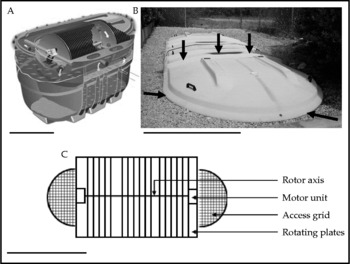
The sewage disposal needs of office buildings and condominiums, such as those in Caribbean islands where main-line sewerage is unavailable, are met by packaged plant (PP) sewage systems or by multi-chamber septic tanks. PP systems are based on a large chamber, housing rotating disks that increase surface area, thereby enhancing the efficiency of the catabolic process of decay (Fig. 1A); smaller domestic systems use two or more separate chambers for solid settlement. PP systems are easily overlooked or neglected by public health officials and mosquito control operators because of their discreet design. This is often the case when the PP system is functioning correctly. The high ambient temperature and ultraviolet radiation, typical of tropical islands like Grand Cayman, damage the leading edges of these structures and create further access points for mosquitoes (Fig. 1B). Such systems are neither airtight nor pressurized, allowing gravid mosquitoes access to oviposit. This makes PP systems suitable habitats for immature mosquitoes, although not all septic systems are amenable to mosquito colonization. In Dar es Salaam, Tanzania, Chavasse et al. (Reference Chavasse, Lines, Ichimori and Marijani1995) reported that a proportion of the septic systems sampled in their study were not acting as a larval habitat due to the thick layer of biofilm on top of the water surface. PP sewage systems present an organic-rich habitat for the development of medically important flies, such as mosquitoes (Diptera: Culicidae) and biting midges (Diptera: Ceratopogonidae) (Wada et al., Reference Wada, Saijo and Takeshi1964).
Typical packaged plant (PP) systems of Grand Cayman, Cayman Islands. A, diagram of a PP system (adapted, Klargester, Reference Klargester2008); B, typical presentation of a PP system in situ: located in a residential area of George Town, Grand Cayman (arrows, entry points for gravid female mosquitoes); C, plan of a PP system (aerial view) highlighting areas accessible by mosquito control operatives (hatched); scale bars ≈ 1 m.

The southern house mosquito Culex quinquefasciatus (Say) (Diptera: Culicidae), besides acting as an important biting nuisance, represents a public health threat in the Cayman Islands. C. quinquefasciatus is a vector of Wuchereria bancrofti (Cobbold) (aetiological agent of Bancroftian filariasis in humans) and Dirofilaria immitis (Leidy) (canine filariasis) in the Caribbean (Ahid et al., Reference Ahid, Vasconcelos and Louren-de-Oliveira2000). In the last decade, there has been a substantial increase in vector-borne disease reports from the Caribbean, attributed primarily to C. quinquefasciatus (Rawlins, Reference Rawlins1999). Haiti, northwest of Grand Cayman, is an important focus of Bancroftian filariasis (Raccurt, Reference Raccurt1999), with other neighbouring smaller foci occurring on other Caribbean islands. Undocumented travellers are not routinely screened for notifiable diseases, especially arthropod vector-borne diseases, so the island's inhabitants and vector populations are potentially exposed to microfilaraemic individuals (Vincent et al., Reference Vincent, Gonzalvo and Cowell1987; Halstead et al., Reference Halstead, Streit, Lafontant, Putvatana, Russell, Sun, Kanesa-Thasan, Hayes and Watts2001). Local transmission of mosquito-borne pathogens is putting the local 52,000 residents and c. 20,000 daily tourists at risk of infection. Research in Puerto Rico confirmed that significant populations of immature C. quinquefasciatus (Mackay et al., Reference Mackay, Amador, Diaz, Smith and Barrera2009) and Aedes aegypti (L.) are produced in large septic tanks similar to those used in the Cayman Islands (Barrera et al., Reference Barrera, Amador, Diaz, Smith, Munoz-Jordan and Rosario2008). The potential for vector-borne pathogens to enter the Cayman Islands, coupled with the relatively large populations of efficient vectors that are supplemented by sewage systems found island wide, means that constant surveillance and management of PP systems by all parties concerned is necessary.
Field trials were performed in PP systems (functioning and non-functioning units) to assess the efficacy of industry-standard insecticides for the management of C. quinquefasciatus on Grand Cayman. A PP system is deemed functional if it possesses a central rotor that continuously turns and whose plates remain unclogged (Fig. 1A). A non-functioning PP system has a central rotor that does not rotate; therefore, raw sewage continually flows into the chambers. PP systems were treated with applications of Bacillus sphaericus (VectoLex® WDG; Valent BioSciences, Libertyville, Illinois, USA), Bacillus thuringiensis var. israelensis (Bti; VectoBac® CG; Valent BioSciences), monomolecular film or ethyoxylated alcohol surfactant (Agnique® MMF; Cognis Corp., Cincinnati, Ohio, USA), (S)-methoprene (Altosid® Pro-G; Wellmark International, Schaumburg, Illinois, USA) and temephos, (Abate® 4-E; Clarke Mosquito Control, Roselle, Illinois, USA), to test their efficacy against C. quinquefasciatus. This is the first investigation looking at management options for immature C. quinquefasciatus in sewage systems in the Cayman Islands and provides a backdrop to further investigations for managing this potential vector in the Caribbean.
Materials and methods
Study sites and insecticides
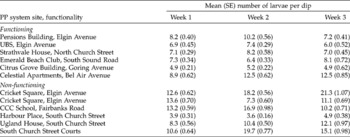
Study sites and functional status of the PP systems used in this study are summarized (Table 1). PP systems were attached to buildings with greater than 20-person occupancy and located in suburban George Town (capital of Cayman Islands, population c. 31,000). In keeping with the design of these systems, PP systems were located on the rear of the properties, often hidden by ornamental plantings such as Bougainvillea or Hibiscus species (Fig. 1B). For our experiments, we used the following active ingredients: B. sphaericus, Bti, monomolecular film, (S)-methoprene and temephos. B. sphaericus (VectoLex® WDG; Valent BioSciences) in a powder form, and Bti (VectoBac CG; Valent BioSciences) as granules. Both Bacillus products are toxins that, once ingested by 1st and 3rd instar larvae, lead to damage to the gut lining and eventual death of the larva. Our monomolecular film (Agnique® MMF, Cognis Corp.) was used in the pellet form. The monomolecular film produced as the pellet dissolves provides a physical interference with the water's surface tension, preventing larval and pupal (target stage) respiration, with mortality mediated via hypoxia. Abate® 4-E (Clarke Mosquito) was used in the liquid form. The target stage of Abate® 4-E is the larvae, as it is not as active against pupae (even at high application rates of >105.1 g/ha due to the lack of filter feeding by the pupal stage). (S)-methoprene (Altosid® Pro-G; Wellmark International) was used in the pellet form. (S)-methoprene is a mimic of juvenile hormone III (naturally found in mosquitoes) and targets 4th instars by interfering with diploid cell division and apoptosis in polytene cells, thus creating mid-guts in pupae that are similar to larval mid-guts, therefore preventing normal development (Nishiura et al., Reference Nishiura, Ho and Ray2003).
Larval populations of Culex quinquefasciatus prior to treatments in packaged plant (PP) sewage systems of Grand Cayman (1, 7 and 14 May 2007), n=15 dips

Immature sampling protocols
Sampling of mosquito immatures in a PP system requires an adjustment to standard sampling protocols, due mostly to the presence of a thick biofilm and the difficulty experienced in accessing all areas of the PP system (Fig. 1). The most effective method of dipping required breaking up the biofilm by sweeping through the biofilm with a standard dipper (model no. 1132; BioQuip, Rancho Dominguez, California, USA). After breaking up the biofilm, we waited 2–3 min for ripples to subside; then, larvae were readily observed and sampled according to accepted protocols (Huffaker and Back, Reference Huffaker and Back1943). For each sampling event, the modified technique was performed ten times in different areas of the PP system and immature C. quinquefasciatus quantified. We define a functioning PP system as one with freely rotating disks; these disks then disrupt biofilm continuity and allow for oviposition. The non-functioning PP system does not have moving disks, decreasing oviposition areas for C. quinquefasciatus; however, the non-functioning PP system will still have refugia for oviposition based on physical construction of these disks. The disk itself consists of smaller cells; these would in effect be separated from the main volume of the tank when the main disk is not rotating. Those cells remaining in the liquid could be considered a separate refugium as penetration of the dissolved control product would slow to reach these cells.
Application of insecticides and preliminary trials
To determine larval populations, a consistent and effective means of applying the insecticides to the PP systems was needed, especially a means to bypass the thick biofilm on the water surface; therefore, several approaches were considered (e.g. applying insecticide to the top of the biofilm). The only means of getting insecticides to the water surface and near immature mosquitoes was using a technique that broke up the biofilm (using a stirring motion with a dedicated dipper). Certain areas of the biofilm were more accessible for applications, e.g. areas near each end of the rotor and the motor housing (Fig. 1C).
Once the biofilm had been broken up, the application was made according to assigned application rates using designated dippers (Table 1). To make the dipper a quantitative device, it was necessary to calibrate it against known quantities (mass or volume depending on product) followed by adding gradations on dipper. Personal protective equipment was used at all times, and applications were not made during excessively windy or wet conditions, in accordance with the label instructions. Voucher specimens were deposited in the synoptic collection of PC.
Experimental design
Prior to application of insecticides, each PP system was sampled for immature C. quinquefasciatus using our modified protocols to obtain a population mean. These pre-application means would provide baseline information for subsequent post-application results; all sampling events took place between 10.00 and 11.00 Eastern standard time.
Initial investigations were performed to determine whether each of the insecticides was even feasible for the management of C. quinquefasciatus in PP systems, given susceptibility to degradation in organic-rich media of organic compounds. These feasibility trials were performed in two randomly assigned PP systems per insecticide and applications made at suggested label rates, except for B. sphaericus and Bti at low and high rates (Bti was used at a high rate for subsequent trials). After 24 h, application of low-rate B. sphaericus, label-rate monomolecular film and label-rate (S)-methoprene did not produce any detectable mortality (data not presented); therefore, these treatments were dropped from further investigations. Applications of B. sphaericus at 1.68 kg/ha proved ineffective; therefore, we increased the dose to 5.04 kg/ha in further trials, which is permitted due to the extreme organic content of a PP system, and mortality was finally noted. Similarly, (S)-methoprene (high label rate) gave no control when applied; also the monomolecular film, Agnique® MMF (high label rate), showed no control of larvae or pupae; therefore, this product was not included in further trials.
A PP system was sampled 24 h post-treatment using our modified dipping method and then sampled at weekly intervals until re-establishment of C. quinquefasciatus was noted (i.e. mean of >3 immatures). While sampling was made on a broad time scale, the sampling method best reflected activities from an operational standpoint. Data were analysed using ANOVA in SAS (2003) using a two-way ANOVA with replication and tested for normality against the generalized linear model (GLM).
Results
In the 3 weeks prior to application of insecticides, the mean number of C. quinquefasciatus larvae per dip was recorded (Table 1). Of the 12 systems in the study, six were functioning correctly, i.e. the central rotor was turning and the plates were not clogged (Fig. 1A). However, the other six were defunct, i.e. the central rotor was not rotating so that raw sewage was continually flowing into the chambers and therefore being processed very slowly. Analysis of the larval populations in the PP systems prior to applications of larvicides was facilitated by repeated-measures ANOVA (GLM procedure) in SAS (2003). This analysis revealed that the non-functioning systems harboured a significantly larger larval population (treatment effect) when compared with the functioning systems: F(1,178) = 59.16, P < 0.0001. The analysis also showed a significant effect of treatment (functional status) and time, i.e. the non-functioning systems represented a larger population of larvae for each sampling period, the least-square means for each week were significantly different (Tukey's multiple comparison test, P < 0.001, week 1: 7.22, 10.37; week 2: 8.32, 12.61 and week 3: 7.70, 12.47). The interaction of week and functional status was also significant (F(2,265) = 3.96, P < 0.0199). This justifies the experimental use of larvicides to reduce the population of C. quinquefasciatus found residing in the PP systems of Grand Cayman.
B. sphaericus (high label rate), in general, Bti and temephos gave longer control in non-functioning PP systems compared with functioning PP systems. Bti prevented the recolonization of PP systems longer than temephos and B. sphaericus (Table 2). The other larvicides in the study did not provide acceptable control: monomolecular film, B. sphaericus (low rate) and (S)-methoprene (results not shown).
Mean number of days (±SE) until recolonization of packaged plant (PP) sewage systems by Culex quinquefasciatus following treatment by temephos (109.6 ml/ha), Bacillus sphaericus (Bs; 5.04 kg/ha) and Bacillus thuringiensis var. israelensis (Bti; 22.4 kg/ha)

* Means followed by different letters in a row are significantly different at a familywise error rate (P < 0.05).
Relative costs of the different treatments at current market prices are presented (Table 3). The cost of individual application in terms of logistics, personal protective equipment and other operational considerations is not included here.
Relative and yearly cost of larvicides used in packaged plant (PP) sewage systems in our study, Grand Cayman, Cayman Islands (2007)

* Non-functioning PP system results in parentheses; MP, market price.
Discussion
B. sphaericus (high label rate VectoLex® WDG), Bti (VectoBac® CG) and temephos (Abate® 4-E) provided control of C. quinquefasciatus immatures in both functioning and non-functioning PP systems on Grand Cayman. Bti showed the longest effective control of immatures, with recolonization not occurring until 35 days (functioning PP) and 48 days (non-functioning) post-treatment. Cetin et al. (Reference Cetin, Yanikoglu, Kocak and Cilek2006) report that in smaller two-tank systems, temephos provides protection from C. pipiens (L.) for up to 21 days. In a later study, Cetin et al. (Reference Cetin, Dechant and Yanikoglu2007) also show that management of C. pipiens is possible with biological larvicides and that B. sphaericus and Bti gave 90% control for 28 days. These data are in broad agreement with the study presented here. In a study by Paing et al. (Reference Paing, Thu and Sebastian1987), a 105-day suppression of C. quinquefasciatus from a single use of B. sphaericus was reported. An explanation of this would be the regeneration phenomenon, where any viable B. sphaericus bacteria in the product become established in the surroundings. This study used water from the treated septic tank and applied it to a laboratory culture of C. quinquefasciatus, so it is not directly comparable to the study here. In our system, the large microbial load would have meant a significant amount of bacterial competition; this could have prevented the regeneration of viable colonies.
While not directly tested in our trials, temephos is likely to degrade under the warm, oxidative and acidic conditions of a Caribbean PP system (Fortin et al., Reference Fortin, Maire and Leclair1987; Burke et al., Reference Burke, Barrera, Lewis, Kluchinsky and Claborn2010). Under situations of degradative stress, where a residual control is indicated, temephos can be applied as a pellet or in granular form (e.g. 5% Skeeter Abate®; Clarke Mosquito Control). While some insecticides showed acceptable efficacy in the PP systems of Grand Cayman, logistics and residual activity must be considered.
Recolonization by C. quinquefasciatus took longer in non-functioning PP systems compared with functioning units. A PP system that is functioning correctly will have a more stable temperature profile and will exhibit higher levels of aerobic biological activity when compared with a non-functioning PP system (McKinley and Vestal, Reference McKinley and Vestal1984). This level of microbial activity could explain the general trend; functioning PP systems were recolonized earlier than non-functioning systems, i.e. the insecticidal products were oxidized earlier in the functioning PP systems versus the non-functioning PP systems. A limiting factor for C. quinquefasciatus colonization of PP systems might not lie within the organic load or insecticide degradation within units, but rather the physical survival advantages associated with operational units.
Low label rate B. sphaericus, (S)-methoprene (Altosid® Pro-G) and monomolecular film (Agnique® MMF) were not effective in controlling juvenile C. quinquefasciatus in both functioning and non-functioning PP systems on Grand Cayman. The relatively high organic levels in these PP systems putatively degrade the insecticides under these conditions, and organic loads considered should be made when making applications with certain products. The monomolecular film was unable to form a film on the surface, blocked by the organic biofilm present in non-functioning PP system; therefore, control of immatures in the PP systems using monomolecular films was not feasible in our trials. In the functioning PP systems, the monomolecular film cannot be maintained because of the continual disturbance caused by the rotating disks. Monomolecular films have been successfully used to control C. quinquefasciatus in domestic septic systems (Mariappan et al., Reference Mariappan, Somachary and Das1984); these systems do not include such disks as in PP systems. The large numbers of bacteria present in these systems would find the relatively simple molecule (S)-methoprene a readily available carbon source and would have soon oxidized this substrate. While not effective in our PP systems, B. sphaericus (low rate), monomolecular films and (S)-methoprene should be tested in other sewage systems such as multi-chamber systems, latrines, soakage pits or other septic tank configurations.
All treatments were relatively inexpensive, with temephos the least expensive and Bti the most costly on a per treatment basis. Cost should not be a major driving trigger for the use of a single insecticide due to the potential of resistance; instead, a more integrated approach is recommended (Axtell, Reference Axtell1979). While limited in scope, our work provides a backdrop for more intense hypotheses testing with respect to insecticide efficacy in PP systems in the Caribbean. Insecticides will vary with respect to efficacy in sewage systems and will depend on the physical nature of the system, its functional status and the presence of organics and biofilms. Further studies should focus on the longer-term aspects such as resistance management, awareness by the building management agencies and trapping of adults, during both oviposition and emergence.
Conclusions
Management of C. quinquefasciatus in the PP systems of Grand Cayman is possible with commercially available larvicides, which are relatively inexpensive with residual activity (i.e. B. sphaericus, Bti and temephos). While Bti prevented recolonization of PP systems by C. quinquefasciatus for the longest period, temephos was the least expensive of the management options. Choosing effective insecticides to combat C. quinquefasciatus in PP systems and similar septic devices requires consideration of operational needs, economics and the nuisance and disease risk. Rotation of products, representing different chemical classes, must be considered when mitigating potential insecticide resistance (Axtell, Reference Axtell1979), an area requiring more research in these systems. More research is warranted for all types of sewage systems where associated vector species pose a risk to human health.
Acknowledgements
The Mosquito Research and Control Unit (MRCU) is the local governmental agency responsible for vector control on all three islands (Clayson, Reference Clayson2009); we thank all staff of the MRCU for their valuable input to this project. We would also like to acknowledge the help of Greg Yeomans, Nick Kelly, Greg Curler and Dr Rajinder Mann.