





Introduction
Treatment of asymptomatic bacteriuria (ASB) is common in hospitalized patients and can lead to significant harms including antimicrobial resistance, adverse events such as Clostridioides difficile infection, and paradoxically, an increased risk of subsequent symptomatic urinary tract infection (UTI). Reference Nicolle, Gupta and Bradley1–Reference Cai, Nesi and Mazzoli3 Clinical practice guidelines recommend against screening for or treating ASB except in select populations; however, inappropriate testing and treatment persists. Because ASB is only identified when urine culture is obtained, unnecessary culturing is a critical upstream driver of overtreatment. Subsequently, reducing urine cultures through diagnostic stewardship, particularly by modifying electronic order pathways, has emerged as a priority strategy to decrease low-value testing and downstream antimicrobial exposure.
Urinalysis (UA) — driven reflex urine culture protocols have been developed to decrease the number of urine cultures obtained although the clinical success of reducing inappropriate treatment of ASB has been mixed. Reference Ourani, Honda, MacDonald and Roberts4–Reference Zheng, Hamid, Bixby and Hirsch6 This occurs because while laboratory markers may correlate with isolation of bacteriuria on cultures, this approach does not include the presence of symptoms to diagnosis UTI. Reference Advani, Turner and Schmader7
Our institution has reported success in reducing inappropriate urine cultures and subsequent reduction in identification of CAUTI through the introduction of a symptom-based, UA-driven reflex urine culture UTI panel in the inpatient setting. Reference Torres, Lyden, Gillett, Rupp and Van Schooneveld8 Clinicians may select a predefined special indication field to bypass the UA-based criteria and proceed directly to culture in patients when UA results may be unreliable (neutropenia) or when treatment of asymptomatic bacteriuria is potentially clinically indicated (renal/pancreas transplant, impending urologic procedure, and pregnancy). An “other” free text special indication has also been historically present; however, previous analysis determined that this indication had little clinical utility. Reference Keintz, Marcelin, Rupp and Van Schooneveld9 This analysis resulted in the removal of the “other” free text special indication and the addition of deceased donor evaluation. We evaluated the effect of removing the “other” free text special indication from UTI panel on urine culture rates.
Methods
Setting
All inpatient UTI panels obtained between July 1, 2022–October 31, 2025 at a Midwestern tertiary academic medical center. UA and urine cultures obtained in the emergency department or ambulatory settings were excluded due to UTI panel not being implemented in those settings.
Urinalysis-driven reflex urine culture panel
A urinalysis-driven reflex urine culture panel was implemented in April 2014. To potentially obtain a culture clinicians must document potential UTI symptoms using a checklist (dysuria, new onset frequency or urgency, suprapubic or CVA tenderness, fever and inability to assess UTI symptoms, acute hematuria, new alteration in mental status without a clear cause, and other (specify)). It also included a “special” designation field allowing clinicians to override the reflex algorithm when patients have a condition where treatment of ASB may be indicated or when symptoms or UA findings may be unreliable (pregnancy, renal/pancreas transplant, age< 3, neutropenia, impending urologic procedure, and an “other” free text indication) (Figure 1). Samples with documented symptoms and UA findings potentially consistent with infection (epithelial cells< 10 cell/high powered field) (HPF) and pyuria (>10 WBC/HPF) are reflexed to culture. Samples designated as special proceeded to urine culture regardless of symptom documentation or UA results.
Urinalysis with reflex microscopic and possible culture (UTI evaluation) orderset. © 2026 Epic Systems Corporation.

Intervention
An evaluation by the stewardship team of the “other” special indication free text documentation noted frequent misuse (citing inappropriate indications for urine testing). Based on this in February 2024 we removed the “other” free text special indication from the UTI panel. The change was implemented as an electronic order-set modification without a concurrent prescriber educational campaign. A “deceased donor” special indication was also added as it was frequently cited as an “other” indication and this testing is required to maintain compliance with local organ procurement regulations.
Definitions
Urine cultures per 1,000 patient days (PD) was the primary outcome. Secondary outcomes included individual special indications per 1,000 PD (neutropenia, pregnancy, renal/pancreas transplant). Impending urologic procedure and child age <3 years were not analyzed due to low volume. The preimplementation period was defined as July 1, 2022–February 12, 2024. The post implementation period was defined as February 13, 2024–October 31, 2025.
Statistical analysis
A single interrupted time series analysis using segmented regression was conducted to evaluate the impact of “other” free text option removal on the monthly rate of urine culture ordering. Segmented regression analysis was used to evaluate simultaneously both the significance of the immediate change in the ordering after the option removal (immediate intervention effect) and the increase or decrease in the slope of the regression line after the transition in comparison to the trend/slope of the regression line before the transition (change in trend). The Durbin-Watson (DW) test was used to assess the presence of autocorrelation in the residuals of the regression model. No autocorrelation was detected for all the rates of ordering except pregnancy. For rates with no autocorrelation, ordinary least squares (OLS) regression was used to estimate the parameter coefficients from the segmented regression model. Model diagnostics were conducted to verify that the assumptions of OLS regression were adequately met. To address the autocorrelation in the error terms for pregnancy rate, OLS estimates were computed with NeweyWest heteroskedasticity-and autocorrelation-consistent (HAC) standard errors to correct for serial correlation. All analysis was done using SAS, Version 9.4 and a P value<.05 was considered statistically significant.
Results
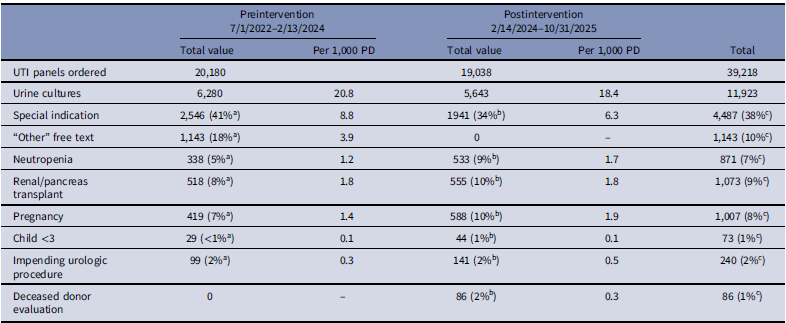
A total of 39,218 UTI panels were ordered resulting in 11,923 urine cultures during the time frame of interest. Forty-nine percent of UTI panels were ordered after intervention was implemented (N = 19,038). Special indications were selected in 4,487 UTI panels with 56.7% of these prior to the intervention (Table 1). Without the “other” option, the most common etiology for special indication designation was pregnancy (30%, n = 588) (Figure 2). Prior to the removal of the “other” free text indication, special indication bypass was responsible for 41% of all urine cultures vs 34% after removal.
A. Special indication category breakdown preintervention. B. Special indication category breakdown postintervention.

Urinalysis-driven reflex urine culture protocols outcomes and characteristics

Table 1. Long description
A table comparing the number of UTI panels ordered and urine cultures performed pre and post intervention. The table has 11 rows and 5 columns. Column headers are Preintervention 7/1/2022-2/13/2024 Total value, Preintervention 7/1/2022-2/13/2024 Per 1,000 PD, Postintervention 2/14/2024-10/31/2025 Total value, Postintervention 2/14/2024-10/31/2025 Per 1,000 PD, and Total. Row labels are UTI panels ordered, Urine cultures, Special indication, Other free text, Neutropenia, Renal/pancreas transplant, Pregnancy, Child <3, Impeding urologic procedure, and Deceased donor evaluation. Row 1: UTI panels ordered, 20,180,, 19,038,, 39,218. Row 2: Urine cultures, 6,280, 20.8, 5,643, 18.4, 11,923. Row 3: Special indication, 2,546, 8.8, 1,941, 6.3, 4,487. Row 4: Other free text, 1,143, 3.9, 0,, 1,143. Row 5: Neutropenia, 338, 1.2, 533, 1.7, 871. Row 6: Renal/pancreas transplant, 518, 1.8, 555, 1.8, 1,073. Row 7: Pregnancy, 419, 1.4, 588, 1.9, 1,007. Row 8: Child <3, 29, 0.1, 44, 0.1, 73. Row 9: Impeding urologic procedure, 99, 0.3, 141, 0.5, 240. Row 10: Deceased donor evaluation, 0,, 86, 0.3, 86.
PD = patient days.
a Percent of total urine cultures preintervention (N = 6,280).
b Percent of total urine cultures postintervention (N = 5,643).
c Percent of total urine cultures (N = 11,923). Special indications included pregnancy, neutropenia, renal/pancreas transplant, age <3, impending urologic procedure, and an “other” free text indication.
There was no significant preintervention trend in urine cultures per 1,000 PD (P = .336). The intervention was associated with a significant immediate level decrease of 2.09 urine cultures per 1,000 PD between the pre and postintervention periods (P < .05). There also was a significant change in slope (P = .0184) and a sustained postintervention decline of 0.15 urine cultures per 1,000 PD each month (P < .05) (Figure 3, Supplement 1).
Interrupted time series analysis of monthly urine culture rates per 1,000 patient days.

Prior to the intervention, special indication designation on UTI panel increased by.1 orders per 1,000 PD per month (P < .05). Following the removal of the “other” option, there was an immediate level decrease of 2.17 special indication designation per 1,000 PD (P < .05) and reversal of slope (P < .05). There was a significant postintervention decrease of 0.11 special indication designation per 1,000 PD per month (P < .05) (Figure 4, Supplement 1).
Interrupted time series analysis of monthly total special indication rates per 1,000 patient days.

There was not a statistically significant preintervention trend in neutropenia special indication designation per 1,000 PD (P = .518). Following the intervention, there was a significant immediate level increase in neutropenia designation corresponding with an absolute increase of 0.74 orders per 1,000 PD (P < .05). There was no significant change in slope between the pre and post intervention periods (P = .871). The trend was stable postintervention (P = .313) (Figure 5, Supplement 1).
Interrupted time series analysis of monthly special indication—neutropenia rates per 1,000 patient days.

There was no statistically significant preintervention trend in renal/pancreas transplant special indication designation per 1,000 PD and no significant immediate level change at time of intervention. However, there was a significant reversal in the trajectory of renal/pancreas transplant special indication designation rates after implementation, with trend decreasing by approximately 0.05 designation per 1,000 PD each month (P < .05) (Supplemental Table 1, Supplemental Figure 1).
There was a statistically significant upward preintervention trend with pregnancy special indication designation increasing by 0.04 per 1,000 PD per month (P < .05). There was no significant level change following intervention, with stable trend postintervention (Supplemental Table 1, Supplemental Figure 2).
Discussion
The removal of the “other” free text special indication option correlated with a decrease in use of the special indication as well an overall decrease in urine cultures obtained. The observed reduction supports the concept that electronic orderset architecture meaningfully shapes clinician behavior. We were able to remove this option after a detailed analysis of the use of the “other” indication noting it was frequently used to provide non-evidence-based indications for urine culturing in asymptomatic patients. Bypass options are an important component of clinical decision support, as clinicians often expect flexibility for appropriate atypical scenarios; however, they are also prone to misuse. Removing low-value bypass options may reduce discretionary testing, minimizing unintended harm without restricting access to clinically appropriate indications. Ongoing evaluation and refinement of these options should be a priority for diagnostic and antimicrobial stewardship programs.
We did not measure clinical outcomes, but it is likely there was a decrease in the number of episodes of asymptomatic bacteriuria detected due to the elimination of the bypass of the clinical decision support built into the UTI panel.
The removal of the “other”: indication may have resulted in some initial diagnosis shifting to other special indications. There was an immediate increase in neutropenia special indication designation postintervention; however the absolute volume remained low, the trend was decreasing, and this change did not affect the overall number of urine cultures per 1,000 PD postintervention. We hypothesize this may represent substitution of neutropenia for the previously available “other” bypass option rather than a change in the prevalence of neutropenia. Neutropenia itself is not an established indication for screening for or treatment of ASB. Although historically neutropenia has been included as a bypass option because of concern that pyuria is not predictive of UTI in this population, a recent study suggests urinalysis-based reflex culture strategies maintain high negative predictive value even among neutropenic patients. Reference Laracy, Chan and Kodama10 These findings support future evaluation of whether neutropenia should remain a special indication that bypasses the UA-driven reflex algorithm.
Limitations included a single center evaluation; however our center has high utilization of the UTI panel. We did not perform independent validation of documented urinary symptoms. As a result, it is possible that symptoms which were not present were documented to justify obtaining a urine culture rather than reflecting true clinical presentation. Even if this occurred, the urinalysis reflex protocol would have applied, and culture would only have been obtained if pyuria present. However, even if documentation practices shifted, a persistent reduction in urine cultures per 1,000 PD was observed following the intervention. We also did not evaluate antimicrobial use following the intervention. Although reducing urine cultures likely decreased detection of ASB, we cannot determine whether the intervention reduced unnecessary antimicrobial treatment or whether clinicians initiated empiric therapy in the absence of urine culture testing.
In conclusion, we noted a sustained decrease in urine cultures with removal of the “other” free text special indication from a UTI panel. This change was associated with minimal diagnosis shifting which decreased over time. Our strategy represents a scalable diagnostic stewardship intervention that decreases urine cultures and has the potential to decrease detection and overtreatment of asymptomatic bacteriuria while still preserving appropriate pathways for high-risk populations.
Supplementary material
The supplementary material for this article can be found at https://doi.org/10.1017/ice.2026.10596.
Financial support
None reported.
Competing interests
All authors report no conflicts of interest relevant to this article.




 Open access

