Introduction
Advanced paternal age at birth has been associated with increased risk for de-novo mutations (Kong et al., Reference Kong, Frigge, Masson, Besenbacher, Sulem, Magnusson, Gudjonsson, Sigurdsson, Jonasdottir, Jonasdottir and Wong2012; Jónsson et al., Reference Jónsson, Sulem, Kehr, Kristmundsottir, Zink, Hjartarson, Hardarson, Hjorleifsson, Eggertsson, Gudjonsson and Ward2017) and with increased incidence of several developmental and neurologic disorders (for review see Frans et al., Reference Frans, Maccabe and Reichenberg2015). In schizophrenia, results are mixed. While some studies show a monotonic increase in risk with increasing paternal age (Malaspina, Reference Malaspina2001, McGrath et al., Reference Mcgrath, Petersen, Agerbo, Mors, Mortensen and Pedersen2014), other studies found no association after adjustment for potential confounding factors, including maternal age (El-Saadi et al., Reference El-Saadi, Pedersen, Mcneil, Saha, Welham, O'callaghan, Cantor-Graae, Chant, Mortensen and Mcgrath2004; Lopez-Castroman et al., Reference Lopez-Castroman, Gómez, Belloso, Fernandez-Navarro, Perez-Rodriguez, Villamor, Navarrete, Ginestar, Currier and Torres2010). In some studies, risk was not consistently increased across paternal age categories (Byrne et al., Reference Byrne, Agerbo, Ewald, Eaton and Mortensen2003), and yet in others, risk was restricted to cases with no family history of schizophrenia (Sipos et al., Reference Sipos, Rasmussen, Harrison, Tynelius, Lewis, Leon and Gunnell2004). In bipolar disorder, a similar pattern has emerged, with some but not other studies supporting an association between advancing paternal age and risk for bipolar illness in the offspring (Brown et al., Reference Brown, Bao, Mckeague, Shen and Schaefer2013).
The underlying cause of the association has been debated as well. Because older fathers have more replications of sperm cells and therefore increased rate of de-novo mutations over time, some investigators suggested that de-novo mutations are behind this association (Malaspina et al., Reference Malaspina, Corcoran, Fahim, Berman, Harkavy-Friedman, Yale, Goetz, Goetz, Harlap and Gorman2002). As an alternative to the de-novo mutation hypothesis, it has been suggested that personality traits predisposing to schizophrenia are associated with advanced paternal age at birth. Specifically it has been hypothesized that fathers who have schizoid or schizotypal traits mate and have children at an older age, hence their children will have genetically increased risk for serious mental disorders such as schizophrenia (Petersen et al., Reference Petersen, Mortensen and Pedersen2011). Another challenge to the de-novo mutations hypothesis is that while some molecular genetic studies found higher rates of copy number de-novo mutations in sporadic (non-familial) schizophrenia (Xu et al., Reference Xu, Roos, Levy, Van Rensburg, Gogos and Karayiorgou2008), recent studies have suggested that de-novo mutations do not play a substantial role in risk for schizophrenia (Fromer et al., Reference Fromer, Pocklington, Kavanagh, Williams, Dwyer, Gormley, Georgieva, Rees, Palta and Ruderfer2014), and the role of de-novo mutations has not been convincingly demonstrated in bipolar disorder (Grozeva et al., Reference Grozeva, Kirov, Ivanov, Jones, Jones, Green, St Clair, Young, Ferrier and Farmer2010).
Methodological issues are also important to consider. Studies varied in the duration of follow-up and their analytic approaches. Family-based study designs comparing risk between siblings allow, under certain assumptions, better statistical control for familial, possibly genetic, factors shared between siblings (Frisell et al., Reference Frisell, Öberg, Kuja-Halkola and Sjölander2012; Sjölander et al., Reference Sjölander, Frisell, Kuja-Halkola, Öberg and Zetterqvist2016). While one study using this approach confirmed the association between advancing paternal age and schizophrenia and bipolar disorder (D'Onofrio et al., Reference D'onofrio, Rickert, Frans, Kuja-Halkola, Almqvist, Sjölander, Larsson and Lichtenstein2014) two others did not (Granville-Grossman, Reference Granville-Grossman1966; Petersen et al., Reference Petersen, Mortensen and Pedersen2011).
The aim of this study was to test the association between advanced paternal age at birth and risk for schizophrenia and bipolar disorder in the offspring using a large-population based cohort and to contrast two alternative hypotheses for the origins of this association: the ‘de-novo mutation hypothesis’, and the ‘delayed fatherhood hypothesis’. If de-novo mutations increase risk for schizophrenia/bipolar disorder, we would expect advanced paternal age to be associated with elevated risk for these disorders in a monotonic pattern throughout life. If, however, risk is restricted to factors related delayed fatherhood, we would not expect the risk to increase after the birth of the first-born child.
Materials and methods
The study was approved by the Israeli Defense Forces Medical Corps Institutional Review Board, and the Institutional Review Board of the Sheba Medical Center. Anonymized data were made available through linkage of population-based registers in Israel using the unique personal identification number assigned to each Israeli citizen at birth or upon immigration, enabling accurate linkage.
Population
The study population comprised of all Jewish Israeli citizens born between 1960 and 1991 assessed in Israeli Draft Boards. All Jewish adolescents in Israel, males as well as females, undergo a mandatory pre-induction screening and assessment procedures at ages 16–17, excluding those with severe developmental disorders who are in institutions or chronically hospitalized, and adolescents in jail (approximately 4% of the population).
Exposure variable
Information on paternal age at birth (years) of the first and subsequent children was obtained from the Draft Board registry using family relationship information recorded in the registry (Weiser et al., Reference Weiser, Reichenberg, Werbeloff, Kleinhaus, Lubin, Shmushkevitch, Caspi, Malaspina and Davidson2008).
Outcome variables: diagnosis of schizophrenia and bipolar disorders
The Israeli National Psychiatric Hospitalization Case Registry includes a complete listing of all psychiatric hospitalizations in Israel. All psychiatric facilities in the country (psychiatric hospitals, day hospitals and psychiatric units in general hospitals) are required by law to report all admissions and discharges to the national registry. The registry includes coded admission and discharge diagnoses assigned by a board-certified psychiatrist at the psychiatric facility. A study comparing Research Diagnostic Criteria diagnoses with registry diagnoses found that the sensitivity of the registry diagnosis of psychotic disorders (ICD-10 F20.0–F29.9) was 0.87 (Weiser et al., Reference Weiser, Kanyas, Malaspina, Harvey, Glick, Goetz, Karni, Yakir, Turetsky and Fennig2005). Ninety-three percent of the patients with schizophrenia in the population are eventually hospitalized and appear in the registry (Weiser et al., Reference Weiser, Werbeloff, Dohrenwend, Levav, Yoffe and Davidson2012). In this study, we identified patients with a hospital discharge diagnosis of narrowly defined schizophrenia (ICD-10 F20.0–F20.9) or bipolar disorder (ICD-10 F30–F31).
Covariates
Covariates included factors associated with paternal age and potentially related to increased risk of schizophrenia and bipolar disorder, including maternal age (El-Saadi et al., Reference El-Saadi, Pedersen, Mcneil, Saha, Welham, O'callaghan, Cantor-Graae, Chant, Mortensen and Mcgrath2004; Lopez-Castroman et al., Reference Lopez-Castroman, Gómez, Belloso, Fernandez-Navarro, Perez-Rodriguez, Villamor, Navarrete, Ginestar, Currier and Torres2010), year of birth (McGrath, Reference Mcgrath2006), and socioeconomic status (SES) (Goldberg et al., Reference Goldberg, Fruchter, Davidson, Reichenberg, Yoffe and Weiser2011). Maternal age and year of birth were derived from the Draft Board registry. SES was based on an index used by the Israeli Bureau of Statistics (Goldberg et al., Reference Goldberg, Fruchter, Davidson, Reichenberg, Yoffe and Weiser2011) and was applied to parental place of residence.
Data analysis
We examined the association between advancing paternal age at birth of offspring and schizophrenia and bipolar disorder, by fitting logistic regression models where paternal age was entered into the models as a categorical variable (16–24, 25–29, 30–34, 35–39, 40–44 and 45–60 years). As measures of relative risk, we quantified the risk of the disorders by calculating the odds ratios (ORs) and the associated two-sided 95% confidence intervals (CI).
All estimates were calculated by models with increasing complexity, beginning with models without adjustment for covariates (model 1), followed by models including maternal age categorically (16–24, 25–29, 30–34, 35–39, 40–45) and SES in quartile categories (model 2) and, additionally, year of birth categorically (1960–1965, 1965–1970, 1970–1975, 1975–1980, 1980–1985, >1985) (model 3), and finally, paternal age at the birth of the first-born child categorically (model 4).
Next, to allow a comparison of disease risk from paternal age to the risk associated with the paternal age of the first-born child, we fitted models including paternal age upon the birth of the first-born child as an exposure variable in a logistic regression model, both crude (model 5) and together with maternal age, SES and birth year – all categorically (model 6).
Finally, to achieve an even more efficient adjustment for familial, potentially confounding factors common to all family members, we fitted the same models in a within-family (sibling) design, using a conditional logistic regression with family as strata, instead of the logistic regression fitted above. Since paternal age for twins and triplets are identical, we randomly removed one twin from each twin pair (two from triplets). This analysis can only utilize the subset of individuals who are siblings, and as one cannot rule out the possibility that the association between advanced paternal age and schizophrenia and bipolar disorder is different in this subset, we then re-fitted the logistic regression models used in the first set of analyses presented above to this subset.
To examine our data for potential multicollinearity, which could lead to unstable Risk Ratios (RR) estimates, we calculated variance inflation factors together with pairwise correlations for the model covariates.
All analyses were repeated for males only, to examine potential sex effects (online Supplementary material).
To test the statistical hypothesis of no difference in risk of schizophrenia or bipolar disease (OR = 1) between offspring born to fathers of different paternal age, the statistical significance was set at the nominal two-sided 5% level. We did not adjust for multiplicity of statistical tests. All analyses were performed using SPSS 23.0.
Results
Out of 916 439 subjects (559 892 males, 356 547 females), 4488 (0.5%) were hospitalized with schizophrenia and 883 (0.1%) with bipolar disorder during the follow-up period, leaving 911 068 as a control group. Those rates resemble previous findings in a mental-health survey of the Israeli population (Levinson et al., Reference Levinson, Zilber, Lerner, Grinshpoon and Levav2007; Simeone et al., Reference Simeone, Ward, Rotella, Collins and Windisch2015). Mean age at follow-up was 39.93 [standard deviation (s.d.) = 4.63, median = 40].
There were 627 917 full siblings in the cohort, including 2772 (0.4%) subjects with schizophrenia and 590 (0.1%) subjects with bipolar disorder, with at least one sibling in the cohort (affected or unaffected). After randomly removing one observation from each twin-pair (two from triplets, n = 7531), there remained 620 386 subjects in the sibling sample (58.6% males, 41.4% females). One hundred and forty-six schizophrenia subjects (3.3% of the schizophrenia patients) and six bipolar subjects (0.01% of the bipolar patients) had at least one affected sibling. Sib-pairs concordant for illness were included in the main analysis. There was no support for multicollinearity in the data (online Supplementary Table 1).
Paternal age at birth and risk of schizophrenia
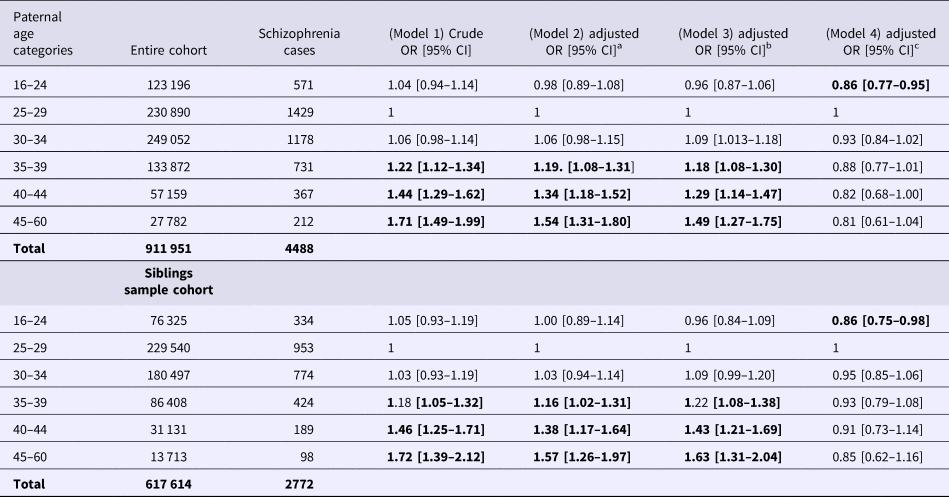
In the entire population, there was a statistically significant increase in risk for schizophrenia with advancing categories of paternal age (Table 1, top panel). Offspring of fathers aged 45–60 at birth were at the highest risk for schizophrenia (adjusted OR = 1.49, 95% CI 1.27–1.75).
Association between paternal age at birth and risk of schizophrenia in the entire population (top panel) and in the sibling cohort (bottom panel) using logistic regression

OR, odds ratio; CI, confidence interval. Bold results indicate statistically significant results.
‘Sibling cohort’ includes the subset of siblings from the ‘entire population’. Maternal age (years) categorically (16–19, 20–24, 25–29, 30–34, 35–39, 40–45), SES categorically into quartiles and year of birth (1960–1965, 1965–1970, 1970–1975, 1975–1980, 1980–1985, >1985) and paternal year of birth (16–24, 25–29, 30–34, 35–39, 40–44, 45–60).
a Adjusted for maternal age at birth and SES.
b Adjusted for maternal age at birth, SES and year of birth.
c Adjusted for maternal age at birth, SES, year of birth and paternal age at birth of first child.
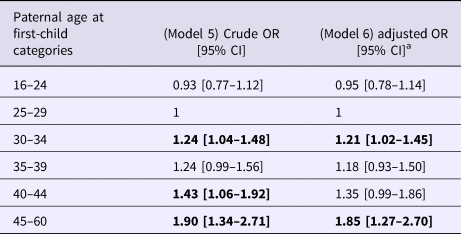
Advanced paternal age at birth of the first-born child was also associated with increased risk of schizophrenia, and remained statistically significant also after adjustment for maternal age at birth, year of birth and SES (Table 2, adjusted model #6). When including paternal age at birth of the first-born child as a covariate, advanced paternal age at birth of a subsequent child no longer increased the risk of schizophrenia (Table 1, adjusted model #4). When performing the exact same analyses only on those participants who had siblings in the sample, the results remained the same (Table 1, bottom panel).
Association between paternal age at birth of first-born child and risk of schizophrenia using logistic regression

OR, odds ratio; CI, confidence interval.
a Adjusted for maternal age (years) categorically (16–19, 20–24, 25–29, 30–34, 35–39, 40–45), SES categorically (by quartiles) and year of birth categorically (1960–1965, 1965–1970, 1970–1975, 1975–1980, 1980–1985, >1985).
We then performed a conditional logistic regression on those participants who had a sibling with schizophrenia in the family, using family as strata, in order to control for potential familial confounding. Advanced paternal age did not increase the risk of schizophrenia within the 3876 families of discordant sibling pairs (N = 10 232, online Supplementary Table 3). Twenty-nine families with a total of 60 children were concordant to the outcome and did not contribute relevant information to this analysis.
Analyses in males only showed similar results to those observed in the entire population (online Supplementary Text 1, Supplementary Tables 5–7).
Paternal age at birth and risk of bipolar disorder
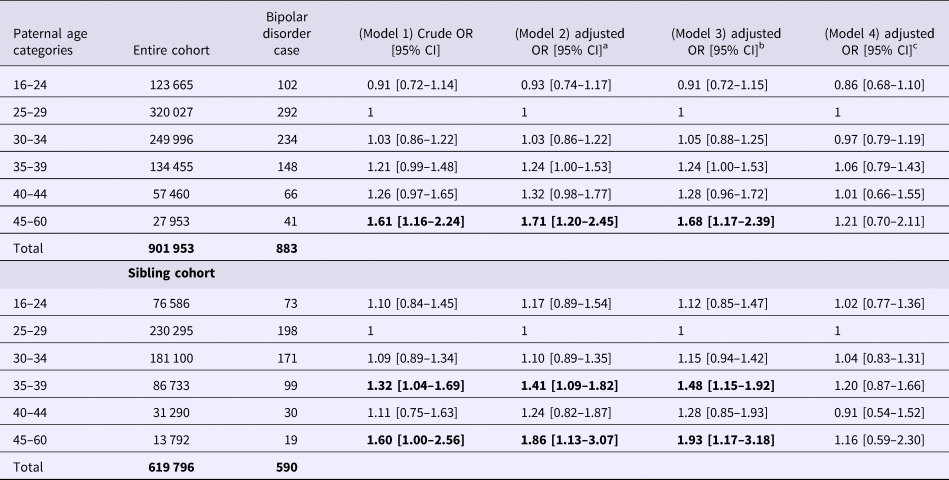
In the entire population, there was a statistically significant increase in risk for bipolar disorder with advancing categories of paternal age (Table 3, top panel). Offspring of fathers aged 45–60 at birth were at the highest risk for bipolar disorder (adjusted OR = 1.68, 95% CI 1.18–2.39). Advanced paternal age at birth of the first-born child was also associated with increased risk of bipolar disorder, but this association did not remain statistically significant after adjustment for maternal age at birth, year of birth and SES (Table 4, adjusted model #6). When including paternal age at birth of the first-born child as a covariate, advanced paternal age at birth of a subsequent child no longer increased the risk of bipolar disorder (Table 3, adjusted model #4). When performing the exact same analyses only on those participants who had siblings in the sample, the results remained the same (Table 3, bottom panel).
The association between paternal age at birth and risk of bipolar disorder in the entire population and in the sibling cohort using logistic regression

OR, odds ratio; CI, confidence interval.
‘Sibling cohort’ includes the subset of siblings from the ‘entire population’. Maternal age (years) categorically (16–19, 20–24, 25–29, 30–34, 35–39, 40–45), SES categorically into quartiles and year of birth (1960–1965, 1965–1970, 1970–1975, 1975–1980, 1980–1985, >1985) and paternal year of birth (16–24, 25–29, 30–34, 35–39, 40–44, 45–60).
a Adjusted for maternal age at birth and SES.
b Adjusted for maternal age at birth, SES and year of birth.
c Adjusted for maternal age at birth, SES age of birth and paternal age at birth of first child.
Association between paternal age at birth of first born child and risk of bipolar disorder using logistic regression

OR, odd ratios; CI, confidence interval.
a Adjusted for maternal age (years) categorically (16–19, 20–24, 25–29, 30–34, 35–39, 40–45), SES categorically (by quartiles) and year of birth categorically (1960–1965, 1965–1970, 1970–1975, 1975–1980, 1980–1985, >1985).
We then performed a conditional logistic regression on those participants who had at least one sibling with bipolar disorder in the family, using family as strata, in order to control for potential familial confounding. Advanced paternal age did not increase the risk of bipolar disorder within the 2287 discordant siblings (online Supplementary Table 4). One family with two children was concordant to the outcome and did not contribute relevant information to this analysis.
Analyses in males only showed similar results to those observed in the entire population (online Supplementary Text 1, Supplementary Tables 8–10).
Discussion
In this large, nationwide cohort with a relatively long prospective follow-up, there was an increased risk of schizophrenia and bipolar disorders among offspring of fathers who delayed fatherhood of their first-born child, but no evidence of additional risk incurred by advancing paternal age. Examining the association between paternal age and risk for schizophrenia and bipolar disorder within siblings in the same family, allows for a more efficient adjustment for potential confounders, including paternal characteristics shared among siblings (Frisell et al., Reference Frisell, Öberg, Kuja-Halkola and Sjölander2012). These analyses also showed no statistically significant increase in risk for later schizophrenia or bipolar disorder with advanced paternal age. Furthermore, the results did not support any differences by sex, as separate analyses of males showed comparable results. This is in line with a meta-analysis reporting no difference in paternal age associated-risk for schizophrenia between male and female offspring (Miller et al., Reference Miller, Messias, Miettunen, Alaräisänen, Järvelin, Koponen, Räsänen, Isohanni and Kirkpatrick2011a). Taken together, these results do not support the ‘de-novo mutation hypothesis’ in schizophrenia and bipolar disorder, but rather suggest an effect of psycho-social factors associated with having first-born children at a later age. This is in line with recent large-scale molecular genetic studies that concluded that de-novo mutations are not likely to play a substantial role in schizophrenia risk architecture (Fromer et al., Reference Fromer, Pocklington, Kavanagh, Williams, Dwyer, Gormley, Georgieva, Rees, Palta and Ruderfer2014).
There are only a few studies examining the association between paternal age at birth and risk of schizophrenia and bipolar disorders using a sibling-comparison design. Similar to our findings, a previous study compared paternal age at birth between discordant siblings for schizophrenia, and found no statistically significant differences (Granville-Grossman, Reference Granville-Grossman1966). In a population-based Danish study, Petersen et al. (Reference Petersen, Mortensen and Pedersen2011) reported that when the paternal age of schizophrenia patients and paternal age at birth of the first child are assessed independently, an effect is only found for the later. Namely, contrary to the de-novo mutations hypothesis, paternal age per se is not related to increased risk of schizophrenia beyond the effect of paternal age at birth of the first-born child. Our findings are in accordance with both of these studies. In contrast, a population-based Swedish study found that advanced paternal age at birth was associated with increased risk of psychosis and bipolar disorder in a within-families design, with even higher risk than the risk found in the entire population (D'Onofrio et al., Reference D'onofrio, Rickert, Frans, Kuja-Halkola, Almqvist, Sjölander, Larsson and Lichtenstein2014). A possible explanation for the different findings in that study might be the use of a broad diagnostic category of psychosis, ICD F20–F29, whereas we used a narrower definition of schizophrenia, ICD F20.0–F20.9. Also, we used the last discharge diagnosis, whereas D'Onofrio et al. assigned the diagnosis of schizophrenia to patients with at least two hospitalizations with a discharge diagnosis of schizophrenia, and defined bipolar disorder as patients with at least two hospitalizations with a discharge diagnosis of bipolar disorder, hence in that paper a patient could be classified both with schizophrenia and bipolar disorder.
Although there is strong evidence linking advanced paternal age to de-novo mutations (Jónsson et al., Reference Jónsson, Sulem, Kehr, Kristmundsottir, Zink, Hjartarson, Hardarson, Hjorleifsson, Eggertsson, Gudjonsson and Ward2017), there is a paucity of findings regarding the effect of genetic mutations on risk for schizophrenia. However, there are several characteristics of individuals that begin parenting at an advanced age that may constitute risk factors. Males entering parenthood at an advanced age in Nordic countries are more likely to be unmarried, suffer from depression, smoke cigarettes and have few social contacts (Nilsen et al., Reference Nilsen, Waldenström, Rasmussen, Hjelmstedt and Schytt2013). Similarly in the USA, the age entering parenthood has been increasing over time, although it varies by race, geographic region and paternal education level. College education and birth in Northeastern states is associated with older fathers. Asian fathers are the oldest and black fathers are the youngest (Khandwala, Reference Khandwala, Zhang, Lu and Eisenberg2017). To the best of our knowledge, there are no published data on older fathers in Israel. Being unmarried, smoking cigarettes, depression and social isolation are associated with risk for schizophrenia (Davidson et al., Reference Davidson, Reichenberg, Rabinowitz, Weiser, Kaplan and Mark1999; Rabinowitz et al., Reference Rabinowitz, Reichenberg, Weiser, Mark, Kaplan and Davidson2000; Weiser et al., Reference Weiser, Reichenberg, Rabinowitz, Kaplan, Mark, Bodner, Nahon and Davidson2001, Reference Weiser, Reichenberg, Rabinowitz, Kaplan, Caspi, Yasvizky, Mark, Knobler, Nahon and Davidson2003, Reference Weiser, Reichenberg, Grotto, Yasvitzky, Rabinowitz, Lubin, Nahon, Knobler and Davidson2004; Reichenberg et al., Reference Reichenberg, Weiser, Caspi, Knobler, Lubin, Harvey, Rabinowitz and Davidson2006; Loughland et al., Reference Loughland, Draganic, Mccabe, Richards, Nasir, Allen, Catts, Jablensky, Henskens and Michie2010), and is consistent with the hypothesis that characteristics of older fathers at birth of first child might be associated with susceptibility to psychiatric disorders in the offspring. Men with schizotypal or other cluster A personality traits could delay having children, hence increasing risk of schizophrenia or bipolar disorder in their offspring (Miller et al., Reference Miller, Suvisaari, Miettunen, Järvelin, Haukka, Tanskanen, Lönnqvist, Isohanni and Kirkpatrick2011b). Conversely, once controlling for paternal age at birth of the first child using conditional logistic regression, the results showed the reversed effect, of decreased risk for schizophrenia as paternal age increases. As our analysis was not designed to explore this correlation, we did not inspect this finding further.
The strength of this study is its large population-based sample, the use of multiple study designs and a sibling-design to test the study hypothesis. The length of follow-up was relatively long, with a mean follow-up of 31.78 years (s.d. = 4.67) from birth to end of study. This allowed us to cover critical years for onset of the disorders.
Our study has limitations. We used clinical, not research diagnoses of hospitalized patients, and thus the study is limited to more severe cases. However, the sensitivity of the diagnoses of schizophrenia within this registry is 0.87 (Weiser et al., Reference Weiser, Kanyas, Malaspina, Harvey, Glick, Goetz, Karni, Yakir, Turetsky and Fennig2005), and 93% of patients with schizophrenia in the population are eventually hospitalized and therefore appear in the registry (Weiser et al., Reference Weiser, Werbeloff, Dohrenwend, Levav, Yoffe and Davidson2012). Also, the prevalence of bipolar disorder varies greatly from one country to another, ranging from 0.1 to 4.4 according to a community based survey performed in 11 countries (Merikangas et al., Reference Merikangas, Jin, He, Kessler, Lee, Sampson, Viana, Andrade, Hu, Karam and Ladea2011). In Israel, a community based survey found the prevalence to be 0.7% (Levinson et al., Reference Levinson, Zilber, Lerner, Grinshpoon and Levav2007). The data presented in this present paper are based on hospitalizations only, which clearly do not include all patients with bipolar I disorder in the population. Also, as this is a military sample, males are over-represented (61.1%).
To conclude, our data do not support the hypothesis that de-novo mutations are behind the association between advanced paternal age and schizophrenia and bipolar disorder. Instead, this might be attributed to psycho-social characteristics of fathers with delayed initial fatherhood that predispose their offspring to schizophrenia and bipolar disorder.
Supplementary material
The supplementary material for this article can be found at https://doi.org/10.1017/S0033291719000242
Author ORCIDs
Or Frenkel, 0000-0002-4594-9776.
Acknowledgements
All authors critically reviewed the manuscript and approved the final draft for submission.
Financial support
This research received no specific grants from any funding agency, commercial or not-for-profit sectors. Sven Sandin, PhD is a Seaver Faculty Fellow.
Conflict of interest
None.
Ethical standards
The authors assert that all procedures contributing to this work comply with the ethical standards of the relevant national and institutional committees on human experimentation and with the Helsinki Declaration of 975, as revised in 2008.