

Several theoretical models have been proposed with the aim of describing the reconciliation of person-based problems. According to Chang, D'Zurilla, and Sanna (Reference Chang, D'Zurilla and Sanna2004), social problem solving (SPS) can be viewed as a special field within general problem solving, in which interpersonal problems are solved according to individual and situational information, based on personal regulation. The latter is a conscious, rational, effortful activity that, due to unforeseen events, may be supplemented by spontaneous processes that refer to sensible, controlled, impulsive and automated cognitive procedures and the links between them.
The role of conscious and unconscious mental processes and their influence on one another is very important: earlier experiences and social patterns affect a practical solution, and its success and effectiveness for a given situation and problem (e.g., Frauenknecht & Black, Reference Frauenknecht and Black2009). Strough and Keener (2013) highlight the importance of environmental factors (situation, person) with regard to the process of SPS. According to Strough and Keener, it is a crucial point in the analysis of how an individual's SPS is specific to a given context and its connection with other people; in other words, what similarities and differences can be revealed in terms of their SPS according to these characteristics.
The model developed by D'Zurilla, Nezu, and Maydeu-Olivares (2004) provides the theoretical foundation of the measurement instrument applied in this study. SPS is a ‘[. . .] self-directed cognitive-behavioural process by which an individual, couple, or group attempts to identify or discover effective solutions for specific problems encountered in everyday living’ (D'Zurilla et al., 2004, p. 12.). According to Maydeu-Olivares and D'Zurilla (Reference Maydeu-Olivares and D'Zurilla1996), SPS comprises five different factors: positive problem orientation, negative problem orientation, rational problem solving, impulsivity/carelessness, and avoidance. The Social Problem Solving Inventory — Revised (SPSI–R, D'Zurilla et al., Reference D'Zurilla, Nezu and Maydeu-Olivares2002) is one of the most widely accepted instruments in SPS assessment that measures these five factors.
International cross-sectional studies (e.g., D'Zurilla et al., Reference D'Zurilla, Nezu and Maydeu-Olivares2002; Graf, Reference Graf2003; Maydeu-Olivares, Rodríquez-Fornells, Gómez-Benito, & D'Zurilla, Reference Maydeu-Olivares, Rodríquez-Fornells, Gómez-Benito and D'Zurilla2000) suggest that in puberty positive orientation decreases, while negative orientation shows a growing tendency, along with rationality and avoidance. It was also revealed that a high level of impulsivity characterises the younger students, which seems to be almost permanent during puberty. Based on the analysis, girls are more often characterised by impulsivity, while for boys, rationality is characterised more frequently from mid-puberty.
Longitudinal studies involving adult participants suggest that negative problem orientation predicts future anxiety, depression, and stress (Ciarrochi & Scott, Reference Ciarrochi and Scott2006). This pattern is also seen in adolescence: adolescents characterised dominantly by positive problem orientation were shown to exhibit positive emotions and empathy more frequently (Ciarrochi et al., Reference Ciarrochi, Leeson and Heaven2009). Positive problem orientation also seems to be related to better family quality of life (e.g., through fewer parent-adolescent conflicts). This latter effect, in turn, has a positive influence on relationships with peers and on SPS at school. Rational problem solving improves the social behaviour of both children and adults, but this is still a matter of debate (D'Zurilla & Nezu, 1990). The findings of Shure (Reference Shure1999) seem to bear out this proposition, while there is also evidence to suggest the opposite: in a study by Cooper (Reference Cooper2011), early adolescents were found to exhibit rational problem solving and a high level of aggression at the same time. According to Takahashi, Koseki, and Shimada's (Reference Takahashi, Koseki and Shimada2009) research, those adolescents who list less adequate modes of solution with regard to a problem situation tend to solve their conflicts more aggressively. An earlier study (Messer, Reference Messer1976) also confirms that more impulsive children are worse problem solvers if the means are not instantly apparent in a given situation.
Based on Hungarian cross-sectional and longitudinal studies (Kasik, Reference Kasik2014, Reference Kasik2015), which are mostly in accordance with other national research data, positive orientation decreases while negative orientation increases in adolescence and, furthermore, rationality and avoidance become more representative. In addition to this, impulsivity becomes more characteristic of children at this age, and the degree of impulsivity stays steady during the whole of puberty. Girls’ and boys’ SPS start to show increasing levels of discrepancy from mid-adolescence; for example, rationality becomes more typical among boys, and impulsivity becomes more characteristic of girls.
The age- and gender-related characteristics and the changes in the style of SPS are influenced by several individual, environmental, and cultural factors. According to international studies (e.g., Chang et al., Reference Chang, D'Zurilla and Sanna2004; Grusec & Davidov, Reference Grusec, Davidov, Grusec and Hastings2007), numerous biological and psychosocial changes take place during adolescence that may strengthen SPS. The age- and gender-specific functioning and alteration of SPS are, on the one hand, defined by the cognitive, emotional, and social features of one's personality and, on the other hand, by environmental variables and the interaction between these variables (e.g., Rich & Bonner, Reference Rich, Bonner, Chang, D'Zurilla and Sanna2004). The most studied mediator variables are genetic aptitudes — the five supertraits; namely, anxiety, emotions, optimism, pessimism, and perfectionism. There is no evidence to prove that SPS is genetically determined. According to some results, emotion regulation, empathy, and some cognitive ability (e.g., inductive reasoning) have an important effect on the development of SPS (e.g., Chang et al., Reference Chang, D'Zurilla and Sanna2004). In our Hungarian studies (e.g., Kasik, Reference Kasik2009, Reference Kasik2015), the correlation between personal distress and impulsivity was stronger among girls than boys, and the relationship between rationality and inductive reasoning was stronger among boys than girls. In the case of correlation between empathy and SPS, similar results were also reported by Siu and Shek (Reference Siu and Shek2005).
Moderating variables of SPS include environmental influences, and many components of the impact of these influences can be separated. The most influential among these components are family background, parents’ and other adults’ (e.g., teachers’) SPS and their opinion of the child's SPS, and peers’ patterns as represented in a given problem situation (Pakaslahti, Karjalainen, & Keltikangas-Järvinen, Reference Pakaslahti, Karjalainen and Keltikangas-Järvinen2002). All social activities are profoundly influenced by the structure of one's family, the quality of communication, emotions, and hierarchical relations between its members (Conger & Dogan, Reference Conger, Dogan, Grusec and Hastings2007). Research conducted by Pakaslathi et al. (Reference Pakaslahti, Karjalainen and Keltikangas-Järvinen2002) and Keltikangas-Järvinen (Reference Keltikangas-Järvinen, McMurran and McGuire2005) has shown that SPS in childhood and adolescence is most influenced by communication between one's family members and parents’ SPS. The influence of communication on the attachment style of mothers and children's emotional relationship with their mother's SPS plays a crucial role as an important factor in this phenomenon (Rich & Bonner, Reference Rich, Bonner, Chang, D'Zurilla and Sanna2004).
Although mothers and fathers provide different patterns, how they handle problem situations both individually and in combination has an impact on their children's adult relationships; therefore, the degree of similarity between their patterns is also significant (e.g., Markulin, Reference Markulin2009). Different SPS styles may be traced back to inherited and learnt reasons, such as gender and role. Negative problem orientation is more typical of adult women, while rational problem solving is more representative among men (D'Zurilla & Nezu, 1998). While men prefer problem-focused problem solving, women favour emotion-focused problem solving (Ptacek, Smith, & Dodge, Reference Ptacek, Smith and Dodge1994). We identified the same gender difference in our longitudinal study among adolescent (12- and 14-year-old) girls and boys. In all years of data collection, rationality and positive problem orientation were typical among boys, whereas negative problem orientation and impulsivity were representative among girls (Kasik, Reference Kasik2014).
Children's SPS is also defined by how parents and teachers see and reflect on children's behaviour and cognition. Their reactions (which also serve as patterns in the child's social learning) and expressed expectations also influence them in dealing with their social problems. Mothers’ and fathers’ education, which influences their practice of child rearing and their goals, informs the measured SPS factors to varying degrees. Mothers tend to influence negative orientation, impulsivity and avoidance, while fathers influence positive orientation and rationality (Kasik, Reference Kasik2014).
Webster-Stratton (Reference Webster-Stratton1988) argues that parents’ and teachers’ reactions to the child's way of overcoming social problems are largely dependent on his/her age and gender. Depending on their cultural background, they formulate expectations about how a boy and a girl should solve a problem at a given age; for example, whether a boy can cry or can be aggressive, and whether or not he can apply this to them as well. Kim and Rohner (Reference Kim and Rohner2003) claim that both parents’ and their children's gender influences the evaluation of SPS; mothers tend to see their daughters in a more positive light, and fathers tend to see their sons in a more positive light. As with Spivack, Platt, and Shure's study (Reference Spivack, Platt and Shure1976), the connection between mothers’ and fathers’ sensibility and orientation towards a problem and the seeking of alternative solutions is stronger with their daughters and sons, respectively, as compared to mothers with their sons and fathers with their daughters. Fathers usually insist more on social expectations regarding gender roles. However, this also depends on one's culture; for example, the differences between Western and Eastern societies are substantial (Cheng, 2011).
It has also been found that teachers’ work determines the development of SPS. The efficiency of their work depends on what information they have about the child's personality, family, and the expectations and pedagogical aims they have drafted and how they carry these out (e.g., Bredekamp & Copple, Reference Bredekamp and Copple1997). Children's age and gender determine teachers’ beliefs as well (Webster-Stratton Reference Webster-Stratton1988). Their information about the child's family and to what extent they agree with parents’ educational style fundamentally determines their expectations and disapproval or approval of the child's problem solving. For instance, the higher a parent's educational qualification is, the more the teachers expect their child to abide by rules and to present an efficient SPS (Webster-Stratton & Lindsay, Reference Webster-Stratton and Lindsay1999). Hastings and Coplan (Reference Hastings and Coplan1999) have observed that teachers’ evaluations were less strict in the case of those children who have shown behavioural problems and whose mothers’ educational methods they approved of, as compared to the opposite.
The Hungarian education system is very selective (Csapó, Molnár, & Kinyó, Reference Csapó, Molnár and Kinyó2008): students from different social backgrounds attend different secondary schools (grammar school, technical college and vocational school), while vocational programs are mostly attended by learners with varying disadvantages (Vári, 2003). Based on research of SPS by Kasik (Reference Kasik2014) in Hungary, in terms of school-type differences, the most apparent is that grammar school students show more rationality while vocational students display more avoidance, although these two groups also exhibit other features in common with each other.
Research Problem, Aims and Hypotheses
The results of international research are varied, and most of these studies describe individuals’ general SPS and do not account for the variations of the person- or factor-based characteristics of SPS. Both in Hungarian and other international studies, many of the characteristics of the SPS have been revealed by using the SPSI–R (positive problem orientation and negative problem orientation; rationality, impulsivity, and avoidance). While completing this questionnaire, children may think of more than one person (in accordance with the instructions of the questionnaire), so we do not know whose process of SPS is reflected in the answers. In any case, before developing a school improvement program, it is advisable to uncover the characteristics of person-based SPS (based on the problems associated with a particular person).
The presented 2012 research focused on the characteristics of SPS, as a field within social behaviour, among pre-pubescent 10-year-olds and 14- and 16-year-old adolescents in connection with the people who affect one's problem solving, that is, mothers, fathers, form teachers and peers. We know relatively little about 10-year-old students’ SPS, and they were therefore selected as part of the sample.
Apart from the children's self-evaluation, mothers, fathers and teachers also assessed students’ SPS in the study. Participants (both children and adults) were asked to evaluate their SPS by taking into consideration their problems and their solutions with the given person.
It was examined whether there were any age- and school type-related discrepancies in relation to SPS with parents and teachers regarding children's and adults’ perception of it, and whether adults’ and children's opinions differed at a certain age, in addition to aiming to find any significant variations between mother-son, mother-daughter, father-son, father-daughter, teacher-boy and teacher-girl evaluations. A comparison of peer-related SPS could not be carried out due to the lack of fellow students’ evaluation.
Based on previous cross-sectional and longitudinal studies carried out with students of the same age, it could be hypothesised that the older a child is, the more similarities he/she exhibits with parents’ and teachers’ evaluations; however, this is different in every factor and cannot be generalised to all. It has also been proposed that both the adult's and the child's gender plays an important role in the assessment of SPS: as compared to students’ own self-evaluations, parents display a tendency to overrate while teachers tend to underrate them. Yet, fathers assess their sons and mothers assess their daughters more positively. It has also been theorised that opinions vary among vocational school, technical college, and grammar school students in terms of the evaluators, especially in the case of teachers: the first group is evaluated more negatively compared to the other two.
The Present Study
Sample
The participants were 10-, 14- and 16-year-olds in Hungary (N = 459; 150 10-year-olds, M = 10.11 SD = .56; 149 14-year-olds, M = 14.23, SD = .24; 160 16-year-olds, M = 16.32, SD = .45). Based on the Family Background Questionnare (Kasik, Reference Kasik2009), girls slightly outnumbered boys in all age groups (10-year-olds: 56%, 14-year-olds: 53%, 16-year-olds: 51%). All the students lived with their parents, and the native language of all participants was Hungarian.
The traditional Hungarian education system is made up of eight elementary and four secondary school classes. The 10- and 14-year-old participants were elementary school students (4th and 8th grade), while the 16-year-old participants (10th grade) were attending secondary school. The 16-year-olds were grammar school, technical college and vocational school students in similar proportions (34%, 35%, and 31% respectively). In the Hungarian educational system, the grammar school students do not learn a profession, but take the Matura Examination at the end of their studies to receive a high school diploma, and the majority continue their studies in higher education. The technical college students are also learning a profession in addition to taking the Matura Examination, while vocational school students only learn a profession.
Apart from the students, mothers (N = 459), fathers (N = 459) and teachers also evaluated the children. We only analysed the data of those children whose parents filled out the questionnaire, so the number of children is equal to the number of mothers and fathers. Twenty-six form teachers participated in the research (all female). All of the students’ SPS of a particular class was evaluated by their form teacher; thus, their number was equal to the number of classes involved in the research. It was very important to gain information about SPS that related to the same teacher in a particular class.
Instrument
We used the short version of the SPSI–R (D'Zurilla et al., Reference D'Zurilla, Nezu and Maydeu-Olivares2002). The original version was first translated into Hungarian, with the resulting Hungarian version then translated back to English, and with the Hungarian version finalised only after clarifying all potentially problematic words or phrases (see Kasik, Reference Kasik2014). The version of the Hungarian adaptation showed adequate reliability (Cronbach alphas) and factor structure (Kaiser-Meyer-Olkin indexes) at all studied ages (12, 14, 16, and 18 years). The results were similar to those found in other international studies and to the results of the first Hungarian adaptation (see Kasik, Reference Kasik2014). In the present study, the Cronbach alphas were above .81, and KMO indexes were above .82, which is sufficient.
This version assesses the five factors of SPS: PPO = Positive Problem Orientation; NPO = Negative Problem Orientation; RPS = Rational Problem Solving; ICS = Impulsivity/Carelessness Style; AS = Avoidance Style. All factors include five items (resulting in a total of 25 items). PPO covers elements of constructive problem solving, such as self-efficacy and positive outcome expectancy. NPO covers a set of dysfunctional cognitive-emotional schemes; for instance, low self-efficacy and negative outcome expectancy. RPS can be defined as a constructive problem solving style that is characterised by rational, deliberate, and systematic application of effective problem-solving skills. ICS is a set of dysfunctional problem-solving attempts such as impulsivity and carelessness. AS is a dysfunctional dimension characterised by passivity and attempts to shift the responsibility of problem solving to others. The SPSI–R subscales consist of 5-point (from 0 to 4) Likert-type items where 0 = not at all true of me, 1 = slightly true of me, 2 = moderately true of me, 3 = very true of me, 4 = extremely true of me.
Data Collection
The contents and structure of the original questionnaire was not changed; the only applied modification pertains to the instruction of being person-based when filling in the questionnaire (i.e., who the student should think of while doing so: mother, father, form teacher, or peers). Accordingly, students had to fill out the survey four times with week-long intervals between each one (the order was the following: mother related, related to a peer, father related and teacher related). For the students, it took 20–25 minutes to fill out the questionnaire each time. Every occasion took place during a home class with the form teacher. Parents had to complete the SPSI–R and Family Background Questionnaire (Kasik, Reference Kasik2009) during parent-teacher meetings, and teachers had 2 weeks to finish it. All the children's parents agreed to a pedagogical evaluation and they also verified their participation in the study and the evaluation of their children with their signature (based on Hungarian Ethical Norms for Psychologist).
Results
Age and Evaluator Differences
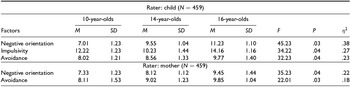
Tables 1–4 display the characteristics of SPS regarding mothers, fathers, form teachers, and peers with regard to the five factors (the tables contain only the significant differences). Table 1 shows the particulars of SPS relating to one's mother according to the students’ and mothers’ evaluations. According to students’ evaluations in connection with their mothers, negative orientation and avoidance is significantly more typical in 16-year-olds than it is in 10- and 14-year-olds; impulsivity is more characteristic of 10- and 16-year-olds than of 14-year-olds; however, there is no discrepancy related to either positive orientation or rationality in either of the age groups. Being in agreement with children, mothers claim that negative orientation and avoidance is more representative in 16-year-old students, but at the same time there is no noteworthy disparity regarding the other factors in the different age groups.
Characteristics Related to SPS With Mothers According to Children and Mothers (M, SD, ANOVA: F, p, η2)

Note: The table shows only the significant differences.
Characteristics related to SPS with fathers according to fathers (M, SD, ANOVA: F, p, η2)

Note: The table shows only the significant differences.
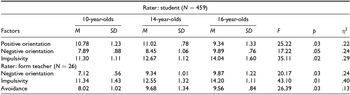
Characteristics related to SPS with teachers according to students and form teachers (M, SD, ANOVA: F, p, η2)

Note: The table shows only the significant differences.
Characteristics Related to SPS With Peers According to Students (M, SD, ANOVA: F, p, η2)

Note: The table shows only the significant differences.
By comparing mothers’ and their children's evaluation in every respective age group, it was observed that their opinions showed no variation with regard to either of the factors in the case of 10-year-olds; thus, they share a viewpoint in terms of measured aspects of SPS. Fourteen-year-olds see their SPS with their mothers more rationally than their mothers do (t = 2.45 p = .04), and 16-year-olds claim that they have a more positive approach to solving their problems than their mothers believe they do (t = 3.03 p = .04).
In terms of SPS with fathers (Table 2), 10- to 16-year-olds all had a similar opinion, and there was no one factor where children revealed a significant difference in their self-evaluation. Nonetheless, fathers of children of different ages had diverse standpoints in relation to positive orientation, rationality, and avoidance, as compared to the children. A constant increase in positive orientation may be presumed, based on the surge of values that showed growth that is exponential with age. Fourteen- and 16-year-olds’ fathers tended to observe a higher degree of rationality in their children's SPS as compared to fathers of 10-year-olds. The fathers of the 16-year-olds regarded avoidance as less typical than fathers of the younger participants.
Similarly to mothers, fathers’ and children's opinions displayed no variation among 10-year-olds in either of the factors. According to fathers, negative orientation (t = 3.11, p = .05) and rationality (t = 3.23, p = .03) were more common in 14-year-olds, and positive orientation (t = 2.25, p = .04) was regarded as more typical of the oldest age group in the survey, as compared to how children see themselves.
With regard to SPS with their form teachers (Table 3) and based on their self-evaluations, 10- and 14-year-olds exhibit a higher tendency of positive orientation than the oldest participants in the research, for whom negative orientation is more typical. The three age groups differ entirely in terms of the evaluation of impulsivity: it is least typical of 10-year-olds and most typical of 16-year-olds.
According to the teachers’ evaluations, it also becomes apparent that impulsivity becomes more typical in each age group; in other words, their evaluations are similar to the students’. Negative orientation is least characteristic of 10-year-olds than the older groups, according to the teachers’ evaluation, in addition to the values that account for avoidance.
Compared to parents, teachers see children differently in all three age groups. Teachers’ descriptions of 10-year-old students vary with regard to the three factors when compared to students’ own evaluation of their SPS: their negative orientation (t = 3.11, p = .03), avoidance (t = 3.45, p = .04), and impulsivity (t = 3.56, p = .03) is regarded as more significant by teachers. They also deem 14-year-olds more impulsive (t = 2.56, p = .02) and claim that negative orientation is more characteristic among 16-year-olds (t = 3.01, p = .02).
SPS related to peers reveals no discrepancy with regard to either factor at the ages of 10 and 14 (Table 4). Sixteen-year-olds, however, significantly separate from the younger participants in this research in terms of impulsivity and avoidance; based on their self-evaluation, both were more typical of this group.
The Links Between Gender-Related Evaluations
Boys’ and girls’ self-evaluations were compared with their parents’ and teachers’ evaluations as per age group with correlation analysis (Pearson r). Then, with a z probe, it was tested whether there were any substantial differences between mother-son and mother-daughter, father-son and father-daughter, teacher-boy and teacher-girl evaluations (p < .05 in the case of all significant differences). It was found that mothers and their daughters, and fathers and their sons more or less shared their opinions in all age groups; nonetheless, none of the patterns observed in relation to parents were identified among the teachers, who were all women.
The strength of the links between mother-daughter evaluations was .32–.47, and .25–.39 between mother-son evaluations. The lowest values can be seen among 16-year-olds, both in girls and boys, and related to negative orientation in both cases. The mother-daughter relationship was stronger in the case of 10-year-olds’ impulsivity (z = 3.76), 14-year-olds’ impulsivity (z = 2.58) and avoidance (z = 3.11), and 16-year-olds’ avoidance (z = 3.24) as compared to the mother-son connection. The strength of the mother-son relation was higher for 16-year-olds’ rationality (z = 2.42) than was the case for mothers and their daughters.
Fathers’ correlation values were between .20–.34 with their daughters and .25–.41 with their sons. Once again, the lowest sums were in relation to 16-year-olds, for impulsivity in the case of girls and negative orientation in the case of boys. Father-son relationships were significantly stronger in all age groups (10-year-olds: z = 3.16; 14-year-olds: z = 2.98; 16-year-olds: z = 3.06), as compared to fathers’ connection with their daughters. The correlation value of negative orientation was higher in father-daughter than in father-son relations (z = 3.11), and the father-son bond was, again, more solid in the case of 16-year-olds’ positive orientation (z = 2.66).
The values of teacher-girl and teacher-boy connections in the whole sample were between .15–.34 and .14–.27, respectively. The lowest sums represent 10-year-old girls’ rationality and 14-year-old boys’ negative orientation. Teachers’ relations to 10-year-olds was stronger for boys’ rationality (z = 3.23) and girls’ positive orientation (z = 2.77). There was only one factor with a noteworthy disparity in the case of 14-year-olds: impulsivity was stronger in the teacher-girl relationship (z = 2.54). Teachers’ bond with 16-year-old boys and girls was stronger for rationality (z = 3.20), avoidance (z = 2.64), and impulsivity (z = 2.57), respectively.
School Type Differences
Whether there were any discrepancies between vocational school, technical college, and grammar school students’ person-based SPS, based on their self-evaluation or adults’ assessment (p < .05 in the case of all significant differences), was analysed in the 16-year-olds’ subsample. It was concluded that grammar school and technical college students tend to think similarly to their parents of their SPS, which is in contrast with vocational school students and their parents.
Rationality related to mothers was more common among grammar school and technical college students for children's and mothers’ evaluation (F = 35.23 and F = 20.11, respectively) than among vocational students; the latter group also see themselves as more impulsive (F = 18.34). In the meantime, mothers’ assessments showed no variation in this regard. As with mothers, the judgment of rationality was the same for fathers: based on the self- and fathers’ evaluations, this is more typical of grammar school students (F = 40.01). Furthermore, both evaluations revealed that avoidance is more common among grammar school and technical college students (F = 30.78).
Furthermore, grammar school students viewed their SPS with regard to teachers as more rational than vocational school and technical college students (F = 22.67); the former also attributed more avoidance to themselves (F = 30.34). Teachers also claimed in their evaluations that rationality was more characteristic of grammar school and technical college students (F = 27.10), while impulsivity (F = 26.23) and avoidance (F = 42.12) were more typical of vocational school students. According to the self-evaluations, grammar school students are more rational (F = 30.67), learners at a technical college display more avoidance (F = 46.03), and vocational school students are more impulsive (F = 28.25) when it comes to SPS with peers.
Discussion
Features of non-person-based SPS among children of different ages have been studied in earlier cross-sectional and longitudinal research (e.g., Kasik, 2010, Reference Kasik2014). The results of the study aimed at person-based SPS only partially support these features. One of the possible explanations for this is that adults and children have given their opinion of the solutions of their mutual problems in the present research while in previous studies no such restrictions were given to either of the parties — they could think of anyone, even more than one person at the same time, when filling out the questionnaire. Thus, the results of the person-based survey are different from the non-person-based survey.
In previous studies aimed at non-person-based SPS, it became apparent, based on correlation analysis, that children's and mothers’ evaluations were more similar to each other than child-teacher or teacher-mother ratings; the latter showed the most discrepancy (Kasik, Reference Kasik2014). It has been shown in the present research how mothers and their children, fathers and their children, and teachers and their students see their SPS as it relates to their mutual problems (the scope of the survey could not cover comparison with peers as children could have thought of many of their fellow students; nonetheless, much new information has been gathered with regard to the variations of SPS in adults).
Also with person-based SPS, it can be seen that mothers’ and their children's opinions are quite similar in all age groups; when compared to previous results, no overrating was seen in the former's opinion when contrasted with self-evaluations. According to Gauvain (Reference Gauvain2001), one key explanation for this is the similarity of the attachment between mother and child. In this study, any kinds of overrating of mothers’ opinion were not experienced; on the contrary, children see rationality as more characteristic than their mothers. Overrating by fathers was not identified in previous research, and in this study they believed that rationality and positive orientation were more typical, contrary to their children's standpoint. Both evaluation-related variations appeared among the oldest participants; consequently, mothers and fathers share their opinion with their children pre-adolescence. Considerable differentiation, based on international research as well, is attributive to adolescents.
Webster-Stratton (Reference Webster-Stratton1999) sees overrating as a concept profoundly defined by expectations that may be increased, in the case of both mothers and fathers. Both individual SPS and SPS in common with their parents can form children's SPS. This becomes apparent among fathers in relation to their sons’ positive orientation and rationality, the development of which is known to be more influenced by their educational levels, and which has a stronger connection with their style and practice of upbringing than the other three factors (e.g., Chang et al., 2002; Kasik, Reference Kasik2014). Underrating self-evaluations and mothers’ assessments, as in the case of all earlier research, was characteristic of the teachers who took part in the current study. Webster-Stratton and Lindsay (Reference Webster-Stratton and Lindsay1999) claim that teachers often underrate children's self-evaluation, in which the fact that their assessment is based on comparison between their students, as opposed to parents’ relationship with individual children, plays a crucial role.
The steady decrease of deviation values in a study carried out among kindergarten and lower primary school (4- to 10-year-old) children's parents and teachers (Kasik & Gál, Reference Kasik and Gál2014) indicated that the latter group sees fewer differences between pupils in terms of their SPS as they spend more years together. The fact that the number of fields in which evaluations sharply differ drops with the advancement of age was related to the changes observed among the teachers in the 2013 research. By this time, teachers have been educating 10-year-olds for one year, 14-year-olds for an average of three years, and 16-year-olds for two years. It was the teachers who instruct 10-year-olds who evaluated children most differently compared to the self-assessments; an issue that, once again, underlines the importance of the time spent together, apart from other factors. A possible explanation for this is teachers’ reconsideration of their opinion about the children when taking their self-evaluations into account.
As with their parents, children's aspirations for social desirability have to be borne in mind with regard to filling out the questionnaire in which they have evaluated themselves as expected by their teachers; that this occurred in a school setting and is reminiscent of taking a test might play a role. Based on the time spent together, 10-year-olds had less information about their teachers’ anticipations than 14- and 16-year-old students. It is known from other studies regarding change in social desirability that it shows a decline in adolescence; yet, higher values may be observed among Hungarian students even at this age (see Gulyás & Varga, Reference Gulyás and Varga2009; Kálmánchey & Kozéki, Reference Kálmánchey, Kozéki, Mérei and Szakács1998).
In light of the collected data, person-based SPS differs mainly in terms of negative orientation and avoidance. One of the core indications of the results of other studies is that rationality is more typical of someone who approaches a problem positively, and the same link can be seen between negative orientation and avoidance. Successful SPS can amalgamate all these person-based connections into patterns; to put it another way, they merge and inform SPS (Chang et al., Reference Chang, D'Zurilla and Sanna2004).
The results also show that these links cannot be assumed in the case of negative orientation and avoidance; and while it can be with regard to rationality and positive orientation, this is only in terms of SPS with peers and teachers, and not with parents. In order to gain a deeper insight into person-based SPS, future analysis is required. For instance, it might be appropriate to examine the process, plans, and possibilities of solutions within interviews and situational exercises, which are also important means and tools of development. The longer, 52-item version of SPSI–R would be suitable for this as it measures these very fields in detail.
Other studies (e.g., Kim & Rohner Reference Kim and Rohner2003; Spivack, Platt, & Shure Reference Spivack, Platt and Shure1976) have argued that parents’ and children's gender profoundly defines how they think about SPS (and about their behaviour in general). Based on the research, evaluation includes gender-related expectations and their differences; mothers and fathers tend to put their daughters and sons, respectively, in a more positive light. The discrepancy is more considerable in terms of problem orientation than it is with solution style; it is stronger between mother and daughter, and father and son than between mother and son, and father and daughter. Variations may also be identified in teachers’ evaluation as well: they attribute negative orientation less to girls than to boys, and they also see the latter as more rational problem-solvers.
Based on the present research, mothers’ evaluations shared more similarities with their daughters’ than with their sons’; however, contrary to the findings of other studies, this was not in relation to orientation but to solution styles (impulsivity, avoidance). The mother-son relationship was more solid only for rationality, than the mother-daughter one. The rate of agreement was especially high among 10- and 14-year-olds. This underlies the general result according to which the connection with judgment is tight in adolescence; nonetheless, a small drop may be observed with the advancement of age. Father-daughter and father-son relationships were also stronger in the age groups of 10- and 14-year-olds, but father-son bonds were stronger (mostly with regard to rationality and positive orientation), except for 14-year-olds’ negative orientation, where father-daughter links were more solid.
Parent-related results revealed that mothers regarded impulsivity and avoidance, and fathers generally saw rational SPS, as more similar with their same-sex children. This is in line with the data from earlier research (Kasik, Reference Kasik2014), which found that mothers’ educational level influenced their children's impulsivity and avoidance, while fathers’ educational level influenced rationality more. These results therefore accounted for parents’ anticipation which, according to Grusec and Davidov (Reference Grusec, Davidov, Grusec and Hastings2007), can be identified in several cultures: the exposure of emotions is seen differently by parents and their opinion varies in relation to the manifestation of these in the behaviour of girls and boys; at the same time, they contrast it with the behaviour-shaping power of emotions and rational thinking, and the chance of their display in social interactions.
The strength of the connections and their gender-related differences were more varied in relation to teachers and with regard to the age of the children; their opinions may be regarded as a mixture of parents’ views. The teachers mostly agree with boys’ rationality and girls’ positive orientation with regard to the youngest age group; the teacher-girl connection is stronger in the case of impulsivity and avoidance with regard to the older age groups; and, in addition to this, teacher-boy relations are only solid in the case of rationality with regard to the older age groups.
Parents’ and teachers’ different evaluations, either age- or gender-related, were largely defined by the fact that they see and assess the children and their behaviour in different situations (at home, at school). It is vital to consider that person-based problems at home and at school can be of a fundamentally different nature (e.g., Kasik, Reference Kasik2014; Vitaro, Gagno, & Tremblay, Reference Vitaro, Gagnon and Tremblay1991). The adherence to rules of behaviour and norms, which play a crucial role in SPS, can be applied in practice to varying degrees at home and at school, in addition to the possibility of differences in both respective contexts. The dissimilarity between mothers’ and female teachers’ evaluations also showed that, for the latter, gender plays a less significant role as opposed to the teacher's role and expectations related to it.
Based on the earlier Hungarian research data, students showed significant differences in many social and cognitive areas (e.g., Csapó, Reference Csapó2001; Kasik, Reference Kasik2009). In the present study, we also included school type. Grammar school and technical college students tended to think more similarly to their parents than vocational students about their SPS. Grammar school students were also seen as more rational, while vocational students were seen as more impulsive by both their mothers and fathers. Conversations and communication about family- and school-related problems and their solutions, as well as the occurrence of types of solutions as models, were also different, which may account for the variations in behaviour. The school type appears to be defining in the case of teachers: they claimed that rationality is more typical of grammar school and technical college students, while vocational learners tend to exhibit more impulsivity and avoidance. According to their own evaluations of peer-related SPS, rationality was seen as more typical of grammar school students, while technical college students displayed more avoidance, and vocational school students were more impulsive.
The previously revealed age-, gender-, and school type-related characteristics have only been partially supported by the results of present research, which points out the necessity and importance of person-based analysis. The collected data, as presented in this article, provides an opportunity for the development of SPS in an institutional setting that also allows for person-based SPS with attitudes and modes of solution related to it. In the 2015–2016 academic year, we are trying out a developmental program among adolescents on an experimental basis, of which an integral part is the data deriving from the study of person-based SPS related to both the program content, its structure, and the range of people involved. In addition to the involvement of teachers, parents’ participation is also planned, as it is very important to take into account the differences in their beliefs and opinions. According to Anderson (Reference Anderson2000) and Webster-Stratton (Reference Webster-Stratton2011), this can fundamentally determine the long-term development success, efficiency and effectiveness of such research.
In the current study, it was not possible to analyse the problems between peers, but it was important to discover how the students felt about the solution of problems related to each other. There were certainly identifiable differences in SPS for preferred and non-preferred peers. Another limitation of the study can also be a basis for further research: it has to be taken account that in the teacher-student relationship, all of the teachers were women. It is possible that we would have obtained other results in the case of some factors if the teachers were male.
Acknowledgments
This research was supported by the European Union and the State of Hungary, co-financed by the European Social Fund in the framework of TÁMOP-4.2.4.A/2-11/1-2012-0001 National Excellence Program.