Introduction
Neuroimmune mechanisms have been proposed as etiological hypotheses for psychosis since the 1870s (Bullmore & Lynall, Reference Bullmore and Lynall2014; Carter, Bullmore, & Harrison, Reference Carter, Bullmore and Harrison2014). Evidence from epidemiological studies has shown that prenatal exposure to infections was consistently reported to be associated with increased psychosis risk (Barr, Mednick, & Munk-Jorgensen, Reference Barr, Mednick and Munk-Jorgensen1990; Brown, Reference Brown2006; Brown & Derkits, Reference Brown and Derkits2010; Mednick, Machon, Huttunen, & Bonett, Reference Mednick, Machon, Huttunen and Bonett1988). A hypothesized mechanism for this association is that infectious agents or other maternal stressors provoke a maternal immune response, which leads to the release of cytokines in pregnant women that in turn activates the fetal immune system and subsequently modulates fetal brain development (Bilbo & Schwarz, Reference Bilbo and Schwarz2012). In addition to the maternal immune model, different lines of evidence support the hypothesis of complex immune–brain interactions that might have causal and therapeutic implications for psychosis, such as elevated peripheral inflammatory cytokine levels in patients with first-episode psychosis (FEPs) (meta-analysis: Goldsmith, Rapaport, & Miller, Reference Goldsmith, Rapaport and Miller2016; Miller, Buckley, Seabolt, Mellor, & Kirkpatrick, Reference Miller, Buckley, Seabolt, Mellor and Kirkpatrick2011); increased levels of circulating proinflammatory cytokines in different phases of bipolar disorder (BD) (Brietzke et al., Reference Brietzke, Stertz, Fernandes, Kauer-Sant'anna, Mascarenhas, Escosteguy Vargas and Kapczinski2009); genome-wide association studies suggesting major histocompatibility complex region as the most consistently replicated risk loci for schizophrenia (Sz) (The Schizophrenia Psychiatric Genome-Wide Association Study et al., Reference Ripke, Sanders, Kendler, Levinson, Sklar, Holmans and Gejman2011); and antibodies to the N-methyl-D-aspartate receptor in a subgroup of FEPs (Deakin, Lennox, & Zandi, Reference Deakin, Lennox and Zandi2014).
A novel neuroimaging approach utilizes a two-tensor free water (FW) model to distinguish the FW component from FA in tissue compartments, which is referred to as FA-t (Pasternak, Sochen, Gur, Intrator, & Assaf, Reference Pasternak, Sochen, Gur, Intrator and Assaf2009). FA-t measures water diffusivity in the brain parenchyma that is proposed to reflect a pathophysiological white matter (WM) microstructure with a greater sensitivity compared to standard diffusion tensor imaging (DTI) measures, while FW maps measure water diffusion in extracellular space (ECS) that may be related to various neurobiological changes in the brain such as brain parenchyma atrophy, axonal density changes, and neuroinflammatory processes (Lyall et al., Reference Lyall, Pasternak, Robinson, Newell, Trampush, Gallego and Szeszko2018). In support of the latter association, brain ECS alterations are seen in the presence of neuroinflammation in animal studies including an encephalomyelitis rat model which showed ECS expansion in the spinal cord (Simonova et al., Reference Simonova, Svoboda, Orkand, Bernard, Lassmann and Sykova1996) and an acute inflammatory Staphylococcus aureus rat model which revealed an increased ECS volume in the neocortex (Lo, Wolny, Timan, Shin, & Hinkle, Reference Lo, Wolny, Timan, Shin and Hinkle1993).
Indeed, Pasternak et al. (Reference Pasternak, Westin, Bouix, Seidman, Goldstein, Woo and Kubicki2012b) applied free water diffusion tensor imaging (FW DTI) in patients with FEPs and reported widespread FW elevations throughout the brain, while FA-t changes were limited to focal areas in the frontal lobe WM in patients. Additional studies using independent datasets have replicated this dual-mechanism underlying WM abnormalities in FEPs (Lyall et al., Reference Lyall, Pasternak, Robinson, Newell, Trampush, Gallego and Szeszko2018). Tuozzo et al. (Reference Tuozzo, Lyall, Pasternak, James, Crow and Kubicki2018) reported widespread higher FW in chronic BD but no significant FA-t changes compared to controls. FW DTI may also shed light on discrepant results of WM microstructural abnormalities previously reported in studies of FEPs using traditional FA. Specifically, while the majority of studies showed significantly lower FA in patients (Douaud et al., Reference Douaud, Mackay, Andersson, James, Quested, Ray and James2009; Rae et al., Reference Rae, Davies, Garfinkel, Gabel, Dowell, Cercignani and Critchley2017), a number of studies showed no differences between FEPs and controls (Review: Peters, Blaas, & De Haan, Reference Peters, Blaas and De Haan2010). Moreover, a small group of studies suggested that FEPs showed significantly higher FA in comparison with controls (Knöchel et al., Reference Knöchel, O'dwyer, Alves, Reinke, Magerkurth, Rotarska-Jagiela and Oertel-Knöchel2012; Schmidt et al., Reference Schmidt, Lenz, Smieskova, Harrisberger, Walter, Riecher-Rössler and Borgwardt2015). These mixed findings may be related to various factors such as antipsychotic medication exposure and duration of untreated psychosis (Filippi et al., Reference Filippi, Canu, Gasparotti, Agosta, Valsecchi, Lodoli and Sacchetti2014). Another factor that could add variability to the FEP diffusion literature is the presence of partial volume effects, where increases in the FW compartment may decrease the specificity of WM diffusion properties. Indeed, recent studies using FA-t report relatively limited extent of lower FA-t after correcting for FW rather than wide-spread lower FA in psychosis at various stages of the illness (Oestreich et al., Reference Oestreich, Lyall, Pasternak, Kikinis, Newell, Savadjiev and Mccarthy-Jones2017; Pasternak et al., Reference Pasternak, Sochen, Gur, Intrator and Assaf2009; Pasternak, Shenton, & Westin, Reference Pasternak, Shenton and Westin2012a; Pasternak et al., Reference Pasternak, Westin, Bouix, Seidman, Goldstein, Woo and Kubicki2012b).
The present study is designed to measure FW in early psychosis patients with Sz and BD with psychotic features upon admission to the Early Diagnosis and Preventive Treatment (EDAPT) clinic at University of California (UC), Davis Medical Center and in a substantial subset of patients, at 12-month follow-up. Using this longitudinal approach, we sought to confirm the presence of increased brain FW in patients with FEPs at baseline, to determine whether this was present in Sz only or in both BD with psychosis and Sz, and to determine if and how FW may change over the first year of the illness. We also directly compared FW measures between unmedicated patients and medicated patients and further examined the effect of FW correction on FA changes in WM in early psychosis patients.
Methods
Participants
The current study selected participants 16 years of age and older from the EDAPT clinic at UC Davis (http://earlypsychosis.ucdavis.edu/sacedapt). This is the first 1.5T DTI study from the EDAPT cohort which was approved by the University of California, Davis Institutional Review Board. All participants were provided with a detailed description of the study and submitted an informed consent before testing. Patient diagnoses were determined using the Structured Clinical Interview for DSM-IV (SCID; First, Spitzer, Gibbon, & Williams, Reference First, Spitzer, Gibbon and Williams2002) and diagnostic status was confirmed at a consensus conference with the whole treatment team present. Patients with onset of psychosis within one year having Sz spectrum (Sz, schizoaffective disorder, or schizophreniform disorder) or BD with psychotic features diagnosis were included in the current study.
General exclusion criteria for both patients and controls are a history of substance abuse within 6 months prior to baseline assessment, neurological illness, head trauma, Wechsler Abbreviated Scale of Intelligence (WASI IQ) <70, and contraindications to magnetic resonance imaging (MRI). Specific exclusion criteria for controls are a lifetime history of an Axis I psychiatric disorder or a first degree relative with a psychotic disorder. Out of 205 participants with diffusion-weighted imaging (DWI) scans at baseline, four patients were excluded for the presence of drug abuse (positive urine drug screen) and 13 participants were excluded due to poor DWI image quality. A total of 118 patients with FEPs were scanned from 2004 to 2015. In summary, the baseline sample consisted of 188 participants in total: 83 patients with Sz, 35 patients with BD, and 70 healthy controls. A total of 76 (40.4%) participants completed 12-month DWI scans, 12 of whom were excluded for inadequate DWI image quality, leaving a final follow-up sample of 23 patients with Sz, 13 patients with BD and 28 controls. Attrition bias was observed in IQ and participants' level of education (online Supplementary Table S1)
Clinical assessments
The clinical state of the participants was described by three major factors that were calculated according to following clinical assessments: Brief Psychiatric Rating Scale (Overall, Reference Overall1974), Scale for the Assessment of Positive Symptoms (Andreasen, Reference Andreasen1983b), and Negative Symptoms (Andreasen, Reference Andreasen1983a). These three major factors include reality distortion (positive symptoms dimension), disorganization (cognition and thought disorder), and poverty symptoms (core negative symptoms) (Barch, Carter, MacDonald, Braver, & Cohen, Reference Barch, Carter, MacDonald, Braver and Cohen2003). Clinical assessment associations with FW are presented in the supplementary materials (online Supplementary Fig. S2).
Medication exposure
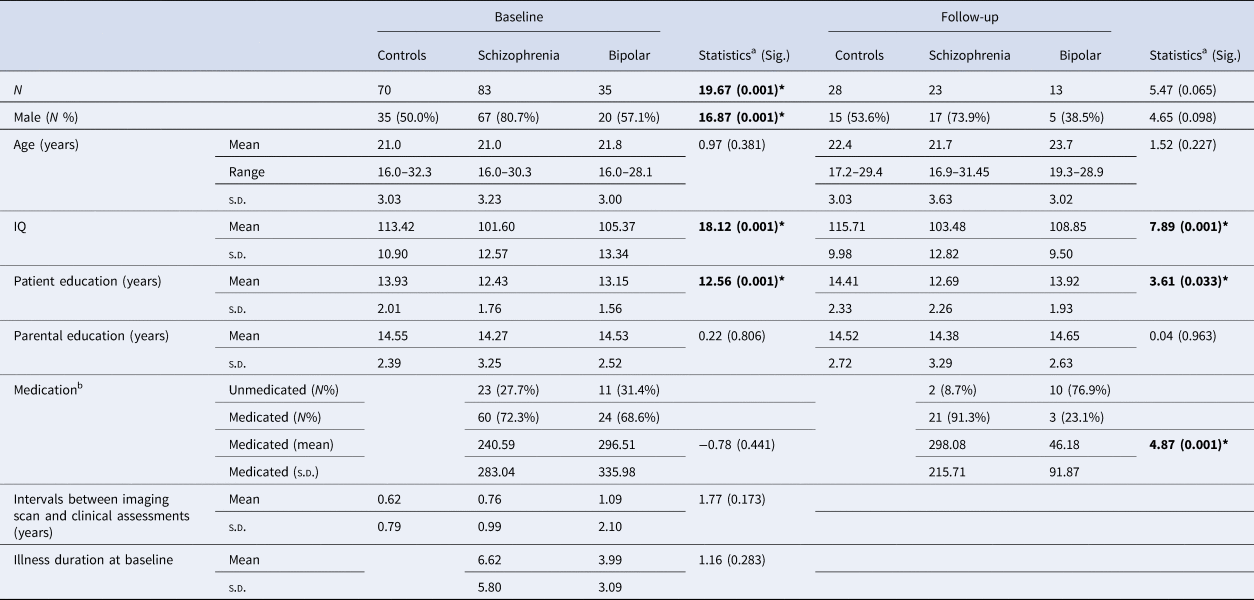
In the current study, 19 patients with FEPs were antipsychotic medication naïve at the baseline scan. Additionally, 15 FEPs had been previously exposed to a small dose of antipsychotics prior to baseline that is defined as either less than 80 mg chlorpromazine equivalents or for a brief period of time (2 weeks or less), but were not taking medication at the time of the baseline scan. Consequently, 34 patients are described as unmedicated in the current study representing 23 patients with Sz and 11 patients with BD. The remaining 84 patients with FEPs were taking primarily atypical antipsychotic medications at the time of the scan. Chlorpromazine equivalents of baseline antipsychotics were reported in Table 1. Further detailed categories of antipsychotic medications were reported in supplementary materials (online Supplementary Table S3). Baseline demographics, including IQ, sex, years of education, and medication exposure at follow-up, were significantly different among the groups. However, group differences were not found in age, parental education, illness duration at baseline, intervals between baseline DWI scan and clinical assessments or antipsychotic medication exposure (Table 1).
Demographic data

a χ2 test was utilized for Non-parametric tests and ANOVA was applied for parametric tests.
b Medication defined as mean daily chlorpromazine equivalent.
Imaging acquisition and analyses
T1 and DWI image acquisition parameters
All imaging data were acquired in the same session on a GE Sigma 1.5 Tesla MRI scanner at the UC Davis Imaging Research Center. T1 images were collected using a spoiled gradient recalled sequence (slice thickness = 1.5 mm, in-plane resolution matrix size = 128 × 128, voxel size = 1 × 1 × 1.5 mm3, field of view 220 mm; TR = 9 ms, TE = 2 ms, and flip angle = 15°). DWI images were acquired using a Spin-Echo EPI sequence with six diffusion gradient directions (slice thickness = 5 mm, in-plane resolution matrix size = 128 × 128, voxel size = 1.7 × 1.7 × 5 mm3, field of view 220 mm, TR = 8 s, TE = 94 ms, flip angle = 90°, and b value = 1000 s/mm2). The same protocols were conducted at both at baseline and 12-month follow-up.
Preprocessing and tensor fitting
To minimize the influence of scanner artifacts or subject motion, prior to the standard DWI pre-processing pipeline implemented in FSL (Smith et al., Reference Smith, Jenkinson, Woolrich, Beckmann, Behrens, Johansen-Berg and Matthews2004), we conducted a two-step DWI quality control process: (1) rigorous manual quality inspections to screen for obvious slice intensity inhomogeneity and (2) normalized correlation analysis and interlaced correlation analysis to detect inter-slice brightness venetian blind artifacts (Oguz et al., Reference Oguz, Farzinfar, Matsui, Budin, Liu, Gerig and Styner2014). There were 24 volumes in the raw DWI sequence, including six DWI directions along with their opposing directions. Two b0 images were also collected, resulting in a total of 26 volumes. Whole participants were excluded if artifacts were detected in more than half of the DWI volumes (>12) or if no usable data was present for one of the six directions. Twenty-two participants were excluded based on these criteria. Within the rest of the 188 included participants, 91 participants had no problematic DWI volumes and 97 participants had average of 2.2 problematic DWI volumes (control: N = 20, mean = 2.70, s.d. = 1.56; Sz: N = 53, mean = 4.26, s.d. = 2.10; BD: N = 24, mean = 5.54, s.d. = 1.67). The two patient groups had more problematic volumes compared to controls (BD: U = 39.18, p = 0.000, adjusted p = 0.000; Sz: U = 56.75, p = 0.000, adjusted p = 0.000), however, no significant differences were found between the two patient groups (U = 17.57, p = 0.088, adjusted p = 0.265). All problematic DWI volumes were discarded in terms of subject movement, the mean framewise displacement did not differ significantly among three diagnostic groups (F (2,185) = 0.734, p = 0.481). Standard diffusion data processing steps were implemented in FSL, including the correction of eddy current distortions and subject head motion using eddy_correct in FSL (Andersson, Skare, & Ashburner, Reference Andersson, Skare and Ashburner2003). The bi-tensor FW model was fitted at each voxel in eddy corrected DWI images to generate FW and FA-t images (Pasternak et al., Reference Pasternak, Sochen, Gur, Intrator and Assaf2009). FW was calculated using the FW elimination toolbox obtained from the Department of General Psychiatry, Heidelberg University (https://projects.sfb125.de/) (Maier-Hein et al., Reference Maier-Hein, Westin, Shenton, Weiner, Raj, Thomann and Pasternak2015). Moreover, a traditional single tensor model was also fitted to the eddy corrected DWI imaging to estimate FA using DTIFIT in FDT FSL (Behrens, Berg, Jbabdi, Rushworth, & Woolrich, Reference Behrens, Berg, Jbabdi, Rushworth and Woolrich2007).
Whole-brain gray matter and white matter masks
A rigorous procedure was employed to create whole-brain gray matter (GM) and WM masks in an attempt to minimize partial volume effects. Specifically, structural images were first manually reviewed for data quality. GM and WM masks were then created using Freesurfer parcellations (Fischl et al., Reference Fischl, Van Der Kouwe, Destrieux, Halgren, Segonne, Salat and Dale2004). Then, the masks were aligned to b0 space by first registering the T1 whole-brain image to the b0 image using bbregister in Freesurfer (Greve & Fischl, Reference Greve and Fischl2009); and then applying the calculated registration matrix to the masks using FLIRT in FSL (Jenkinson, Bannister, Brady, & Smith, Reference Jenkinson, Bannister, Brady and Smith2002). To remove voxels composed primarily of cerebral spinal fluid, each FW image was thresholded at 0.7, meaning that voxels comprised of greater than 70% free water were excluded from analyses (Macey, Thomas, & Henderson, Reference Macey, Thomas and Henderson2018). Finally, mean FW values were extracted from whole-brain GM and whole-brain WM masks and exported into R version 3.5.1 (https://www.r-project.org/) for statistical analysis.
Voxel-wise analyses in WM
Voxel-wise analyses were conducted using the standard tract-based spatial statistics pipeline for pre-processing. Individual FA images were non-linearly aligned to the standard space FMRIB58_FA template provided in the FSL package (Smith et al., Reference Smith, Jenkinson, Johansen-Berg, Rueckert, Nichols, Mackay and Behrens2006). The final mean FA skeleton was thresholded at 0.2. This mask and warping parameters were also used to evaluate FA-t and FW maps. Then, the non-parametric Randomize script in FSL was performed with 10 000 permutations for statistical analyses (Winkler, Ridgway, Webster, Smith, & Nichols, Reference Winkler, Ridgway, Webster, Smith and Nichols2014). Multiple comparisons are corrected via the threshold-free cluster enhancement method (Salimi-Khorshidi, Smith, & Nichols, Reference Salimi-Khorshidi, Smith and Nichols2011) with a significance set at p < 0.05, adjusting for family wise-error.
Statistical models
Cross-sectional group comparisons were performed with ANOVA, ANCOVA, and t tests. Specifically, one-way ANOVAs with post hoc t tests were performed to explore diagnostic group differences. ANCOVAs with post hoc t tests were utilized to compare the three groups while adjusting for sex. Independent t tests were used for two-group comparisons between patients with antipsychotic exposure and unmedicated patients in Sz or BD groups respectively. Voxel-wise group comparisons were performed among three diagnostic groups while controlling sex as a covariate. Statistical model selection procedures are presented in the Supplementary materials (online Supplementary Fig. S1). Given no significant sex differences in the longitudinal sub-dataset, a mixed-design ANOVA was performed to examine the main effect of groups (Sz, BD, and controls) and time (baseline and follow-up) and group by time interaction. Antipsychotic medication effects were not explored longitudinally because of the smaller sample size (N total = 36 and N unmedicated = 5) with DWI scans at follow-up. Non-parametric correlations were performed between clinical assessments and FW in GM and WM masks (Spearman) and in voxel-wise WM (Randomize). We had clear a priori plans for comparing controls with each of the two patient groups and consequently did not correct for multiple comparisons for these tests (Althouse, Reference Althouse2016).
Results
Cross-sectional results in whole-brain GM and whole-brain WM
Diagnostic group comparisons
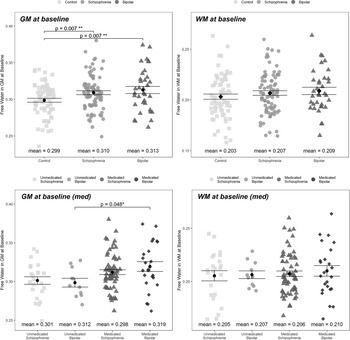
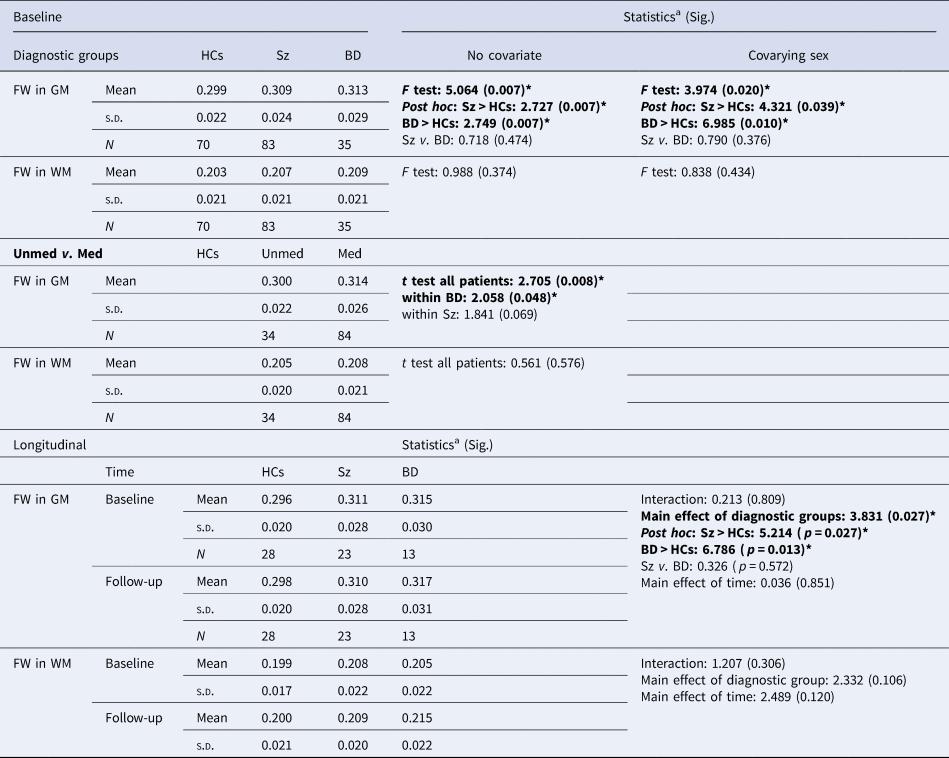
Three-group ANOVA and post hoc t tests revealed a significant main effect of diagnosis (F (2,185) = 5.06, p = 0.007), characterized by significantly higher FW in GM at baseline in both patients with Sz (t (151) = 2.73, p = 0.007) and patients with BD (t (103) = 2.75, p = 0.007) compared to controls. When sex was included as a covariate, the FW increase in GM remained significant in both patient groups compared to controls (Sz: F (1,150) = 4.32, p = 0.039; BD: F (1,102) = 6.99, p = 0.010). The two patient groups did not differ significantly in terms of whole-brain GM free water [(with F (1,115) = 0.79, p = 0.376) or without (t (116) = 0.72, p = 0.474) sex as a covariate] (Fig. 1, Table 2). FW in WM at baseline, however, failed to reveal differences among the three groups (F (2,185) = 0.99, p = 0.374) (Fig. 1, Table 2).
A significant FW increase in GM was revealed in both FEP groups compared to controls at baseline (left upper panel t tests); whereas non-significant FW differences in WM were found between diagnostic groups at baseline (right upper panel F test). Antipsychotic effects on FW in GM at baseline were revealed in patients with BD, not in patients with Sz (left lower panel t tests). Antipsychotic medication was not related to FW in WM at baseline (right lower panel t tests).

ROIs cross-sectional and longitudinal results

FW, free water; GM, gray matter; WM, white matter; Sz, schizophrenia; BD, bipolar disorder; HCs, controls; Med, medicated patients; Unmed, unmedicated patients.
a t test for two groups comparison, ANCOVA for three groups comparison or groups comparison covarying for sex.
Medication group comparisons
BD patients with antipsychotic medication exposure at baseline showed significantly higher FW in GM (t (33) = 2.06, p = 0.048) compared to unmedicated BD patients, but antipsychotic effects on FW in GM did not reach significance in patients with Sz (t (81) = 1.84, p = 0.069) (Fig. 1, lower left and Table 2). There were no antipsychotic medication exposure effects on FW in WM in either patient groups at baseline (Sz: t (81) = 0.38, p = 0.706; BD: t (33) = 0.59, p = 0.561) (Fig. 1, lower right and Table 2).
Longitudinal results in whole-brain GM and whole-brain WM
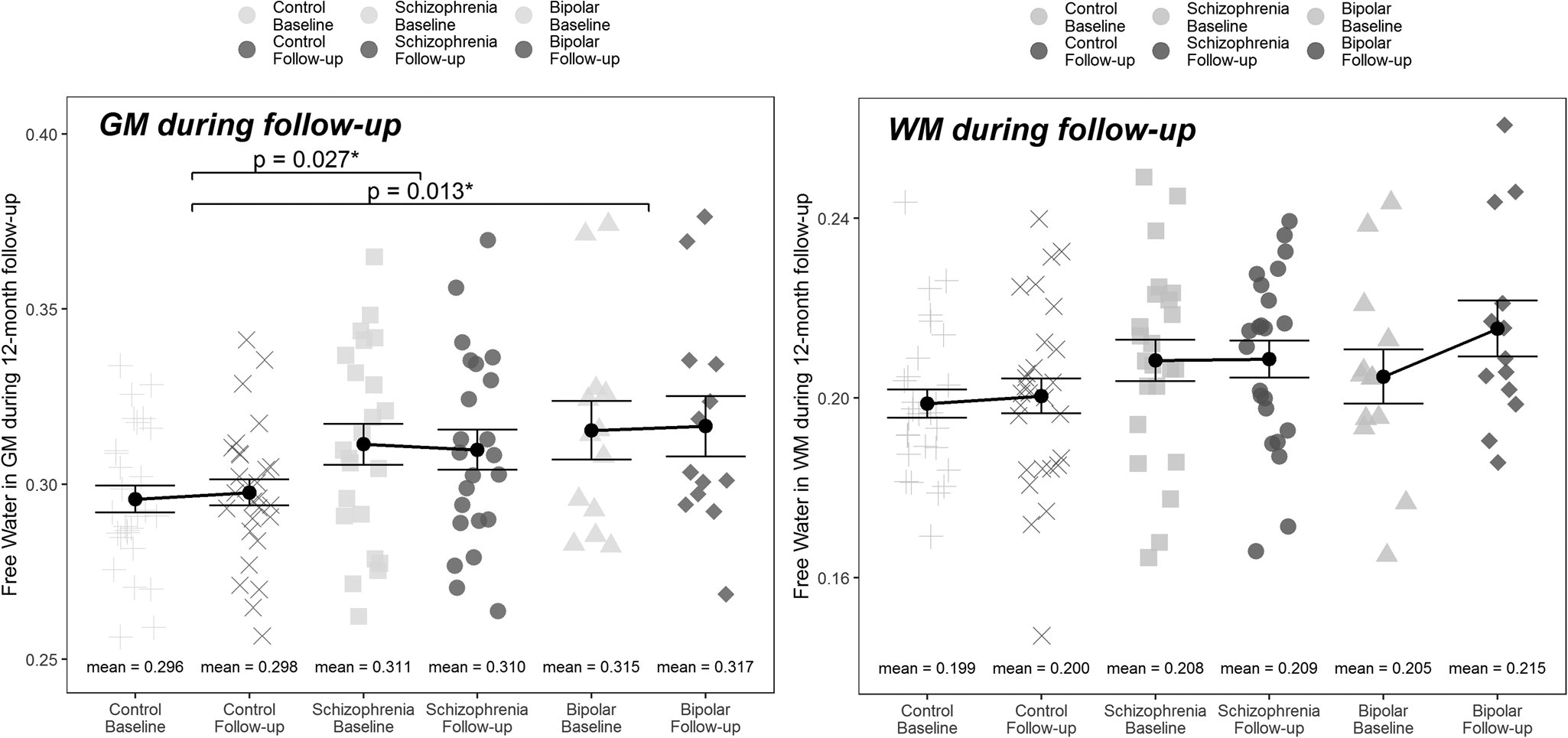
The results of the mixed-design ANOVA revealed a significant main effect of diagnosis on FW in GM (F (1,61) = 3.83, p = 0.027). Post hoc tests revealed significantly higher FW in GM in both Sz (F (1,49) = 5.21, p = 0.027) and BD (F (1,39) = 6.79, p = 0.013) compared to controls (Fig. 2, left panel; Table 2). However, the main effect of time (F (1,61) = 0.04, p = 0.851) or time by diagnosis interaction (F (2,61) = 0.21, p = 0.809) did not reach significance. On the other hand, the mixed-effects ANOVA on FW in WM failed to reveal a significant diagnosis by time interaction (F (2,61) = 1.21, p = 0.306), main effect of time (F (1,61) = 2.49, p = 0.12), or diagnosis (F (1,61) = 2.33, p = 0.106) (Fig. 2, right panel; Table 2).
Longitudinal mixed design ANOVA revealed a significant main effect of diagnosis on FW in GM, suggesting FW increase in GM in patients with Sz and BD remains stable over 12-month follow-up (left panel).

Voxel-wise cross-sectional group comparisons in WM at baseline
Diagnostic group comparisons
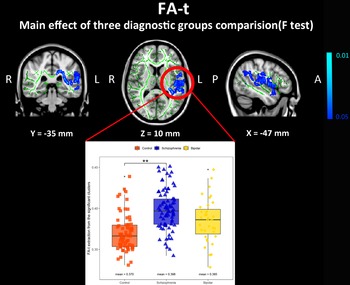
Voxel-wise analyses in WM failed to reveal diagnostic group differences on FW and FA at baseline, while a significant effect of group was identified in FA-t in the left superior longitudinal fasciculus (SLF) and left superior corona radiata (SCR). Post hoc tests indicated higher FA-t was seen in patients with Sz, but not in patients with BD in comparison with controls (Fig. 3). Moreover, FA-t was not significantly different between patients with Sz and BD.
Voxel-wise analyses showed a significant main effect of three diagnostic groups (Blue clusters). Post hoc tests revealed significantly higher FA-t in the left SLF and SCR in patients with Sz in comparison with controls. However, no significant FA-t differences were found between patients with BD and controls.

Medication group comparisons
Voxel-wise analysis failed to reveal an effect of antipsychotic medication on FA and FA-t where we found no significant group differences between patients with antipsychotic medication exposure and medication naïve patients. Similarly, whole-brain WM analyses revealed no significant FW differences between patients with and without antipsychotic medication exposure at baseline.
Voxel-wise longitudinal results in WM
Voxel-wise analysis failed to reveal a significant main effect of diagnosis, time or possible interactions on FW, FA, and FA-t.
Discussion
To our knowledge, this is the first longitudinal study to estimate FW, a putative biomarker of neuroimmune pathology in Sz, in patients with FEPs at onset and during the first year of the illness. Four main findings emerged: (1) higher FW in GM is present at the onset of psychosis in both patients with Sz and BD; (2) elevated GM FW remains stable during the first year of the illness, with no evidence of either progression or remission; (3) antipsychotic medication exposure was associated with higher FW in GM in patients with BD, while a comparable pattern of effects did not reach significance in patients with Sz; and (4) WM differences were quite subtle, with no group differences identified in WM FW and a focal effect of diagnosis on FA-t.
Increased FW in GM was observed in both groups of psychotic patients compared to controls at the onset of the illness, consistent with previous work reporting elevated FW in first episode Sz (Pasternak et al., Reference Pasternak, Westin, Bouix, Seidman, Goldstein, Woo and Kubicki2012b). This finding extends previous work and suggests that higher FW in GM is also present in individuals with BD, suggesting the presence of GM microstructural pathology across the early psychosis spectrum. FW DTI has been proposed to measure water diffusivity in the ECS (Pasternak et al., Reference Pasternak, Shenton and Westin2012a); as such higher FW represents ECS enlargements, a finding that has been interpreted as indicative of neuroinflammatory processes. Notably, a recent paper reported that dorsolateral prefrontal cortex (DLPFC) glutathione decreases are significantly associated with higher FW in whole-brain and DLPFC-specific GM in patients with Sz. These results provide additional evidence that FW may be associated with neuroinflammatory processes (Lesh et al., Reference Lesh, Maddock, Howell, Wang, Tanase, Daniel Ragland and Carter2019). Also, Di Biase et al. (Reference Di Biase, Katabi, Piontkewitz, Cetin-Karayumak, Weiner and Pasternak2020) performed FW DTI on 17 male offspring from the rodent model of maternal immune activation and reported higher FW in the frontal WM fibers of rats exposed to prenatal immune activation. However, direct evidence is needed in animal models to confirm or refute this interpretation, as other factors may also increase the ECS, such as atrophy, edema, or excessive synaptic pruning (Feinberg, Reference Feinberg1982), which is regulated by neuroimmune related genetic mechanisms and hypothesized to be dysregulated in Sz (Sekar et al., Reference Sekar, Bialas, De Rivera, Davis, Hammond, Kamitaki and Mccarroll2016). Moreover, we observed comparable patterns of FW changes in FEP patients with both Sz and BD with psychotic features. Previous studies have suggested that both Sz and BD are associated with dysfunction in inflammatory pathways and potentially a shared immune-related pathophysiology (Kunz et al., Reference Kunz, Cereser, Goi, Fries, Teixeira, Fernandes and Gama2011). In line with the hypothesis of ‘continuum of psychosis’ (Lawrie, Hall, Mcintosh, Owens, & Johnstone, Reference Lawrie, Hall, Mcintosh, Owens and Johnstone2010; Murray et al., Reference Murray, Sham, Van Os, Zanelli, Cannon and Mcdonald2004), the current study revealed higher FW in GM at the onset of both disorders.
The longitudinal dimension of the current study adds a unique contribution to the literature, by showing that higher FW in GM remains unchanged during the first year of both psychotic illnesses. These findings are not consistent with models of a deteriorating course in early psychosis and rather follow predictions of neurodevelopmental models of Sz (Lewis & Murray, Reference Lewis and Murray1987). However, one critical piece of evidence is missing with regard to this model, namely whether higher FW in GM is presented in individuals at clinical high risk (CHR) for psychosis prior to the onset of psychotic symptoms. We might predict that we would find an intermediate level of elevated FW in CHR individuals compared to FEPs and controls.
Analyses of antipsychotic medication exposure at baseline revealed higher FW in GM in medicated patients with BD compared to unmedicated patients with BD, with a similar but non-significant pattern in Sz. It is noteworthy that both patient groups have a smaller number of unmedicated patients than medicated patients, specifically, with 27.7% and 31.4% unmedicated patients in Sz and in BD respectively. As such the present medication results should be considered preliminary. If confirmed, however, these results would be inconsistent with studies that indicated anti-inflammatory properties of antipsychotic medications in animal models (Sugino, Futamura, Mitsumoto, Maeda, & Marunaka, Reference Sugino, Futamura, Mitsumoto, Maeda and Marunaka2009), utilizing peripheral inflammatory markers (Al-Amin, Nasir Uddin, & Mahmud Reza, Reference Al-Amin, Nasir Uddin and Mahmud Reza2013) as well as histological markers of microglial activation (Kato et al., Reference Kato, Monji, Mizoguchi, Hashioka, Horikawa, Seki and Kanba2011). However, the literature to date is limited and mixed. For instance, Zajkowska and Mondelli (Reference Zajkowska and Mondelli2014) systematically reviewed antipsychotic medication effects on peripheral inflammatory markers in FEPs and reported decreased interleukin- (IL-) 6, IL-4, IL-1β, and IL-27, increased transforming growth factor-β, IL-12 as well as unchanged interferon-γ and tumor necrosis factor-α after 4 and 6 weeks of antipsychotic treatment. These results suggested that the antipsychotic treatment effects on cytokines vary significantly depending on the specific markers examined. Therefore, further research is needed to clarify the association between the hypothesized anti-inflammatory effects of antipsychotic medication, inflammatory markers, and clinical symptomatology.
The voxel-wise analyses in the current study did not find significant FA differences between two groups of FEP patients and controls at baseline. Null findings related to hypothesized FA reductions in psychosis have also been reported in studies involving patients at various stages of the illness including childhood-onset (Clark et al., Reference Clark, Narr, O'neill, Levitt, Siddarth, Phillips and Caplan2012), recent onset (Jones et al., Reference Jones, Catani, Pierpaoli, Reeves, Shergill, O'sullivan and Howard2005), first episode (Price, Bagary, Cercignani, Altmann, & Ron, Reference Price, Bagary, Cercignani, Altmann and Ron2005), and chronic Sz (Foong et al., Reference Foong, Symms, Barker, Maier, Miller and Ron2002). However as noted above, the majority of published DTI studies in psychosis have reported relatively widespread FA reductions (for a review see: Wheeler & Voineskos, Reference Wheeler and Voineskos2014). Interestingly, a recent conventional DTI study including 4322 participants (N Sz = 1963 and N control = 2359) reported that patients with Sz showed widespread FA decreases along with a focal FA increase in the posterior limb of the internal capsule compared to controls (Kelly et al., Reference Kelly, Jahanshad, Zalesky, Kochunov, Agartz, Alloza and Donohoe2017).
In the current study, we did not replicate previous findings of whole-brain WM FW increases in patients with FEPs compared to controls (Lyall et al., Reference Lyall, Pasternak, Robinson, Newell, Trampush, Gallego and Szeszko2018). Of note, Mandl et al. (Reference Mandl, Pasternak, Cahn, Kubicki, Kahn, Shenton and Hulshoff Pol2015) did not find a WM FW difference between patients with Sz and controls. Our negative whole-brain WM result may be associated with the lower resolution of 1.5T DTI for capturing FW alteration in patients with FEPs (Review: Pasternak, Kelly, Sydnor, & Shenton, Reference Pasternak, Kelly, Sydnor and Shenton2018). It may also be related to the high percentage of younger participants included in the current study, where 25% of participants were between age 16 to 18 and 55.9% of participants were under the age of 20. A recent large sample-based study reported a significant positive correlation between age and FW throughout widespread regions of WM (Chad, Pasternak, Salat, & Chen, Reference Chad, Pasternak, Salat and Chen2018). Also, we found significantly higher FA-t (but not traditional FA) focally around the left SLF region in patients with Sz compared to controls. The added specificity of FA results in corrected v. uncorrected FA estimates have been increasingly reported in the literature. For example, a recent study consisting of 212 participants explored aging-related WM integrity utilizing FW DTI (Chad et al., Reference Chad, Pasternak, Salat and Chen2018). The study found focally higher FA-t in the superior corona radiata and the internal capsule after accounting for FW contributions to FA in older adults compared to younger adults. It is likely that our understanding of microstructural changes indexed using DWI methods in various clinical populations will change as the application of FW correction methods becomes more widespread.
Limitations
Limitations of the present longitudinal study include a differential proportion of males v. females in patients with Sz compared to the other two groups at baseline. To address this issue, we included sex as a covariate in the cross-sectional ROI and voxel-wise analyses. Secondly, only a subset of this naturalistic sample was scanned at follow up. However, a comparison of clinical and demographic data showed that there are no significant differences in sex, age, duration of illness, medication history, and diffusion metrics between those who did and did not participate in follow up scanning. Finally, the DTI acquisition methods in the current study, which was conducted prospectively over an extended period of time, had larger voxels and fewer directions compared to the current state of the art. This is a challenge for longitudinal studies in a field where methodologies are rapidly developing. The concerns of lower SNR, larger voxels with 1.5T DWI scans, while important, are likely to impact the diagnostic groups equally, which should protect the study from bias in terms of group differences. One specific concern is that the larger voxel size may exacerbate partial volume effects in patients with reduced GM, which could lead to FW increases in the two patient groups compared to controls. We do not feel this is a significant concern in the present study given that participants were recruited from a younger population (adolescent to young adulthood) and showed no significant diagnostic group differences in GM, WM, and intracranial volume (online Supplementary Table S4).
Conclusion
The current study replicated the presence of higher FW in GM at the onset of psychosis in patients with both Sz and BD with psychotic features, and further indicated the stability of these FW elevations in GM during the first year of the illness, with no evidence of either progression or remission. Preliminary analyses suggested atypical antipsychotic medications were associated with higher FW in GM, however, this needs replication given the small numbers of unmedicated patients in the present study. These results add to the current literature by increasing our understanding of the time course of FW elevations in FEPs with both Sz and BD and add to the body of evidence suggesting that treatment development efforts should address neuroimmune mechanisms related to brain function during the earliest phases of the illness.
Supplementary material
The supplementary material for this article can be found at https://doi.org/10.1017/S0033291719003969.
Financial support
This project was supported by the following funding: this research was supported by [grants: R01MH 084895 and R01MH105411]. The National Institute of Health RO1 grant: R01MH105411 (PI Dr Ragland). Building Interdisciplinary Research Careers in Women's Health award (K12 HD051958) awarded to Dr Laura M. Tully and funded by the National Institute of Child Health and Human Development (NICHD), Office of Research on Women's Health, Office of Dietary Supplements, and the National Institute of Aging. The National Institute of Health RO1 grant: 5R01MH059883 (PI Dr Carter).
Conflicts of interest
We have no conflicts of interest to disclose.