Introduction
Dongxiang wild rice (Oryza rufipogon Griff.) (DXWR) is a wild rice species found in Dongxiang County, Jiangxi Province, China. It is by far the northernmost (28°14′ N) distributed wild rice found in the world (Mao et al., Reference Mao, Yu, Chen, Li, Zhu, Xiao, Zhang and Chen2015). Previous studies have shown that DXWR possesses many stress tolerance and high yield-related genes, which have been lost in modern cultivated rice (Zhang et al., Reference Zhang, Xu, Mao, Yan, Chen, Wu, Chen, Luo, Xie and Gao2016). For example, Quan et al. (Reference Quan, Wang, Hui, Bai, Lyu, Zhu, Zhang, Zhang, Li and Huang2018) successfully used DXWR as a source of salinity-tolerant genes to improve the salinity tolerance of NJ16. Therefore, DXWR has been used as an elite genetic resource for rice improvement.
Long non-coding RNAs (lncRNAs) are an important type of non-coding RNAs (ncRNAs). In plants, lncRNAs act as key regulators of plant growth and development, as well as in response to various biotic and abiotic stresses (Xu et al., Reference Xu, Song, Zhu, Tao, Kang, Liu, He, Yan and Sang2017). Molecular marker-assisted selection (MAS) can make great use of the valuable genetic resources in wild rice by precisely selecting genes for various traits, therefore producing superior germplasm (Collard and Mackill, Reference Collard and Mackill2008; Akhtamov et al., Reference Akhtamov, Adeva, Shim, Lee, Kim, Jeon, Luong, Kang, Lee and Ahn2020). Simple sequence repeats (SSRs), also known as microsatellites, are DNA segments with 1–6 nucleotides short base-pair motif repeated several times in tandem (Kozlowski et al., Reference Kozlowski, de Mezer and Krzyzosiak2010). They have been extensively used in genetic diversity analysis and MAS breeding because of their high reproducibility, abundant polymorphisms, co-dominant inheritance, high genome coverage and simple analysis methods (Xie et al., Reference Xie, Zhang, Sun and Zhang2017; Singh et al., Reference Singh, Chaurasia, Kumar, Singh, Kumari, Yadav, Singh, Gaba and Jacob2018). However, there are no reports on the development of lncRNA-derived-molecular markers in O. rufipogon so far, which greatly limits the discovery and utilization of the elite lncRNA genes from this important and valuable germplasm resource. Therefore, the main objectives of this study were to: (i) use the lncRNAs sequencing data to develop a set of lncRNA-derived-SSR markers and (ii) test their stabilities and polymorphisms for DXWR.
Experimental
Details of the plant materials used in this study are presented in online Supplementary Table S1. To develop more lncRNA-derived-SSR markers, SSR Hunter software was used to identify all possible di-, tri-, tetra-, penta- and hexa-nucleotide SSRs with a minimum set of three repeats, respectively (Li and Wan, Reference Li and Wan2005). Subsequently, primers were designed based on the flanking sequences of the SSRs using Primer3.0 software (Untergasser et al., Reference Untergasser, Cutcutache, Koressaar, Ye, Faircloth, Remm and Rozen2012). The main parameters of the primer design were as follows: the primer length was 18–25 bp, GC content was 40–60%, melting temperature was 55–65 °C, the expected length of the amplification product was 100–250 bp.
Genomic DNA was extracted using the Plant Genomic DNA Rapid Extraction Kit (Sangon Biotech Co., Ltd). The PCR reaction system was 10 μl, including 1 μl (200 ng/μl) genomic DNA, 5 μl 2 × FastTaq Premix (Tolo Biotech Co., Ltd), 1 μl (0.01 nmol/μl) primers and 3 μl ddH2O. The PCR amplification reaction program was as follows: pre-denaturation at 95 °C for 5 min; denaturation at 95 °C for 30 s, annealing at 55 °C for 45 s, extension at 72 °C for 45 s for 30 cycles; and a final extension at 72 °C for 10 min. The PCR products were run on 9% denaturing polyacrylamide gel with 0.5 × TBE buffer. After electrophoresis, the gels were visualized using the silver staining method (Cook et al., Reference Cook, Prakash, Zhang, Shank, Takeguchi, Robbins, Gong, Iwamoto, Schultz and Tomich2004). The genetic parameters were analysed using Powermarker software (Liu and Muse, Reference Liu and Muse2005).
Discussion
In our previous study, a total of 1655 lncRNA transcripts were obtained from DXWR using strand-specific RNA sequencing (Qi et al., Reference Qi, Chen, Yang, Hu, Luo, Ai, Luo, Huang, Xie and Zhang2020). In this study, to develop a set of lncRNA-derived-SSR markers for DXWR, SSR Hunter software was used to search for SSRs present in these lncRNA transcripts. In total, 1878 SSRs were detected. Among them, the dinucleotide (1291, 68.74%) and trinucleotide (498, 26.52%) repeat motifs were the most abundant types (Table 1). Moreover, the types of AG/CT (505, 26.89%) and AC/GT (369, 19.65%) were the most predominant repeat types (Fig. 1). These results follow the same pattern as the lncRNA-derived-SSR study in wheat (Bhandawat et al., Reference Bhandawat, Sharma, Pundir, Madhawan and Roy2020).
Frequency of different SSR repeat motif types in DXWR.

Percentage of the identified SSR motifs in different repeat types

Based on the detected lncRNA-derived-SSR loci, we successfully developed 1258 molecular markers, including 885 (70.35%) for the dinucleotide repeat type, 316 (25.12%) for the trinucleotide repeat type, 35 (2.78%) for the tetranucleotide repeat type, 16 (1.27%) for the pentanucleotide repeat type, and 6 (0.48%) for the hexanucleotide repeat type (online Supplementary Table S2). These lncRNA-derived-SSR markers were present throughout all of the 12 chromosomes. Of these markers, 781 (62.08%) were found to be present in the first six chromosomes (Chr. 1–6), while 477 (37.92%) were present in the remaining six chromosomes (Chr. 7–12). This is largely due to the identified SSR loci exhibiting some preference for the lncRNA transcripts located in chromosomes 1–6 of DXWR. It was also observed that Chr. 2 has the highest number of lncRNA-derived-SSR markers (169, 13.43%) while Chr. 9 has the lowest number of lncRNA-derived-SSR markers (66, 5.25%).
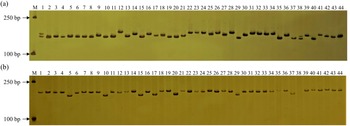
To test the stabilities and polymorphisms of the developed lncRNA-derived-SSR markers, we randomly selected 72 pairs of primers for further analysis. As a result, 42 (58.33%) pairs of primers showed abundant polymorphisms among the 44 rice accessions (Fig. 2). The 42 polymorphic SSRs produced a total of 183 alleles among the 44 rice accessions, ranging from 2 to 11, with an average 4.36 alleles per locus. The polymorphic information content (PIC) of these polymorphic SSR markers ranged from 0.04 to 0.87 with an average of 0.50. The genetic diversity index was observed from 0.04 to 0.88, with a mean value of 0.56 (online Supplementary Table S3). The mean number of alleles and PIC value of the verified lncRNA-derived-SSR markers in our study were more than capsicum which were 2.50 and 0.39, respectively (Jaiswal et al., Reference Jaiswal, Rawoof, Dubey, Chhapekar, Sharma and Ramchiary2020), indicating that the developed lncRNA-derived-SSR markers were highly polymorphic and can be widely applied in DXWR and modern cultivated rice.
Representative results of polymorphic lncRNA-derived-SSR markers amplified by the genome of DXWR and some worldwide rice cultivars. (a) Lnc-SSR-566686; (b) Lnc-SSR-353993; M: DL2000 DNA Marker; 1–3: three different populations of DXWR; 4–44: worldwide cultivars. The information of the 44 rice accessions is presented in online Supplementary Table S1.

In summary, this is the first report of the development and characterization of lncRNA-derived-markers in wild rice, O. rufipogon, which lays the foundation for discovery and utilization of the elite lncRNA genes to further make good use of this valuable wild rice germplasm resource.
Supplementary material
The supplementary material for this article can be found at https://doi.org/10.1017/S1479262121000617
Acknowledgements
This research was partially supported by the National Natural Science Foundation of China (32070374, 31960370, 31960085), the Natural Science Foundation of Jiangxi Province, China (20202ACB205002), the Foundation of Jiangxi Provincial Key Lab of Protection and Utilization of Subtropical Plant Resources (YRD201903).