1. Introduction
Current evidence suggests exposure to two languages, typically from birth, can positively affect the cognitive development of children, specifically in regards to attention and executive control (see Adesope, Lavin, Thompson & Ungerleider, Reference Adesope, Lavin, Thompson and Ungerleider2010 and Bialystok, Reference Bialystok2011 for review). These positive effects are often observed on tasks involving salient conflict/incongruence or selective attention. The cognitive correlates of bilingualism have been proposed to arise from joint language activation, which may require the presence of an attentional or inhibitory control mechanism to allow one to attend to and use the situation-relevant language system (Green, Reference Green1998).
Attention and executive control are commonly considered to be aspects of the broader domain of executive functioning (EF). This term refers to those functions responsible for planning and organizing behavior and regulating one's actions, feelings, and thoughts (Gioia, Isquith, Kenworthy & Barton, Reference Gioia, Isquith, Kenworthy and Barton2002). In their widely accepted unity and diversity model, Miyake, Friedman, Emerson, Witzki, Howerter and Wager (Reference Miyake, Friedman, Emerson, Witzki, Howerter and Wager2000) subdivided the executive functions into three core components: inhibition, updating/working memory, and shifting, emphasizing that these components can be differentiated from one another but also contribute toward unified EF. Morales, Calvo and Bialystok (Reference Morales, Calvo and Bialystok2013) discussed the cognitive correlates of bilingualism as primarily having been observed in children's inhibition and shifting but add that, according to this model's unity proposal, one might also expect benefits in working memory. This finding was supported in their own study and in a recent latent variable analysis (Soliman, Reference Soliman2014). It is also helpful to conceptualize these correlates as being metacognitive in nature, given their influence primarily on cognitive processing as opposed to the behavioral aspects of EF.
1.1. Balanced Bilingualism
Balance in children's bilingualism, or the degree to which one has equivalent proficiency in both acquired languages, is associated with their performance on some cognitive tasks (Bialystok & Majumder, Reference Bialystok and Majumder1998). Bialystok and Majumder compared the performance of two bilingual groups of children, one with balanced bilingualism and one without (described as “partially bilingual”). The balanced bilingual group outperformed their partially bilingual peers on tasks requiring visuomotor construction and planning. More recently, Vega and Fernandez (Reference Vega and Fernandez2011) and Bialystok and Barac (Reference Bialystok and Barac2012) created indices of balance in the bilingualism of their samples, using these indices to predict performance on tasks. Vega and Fernandez (Reference Vega and Fernandez2011) found that balance in bilingualism was correlated with perseveration on the Wisconsin Card Sorting Test (WCST; Heaton, Reference Heaton1993), suggesting a potential relationship between balanced bilingualism and shifting. Bialystok and Barac (Reference Bialystok and Barac2012) found that a ratio of balanced bilingualism was significantly related to performance on metalinguistic tasks.
While these results are promising, further research is needed to examine the relationship between balanced bilingualism and cognitive development in children. In addition, no studies to date have examined the cognitive correlates of bilingualism in light of the everyday applications of EF skills. To address these gaps in knowledge, this study examined the contribution of balanced bilingualism to performance on EF tasks and daily EF ratings in Spanish–English speaking bilingual children. Given previous findings, it was hypothesized that balance in bilingualism would significantly predict performance on a task requiring attentional control. It also was hypothesized that this variable would significantly predict performance on tasks requiring working memory, inhibition, and complex problem solving, in accordance with previous findings related to the unity aspects of EF (Miyake et al., Reference Miyake, Friedman, Emerson, Witzki, Howerter and Wager2000; Morales et al., Reference Morales, Calvo and Bialystok2013; Soliman, Reference Soliman2014). In regards to daily EF, it was hypothesized that balance in bilingualism would significantly predict caregiver ratings regarding children's metacognitive functioning.
2. Method
2.1 Participants
Participants in this study were 30 children with a history of only Spanish and English exposure (ages 4–7 years; mean age = 6.29 years, SD = 0.95), recruited from organizations and schools in the Southwestern United States. There were slightly more female children than males (n = 19 and 11, respectively). Caregivers reported an average education of 11.42 years (SD = 4.65). Caregiver reports indicated that the majority of the sample (56.7%) resided in monolingual households in which only Spanish was spoken by the children and their caregivers. Few participants resided in monolingual, English-only speaking households or bilingual English–Spanish speaking homes (n = 2 and 2, respectively). Five children also reportedly spoke both English and Spanish at home while their caregivers only spoke Spanish. Caregivers indicated their child's overall use of language at school (including both academic/instruction time and casual interactions) with the majority of the sample (63.3%) reportedly using both English and Spanish throughout their school day. No information was collected regarding the language of instruction for these students, which will be addressed in the limitations discussion. Participants with an identified disability, who were currently prescribed stimulant medication, or with exposure to languages other than English or Spanish were excluded from the larger study.
2.2 Procedures
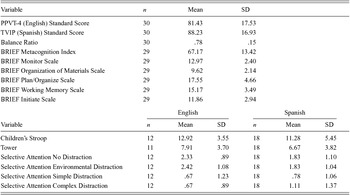
After informed consent procedures, data collection began with a demographic interview followed by additional data collection sessions. Caregivers completed ratings of daily EF and children's receptive oral language and EF were assessed. Children's receptive oral language performance on standardized measures (PPVT-4 and TVIP) was used to determine the language in which to administer the EF tasks (i.e., the higher receptive language performance determined the language of administration). Of note, no significant group differences emerged when comparing participant performance across the languages of EF task administration (see Table 1).
Means and Standard Deviations.

Note. English = English-administration of EF tasks; Spanish = Spanish-administration of EF tasks
Each family received $20 (USD) for their participation and gained entry into a drawing for a $150 (USD) gift card. Each child participant received two small additional toys/prizes for participation.
2.3 Instruments
Demographic interview
A demographic interview containing four items addressed language use by the caregiver and child and the caregiver's level of education. Caregiver education was measured by reported years of education and used as an indicator of socioeconomic status (SES). Demographic interviews were provided in English or Spanish, depending on each caregiver's preference. The four items from the demographic interview are available in Appendix A.
Daily executive functioning
Children's daily EF was assessed using the Behavior Rating Inventory of Executive Function (BRIEF; Gioia, Isquith, Guy & Kenworthy, Reference Gioia, Isquith, Guy and Kenworthy2000). While the BRIEF includes additional indices and clinical scales, those of interest in this study addressed daily metacognitive functioning. For this reason, the Metacognition Index (MI) and individual scales comprising this index (Initiate, Working Memory, Monitor, Plan/Organize, and Organization of Materials) were included in these analyses. Gioia et al. describe the MI as measuring the “ability to cognitively self-manage tasks” and monitor one's own performance. It also relates to the “ability to actively problem solve in a variety of contexts” (p. 20–21). Caregivers completed the BRIEF in English or Spanish, pending preference. BRIEF raw scores were included in these analyses, as the Spanish form was not used in the BRIEF's normative sample. It is important to note scores on the BRIEF are indicative of EF difficulty, in that a higher raw score indicates a higher level of difficulty in daily EF.
Receptive oral language
The Peabody Picture Vocabulary Test, Fourth Edition (PPVT-4; Dunn & Dunn, Reference Dunn and Dunn2007) and Test de Vocabulario en Imagenes Peabody (TVIP; Dunn, Padilla, Lugo & Dunn, Reference Dunn, Padilla, Lugo and Dunn1986) were used to measure receptive oral language in English and Spanish. Both tests require respondents to point to the one of four pictures that best represents the meaning of an orally presented word. Standard scores were obtained for each child's performance, using published normative data.
Executive functioning tasks
Each child completed three EF tasks: the Children's Stroop Task (Gerstadt, Hong & Diamond, Reference Gerstadt, Hong and Diamond1994), the Tower task (Korkman, Kirk & Kemp, Reference Korkman, Kirk and Kemp1998), and a selective attention task (Humphrey, Reference Humphrey1982). The Children's Stroop task (Gerstadt et al., Reference Gerstadt, Hong and Diamond1994) involves working memory and inhibition and requires children to respond to cards that have a white face with a picture of a sun or a black face with pictures of the moon and stars. They are to say “Night” when seeing the sun card and “Day” when seeing the moon and stars card. The total number of initially correct responses was used to measure performance on this task. The Tower task from the NEPSY (Korkman et al., Reference Korkman, Kirk and Kemp1998) involves inhibition, working memory, and shifting and requires children to move three colored balls to match a target position on a set of pegs. They must achieve this target position within a set number of moves and a time limit while also following specific movement rules. The total number of trials passed was used to measure performance on this task.
The selective attention task (Humphrey, Reference Humphrey1982) was included as a measure of attentional control. In this task, children are briefly presented with a stimulus card (four per condition), after which they are asked to immediately select two shapes that match those on the stimulus card. The two shapes appear as a pair on the stimulus card and must be matched by shape (circle, square, triangle or star) and color (red, yellow or green). The task increases gradually in difficulty and involves four conditions, which vary by the form of the distraction presented. The first condition involves no distraction and only one pair of presented shapes to match. The second condition involves the placement of a mirror immediately next to the stimuli (an environmental distracter). The third and fourth conditions involve the presentation of extra shapes on the stimulus cards that vary in the number of their groupings (simple distracter condition) and by the number of their groupings and their size (complex distracter condition). In all of these conditions, the child is instructed to attend to and match only the two small shapes that are grouped together. Before beginning this task, the child participants were asked to name each shape and color to ensure they possessed the necessary prerequisite skills to complete the task. The total number of correct responses was used to measure performance on each condition.
3. Results
Mean scores and standard deviations are provided in Table 1. Balance in bilingualism was calculated, similarly to Bialystok and Barac (Reference Bialystok and Barac2012), using a ratio of dominant (higher) receptive oral language performance to nondominant (lower) receptive oral language performance where a perfect balance in bilingualism would produce a score of 1. In this sample, 12 children demonstrated English dominance and 18 children demonstrated dominance in Spanish.
3.1 Correlations
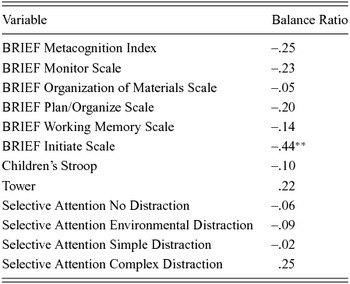
A one-tailed correlational analysis examined the relationship between balance in bilingualism and EF. A significant correlation was found between balance in bilingualism and caregiver ratings of task initiation (r = −.44, p < .01) only. Correlational data are presented in Table 2.
Correlations.

** p < .01
A follow-up partial correlational analysis was conducted to control for the effects of age and caregiver education on these variables; this analysis yielded a continued significant relationship between balance in bilingualism and task initiation ratings (r = −.60, p < .01).
3.2 Regression Models
A hierarchical multiple regression model was used to evaluate the contribution of balance in bilingualism to task initiation ratings. The independent variables were entered in the following order: age and caregiver education were entered first and second, and balance in bilingualism entered third. Results of the regression analysis are reported in Table 3. For task initiation, the model significantly explained 37% of the variance (F (3, 25) = 4.31, p < .05) with a significant contribution only from balance in bilingualism.
Regression Model for Task Initiation.

* p < .01
4. Discussion
The current study sought to examine the relationship between balance in bilingualism and performance on additional EF measures not previously utilized in this line of research, including both “daily life” reports and performance-based assessments of EF. In partial support of the study's hypotheses, balance in bilingualism was associated with caregiver ratings of daily task initiation. No other significant relationships were found.
4.1 Attentional Control
Study results do not support the hypothesis regarding a relationship between balance in bilingualism and performance on the distracting conditions from the selective attention task. Of note, the sample obtained, on average, less than one item correct in the simple and complex distracting conditions of this task (out of four; see Table 1). It is possible that the task demands for these conditions were too high or that the task instructions were unclear. It is also possible that the demands of this task do not best capture the bilingual correlates of attention, which have been primarily found on tasks with perhaps more apparent incongruence or conflict. While this task does require that the participants ignore irrelevant stimuli, it may not include truly incongruent information. If this is the case, then these findings may be consistent with previous studies that also failed to detect bilingual effects on attentional tasks without these specific demands (Costa, Hernández, Costa-Faidella & Sebastián-Gallés Reference Costa, Hernández, Costa-Faidella and Sebastián-Gallés2009). Finally, it is also possible that balance in children's bilingualism is not the best indicator of their linguistic competence, such that a child with relatively low proficiency in each language would achieve near perfect balance. Alternative indicators, such as high “global multilingual competence,” for example, have demonstrated perhaps stronger relationships with attentional measures (Videsott, Della Rosa, Wiater, Franceschini & Abutalebi, Reference Videsott, Della Rosa, Wiater, Franceschini and Abutalebi2012, p. 88) and may better serve this line of research in the future.
4.2 Unity and Diversity
Additional findings further support the specific nature of bilingual cognitive correlates, as no evidence emerged in this study for a relationship between balanced bilingualism and universal EF on tasks measuring children's working memory, inhibition, and shifting in various combinations. The lack of findings on the NEPSY tower task is consistent with Garratt and Kelly's (Reference Garratt and Kelly2008) findings, which may suggest, as Barac, Bialystok, Castro and Sanchez (Reference Barac, Bialystok, Castro and Sanchez2014) write, that the NEPSY is “generally not sensitive to the effects of bilingualism” (p. 709). Previous studies utilizing Stroop tasks have produced mixed findings (i.e., Martin-Rhee & Bialystok, Reference Martin-Rhee and Bialystok2008; Poulin-Dubois, Blaye, Coutya & Bialystok, Reference Poulin-Dubois, Blaye, Coutya and Bialystok2011), which may call into question whether this task is sensitive to bilingual effects as well. In sum, it is most likely that these results further support a very specific bilingual cognitive correlate that does not appear to have been sufficiently required in these tasks.
4.3 Daily Executive Functioning
The final analyses of daily metacognitive functioning yielded one robust finding regarding task initiation, which is described as the ability to “begin a task or activity” and to “independently generate ideas” (Gioia et al., Reference Gioia, Isquith, Guy and Kenworthy2000, p. 2). This result may relate to other evidence of bilingual advantages in reaction time (Hilchey & Klein, Reference Hilchey and Klein2011) as well as a recently identified advantage for highly competent multilingual children in alerting (Videsott et al., Reference Videsott, Della Rosa, Wiater, Franceschini and Abutalebi2012), such that the “real world” implications of this faster processing may involve more rapid initiation of tasks or idea generation.
Surprisingly, other metacognitive constructs measured were not significantly related to balance in bilingualism. This lack of additional findings could be related to the rating scales’ measurement of executive dysfunction rather than EF, such that evidence of a bilingual advantage in EF does not necessarily indicate a dysfunction in monolingual children nor do children with less balanced bilingualism necessarily experience problems in daily EF. It may also represent, again, the very specific nature of the cognitive correlates of bilingualism, which are unlikely reflected by the items included in this measure. For example, the working memory scale inquires about children's ability to stay on task and remember things, but these may not reflect the skills in which bilingual children excel. Nevertheless, these results add to the conversation regarding the cognitive impacts of bilingualism, as very little is known regarding the “real life” effects of any bilingual cognitive correlates. They also suggest an area not previously examined, that of initiation and possibly even creativity in idea generation, as potential aspects of daily life associated with increased bilingual proficiency.
4.4 Limitations
While this study offers robust support for the relationship between balance in bilingualism and task initiation, it also contains some limitations that need to be acknowledged. Most pertinent to this discussion is that of the data regarding the participants’ language exposure and educational language use. Data were not obtained regarding the onset of participants’ exposure to their second language or of the frequency with which they were exposed to or use each language, apart from the general language use data already reported. In addition, exact information regarding the children's language of educational instruction was not obtained. Such data may have provided valuable opportunity for additional analysis regarding the EF findings and their relationship to previous research.
This study is also limited by the difficulty of assessing EF skills in young children, most notably the daily application of their EF skills. Given their young age, it may be there is little demand for daily EF skill use in this population. In addition, children in this age range (most notably 4- and 5-year-olds), while possessing metacognitive awareness, are often unable to utilize these skills in daily life due to their limited attentional resources (e.g., Schneider & Bjroklund, Reference Schneider, Bjroklund, Damon, Kuhn and Siegler1998; Schwanenflugel, Fabricius & Alexander, Reference Schwanenflugel, Fabricius and Alexander1994).
Finally, it is important to acknowledge that this study utilized a community sample of convenience where only volunteers were included and used a small sample in a restricted geographic region, which limits generalizability across bilingual populations.
4.5 Future Research
The current study adds to the existing literature by emphasizing the specificity of the cognitive correlates of bilingualism in children and contributing novel findings regarding daily EF in bilingual children. In light of the limitations of this study, it is crucial that future studies include thorough background information about children's language use and exposure at home and school, which likely contribute to their cognitive development and any effects of dual-language exposure. It would be of interest to determine the extent to which the cognitive correlates of bilingualism emerge as children's general development and linguistic proficiency progress and as daily EF demands increase, utilizing longitudinal designs. Given the findings of this study, it would also be of interest to include other measures of task initiation and creative problem solving in future research on bilingual children, in addition to a general, added focus to the implications of bilingual cognitive correlates on daily life.
Appendix A
Demographic Questionnaire
-
1. Which language do you speak to your child at home? ________________________________
-
2. Which language does your child speak at home? ____________________________________
-
3. Which language does your child speak at school? ____________________________________
-
4. What is the highest level of education/grade you completed? ___________________________